Showing posts with label scientific method. Show all posts

Thursday, November 27, 2025

Scientist

On Fridays, parking enforcement officers are allowed to wear UT spirit gear with our uniforms. I have a Texas Science t-shirt from the UT College of Natural Science. (I had to write a letter to get it.) After work, I was at the Wheatsville Co-op and one of my comrades there asked me, "Are you a scientist?" and I demurred, "No," adding "I am a citizen scientist. We live in a scientific era. Everyone should know their science." In the moment, identifying myself as a scientist seemed pretentious to me. If she had asked, "Are you an astronomer?" that identification would have been easier. Continuing  homeward, I reflected.    


Step 1: Observe. Most of my time at astronomy is given to simply enjoying the act of locating and viewing. One of my best catches was finding Messier 15 near the star Enif in Pegasus, a lighter gray within the gray sky of my citified suburb. Usually, I locate targets by star-hopping. Often, I rely on the database of a computerized mount. I also have made careful measurements within the limits of my instruments. (See "Merry Newtonmas 2020" here.) That being so, I have not advanced to asking questions and arranging tests.

It is the testing that identifies the scientific method of our modern society. Steven Weinberg said that the scientific experiment is defined by its being unnatural in the sense that a specific arrangement not found in nature is devised in order to test a theory of cause of an observed phenomenon. This differentiates our culture from the ancient observers. Thales and Hypatia would be astounded but not enlightened by my photographs of the Orion Nebula, the Whirlpool Galaxy, or the cells of an onion rind. 

Step 10: Publish Your Work. Independent verification of your discovery adds to the net wealth of the society you live in. 
History is a science. Building on the works of others and asking the right questions, I was able to construct a consistent narrative to explain the Mutiny Aboard the San Antonio. 
Reviews of the publications of other scientists.
My science degree is in criminology (Eastern Michigan University, 2008.)

My Master of Arts is in social science.

PREVIOUSLY ON NECESSARY FACTS

The Scientific Method (2021) 

The Scientific Method (2016) 

The Science of Liberty 

The Remarkable Story of Risk 


Friday, December 23, 2022

The Courage of Your Convictions

It is really easier to say nothing. You are under no obligation to say anything. If you must voice an opinion against some nonsense, it is enough to say that you disagree and leave it at that. Moreover, a postmodernist or someone similar will tell you that right and wrong are only cultural constructs. Of course that assertion itself is a cultural construct. And even a scientist will remind you that our ideas about truth have changed as new facts have been discovered and new theories developed to explain them. It was not always so. There was a time when a scientist would truly go to the ends of the Earth to prove a theory. 


Today, scientists are not alone in accepting a false theory of induction which asserts that we can only approach but never know the truth. 

From Susan M. Lea and John Robert Burke, Physics: the Nature of Things (Thomson Brooks/Cole; 1997). 

“Physics is an experimental science that prides itself in getting close to reality through laboratory testing of theory. … How can we be certain that the experimental process of dissecting nature into component part is ultimately correct? We can’t! Belief in experimental science depends on one’s worldview.” -- page 12.


“Consistency with experiment and usefulness in understanding nature are the properties of a good physical theory. The word truth is conspicuously absent. Aristotle… Kepler and Galileo… Newtonian physics, [were] thought absolutely true for 250 years. In the twentieth century, we have learned that Newtonian physics is not exact but stands as an excellent approximation. Absolute truth is elusive. We continue to seek greater depth in our understanding, greater elegance in our theories, and greater precision in our experiments. Whether truth can be achieved in some approximate sense by this process is unanswerable. We believe in physics because we know we can organize our knowledge and employ it to describe the behavior of nature with greater accuracy using only a small number of fundamental ideas.” -- page 14


Not all scientists are timid.


“As a scientist, Sagan speculated freely, sometimes wildly, and outraged his more cautious colleagues. ... He anticipated some interesting scientific discoveries, although sometimes (and oddly) for the wrong reasons. ... The price of fame is a big head, and Sagan’s grew mighty big; eyewitness testimony to this effect abounds.... Most scientists, by contrast, are rarely so self-assured. To them, Truth is a like a blob of mercury—it’s hard to pin down. Sagan’s air of omniscience made him seem sometimes slightly inhuman, more like Mr. Spock than Mr. Wizard.” ) Carl Sagan: A Life by Keay Davison, John Wiley & Sons, 1999, pages xiii- xiv passim.


When the American Astronomical Society sought to present Margaret Burbidge with the Annie Jump Cannon Award in May 1971, she rejected their offer.  

[quote] In a letter to AAS secretary Laurence Frederick, Burbidge wrote, “I believe that it is high time that discrimination in favor of, as well as against women in professional life be removed, and a prize restricted to women is in this category.” Underlying that official statement was the suspicion that the Cannon Award had kept women from receiving other recognition. In conclusion, Burbidge wrote, “It would be interesting to know, however, how often our names have been excluded from consideration for professorships, directorships . . . because we are women.” 
At that time, AAS offered two other awards—the Henry Norris Russell Lectureship, which honored an astronomer’s long and distinguished career, and the Helen B. Warner Prize, for astronomers no more than 35 years old. No woman had received the Russell. Burbidge was the only woman to have won the Warner Prize, in 1959, and she had shared it with her husband Geoffrey for their work on stellar nucleosynthesis.
From Physics Today 27 Feb 2018 in People & History: The award rejection that shook astronomy by Roberta Humphreys at https://physicstoday.scitation.org/do/10.1063/pt.6.4.20180227a/full/

Interviewed by Joe Rogan (YouTube here) Neil deGrasse Tyson said that while the dictionary definition of “atheist” applies to him, the functional definition does not. Functionally, he said, an atheist is someone who feels compelled to argue with religious people. He also said that he often uses the word “God” in the vernacular sense, as when he wished an astronaut friend, Godspeed, echoing “Godspeed, John Glenn.” 


On the other hand, Richard Dawkins advocates for militant atheism. Granting that religious people can be good, he refuses to relinquish the epistemological high ground. Not only does God not exist, as good as many people seem to be, only religion specifically allows and encourages them to be bad. Arguing against that proposition some people point to the atheists of communist governments—the USSR, Cambodia, and China--who carried out atrocities against people holding religious beliefs. However, despite claims to “scientific socialism” political Marxism-Leninism is really another religion: it has books of sole truth, a priesthood, and intense internal battles over dogma, none of which can be empirically verified. Whatever failings that scientists have as individuals—to err is human—they do not bomb each other’s classrooms and cafes. 


It is not a lack of standards or a want of values. Right and wrong exist and we can know them. Only physical force is forbidden. As the US Supreme Court ruled on the legality of polygamy in Utah (Reynolds vs. the United States 18 US 145; 1879):You are free to believe whatever you want; you are not free to do whatever you want. Personally, I believe that SCOTUS was in error on the wider issue. As long as no one was coerced, they were all free to do whatever they wanted. The fundamental truth remains, however: The strength and resiliency of an open society is a consequence of the interactions—even acrimonious debate—among people advancing their own ideas.


It is infamously known in astronomy that Cecilia Payne changed her doctoral dissertation to agree with the (widely accepted) theory of her advisor Harlow Shapley and astronomers generally that the elements are distributed in the stars very much as they are on and within the Earth. Payne found that hydrogen is a million times more abundant in the stars. Similarly, 80 years later, confronted with doubts from the highest authorities, Bruce Campbell and Gordon Walker retracted their claim to have found the first evidence of an exoplanet. Nonetheless, it remains foundational to the scientific method that you have to know when you were wrong. How you know is as much a matter of introspection as it is of epistemology. 


PREVIOUSLY ON NECESSARY FACTS


Karl Popper and His Enemies 

Karl Marx and the Dustbin of History 

The Scientific Method 

The Scientific Method (Revisited)


Wednesday, September 7, 2022

Sociology is a Science

Not usually my favorite scientist, I enjoyed Neil deGrasse Tyson interviewed by Ben Shapiro mostly because I agreed with Tyson and I was impressed with his engagement style as Shapiro baited him on genderism as a progressive cause. Shapiro wanted Tyson to say that subjective claims of gender identity are not scientific: sex is scientific; gender is based on sex. Tyson pointed to the objective reality of sociology which says that it is worthy of scientific study to discover what it is in a social context that people believe is true. 

Neil deGrasse Tyson - The Ben Shapiro Show Sunday Special Ep. 72

835,919 views Oct 13, 2019 -- Neil deGrasse Tyson — renowned astrophysicist, host of "Cosmos: A Spacetime Odyssey" on PBS, the "StarTalk Radio" podcast, and best-selling author of "Letters from an Astrophysicist" — joins Ben to discuss science, religion, morality, climate change, transgenderism, abortion, and much more.

https://www.youtube.com/watch?v=WBxAQYmPHDA


Ben Shapiro committed the same error as progressives and accepted by conservatives and traditionalists such as Keynesian and Chicago economists who believe that as man-made artifacts, the social sciences are subjective and ultimately arbitrary. 

Posted to Galt’s Gulch Online -- 18 March 2016

Yes, exactly, that was my point to jlc. Not alone here, she prides herself in having majored in “real” science, not social science. But “real” science is plagued with positivism and the eternal harvesting of one more data point in pursuit of inductive truth.


As I have pointed out, in the sociology classes I took while majoring in criminology, and finishing a masters in social science, we actually did study the scientific method, at every level, at least at the beginning of the semester. (In the world standard textbook by Sir Anthony Giddens (architect of “New Labour”), it is discussed twice, once at the outset and again with more detail at the end of the book.) Moreover, in sociology, we study the origins and development of the science, sometimes to our own dismay.


Many in sociology accept physics as the gold standard of science. They point out that you can find many recent social science papers that cite Max Weber but no one in Physics Letters A-G or Physics Today cites James Clerk Maxwell in support of an argument. Conversely, few sociology papers cite research less than five years old. Physics is always about citing the latest research in your paper.


But that speaks exactly to the point. We do not bury our story of development, the false paths, the overturned assumptions, the backpedaling and even the curious, if not hypocritical, yet highly rewarding research of Marxists who set up a consumer polling business. (Read Paul Lazarsfeld in Wikipedia.) 


I had a 200-level class, required not only for sociology, but also for social workers in Research Methods. Every week, we chose and criticized two peer reviewed papers of our own selection. "Can undergraduates meaningfully criticize peer-reviewed papers?" I asked. “Start with the math,” the professor said. You don't get that in physics.


Social sciences obviously are plagued by many problems, fundamental conceptual problems. They appear as basic ideological problems. The reason that I did not pursue a master's in criminology was that there was nothing more to learn: race, gender, and capitalist oppression pretty much defined the sources of all of our problems. By choosing an open program in “social science” I put together an approved study of transnational white collar crime by taking graduate classes in criminology, U.S. foreign policy, economics, and geography. 


But by then - as opposed to when I was first a freshman in 1967 - my understanding of Objectivism was better integrated.

[Edited for typography and spelling 7 September 2022.]


PREVIOUSLY ON NECESSARY FACTS


The Scientific Method

The Scientific Method Revisited

Is Physics a Science? 

Is Philosophy a Science? 

The Pretense of Sociology 

Sociology: A Defense and a Call for Reform 

Engineers and Jihadi 


Sunday, November 14, 2021

Discovering gamma Arietis

Having packed away the three 70-mm entry-level refractors I was enjoying (last week), I returned to my Explore Scientific First Light 102-mm doublet refractor but now using the better oculars, 82-degree sealed from Meade (14mm; Series 5000) and Nagler (7mm; Type 1), and a Vixen 25-mm SLV Plössl for wider views. The mount was an Explore Twilight I gear-driven Altitude-Azimuth.

10 November 2200 hours. Nominally “clear” but with not much sky, still clearing from rain with high overcast. In Aries only alpha (Hamal) and beta (Sheratan) were easily visible. So, I swept the area. Below Sheratan was another faint star and I found the double gamma Arietis (Mesarthim). Both were about equally bright. The next day, I checked An Anthology of Visual Double Stars by Argyle, Swan, and James (Cambridge, 2019). 

Gamma Arietis was found by Hooke (1664) and verified by Herschel (1779) as being “almost equal” in magnitude. 


Land-based estimates of magnitude for them is Gamma-1 = 4.58 and Gamma-2 = 4.52 while more recent estimates from Hipparcos are 4.75 and 4.64 respectively. Combined they appear as 3.86 from the ground. Their common orbital period is about 5000 years.


Two thousand years ago, the vernal equinox was in Aries. (It is now in Pisces and moving to Aquarius, which brings in very many cultural references to new ages.) The coordinates for Mesarthim are given as 

Right Ascension 01 hours 53 minutes 31.76 seconds; 

Declination +19 degrees 17 minutes 37 seconds. 


PREVIOUSLY ON NECESSARY FACTS

Newton versus the Counterfeiter

A Successful Imitation of Alan Turing

Coins and Stamps

Burnham's Celestial Handbook


Saturday, October 23, 2021

National Geographic 70-mm Refractor Field Test

With a sturdy mount and tripod (see previous post), I was able to spend more time on targets that I know in order to determine the limits of this “hobby killer” department store telescope. My motivation was a discussion on The Sky Searchers board centered on another newbie who posted questions about the limits of his Svbony SV501 70mm f/6 (F=420 mm) refractor. Two stalwarts insisted that a “a good 70-mm” could split the famous double-double system epsilon Lyrae. He could not do that. I could not either with my 70 mm f/10 F=700 mm. So, the problem is: Is this “a good 70-mm”? My final judgement is that given the return-on-investment (ROI) for the price, it is good enough. 

[07 November. After working with two other 70-mm telescopes in the same price range, and after working with another, newly-purchased National Geographic, I believe that that product does not perform competitively.]

Three versions of the National Geographic 70 mm refractor
offered by Explore Scientific.
Walmart is not alone in pricing it at $145
and out-of-stock.

I started with two entry-level “First Scope” oculars from Celestron, a 12.5 mm and a 6 mm for 56X and 116.6+ respectively, both 50-degree field of view. I believe that these are Kellner designs, not Ploessl, (three lenses not four) just because they are inexpensive. I took one apart as far as I could conveniently, but never got down to the basic components and I left it at that. 

21 Oct 20:45 (CDT UT -5)

Venus. Noticeably just past quarter phase. Chromatic aberration (CA) red to right blue to left worse with these and less pronounced with Celestron 17-mm and 8-mm Ploessl. More CA with Celestron 2X Barlow and 17-mm. 

Jupiter. Less CA. Two bands. Four moons. No problems. But seeing is not good. Nominally clear but obviously poor sky high up. I quit early.


22 Oct 17:20 Forecast is clear through 03:00 hours.

Set up on Venus. CA depends on centering: blue to right, red to left; red to right purple to left. Worse with Kellners than Ploessls but both about the same and noticeably less than last night.


19:30 to 19:44. Jupiter.  12.5-mm Kellner. Planet and moons fill about one-third field of view (50 / 56 = 53.5 arc-min). Timed passages across FOV 2:01 min:sec and 1:55 min:sec. at 19:40 and 19:44 hours. Watching Jupiter, some detail in the south appears, another band, but broken, not distinct, comes and goes.

19:52 after some searching found Messier 22 in Sagittarius. Very faint. 

20:02 Albireo. Smaller blue on top of larger yellow. Yellow about twice the size of the blue. 


20:15 Test on epsilon Lyrae. No joy with both 12.5 mm and 6 mm oculars. I was able to see the first double, of course, but could not split their companions. 

20:29 switched to TeleVue Nagler 7 mm Series 1 eyepiece. This is a high value, wide view 82-degrees, that I acquired on close-out from Enerdyne in Suttons Bay. (It had been on the shelf unsold for four years and was now outdated by new designs from TeleVue.) No change. Same view as 6-mm Kellner.

(It is important to let your eyes left and right take long turns viewing as the sky changes, shimmering, clearing, worsening, etc.) 

Changed to 6-mm Kellner with 2X Barlow. (700/3 = 233.3+ X). 

Right pair is more pronounced. I can make out the companion above.

23:13 hours - Second companion is still not there. It should be to the left but is not.


23:13 Checked eta Cassiopeiai double star 12.5 mm (56X) with no problem. 


I spent the rest of the night not photographing the Moon and Jupiter with my Explore Scientific 102-mm refractor and my iPhone 11. I closed up shop at 02:00 on 23 October 2021. The ES 102 is a nice scope. It is my grab-n-go. But it has a design problem in that the draw tube does not allow a shorter focus with more than a basic lens in the diagonal. I had the same problem trying to view Venus with two filters to cut the glare. (The Natl G worked just fine.) So, none of the 50 snapshots was publishable. 


PREVIOUSLY ON NECESSARY FACTS

Four Books about Bad Science 

Science versus Common Sense 

The Philosophical Breakfast Club 

Science Fair: A National Geographic Film 


Sunday, August 15, 2021

The Scientific Method

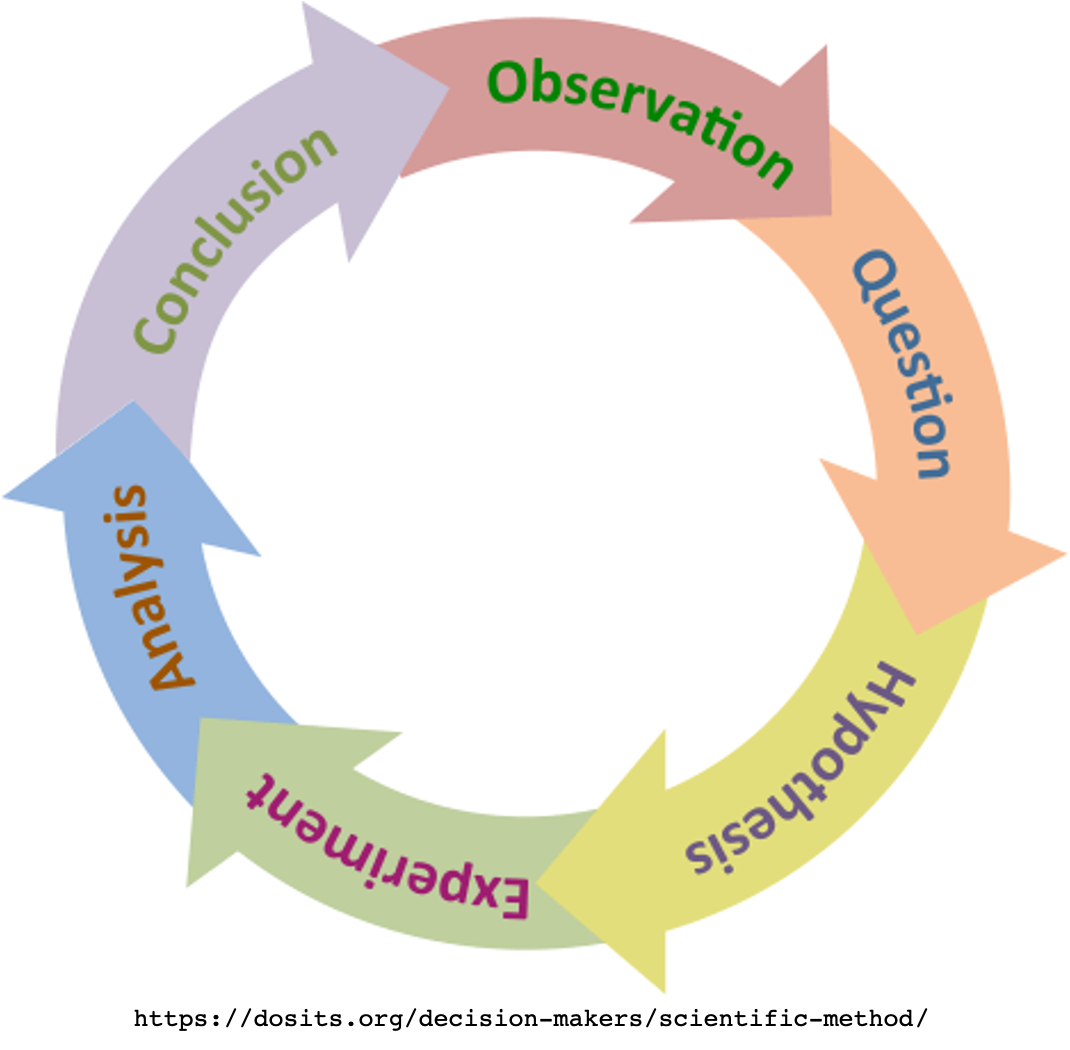
Emergency management, physical security, and information security are three disciplines in which the process of continuous improvement is a model for action. We have cycles of emergency-response-mitigation-remediation. Therefore, I found it interesting to have the Scientific Method presented as a cycle. 

Discovery of Sound in the Sea (DOSIS) is a website created by the University of Rhode Island and the Inner Space Center, here: https://dosits.org


Copyright © 2002-2021 
University of Rhode Island and Inner Space Center. 


Among their website pages is a self-quiz on Facts and Myths. 
1. The greatest uncertainty in understanding the effects of anthropogenic underwater sound on marine animals is understanding how sound propagates.
See the Answer - This is a MYTH
There are many factors that contribute to the uncertainty of how underwater sound impacts marine animals. These include ... 

22. One way to arrive at “scientific truth” is to conduct an opinion poll of scientists.
See the Answer - This is a MYTH
An opinion is a personal judgment or belief, not necessarily based upon fact. On the other hand, “scientific truth” is arrived at through the scientific method, which is an orderly and very well-established process for asking questions about the natural world and testing the answers. Hypotheses that have been consistently validated through observations or experimentation can eventually be advanced to the status of theory. A theory is a thoroughly substantiated explanation of some aspect of the observable world. Theories come as close to objective truth as possible.

PREVIOUSLY ON NECESSARY FACTS

Sunday, August 1, 2021

A good night observing

After an unusually long four months of clouds and rain, the skies have been clearing over the past week. On the 29th, I got my first view of the globular cluster Messier 22. Last night and this morning, I revisited targets that had not been attainable a week ago because of the poor seeing despite nominally “clear” reports from weather websites. I also observed Messier 21, a globular cluster in northwest Sagittarius. 


We amateurs speak of our “grab and go” instruments, smaller lightweight, that are easy to set up and transport. After borrowing three catadioptric telescopes weighing up to 65 lbs (30 kg)—and buying one of them—from the local club, portability was a consideration for me for all of my recent purchases. But “grab and go” does not work well for me. I like to do a lot of reading, planning, and arithmetic before I go out. And I prefer to be out for three or four hours, not just one. I got that opportunity. And last night’s work will allow me to plan better for my next viewing.  

I started with the intent to find M13 the Hercules Cluster, M51 the Pinwheel Galaxy, and the stunning double Albireo. I obtained only the last. The first two would have been new for me. I have seen Albireo often in the past (though not recently for the time of night, the poor seeing, and my neighbor’s trees). I also revisited other targets. For myself, I find that comforting, like meeting with friends. 


At 2145 hours CDT  I started by aligning on Mizar-Alcor. I worked out the arithmetic for the field of view (FOV) and drew a sketch. I then went inside for dinner. Returning at about 2300, I realigned and viewed Saturn to compare a 40mm ocular with a 5X focal extender against the simpler 8mm ocular alone. I thought that the 40mm with its wider exit pupil would give a better view than squinting down into the 8mm, but I did not see much difference. 


Then I went hunting for Messier 4 near Antares, a target I have been chasing for several nights, and again, recording “no joy.” I gave up at 2332 and turned eastward to Sagittarius, a rich area of the sky. I sought M22, a globular cluster that I recorded earlier, but just gave up for lack of patience with the scanning and panning and turned to “the Steam from the Teapot.” Like many constellations, Sagittarius has other folk identities. Above the “spout” are several Messier objects. At 2353 hours CDT, I found Messier 21, also catalogued as NGC 6531. 


I sketched its location and returned to it with different eyepiece arrangements. With the 32mm ocular and 2X Barlow almost all of the neighborhood was in the field of view. I counted about 30 stars, most easily about the same magnitude, but others dimmer that appeared clearer with averted vision. Just after midnight (0005 hrs), I used the 8mm with 2X Barlow to home in on the center of the cluster. Then (0010 hrs) I compounded the 32mm with the 5X focal extender to again count the stars there: about 24 the first time, about 30 the second. Boosting the magnification to 250X with the 13mm and 5X extender, I found the focus difficult despite the additional helical threads on the right-angle focal adapter.


I turned to Jupiter (0023) with the same 13mm 5X arrangement. It was big, with subtle brown and gray bands, but grainy with poor resolution. Still, the eye adapts and we see mostly with the brain. Ronald Stoyan “The Visual Astronomer” (not secure https, but here - http://visualastronomer.com/- anyway) says that no magnification is wasted and that the eye adapts to take advantage of moments of best seeing. Despite that encouragement I think that it is better to perceive details in clearer though smaller presentations.


Taking a break on the chaise longue with a binocular (12x42 Bushnell), Albireo was an easy find as was the “first double” Epsilon Lyrae. Mostly, I just looked up at the sky without the glasses. 


Typical notebook entry scaled to FOV.
At 0059 with a modest 17mm ocular (38.8X) alone and then the 17mm with 2X Barlow, I viewed Albireo down to its “Airy disks” of tightest focus. I noted the yellow and blue members of the visual (not physical) pair.  


Epsilon Lyrae is the “double double.” What the naked eye perceives as a single star, is easily a pair with the smallest of instruments. William Herschel is accepted as the first to have recorded the double-double in August 1779 (Burnham, page 1151). It is a favorite with amateur observers. All four stars are accepted as “white” though Burnham credits others with assigning colors “greenish-white and bluish white… red tint… yellow and ruddy.” At the highest power 8mm with 5X (ridiculous 400X), I noted them (larger first) as yellow and blue (northwest) and white and yellow (southeast). Just to note, also: at 253X (13mm with 5X), they filled two-thirds of the field of view though were not much improved.

That was my night. I can now prepare more accurate templates for recording these same targets again. 


PREVIOUSLY ON NECESSARY FACTS


Seeing in the Dark: Your Front Row Seat to the Universe 

An Online Class in Astrophysics 

Jupiter-Mars Conjunction 

Measuring Your Universe: Alan Hirshfeld’s Astronomy Activity Manual 


Thursday, July 29, 2021

JUPITER AT 1100x

As a child, though I owned telescopes, most of my instrument viewing was with microscopes. I learned well that more power does not make a better view because you lose resolution. Soon, you are viewing your own floaties. This applies to telescopes. However,… Magnification is seldom wasted. To split a close pair of stars, you only need two small circles of light. 

Also, as it happens with a telescope, with low power, you get less contrast: the background is brighter. With more magnification, you get a deeper black where the points of light are not.


I accept the limitations of my instruments. The system must be balanced. My telescopes work best below 110X. My 70mm National Geographic refractor is an f/10 F=700 mm and the Explore Scientific First Light 102mm refractor is an f/6.47 F=660mm. So, for me (or them), the limits are the 6mm ocular or the 13mm with a 2X Barlow. And those are limits. Practically, I work between 20X and 80X, though, as noted above, when pursuing binary stars and similar objects, I accept the degraded resolution. 


Then, I found interesting advice at Ronald Stoyan’s “The Visual Astronomer” webpages (here: http://visualastronomer.com/ -- but not https secure and not updated recently). During the last Mars opposition in October 2020, he posted this: “Most people tend to use a power that still renders a “sharp” image. I would like to encourage to go further: Even if the image does not look as good and is a bit soft, and turbulence is destroying definition most of the time, your eye will be able to make out more fine detail in the milliseconds of calm air as when looking at the sharper image at lower power. This requires a certain amount of patience, in many cases you’ll have to wait several tens of minutes to get glimpses of fine detail. But it will pay off eventually. Actually, there is no such thing as “empty” or useless magnification. Discard all obsolete rules!”


And so I did. With a 5X focal extender coupled to a 2X Barlow, I used a 6mm ocular in my F/660 telescope and viewed Jupiter at 1100 power. I was also encouraged in that by Don Pensack who does a bit of writing himself. Helping me to find M4 in Scorpius (still not found), in a chat on The Sky Searchers website, he wrote: “Higher magnification is the obvious answer, but only once it is in the field. Worry more about the magnification than the amount of glass. You have to diminish the brightness by 10% or more before it's even noticeable in a lab environment (10% is only 0.1 magnitude), and a Barlow does not do that. If the field is darker, it's because of magnification, not the number of glass elements in the focuser.” I had been reluctant to use more ocular than necessary to view. While I personally prefer the wider view of a 17 mm ocular with a 2X Barlow, I would nod to the fact that the 8mm ocular delivers the same view with less interference. Last night, I abandoned my vitrophobia, and went full bore. 


I can’t say that I learned much about the planet. But it was an interesting experience. I also viewed Saturn. Again, it has looked better farther away. But it was an interesting experience. And it led to a personal discovery: I observed the globular cluster Messier 22 (NGC 6656) in Sagittarius. (At left from Sky & Telescope reduced to approximate actual experience at 500X with an Explore Scientific First Light 102mm refractor.)


PREVIOUSLY ON NECESSARY FACTS


The Andromeda Galaxy 

The Beehive Cluster 

Assign a Number to It Said Lord Kelvin 

Baader-Planetarium Micro-Guide Reticle 


Saturday, June 26, 2021

An Objective Philosophy of Science

In framing her philosophy as capital-O Objectivism, Ayn Rand was following in the tradition of Enlightenment objectivism, which was never explicitly defined in its own time. Enlightenment objectivism broadly asserted an integration of two schools of thought, continental rationalism and British empiricism. We know it commonly as the scientific method: theories explain facts; facts test theories. You cannot have one without the other. 

Furthermore, necessary factual truths do not contradict each other. Whatever is true in biology, sociology, history, or aesthetics supports and is supported by truths in physics, chemistry, economics, or ethics. It is also true that facts are contextual. Breaking a rack of billiard balls is different from charging into a crowd on a street corner.


I find it frustrating and disappointing when experts to whom I turn for knowledge about astronomy blunder when they discuss philosophy. For me, the nadir has been Nobel laureate Steven Weinberg who praises Paul Feyerabend in Dreams of a Final Theory. Unfortunately, Dr. Weinberg is not alone in lacking an objective philosophy of science. It remains true that Steven Weinberg has much to teach about applying philosophy to science. 

The Philosophy of Science according to Steven Weinberg.
He is always interesting and not always wrong.
I also have his textbook on astrophysics.
(If he's wrong there, it's above my level.)


Ultimately—and here I side with Weinberg and not with my Objectivist comrades—even mathematics describes and explains physical facts, whether or not we perceive them. See “Imaginary Numbers are Real: Pegasus is Not” here on this blog. For Objectivists who adhere to the final writings of Ayn Rand, mathematics is the science of measurement. (See Introduction to Objectivist Epistemology.) Unpublished are any notes or journal entries from Ayn Rand on the tutorials that she took in mathematics late in life, even if they exist. Regarding the “hard realism” of mathematics, I offer my own theory, i.e., an integrated conceptual explanation of known facts, which differs from canonical Objectivism. My understanding was informed by Nobel laureate Steven Weinberg’s book, To Explain the World. Weinberg asserts a philosophical assumption that he calls “hard realism” when he demonstrates that the modern scientific method was discovered, not invented. It exists independent of the observer and is the same for anyone anywhere.


These are two aspects of the same reality.
No dichotomy exists.
Leonard Peikoff's doctoral dissertation on the 
Analytic-Synthetic Dichotomy is reproduced in
recent editions of Introduction to Objectivist Epistemology.

Weinberg allies himself with the scientists who are being assaulted in “culture wars” in which postmodernists like Paul Feyerabend claim that there is no such thing as “science” only a “scientistic narrative” that (in their terms) “privileges white males and denies space, voice, and agency to women and persons of color” who have been and are oppressed by “the Enlightenment project” of colonialism, imperialism, and capitalism. 


I suffered through a semester of that in my final graduate class in criminology in which our texts were Philosophy, Crime, and Criminology, edited by Bruce A. Arrigo and Christopher R. Williams (University of Illinois Press, 2006) and Essential Criminology Reader, edited by Stuart Henry and Mark Lanier (Westview Press, 2006). Pseudo-mathematical fashionable nonsense such as “crime is a torus” and “crime is a strange attractor” were offered along with denunciations of open-market economics and the Enlightenment. (For more about “fashionable nonsense” see The Sokal Affair and Reflections on the Sokal Affair on this blog.)


Among the many strengths of Ayn Rand’s essays on philosophy was her insistence on connecting the higher studies of aesthetics, politics, and ethics to fundamental truths in epistemology and metaphysics. The lack of such integration is evident in the opinions of scientists who endorse political solutions to anthropogenic global warming. Even if AGW were real, the integration of reason and reality indicates that market solutions offering valuable products and services would be more effective than legislation restricting human action.


I read it often enough to wear it out.
The one on the right has my marginalia.

The relationship between inspiration and proof is that based on your lifetime of experience, you can have an intuitive feeling that a course of investigation will be fruitful and reveal new facts and therefore perhaps deeper or wider truths. But you cannot convince another scientist by a heartful plea. You must provide evidence and your method must be repeatable. 


As a judge in regional science fairs for the past eleven years, I have seen the consequences of failing to hold to that standard. Quite simply, we reward creativity and originality and discount and even denigrate the mere repetition of a known experiment. It is true that careful work is expected as the baseline of performance. So, you do not get an award just for doing a good job. But we never see any of these bright youngsters challenging or refuting a previously accepted claim. 


I find that especially disappointing because I judge in behavioral and social science. Unlike the physical sciences, working social science researchers do test and challenge each other’s published works. Unlike the physical sciences, in my undergraduate curriculum, I had a 200-level class in research methods that required the critical examination of peer-reviewed journal articles. In graduate school, even though I steered to starboard, as long as I presented a coherent reply based on facts, my essays earned A grades. And in one class, I had a colleague whom I would describe as “to the right of the Kaiser” and he got A grades, also. On the other hand, serving on a committee of the American Astronomical Society, criticism of AGW is pointedly unfashionable. The subject came up because astronaut, geologist, and “climate denier” Harrison “Jack” Schmitt is scheduled to be a guest speaker at the Astronomical League conference in 2022.


In Dancing Naked in the Mind Field, Nobel laureate Kary Mullis described how the inspiration for polymerase chain reactions came to him while driving his sports car through the Sangre de Cristo mountains near Santa Fe, New Mexico. Whatever the personal inspiration, proof to others of the process required publishing repeatable results according to the scientific method. In that book, Mullis also mused about the validity of natal astrology when he noticed that many other scientists in his field were born about the same month as he. Astronaut Ed Mitchell attempted experiments with ESP. Any working scientist is in good company in denying or even denouncing astrology and ESP. However, absence of evidence is not necessarily evidence of absence. Lacking proof and making a claim is wrong but seeking proof according to the scientific method is not. On that note, I point out that we accept the electroencephalograph as a valid instrument and yet deny that people can communicate directly mind-to-mind. Maybe we just do not know how to measure it yet. 

On the problem of failed experiments, Edward W. Morley was not satisfied with the results of his famous tests and continued to pursue the luminiferous ether. This speaks to the fact that Ayn Rand called her philosophy Objectivism, not Absolutism. While many things in life are absolute, your choice of a career is not one of them. Morley was acting in his best interests by his best judgment when he continued to pursue empirical verification of the ether. He did not sacrifice everything, or even anything. He continued to be productive as a working researcher. His choice was objectively correct. 


In the AAS committee that I serve on to facilitate collaboration between amateurs and professionals, one of my colleagues suggested that we recommend that all of us who practice science engage in community outreach to teach critical thinking. I pointed out that Dr. Harrison Schmitt is not alone among my conservative comrades who are degreed engineers and who believe that they engage critical thinking when they deny climate change or endorse conspiracy theories. The attainment of objective knowledge requires more than doubting whatever you feel that everyone else believes.


In order to work successfully, scientists must implicitly accept the axioms of Objectivism: Existence, Consciousness, and Identity. These are colinear, not hierarchical. We accept that we possess consciousness, that something exists outside of our consciousness, that whatever we discover has a specific nature that we are capable of knowing. In Understanding Objectivism: A Guide to Learning Ayn Rand’s Philosophy, Leonard Peikoff addressed the fact that epistemology and metaphysics are interwoven. Many students of Ayn Rand’s works misunderstand the hierarchy of philosophy to mean that reasoning from the law of identity you can rationally derive the laws of epistemology. It cannot be done. That is the failure of philosophical rationalism from Plato to Descartes to Russell. The alternate choice of the false dichotomy is positivism going back to the ancient medical writers who treated diseases without attempting to understand their deeper causes. Objectivism integrates the mind and the body, our ideas with our experiences. 


Consider the moralistic handwringing of scientists awestruck and terrified by the atomic weapons they created and delivered to the political leaders of their world. Two of Rand’s novels address the question of who benefits from your work, The Fountainhead (implicitly) and Atlas Shrugged (explicitly). Rand wrestled with the problem earlier, as expressed in a play, Think Twice. I am not aware of anything like this in science education. I had a graduate class in ethics in physics. We were concerned more with adhering to the procedures of science than with the purposes to which it is put.


(To be continued.)


Previously on Necessary Facts

Gregory M. Browne’s Necessary Factual Truths 

The Influence of Ayn Rand’s Objectivism 

The Scientific Method

Harriman’s Logical Leap Almost Makes It 

That Goddam Ayn Rand Book 


Also on Necessary Facts

Patent Nonsense: Intellectual Property Rights and Non-Objective Law 

Four Books About Bad Science 

Another Case of Fraud in University Research 

Misconduct in Science and Research 

Junk Criminology as Pseudo-Science 

Criminalistics: Science or Folkway?