
Previous eces aryFacts
ArmadilloCon 39 Arm lloCo 0 rt 2 A Day 1 rma. and Day 2 Armad n 4 Part 2 Con 4. Da ArmadilloC n 5 ma dilloCon 47 Part 3
I checked out a book of essays by Kurt Vonnegut from my local library. Speaking at college graduation ceremonies through the 1990s, Kurt Vonnegut said that you need about fifty people in your life, not “electronic ghosts” but real people. So, I had an additional reason to attend InnoTech Austin. I had not been to an InnoTech conference in too many years. (See “Previously” below.) Celebrating the start of its third decade, this year’s convention was for computer security professionals. I had a great time meeting people and their companies, and talking with them about their products and services.
 |
This year’s host was The HT Group, a recruiting, staffing, and management consulting agency. They had three tables. |
"In one focused day, Austin InnoTech creates an environment where education, innovation, peer-to-peer networking, and the latest technology and business solutions are all available specifically for IT & security professionals."

 | ||
| Entering the hall, the first people I met were Hannah Webster and Will Arnett from Alias Digital Forensics.
|
 |
To encourage circulation, there was a “Passport” game. Completed itineraries were dropped into box from which randomly selected winners were dawn. |
 |
| Loren Woeber, VP at WiCyS: Women in Cyber Security greeted many interested visitors. |
 |
Diane Kenyon and Jazmen Wright from Austin Women in Technology staffed a table at the Entrance. |
 |
Red Hat was a major sponsor. They handed out red leis that were popular. |
 | |||
There was a lot of active listening. |
 |
| Contrary to the assertion of Google's AI Overview, the conference was held at the PALMER EVENT CENTER at Barton Springs Road and Riverside Drive. |
PREVIOUSLY ON NECESSARY FACTS
Austin Astro Public Star Party
About a dozen of us Austin Astronomical Society club members were there with instruments. The Perseid meteor shower was the main event. Advance publicity across social media promised the best live sky spectacle of the year; judging from the oohs and aahs of the crowd starting at first darkness, the promise came true. I left at 11:15 PM. As a regular backyard enthusiast, I see meteors all the time in my telescope, binocular, and naked eye. And, I own several meteorites. So, my focus was on talking about the stars while standing at my telescope.
 |
| Brian Lippincott explaining eyepieces to guests. A good fabricator, Brian has been the Equipment Chair. |
Brian Lippincott was first on the field when I arrived, all set up with his solar viewing binocular rig and large Dobsonian reflector. He went off to place the entrance signs and I set up my Explore Scientific 102-mm achromatic refractor on a Celestron AVX computerized (“go to”) tripod and mount. At home, I rely on a much simpler and easier Explore Twilight 1 manual altitude-azimuth (“alt-az”) mount but the AVX with automatic tracking and menu selections supports public engagement very well. The only ocular (“eyepiece”) was a 14-mm 82-degree Meade 5000 for 47X. It was sufficient. Soon after Brian returned, other club members trailed in and found their places.
I stopped counting visitors at 125, and I estimated 200 overall, which was the headcount that Joyce and Jim Lynch at the greeting table said that they expected. At the Sky Theater mini-megalith Ed Labelle and Jim Lynch welcomed our guests. In the growing darkness, Ed devoted about an hour to explaining our local Stonehenge and highlighted the basics of viewing the sky, measuring distances with your hand, the general mechanics of celestial motion, and how to dim your cell phone.
 |
| Austin Astro Outreach Chair Ed Labelle at the Obelisk talking to the visitors. |
.jpg) |
| Overture! Curtain! Lights! This is it: the night of nights! |
But I started with Messier 11, the Wild Duck cluster because I aligned on Arcturus, Antares, Vega, and then Altair; and it was a short drop to Messier 11. For myself, this was a first sighting. I had tried two nights before from my backyard, but the view was unremarkable and I did not log it. This time, I could see the cluster and its red and orange stars. The guests were also happy. “Wild Duck” is a cooler name than “Messier 11.”
 |
| Fixin' to Start: Many club members brought large Dobsonians. |
A steady stream of people in small groups and families, came and went and lined up again until about 11:00. We also looked at Beta Scorpii (Graffias) because some had seen Albireo at another instrument. They easily remembered the stunning yellow and blue pair. I explained that this is not as pretty, but these stars are truly gravitationally locked whereas Albireo is an accidental arrangement. I then talked about the 200 years between Galileo and William Herschel when it was assumed that the stars are more or less randomly arranged and are more or less alike with differences in color perhaps relating to their temperatures by analogy with an iron bar heated in furnace. Then, about 1810 William Hershel changed our paradigm. My groups viewed Messier 7, Messier 80, and Messier 4. After I pointed to Mizar and Alcor naked eye, we viewed the system in the telescope, and I indicated Mu Scorpii, the Eyes of the Lion, another naked-eye double. I suggested that club members with larger instruments could show them that Polaris is also a double star.
Then, I went searching for Messier 51 (another first light for myself). My three guests agreed that they could see the small grayer patch in the middle of the field of view. And, again, I recommended that more aperture would be rewarding. Finding myself alone, I packed up.
PREVIOUSLY ON NECESSARY FACTS
Austin Astro Public Star Party
Kyle Astronomy Club Observe the Moon Night
 |
| This year's poster was designed 'by Gonzalo Alvarez who also created an RPG based on Aztec mythology. This year, there was no t-shirt. |
Laurel and I attend because of our shared interests in the craft of writing. She is a murder mystery fan and has edited for Bantam Doubleday. For myself, writing non-fiction, the break-out sessions on plot, structure, and character help me to bring my public into a document which they really do not want to read. I also benefit from learning about marketing, advertising, contracting, and other business issues. And it is a good time to be surrounded by other creatives, to socialize, listen, and chat.
 |
| Special Guests. Charles Siros was this year's FGoH. |
 |
| "Space Tries to Kill You" filling up early. |
 |
| Persevering on Mars |
David Afrarishad of Baen Books led a panel session with Stina Leicht, Dantzel Cherry, and C. S. "Seth" Humble on religion. It is deep in human culture and except for special cases such as Dune and planet Bajor, we seldom consider it in character building or world building. Science fiction tends to default to the Star Trek assumption that we have evolved past all of that. But that is just not likely for any foreseeable future. Even atheists grow up in families and cultures where religion is at least present and often important. And why is Catholicism the default in stories written by people who grew up in Protestant America? Seth Humble pointed out that religion begins with mystery. Stina Leicht called it “the big, black unknown.” She also said that most people confuse morality and ethics and those two with religion. However, Leicht said, religious people do not confuse morality and ethics. Danzel Cherry said that she grew up LDS (“Mormon”) and that gave her a different perspective.
The History session was disappointing. The showguide asked: “How does a horsedrawn carriage get down a mountain?” But nothing like that came of this. Each panelist complained that their self-identified minority was unfairly presented or under-represented in popular history. There were some takeaways. Scrivener was touted as better than Word because it allows keeping backstory notes in the document. Wikis have pros and cons; some people like them. The writers agreed that research can be a rabbit hole that prevents productive writing.
 |
| The Future of Publishing. |
The Future of Publishing was a wide-ranging discussion on the business of writing today. Barbara Ann Wright, Alexis Glynn Latner, and Rick Klaw spoke for self-published and small press markets. Stina Leicht is published by Saga Press of Simon and Schuster. Writing is a business and the craft of authoring is the easy part. Leicht recommended getting an agent, advice she gave in other sessions and chatting in the lobby. Your agent will protect your legal interests and be a buffer for any discussions with the publisher. Rick Klaw said to always negotiate the contract. He said that even if a small press cannot offer more money, they can always provide you with more copies of the book. The others all agreed. Early on in the hour, everyone nodded when Klaw said that they have no idea what the future will be like. (In the car on the way home, Laurel said that they said the same thing last year.) Toward the end, Latner said that so much as changed in the last five years (or three)—from Twitter to TikTok and Booktok—that no one knows what is coming next. They did agree, however, that history is cyclic and vampire stories are popular again.
Laurel and I do not buy more “stuff.” We have too much already and need to get rid of it. But we bought stuff anyway. She got a new coffee cup and I came home with seven books.
[1] Kurt Baty has been on the organizing committee often and one year was the FGoH (Fan Guest of Honor). Kurt wrote an article for me about the Antikythera Device for the Historical Astronomy Division of the AAS. I wrote up his discovery of the first coins struck by the Denver Mint. The accepted narrative had been thin; Kurt did some digging. I placed his story in the E-Sylum of the Numismatic Bibliomania Society, my blog at the ANA Member pages (abandoned in 2021), and the Michigan State Numismatic Society MichMatist. (The MichMatist paid 10 cents a word up to $100; that made my life easier when I edited the magazine because it set a natural limit on lengths. In the wake of Covid, they stopped paying and I stopped writing for them. Anyway, astronomy took me away from numismatics).
PREVIOUSLY ON NECESSARY FACTS
Armadillocon 44 Day 1 and Day 2
According to the registration desk, about 100 visitors came to the Austin Astronomical Society public star party at Pedernales Falls State Park last night (8 July). The club works closely with Texas Parks and Wildlife there and also at Inks Lake State Park. Half a dozen of us have been vetted with background checks to be volunteer docents. Pedernales extends their closing time from 10:00 PM to 11:30 PM for these events and beyond that we can take the time we need to pack up and close up. The club maintains a cargo container converted into a lecture room and storage for our largest telescopes.
Club members bring a wide range of instruments to these events. This time there was a plethora of large Dobsonian reflectors, with apertures of 18, 22, and 24 inches. I brought a 130mm (5-inch) tabletop dob mounted on a altitude-azimuth mount. The other AWB 130 on the field came with two new stargazers and this was the "first light" for their telescope. They had hoped to view Messier 101, Messier 81 and 82 galaxies in and around Ursa Major but the fish were not biting. You really need to understand what you are looking at and looking for. A couple of star parties back, another stargazer and I were laughing about the times we went back and forth looking for the thing we kept passing up. Nonetheless, I told our new friends about the Astronomical League: membership in the AL comes with your membership in Austin Astro and the AL offers mentored, self-paced observing programs with certificates and pins. One of the AL programs is pursuing double stars and I helped Manfred and Melissa find Albireo, Zubenelgenubi, Mu Scorpii, and Alcor-Mizar. "See, you have four down and 46 to go."
 |
| Terry Phillips explains how a reflector telescope works. Terry has served as vice president, secretary, and president. |
 |
| Tracy and David Urban brought their 6-inch Newtonian on a Dobsonian mount. |
 |
| Abhir Joshi and his large Dobsonian. |
 |
| The key to Jim Gardner's astrophotography rig is the very nice Takahashi refractor (white at left). |
 |
| Manfred Trent with his 130-mm tabletop Newtonian from Astronomers Without Borders. He built a light shroud. His wife, Melissa, is encouraging him to add an alt-az mount. |
 |
| Collimating the other AWB 130 on the field last night. (Explore Scientific Twilight-1mount.) Retail from Astronomers Without Borders is $249. Celestron donates some of the wholesale price to support the not-for-profit mission of AWB. |
 |
| Austin Astro stalwart Ron Carman brought a telescope that he did not make. A brief biography ran in Sidereal Times for April 2016. |
 |
| Jamie Canfield worked the registration desk along with Joyce Lynch. Jamie is the VP this year. She previously served as secretary. Joyce has been the editor of Sidereal Times and the club president. Before Covid, when she was the Outreach chair we did events at schools and libraries as often as three times a week. |
PREVIOUSLY ON NECESSARY FACTS
Physics for Astronomers: The Works of Steven Weinberg
Kyle Astronomy Club International Observe the Moon Night
I met the local sales rep at the Wheatsville Co-op last Sunday. It has been perhaps six months since any vendor was set up when I was in, so it was a good opportunity to chat and find out about their products.

“We want to take hemp products out of the shadows,” said Sam Curtiss. In that, he succeeded at Wheatsville. He told me that while he was there, he restocked his shelves in the cooler twice. Bayou City Hemp is working on becoming totally vertically integrated from growing to canning and from non-alcoholic beverages to tequilas and beers. In their view, you should not be stuck with just one beverage.
 |
| https://www.bayoucityhemp.com |
PREVIOUSLY ON NECESSARY FACTS
Funky Mellow: Feel Good Marshmellows
It is nice to see vendors in the store again in the wake of the continuing Covid concerns. Derek and Daniel, founders of Daysmith Coffee, were set up at the Wheatsville Co-op.
 |
| https://drinkdaysmith.com |
From their website:
COFFEE + BENEFITS
Our mission at Daysmith is simple: to transform wellness with everyday goodness. That’s why we make delicious coffees that combine the benefits of vitamins and plant-based nutrients to support your health and power your day
GOODNESS
It all starts with our ultra smooth coffees and creamy oat milks. We know taste is number one, so we've taken our time to perfect our recipes with ultra smooth coffee and creamy oat milk to maximize deliciousness.

All our coffees are infused with vitamins and plant-based nutrients to provide targeted benefits and support your health.
LESS IS MORE
We pride ourselves on what’s IN our cans, just as much what we’ve left OUT of them. While other coffees are loaded with calories and sugars, we’ve cut them down. All our coffees have only 15-70 calories and 0-5g of sugar per can.
PREVIOUSLY ON NECESSARY FACTS
Awesome Austin Foods at the Wheatsville Co-op
Crisp Greens at the Wheatsville Co-op
Salsa Showdown: Jaime's versus Royitos
How do you get your kids to eat sauerkraut? For Kristin Simpson, the solution was to develop a line of fermented foods that their palates would accept. The resulting array of garnishes is now available in Austin and around Texas.
They say about themselves:
Launched by two women in Austin, the Cultured Carrot has revolutionized ancient fermentation. While we were amazed at the exploding amount of information about the microbiome, gut health and the amazing benefits of fermented foods we knew there had to be a better way to get them onto our plate and into our families tummies.
Kristin Simpson and
The Cultured Carrot
https://theculturedcarrot.com
The Cultured Carrot was founded by Palak Sadarangani, a health coach practicing an Ayurvedic lifestyle and Kristin Simpson, a pharmacist with a holistic lifestyle approach. Both busy moms of young kids were blown away by the research and study of the microbiome. Up to 80% of our immune system is found in the gut. Eating fermented foods adds good bacteria to our guts to help maintain the balance we need for a healthy immune system. A healthy microbiome was the key to our families overall health. We knew we had to get more probiotics from fermented foods into our families tummies. Currently all the fermented foods on the market were traditional kimchi, sauerkraut, kombucha, kefir, miso etc. Remembering to take these traditional fermented foods everyday became difficult. We had to create something that was convenient and part of our everyday palates. That's when the idea was born, to create fermented vegetable dressings for salads, marinates and sauces. This concept is the new revolution of fermentation, making traditional ferments more convenient and bringing them to today's busy modern tables. -- https://theculturedcarrot.com/pages/about-us
Kristin told me that she graduated with a degree in pharmacy and worked for local hospitals in Florida before moving to Texas and working in a hospital here. Her goal has always been to introduce healthful, natural alternatives to the over-prescription of synthetic antibiotics.
Her products have a three-month shelflife. She said that refrigerating it keeps the biotics more potent through that time.
It was really nice to meet another vendor at the Wheatsville coop. We went about 18 months without visitors from among our local providers.
PREVIOUSLY ON NECESSARY FACTS
Salsa Showdown: Jaime's versus Royitos
Biobash: Chamber Replicates Success
We have not been treated to vendors at the Wheatsville Co-op since Covid started and it was a pleasant shock to see Delisa and Zach of Funky Mello set up in the front aisle.
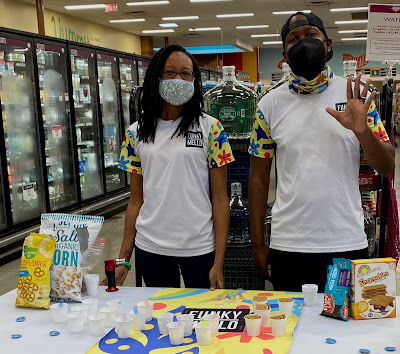 |
| As kids we were obsessed with marshmallows, but as adults our bodies couldn't handle the unfriendly ingredients. Determined to keep the beloved marshmallow in our lives, we spent tireless hours in the kitchen crafting a new kind of marshmallow. Today, we are thrilled to bring happiness back to marshmallows! |
Their products are plant based, dairy-free, and gluten free. The three flavors--Vivacious vanilla, Satisfying strawberry, and Creamy cookie--also are free of the top eight allergens. Of course, the treats have no artificial colors or artifical flavors and have no genetically-modified organisms in their contents.

 |
| Their website features recipes based on marshmellows. |
They have developed an impressive presence at natural, organic, and alternatives retailers here in Texas and they have already established sales through stores in California, Colorado, Pennsylvania, New York, and New Jersey. The three-pack sample goes for $18.99 at the register.
PREVIOUSLY ON NECESSARY FACTS
Coffee at the Co-op: Tradition and Novelty
Awesome Austin Foods at the Wheatsville Co-op
At Oryana Co-op I Took My Change in Bay Bucks
My wife and daughter bought me a telescope for my birthday in 2014. Today, I reviewed by notebook. It was disappointing. Overall, I made very little progress in observation, even though encouraging entries do exist. I first saw Mars on 17 June 2016. I sketched it two years later on 17 August. I spotted the Andromeda Galaxy 1 December that year. I attended some good star parties and a lecture by Dr. Steven Weinberg. This past June, I became an assistant editor with the History of Astronomy Division of the American Astronomical Society. In six years (2162 days), I have 195 pages with ten colored flags for wins. Flags aside, the latest entries since April are more informative.
 |
| Community Outreach is important to the mission of the Austin Astronomical Society. |

 |
The Celestron telescope came with a lot of trade-offs. The Celestron Lens & Filter Kit is popular with many amateurs and has served me well with all of my telescopes. |
 |
| Top: What their uncle gave them for Christmas. Bottom: In July I repaired it well enough for myself. |
 |
| My newest is an Explore Scientific 102-mm f/6.47 refractor "First Light" series. Typically a beginner scope, it is easy to use. |
I like to go out at night, observe the universe, and satisfy myself that it is pretty much as described. The heavens are orderly and predictable, made of the same stuff as I am, yet made astonishingly different from mundane, secular experience. The stars are pretty at any magnification. Viewing them bigger and brighter only reveals their surfaces. As pleasurable as observing is, my greater passions are for the history, the theory, and the history of the theory.

Ultimately, for myself, astronomy is about the mathematics and science and the people who discovered them by creating methods and instruments. The invention and improvement of the telescope, the discovery of the spectrum, the application of radio to astronomy, and then launching those telescopes and radios into outer space are all very grand. That it can be expressed as a small set of symbols that I can understand is at once humbling and ennobling.
PREVIOUSLY ON NECESSARY FACTS
Measuring Your Universe: Alan Weinberg's Astronomy Activity Manual
Physics for Astronomers: the Works of Steven Weinberg


