Showing posts with label Trader's Ethic. Show all posts

Monday, May 12, 2025

Official Innumeracy

Cutting tariffs by 115% means that everything gets a 15% subsidy, perhaps by a reduction in declared value. Secretary of the Treasury Scott Bessent certainly must know the difference. He went to Yale and worked for George Soros. I have to wonder why he did not correct his speechwriter. 


In other reports, the number was given correctly as “115 percentage points” to highlight the drop from 145% tariff to a 30% tariff for a net change of 79% downward on the American side. 


The wrong number was repeated by many news copiers ...

"One hundred percent" means "all of it."

... but was given the correct context by others. 


See, especially, The Detroit News.


PREVIOUSLY ON NECESSARY FACTS


The Success of the WEIRD People

Numismatics: History as Market 

The Art of Finance

Money as Press and Speech


Tuesday, March 8, 2022

World Peace Through World Trade

I stopped at Walmart because they have the best organic salad greens in a box at a price even lower than Whole Foods. Usually, it is a quick trip. This time all of the scanners near the groceries were gone and in their place were large boxes. After paying at a cashier's station, I took some snapshots.

Waiting to be uncrated

Each is half a unit.

Made in India. Over 7000 lbs of convenience.


The half that we consumers care about was made Mexico.

Previously on Necessary Facts

World Peace Through Massive Retaliation 

Chopmarks 

The Shroff 

Awesome Austin Foods at the Wheatsville Co-op 


Sunday, July 5, 2020

The GOP as Pushy Beggars

That Donald Trump is a bully is obvious. His influence on the Republican Party and conservatives is also apparent. Back in late October 2016 when Trump’s election was still in some doubt in the minds of Democrats, at a press conference in Michigan, Michael Moore explained in clear language why Trump would win: Donald Trump brought to the polls millions of disaffected non-voters and other centerists whose personal losses and disappointments opened them up to a Leader making Promises. Now, the Grand Old Party attempts to energize its loyalists by reacting as a victimized bully.


Where do these "matching funds" come from?


Back in 2007, I was elected as a Republican precinct delegate from Ann Arbor Township. It was pretty easy. Ann Arbor is heavily Democrat. There were six slots on the GOP side of the ballot and I was one of four people running. Before moving here, I joined the Austin Tech Republicans luncheon club. Since then, I have been registered on both sides depending on the candidates in the local elections. Austin is heavily Democrat, but sometimes it is important to send the GOP leadership a message in a primary. The same is true of the Democrats. In 2016, I voted for Bernie Sanders as a vote against Hillary Clinton. 


Because I still have my Ann Arbor cellphone number, I have been getting these text messages from the Republicans. Their strategy reveals their soul. (And, yes, I block each one. They use a different number the next time.)


Now, it's my fault.


Aggressive beggars kept us from moving to Portland, Oregon. Back in 2010, after completing an associate’s, a bachelor’s, and a master’s, work was still hard to find in Michigan. So, we looked around. Portland was nice. The beggars were hard to take. They followed us on the street; sometimes they stood in front of us. Austin was different. With four months of 100-degree highs and no rain, brown was the new green. The beggars in the medians were selling ice water. I liked that entrepreneurial spirit. 


Despite the political narratives to the contrary, government in Texas follows the Taxachusetts model. Our senior federal senator, John Cornyn, never met a new law he did not like. We got a problem? Make it illegal. The state legislature made it illegal to buy Tesla automobiles by making it illegal to buy a car from a manufacturer who did not have a dealership in the state. It was the Texas automotive dealers association who got that passed in the Republican-controlled state legislature and signed by the Republican governor. That was changed a couple of years ago. Tesla is in orbit now and that plays well in Houston. 


Insistent Begging from Trumps Senior and Junior 


Working on a state agency project now, I have been diving into the Texas Compiled Laws, especially the Texas Government Code and the Texas Administrative Code. We have a franchise tax here. If you license your music or your painting or your poetry, you pay a tax on the income. But, if you license mineral rights, you are exempt from the franchise tax. That’s what makes fascism more successful than socialism: they know whose bread to butter.


Showing some concern and then blaming others.


The root of the problem is that in essence fascism is just another kind of socialism. Right wing syndicalism and left wing syndicalism are mirror images. Whatever the shades in their rainbows, the radiation is on the same spectrum. 


July 14 -- Bastille Day. I am not going to post all of these as they keep coming in, but this is starting to sound like On the Waterfront.


PREVIOUSLY ON NECESSARY FACTS

Tycoon Dough is Democratic 

In Support of Paid Political Advertising 

President Trump and the Military 

Toxic Leadership 


Sunday, November 4, 2018

VETERANS DAY 2018

“Why My Brick” by Michael E. Marotta on behalf of SFC Edward M. Marotta 

I was drafted. They called it the peacetime Army, but the Korean armistice had just been signed and the Russians occupied Eastern Europe. They say that conscripts do not make good soldiers but I served nine years active duty and 15 years in the reserves. I was an average soldier. My medals were for good conduct and component readiness. My only war story is how a non-judicial punishment led to a promotion and assignment to be a colonel’s driver. In my off-duty time on base, I trained Soldiers in hand-to-hand combat and sent two to the Olympics to compete in boxing. My longest billet was to be a trainer in race relations and equal opportunity. For me, a trade school graduate, with no special purpose or direction, the Army was my equal opportunity to earn maturity, learn teamwork, and help to build the next generation of Soldiers. -- For the "Buy a Brick" campaign of the National Museum of the Army (here) of the Army Historical Foundation (here).

(The photograph is the only artifact of Dad in uniform in the possession of his second family. His DD-214 cites the second rocker for Sergeant First Class, not shown here. After his first re-enlistment expired in 1958, Dad's 15 years in the Ohio National Guard came only after the second set of boys was grown up and mostly gone. We all support our men in uniform; we do not all encourage them to join. "Why did you go, Michael? It was not your fight," said Don Corleone.)

PREVIOUSLY ON NECESSARY FACTS
Syriaphobia 
Soldiers of Peace 
Wooden Ships 
Leaders are Readers 

Thursday, May 10, 2018

Spanish Coins on American Notes

Until 1857, silver and gold coins from Mexico, Spain, France, Brazil, and other nations were legal tender in the United States. We know commonly that that US dollar was modeled directly on the "Spanish milled dollar" or "pieces of eight." However, the influence of international trade on the new republic was very deep and broad.

http://scoan.oldnote.org/
The website linked at left is replete with examples of private banks from the 1830s, 1840s, and 1850s that issued paper money promising American federal dollars (most often, fractions, actually) but showing Mexican or Spanish coins as graphic images. 

We still sometimes call a 25-cent quarter dollar coin "two bits."  Two hundred years ago, one bit was was one Spanish real. Eight reales made a Spanish dollar. When I was in high school in the 1960s, it was a known cheer: "Two bits, four bits, six bits a dollar. All for [our side] stand up and holler." Spanish Mexican culture continued in the West, of course. You can find The Texas Rangers: Wearing the Cinco Peso by Mike Cox (Tom Doherty Associates, 2009). The 5-peso dollar-sized coin of the United Mexican States of 1947 was a much later version of the Spanish dollar and the Republic of Mexico "Cap and Rays" silver 8-reales (1825-1897).

Thames Bank of Laurel, Indiana, 1856, promises Two Dollars
and shows two Mexican 8-reales
The website Spanish Coins on American Notes lists two dozen examples from twelve states. Most of them were "wildcat" banks from the era of unregulated banking. State regulation was no more successful than the constraints of market competition. Even numismatists look askance at that period of rampant laissez faire. A more objective appraisal would put banking in with other businesses. In the frontier era, economies were shaky at best. People enjoyed a lot of opportunity, but few guarantees. We think of "ghost towns" as a consequence of mining in the West, but Michigan has many from the lumber industry, as well from copper mining.

It is also true that along the eastern seaboard, where trade with the United Kingdom dominated, merchants often kept their books in pounds/shllings/pence into the 1830s. The florin and crown coins of the UK were their attempt to bring their currency into some accord with the dollar. Meanwhile the 4-dollar "Stella" gold coin of the United States was our attempt to align with the 20-franc gold coins of France and other nations.

PREVIOUSLY ON NECESSARY FACTS

Wednesday, March 14, 2018

President Trump to Meet Chairman Kim Jong-un

Donald Trump likely thinks of himself as a cut-throat negotiator, but Kim Jong-un has killed family members.

We often do not grasp immediately the consequences of capitalism, and peaceful coexistence is one of them. The age of reason and capitalism were causally connected. People do not kill or die for what they can sell or buy.
I am reminded of a line from The Right Stuff. I think that it was Trudy Cooper who was talking about a college reunion and how the other girls were going on about their husbands' careers "... on Wall Street and places like that. 'Dog-eat-dog competition' [she scoffs]. I wonder how they would feel knowing that there was a 25% chance their husbands would not come out of that board room." 
In Die Hard, Hans Gruber has no interest in corporate "green mail."
Million dollar negotiator Harry Ellis has no idea who he is dealing with.
We were watching The Edge starring Anthony Hopkins and Alec Baldwin. Hopkins plays Charles Morse a multi-millionaire in the fashion industry. (Seeking to run off with Morse's wife, Bob Green [Baldwin] tries several times to kill him.) They are on a photo shoot in the Canadian Northwest when their plane goes down, killing the pilot, leaving them stranded. (Great shot of Morse with his cell phone looking at an empty horizon.) Everyone flounders. Most of them die. But Morse is up for this. He is a voracious reader. When he spoke the line, "All my life I wanted to do one unequivocal thing." I said to myself in my head, "You ought to try landing a Cessna 185."

I learned to fly in the 1990s. Since 2014, I have been in a military unit working closely with the National Guard and Air National Guard. Many of them are combat veterans. Even the guy, who when you ask him, "What are you doing?" says, "Sharpening my bayonet and praying for war." is really a teddy bear: he cares about other people. He's a good soldier, a good leader. I would follow him into hell because he has already been there--three times. But that's the point: the horror of war made him a deeper person than he expected to become. That is true of all of them. No combat veteran I have met ever treated a subordinate with the callous disrespect that President Trump displays.

Donald Trump has never done anything of mortal consequence. His whole life has been one of very vocally making everything negotiable. That is why President Trump has no emotional understanding of Marshal Kim.

PREVIOUSLY ON NECESSARY FACTS

Friday, October 13, 2017

THE UNWISE SAPIENS OF YUVAL NOAH HARARI

Harper, 2014, 443 pages
I was on a long waiting list despite the many copies at the Austin Public Library. When I was done, I could not renew the checkout because other people were waiting. Gratefully, I did not pay for the book. Despite (or perhaps indicative of) its runway popularity, it is shallow and facile, drawn from second-hand sources and not well integrated in its presentations.

Harari failed to correctly explain the origin of writing, the origin of counting, the origin of money, and the origin of coinage.  They are all tightly bound. In every case, his supporting citations point to other popularizers, rather than validated peer-reviewed academic publications. So, he gets a lot of the details wrong. From those he builds his attractive and erroneous narrative. Finally, like me and other bloggers, he is a synthesizer, collecting and republishing ideas that he likes without actually challenging any of those claims for their want of proof. 

One such assertion is that the agricultural revolution was not worth the price. Domestication of wheat brought longer working hours and slavery. It actually brought malnutrition, and set the stage for periodic starvation never known to hunter-gatherers. I reviewed Against the Grain: How Agriculture Has Hijacked Civilization by Richard Manning (North Point Press,  2004 ISBN: 0865476225) for the Objectivist discussion site, Rebirth of Reason, here  in 2006 and later in 2010 here.  I wrote: "Among Manning's many points is that the "surplus" usually went to a handful of unproductive people, priests and nobles."  

Moreover, as I pointed out in my original review, the nobles themselves hunted -- which they denied to those who were bound to the cultivating fields.  Nobles did not suffer a steady diet of grain.  When times were good, they ate well, a variety -- another point Jacobs made about city life -- with lots of fresh meat." It is an interesting fact to consider. But Harari just stops there. He does not see strawberries in January. Cutting off our food supply is integral to his thesis, which includes disdain for liberal humanism. Harari advocates for the postmodern anti-industrial revolution. 

PREVIOUSLY ON NECESSARY FACTS


Sunday, October 8, 2017

What is Cost?

We generally accept the dollar price of something to be its cost to us. The truth is more complicated. Accountants and economists know “opportunity cost,” the hidden tally of what you must give up in order to obtain what you get. I suggest that an “inverse opportunity cost” is represented by blackmail: what you would give up not to lose a thing. Insurance and safety precautions are among those measurable costs.
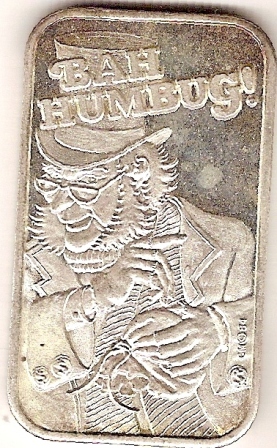
1-ounce silver bar
celebrating
Ebenezer Scrooge

We know retail prices, wholesale prices, and producer prices, salvage value and replacement cost. Many people who are successful traders believe that if they sell you something for $700 and discover later that you would have paid $1000, then they just lost $300. They call it “leaving money on the table.”

This avenue of inquiry was opened for me just over 40 years ago by R. W. “Bill” Bradford when he owned Liberty Coin Service of East Lansing. Soon after the precious metals run-up (or paper money collapse, depending on your view), he retired to Port Townsend where he followed his true calling, publishing Liberty magazine. He always admired H. L. Mencken and saw himself in that role. I was happy to see Liberty on the newsstands next to Reason. Bill passed away too young in 2005. (Wikipedia here.)  I learned a lot in Bill’s coin shop, mostly from the questions he asked. I often could not answer them; and he never did, leaving the work to the student.
 
Plastic tokens from bars and taverns
(US Quarter center for size.)
He asked three rapid-fire questions: “Is a thing worth what you paid for it?  Is it worth what you could sell it to someone else for? Is it worth what it would take to replace it?” 
Collectors pay 60% to 100%
over the spot price of silver
for these common coins.
"The market is always right."

Those were all cogent and obvious, even from my side of the counter. The inherent inflation caused by government deficits was driving up the prices of collectible numismatics which normally would have been insensitive to those markets. When the price of silver went to $50 per ounce because of the Hunt Brothers, coin stores were tossing otherwise “rare” items, such as U.S Mint and Proof sets into shipments bound for smelters. Many collectible silver coins would be replaced at higher prices later, after the collapse of the silver futures market.

PREVIOUSLY ON NECESSARY FACTS