Showing posts with label invention of enterprise. Show all posts

Sunday, October 8, 2017

What is Cost?

We generally accept the dollar price of something to be its cost to us. The truth is more complicated. Accountants and economists know “opportunity cost,” the hidden tally of what you must give up in order to obtain what you get. I suggest that an “inverse opportunity cost” is represented by blackmail: what you would give up not to lose a thing. Insurance and safety precautions are among those measurable costs.
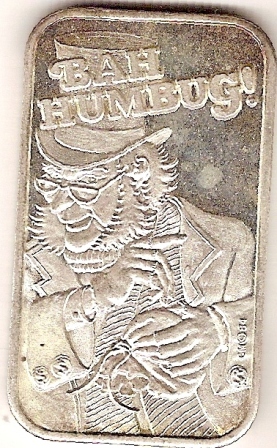
1-ounce silver bar
celebrating
Ebenezer Scrooge

We know retail prices, wholesale prices, and producer prices, salvage value and replacement cost. Many people who are successful traders believe that if they sell you something for $700 and discover later that you would have paid $1000, then they just lost $300. They call it “leaving money on the table.”

This avenue of inquiry was opened for me just over 40 years ago by R. W. “Bill” Bradford when he owned Liberty Coin Service of East Lansing. Soon after the precious metals run-up (or paper money collapse, depending on your view), he retired to Port Townsend where he followed his true calling, publishing Liberty magazine. He always admired H. L. Mencken and saw himself in that role. I was happy to see Liberty on the newsstands next to Reason. Bill passed away too young in 2005. (Wikipedia here.)  I learned a lot in Bill’s coin shop, mostly from the questions he asked. I often could not answer them; and he never did, leaving the work to the student.
 
Plastic tokens from bars and taverns
(US Quarter center for size.)
He asked three rapid-fire questions: “Is a thing worth what you paid for it?  Is it worth what you could sell it to someone else for? Is it worth what it would take to replace it?” 
Collectors pay 60% to 100%
over the spot price of silver
for these common coins.
"The market is always right."

Those were all cogent and obvious, even from my side of the counter. The inherent inflation caused by government deficits was driving up the prices of collectible numismatics which normally would have been insensitive to those markets. When the price of silver went to $50 per ounce because of the Hunt Brothers, coin stores were tossing otherwise “rare” items, such as U.S Mint and Proof sets into shipments bound for smelters. Many collectible silver coins would be replaced at higher prices later, after the collapse of the silver futures market.

PREVIOUSLY ON NECESSARY FACTS

Sunday, December 20, 2015

Corporations and Capitalism

Many libertarians are opposed to corporations, calling them creations of the state.  They certainly are creations of law. Corporations are an improvement over traditional modes such as Shariah law; and they have ancient roots of their own in Roman law. 

Before corporations as we understand them today were invented, unrelated people could only come together for business as partnerships. By law, if one partner died, the partnership was dissolved. No one can speak for a dead person. Limiting businesses to partnerships would make modern enterprise impossible. 

The family business is a different matter. Under traditional law, left over from agrarian times, the family business is a kind of farm, owned by the pater familias, and ownership passed by inheritance. In order to avoid the limitations of partnership, every co-owner would have to be adopted into the family. In that case, the head of the family decides your shares and your profits. That is what privilege is, literally, private law. The pater familias can do whatever on the farm. In Roman times, he could sell family members into slavery.

However, Roman law also recognized the collective entity: the herd. The herd exists independent of any one animal. If you buy or sell the herd, some die and others are born along the way. It is the same herd. Roman emperors granted charters to groups of individuals: burial societies and fire fighters were among the first. Some people claim that the Benedictine Order, chartered in 579, is the oldest continuing corporation. Wikipedia has other ideas here.  But note that many of those are family businesses. 


The modern corporation was the steam engine of commerce. It allowed the creation and management of capital on the scale demanded by the industrial revolution, and wholly beyond the needs of simpler, land-based societies. Shariah Law recognizes partnerships, not corporations. Also, it forbids the payment of interest. Anyone who lends money becomes a partner and shares in the profits. It worked well enough for simpler times and places. However, even Shariah recognizes something called a waqf. A waqf is like a foundation. It was created first over wells: everyone needs it; no one can own it; it must be managed for the common good. Sometime later - I know only about Cairo 1600 - the waqf was used to create family
Trustees of Dartmouth College
v. Woodward,
17 U.S. 518 (1819) was
the landmark case
in U.S. law for
corporations.
foundations that let merchants aggregate their wealth without it being redivided by inheritances. 

In the West, universities were chartered as corporations to allow them to survive their founders. They also could make their own laws for their own communities: Bologna, Oxford, Cambridge, Padua, Heidelberg, ... When Cambridge discovered its original charter to be unhelpful, they went to Parliament for one -- and got a seat in Parliament as a result. Even Sir Isaac Newton served a term.

As for the modern corporation, you could not own most of your comforts without them. To condemn the entirety because of the actions of a few individuals is collectivism.

In the future, the corporation may be the legal structure by which a software earns its legal rights. We already have electronic filing. There is no way to know who the original actor is. She might be a program.


ALSO ON NECESSARY FACTS
Capitalist Culture
Venture Capital
Money as Press and Speech
Numismatics: The Standard of Proof in Economics

Friday, November 20, 2015

Syriaphobia: the latest fad in collectivism

It has been claimed that at least one of the terrorists of Paris November 13 hid among Syrian refugees to gain entrance into Europe. On the basis of that, some (Republican) governors of American states have declared that they will not accept Syrian refugees sent to them by the federal government. But immigrants to America have been associated with crimes since 1492. Immigrants also bring enterprise, initiative, invention, and, most of all, descendants.
 
Michael Ansara,
perhaps best known for his role 

as Cochise in Broken Arrow, 
was also Star Trek's Kang, 
above as "Soldier" 
from The Outer Limits.
In the wake of the French Revolution, Federalists and Republicans both supported and opposed the immigration of French refugees, depending on who was referring to whom.  To the Federalists, the French Revolution was the expression of everything evil in democracy.  However, many of the refugees were aristocrats, fleeing the Terror.

(And that is another point for another essay: Terrorism, as we understand it today, was invented by a native government. The Reign of Terror was not imported from Arabia.) 

Those aristocrats were worrisome for the Republicans whose sympathies were with the Revolutionaries. However, the Revolutionary government of France sent spies. Its envoys interfered in American politics,  attempting to influence our foreign policy. For all of that, and more, see the website of the Office of the Historian of the U.S. Department of State here
 
Anousha Ansari, entrepreneur,
ISS astronaut
and co-founder of the
Ansari X-Prize.
Long established as proper Bostonians, the English in America were appalled by the Irish immigrants of 1848. They lived like animals, bred like animals -- and bred crime. Or so the English of Boston claimed. Among the consequences of Irish in America was the cliché of the Irish cop, established following the War Between the States, and enduring even today. Another cliché was the Irish army sergeant. 

Many had enlisted in the North and South in order to obtain military experience that they could take home to fight Great Britain. Many more stayed here. And their descendants supported terrorism for over 150 years. With the founding of Sinn Fein in 1905, evermore American money flowed into the conflict. 

We worry today about Arab Americans and Islamic Americans supporting terrorism now, but no one was concerned when “professional Irish” in America paid for revolution in Ireland and terrorism in the United Kingdom. 
Like Boston and New York,
Cleveland was a center of Finnianism.
They were not alone. In the 1930s and 1940s, both Nazi Germany and Communist Russia maintained huge networks of supporters. It is also quite likely that the USSR insinuated its agents into the stream of European refugees from World War II. Similarly, communist agents probably were among the Vietnamese. We know that China sends its operatives in as students. Disturbing as that is to consider, actual harm is harder to prove.

Homegrown socialists, whether Fascist, Bolshevik, or others were common enough. Our coinage of the era should appear shocking to any thinking person today. It was not an accident: many progressives and intellectuals of the late 19th through mid-20th centuries were collectivists. In Aldous Huxley’s Brave New World, the clones were named after great collectivists of the times, Polly Trotsky, Lenina Crowne, and Benito Hoover, and others. In our time, the political leaders charged with defeating ISIL actually share many of its philosophical foundations: mysticism, revelation, altruism and collectivism, and ascetisim.
Fasces on American dime 1917-1945. German half mark and US quarter dollar.
Among the spies for the USSR was Samuel Dickstein, a US Congressman and New York Supreme Court justice. Meanwhile Prescott Bush, scion to the presidents of our time was able to get out of being implicated in a Wall Street Coup against President Roosevelt.  The German-American Bund pushed the Nazi Party line here at home. It only resulted in more anti-German sentiment.  Unlike the Japanese, the Germans were not put in concentrations camps - it was a possibility. In the movie Wings, about World War I, when the comic German, Arnold Schwimpf enlists with his buddies, the recruiting sergeant (an Irishman) says, "If you ask me, all you Dutchmen ought to be locked up until this thing is over." Those were heady times.  And America survived.

Civilization will survive ISIL.

Ayn Rand used the term “muscle mystic” (likely invented by Nathaniel Branden) to explain people who worship brute force. They thought that seizing factories would make them productive. They saw goosestepping rows and columns followed by arrays of tanks and mobile artillery, and accepted that whoever brandished them must be strong. In fact, reality and reason required that the Nazis and Communists would fail. So, too, is ISIL's program ultimately unworkable.

According to the news reports now about the Paris bombings, this murder of 180 people was carefully planned and executed over months.  Over 700 million people live in Europe, about 68 million of them in France. A million years will not be enough time for the terrorists to kill everyone they dislike.

Meanwhile, immigrants to Europe and the USA and everywhere else bring valuable human capital away from ISIL.

Yes, some may be criminals, as were the boys at Five Points, the Purple Gang, and the Mafia. It is a fact of human population distribution, however, that there must be at least as many Kennedys, Reagans, Einsteins, Fermis, Scalias, and Ayn Rands. And the creative work of good people outlasts  the destruction by evil people. 

It is an axiom of criminology that "crime knows no neighborhood." In other words, no place, no population is especially criminogenic. Crimes are committed by individuals who make bad choices. That is why Dr. Martin Luther King's dream was a world where a person is judged by the content of their character, not the color of their skin. The basic error, the fundamental fallacy, is considering masses of people as collectives. Including or excluding groups, tribes, ethnicities, etc., is the wrong way to consider the question. In point of fact, US immigration policy requires each legal immigrant to prove their case on their own merits. That is appropriate. 

ALSO ON NECESSARY FACTS
Friday, January 16, 2015

Tycoon Dough is Democratic

Today's "Great Debate" from Reuters online was a one-sided argument about the effect of "uber-rich tycoons" on our democracy.  The authors acknowledge that these individuals express a range of political opinions, from Republican, to liberal, and libertarian. (Put into your search engine "richest Democrat … ic Party Donor …. in Congress…")  However, their thesis is that no one person should have too much influence; and that claim is arguable.  


Read the full article here
What is "too much" of anything?  Obviously, if you had such power, you would engage it ethically.  You would support worthy causes and meritorious candidates.  Of course, from my point of view, your actions might be objectionable. 

It is known that "facts do not matter." In other words, research has shown that people make up their minds first and then find the expert opinions and demonstrated facts that support their notions.  (See "Why Evidence is Not Enough" on this blog for a discussion and a link to the Yale Law School research archived on Mother Jones.)  The spectacular failures of the presidential bids of Steve Forbes and Mitt Romney are only paradigmatic of a myriad of others where all the slick advertising thrown at the voters did not bring victory.  On the other hand, the meteoric rise of Barack Obama shows that you can go far if you speak well in public for other people who prefer to remain private. But those Chicago communists are not rich. They just write well.  By the commutative law of arithmetic, if money is speech, then speech is money.  

And wealth is power.  We Americans distrust power.  Our federal and state constitutions distribute and balance power.  That explains both the integrated elegance of the federal charter and why state constitutions are often clumsy amalgams.  We all know Lord Acton's maxim that power corrupts.  The full statement is a louder alarm:  "Power tends to corrupt, and absolute power corrupts absolutely. Great men are almost always bad men." Perhaps the root of the problem is how we measure greatness. Also, we apparently have no corollary about great women.

Good writers address the back of your mind.  Lawrence Norden and Daniel Weiner call these people "uber-rich." According to the Urban Dictionary (here) the germanism "uber" came into our language in the 1980s via California punk music as a direct play on Deutschland Über Alles.  While the Urban Dictionary allows that you can be uber-confused, the subliminal message from Weiner and Norden is that tycoons are unAmerican, perhaps even anti-American crypto-nazis.  Slandering the rich pays big dividends.

Among the targets chosen by Norden and Weiner was Sheldon Adelson whose many charities include the Republican Party. However…
Adelson was born into a poor family and grew up in the Dorchester neighborhood of Boston, Massachusetts, the son of Sarah (née Tonkin) and Arthur Adelson.  His family was of Ukrainian Jewish ancestry.  His father drove a taxi, and his mother ran a knitting shop.
"An entrepreneur is born with the mentality to take risks, though there are several important characteristics: courage, faith in yourself, and above all, even when you fail, to learn from failure and get up and try again."  - Sheldon Adelson, 2013
He started his business career at the age of 12, when he borrowed two hundred dollars from his uncle and purchased a license to sell newspapers in Boston. At the age of 16, he had started a candy-vending-machine business. He attended trade school to become a court reporter and subsequently joined the army. Adelson attended City College of New York, but soon decided to drop out.
He established a business selling toiletry kits after being discharged from the army then started another business named De-Ice-It, which sold a chemical spray to help clear frozen windshields. In the 1960s, he started a charter tours business. He had soon become a millionaire, although by his 30s he had built and lost a fortune twice. Over the course of his business career, Adelson has created over 50 of his own businesses.  -- Wikipedia here.
In The Invention of Enterprise: Entrepreneurship from Ancient Mesopotamia to Modern Times, edited by David S. Landes, Joel Mokyr & William J. Baumol (Princeton University Press, 2011), the authors admit that in every society, some people rise in status, but what matters is the moral standards of the society.  

In America, from Benjamin Franklin's Way to Wealth to Napoleon Hill's Think and Grow Rich, the "bourgeois virtues" elucidated by Deirdre McCloskey were the implicit norms.  In ancient Rome, conquest brought honors. You cannot blame Marc Antony for looting the town of Pergamum and giving its library to Cleopatra. We might prefer that he had used his organizational skills in some great profit-making ventures, but he was only a man of his time. It is also true that in Republican Rome, "ambition" (literally, ambling around glad-handing citizens for votes) was a crime.  Today, we reward it.

My libertarian and Objectivist comrades wring their hands over Elon Musk, Jeff Bezos, Mark Zuckerberg and other entrepreneurs who achieve great success in the marketplace and then go to bed with governments.  Rather than squelching individual efficacy, we should just limit the government's powers.  That is easier said than done.  The strictest constitution cannot prevent unlimited government, if that is what very many people want.  As Aristotle said, tradition is stronger than law.  

ALSO ON NECESSARY FACTS
Money is Speech

Friday, June 28, 2013

Venture Capital

“Writing the check is the easy part.” Genentech, Apple, Intel, Cisco, Oracle, … none of them would exist, nor would a hundred others that created billions of dollars worth of new wealth by delivering new inventions.  More than the money – though there was that – venture capitalists brought expertise in management and marketing, guiding start-ups, connecting people with each other, sometimes even making the most difficult of all decisions, to fire the founder CEO for the good of the company.
 

Everyone knows Steve Jobs and Steve Wozniak; many recognize Nolan Bushnell, Gordon Moore, and Mike Markkula.  Fewer have heard of Arthur Rock, Tom Perkins, or Don Valentine.  Something Ventured (website here) is their story, the viewpoint of the venture capitalist.  They are a humble lot.  At the end of the movie, they admit that writing the check is the easy part. Without the inventors, the creators, the innovators, the visionaries, the venture capitalists would have nothing in which to invest.  But, invest they did – and do. 
 “They saw opportunity where others only saw risk.”
Arthur Rock was working as an investment banker when his firm received a letter from a group of engineers and scientists who were unhappy working for Nobel laureate William Shockley and were looking for an employer to take them all as a group.  Rock convinced them to start their own company.  Rock approach thirty-five companies – Chrysler, National Cash Register, Curtiss Wright, Borg Warner, Ford, Champion, Motorola, Magnavox, … - and no one wanted to invest.  Then, Arthur Rock met Sherman Fairchild.

Fairchild Semiconductor led to the “Fairchildren” the entrepreneurs within the “Traitorous Eight” of Shockley’s lab who would go on to form their own firms with other venture capitalists backing them. 
“I do not know how to write a business plan. I only know how to read them. We start at the back; and if the numbers are big we read the front to see what kind of business it is.”  (Tom Perkins investor in Genetech, AOL, Compaq, and Amazon).
When Dr. Tom Kodadek spoke to the post-doctoral biological student association at the University of Texas (see Disruptive Diagnotics here), he touted “angel funding” and warned against venture capitalists who take 30% of your firm.  Like a good scientist, he admitted that his narrative was a personal story.  Thirty percent is much less than the half that others have been willing to trade for $1 million or $2 million in start-up funding for an idea that might be (at best) three pages badly written.  Venture capitalists have vision.
“We turned down Jobs and Wozniak.” (Don Valentine) “What are you going to do with a computer in your home? Put recipes on it?” (Pitch Johnson)  “I sent my partner down to look at it and he said, the guy kept me waiting for an hour and he’s very arrogant, and of course that was Steve Jobs!” (Bill Draper)  “They offered me a third of Apple Computer for $50,000 and I said, ‘Gee I don’t think so… … but I said, ‘Call Don Valentine.’ (Nolan Bushnell)
… and Steve asked me, What do I have to do to have you finance me and I said, you need someone who knows marketing and distribution and he said, Fine, send me three people and one did not like him and one he did not like and the third was Mike Markkula. Mike Markkula worked with me at Fairchild before he worked at Intel.” – Don Valentine. 
Mike Markkula wrote the check for Apple and his first order of business as CEO was to build a board of trustees and his first call was to Arthur Rock.  “Arthur said, ‘I want to put some money in that company,’ and I said, ‘Then you have to come on the board.’ His expertise was in marketing and distribution and how to choose people.”
“I was 32. I was retired from Intel, but that’s what I did on Mondays: I helped people write business plans, just because I liked meeting bright people with fire in their belly. ... The business plan said that with $142,000 we could be cash flow positive in nine months.” – Mike Markkula about Apple.  
  • Mike Markkula -- $142,000 
  • Arthur Rock -- $57,000  
  • Don Valentine -- $150,000  
  • Apple's 2010 Market Value: $220 billion
The Austrian School of Economics advocates consistent laissez faire.  They are different from the Chicago School, made famous by Milton Friedman.  The Chicago school argues macro-economic policies with its Keynesian rivals.  The Austrians focus on individuals.  Israel Kirzner, Frank Knight, Peter Klein, and others have attempted to understand and formalize—and continue to investigate – entrepreneurship.  However, as individualists, they argue what the word means, not how to produce more of the same by some cookie-cutter process.  That cannot be done.

The "Traitorous Eight" of Shockley Semiconductor
Who Formed Fairchild Semiconductor
Arthur Rock grew up clerking in his father’s candy store from the time he was six or seven.  Don Valentine’s father was a union organizer and once he understood what a union was, they fought constantly.  Dennis Kramlich was about twelve or thirteen when he bought half a freight car of light bulbs from Sylvania and sold them from his wagon.  “I called it the Bright Boy Lightbulb Company.”  Tom Perkins earned a degree in electrical engineering from MIT and found the work incredibly boring. He then went to Harvard Business School where his professor, George Doriot, taught a unique class in entrepreneurship.  (Doriot’s own company, American Research and Development, made only one insightful commitment, to Ken Olsen’s Digital Equipment Corporation.) Doriot’s students included Perkins, Kramlich, Pitch Johnson, and Bill Draper. 
"These were companies with a lot of things missing.  And our approach was always, ‘Is our Rolodex strong enough to help these people?’”  -- Don Valentine.
This film glorifies the essential individualism of investment capital and entrepreneurship. No formula exists. No formula can exist. Each of the venture capitalists in this documentary has a unique narrative. In every case it reduces to the same primary: “I thought that it was a good idea.” Not everything turns a profit. Ultimately, something does, some ventures do. 
“At the time we started Genentech, there was no such thing as genetic engineering. The risks were enormous.” 
A quarter million invested in Genentech in 1976 became $47billion when sold to La Roche in 2009.  Five million invested in Intel became $90 million.  $1.4 million invested in Tandem Computers in 1974 became $3 billion when Compaq bought the company in 1997.
I was told by a guy at Salomon Brothers, "We’ve heard the pitch, but you did not go to Harvard Business School.”  -- Don Valentine, founder of Sequoia Capital, investors in Apple, Cisco, Oracle, Electronic Arts and LSI Logic. 
  • “There are no firm rules in the venture capital business, except that there are no firm rules.”  Reid Dennis
  • “I would trust him with my life, but not with my money.”  Eugene Kleiner.
  •  "You gotta get money from strong people because weak people don’t invest in tough times, but that is when most of the big winners are created. ”Jimmy Treybig, co-founder Tandem Computers.  
  • “I am not interested in entrepreneurs who want to do things our way. I am not interested in entrepreneurs who come with a dress code. I am interested in entrepreneurs who want to something new that preferably becomes big.” -- Don Valentine
 For all of its individualism – and Donald Valentine is a supporter of the Ayn Rand Institute – capitalism depends on the bourgeois virtues of community. (See the works of Dierdre McCloskey.)  To fund Atari, Sequoia found Fidelity Ventures and the Mayfield Fund to share the burden of risk in return for the opportunity of profit.
PowerPoint was like the Night of the Living Dead, a company that never failed, but just sucked a lot of life out of other people…. until it was sold to Microsoft…


PREVIOUSLY, ON "NECESSARY FACTS" 

Tuesday, October 9, 2012

The 1% are the Atlases


The disappearance of the middle class is a direct consequence of failed economic policies enforced by bad laws.  Regulations (first) and taxes (second) destroyed the manufacturing industries. Desperate for productivity, firms seek and reward the best managers.  But they cannot work miracles.

America moved forward on information technology.  Computering is wholly unregulated, though the incomes are taxed.  But computers are only one sector.  Genetics is stalled.  Spaceflight is marginal.  Robotics is stuck.

Just like physics, to the extent that economics actually describes reality, the facts cannot be evaded without consequence.  Machinery needs motive power. Engines need fuel.  Friction must be reduced and worn parts must be replaced by preventive maintenance.  Most of all, no engine design solves all problems.  Therefore, innovation and invention – innovators and inventors - are the prime movers.  To pretend otherwise is to beg for disaster, which is where we are headed.

On the nearly-free enterprise blog, OrgTheory, from almost-rational sociologists, is a current topic spinning nonsense about the “income gap” caused by the salaries of top managers.  Idiocy is easy to find, for instance, at Huffington Post (which, in fact, delivers the marketable facts of your session to its parent AOL, a ironic and just consequence, like profits on Che Guevara t-shirts).  I single out OrgTheory because they usually exemplify good thinking about new ideas in sociology.  But sociology never shrugged off its Marxist chains.  So, sociologists labor under a burden of false assumptions and wrongful conclusions.  

The problem is not that top salaries have increased, but that the middle class has disappeared into the working poor. They were crushed by the regulations and taxes that destroyed the businesses that employed them – and made impossible other new firms offering inventions, innovations, creations, and developments which never happened. 

The Congressional Budget Office statistics are unarguable. The top quintile earns 50% of the income and pays nearly 70% of the taxes.  The broad middle class – 60% of the workers in quintiles 2, 3, and 4 – earn only 45% of the gross income and pay only 33% of the taxes., with the 4th quintile accounting for more than the lower two. The top 1% earns 15% of all incomes and pays almost 30% (28.9%) of all federal taxes.  The richest carry twice their fair share.

We are killing the goose that lays the golden eggs.

The wealthy have proved that they are accomplished at creating and managing wealth.  We know that the government is neither.  The government does not create wealth. The government does not manage wealth.  Those are not its purposes.  If it has any function at all, government is defensive and remediatory: we look to power for justice and protection.  Even “infrastructure” is not its purpose.  President Obama pointed to highways when he told innovators and creators, “you did not build that.”  But like Bastiat’s broken window, the highways are only visible events that mask the unseen.  When the highways were built, cell phones and the internet were possible.  But AT&T was the “Ma Bell” monopoly.  Car phones were exotic luxuries; even answering machines were rare.  Private highways – the Lincoln Highway; the Dixie Highway – were created; tollroads and turnpikes did exist.  Then taxways called “freeways” prevented innovation in public transportation.  The construction of the superhighways – and the support they gave to the automotive industry – actually derailed innovation and invention by draining capital into less productive channels.

The American government invested monumental resources in a cold war against a hollow empire that never knew a successful harvest.  Every jet fighter, bomber, missile, and submarine represented one more utopian promise from 1900 never to be fulfilled.  Public education Kindergarten through College still consists of one person lecturing to a passive array of listeners – and we wonder why it failed. We speak of “cancer” the way 19th century people did of “miasma” and “consumption.” Meanwhile latter age neo-primitives protest for laws against genetically-modified plants and animals. We do not fly to work in personal aircars, vacation on the Moon, or transship freight from highspeed rail to dirigible airships.  The missing innovations were the unseens of Bastiat’s unbroken windows.  

From the vantage point of the Wright Brothers, Robert Goddard, Thomas Edison and Nicola Tesla – or Jules Verne and H. G. Wells – we should be colonizing the asteroids by now, enjoying median IQs of 150, and inventing new art forms for 3-D displays.  Instead, we still wear colored glasses like they did in 1955 to watch remakes of 1955 cinemas, because engines of innovation and invention were stopped by the sands and sugars of regulation and taxation.

The wealth of the 1% came from the computer revolution.  It was the only sector of the economy not regulated because its very nature literally mystified the legislators.  They could not regulate what they could not understand, gratefully.  With Moore’s law racing ahead of all the other laws, computering is the only train on the track.

Make no mistake: it was not Al Gore or even his science advisor Dr. Michael Nelson who built the Internet.  It was hackers and hobbyists who built the first consumer modems and wrote the cyclic redundancy check programs for them to let ordinary people in their homes use the voice-grade landlines while the government-backed AT&T Bell monopoly wanted to charge “business rates” for data grade lines.  As BBSes were spreading, local Bell operating companies were lobbying for laws against them, seeking government-sanctioned permission to offer the only dial-up information services.  That did not happen.  They did not build that.  And we have some thin blanket of prosperity against the chill of regulation and taxation.


Friday, July 29, 2011

Innovation and Discovery

The merchants of Sumeria invented fiduciary instruments on clay tablets 3000 years before the first coin was struck.  Coins, philosophy, and democracy were invented all at the same time in the Hellenic hinterland of Middle Eastern civilization.  It is often the case that new ideas and the new cultural activities that spring from them come from the frontiers, not the centers.  Those centers are vital, analogous to the heart and brain of a person.  But we explore with our fingertips ...
The Chronicle of Higher Education online for July 24 featured news about a robotic retrieval system for archive storage installed at the University of Chicago.  The University of Chicago is an important school.  Like Harvard, MIT, the University of Michigan, Ohio State University, UNC Chapel Hill, Berkeley, Stanford, and a dozen others, it has instant name recognition.  However, the first automated retrieval system was installed at Cal State Northridge in 1991.  I benefited from ours at Eastern Michigan University. 
“The ARC was built as part of the new Bruce T. Halle Library in 1998 at a cost of $1.6 million...Eastern was the second university in the U.S. to install an industrial strength inventory control system adapted for library use ... ” (ARC Handout; courtesy of Keith Stanger, Information Services Librarian.)
Like Cal State Northridge (36,000 students), EMU (24,000 students) is a midrange school, not special, not famous for scientific research or football.   Yet, at least in my case, EMU did deliver world class education.  
I made the mistake of blowing through criminology with a lot of community college credits.  We have an “articulation agreement” between Washtenaw Community College and Eastern Michigan University. As a grad student, one summer, I met an undergrad whose feet never touched the ground running through two short summer terms toward a bachelor’s.  He missed a lot.  I would have, too, but as a graduate, I had Gregg Barak for crim theory and then for global crime.  An expert dialectician, he can argue any side of any topic; and we did that.  He loves facts and has no patience for unfounded opinions.  Long having enjoyed tenure, he has had the freedom to write textbooks which influence the next generation of criminologists.
I also profited from having Young S. Kim for the undergrad class in social science research.  Dr. Kim assigned two peer-reviewed articles each class and he encouraged us to read them carefully, even to check the arithmetic.  Kim and Barak are co-authors with Judge Donald Shelton on the only statistically rigorous studies of the so-called “CSI Effect.”
Majoring in criminology, I had a lot of sociology classes.  As an undergraduate and graduate, I benefited from Prof. Ronald Mark Westrum, a pioneer in complex organizations, along with Charles Perrow of Yale.  Ron Westrum was my prof for complex orgs, undergrad seminar, technology in society, and social problems.  For him, I wrote papers on the FBI as a complex organization, the history of coinage as a technology of commerce, and the benefits of healthy aging, among five or six others.  
I first enrolled as a freshman in 1967.  I never stopped going to school.  I enjoy learning, of course, but working in information systems since 1977, I had to ride the leading edge in computer programming with repeated classes in languages and applications, from BASIC to Java, and accounting to robotics.  When I came to EMU, I transferred in 180 credits from the College of Charleston, Case-Western Reserve, Cleveland State, Lansing Community College, New Mexico State, and Washtenaw.  Big and small, I’ve seen them all.  I feel sorry for kids who forego the opportunity to profit from small classes, and close interaction with the actual professor whose name appears in the catalog for that class, rather than being tutored by a grad student who lacks not just lifetime experience, but deep academic experience.  
When I enrolled at the College of Charleston, I was assigned Mark van Doren’s Liberal Education. Back then, C of C was a small four-year school with 450 enrolled.  One of our professors for European history was György Heltai who worked in the government of Hungary after WWII and was arrested, imprisoned and tortured in a Stalinist purge.  The professor of classics, Alexander Lenard, published his Latin translation of Winnie-the-Pooh.  My professor for chemistry, Carl Lykes, spent his summers at the Savannah River Nuclear Power Plant.  It was just a little old college, nothing special, but a place where world class intellectuals shared their working lives with any interested student.  
Over the years, I have had the “coasters” and “dodgers” excoriated in the recent report to the University of Texas by consultant Rick O’Donnell.  But I also benefited from “stars” and “pioneers.”  Like the invention of coinage, philosophy, and democracy, or the lightbulb, airplane, and computer, excellent education is drawn to the cultural centers, but it may not begin there.  
As Plato is famous for his Cave and Republic, F. A. Hayek’s stamp is “spontaneous order.”  Ludwig von Mises warned of “planned chaos.”  Certainly, I plan to be on a bus by 3:30 PM and be picked up by a taxicab at a transit center at 4:30 PM.  I have some control over those events only because the providers have known intentions of their own  which bring me at least one unplanned order of events.  It certainly works better than going to a government office, filling out some forms, and requesting two modes of transport for a personal motive.  When the Washington planners talk of high-speed rail, they do not think of Mike Marotta’s transient desires... or yours...  
Discovery, invention, and innovation cannot be planned.  Some schools have been successful with their robotic library retrieval systems.  But I know that the system does have failures - Perrow calls them “normal accidents” - and when the robot goes down, no one gets any books until a service technician shows up.  You can plan your actions; you cannot plan their consequences.
I usually blow off Chronicle articles.  I read this one.  And it worked out in an unplanned way.  As soon as I saw the headline, I planned to write this post.  The serendipity came toward the conclusion.   
The case for keeping print within reach is more complex than fuzzy rhetoric about the joy of serendipitous browsing. The research habits of Adrian Johns, a history professor at Chicago, give you a sense of why.Mr. Johns specializes in the history of the book; his recent work, Piracy, traces the intellectual-property wars from Gutenberg to Bill Gates. When a reporter visited his bright, fifth-floor office re­cently, the bespectacled British historian had just returned from a trip to Glasgow. He was interested in Robert Andrew Macfie, a 19th-century sugar magnate and member of Parliament who ran the first big campaign to abolish intellectual-property rights. A lot of Macfie material hasn't been digitized: pamphlets, election manifestos, correspondence. Much probably never will be, because there's little economic incentive.
Now I know about Robert Andrew Macfie.  

ALSO ON NECESSARY FACTS
Objective Intellectual Property Law
Copy Rights and Wrongs
Open Secrets

Sunday, May 29, 2011

Capitalist Culture

Instead of vilifying him for being an idiot, we should be praising Michael Moore for being a millionaire.

 The Invention of Enterprise: Entrepreneurship from Ancient Mesopotamia to Modern Times (Princeton University Press, 2010) is an anthology that gives an high level view of the broad history of trade and commerce.  (My full review published by Libertarian Papers here.)  In separate chapters, David Landes and Michael Hudson identify the difference between creative and corrosive capitalism. The latter dominates in societies that deny the former.  The editors generally point out that in any society, some people will take the best advantage of whatever modes are offered for personal advancement.

In Rome, glory came from looting provinces.  Making money was not honorable.  So the wealthy left the management of their businesses to their freemen and slaves.  In America today, we allow both the marketing of technology and gaining government subsidies.  It is not just that both are legal, but that culturally, we do not distinguish between them.  Instead of vilifying him for being an idiot, we should be praising Michael Moore for being a millionaire.  He should get a hero's medal for selling large volumes of what people want to buy voluntarily.  

Instead of praising clever children who memorize the Presidents in order, we should be teaching them that "LinkedIn started out in the living room of co-founder Reid Hoffman in the fall of 2002. The five original founders were Reid Hoffman, Allen Blue, Jean-Luc Vaillant, Eric Ly, and Konstantin Guericke." (Company "About" here. )  I am not sure how to commemorate the chic restaurants in Rep. Nancy Pelosi's district that won exemptions to opt out of Obamacare.  The avoidance of regulation should not be taken lightly. 

BOURGEOIS VIRTUE

Deirdre McCloskey developed her theories on "Bourgeois Virtue" over the past two decades.  She now has two books out, with a third on the way.  She investigates the topic from many standpoints.  Generally, she finds that the things we are taught to dislike about being middle class include the social graces that benefit and profit us all. 
A potent source of bourgeois virtue and a check on bourgeois vice is the premium that a bourgeois society puts on discourse. The bourgeois must talk. The aristocrat gives a speech, the peasant tells a tale. But the bourgeois must in the bulk of his transactions talk to an equal. It is wrong to imagine, as modern economics does, that the market is a field of silence. "I will buy with you, sell with you, talk with you, walk with you, and so following. . . . What news on the Rialto?"
For one thing, talk defines business reputation, as at the Iowa City cocktail party. A market economy looks forward and therefore depends on trust. The persuasive talk that establishes trust is necessary for doing much business. 
"
Bourgeois Virtue" by Deirdre McCloskey, American Scholar vol. 63, no. 2, Spring 1994, page 249,  here.
Today we have social media. Corporations hire people or not, and fire them, based on what is revealed on Facebook and Twitter.  Reputational gossip has become all the more intense.  In a global culture, other people in other places grew up with different expectations entirely.  Rather than forcing conformity and avoiding risk, hiring managers who want their firms to profit should have the mechanisms in place analogous to those engaged by entrepreneurs. 
Market theorist Henry Girard Manne suggests that insider trading is one of those. 

In the anthology cited above, the chapter on the Middle East by Timur Kuran pointed to a biography of a Cairo merchant.  Making Big Money in 1600: The Life and Times of Isma'il Ibn Taqiyya by Nellie Hanna is a detailed account of one merchant in one place.  It so happened that he had his choice of courts, four of them, from different schools of law, in which he could register contracts.  Abu Taqiyya flexibly extended his trade network by crafting the clauses in his agreements.  Benjamin Franklin would have called it "prudence."

A MAN'S HOME IS HIS MARKET

We see the "castle" as a paradigm, not just because we are at war with our neighbors - Hobbes' war of all against all being the reason for government. For us, the home is primary protection against the elements. In a society of open courtyards, verandas (a Hindi word, likely borrowed from Portuguese), decks, roofs with hanging gardens, patios, arcades and colonades, concepts of safety, security, and ultimately, property rights, must have other paradigms. As he became wealthy, Isma'il Abu Taqiyya extended and expanded his personal space until his large home dominated his street.  He shared that street with a partner who made the same arrangements. They also did this with their warehouses (wikalat), which served as storage, emporia, and guest lodgings.  Public life was gradually excluded from private contexts as the visitor moved inward from the business into the home.


The piazza is a public space, but among urban Americans in the 19th century, it came to be a somewhat pretentious word for the front porch.  For Americans, the front porch became the margin between the public street and the privacy of the interior home.  Adults could sit and rock while children played games.  Friends and neighbors could stroll pass and bid hello and good day.  An industry arose to create special furniture for this special space.  Europeans assigned to work in Detroit visit  Ann Arbor because our restaurants extend to the street, using the sidewalks for table spaces.  The margins between public and private spaces are blurred.  It would be difficult to discuss anything illegal or immoral in such a context.  Business and social life become transparent when conducted on the street.  In such a context, you grant privacy by minding your own business.

Therefore, rather than the castle which holds against the storm, a commercial society of productive traders, offering values in voluntary exchange, is better served by a theoretical model of ready communication.  Jane Jacobs made the same point in Systems of Survival.  It is the Trader's Ethic to be open and available to deals with strangers.  Thus, capitalism is inherently globalist and democratic. 

ALSO ON NECESSARY FACTS
A Man's Home is His Market
Thank-you Notes
City Air Makes You Free
Knowledge Maps