Showing posts with label bourgeois virtue. Show all posts

Sunday, February 27, 2022

Unscientific American

I did not renew my subscription to Scientific American because it has devolved into a platform for collectivism. It is not merely the political agenda. Politics rests on epistemology and Scientific American has abandoned the scientific method and replaced it with authority opinion. 

In fact, science was presented that way 100 years ago. A scientist (professional or amateur) submitted their paper and if the journal found merit in it, they published it. Footnotes and references are the modern style. It can get excessive. In my review of The Invention of Enterprise for the now defunct Libertarian Papers (reprinted here), I took issue with an avalanche of citations to validate an obvious fact. Erring in the other direction, authors in Scientific American assert the hypothesis rather than offering evidence and Scientific American now publishes empassioned pleas for an intellectually bankrupt political agenda.

I have been thinking this through for over a year. I subscribed in 2020 because Covid closed the University of Texas and I (among very many other independent scholars) lost my library privileges. Subscribing to Scientific American (as well as Sky & Telescope) bought access to their archives. For Scientific American that was highly important. 


Today's left wing slant was obvious and I just ignored it. The science articles were still respectable. Evidence of that was in the January 2022 issue, which carried an article about the Antikythera Mechanism by Tony Freeth. However, the same  issue carried “Inside America’s Militias” by Amy Cooter. The first was a technical report for the general reader who is interested in science but uninformed on this topic. The second was one person's self-validation of beliefs she formed before she began her university education. 
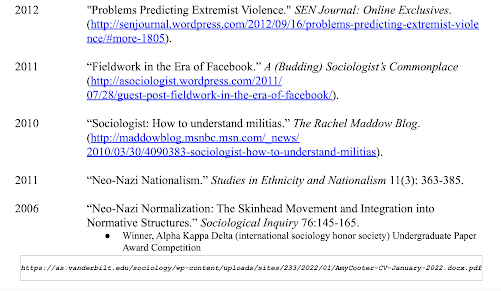
 

From Dr. Amy Cooter's curriculum vitae.

Both were personal narratives. Freeth has devoted decades to studying, writing, and lecturing about the ancient computer. His article in this issue included many references, citations, and pointers to the works of others. Freeth has puzzled over the Antikythera and invested careful, questioning thought to the many problems it presents.


Cooter cites two people who agree with her, or with whom she agrees. Unlike Freeth, she did not come to this research with an open mind. She is not necessarily wrong in her basic facts, only in how she weaves them into a scripted oratorio.


It is an easy claim that the militias, being traditionalist are also masculine. The affinity of men for weapons is obvious by inspection. Benign sexism is a consequence of that. As a guy who has served in uniform, I assure you that protecting women and children is not open to question. At that same time, I served with, alongside, and under the command of women. I never had a problem, though I did report up the chain to inform the leadership about other men who did need some corrective counseling on the subject.[1] It is a known situation.


Dr. Amy Cooter does admit that the right wing militias do have women in command. In her January 2022 Scientific American essay, she wrote: “There are a few women who fully participate in militias, and because of their activity they tend to be well respected and rise to leadership roles. (Jessica Watkins, leader of an Ohio militia who was arrested for her participation in the Capitol riot, is one example.) Still, most militia units have a culture suffused with casual misogyny.” Personally, with my master’s in social science, if I were considering a doctorate, I would find the subject of women in command of traditionalist militias more compelling research than the observable truth that boys like to camp out and play with guns.


Like Cooter, I grew up Republican. My introduction to libertarian versus traditional conservative ideology came at the 1965 convention of Young Americans for Freedom. There, I met conservatives who were opposed to the draft and to the war in Vietnam. I also had to come to grips with the fact that many of my comrades on the right were racists who believed that Negroes are substantially different from and inferior to us white folk. I found that attitude repugnant and distanced myself from the people who asserted it. 


So, when in college, I turned hard to the left, I also found it easy to parse the many, many varieties of socialist theory, including the distinctions among British Labour and Social Democrats, Lenin, Trotsky, Bolsheviks, Mensheviks, and the American Marxist, Daniel de Leon and his Socialist Labor Party. Much later in life, I came to understand how left wing syndicalists became the anarchists of the Spanish civil war and right wing syndicalism became fascism. 


Understanding those nuances led me to ask why the same people who decry the insurrection of 6 January 2021 were silent during Occupy Wall Street. I admit that it is a rhetorical question. 


The final failure came in a special supplement for March 2022. Under the rubric “How COVID Changed the World” by senior editor Jen Schwartz, the lead article was “A Microbe Proved That Individualism Is a Myth: Humans evolved to be interdependent, not self-sufficient” by Robin G. Nelson (biological anthropologist at Arizona State University). Nelson builds her hypothesis from an inventory of complaints: 


“For countless Americans, there was a dull but persistent pain to prepandemic life: high-priced housing, nearly inaccessible health care, underresourced schools, wage stagnation and systemic inequality. It was a familiar ache, a kind of chronic hurt that people learned to live with simply because they had no other choice. Faced with threadbare safety nets and a cultural ethos championing nationalist myths of self-sufficiency, many people did what human have always done in times of need: they sought emotional comfort and material aid from their family and friends. But when COVID-19 hit, relying on our immediate networks was not sufficient. Americans were gaslit into thinking that that are immeasurably strong, impervious to the challenges people in other countries face. In reality, our social and economic support systems are weak, and many people are made vulnerable by nearly any change in the capacity to earn a living. The fallout from the pandemic is an urgent call to strengthen our aid systems.”


The thesis fails from unnamed collectives: “countless Americans … people… many people… Americans… people in other countries… many people...” It offers not a single measure, no statistical survey, no validated polling. 


I point out that nationalism is not individualist. I might accept that the myth of personal self-sufficiency may be found nationwide. I must insist that nationalism denies personal self-sufficiency and insists on the integration (or total absorption) of the individual into the nation (as defined by its self-identified leaders). 


And individualism is not a myth; it is fact of life. 


"In his apologia for chemistry, The Same and Not the Same, (Columbia University Press, 1995) Nobel laureate Roald Hoffmann asserts that no two hemoglobin molecules are identical. So-called “identical twins” are not. Individualism is objectively real: both empirically knowable and rationally explainable." On my blog here.


People who receive intense family care and people who benefit from the highest levels of professional medical care in a hospital still die. They give up. The time comes when you decide. You make the choice that no one else has the right to make for you. And every moment of every living day, you decide to make the best of your life, regardless of your circumstances.[2] 


Moreover, during the pandemic, hobbyist markets have flourished. In amateur astronomy, we found sales exploding. Millions of other people returned to reading, walking, and other pastimes. These are personal pursuits, edifying and enjoyable. Millions of parents learned to get along with their own children and to appreciate the teachers on whom they previously had inflicted their brats. There was no shortage of the very family life which the collectivists had long complained that work outside the home was destroying. 


I confess that I had to read the introduction to Nelson's phillipic several times over several days before I understood “gaslit.” Then just to be sure, I googled it. It is a neologism, a trope from a 1944 movie that only became vernacular in popular writing from about 2016. (See https://en.wikipedia.org/wiki/Gaslighting.) That being the assertion, who then is the villain? Who is robbing the unnamed collectives and what is being taken from them? 


Ultimately, you can only steal from individuals. That speaks to a deeper fallacy: the stolen concept. You cannot have theft without property: even a landlord is debarred from transgressing the renter’s “quiet enjoyment.” Quiet enjoyment is an economic value that can be stolen. So, what is missing here? And while it is theoretically possible that lacking any other motivation except your pain your landlord could set up loudspeakers and blast Wagner into your home, it would be bizarre. Most landlords only do things that make them money or prevent losses. So, who is getting the money from gaslighting Americans into believing that we can make decisions that result in our happiness? Are the perpetrators Runner's World, Sky & Telescope, and Papercraft Essentials


Speaking to the deeper point, if engaging in new hobbies makes us happier and perhaps morally better, is it gaslighting? I think that we are being gaslit into believing that we are unhappy in order to rob us of money to pay college professors at public universities who tell us that we really are unhappy despite all evidence to the contrary. (For some point-counterpoint on the subject, put "happiness conservatives liberals" into your search engine.) 


Social facts being complicated, it is also true that many people did and do suffer from the strain on the healthcare system: the providers themselves. Their plight does not appear in Robin G. Nelson’s article. (See "The Forgotten Man of Socialized Medicine" by Ayn Rand.)


In a second illogical attack on personal freedom, Dr. Robin Gair Nelson strikes at the root of American exceptionalism by conflating our chosen virtues with our inherited sins. “
Since this country’s inception, the dominant ideologies here have encouraged not only individualism but also the dehumanization of certain groups, as evidenced by the enslavement of Black people and the displacement of Indigenous communities from their ancestral lands. This dehumanization continues today in the form of the bootstrap narrative—the myth that anyone can prosper if only they work hard enough—and in efforts to weaken relief programs for people who need help.”


She does not parse those dominant ideologies. One of them was collectivist. Way back then, correctly stated individualism would have ended slavery and recognized the property rights of the people who were here first. Collectivist thinking based on incorrect epistemology caused those evils and many others. In point of fact Article I Section Nine of the Constitution contemplated the end of slavery after 1808 and allowed the imposition of a tax on the importation of slaves until then. As the Supreme Court ruled in a different case: The power to tax is the power to destroy. Apparently, since this nation’s inception we were intent on destroying slavery, and that is why we eventually fought a civil war over it. 


As for the Native Americans, as long as the trespassers were only individuals who chose the harsh frontier over the comforts of village and city life, the Natives usually won any battles. They struck hard and terribly. The theft of their lands was possible only because of the collectivized action of a central government that had no intention of keeping its promises. That is quite different from the bourgeois ethics of individualism.


One way or another, we all have bootstraps. It is true that some inherit their very nice boots including four generations of wealthy African-Americans. (See Our Kind of People by Lawrence Otis Graham. In an episode of The West Wing, the staff writers are in a quandary over Republican resistance to escalating the estate tax because it also would penalize the first  generation of African-American millionaires.) Envying them and being jealous of their status will not provide you with the intellectual tools required to make your own or to pull yourself up by whatever you do have. Some of the answers are hidden in books like Think and Grow RichHow to Win Friends and Influence PeopleRich Dad Poor Dad and Benjamin Franklin’s collected aphorisms published as “The Way to Wealth.” You can read about Madam C. J. Walker, Maggie Lena Walker, Steve Jobs, or Steve Forbes. 


From reading the theories of the arch-capitalist economists of the Austrian School, I am willing to believe (provisionally) that financial success is ineffable: it must be learned and cannot be taught. Working hard is absolutely required and yet alone is not enough. Knowing the principles of accounting may be necessary but insufficient. Finding a thriving market or a floundering one that will reward nurturing may both be exploitable alternatives or failure modes. 


Nelson closes her complaint with a demand: “Committing ourselves to upholding our evolutionary mandate to help one another—not just the people we see every day but everyone everywhere—is the only thing that will save us.” 


If helping one another is our evolutionary mandate, then it must be beyond our choice. If it is not, then by what standard is it required by evolution? Evolution required that people who have diabetes live long enough to have children and we have people with family names like Drinkwater and Passwater. Yet we are investing billions of dollars to overthrow that evolutionary mandate. 

  • https://professional.diabetes.org/research-grants
  • https://pubmed.ncbi.nlm.nih.gov/26798117/

 And that is just Type 1. It may well be the case that the other types are remediable and preventable with common sense diet and exercise. Or would Professor Nelson prefer that we follow our evolutionary mandate to let the infirm die off lest they degrade the gene pool? In The Ascent of Man, Jacob Bronowski tells of the Bakhtiari tribe who even in modern times  leave behind any individual who cannot by their own power cross a swollen stream. The right answer to that question begins with the assumption of individualism: each individual is important to the survival of the tribe, including (and especially) the one who does not want to belong to any tribe.


Tribalism also underlays Amy Cooter’s essay. The militias are clearly tribal and define themselves in those terms of “we versus they.” Yet within that is a strong strain of individualism, self-dependence and self-sufficiency. Dowsing the militias with the individualism they recognize would defuse their desire for collective action. Instead of storming the Capitol, they would “go Galt” and just leave the society that has rejected their values. I suspect that Amy Cooter, Robin Nelson, and the editors at Scientific American would not be happy with that and would prefer that everyone just go along with their plans. 


Notes

[1] Reflexes speak. There was one time working security, we made regular bank deposits, pretty much the same time, same place, unarmed and unarmored. I was in the bank with my partner, being vigilant and the left side of my brain said, “If guys with guns came in right now, I would knock her to the ground and cover her with my body.” And the right side of my brain said, “Marotta, she would knock you down and cover you because is the better officer.”

[2] It is fully consistent and epistemologically integrative that Dr. Robin Gair Nelson extols the tribal values of the Navajo Nation for their immunization campaign. Apparently, those individuals were unable to make the right choices. Unlike the WEIRD people (Western, Educated, Industrialized, Rational, Democratic), the Navajo Nation has no tradition of individualism.


PREVIOUSLY ON NECESSARY FACTS


The Scientific Method 

The Science of Liberty 

Michael Schermer’s Moral Arc 

The Influence of Ayn Rand’s Objectivism 

Modes of Survival

Shifting the Paradigm of Private Security 


Sunday, August 24, 2014

Chopmarks


Colin Gullberg’s book, Chopmarked Coins: A History; the silver coins used in China 1600-1935, provides an overview of interesting artifacts often seen but little understood in numismatics.  In China, trust was low; the solution was chopmarks.  Specially trained clerks, called shroffs, tested and counter-struck coins to validate them. 
Chopmarks, Gullberg, page 87
Similar counter-stamps are known on ancient Greek and Roman coins; we call them banker’s marks. Generally, they are rare.  In American history, they are unknown, even as the same Spanish and Mexican coins supported trade commerce here as in East Asia. In China, chopmarks were profuse. 

Before he was chairman of the Federal Reserve Board, Alan Greenspan wrote an essay on trust for Ayn Rand’s anthology, Capitalism: the Unknown Ideal.   “The Assault on Integrity” was a response to those who claim that capitalism is a rapacious system serving swindlers at the expense of the public.  In fact, said Greenspan, capitalism depends on trust.  Writing in 1966, Greenspan reminded us that millions of dollars of value in fiduciary instruments could be transferred with a telephone call.  Twenty-five years later, speaking to a Republican Party dinner, Newt Gingrich made the same point: you call an 800-number to make an airline reservation, give your credit card information, and the next morning show up at the airport actually expecting a ticket to be waiting. 

Frontier America 1600-1935 and China of the same period shared much: the same global commerce carried by the same forms of money; a rough-and-tumble laissez faire business environment; benign neglect by the central authorities; even periodic booms and busts that could have been linked to each other. Yet, we never chopmarked our coins.

Bob Schreiner’s “Spanish Coins on American Notes”   provides ample evidence that U.S. federal coinage was a secondary medium.  Banks promised cents and dollars; but they showed reales as their guarantees.   Until 1857, many foreign gold and silver coins were recognized as legal tender. The U.S. Mint periodically published tables showing exchange rates for the issues of Spain, the UK, France, the Netherlands, Brazil, German states and Italian states. 


Of all the US coins, the Capped Bust Half dollar 1807-1836 was most commonly counterfeited.  Varieties of counterfeit “busties” are popular among some collectors who call them “bogos.”  Fifty cents represented about a day’s wages for the average industrial or crafts worker, about like $100 today.  (The modern $100 bill is the most frequently counterfeited both at home and abroad.)  Through the nineteenth century, we had privately struck “pioneer” gold coins from the Bechtlers (1831-1850), to the California gold rush mints, to the Mormons, and beyond. Yet, America never developed an institution similar to the shroffs. 

Causes may be hard to find.

Religion is an easy guess.  In the punishment triangle of "swift, certain, and severe", all that really matters is certainty.  Prove to a criminal that he will 100% surely be punished lightly 20 years from now and you deter the crime.  It is better to take a chance on not getting caught, no matter how severe the threat.  God is omniscient, knowing not just your actions but your thoughts. For Christians and Muslims, punishment is certain.  Nothing equivalent exists in Buddhism or Confucianism, even as both do teach the importance of right action.  But neither do the Jews have any strong fear of punishment (or much reward) in the afterlife.  Despite being the bankers of the West, and having little reason to trust their Christian customers, Jews never established factories to manually counter-strike millions of coins.

Max Weber’s The Protestant Ethic and the Spirit of Capitalism opens with an extended quote from Benjamin Franklin’s Way to Wealth (1758)Franklin’s advice is to rely on yourself: “But with our industry we must likewise be steady, settled, and careful, and oversee our own affairs with our own eyes, and not trust too much to others; . . . Trusting too much to others' care is the ruin of many; for In the affairs of this world men are saved, not by faith, but by the want of it”. 

The religious basis for trust may be only sublimated.  We do have social structures for establishing reputation.  In numismatics, we have third-party grading.  Electrical apparatuses come with the UL from Underwriters Laboratories and other stamps of approval.  Standard & Poor and Moody’s rate fiduciary instruments.  Our memberships in social organizations also validate us. 

Perhaps the most curious fact about Chinese chopmarks is that they did not actually identify anyone. According to Gullberg, only the British tea trading firm, Tait & Co., used an identified mark, two characters giving its name.  While the myriad others must have been recognized in their times and places, no table was ever constructed, even though Canton (Guangdong), Shanghai, Hong Kong, Taipei, and other centers all had schools for training shroffs.
 
Chopmarked Coins: A History; the silver coins used in China 1600-1935 
by Colin James Gullberg (iAsure Group JEAN Publications, June 2014, 
187 pages, 8-1/2 x 11, color ill., $40 + S&H).
The book is for sale directly from the author.  
Send an email to Colin Gullberg chopmarknews@gmail.com/

Also on Necessary Facts 

Tuesday, August 19, 2014

Megacities


“Today there are more than 20 cities with over 10 million inhabitants. Some are sleek, modern, and hightech; others are filled with slums. BBC journalist Andrew Marr visits five megacities: one of the oldest (London), the fastest-growing (Dhaka, Bangladesh), the largest (Tokyo), one of the most dangerous (Mexico City), and one that considers itself the new world capital (Shanghai).” From Athena Learning and Acorn Online  I believe that these three one-hour episodes can open a door, if not to the right answers, then perhaps to the right questions.  Though I disagreed some of narrator Andrew Marr's opinions, the presentation was important and timely.  

Episode 1: Living in the City
The need to strike a balance between community and efficiency is nowhere more apparent than in megacities. Marr examines Shanghai’s bursting-at-the-seams growth and the isolation of Tokyo. He also spends the night in a Dhaka slum—and despite its crime, pollution, and congestion, finds Mexico City an overwhelmingly friendly and livable place.

Episode 2: Cities on the Edge
How do you protect a city of 20 million people? Some of the dangers of the megacities are natural—earthquakes, floods, typhoons—while others are manmade. Marr takes an evasive driving course in the kidnap capital of the world and volunteers for the London police’s riot unit. In Tokyo, situated on three of the world’s most unstable geological fault lines, he learns how locals have planned for disaster.

Episode 3: Sustaining the City
Highways, roads, rail lines, and subway systems are the arteries of the megacity—and just like human arteries, they can become dangerously clogged. Marr pedals a rickshaw taxi in Dhaka, flies with Mexico City’s airborne traffic cops, and rides a high-speed magnetic railroad in Shanghai. He also finds out what London’s fast-food obsession is doing to its Victorian-era sewers.

I do note that "mega" is relative.  Today over 300 cities have over one million inhabitants. We live on an urban planet. On May 23, 2007, the population of Earth crossed to 50% urban (ScienceDaily). Most of us live in cities.  Are megacities just very large towns or really huge villages; or do they have social structures with special functions different from their predecessors—if indeed, the village is the ancestor of the city.  It may not be.

Historically, cities seem to have blossomed all at once, even as other places have remained villages for 8,000 years.  Sumer and Babylon are gone, but Athens, Rome, London, Shanghai, Tokyo, and even New York, have long continuous histories of almost-uninterrupted growth. 

But even they are not unrelieved deserts of concrete and steel. For a graduate class in Remote Sensing (2010), I wrote a paper on agriculture within megacities.  Moreover, about half of us urbanites are in small cities of fewer than half a million inhabitants. Only about 12% of us live in one of the 28 megacities.  (Christian Science Monitor here and National Geographic here.)
“Ugne Saltenyte, an analyst at the market research firm Euromonitor, recently calculated that 24 percent of the world's population over 15 years of age and with the equivalent of a two-year degree or more is concentrated in the world's 100 largest cities (report here). These same 100 cities — Saltenyte is counting full metropolitan areas here — are home to just 11 percent of the world's total population.” Washington Post here.

PREVIOUSLY ON NECESSARY FACTS
City Air Makes You Free
Capitalist Culture
Engines of Creation
The Genius of Design
Objectified


Tuesday, July 16, 2013

The Virtues of Aviation Culture

Aviation is unequivocal: flying your own airplane is forty-nine times more likely to result in your death than being a passenger in a commercial airliner. The facts of reality force an ethos on pilots. The virtues of aviation are Intelligence, Self-Control, Independent Judgment, and Honor.  Within these overlapping spheres are other concepts, often shades of meaning with arguable differentiations among them.

What is the culture of aviation? In what ways do pilots think, talk, and act differently from other people? What is good etiquette in aviation? When is a pilot behaving in a non-aviation or anti-aviation manner? What mechanisms inform us of aviation's unwritten rules and by what means is our behavior corrected when it strays from the expected or normal?

(This essay originally appeared on two webstites, www.studentpilot.com and www.aviatorwebsite.com in 2001 when I was learning to fly. My first flying lesson was in 1984 after reading The Right Stuff, but it was not until 1997 that I seriously pursued the requirements. I wanted to write a newspaper story about our local airport in Howell, Michigan, but getting the pilots to talk to me as a reporter was difficult. So, I started taking lessons. After half a dozen or so, meeting the local fliers became easier. I eventually sold a multi-page front page story for the Sunday edition of the Livingston County Press. From there, I continued writing and flying.)


In a Schleicher sailplane
One way to draw an outline of aviation culture is to look at its virtues. We all might want to be virtuous according to every standard.  However, humility is simply not a virtue in aviation. Bragging is not a virtue, either, and displaying humility is not necessarily wrong.  However, nothing in aviation implicitly demands and specifically rewards humility--even though a good dose of it might be a blessing. Other virtues such as charity or fidelity also might be nice to have, but aviation does not require them of you.
  • Intelligence The primary virtue of any human. More than being born "smart" it means using what you have. Intelligence is thinking things through, knowing a tool when you see one and knowing when and whom to ask for help. Accompanying Intelligence are honesty, foresight, wisdom.
  • Self-Control Aviation is scary. The question is whether or not you are ruled by your viscera. Other aspects of this are courage, fortitude, pride.
  • Independent judgment The first Federal regulation of flying is that you can break any rule in order to maintain or achieve safety. This derives from the undisputable fact that the pilot is in command. Objectivity, conjectivity and integrity are corollaries.
  • Honor The above are personal virtues. These here are social virtues. Generally speaking, the unequivocal nature of aviation—the fact that you can get killed—is the source of these honorable attributes. Other aspects of Honor are responsibility, trustworthiness, forthrightness, magnanimity, respect, courtesy, and humor.
 As an attribute of intelligence, honesty means more than not lying to other people.  It means recognizing the “primacy of existence”—in other words admitting what you know to be true (about the plane, about the weather, about yourself) no matter how much you wish it were not.

Pride is an aspect of self-control. Ultimately, pride may be considered the source of self-control.  In either case, the pride referred to is not just the external show of proper respect for your own achievements but the inner strength that causes and is rewarded by self-control.
Preflight inspection
Integrity makes independent judgment possible.  Not all pilots practice it, but aviation rewards it, nonetheless. Integrity is being who and what you are.  Independent judgment requires the objectivity (honesty) of recognizing the facts.  Conjectivity is the virtue of being willing to try something—especially when you are in trouble—to see if the effect is beneficial to you.
"We lived in fear of the mountains of Spain
over which we had to fly,
and in awe of our elders." 
Antoine Saint Exupery on France 50 Franc Note
The list of social virtues under Honor stem from the fact that no one else's opinion of you is as important as your own opinion of yourself.  We tend to gloss over this.  We are shy and we do not like to brag.  The bottom line is that every flight is a test flight. Flying is unequivocal: you cannot argue the facts away. We are reality-based and this colors all of our relationships. 

To act dishonorably, or irresponsibly, or disrespectfully is to fall from grace. Pilots act like angels because we live in the sky.

Friday, December 7, 2012

Open Secrets

A popular TED Talks from Johanna Blakley (view here), showed that revenues in the fashion industry where intellectual property rights are weak are three orders of magnitude greater than in sectors with strong intellectual property rights.  In "Bourgeois Virtue (link here)" Deirdre McCloskey cited Shakespeare's Merchant of Venice as one of many examples of the importance of discourse to commerce: "I will buy with you, sell with you, talk with you, walk with you, and so following...  What news on the Rialto?"  Modern insurance and modern banking both have origins in the coffeehouses of London. The great value in urban culture is that communication is profitable.  


Openness brings risk.  We all take the keys from the car and lock the doors when we leave it parked. But for 100 years collectivists right and left declared that our open society would be easy to infiltrate and destroy. We're here. The Nazis and Communists are gone. Today, the open society, the agora, is attacked by new enemies who fear knowledge.  While the need to secure our infrastructure is clear, it is more important to maintain, reward and enhance the creation and  transmission of information, money, goods, services, and people.


In Systems of Survival: A Dialogue on the Moral Foundations of Commerce and Politics Jane Jacobs identified the dichotomy between the commercial ethos and the guardian way. Secrecy is important to police forces, armies, charities, and socialist economies.  On the other hand, scientists, farmers, and merchants depend on open communication.


Your computer is the result of a completely open and unregulated market in cybernetics.  No government agency defines what a computer is, who can build one, who can own a computer or who is qualified to program one.   The USSR excelled in theoretical mathematics and chess because the people of the mind, the initiators, the doers, the contrarians had no other outlet.  Politics was forbidden and economics did not exist. Meanwhile, in America, personal enterprise continued to blossom and bear fruit.


In 1991, I was a delegate from the Michigan patron community to the White House Conference on Libraries and Information Services (WHCLIS-2).  Among the guest speakers was Newt Gingrich.  As a result of that, I sent a check to GOPAC and benefited from being on their mailing list for audio tapes.  At some $100-a-plate dinner Dr. Gingrich said that at a previous dinner, someone asked him if he did not think that it was horrible that welfare recipients sell their food stamps for 75 cents on the dollar to buy booze and cigarettes.  The professor said, "Of course not."  These people are Americans, he said.  "You cannot give an American a negotiable instrument and then complain when they negotiate it for something they want."

In April 2009, I attended a presentation by former KGB agent Boris Yuzhin. (See New York Times story "Graying Double Agent" here.  Visit his Wikipedia biography here. Read the ZoomInfo sketch here.)


As he told it, trained in computer architecture, he was recruited by the KGB to come to American and find others to work for the USSR. The KGB heard that there were a lot of "communists" at Berkeley, so they sent him there. Not only did none of the comrades want to talk to him, when they did, it was a debate -- and he lost. He could not win a debate on Marxism because in the USSR they could not read all of the theoretical works which we in the USA can. So, he got a carrel at the library and began studying Marxism in the USA.  That convinced him of the strength of an open society. He defected to our side.

ALSO ON NECESSARY FACTS
Engines of Creation
The Genius of Design
Venture Capital
Entrepreneurship

Sunday, January 22, 2012

Choose Your Virtues

Virtue is contextual. It is easy to claim that honesty is the best policy.  That would contradict the fact that no dress ever made any woman look fat.  

Jane Jacobs compared and contrasted the Commercial and Guardian modes of survival.  The Guardian is the traditional one, common also to animal packs.  The Commercial was invented with cities.  Both, however, ignore the moral context.  Guardians may be good guys or bad.  Commerical enterprises can be benefactors or swindlers.  For Jacobs, the key consideration was that these arrays were syndromes. Literally, they run together to define a complex system. 

Deirdre McCloskey contrasted bourgeois virtues against those of the aristocrat and peasant.  But it can be a challenge to cull wit from jocularity from humor.  McCloskey's goal was not to elevate the middle class merchant above the aristocrat and peasant.  Rather, she sought only an open dialectic space in which trustworthiness, thrift, and integrity are recognized as being hallmarks of the entrepreneur and the sales clerk.  It is who we are today.

TWO CATALOGS OF VIRTUES
From Jane Jacobs' Systems of Survival: Moral Foundations of Commerce and Politics.


From "The Bourgeois Virtues" (1994) by Deirdre McCloskey.


"The point is not to elevate bourgeois virtue over the others in some universal sense. The point is to sidestep universal senses. In some personal and social circumstances, courage is a virtue. ... So is humility.....  But when the class left out by the virtue-talk is half the population, on its way to all the population, the vocabulary of the virtues is not doing its job." -- McCloskey

Thursday, July 28, 2011

Should Home Mortgages Enjoy Tax Benefits?

(This essay began in slightly different form at The Pretense of Knowledge: A Shout-out to Von Hayek.)

Should the federal government reduce the deductions for interest paid on home mortgages?  If you put "budget battle mortgage deductions" in a search engine, you will see that this has been a proposal going back to February 2009.  (See the July 21, 2011 article at CNBC.com here.)

"Tax breaks" (so-called) are always problematic.  On the one hand, the money is yours, not theirs, so when they decide not to take it, they are not really giving you anything.  Tax breaks for the rich should be called not robbing the plunderable -- after all, taxing poor people does not pay as well, just by definition.

However, taxes are how we pay for services from fire, police, and schools, to parks and other infrastructure.  Granted that these could or should all be privatized, the truth is that they are not.  So, what one person does not pay in taxes, another must, either now directly or in the next generation via inflation.

Owning land and owning your home was traditionally the demarcation of privileged class.  That is why so many of the founders of the American republic argued for their right to pay taxes based on tangible property.  Being merchants, living in the city, they did not own land.   But paying taxes was the basis for the right to vote, as it should be.  Thus, we had poll taxes, until they were outlawed for federal elections by the 24th Amendment in 1964.  

This Glasgwegian capitalist was
homeless until about 30 years old.
(In the capitalist fantasy, What Might Have Been; The Story Of A Social War by Ernest Bramah (1907), the UK is finally reorganized like a joint stock company with one share equal to one vote, shares costing 500 pounds, and no limit on the number you can own. The book has been suggested as a lost precursor to Atlas Shrugged, though nothing in Ayn Rand's journals suggests that she read it.)

The poor of America, coming from Europe, easily understood the status accruing to land ownership.  At Pretense of Knowledge, is a chart from the Joint Committee on Taxation JCS-3-10 showing the tax deductions enjoyed by households with incomes of $100,000 per year and less.  Before the latest meltdown, almost any steady income and a modest down payment would qualify you for a loan. 

Having your own home was easier when the land was open and 90% of us were farmers.  Owning a home in the city was always harder and city dwellers - rich or poor - were most often renters.  If you think of the old Make Room for Daddy (Danny Thomas) or I Love Lucy shows, as New Yorkers, they lived in apartments - Lucy's was more modest than Danny's, which had a walk-up to the bedrooms left and right.  

Everything has a price.  The federal government granted tax breaks based on the interest paid on mortgage loans.  The early years are all interest, of course.  So, this was an incentive for young families.  The system worked fine as long as employers in particular and the local economies in general were doing well.  However, with a downturn, the home owner is not free to move to the next place.  Now, we see not just the downside, but the nadir.  

If, instead of mimicking manorial barons and yeomen, Americans had understood deeply the bourgeois ethic, our cities would look much different, and our mobility would ensure both our freedom and our prosperity.

Moreover, landlords really do not pay property taxes.  (Interesting word, "land lord."  Lord is a contraction for "loaf warden" a deeper echo from the stone pit of feudalism.)  Farmers do pay taxes, of course.  Homeowners do, too.  But the rentee pays the landlord's taxes, though as with any business, many commercial rentors face tax bills without rentees to cover them.  In Ann Arbor, the final demise of Borders follows abandonment by Pfizer in 2007, even if the automotive industry were not moribund.  So, times can be hard for everyone.

But commercial rentors ("landlords") do not enjoy tax breaks on the interest of those rental properties.  The laws favor the single family in a single home.  Again, as long as we pay for public services with taxes, it is impossible to not tax one person without taxing another more.  That still leaves unanswered the more basic question:  How is the interest paid on a mortgage different from any other interest, whether paid for a credit card, or paid by a corporation to its bond holders?