Showing posts with label Guardian ethos. Show all posts

Sunday, February 27, 2022

Unscientific American

I did not renew my subscription to Scientific American because it has devolved into a platform for collectivism. It is not merely the political agenda. Politics rests on epistemology and Scientific American has abandoned the scientific method and replaced it with authority opinion. 

In fact, science was presented that way 100 years ago. A scientist (professional or amateur) submitted their paper and if the journal found merit in it, they published it. Footnotes and references are the modern style. It can get excessive. In my review of The Invention of Enterprise for the now defunct Libertarian Papers (reprinted here), I took issue with an avalanche of citations to validate an obvious fact. Erring in the other direction, authors in Scientific American assert the hypothesis rather than offering evidence and Scientific American now publishes empassioned pleas for an intellectually bankrupt political agenda.

I have been thinking this through for over a year. I subscribed in 2020 because Covid closed the University of Texas and I (among very many other independent scholars) lost my library privileges. Subscribing to Scientific American (as well as Sky & Telescope) bought access to their archives. For Scientific American that was highly important. 


Today's left wing slant was obvious and I just ignored it. The science articles were still respectable. Evidence of that was in the January 2022 issue, which carried an article about the Antikythera Mechanism by Tony Freeth. However, the same  issue carried “Inside America’s Militias” by Amy Cooter. The first was a technical report for the general reader who is interested in science but uninformed on this topic. The second was one person's self-validation of beliefs she formed before she began her university education. 
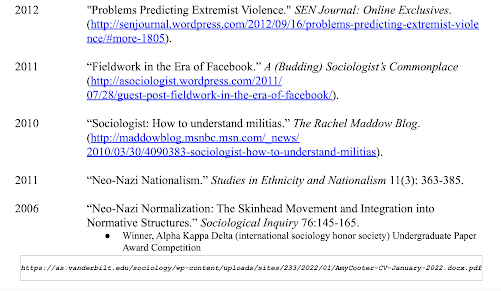
 

From Dr. Amy Cooter's curriculum vitae.

Both were personal narratives. Freeth has devoted decades to studying, writing, and lecturing about the ancient computer. His article in this issue included many references, citations, and pointers to the works of others. Freeth has puzzled over the Antikythera and invested careful, questioning thought to the many problems it presents.


Cooter cites two people who agree with her, or with whom she agrees. Unlike Freeth, she did not come to this research with an open mind. She is not necessarily wrong in her basic facts, only in how she weaves them into a scripted oratorio.


It is an easy claim that the militias, being traditionalist are also masculine. The affinity of men for weapons is obvious by inspection. Benign sexism is a consequence of that. As a guy who has served in uniform, I assure you that protecting women and children is not open to question. At that same time, I served with, alongside, and under the command of women. I never had a problem, though I did report up the chain to inform the leadership about other men who did need some corrective counseling on the subject.[1] It is a known situation.


Dr. Amy Cooter does admit that the right wing militias do have women in command. In her January 2022 Scientific American essay, she wrote: “There are a few women who fully participate in militias, and because of their activity they tend to be well respected and rise to leadership roles. (Jessica Watkins, leader of an Ohio militia who was arrested for her participation in the Capitol riot, is one example.) Still, most militia units have a culture suffused with casual misogyny.” Personally, with my master’s in social science, if I were considering a doctorate, I would find the subject of women in command of traditionalist militias more compelling research than the observable truth that boys like to camp out and play with guns.


Like Cooter, I grew up Republican. My introduction to libertarian versus traditional conservative ideology came at the 1965 convention of Young Americans for Freedom. There, I met conservatives who were opposed to the draft and to the war in Vietnam. I also had to come to grips with the fact that many of my comrades on the right were racists who believed that Negroes are substantially different from and inferior to us white folk. I found that attitude repugnant and distanced myself from the people who asserted it. 


So, when in college, I turned hard to the left, I also found it easy to parse the many, many varieties of socialist theory, including the distinctions among British Labour and Social Democrats, Lenin, Trotsky, Bolsheviks, Mensheviks, and the American Marxist, Daniel de Leon and his Socialist Labor Party. Much later in life, I came to understand how left wing syndicalists became the anarchists of the Spanish civil war and right wing syndicalism became fascism. 


Understanding those nuances led me to ask why the same people who decry the insurrection of 6 January 2021 were silent during Occupy Wall Street. I admit that it is a rhetorical question. 


The final failure came in a special supplement for March 2022. Under the rubric “How COVID Changed the World” by senior editor Jen Schwartz, the lead article was “A Microbe Proved That Individualism Is a Myth: Humans evolved to be interdependent, not self-sufficient” by Robin G. Nelson (biological anthropologist at Arizona State University). Nelson builds her hypothesis from an inventory of complaints: 


“For countless Americans, there was a dull but persistent pain to prepandemic life: high-priced housing, nearly inaccessible health care, underresourced schools, wage stagnation and systemic inequality. It was a familiar ache, a kind of chronic hurt that people learned to live with simply because they had no other choice. Faced with threadbare safety nets and a cultural ethos championing nationalist myths of self-sufficiency, many people did what human have always done in times of need: they sought emotional comfort and material aid from their family and friends. But when COVID-19 hit, relying on our immediate networks was not sufficient. Americans were gaslit into thinking that that are immeasurably strong, impervious to the challenges people in other countries face. In reality, our social and economic support systems are weak, and many people are made vulnerable by nearly any change in the capacity to earn a living. The fallout from the pandemic is an urgent call to strengthen our aid systems.”


The thesis fails from unnamed collectives: “countless Americans … people… many people… Americans… people in other countries… many people...” It offers not a single measure, no statistical survey, no validated polling. 


I point out that nationalism is not individualist. I might accept that the myth of personal self-sufficiency may be found nationwide. I must insist that nationalism denies personal self-sufficiency and insists on the integration (or total absorption) of the individual into the nation (as defined by its self-identified leaders). 


And individualism is not a myth; it is fact of life. 


"In his apologia for chemistry, The Same and Not the Same, (Columbia University Press, 1995) Nobel laureate Roald Hoffmann asserts that no two hemoglobin molecules are identical. So-called “identical twins” are not. Individualism is objectively real: both empirically knowable and rationally explainable." On my blog here.


People who receive intense family care and people who benefit from the highest levels of professional medical care in a hospital still die. They give up. The time comes when you decide. You make the choice that no one else has the right to make for you. And every moment of every living day, you decide to make the best of your life, regardless of your circumstances.[2] 


Moreover, during the pandemic, hobbyist markets have flourished. In amateur astronomy, we found sales exploding. Millions of other people returned to reading, walking, and other pastimes. These are personal pursuits, edifying and enjoyable. Millions of parents learned to get along with their own children and to appreciate the teachers on whom they previously had inflicted their brats. There was no shortage of the very family life which the collectivists had long complained that work outside the home was destroying. 


I confess that I had to read the introduction to Nelson's phillipic several times over several days before I understood “gaslit.” Then just to be sure, I googled it. It is a neologism, a trope from a 1944 movie that only became vernacular in popular writing from about 2016. (See https://en.wikipedia.org/wiki/Gaslighting.) That being the assertion, who then is the villain? Who is robbing the unnamed collectives and what is being taken from them? 


Ultimately, you can only steal from individuals. That speaks to a deeper fallacy: the stolen concept. You cannot have theft without property: even a landlord is debarred from transgressing the renter’s “quiet enjoyment.” Quiet enjoyment is an economic value that can be stolen. So, what is missing here? And while it is theoretically possible that lacking any other motivation except your pain your landlord could set up loudspeakers and blast Wagner into your home, it would be bizarre. Most landlords only do things that make them money or prevent losses. So, who is getting the money from gaslighting Americans into believing that we can make decisions that result in our happiness? Are the perpetrators Runner's World, Sky & Telescope, and Papercraft Essentials


Speaking to the deeper point, if engaging in new hobbies makes us happier and perhaps morally better, is it gaslighting? I think that we are being gaslit into believing that we are unhappy in order to rob us of money to pay college professors at public universities who tell us that we really are unhappy despite all evidence to the contrary. (For some point-counterpoint on the subject, put "happiness conservatives liberals" into your search engine.) 


Social facts being complicated, it is also true that many people did and do suffer from the strain on the healthcare system: the providers themselves. Their plight does not appear in Robin G. Nelson’s article. (See "The Forgotten Man of Socialized Medicine" by Ayn Rand.)


In a second illogical attack on personal freedom, Dr. Robin Gair Nelson strikes at the root of American exceptionalism by conflating our chosen virtues with our inherited sins. “
Since this country’s inception, the dominant ideologies here have encouraged not only individualism but also the dehumanization of certain groups, as evidenced by the enslavement of Black people and the displacement of Indigenous communities from their ancestral lands. This dehumanization continues today in the form of the bootstrap narrative—the myth that anyone can prosper if only they work hard enough—and in efforts to weaken relief programs for people who need help.”


She does not parse those dominant ideologies. One of them was collectivist. Way back then, correctly stated individualism would have ended slavery and recognized the property rights of the people who were here first. Collectivist thinking based on incorrect epistemology caused those evils and many others. In point of fact Article I Section Nine of the Constitution contemplated the end of slavery after 1808 and allowed the imposition of a tax on the importation of slaves until then. As the Supreme Court ruled in a different case: The power to tax is the power to destroy. Apparently, since this nation’s inception we were intent on destroying slavery, and that is why we eventually fought a civil war over it. 


As for the Native Americans, as long as the trespassers were only individuals who chose the harsh frontier over the comforts of village and city life, the Natives usually won any battles. They struck hard and terribly. The theft of their lands was possible only because of the collectivized action of a central government that had no intention of keeping its promises. That is quite different from the bourgeois ethics of individualism.


One way or another, we all have bootstraps. It is true that some inherit their very nice boots including four generations of wealthy African-Americans. (See Our Kind of People by Lawrence Otis Graham. In an episode of The West Wing, the staff writers are in a quandary over Republican resistance to escalating the estate tax because it also would penalize the first  generation of African-American millionaires.) Envying them and being jealous of their status will not provide you with the intellectual tools required to make your own or to pull yourself up by whatever you do have. Some of the answers are hidden in books like Think and Grow RichHow to Win Friends and Influence PeopleRich Dad Poor Dad and Benjamin Franklin’s collected aphorisms published as “The Way to Wealth.” You can read about Madam C. J. Walker, Maggie Lena Walker, Steve Jobs, or Steve Forbes. 


From reading the theories of the arch-capitalist economists of the Austrian School, I am willing to believe (provisionally) that financial success is ineffable: it must be learned and cannot be taught. Working hard is absolutely required and yet alone is not enough. Knowing the principles of accounting may be necessary but insufficient. Finding a thriving market or a floundering one that will reward nurturing may both be exploitable alternatives or failure modes. 


Nelson closes her complaint with a demand: “Committing ourselves to upholding our evolutionary mandate to help one another—not just the people we see every day but everyone everywhere—is the only thing that will save us.” 


If helping one another is our evolutionary mandate, then it must be beyond our choice. If it is not, then by what standard is it required by evolution? Evolution required that people who have diabetes live long enough to have children and we have people with family names like Drinkwater and Passwater. Yet we are investing billions of dollars to overthrow that evolutionary mandate. 

  • https://professional.diabetes.org/research-grants
  • https://pubmed.ncbi.nlm.nih.gov/26798117/

 And that is just Type 1. It may well be the case that the other types are remediable and preventable with common sense diet and exercise. Or would Professor Nelson prefer that we follow our evolutionary mandate to let the infirm die off lest they degrade the gene pool? In The Ascent of Man, Jacob Bronowski tells of the Bakhtiari tribe who even in modern times  leave behind any individual who cannot by their own power cross a swollen stream. The right answer to that question begins with the assumption of individualism: each individual is important to the survival of the tribe, including (and especially) the one who does not want to belong to any tribe.


Tribalism also underlays Amy Cooter’s essay. The militias are clearly tribal and define themselves in those terms of “we versus they.” Yet within that is a strong strain of individualism, self-dependence and self-sufficiency. Dowsing the militias with the individualism they recognize would defuse their desire for collective action. Instead of storming the Capitol, they would “go Galt” and just leave the society that has rejected their values. I suspect that Amy Cooter, Robin Nelson, and the editors at Scientific American would not be happy with that and would prefer that everyone just go along with their plans. 


Notes

[1] Reflexes speak. There was one time working security, we made regular bank deposits, pretty much the same time, same place, unarmed and unarmored. I was in the bank with my partner, being vigilant and the left side of my brain said, “If guys with guns came in right now, I would knock her to the ground and cover her with my body.” And the right side of my brain said, “Marotta, she would knock you down and cover you because is the better officer.”

[2] It is fully consistent and epistemologically integrative that Dr. Robin Gair Nelson extols the tribal values of the Navajo Nation for their immunization campaign. Apparently, those individuals were unable to make the right choices. Unlike the WEIRD people (Western, Educated, Industrialized, Rational, Democratic), the Navajo Nation has no tradition of individualism.


PREVIOUSLY ON NECESSARY FACTS


The Scientific Method 

The Science of Liberty 

Michael Schermer’s Moral Arc 

The Influence of Ayn Rand’s Objectivism 

Modes of Survival

Shifting the Paradigm of Private Security 


Wednesday, January 13, 2021

Music Makes You Braver

That is a tag line for the music of Two Steps from Hell founded by Thomas Bergersen and Nick Phoenix. When I was working as a clerk-typist (information specialist) for the Texas Military Department editing, distributing, and sometimes writing plans, procedures, and policies, I searched out music on YouTube to put in my headphones in order to keep out noise while I tried to concentrate. I found their album Battlecry. I signed up for the channel and bought access and then a download for that, Skyworld, Invincible, and Unleashed.

Katica Illényi delivered a full-bodied performance of Vittorio Monti’s “Csárdás.” (I find it acceptable that the best Hungarian dance would be written by an Italian.) It is just the first half of this YouTube video:  https://www.youtube.com/watch?v=BF9uQI-SRv4
She also has a violin performance of Liszt’s Hungarian Rhapsody No. 2 a work usually scored for the piano. (At least, that was Liszt’s intent.)  https://www.youtube.com/watch?v=yMU4SO7rp5w


Speaking of things Hungarian (such as my maternal grandparents), serving in uniform, I identified with this guy, whatever his mission was that day. 

“Ide Születtem” by Hungarica

https://www.youtube.com/watch?v=IC53QRC-jjw


My brother’s band, Styrenes, recorded “Minstrel Boy” as a mock, but I liked the energy (and Paul’s brogue). 

https://www.youtube.com/watch?v=0IgRq4AZXcg

I think that the Hans Zimmer version is the best modern instantiation. Written for Blackhawk Down, it goes well with a similar yarn, Battlestar Galactica. We were fans of the first three seasons, though Ron Moore’s post-modernist sense of life took the plot and theme  into entropy. Minstrel Boy/Battlestar Galactica

https://www.youtube.com/watch?v=KdVN1P16L8o


The performance of “Men of Harlech” from Zulu is iconic. “Very good, mind ye, but they have no top tenors.” Of all the versions I listened to, Charlotte Church’s performance takes the prize.  https://www.youtube.com/watch?v=hZmrS_w6s7s


One May Day, I went looking for The Internationale and following links, I ended up at “Minka.” It was a song that we learned (in English) in grade school. Our neighborhood was very ethnic. When the teacher passed out the sheet music, one girl said, “Our dog’s name is Minka!” and another girl rejoined, somewhat saddened, “My mom’s name is Minka.” 


Minka with Ukrainian lyrics and English liner notes.

https://www.youtube.com/watch?v=bYrGI0FncYc

A more modern theatrical rendition here:

https://www.youtube.com/watch?v=u3EwoLkwq_o


Arturo Toscanini conducts The Internationale

https://www.youtube.com/watch?v=2OPvWFDzDlA

Billy Bragg version

https://www.youtube.com/watch?v=yAw0Ri4FSdM

Oddly enough, in We the Living, Ayn Rand describes the song in positive words. What she hated about communism was communism. For her the October Revolution was a betrayal. She was all for modernism, globalism, and an end to nationalism and racism.


Also misunderstood, I believe, is our own national anthem, The Star Spangled Banner. We sing it as a dirge. It drags the hearse down the street and the carriage is a travois. It should sound like this: 

1814 Version

https://www.youtube.com/watch?v=lvVtFD9Na0I

It was set to a drinking song for a reason. We celebrate a victory. Drink to it!

“The Anacreontic Song” Soloist: Jacob Wright Conducted by Jerry Blackstone from the University of Michigan’s American Music Institute.  “The myrtle of Venus with Bacchus’s vine!” here: https://www.youtube.com/watch?v=3l-n64NWHS4


When I was very young my heroes were cowboys, of course, and they were men on their own, not members of large groups. I liked Gene Autry. (“Whoopee-tie-aye-ay! I go my own way ... Where you sleep out every night and the only law is right.”) “Back in the Saddle Again.”

https://www.youtube.com/watch?v=Bt18gd6OSHk


“The Ballad of Paladin” here: 

http://www.youtube.com/watch?v=tgvxu8QY01s


Being on your own is fine until it is not. Of the very many versions of “The Yellow Rose of Texas” I sent this one to Laurel. 

https://www.youtube.com/watch?v=izz0_qEl_-E


Previously on Necessary Facts 

Postmodernism 

After Action Report: Heartbreak Ridge 

Financing a Revolution 

Rebels: A Well-Regulated Militia 


Monday, June 29, 2020

This Knife Might Not Work Once

This Northwest Trail knife is built wrong. Clipped into your pocket, when you take it out, you have to flip it around before you can open it. You get what you pay for.

My neighborhood Walmart is my pharmacy and I enjoy walking the store while waiting for my presscription. The abundance of stuff speaks to our deep, broad, and wide prosperty, a direct consequence of the market economy. Free markets = free minds. Usually, as much as I like looking, I seldom buy. However, over the years, working in physical security and serving in the Texas Military Department, I have bought extra gear. I learned that lesson from a classmate in criminology. She looked into the trunk of my car and said, "You only have stuff for yourself. I always carry extra." 

And you can always use an extra knife. I never leave home without at least one knife and at least one way to make a fire. That was a lesson from a team-building exercise when I worked for Coin World. We had a series of monthly Monday morning meetings to get to know each other in order to improve our quality of worklife. There were about 40 of us from Coin World, Linn's, Scott's, the press operators, and pre-press at about six or eight tables. The last exercise was a survival scenario.

You are coming home from a vacation in South America with the team mates at your table. Your plane hits a storm and you go down. You crash land. The pilot is killed. The plane is unflyable. The radio does not work. You are all mostly all right. You have to come out together. This is an inventory of what you all packed on your vacation. Golf clubs... a bottle of rum... a .38-cal handgun with six bullets... a Christmas candle... and a bunch of other stuff I don't remember. Not everyone got out. One team gave up right away and decided to settle in place for the rest of their lives. The one press operator on our team said that she was going out on her own. I said that in real life I would join her and leave them behind, but we all have to come out togther, that's the rules. I told my team mates to leave the gun and the rum or not everyone is going to make it. They ignored that. One guy said to bring the gun so that we could fire it into the air to attract natives who would help us. I thought that was a bad idea on several levels. He asked why I wanted the Christmas candle. I replied, "To help make a fire." He said that we are in a jungle and can build a fire anytime. He said to bring the golf clubs. "Whatever for?" I asked. "To make a stretcher and carry someone who is wounded or to kill small game." The others saw the wisdom in both of those plans. You see, this guy was obviously the de facto leader, well known and well liked. It went on for about 45 minutes. Then they gave us the answer from the back of the book.

According to the Army Rangers, you stay with the plane for 72 hours. Someone knows you are missing. They will come looking for you. The plane is unflyable. If you hear help coming you can set it on fire as a signal. In any case, after 72 hours, set it on fire anyway and head out. Find a stream and follow it downhill. Somewhere near the water's edge, probably at the mouth of the river, you will find a village. Whatever you took, you always need a knife and a way to make fire.

Since that day in AD 2000, I never leave home without at least one knife and at least one way to make a fire. 

How many knives do you need? How many can you carry? As the public affairs officer for the Maritime Regiment of the Texas State Guard, I went out with our dive team several times. One time on shore, one of the divers was fussing with some line and needed to cut his knife free. He reached around left and right and went for the leg he was sitting on and then tried to lean over his tanks to grab his pack. I handed him one of mine. His unit leader saw that. "Don't you always have three knives?" he barked. "Well, yeah, but this one is tied up and ... " His leader shook his head and walked away. 

I do not know what I will do with the Northwest Trails knife. I won't toss it out, but I cannot have it for an everyday carry. My Victorinox is my EDC. When I retired from the TXSG, I stopped carrying the Benchmade that I always clipped to the right pocket of my ACUs. The Benchmade works the way a knife is supposed to. I still need a replacement for civilian life. (See, also Gibbs's Rule #9 from NCIS.) You can always use an extra knife; and in the worst case, it only has to work once.

When I was learning to fly, I was coming in a bit low, and the instructor pushed the yoke forward for a little more airspeed and lift. When we were done, he asked, "What you have done if you had come down in the bean field at the end of the runway?" I replied, "Stay with the plane 72 hours, then set it on fire and walk in to the terminal." 

PREVIOUSLY ON NECESSARY FACTS

Friday, November 29, 2019

Donating to the USO

The USO is the only military service charity that I donate to. Soon after I joined the Texas State Guard, I began getting solicitations from military and veteran charities. I ignored them all, as they are typically shot through with fraud, corruption, and self-serving executives and marketing staffs. When I was assigned to work as an operations analyst in the Texas Military Department, I asked my National Guard buddies about charities. They all endorsed the USO. 

The United Service Organizations, Inc. (USO) dates from 1941. It was founded as a civilian effort in preparation for America's entry into the world war of that time. Its history is famous. 

In our time, among its many services to those who serve, the USO maintains safe spaces in civilian airports where military personnel in transit can billet while they wait for connections. Sometimes, that can take days. Orders change. Orders lag. You wait. You text; you email; and you wait. And the USO is there for you and your buddies  in a lot of places around the world. 

I just sent $50 to Wikipedia for the first time in seven years. And as a professional writer, I depend on Wikipedia. I am much more generous far more frequently in answer to the solicitations from the USO. I do not respond to all of their requests. Some needs seem less immediate than others. Ask your own serving Soldiers, Sailors, Airmen, and Marines what they think.

PREVIOUSLY ON NECESSARY FACTS

Do You Know Your Military?
A Critic Meets the Military
President Trump and the Military
Thoughts on "Soldier's Heart"

Sunday, November 4, 2018

VETERANS DAY 2018

“Why My Brick” by Michael E. Marotta on behalf of SFC Edward M. Marotta 

I was drafted. They called it the peacetime Army, but the Korean armistice had just been signed and the Russians occupied Eastern Europe. They say that conscripts do not make good soldiers but I served nine years active duty and 15 years in the reserves. I was an average soldier. My medals were for good conduct and component readiness. My only war story is how a non-judicial punishment led to a promotion and assignment to be a colonel’s driver. In my off-duty time on base, I trained Soldiers in hand-to-hand combat and sent two to the Olympics to compete in boxing. My longest billet was to be a trainer in race relations and equal opportunity. For me, a trade school graduate, with no special purpose or direction, the Army was my equal opportunity to earn maturity, learn teamwork, and help to build the next generation of Soldiers. -- For the "Buy a Brick" campaign of the National Museum of the Army (here) of the Army Historical Foundation (here).

(The photograph is the only artifact of Dad in uniform in the possession of his second family. His DD-214 cites the second rocker for Sergeant First Class, not shown here. After his first re-enlistment expired in 1958, Dad's 15 years in the Ohio National Guard came only after the second set of boys was grown up and mostly gone. We all support our men in uniform; we do not all encourage them to join. "Why did you go, Michael? It was not your fight," said Don Corleone.)

PREVIOUSLY ON NECESSARY FACTS
Syriaphobia 
Soldiers of Peace 
Wooden Ships 
Leaders are Readers 

Saturday, September 15, 2018

The Market is Always Right – About the Market

“Employee Salaries versus Contributions to Society” was a recent poll of 1013 people conducted by CreditLoan dot Com. The survey was not rigorous, but it was not all that bad. At least they had a large number of respondents in their convenience sample. The flaws in the poll reflect common errors in philosophy within our broader culture. 

“Hardly a week goes by where we don't hear about a CEO, professional athlete, or celebrity who's scored a multimillion-dollar salary or bonus. Maybe their talent or skill set is worthy of a hefty paycheck, but considering the small amounts paid to teachers, soldiers, and first responders, it makes us wonder if we are underpaying those who perform outside the spotlight.”  

The survey is long and involved. It ranked eleven occupations:  teachers, scientists, social workers, police officers, military, legislators/elected officials, journalists/reporters, transportation security screeners, artists, clergy, and chief executives. It considered Republicans versus Democrats, Baby Boomers vs. Gen X vs. Millennials. So, it is worth looking at for its detail, again, given some warning about its not being perfectly aligned to the standards of sociology research. They do close with an open explanation of their methodology. For one thing, they grouped occupations so that actors, designers, singers, photographers, writers, and dancers are among the “artists” as are sports figures. Nine kinds of “scientist” are listed, as are four types of “military.” Note that security screeners are considered apart from police and military.


The More You Do for Other People the More You Earn


Generally, as the aggregate data shows, the more you do for other people (in their own aggregate estimate), the more you make. That’s how markets work. So, it is erroneous to say that “most people think that teachers are underpaid.”

More to the point, teachers knew the markets before they went to college. They chose teaching anyway.  The same is true of the military. They are not in it for the money—though the money is there if you stop to think about it. 

Occupation
Actual
“Should”
Military
$40,217
$92,033
Farmers/Ranchers
21,076
70,101
Scientists
70,510
109,956
EMT Paramedic
39,675
71,765
Teachers
38,181
70,248

That is one of the problems with this survey. Military people get great healthcare for some ailments such as bullets and burns. Psychological problems have been less well attended. But they get food, clothing, and shelter. On the downside, female Navy officers pay much more than their male colleagues for uniforms. Home mortgages are cheaper; and they can get Basic Allowance for Housing, and Bachelor Officer Quarters subsidy. And housing is determined by cost of living at your home of record. I met a “special forces” kind of guy who was always on the road and whose HOR was Anchorage, Alaska. (Good thinking, Sarge!) After twenty years of military service you can retire and start another career. If you move to another federal agency, you take a lot with you. Even if you go into the private sector, you can cash in on college degrees and other untallied benefits – assuming you live through your employment, a very real untallied cost for many protective services. 
  
And if we could magically triple the pay of teachers or soldiers, what would be the consequences of that? Conversely, if we capped the pay of executives at 60% of this moment’s “average,” would corporations change for the better?

And it is those “averages” that beg so many questions. Granted that “artists” do not make much money on average, Tom Cruise earned $12.5 million for his role in A Few Good Men, which cost $33 million to make. As Deke Slayton said, “Averages only apply to average pilots.” 

Previously on Necessary Facts

Sunday, July 15, 2018

After Action Report: Heartbreak Ridge

Heartbreak Ridge is a good action story with few leadership lessons. Dissenting for the sake of the task is one of the ethical standards that makes businesses (and scientists) successful. The guardian ethos rewards conformance to hierarchy and tradition. So, a story about an unorthodox soldier provides a context for thinking about values. In the case of Heartbreak Ridge, the hero’s values are ultra-orthodox. The complexity is delivered in the contrast between his military work and his successful attempt to re-unite with his ex-wife. When not firing an AK-47 at his men to teach them what it sounds like, GySgt Tom Highway is reading women’s magazines in order to eventually ask, “Do you think our relationship failed because of a lack of commitment?” 

As an actor, Clint Eastwood makes a good Marine. He has said that personally he is a libertarian conservative. He stays in great physical condition. He directed and produced the movie. The writer was James Carabatsos who created Hamburger Hill and Heroes. The story was gung-ho and left me feeling happy, but not any smarter. 

GySgt Highway is assigned to a reconnaissance platoon that has been allowed to lapse. This was 1986. The American military was not yet over Vietnam. “We are 0-1-1: no wins, one tie, and one loss.” The previous platoon sergeant was “retired on active duty.” The men are unmotivated. But that assessment and this assignment come from Maj. Malcolm A. Powers, who has been set up as the antithesis of our hero. Maj. Powers is an Annapolis graduate. He transferred to a combat regiment coming from supply and logistics. Although he expects GySgt Highway to get the platoon into shape, he calls the Gunny an anachronism with no role to play in the modern Marine Corps. In contrast to the martinet, we have 2LT Ring. Ring led his ROTC unit. He wears glasses. He excuses himself from an exercise to make a doctor’s appointment. Nonetheless, he supports GySgt Highway’s actions, speaking up to the Major to take responsibility for the Gunny. He tries hard. His heart is in the right place. He leads the men into combat. 

Under direct fire, the Lieutenant makes a bad choice and his radioman is killed. He is crestfallen. “You won’t make the same mistake again,” the Gunny says. We can believe that; and it might be interesting to write a story about Major Ring in Iraq during the Surge. 

Overall, Heartbreak Ridge charges through a barrage of intellectual bullets. The warrior ethos embraces fatalism. When 2LT Ring is floundering over the death of Private Profile the Gunny tells the Elltee that the man’s time was come and no matter how fast you run when it’s your time there’s nothing you can do about it. But that is not entirely true, or no reason would exist for GySgt Highway’s gung-ho training regimen and relentless pursuit of combat readiness. 

And that speaks to the problem of Maj. Powers. The story line denigrates him for coming from supply. He wants every form filled out, every bullet tallied. He is not the hard-charging Bionic Marine that GySgt Highway is. We get that. It is the story. But the fact remains that while good commanders know tactics and great commanders know strategy, winning commanders know logistics: an army moves on its stomach. But we do not get a lot of hero stories about the 4-shop.

Powers and Ring are college graduates whereas Highway “graduated” from Heartbreak Ridge when he and two others were the only survivors of three days of human wave assaults. (Highway was granted a Medal of Honor. That speaks to other problems with the story line, but let that go for now.) Although GySgt Highway is condemned as an anachronism, we see him learning to understand his ex-wife by reading women’s magazines. It is an emotional problem, not an intellectual one. The Gunny does outfox his wargame opponents by setting a better trap but it is range of the moment, concrete, not something you learn from a book. In point of fact, of course, it is exactly one of the many lessons in the books assigned to those who want to become leaders in combat. It is just that we did not sit with young Cpl Highway at the NCO school.

(For more on the differences between the commercial ethos and the guardian ethos see Systems of Survival: A Dialogue on the Moral Foundations of Commerce and Politics by Jane Jacobs, New York: Random House, 1992, which is cited in several other posts in this blog.)

PREVIOUSLY ON NECESSARY FACTS


Saturday, May 26, 2018

Captain America

Directed by Joe Johnston
I watched Captain America: The First Avenger expecting no more (and hopefully no less) than the other superhero movies. But I liked the character because we share the same virtues. I bought the movie on DVD. I also shopped the comic book stores and subscribed to a current series. I now have a shelf of Captain America stories; and I went through half a dozen graphic novels from the library. But I did not find the origin story that I was looking for. The origins are all the same, yet all different. From being a non-descript and anonymous teenager, he became an artist. He was reborn many times, at least once as the Red Skull. He grew old and was rejuvenated. He was replaced by Sam Wilson, Bucky Barnes, and then by his own son (by the Black Widow), James Rogers. None was the story told in the screenplay by Christopher Marcus and Stephen McFeely. 

Myths are not merely repetitions of traditional stories. The retelling changes as we change. The definition of fiction (from Aristotle) is that drama shows what could be. Moreover, the telling must be integrated, whereas historical events just happen, seemingly without reason (and therefore without rhyme). I believe that now, 2500 years later, we do demand and get integrated narratives from historians. That being as it may, the fact remains that enduring popular fiction changes to meet the needs of the audiences. According to Joseph Campbell that has always been true. In the retelling of myths, characters can be split off or merged. Some retellings transmogrify characters into their opposites. But always, the poet speaks to the audience of the moment.
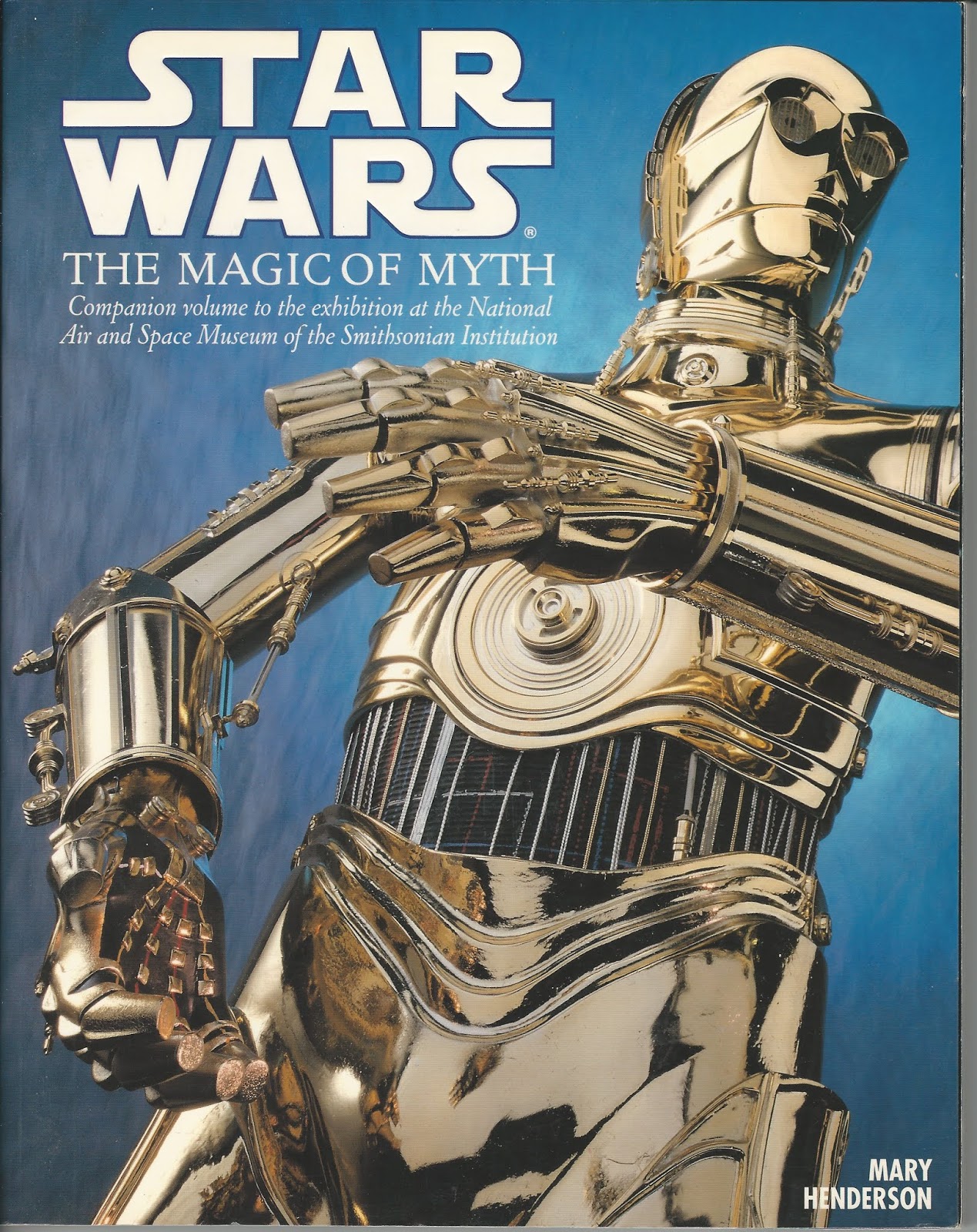
Star Wars: The Magic of Myth
by Mary Henderson
Bantam Books, 1997
Jospeh Campbell, Carl Jung, and more.
In The Virtues of Captain America: Modern Day Lessons from a World War II Superhero, Mark D. White argues for a continuity of character in The Captain despite the many authors who penned the narratives. Of course, he represents the best aspects of the nation he personifies. He does not just beat up bad guys – though he did a lot of that, and not much more, in the Silver Age of the 1960s. Nonetheless, he went to Vietnam twice, the second time to rescue a kind of Medecins sans Frontiers doctor. The Captain is honest, courageous, persevering, and loyal. Above all, he is honorable.

On the other hand, for many people, America is not inherently good; and, therefore, as its embodiment, The Captain is also flawed and perhaps evil. 

Captain America Complex: The Dilemma of Zealous Nationalism by Robert Jewett went through two editions (1973, 1984). It was reborn in 2003, co-authored with John Sheldon Lawrence, as Captain America and the Crusade Against Evil: The Dilemma of Zealous Nationalism. It garnered an accolade as a ForeWord Magazine Book of the Year Finalist. 

The Evolution of a National Icon: Captain America, Masculinity, and Violence by J. Richard Stevens also encircles The Captain with the negative energies of our culture. 

Despite their leftwing titles, both books are approximately objective, though selective, in teasing out the threads of a long-running story. What that story means depends on who you are.  
"We're not conquerors." 
The men in Washington are not impressed with the shield. 
They want The Captain to sponsor The Ameri-Gun.
Two scenes in the movie resonated with me. When Colonel Philips tossed out the dummy grenade, Steve Rogers threw himself on it. “Well, that’s what I’d do,” I said. “You would??” Laurel asked. It is not the sentiment of a Randian egoist. “Hand grenade comes into the foxhole, everyone’s dead anyway. You might as well do what you can to save the others.” It is not a rational decision but a heartfelt response. The other scene was the flag pole climb. I would not see the outside-of-the-box answer right away. I would have to sleep on it – which is why I am not a field commander or even a department manager-but it would be clear to me eventually that there is a better solution. 
The Captain was always man of his time 
Today, everything is complicated.
"An Allied superspy from World War II working with
a rogue Hydra cell. Now I really want to know what
went wrong on that mission."
(Man out of Time by Ed Brubaker, the longest-running writer.)


For one thing, though not 4-F, I was 1-Y in the draft. Like Sheldon Cooper and Leonard Hofstadter, I was never anyone’s choice to be in their squad in gym class. All I asked of my body was to carry my brain around. When I joined the Texas State Guard, my friends and family were surprised, if not shocked. I was never in favor of any of America’s military adventures. But the TXSG is not issued weapons; and we cannot be sent overseas. We are Texans serving Texas. The physical requirements are minimal but when I enlisted, November 22, 2014, having just turned 65, I found that I could do zero push-ups and zero sit-ups. Fortunately, I was always a walker. So, clearing the mile under time was the first win. Now, what I cannot do is 20 push-ups. This morning, I did 31 sit-ups. No serum. No vita-rays. Just the will to succeed and to do better the next time. That, too, is easy to find in the mythology of Captain America.

PREVIOUSLY ON NECESSARY FACT