Showing posts with label Objectivism. Show all posts

Sunday, January 12, 2025

If a Philosopher Falls in the Forest …

I thought that I might pursue a doctorate here at the University of Texas because the school will pay for up to 5 credit hours per semester for an employee. The plan died aborning. I sent a letter to the philosophy department and they never answered. While I was waiting, I checked out some books from the library to read over Christmas. Among them were two from the department chair, David Sosa, and an anthology on epistemology by a group of Objectivists. I cannot see myself engaged in such meaningless discussions based on unstated, arbitrary assertions. I actually think well of philosophy and invest time in it and if this is the best that they can do, then I confess to hubris here: It is not that I know more than they do but that I think more clearly.

The Mantis Shrimp sees things that you do not.
It is the same universe for all of us.

When I say “red” and you say “red” are we talking about the same thing? People who are color blind adapt to the world around them. It is only by the application of a special visual test—given to aircraft pilots, medical doctors, and others—that we can establish that a person is color blind. These philosophers seem to be disengaged from the experiential world. Their limiting cases are people with eyeglasses. And they gloss over the problem of what it means for tree to appear “fuzzy” as if bark were made of acrylic sheets. 


Microscopes at right reveal details not visible to
the naked eye. It is the same universe.

Is Perception Infallible?

Consider Salmieri’s instructive example of the myopic man looking at a tree without his glasses. While he sees the same tree he would see if he was wearing them, he sees it blurrily, and this blurriness is part of the way or form by which he sees the tree. As Salmieri notes in his section, “Epistemology and the Nature of Awareness,” “An especially naïve realist would take the blurriness to be a feature of the very tree in front of which the man is standing.” Such a naïve realist is, of course, mistaken, for he mistakes a way he perceives an object for a feature of the perceived object. -- Concepts and Their Role in Knowledge: Reflections on Objectivist Epistemology, Allan Gotthelf, Editor; James G. Lennox, Associate Editor; Ayn Rand Society Philosophical Studies, University of Pittsburgh Press; 2013; page 217, “In Defense of the Theory of Appearing: Comments on Ghate and Salmieri,” by Pierre Le Morvan.

 Onkar Ghate is resident expert in Objectivism at the Ayn Rand Institute. He received his doctorate in philosophy in 1998 from the University of Calgary. Gregory Salmieri completed his doctorate at the University of Pittsburgh in 2008. Pierre Yves Le Morvan earned his Ph.D. in philosophy at Syracuse University in 2000.


Orion Nebula (Messier 42) and the Moon and the 
consumer goods that bring them to your iPhone camera.


Spectroscopy kits for amateur astronomers and other
citizen-scientists.

Data available to anyone who wants to explore the 
Universe otherwise unrevealed to the naked eye
(Image at right from "The Revival of Amateur Spectroscopy"
by Maurice V. Gavin. Sky & Telescope, July 2006.

It is not only my Objectivist comrades who are lost in the woods. This passage starts off sounding very technical, promising close analysis. In the end, though, it comes down to a sophomoric failure. It is well known that so-called “natural language” allows nonsense. And this is an example of it.

If philosophers were pursuing new knowledge, they would be formalizing the integration of perception across many transducers from your own senses to the most sophisticated instruments. How and why do all of these outputs describe the same objects? 

“A simple account teaches us that argument validity is a matter of truth-preservation: roughly, an argument is valid just in case the truth of the premises guarantees the truth of the conclusion. A bit more precisely, a set of sentences G of a language L entails a sentence s of L just in case, (for any model M), whenever all elements of G evaluate to the truth (in L, and M) so does s. Then we can say that an argument is valid, just in case (for all models), the premises entail the conclusion(s). On this account, then, entailment is characterized as a relation between sets of sentences and a sentence (a conclusion); and arguments are individualized as sets of premises and conclusion(s).

“But this simple account becomes instantly more complex once we are dealing with inference patterns in natural languages. One immediate problem is ambiguity. For instance, consider the following:

(1)   Ambiguity

a.     If John is at the bank, he will deposit a check

b.     John is at the bank.

c.     He will deposit a check.

“Suppose that ‘the bank’ in the big premise, (1-a) refers to a financial institution and in the small one, (1-b), to the bank of a local river.”

Oxford Studies in the Philosophy of Language (2 vols), edited by Ernie Lepore and David Sosa; Oxford University Press, 2022. Vol 2. 7; “The Anatomy of Arguments in Natural Language Discourse,” by Una Stojnic, page 184.

Ole Miss journalism interns working for ESPN use
parabolic reflectors to capture voices on the field.
If a tree falls in the forest, they will hear it.

The failure of so-called “natural language” to explain the truly supernatural is an old lesson.  To hang an argument on a pun--bank versus bank; and no mention of turning an aircraft-- seems frivolous. 

(ii) Yet sometimes men are led by a natural tendency to think and speak of God as if He were a magnified creature — more especially a magnified man — and this is known as anthropomorphism. Thus God is said to see or hear, as if He had physical organs, or to be angry or sorry, as if subject to human passions: and this perfectly legitimate and more or less unavoidable use of metaphor is often quite unfairly alleged to prove that the strictly Infinite is unthinkable and unknowable, and that it is really a finite anthropomorphic God that men worship. But whatever truth there may be in this charge as applied to Polytheistic religions, or even to the Theistic beliefs of rude and uncultured minds, it is untrue and unjust when directed against philosophical Theism. The same reasons that justify and recommend the use of metaphorical language in other connections justify and recommended it here, but no Theist of average intelligence ever thinks of understanding literally the metaphors he applies, or hears applied by others, to God, any more than he means to speak literally when he calls a brave man a lion, or a cunning one a fox. 

“The Nature and Attributes of God”

New Advent Catholic Encyclopedia https://www.newadvent.org/cathen/06612a.htm

It is a fact that if all of the boulders, rocks, and stones between Mars and Jupiter were gathered into a single body, it would be the size of our Moon, hardly a planet, and yet we still call them “asteroids” as if they were star-like. The first quasar was identified as a pulsar. And Pluto is no longer a planet. And that is just one science. 


I have several books from the library on genetics. As much as we know, we still describe basic knowledge with footnotes and exceptions. Just for one fun fact: sometimes for a gene to be replicated the transcription RNA must “read” the molecule backwards. And yet here we all are, even if we do not know everything about how and why. 


Science proceeds by accepting ambiguity. Philosophers want to argue it away—in English. If you want to fall down the rabbit hole of analytic philosophy, read what many philosophers think that Immanuel Kant meant by “Das Ding an sich.” The problem is the word “an.” It sounds like “on” but it means “next to” or “nearby. “ Hans ist an den Wandtafel. (John is at the blackboard.) And it could be “in” “of” “with” and so on, depending on the context and the acceptance of idiomatic expressions. 


PREVIOUSLY ON NECESSARY FACTS

Galileo and Saturn: Epistemology not Optics 

An Objective Philosophy of Science 

The Scientific Method 

Harriman’s Logical Leap Almost Makes It 

The Big Whimper of Modern Philosophy 

Understanding Objectivism 


Sunday, March 24, 2024

HOW TO KEEP TEENAGERS FROM READING AYN RAND

The Ayn Rand Institute created a guide book for high school teachers who want to bring Anthem into their classroom as an assigned reading. I can think of no better way to make sure that no one who deserves to read it actually will. 

Appendix: Teaching Anthem: A Guide for High School and University Teachers

Lindsay Joseph -- February 16, 2024 -- 24 min read

How can we help students understand Anthem with greater depth and clarity?

https://newideal.aynrand.org/appendix-teaching-anthem-a-guide-for-high-school-and-university-teachers/

“This essay is intended as a guide for teachers as they help their students understand Anthem with greater depth and clarity.

“Once students have achieved an integrated understanding of Anthem, they should be encouraged to relate their newfound knowledge to the world around them. Their knowledge is not useful if it is compartmentalized. The third part of this guide is designed to help students apply Anthem’s meaning to other areas of study, the real world, and their own lives.”

First of all, if the essay is a guide, then that is what it is. To say that it is intended as a guide denies the premise: perhaps it will not be accepted as a guide or be understood as a guide. If so, then the writer of the guide failed. More to the point, no one who reads Anthem needs to have it explained. If they do, then the writer of the story failed—and she did not. 


Back in the ‘60s, sometime after I read Anthem, I saw a social commentary comedian on Ed Sullivan. He said that people are upset at campus protests. He said that some people think that kids should spend more time in church. He said that perhaps the way to get kids into church is to put tanks in front of them and order the kids to stay away. That sort of sums up the message in Anthem. I did not need it explained to me. No one did. In fact, just as a classmate of mine had passed the book to me, I handed it off to a girl who took great exception to its message and marked it up with counter claims. Turns out, she was a Christian who understood the message quite well and disagreed with it quite clearly. She also did need not a study guide.


You want to keep kids from reading Ayn Rand? 

Order them to do it.


PREVIOUSLY ON NECESSARY FACTS

Anthem as a Graphic Novel 

The Girl Who Owned a City 

“Star Trek: Discovery” and the Conflict of Values 

Firefly: Fact and Value Aboard “Serenity” 


Saturday, June 26, 2021

An Objective Philosophy of Science

In framing her philosophy as capital-O Objectivism, Ayn Rand was following in the tradition of Enlightenment objectivism, which was never explicitly defined in its own time. Enlightenment objectivism broadly asserted an integration of two schools of thought, continental rationalism and British empiricism. We know it commonly as the scientific method: theories explain facts; facts test theories. You cannot have one without the other. 

Furthermore, necessary factual truths do not contradict each other. Whatever is true in biology, sociology, history, or aesthetics supports and is supported by truths in physics, chemistry, economics, or ethics. It is also true that facts are contextual. Breaking a rack of billiard balls is different from charging into a crowd on a street corner.


I find it frustrating and disappointing when experts to whom I turn for knowledge about astronomy blunder when they discuss philosophy. For me, the nadir has been Nobel laureate Steven Weinberg who praises Paul Feyerabend in Dreams of a Final Theory. Unfortunately, Dr. Weinberg is not alone in lacking an objective philosophy of science. It remains true that Steven Weinberg has much to teach about applying philosophy to science. 

The Philosophy of Science according to Steven Weinberg.
He is always interesting and not always wrong.
I also have his textbook on astrophysics.
(If he's wrong there, it's above my level.)


Ultimately—and here I side with Weinberg and not with my Objectivist comrades—even mathematics describes and explains physical facts, whether or not we perceive them. See “Imaginary Numbers are Real: Pegasus is Not” here on this blog. For Objectivists who adhere to the final writings of Ayn Rand, mathematics is the science of measurement. (See Introduction to Objectivist Epistemology.) Unpublished are any notes or journal entries from Ayn Rand on the tutorials that she took in mathematics late in life, even if they exist. Regarding the “hard realism” of mathematics, I offer my own theory, i.e., an integrated conceptual explanation of known facts, which differs from canonical Objectivism. My understanding was informed by Nobel laureate Steven Weinberg’s book, To Explain the World. Weinberg asserts a philosophical assumption that he calls “hard realism” when he demonstrates that the modern scientific method was discovered, not invented. It exists independent of the observer and is the same for anyone anywhere.


These are two aspects of the same reality.
No dichotomy exists.
Leonard Peikoff's doctoral dissertation on the 
Analytic-Synthetic Dichotomy is reproduced in
recent editions of Introduction to Objectivist Epistemology.

Weinberg allies himself with the scientists who are being assaulted in “culture wars” in which postmodernists like Paul Feyerabend claim that there is no such thing as “science” only a “scientistic narrative” that (in their terms) “privileges white males and denies space, voice, and agency to women and persons of color” who have been and are oppressed by “the Enlightenment project” of colonialism, imperialism, and capitalism. 


I suffered through a semester of that in my final graduate class in criminology in which our texts were Philosophy, Crime, and Criminology, edited by Bruce A. Arrigo and Christopher R. Williams (University of Illinois Press, 2006) and Essential Criminology Reader, edited by Stuart Henry and Mark Lanier (Westview Press, 2006). Pseudo-mathematical fashionable nonsense such as “crime is a torus” and “crime is a strange attractor” were offered along with denunciations of open-market economics and the Enlightenment. (For more about “fashionable nonsense” see The Sokal Affair and Reflections on the Sokal Affair on this blog.)


Among the many strengths of Ayn Rand’s essays on philosophy was her insistence on connecting the higher studies of aesthetics, politics, and ethics to fundamental truths in epistemology and metaphysics. The lack of such integration is evident in the opinions of scientists who endorse political solutions to anthropogenic global warming. Even if AGW were real, the integration of reason and reality indicates that market solutions offering valuable products and services would be more effective than legislation restricting human action.


I read it often enough to wear it out.
The one on the right has my marginalia.

The relationship between inspiration and proof is that based on your lifetime of experience, you can have an intuitive feeling that a course of investigation will be fruitful and reveal new facts and therefore perhaps deeper or wider truths. But you cannot convince another scientist by a heartful plea. You must provide evidence and your method must be repeatable. 


As a judge in regional science fairs for the past eleven years, I have seen the consequences of failing to hold to that standard. Quite simply, we reward creativity and originality and discount and even denigrate the mere repetition of a known experiment. It is true that careful work is expected as the baseline of performance. So, you do not get an award just for doing a good job. But we never see any of these bright youngsters challenging or refuting a previously accepted claim. 


I find that especially disappointing because I judge in behavioral and social science. Unlike the physical sciences, working social science researchers do test and challenge each other’s published works. Unlike the physical sciences, in my undergraduate curriculum, I had a 200-level class in research methods that required the critical examination of peer-reviewed journal articles. In graduate school, even though I steered to starboard, as long as I presented a coherent reply based on facts, my essays earned A grades. And in one class, I had a colleague whom I would describe as “to the right of the Kaiser” and he got A grades, also. On the other hand, serving on a committee of the American Astronomical Society, criticism of AGW is pointedly unfashionable. The subject came up because astronaut, geologist, and “climate denier” Harrison “Jack” Schmitt is scheduled to be a guest speaker at the Astronomical League conference in 2022.


In Dancing Naked in the Mind Field, Nobel laureate Kary Mullis described how the inspiration for polymerase chain reactions came to him while driving his sports car through the Sangre de Cristo mountains near Santa Fe, New Mexico. Whatever the personal inspiration, proof to others of the process required publishing repeatable results according to the scientific method. In that book, Mullis also mused about the validity of natal astrology when he noticed that many other scientists in his field were born about the same month as he. Astronaut Ed Mitchell attempted experiments with ESP. Any working scientist is in good company in denying or even denouncing astrology and ESP. However, absence of evidence is not necessarily evidence of absence. Lacking proof and making a claim is wrong but seeking proof according to the scientific method is not. On that note, I point out that we accept the electroencephalograph as a valid instrument and yet deny that people can communicate directly mind-to-mind. Maybe we just do not know how to measure it yet. 

On the problem of failed experiments, Edward W. Morley was not satisfied with the results of his famous tests and continued to pursue the luminiferous ether. This speaks to the fact that Ayn Rand called her philosophy Objectivism, not Absolutism. While many things in life are absolute, your choice of a career is not one of them. Morley was acting in his best interests by his best judgment when he continued to pursue empirical verification of the ether. He did not sacrifice everything, or even anything. He continued to be productive as a working researcher. His choice was objectively correct. 


In the AAS committee that I serve on to facilitate collaboration between amateurs and professionals, one of my colleagues suggested that we recommend that all of us who practice science engage in community outreach to teach critical thinking. I pointed out that Dr. Harrison Schmitt is not alone among my conservative comrades who are degreed engineers and who believe that they engage critical thinking when they deny climate change or endorse conspiracy theories. The attainment of objective knowledge requires more than doubting whatever you feel that everyone else believes.


In order to work successfully, scientists must implicitly accept the axioms of Objectivism: Existence, Consciousness, and Identity. These are colinear, not hierarchical. We accept that we possess consciousness, that something exists outside of our consciousness, that whatever we discover has a specific nature that we are capable of knowing. In Understanding Objectivism: A Guide to Learning Ayn Rand’s Philosophy, Leonard Peikoff addressed the fact that epistemology and metaphysics are interwoven. Many students of Ayn Rand’s works misunderstand the hierarchy of philosophy to mean that reasoning from the law of identity you can rationally derive the laws of epistemology. It cannot be done. That is the failure of philosophical rationalism from Plato to Descartes to Russell. The alternate choice of the false dichotomy is positivism going back to the ancient medical writers who treated diseases without attempting to understand their deeper causes. Objectivism integrates the mind and the body, our ideas with our experiences. 


Consider the moralistic handwringing of scientists awestruck and terrified by the atomic weapons they created and delivered to the political leaders of their world. Two of Rand’s novels address the question of who benefits from your work, The Fountainhead (implicitly) and Atlas Shrugged (explicitly). Rand wrestled with the problem earlier, as expressed in a play, Think Twice. I am not aware of anything like this in science education. I had a graduate class in ethics in physics. We were concerned more with adhering to the procedures of science than with the purposes to which it is put.


(To be continued.)


Previously on Necessary Facts

Gregory M. Browne’s Necessary Factual Truths 

The Influence of Ayn Rand’s Objectivism 

The Scientific Method

Harriman’s Logical Leap Almost Makes It 

That Goddam Ayn Rand Book 


Also on Necessary Facts

Patent Nonsense: Intellectual Property Rights and Non-Objective Law 

Four Books About Bad Science 

Another Case of Fraud in University Research 

Misconduct in Science and Research 

Junk Criminology as Pseudo-Science 

Criminalistics: Science or Folkway? 


Wednesday, April 1, 2020

NYC Covid-19 and Conservative Business Interests

“People of the same trade seldom meet together, even for merriment and diversion, but the conversation ends in a conspiracy against the public, or in some contrivance to raise prices.” – Adam Smith, The Wealth of Nations, (Book I, X “Wages and Profit,” Part I)

Writing for The Savvy Street and cross-linked for discussion on Galt’s Gulch Online, Objectivist scholar Walter Donway identified New York City’s long history of business regulations as the root cause of its horrific Covid-19 death toll. Writing primarily for an audience that supports President Donald Trump’s populism, Donway sprinkled his essay with a pejorative use of “liberal” via the redundant “left-liberal.” But his facts would have been the same and more damning if he had called the failed political policies “service to conservative business interests.”
Donway wrote: “But the city is the most ideologically left-liberal city in America. ...  Here is the briefest rundown on the left-liberal ideological principles and policies that have left New York City spread-eagled, utterly vulnerable to violation by the new epidemic. It was inevitable, an accident waiting to happen. ...  Understand that almost every university, government agency, foundation, and think tank in New York City has a left-liberal bent, tending to support and further these housing policies....  NYC is the U.S. epicenter of the  coronavirus because it is the U.S. epicenter of left-liberal economic intervention that in every possible way has increased the cost and decreased the pace of building ordinary housing for ordinary people.”
Donway has two targets: rent control and labor unions. Donway conflates rent control and rent stabilization. NYC has only 22000 rent-controlled apartments. About half the housing in NYC is “rent stabilized.” 
NYC as seen by the New York Times
Onerous as the regulations are, though, realize that they are business regulations that benefit a special interest: renters. Many capital goods are leased: personal automobiles, taxicabs, semi-trucks and trailers, railroad engines and cars, construction equipment, aircraft, computers, telephones, and office space. If semi-truck rentals were subject to onerous government-mandated pricing, it would be wrong, but we would all know how to analyze the problem. It would be a business interest using civic legal authority for its own profits. And so it is with apartment renters. 

Rent-stabilized housing distorts those markets. Landlords seek and find escapes. Rentals become condominiums. Owners sell and go into other businesses that they hope to enjoy more. Tenants also could find escapes. My brother was an executive for a classical music label headquartered in the City. When I found out how little he paid his warehouse workers, I was shocked. “How can they afford to live in the City?” I asked. “They don’t,” he replied. “They live in New Jersey and take the train.” So did junk bond billionaire Michael Milken. Everyone knows that Warren Buffett enjoys his middle class home in Omaha. No one has to live in NYC, though Walter Donway himself is among the 20 million who choose to.

Labor unions are also businesses, no less than are our local chambers of commerce. Their members pay dues. The unions set up their own qualifications, including specialized training; and in that they are in the same category as university MBA programs. The political advantage that labor unions enjoy is a direct consequence of one-person-one-vote. But they are voting for their business interests. 
NYC as seen by the New York Post
 Among the business interests that Donway disparages—I say that he sleights it as left-liberal snobbery—is the explosion in “historical” properties. It may be true that zealous urban planners at city hall hunt for such opportunities, but largely, the historical marker plaque is sought, applied for, fought for, and won by the property owner who seeks a marketable cachet, whether for a building or a vacant lot. It is the hallmark of conservatism to find intrinsic value in that which went before and to fear change. So, we must preserve barns and tenements just as we protect markets and job titles.

In excoriating renters and laborers (and left-liberals), Donway engages in a strategy explained succinctly in The True Believer by Eric Hoffer. A mass movement can succeed without God, Hoffer noted, but none can succeed without a devil. In modern language, we “otherize” our enemies: they are essentially different from us and therefore essentially evil. I believe that in otherizing labor unions and renters as beneficiaries of left-liberal government intervention Walter Donway’s goal is to seduce pro-Trump conservatives into accepting Ayn Rand’s Objectivism. See his two essays on The Savvy Street, “The Unquiet Grave: Ayn Rand Declared Conservatism Dead in 1960,” and “The Unquiet Grave Part II : Edmund Burke’s Challenge for Objectivism.” He could have made the same argument that I just did: disasterous as such government interventions have proved to be, they were motivated by conservatism in service to business interests.

For context, remember that Ayn Rand was radically opposed to racism and that the central figures of her three novels were independent women. Moreover, she was in favor of open immigration. And she was proud of having gotten around the laws limiting her own immigration. In addition, she was also an atheist. No surprise, she advocated for a woman’s right to end her pregnancy. In her novels and in her own life, she rejected the social traditions of family as the foundation for society. And among all of the very many political interventions in the economy, she was opposed to tariffs. 

Even more to the point here, many of the villians in her novels are businessmen, some of inherited wealth, all with close ties to government regulators. On the other hand, when we first meet the architect Howard Roark, he is wearing blue jeans, sandals, and a shirt missing most of its buttons. Before going to the dean's office to be expelled, he tosses his long hair into a semblance of order. 
 
Ayn Rand on Wall Street
(Cover of The Virtue of Selfishness)
Those are all points of failure for anyone who wants to sell her utopia to conservatives. The reason why is fundamental. Conservatism absolutely requires other people for its practice because it is a social philosophy. Objectivism is a personal philosophy. If your neighbors play loud music at 3:00 in the morning, the conservative response is to call the cops because their anti-social behavior deprives you of your right to property. The Objectivist response is to move. Objectivist ethics of selfishness recognize that you might find it much easier (and satisfying) to call the cops. But that would be your choice based on your values and your decision on how best to minimize your losses and discomforts. You might take your guitar over there and join them. But the choice remains yours because Objectivism is a personal philosophy. 

Walter Donway's major premise is empirically undeniable: New York City's terrible losses from the novel coronavirus are a direct consequence of over-crowding. It is population density rather than population alone that spreads the infection. In response to Donway's discussion on Galt's Gulch, I posted these comparisions.

New York City Population 18 million (Metro area 21 million)
Covid-19 cases 40,900 (31 March)

Houston area: Population 7 million
2020 Estimate 2.4 million for the city proper
1,266 cases
12 dead
168 recovered
(31 March Fox News 26)

The City of Houston does not have zoning but development is governed by codes that address how property can be subdivided. The City codes do not address land use.-- Oct 1, 2018; Planning and Development - City of Houston at https://www.houstontx.gov/planning/De...

Corona Virus Cases Metropolitan Dallas-Ft. Worth
Total Population 7.5 million
Dallas Dallas County - 549
North Suburbs Collin County - 160
Northwest Suburbs Denton County 191
Fort Worth Tarrant County - 161
Dallas Metro total case: 1061 (31 March)

PREVIOUSLY ON NECESSARY FACTS


Friday, May 25, 2018

Blaming Ayn Rand for the 2010 Financial Crisis

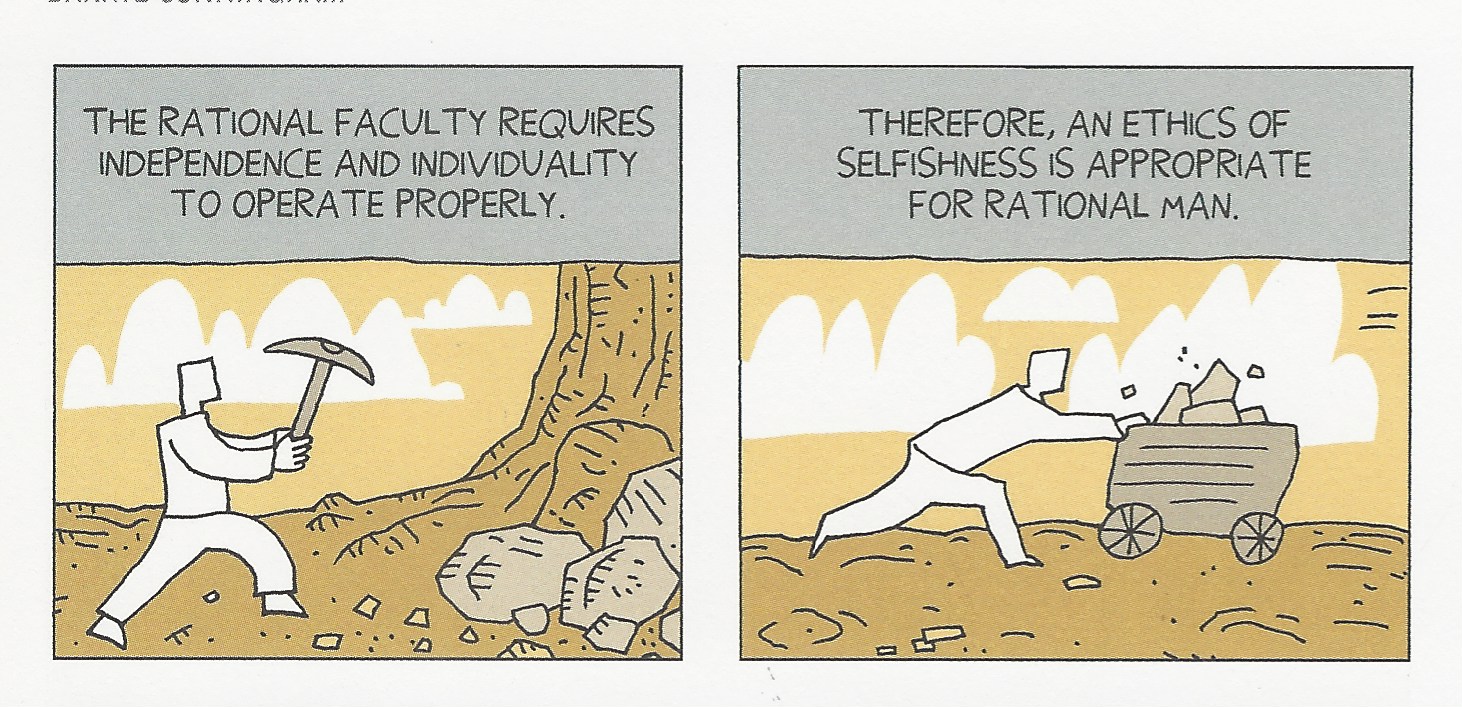
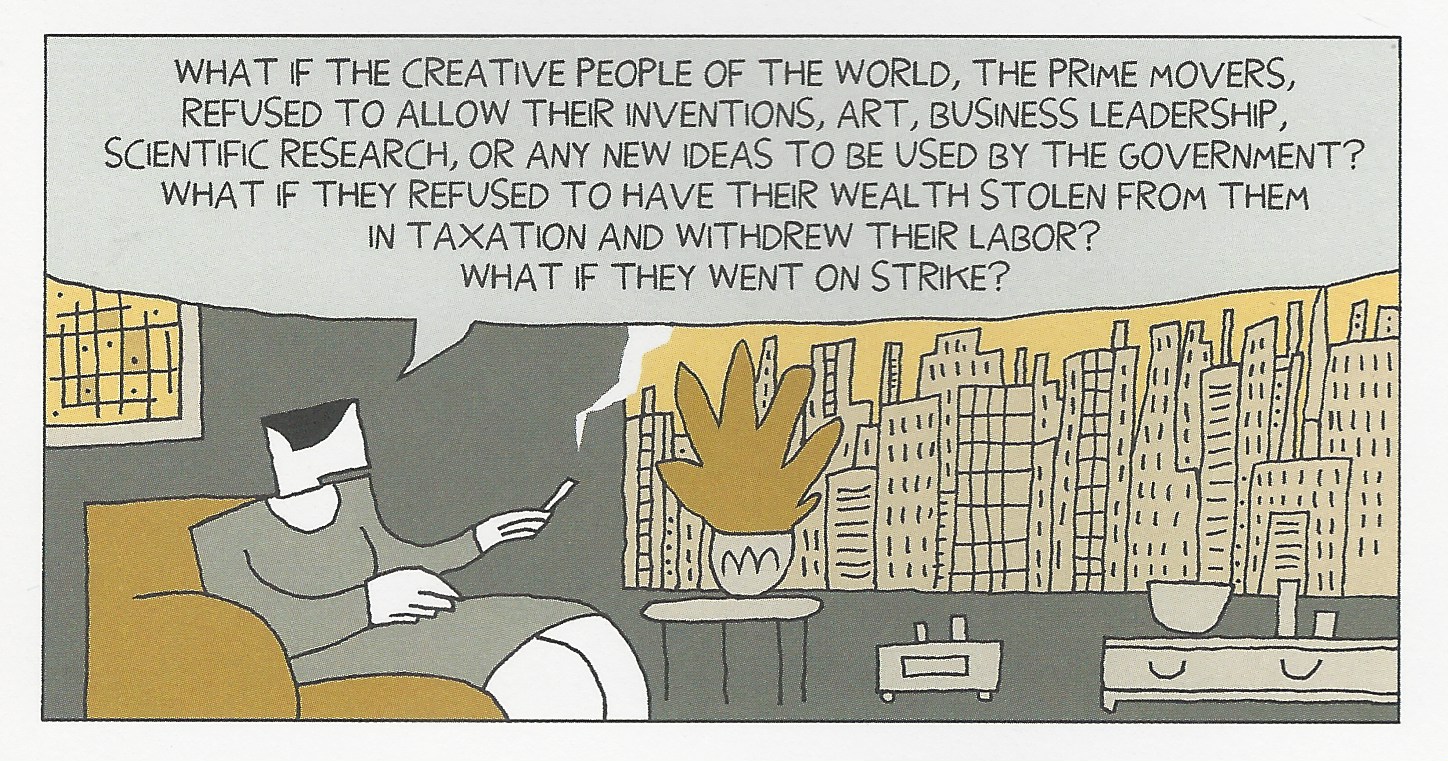
The Age of Selfishness: Ayn Rand, Morality, and the Financial Crisis by Darryl Cunningham (Abrams, 2015) is a closely written and tightly integrated misinterpretation of Ayn Rand’s life, her works, her philosophy of Objectivism, and the causes of the market collapses of 2007-2010. This book is a graphic novel because Cunningham is a cartoonist. His drawings can be crude, but are often essentialist and representational. He does sublimely capture people, often through their coiffeur and stance. But his work is never fine, detailed, or realistic. This book is largely a running monologue that needed no illustrations. The author claims that the popularity of Ayn Rand’s ideas among American (and British) conservatives caused the mortgage meltdown and subsequent bailouts.

Cunningham latches on to all of the negatives of Rand’s life and disparages the few successes that he acknowledges. 

What I find most interesting in this and similar attacks is that no one seems to be motivated to rip apart Karl Popper, Ludwig Wittgenstein, Jean-Paul Sartre, Jacques Lacan, or Richard Rorty for their foibles. We can condemn Thomas Jefferson’s relationship with Sarah Hemings without dismissing the Declaration of Independence as a hypocritical façade to justify the theft of lands owned by the British crown and its loyalists. Ayn Rand is different. 

Cunningham takes the time to make his case. The 231 pages begin with Ayn Rand’s life (Part One), explain the details of the financial contractions (Part Two), and then tie the first to the second (Part Three). His sources include biographies of Ayn Rand by her nominal admirers, Barbara Branden, Ann Heller, and Jennifer Burns. Ultimately, the thesis is not supported because the summary rests on omissions, flaws, and fallacies. Of necessity, the author contradicts himself. 

Cunningham does nod to the virtues of traditional conservatism, though he finds them not as powerful and promising as progressive liberalism. We need to be conservative in order to preserve the family, social order, and the freedoms we enjoy in our democracies. He presents World War II as an example of that. The error here is that Ayn Rand was not a traditional conservative. (And she was not alone in being less than sanguine about America's role in World War II.)  She called herself a “radical for capitalism” explaining that capitalism rests on a foundation of reason in acknowledgement of reality. Cunningham admits that Rand was opposed to the war in Vietnam, the draft, and laws against abortion. He fails to identify Rand as having been as “liberal” as she was “conservative.”  It would be possible to criticize Rand’s novels and her philosophy as an expression of unbridled liberalism.

Cunningham does not perceive the contradiction in his thesis.
Liberals actually share Rand's epistemology and
much of the "psycho-epistemology" of independence.
Conservatives attempt to advocate for the
consequential material gains, but deny reason and
independence.
Her heroes are socially disruptive. In AnthemThe Fountainhead, and Atlas Shrugged, the bad guys are the people in power who fear change. In the last two, the wealthy and powerful are mediocrities. The heroes also achieve wealth, but do not pursue power. (In The Fountainhead, the pursuit of power destroyed Gail Wynand who “was not born to be a second-hander.”) Her heroes famously stand on their own, especially in confronting adversity, a virtue that Cunningham identifies with children who grow up to be self-identified political liberals. 
In truth only six of the eight needed the bailout.
Moreover, all were forced to take it.
And all were forbidden to discuss it publicly
under threat of government retaliation.
Cunningham never grasps the fact that Objectivism is a personal philosophy. Rand’s heroes live sparsely; her villains are ostentatious. Ayn Rand’s heroes are more concerned with their own place in the physical world than in the society around them. Personally, I find that the conservatives who discovered Ayn Rand's works only through the Atlas Shrugged movies think that this is all about politics. Hank Rearden had a mansion to house his family, not himself. And it was his family that oppressed and exploited him. The government’s interference was just a footnote in his life. He cut the chains of government regulation only after he was able to get himself an apartment in the city. 
 
Cunningham is wrong.
The accepted story is that Ayn Rand was on the phone with
Isabel Paterson. Paterson insisted that Rand "owed it to her readers"
to follow The Fountainhead with another novel.
"What if I refused?" Rand asked.
The Strike was about the cause of such demands.
Ayn Rand did not consider the government
to be metaphysically important.
The central failure of Cunningham’s thesis is that the personal morality of Objectivism would never suggest, support, justify, or excuse the acts committed by the people who caused and profited from the financial crisis of 2007-2010. Those men were portrayed in The Fountainhead as Homer Slottern the successful businessman who was terrified by religion and in Atlas Shrugged as Mayor Bascom of Rome, Wisconsin, who turned a quick profit buying and dumping the remains of 20thCentury Motors. The Fountainhead also has looter architects, among them the hooligan Gus Webb, just as Atlas Shrugged’s villains include Mr. Mowen and Orren Boyle among the businessmen with Washington connections. 

Cunningham’s story contains a kernel of truth. However, deeper than the mechanics of shady deals was the lack of integrity of the dealers. “Do you think integrity is the monopoly of the artist? And what, incidentally, do you think integrity is? The ability not to pick a watch out of your neighbor’s pocket? No, it's not as easy as that. If that were all, I'd say ninety-five percent of humanity were honest, upright men. Only, as you can see, they aren't. Integrity is the ability to stand by an idea. That presupposes the ability to think. Thinking is something one doesn't borrow or pawn.” Kent Lansing to Howard Roark in The Fountainhead (Chapter X, p. 333; via Wikiquote) “Honesty is the recognition of the fact that the unreal is unreal and can have no value, that neither love nor fame nor cash is a value if obtained by fraud...”– Galt’ Speech.  

PREVIOUSLY ON NECESSARY FACTS

Sunday, December 10, 2017

HOW THE MARTIANS DISCOVERED ALGEBRA

How the Martians Discovered Algebra: Explorations in Induction and the Philosophy of Mathematics by Roger E. Bissell (Amazon here in book and Kindle formats) delivers an algorithm for generating Pythagorean Triples. Central to the thesis of the work, Bissell explains how he discovered this by means of induction, not deduction. From there, Bissell takes the reader into number theory in order to validate his new explanation of the proper understanding of multiplication, and to challenge widespread assumptions about the empty set and infinity.

The relationships between music and mathematics go back to Pythagoras. So, this set of essays by musician Roger Bissell enjoys a solid foundation. Bissell also dabbles at mathematics and has several philosophical explorations to his credit, published in The Reason Papers and the Journal of Ayn Rand Studies.

Objectivism is an integration of rationalism and empiricism. Objectivism rejects the false dichotomies of Descartes, Hume, James, and the myriad other philosophers before and after. Consequently, Bissell and other Objectivists provide logically consistent, reality-based and practicable methods for understanding the universe including our inner selves. Objectivism is what the scientific method was intended to be: a guide to living.

That said, this book failed to convince me on several points with which I was pre-disposed to agree. And I concede that the ultimate failure may be mine, not the author’s.

Bissell begins with some techniques in speed math. These discoveries from his senior year in high school demonstrate his inductive method.  They also provide an introduction to his algorithm for discovering Pythagorean Triples. That alone is worth the price of the book. It is easy enough to explain, though hard to show with the typesetting available here. Basically, you want three integers such that a^2 + b^2 = c^2. Easily, there must be some number, x to begin with. The other number must be some number added to x that can be expressed as x+a, and the result of adding their squares must be some (x+b)^2. It all follows from there.

But I had a hard time following it. I tend to read at bedtime. So, I filled my notebook with pages with arithmetic when I was tired. I told Roger that his algorithms did not work. He asked me to send him PDF scans. I did. He corrected my homework. So, I agree that the Bissell Algorithm will, indeed, generate Pythagorean Triples.

Moving forward, Chapter 5, “Mathematics as an Inductive Science”, adheres to the Objectivist interpretation from Ayn Rand, Leonard Peikoff, and David Harriman. The traditional view of induction is expressed as the problem of the black swan: no matter how many examples of anything you gather, the next test can disprove everything you thought you knew. Induction, the traditionalists say, gets stronger and stronger as more examples are revealed, but final proof and final truth are always denied to us. This view is found weakly in the narratives of Richard Feynman and strongly Stephen Hawking's popular work.  (See “Questions about A Brief History of Time” earlier here.) The Objectivist interpretation is that induction is valid if and to the extent that the generalization from specifics is properly based on the correct characteristics. The problem with the black swan is that nothing about “swanness” requires “whiteness.” Swans are not essentially white; swans are not intrinsically white. On the other hand, Bissell points out that water is essentially and intrinsically H2O, which was discovered to be essentially and intrinsically 6 up-quarks and 4 sideways-quarks. Our better understanding did not invalidate the previous truth to the extent that it was, indeed, true.

From acceptable (if not obvious) Chapter 6, “Equations as Propositions,” Bissell moves toward infinity by discussing “Zero as an Operation Stopper” (Chapter 7, which is also about the number One), and the “fiction” of the mathematical Empty Set. There, and approaching infinity (Chapter 8), he loses me; and I am wide awake.

To me, his complaints about the concept of nothing, zero, and the invalidity of infinity and orders of infinity echo the arguments of ancients against the existence of atoms. If atoms exist as the ultimate particles of the existents we perceive, what is between the atoms? Many ancient philosophers rejected the idea of the void: “nature abhors a vacuum.” But if the universe is a continuity of atoms, why are we not locked in atoms like flies in amber?

http://www.rogerbissell.com
The ancients (some of them anyway) denied Zero. How can you have nothing? From that comes a denial of the validity of negative numbers, irrational numbers, imaginary numbers, dimensions more than 3 (or 4 or 10), or particles that act like waves.

The problem is language. Language allows us to construct nonsense: Mathematics is green. The Catholic Encyclopedia offers some insight on understanding difficult problems. When we say that a brave man is a lion or a clever man is a fox, we know that we are speaking in analogies. “… but no Theist of average intelligence ever thinks of understanding literally the metaphors he applies, or hears applied by others, to God, any more than he means to speak literally when he calls a brave man a lion, or a cunning one a fox.”  (“The Nature and Attributes of God” ) Mathematics is not green, but 5 can be squared. Language is contextual. Language is analogy. Mathematical symbology is highly abstract and compressed. 

Words have meanings because language is based on reality. Whatever stars may be, intrinsically or essentially, categorically, provisionally, or contextually, stars exist and we perceive them. But we identify those perceptions in words not known 100 or 1000 or 10,000 years ago. In discussing the translations in their anthology of Aristotle’s works, Terence Irwin and Gail Fine offer this explanation about a single passage in Meteorologia.  Translated as nearly literally as possible, and allowing for alternative understandings [in square brackets]:
"Substance [essence] is said [spoken of], if not more-wise [several-wise], at any rate in four most; for indeed the essence and the universal and the genus [kind] seem [seems] to be substance [essence] of each, and fourth of these the subject." (See Aristotle: Selections, Irwin and Fine, editors, Hackett Publishing, 1995. Google Books here.)
I accept Roger Bissell’s point that the claim to “orders of infinity” is contrary to common sense. It is obvious that there are twice as many integers as even numbers. Nonetheless, you can, indeed map the “larger” set one-t0-one with elements of the smaller set and keep going forever… to infinity…

The central essay, “How the Martians Discovered Algebra” (Chapter 4) is a parable to demonstrate induction in mathematics as the doorway that opened to the world of algebra. 

Bissell's original algorithm for generating Pythagorean Triples is worth the price of the book. If you have any interest in epistemology, mathematics, or the problem of induction, then Roger Bissell's book delivers more for the money.

Previously on Necessary Facts