Showing posts with label history of mathematics. Show all posts

Monday, June 10, 2024

Jim Simons and the Quants

Being centered on mathematicians, this book was not exciting, but it was interesting. James Harris “Jim” Simons (1938-2024) earned his doctorate at Berkeley, and worked for the NSA and the Institute for Defense Analysis, before teaching at Harvard and MIT. (Wikipedia: https://en.wikipedia.org/wiki/Jim_Simons). And that is in this story, of course. The focus, however, is on Renaissance Technologies and their hedge funds (Medallion and others), the most successful trading firm in history. Simons’s background in language recognition—pattern recognition; pattern prediction—allowed him the insight to expect that correlations must exist across markets, even if causal factors ultimately remain hidden. Therefore, it should be possible to profit from trading on trends that are unexpected and unperceived by everyone else. He was right.

The Man Who Solved the Market:
How Jim Simons Launched
the Quant Revolution
 
by Gregory Zuckerman
(Penguin RandomHouse, 2019
)

The method was easy to explain: mine the data. Look at all the numbers from all the markets and seek out trends and patterns and correlations. Some turned out to be causative. Regression to the mean predicts that after some market has a remarkably bad day, prices will rebound. The prediction applies to hugely profitable days: the market reverts toward its previous level. That much is easy to understand. The rest never gets explained. 


For one thing, no one associated with Renaissance Technologies was willing to talk to Gregory Zuckerman because they were bound by deep long-term non-disclosure agreements. Aside from that, the powerhouse of the company was driven by its staff of Ph.D. mathematicians. It would have to be understood at their level before it could be explained to the rest of us. 


What can be understood is that on average, employees who invested with the firm earned about $50 million each. “Since 1988, Renaissance's flagship Medallion hedge fund has generated average annual returns of 66 percent, racking up trading profits of more than $100 billion…” (Introduction). With that money came power, of course. Robert Mercer put his ideology to work when he found Steve Bannon for the Donald Trump presidential campaign in 2016. However, Jim Simons was a Democrat. And he was not alone in that. Many of the academics in the firm were liberals and they contributed to political campaigns, naturally, and also to special foundations (some of their own creation) supporting education, medical research, and other social initiatives.


Jim Simons’s methodology was a long time coming. Computers were rare and costly. Ten years later, they acquired the first desktop computers, which were woefully underppowered by today's standards. Although he launched the firm specifically to mine data so that profits could be harvested from trends, Renaissance Technologies also employed traditional traders. The two teams often collided, with Jim Simons himself significantly abandoning the algorithms for what would be too easily called “gut instinct.” Sometimes, we just know.  Also, with that mountain of cash, and with their frequent intra-day trades, they did not need to be often right. At the peak, in Jim Simons’s last decade, with the models and algorithms and supercomputers all generating money, Renaissance Technologies was right only 51% of the time.


One aspect of the story which I believe explains as much of their success as their mathematical models, is that Renaissance Technologies adhered to the ideal academic organizational culture. Workspaces were open. Visiting around the office was common. Sharing ideas was habitual. Discussion and disagreement were encouraged. (Pages 199-203). (See also "Team of Teams" on this blog.) It was not always easy and some people never forgave others for their complete lack of social grace. Neither time nor money heals all wounds.


But we all enjoy the profits. Zuckerman presents this as a zero-sum game. For Renaissance Technologies to have profited, many other brokerages, whose clients were stereotypically “dentists” (and other middle class professionals), had to lose. It is true that every trading position requires two people with opposite expectations. Ultimately, conservation of energy (charge; spin) means that everything must be accounted for with nothing magically lost or gained. And yet here we are: 10 billion people, 50% of us in cities of over 1 million; flying around 10 kilometers above the ground or cruising on the ground at 100 kph. We could not have hunted and gathered enough to make this possible. If not for Jim Simons and Renaissance Technologies, we would each of us be poorer by unperceived small fractions that did not become the comforts we enjoy.


PREVIOUSLY ON NECESSARY FACTS

Two Books About Fermat’s Last Theorem 

The Remarkable Story of Risk 

Happy Pi Day of the Century 

Coins Without Realms (Digital Currency) 


Saturday, October 22, 2022

Footnotes on Number Theory

I love to watch the odometer. It is not always convenient to stop and take a picture. 

186285 miles were 1 Light Second

Kaprekar’s Constant

There’s a lot of these out there on YouTube. It is very popular in India, of course. 

Numberphile has it. I was disappointed that Mathologer did not. 


Take any four digits, as long as all four are not the same.


Order them highest to lowest and then lowest to highest. Subtract the smaller from the larger. Do it again. Soon, it reduces to 6174. Every time. I wonder how it works in different bases. 

Hidden Circle in Pi?

That is also a challenge that I have never pursued from Carl Sagan’s Contact.  He posits that if you extend pi out far enough-as I recall, in Base 11—you get a string of 1s and 0s that can be arrayed to display a circle. There’s always something else to do… but a computer program seems easy enough and it can run all night and probably not much longer with today’s MacBook, Dell, etc. 

Kaprekar's Constant from Numberphile


10 REM MIKE MAROTTA. FEB 5, 1987. NEWTON'S ALGORITHM FOR SQUARE ROOTS

19 LIMIT= .0001

20 PRINT "ENTER A NUMBER"

21 INPUT X

56 XN = X/2

60 R1 = (XN + X/XN)/2

70 IF ABS(XN-R1) < LIMIT THEN GOTO 80

75 XN = R1

76 GOTO 60

80 PRINT "THE SQUARE ROOT OF ";X;" = ";R1


Fast Square Root.
(She only does it for Primes.)
I first wrote this in the winter of 1976-1977, cadging time at the Michigan State University computer center when I was between terms at Lansing Community College. I used it again when I was employed (briefly) at the MSU campus bookstore. They had a Data General Nova for which the vendor delivered a “Business Basic” without algebraic functions. (“You don’t need them for business.”) I wanted to project economic order quantities, which does require finding a square root. I also wrote numerical expansions for natural and common logarithms and made the set into a library of callable functions.

Square Roots

YouTube has a ton of videos on calculating square roots by hand. In this day of cellphones, it is seldom necessary. But I found this video interesting and wrote a sticky note to hang on a monitor for a while. 


Another trick I use is based the binary search. Two or three iterations are usually enough. 

Sqrt(97) < 10. Guess 9.3. Square 9.3. Guess again. Richard P. Feynman has a story about beating a Japanese  abacus salesman in a bar in Brazil figuring like that in his head. “More digits! … More digits!”


PREVIOUSLY ON NECESSARY FACTS


Number Theory as an Adventure 

Nerd Nation: Natalie Portman, Danica McKellar, and Felicia Day 

The Man Who Loved Only Numbers 

Contradictions in the Patentability of Numbers 


Tuesday, December 10, 2019

Merry Newtonmas 2019

Born on December 25 (OS), 1642, Sir Issac Newton was more than the most brilliant man of his time. He was the first modern scientist. He discovered the physics and the mathematics that made possible the industrial age and the electronic age. He invented a new kind of telescope, based on his research into optics. He was an accomplished lawyer, both a prosecutor for the state, and later an effective political scientist. His achievements in theology are unappreciated today. He was a skilled chemist. He served in Parliament as the representative of Cambridge College. He was president of the Royal Society. In addition, he served as Warden and Master of the Royal Mint for 30 years, rescuing the economy from imminent disaster. Had Sir Isaac Newton done any one of these, his place in history would have been assured. He did all of them. 

Newton's famous “three laws of motion” were only introductory propositions to his Principia Mathematica. The purpose of the Principia was to demonstrate that the force which at once moves the planets and holds them in their orbits is the same force that pulls apples from their trees. He achieved this proof by creating a new kind of mathematics, called the calculus. 
Newtonian Reflector
https://spaceplace.nasa.gov/telescopes/en/
Many consider Newton to have been the first modern scientist. John Maynard Keynes dubbed him “the last sorcerer.” We commonly believe that alchemy is a superstition or a fraud, like witchcraft or theater magic. To Newton, alchemy was science. We see two magnets drawn together or repulsed. We play with static electricity. We do not doubt that the Sun attracts the planets. Newton believed these things as well specifically because of his understanding of alchemical principles. To Newton, the world operated according to basic principles of natural law that were the same everywhere for everyone. 
 
Feynman's Lecture on Newton's Proof of Kepler's Laws 
https://upload.wikimedia.org/ from energy dot gov

Few people have read the Principia Mathematica in its entirety. The very popular Nobel laureate physicist, Richard P. Feynman, attempted to delight a class with a demonstration of Newton's proof of Kepler's Laws of Planetary Motion. He could not produce the mathematics as Newton had done it and was forced to present his own geometric proof.

PREVIOUSLY ON NECESSARY FACTS

Thursday, June 27, 2019

A Simple Truth

A picture is worth a thousand words, so I will not say much. I just thought that it is interesting that when something is true, it can be demonstrated by many methods.


PREVIOUSLY ON NECESSARY FACTS

From Texas to the Moon with John Leonard Riddell
Nerd Nation: 4.5
Integrating Criminologies
Why a Level Playing Field?

Monday, June 24, 2019

Number Theory as an Adventure

Number theory can be taught to children. It all begins with integers. First year algebra (at least) is required to prove these conjectures. But the facts can be presented and tested by a nine-year old who is comfortable with long division. Even a first grader can understand, appreciate, and test many of them. 

Multiplying odds and evens always yields: odd X odd = odd; even X even = even; odd X even = even. A child learning arithmetic can test examples until she is tired and at least get a lot of practice. It is not a proof, of course, but it can remain a challenge for a child who wants to learn algebra. The algebra is easy to show. 
 
An Adventurer's Guide to Number Theory
by Richard Friedberg, Dover, 1968, 1994
(This Dover edition contains corrections
and appendices not in the McGraw-Hill
printing of 1968.)
A child who is comfortable with first year algebra can get lost in the Pythagorean theorem and many of the truths that can be derived from it. Among the Pythagorean Triples are some such as 3-4-5 and 5-12-13 and 15-112-113 for which the hypotenuse is one unit longer than the longer of the two other sides. And there is an easy formula for generating them. It can be coded up as a computer program or a spreadsheet. 

This second edition was released soon after Andrew Wiles announced his proof of Fermat’s Last Theorem. Richard Friedberg cautions that the proof was not yet accepted. It was not. A second proof was. Friedberg discusses Fermat’s Last Theorem as an extension of other explorations, principally the Pythagorean Theorem. That venerable truth is the crux of this work though Friedberg brings the reader into many other fields: infinite descent, perfect numbers, modulo arithmetic, and prime numbers. Along the way, he cites the discoveries made by Fermat, Euler, Lagrange, Gauss, and, of course, Diophantus, among others. 

PREVIOUSLY ON NECESSARY FACTS


Thursday, April 25, 2019

G. H. Hardy's "Apology"

I am certainly among the perhaps one million readers of this classic who could never master the mathematics that Hardy taught. But the continuous popularity of this book speaks to the fact that our common culture values pure mathematics. It must seem like hubris for me to say that Hardy was wrong about pure mathematics. I enjoyed the book nevertheless and took my time through it, and read parts of it again. I also skipped the introduction by C. P. Snow at first. I wanted to know Hardy, not Snow. But I went back purposefully and accepted Snow on his own terms. 

Hardy asks, "Is this important and am I the person to do it?" On the second point, Hardy is naturally demur.  Even though he makes the case for ego, he does not spend much time advancing his own to the reader. He does say that when he was very young, excelling at maths was a way to beat others, to best them at something difficult. ([29] p. 144) Only later did he discover a different pride, a different merit collaborating with Littlewood and Ramanujan.

A Mathematician’s Apology by G. H. Hardy
(with a Foreword by C. P. Snow).
Cambridge University Press,
1940, 1967; 23rdPrinting 2016.
 
Good work is not done by ‘humble’ men.” – G. H. Hardy. (Math. Ap. [2] p. 66)

“I am not suggesting that this is a defence which can be made by most people, since most people can do nothing at all well.—G. H. Hardy. (Math. Ap. [3] p. 67)
…perhaps five or even ten per cent of men can do something rather well.—G. H. Hardy. (Math. Ap. [3] p. 68; also, [5] p. 73)

… Poetry is more valuable than cricket, but Bradman would be a fool if he sacrificed his cricket in order to write second-rate minor poetry.”–G. H. Hardy. (Math. Ap. [3] p. 69)

“A mathematician, like a painter or a poet, is a maker of patterns. If his patterns are more permanent than theirs, it is because they are made with ideas.”–G. H. Hardy. (Math. Ap. [10] p. 84)

Hardy refers to cricket throughout the book. In the Foreword, C. P. Snow cites John Maynard Keynes who said that if Hardy had spent as much time with the stock market reports as he did with cricket scores, he would have retired a millionaire. The quote above was only one of very many allusions to the sport. It sent me (appropriately enough) googling. 

Sir Donald George Bradman, AC (27 August 1908 – 25 February 2001), often referred to as “The Don”, was an Australian international cricketer, widely acknowledged as the greatest batsman of all time. Bradman's career Test batting average of 99.94 has been cited as the greatest achievement by any sportsman in any major sport. -- Wikipedia.

“There are many highly respectable motives which may lead men to prosecute research, but three which are much more important than the rest. The first (without which the rest must come to nothing) is intellectual curiosity, desire to know the truth. Then, professional pride, anxiety to be satisfied with one’s performance, and shame that overcomes any self-respecting craftsman when his work is unworthy of his talent. Finally, ambition, desire for reputation, and the position, even the power or the money, which it brings. It may be fine to feel, when you have done your work, that you have added to the happiness or alleviated the sufferings of others, but that will not be why you did it. If a mathematician, or a chemist, or even a physiologist were to tell me that the driving force in his work had been the desire to benefit humanity, then I should not believe him (nor should I think better of him if I did).” ([7] p. 79)
Godfrey Harold Hardy 1887-1947. 
https://www.maths.ox.ac.uk/node/13895

Hardy is eloquent, making a strong case for his field of theoretical mathematics as having greater value than applied mathematics. He begins by laying out four theorems. The first is Euclid’s proof that no end exists for prime numbers, that an infinity of prime numbers exists. The second is Pythagoras’s proof that the square root of two is irrational. Those he proves for the reader. 

Two others are left unfinished. The Fundamental Theorem of Arithmetic says that any integer can be resolved in only one way into a product of primes. Hardy shows some examples, but says that the proof might be tedious for the general reader. Similarly, he tells us of Fermat’s “Two Square” Theorem which says that all prime numbers can be divided by 4 with a remainder of either 1 or 3; and that all of the first class and none of the second can be written as the sum of two squares. Again, he lists some examples, but leaves the proof for the reader. 

From section [8] of [29] throughout, Hardy argues on behalf of the beauty of pure mathematics. He says that the practical work that benefits civil engineering and other advances in civilization is not beautiful and therefore not permanent. It does not matter that pure math is not practical. In fact, he says, it is better that it not be. I disagree.

I believe that all mathematics is potentially practical, only that we have not found a specific application. I do not know how to prove that. Hardy says (and I agree) that a proof by enumeration of cases is the least attractive. But I point to irrational, negative, and imaginary numbers, all of which were denied as real and all of which have practical applications today. 

PREVIOUSLY ON NECESSARY FACTS


Friday, December 21, 2018

The Solstice Seasons

“‘Tis the season to be jolly…”  It was easy enough to note the shortest day as the longest night. But the earliest sunset and latest sunrise are several days different from the solstice. In fact, it makes sense to celebrate the Winter Solstice Season (“Christmas”) from December 8 (“St. Nicholas Day”) to January 4 (no best feast day there). On the other side of the year, Summer Solstice would be from June 10 to July 1, call it Flag Day to Independence Day on the civil calendar.

Our New Year comes from Rome during the dictatorship of Gaius Julius Caesar. As farmers, the old Romans had started their year in March.The two winter months had no names. They were dead times. It is why we still call the ninth month by the name of the seventh: “September.” Julius Caesar courted Cleopatra Ptolemy and sought to unite Rome and Egypt. He moved New Year’s Day to January 1. 
Dates and Times of Earliest Sunsets (EarthSky dot com here.)
It may be that the heliacal rising of Sirius marked the flooding of the Nile and the start of a new year only about the time of Claudius Ptolemy (100 to 160 CE). The Nile rises because of monsoon rains in Ethiopia. The waters move down the Blue Nile and White Nile. It is not precise, not astronomical. As we know, the climate changes; weather is variable. 
“In this paper the question of prediction of the Nile flood based on the first morning visibility of Sirius is considered. It is shown that the only text that describes this event is formulated very vaguely. It makes impossible to derive a reliable astronomical dating. Modern interpretations of this text are based on the free interpretation of the original source, and often do not match. According to historical evidence of Greek authors and later Egyptian texts, flooding of the Nile based on heliacal rising of Sirius could be predicted at the beginning of [the first] millennium AD. This fact is confirmed by astronomical calculations.”  (From “Heliacal rising of Sirius and flooding of the Nile” by Nickiforov, M. G. and Petrova, A. A. in Bulgarian Astronomical Journal, Vol. 18, No. 3, p. 53 archived at the Astrophysics Database at Harvard here.
For the Celts, New Year’s was harvest time, Samhain, what we call Halloween. In some places in medieval Europe, New Year's Day was May Day. During a warming period, New Year's Day  became the Vernal Equinox: the first day of spring. Easter is still tied to Passover: the first Sunday after the first full moon after the first day of Spring. Those who kept the old calendar were “April Fools.” Correlating the lunar and solar calendars and marking those over centuries gave rise to modern astronomy. In any case, it was Julius Caesar who made January 1 New Year’s Day. It marked the close of the Saturnalia solstice celebrations. 
 
Earliest sunrise latest sunset near solstice (Washington Post here)

A few years ago, I was working as a security guard and it was late March or early April. Three of us were walking a shift change about 6:00 PM. One guy was an Army brat who had lived around the world, a lot of it in Scotland. The other guy grew up here in Austin. We stepped outside. After about ten days of rain, the sky was clear. “Hey, look,” I said, “the sun is still up.” The guy from Austin was taken aback. “What do you mean?” he said. “The sun goes down the same time every night.” Well, in Austin, it mostly does, but not where I’m from and surely not in Scotland.  

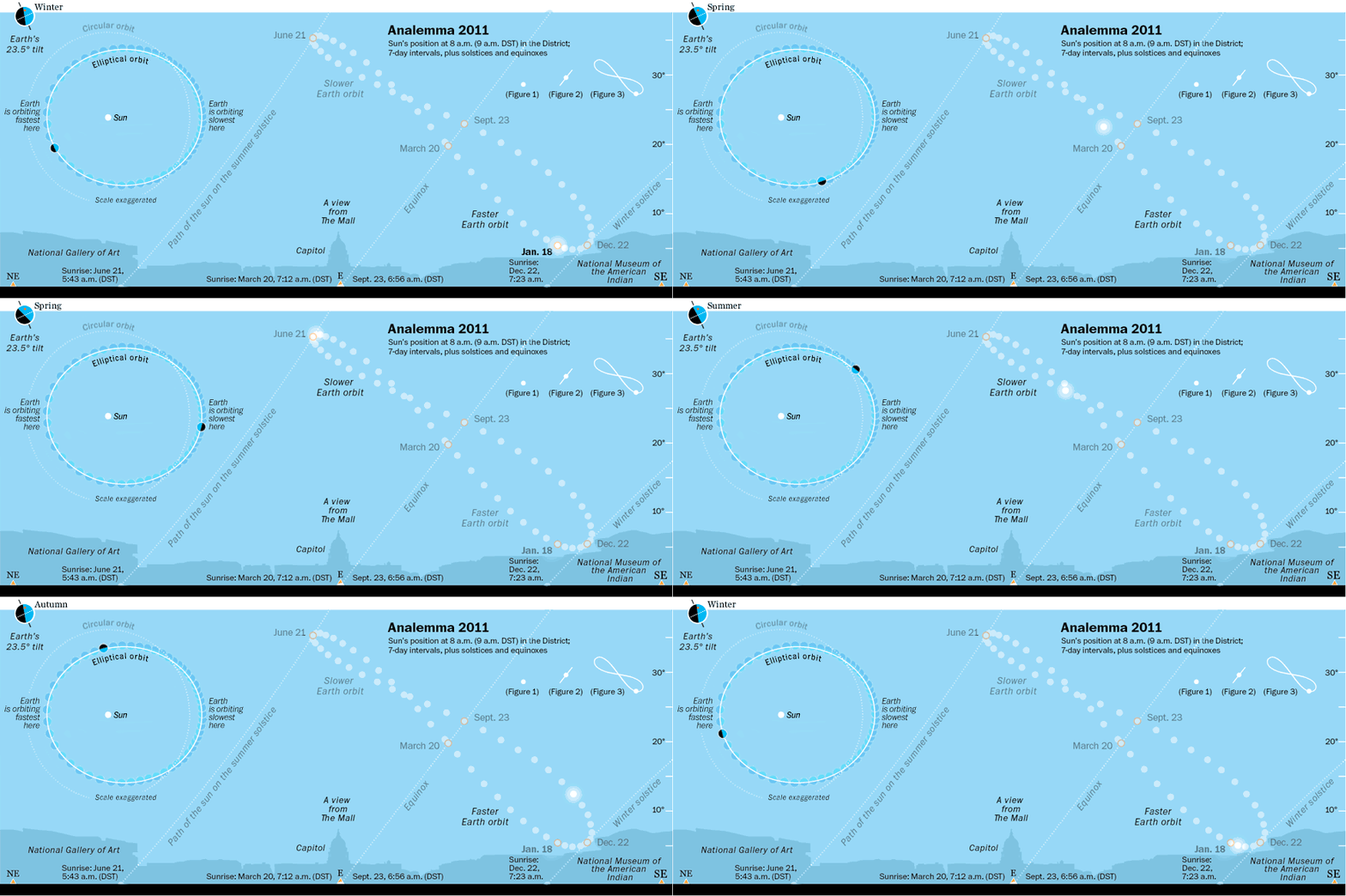
Analemma 2011 from The Washington Post here.
The apparent position of the Sun depends on the tilt
of the Earth and the eccentricity of our orbit. 
More than you ever wanted to know
at the US Naval Observatory web site here.
PREVIOUSLY ON NECESSARY FACTS

Thursday, December 20, 2018

Eclipses?

Obvious though it seems, how and why solar eclipses became important to our civilization is not at all clear. The path of totality is narrow and fleeting, gone in about six or seven minutes. I never experienced a total eclipse, but I have seen three partials: September 20, 1960, May 10, 1994, and August 21, 2017. In every case, had it not been announced long in advance, I would not have known from common experience just what—if anything—had happened.

It is often repeated, citing Herodotus, that Thales of Miletus predicted the solar eclipse of May 28, 585 BCE. How he did that is not recorded. We take for granted our Arabic numerals and positional notation. Absent them, calculation is even more painfully laborious than most of us experience it to be. And the Greeks used geometry, not arithmetic. 
 
Just one construction from
"On the Sizes and Distances of the Sun and Moon" by
Aristarchus of Samos from Aristarchus of Samos:
The Ancient Copernicus
by Sir Thomas Heath
(Oxford University Press; 1977, 1913).
Having long kept records, the Babylonians were aware of the 18-year cycle of eclipses. (18 years 11 days plus a third of a day. See the explanation of the Saros Cycle at Wikipedia.  )

The Chinese also kept records of eclipses, at least back as far as 1302 BCE, the first perhaps in 2159 BCE. (“The eclipse in China”, F. Crawford Brown, Popular Astronomy, Vol. 39, p.567 at The Digital Library for Physics and Astronomy at Harvard  and “Examination of early Chinese records of solar eclipses,” Liu, C., Liu, X., & Ma, L., Journal of Astronomical History and Heritage (ISSN 1440-2807), Vol. 6, No. 1, p. 53 - 63 (2003) at the same archive. )

That being as it may, explanations for the physical events—that the Moon and Earth cast shadows on each other—were lacking until the Greeks, again, beginning perhaps as early as 600 BCE, but certainly known to Aristotle c. 300 BCE. Nonetheless, that knowledge was not widespread.
“The majority of people didn’t really understand what eclipses or shooting stars were until at least the 17th Century,” says Edwin Krupp, director of the Griffith Observatory in California. The ancient Greeks weren’t alone, either.
While a handful of astronomical scholars, from the 8th Century BC onwards, successfully understood the celestial mechanisms behind an eclipse, for another 2,000 years most of the world’s population clung steadfastly to the ancient belief that astronomical events, and particularly solar and lunar eclipses, were the work of the gods. (BBC here.)

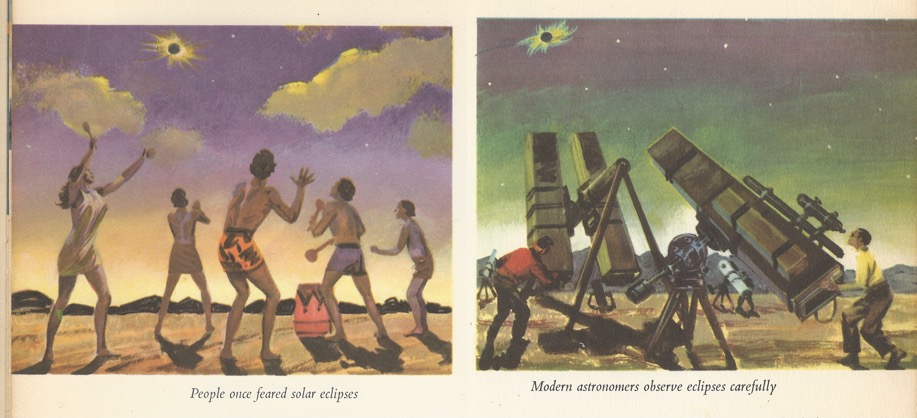
Primitives and Moderns both react to solar eclipses.
(Left: "People once feared solar eclipses" 

Right: "Modern astronomers observe eclipses carefully")
The Golden Book of Astronomy: A Child's Introduction to the Wonders of Space
(Simon & Schuster, 1958, 1955).
My best eclipse was May 10, 1994. The sky did grow visibly darker. The air turned cool. The birds were silenced. But it was impossible to look directly at the sun. For that, I built a viewing box to project the image on a sheet of paper. The first partial eclipse I witnessed on September 20, 1960, was an annular, a ring, because the Moon was too close to the Earth to completely block the Sun. What I saw was a partial annular, a geometric “lune” the shape of part of one circle over another. Although I had exposed film to view it through, the cloud cover was just right to view the sun directly. The third time, although some clouds passed by they were not dense enough to allow direct observation of the Sun. If I had not had exposed film to view through, I would not have known that the eclipse occurred at all: no other environmental changes were manifested.

Lunar eclipses are impossible to ignore. The Earth's shadow is large. The Moon often rises red, blue light being absorbed by our atmosphere. The Moon darkens almost to full black. The entire event takes hours.  

Every Lunar eclipse is followed by a Solar eclipse. However, as noted above, the path of totality is narrow and the duration of darkness is just minutes. You would have to be a pretty good sprinter to cover the mile from your field to your home to the village to the church in time to pray before it would all be over. And people 200 miles away might not be aware that anything happened at all. 

PREVIOUSLY ON NECESSARY FACTS

Sunday, December 10, 2017

HOW THE MARTIANS DISCOVERED ALGEBRA

How the Martians Discovered Algebra: Explorations in Induction and the Philosophy of Mathematics by Roger E. Bissell (Amazon here in book and Kindle formats) delivers an algorithm for generating Pythagorean Triples. Central to the thesis of the work, Bissell explains how he discovered this by means of induction, not deduction. From there, Bissell takes the reader into number theory in order to validate his new explanation of the proper understanding of multiplication, and to challenge widespread assumptions about the empty set and infinity.

The relationships between music and mathematics go back to Pythagoras. So, this set of essays by musician Roger Bissell enjoys a solid foundation. Bissell also dabbles at mathematics and has several philosophical explorations to his credit, published in The Reason Papers and the Journal of Ayn Rand Studies.

Objectivism is an integration of rationalism and empiricism. Objectivism rejects the false dichotomies of Descartes, Hume, James, and the myriad other philosophers before and after. Consequently, Bissell and other Objectivists provide logically consistent, reality-based and practicable methods for understanding the universe including our inner selves. Objectivism is what the scientific method was intended to be: a guide to living.

That said, this book failed to convince me on several points with which I was pre-disposed to agree. And I concede that the ultimate failure may be mine, not the author’s.

Bissell begins with some techniques in speed math. These discoveries from his senior year in high school demonstrate his inductive method.  They also provide an introduction to his algorithm for discovering Pythagorean Triples. That alone is worth the price of the book. It is easy enough to explain, though hard to show with the typesetting available here. Basically, you want three integers such that a^2 + b^2 = c^2. Easily, there must be some number, x to begin with. The other number must be some number added to x that can be expressed as x+a, and the result of adding their squares must be some (x+b)^2. It all follows from there.

But I had a hard time following it. I tend to read at bedtime. So, I filled my notebook with pages with arithmetic when I was tired. I told Roger that his algorithms did not work. He asked me to send him PDF scans. I did. He corrected my homework. So, I agree that the Bissell Algorithm will, indeed, generate Pythagorean Triples.

Moving forward, Chapter 5, “Mathematics as an Inductive Science”, adheres to the Objectivist interpretation from Ayn Rand, Leonard Peikoff, and David Harriman. The traditional view of induction is expressed as the problem of the black swan: no matter how many examples of anything you gather, the next test can disprove everything you thought you knew. Induction, the traditionalists say, gets stronger and stronger as more examples are revealed, but final proof and final truth are always denied to us. This view is found weakly in the narratives of Richard Feynman and strongly Stephen Hawking's popular work.  (See “Questions about A Brief History of Time” earlier here.) The Objectivist interpretation is that induction is valid if and to the extent that the generalization from specifics is properly based on the correct characteristics. The problem with the black swan is that nothing about “swanness” requires “whiteness.” Swans are not essentially white; swans are not intrinsically white. On the other hand, Bissell points out that water is essentially and intrinsically H2O, which was discovered to be essentially and intrinsically 6 up-quarks and 4 sideways-quarks. Our better understanding did not invalidate the previous truth to the extent that it was, indeed, true.

From acceptable (if not obvious) Chapter 6, “Equations as Propositions,” Bissell moves toward infinity by discussing “Zero as an Operation Stopper” (Chapter 7, which is also about the number One), and the “fiction” of the mathematical Empty Set. There, and approaching infinity (Chapter 8), he loses me; and I am wide awake.

To me, his complaints about the concept of nothing, zero, and the invalidity of infinity and orders of infinity echo the arguments of ancients against the existence of atoms. If atoms exist as the ultimate particles of the existents we perceive, what is between the atoms? Many ancient philosophers rejected the idea of the void: “nature abhors a vacuum.” But if the universe is a continuity of atoms, why are we not locked in atoms like flies in amber?

http://www.rogerbissell.com
The ancients (some of them anyway) denied Zero. How can you have nothing? From that comes a denial of the validity of negative numbers, irrational numbers, imaginary numbers, dimensions more than 3 (or 4 or 10), or particles that act like waves.

The problem is language. Language allows us to construct nonsense: Mathematics is green. The Catholic Encyclopedia offers some insight on understanding difficult problems. When we say that a brave man is a lion or a clever man is a fox, we know that we are speaking in analogies. “… but no Theist of average intelligence ever thinks of understanding literally the metaphors he applies, or hears applied by others, to God, any more than he means to speak literally when he calls a brave man a lion, or a cunning one a fox.”  (“The Nature and Attributes of God” ) Mathematics is not green, but 5 can be squared. Language is contextual. Language is analogy. Mathematical symbology is highly abstract and compressed. 

Words have meanings because language is based on reality. Whatever stars may be, intrinsically or essentially, categorically, provisionally, or contextually, stars exist and we perceive them. But we identify those perceptions in words not known 100 or 1000 or 10,000 years ago. In discussing the translations in their anthology of Aristotle’s works, Terence Irwin and Gail Fine offer this explanation about a single passage in Meteorologia.  Translated as nearly literally as possible, and allowing for alternative understandings [in square brackets]:
"Substance [essence] is said [spoken of], if not more-wise [several-wise], at any rate in four most; for indeed the essence and the universal and the genus [kind] seem [seems] to be substance [essence] of each, and fourth of these the subject." (See Aristotle: Selections, Irwin and Fine, editors, Hackett Publishing, 1995. Google Books here.)
I accept Roger Bissell’s point that the claim to “orders of infinity” is contrary to common sense. It is obvious that there are twice as many integers as even numbers. Nonetheless, you can, indeed map the “larger” set one-t0-one with elements of the smaller set and keep going forever… to infinity…

The central essay, “How the Martians Discovered Algebra” (Chapter 4) is a parable to demonstrate induction in mathematics as the doorway that opened to the world of algebra. 

Bissell's original algorithm for generating Pythagorean Triples is worth the price of the book. If you have any interest in epistemology, mathematics, or the problem of induction, then Roger Bissell's book delivers more for the money.

Previously on Necessary Facts

Saturday, August 12, 2017

The Antikythera Device

The wonderfully complex mechanism that predicted eclipses, the positions of the planets, and the dates of Olympic games may have been a collaboration among Archimedes, Eratosthenes, and Apollonius.  Eratosthenes was the Librarian at Alexandria. Apollonius was the best geometer of the time. Or maybe Archimedes built it himself. Although this device is singular, its intricate gearing suggests that it must have been the result of a long series of development. But all the others are lost.
 
from the Freeth Presentation at Stanford
The best citation we have to the mechanical works of Archimedes come from De Re Publica by Marcus Tullius Cicero. You can find the citation archived at “Spheres and Planaria” at NYU Math here:
“Cicero (106-43 BC), De Re Publica, Book I, Sections 21-22
(In this passage Cicero writes of a discussion that takes place in 129 BC among a group of learned Romans. One of them relates an incident in 166 BC in which a Roman consul, Gaius Sulpicius Gallus, is at the home of Marcus Marcellus, the grandson of the Marcellus who conquered Syracuse in 212 BC.)
. . . he [Gallus] ordered the celestial globe to be brought out which the grandfather of Marcellus had carried off from Syracuse, when that very rich and beautiful city was taken, though he took home with him nothing else out of the great store of booty captured. Though I had heard this globe mentioned quite frequently on account of the fame of Archimedes, when I actually saw it I did not particularly admire it; for that other celestial globe, also constructed by Archimedes, which the same Marcellus placed in the temple of Virtue, is more beautiful as well as more widely known among the people. But when Gallus began to give a very learned explanation of the device, I concluded that the famous Sicilian had been endowed with greater genius that one would imagine it possible for a human being to possess. For Gallus told us that the other kind of celestial globe, which was solid and contained no hollow space, was a very early invention, the first one of that kind having been constructed by Thales of Miletus, and later marked by Eudoxus of Cnidus (a disciple of Plato, it was claimed) with the constellations and stars which are fixed in the sky. He also said that many years later Aratus, borrowing this whole arrangement and plan from Eudoxus, had described it in verse, without any knowledge of astronomy, but with considerable poetic talent. But this newer kind of globe, he said, on which were delineated the motions of the sun and moon and of those five stars which are called wanderers [the five visible planets], or, as we might say, rovers, contained more than could be shown on the solid globe, and the invention of Archimedes deserved special admiration because he had thought out a way to represent accurately by a single device for turning the globe those various and divergent movements with their different rates of speed. And when Gallus moved the globe, it was actually true that the moon was always as many revolutions behind the sun on the bronze contrivance as would agree with the number of days it was behind in the sky. Thus the same eclipse of the sun happened on the globe as would actually happen, and the moon came to the point where the shadow of the earth was at the very time when the sun . . . out of the region . . .
(Translation by Clinton W. Keyes in Cicero: De Re Publica, De Legibus, Loeb Classical Library, Harvard University Press, Cambridge, 1928.)”
The Google Doodle for May 17, 2017  celebrated the 115th anniversary of the discovery of the device.  Sponge divers found it amid the treasures of an ancient wreck. Among these are some of the finest bronze statues we have from that context.  Archeologist Valerios Stais (1857-1923) was the first to suggest that the gearing was evidence of a clockwork, but his theory was discounted at the time. The next significant studies were the work of Derek DeSolla Price.
 
PBS NOVA Presentation
Derek John De Solla Price (1922-1983) held two doctorates, one of them in the history of science. You can find 23 one-hour lectures Neolithic to Now from Yale on his honorary blog site. Also there is the full text of Babylonian Science also on his honorary blogsite.  
Derek spent from around 1951 until about 1959 figuring out what that lump was and in a June 1959 Article in Scientific American he first announced to the mass public his theories on the device.” Price DeSolla worked with Charalampos Karakalos who used x-rays and gamma rays to create images of the 82 fragments.  They published 70-page paper, “Gears from the Greeks. The Antikythera Mechanism: A Calendar Computer from ca. 80 B. C.” in the November 1974 issue of Transactions of the American Philosophical Society New Series, 64 (7): 1–70.
 
from Epigraphy.org the lettering styles help to
place the time of construction
In our time, Dr. Anthony Freeth speaks for the team that has decoded much more of the Antikythera device.  Their papers are here:
You can view a 2-hour lecture delivered November 6, 2015, at Stanford.  (I did it in three sittings.) This link takes you to a lead-in article which provides links to their YouTube channel presentation (here) and Apple Store podcast. Freeth answers the basic questions: What, How, When, Where, Who, and Why.
 
Kurt Baty built a faithful LEGO model
That no other similar mechanisms are known is troubling. It is easy to underestimate how much was lost over the centuries of the slow decline of Rome. We know from other citations that the wife of the emperor Claudius was Etruscan. For her, he wrote a history of her people, perhaps in their own language. Not only is that work – the creation of the most powerful citizen of Rome – lost, so is knowledge of the language. We can read the inscriptions we have found, sounding out the letters. Except for the names of some gods such as Minerva and Mercury, and other smatterings, we know nothing. As a weapon of war, a single thermonuclear bomb, exploded 50 miles above the surface will create an electro-magnetic pulse that erases just about all of our electronic storage.  In the wake of even a “limited” nuclear exchange, the subsequent nuclear winter might force us to burn our books to keep warm. Civilization is fragile.

Also on Necessary Facts