Showing posts with label junk science. Show all posts

Sunday, May 17, 2020

Cosmos: A Spacetime Travesty

Watching this on DVD with the captions on allowed me to identify an array of failures of science, reason, and fact. 

The curtain opened with a quote from Carl Sagan: “The cosmos is all that is or ever was or ever will be.” The rest of the series denies that and betrays Sagan’s legacy with frequent allusions to “alternate universes” and “alternate realities.” But those do not exist except as subsets of the universe: all that ever was, is, or will be. That was Carl Sagan’s worldview; and it is the metaphysics and epistemology of rational-empiricism which is the scientific method. But the scientific method is not applied in this series while vague assertions and imaginative claims are touted as “great mysteries” and even “miracles.” 


The failure to adhere to the scientific method led to a cascade of ignorant statements about evolution and the origin of species. Contrary to the narrative of how wolves and humans learned to get along (Episode 2: Some of the Things that Molecules Do), the fact is that crosses of wolves and dogs can produce fertile offspring. They are not species as Darwin defined them. Neither are polar bears. 

Discussing the life and work of Sir Isaac Newton, (Episode 3: When Knowledge Conquered Fear) Dr. Tyson never mentions the fact that Newton’s theory of gravity—powerful as it was in defining not just a branch of science, but the worldview of a civilization—cannot be extended beyond two bodies in empty space. Any 3-body or n-body problem can only be solved for specially restricted cases or by repetitive numerical methods and reliance on compiled tables of direct observations. 

If you stop to read the words and reflect on the content, you realize that there is at once more and less here than meets the eyes and ears. That is a message from the opening of Episode 6: Deeper and Deeper Still, and it is presented in a way that denies the legacy of Carl Sagan. Dr. Tyson says: “Seeing is not believing. Our senses deceive us. Even the stars are not what they appear to be. The cosmos as revealed by science is stranger than we ever could have imagined. Light, and time, and space, and gravity conspire to create realities which lie beyond human experience.” 

But discovering the cosmos is the human experience. Epistemology, psychology, and physiology all inform us that our senses are accurate and precise. Why are the senses of bees, birds, and beavers reliable for them, but ours are specially cursed?  Like them all, we, too, evolved on Earth and adapted to its changing environments. Our senses are in and of the world.  Moreover, we invent and construct transducers – telescopes, microscopes, electroscopes, spectroscopes – that extend and enhance our senses. Would you suggest that the rings of Saturn and the nucleus of a paramecium are not real?

We fail ourselves with bad ideas that deny the evidence delivered by our senses. The scientific method unites the rational and experiential, the theoretical and practical, the synthetic and analytic. Physical reality does not plot against us. We are in and of the universe. That was Carl Sagan’s message from the very beginning.

Episode 14: The Immortals includes several errors across the curriculum of general science. Attempting to explain that we are broadcasting messages into the cosmos, Dr. Tyson offers Project Diana, an effort of the US Army Signal Lab to reflect radar with the Moon as the target. However, our electrical signals were already going out for a hundred years because just closing and opening the DC circuits of telegraphs from the 1840s caused electro-magnetic pulses. And radio transmissions began in the next generation. Anyone who knows the work of Carl Sagan knows that Contact gave the honor of the first the television broadcast into outer space to the opening of the 1936 Olympics. As for Project Diana, contrary to the cartoon, the radar signals from the Earth station did not go sweeping past the Moon. They were targeted to be as close to a lunar diameter as possible in order to maximize the return signal. Most of that, about 95% of the reflection, was scattered into space. But that is not what we were shown. 

Dr. Tyson’s script had him say that the civilizations of 2200 BCE all collapsed because of a worldwide drought. It was easy to claim in 2014. By 2018 that event was arguable. (Read about the Meghalayan debate.) Even so, the script says that among the civilizations that collapsed in 2200 BCE was that of Greece, but Greece had no such civilization then. 

The main point of Episode 14 was that life on Earth could have originated with entities in meteorites. But where did those organisms come from? Cosmos says that they evolved on other planets and were hurled into space by asteroid impacts on those alien worlds. But, then where did they come from? We have an infinite chain of antecedents. The fact is that long polyaromatic hydrocarbons (PAHs) such as naphthalene (C10H8) and anthracene (C14H10), are known to exist in nebulae. Dr. Tyson’s script correctly identified carbon as the key to life on Earth. And carbon seems plentiful in free space. 

Dr. Tyson says that bacteria from outer space are constantly and continuously landing on Earth in meteorites. He suggests that perhaps all life on Earth evolved from such bacteria. But they are fairly complex lifeforms. How could simpler life have devolved from them? If you stop and think about it, was it those alien organisms and not their host asteroids that eradicated life on Earth in massive extinctions? That possibility suggested by their premise seems not to have occurred to Ann Druyan and Steven Soter who wrote the scripts that Neil Degrasse Tyson spoke to us.

PREVIOUSLY ON NECESSARY FACTS


Sunday, January 5, 2020

Astrophotography and Me

It is not easy. I spent three hours over three nights trying to figure it out. The theory is clear and I have the equipment. What I lack is The Knack: I do not enjoy fussing with the fine details of sensitive equipment. On the other hand, not only do I change the sparkplugs, I made an induction coil for a magneto when I dropped the original into the suspension frame somewhere, which is another clue. I found it a couple of years later, when replacing the water pump, which took two tries over two days. Astrophotography does not go that well for me.

Entry-level and beginner telescopes often come with cellphone mounts. Everyone has cellphones. They take pictures that would have astounded professional astronomers of 100 years ago. That is also true of our telescopes. Transported by time machine to 1920, a ten-inch dobsonian “light bucket” costing a week’s wages today would have been the envy of professionals back then. The two telescopes that I own would be called “hobby killers” by advanced amateurs. But it is a poor workman who blames his tools. 

For my birthday, I asked for a NexYZ 3-axis cellphone mount. It is the top of the line. The simple mounts retail for $9.95 and up. This was $59.95. It is a nice little gizmo. My cellphone is an iPhone 5, admittedly a bit old and underpowered. It is not very smart. I could download an app for it to enable or enhance astrophotography, but I am not trusting about apps on my phone. My telescope is a 70 mm National Geographic refractor. 

The first night, back in early December, I went to a nearby field and sighted on Jupiter and Saturn. Seeing them through the telescope, I could not get them in the camera. I eventually tried a street lamp as a target but the camera kept insisting on showing a large white circle. That was the first hour.

With the Moon at first quarter on the 2nd I went out to try again. While the sun was still up, I took everything into the backyard and made sure of my  equipment and set-up. I clamped the NexYZ and cellphone to the 32 mm eyepiece, and inside I sighted across the kitchen to a living room lamp. Then I went outside. I got the Moon. But not in focus. I did find the “iris” control for my phone and brushed the little sun icon down and down. 
 
03 January 2020 about 1900 hours
iPhone 5 and National Geography 70 mm
with 32 mm eyepiece
The third night went better and I found out what the three colored circles are for. Of the eight snapshots two were usable. Last night, I went out again and got one more out of six. However, the moon filter did not help and I still had to close the “iris” all the way. I also failed to get the Barlow lens to work for the camera. (It works fine for me.)

 
04 January 2020 about 1900 hours
iPhone 5 and National Geography 70 mm
with 32 mm eyepiece and Moon filter
All of the work was done with the 32mm eyepiece. I already know that the 20mm correcting ocular does not sit well in the eyepiece tube of this telescope. It is fine in my larger 5¼ inch (130 mm) Celestron reflector. Even though I planned to, I did not try the 17mm lens. I had enough.

I enjoy viewing the night sky. I like even better knowing what I am looking at. So, for me, reading astronomy provides the background for understanding what I see. I am happy that other people take nice pictures.

That said, I am not sure that I am happy with all of their manipulated images using Photoshop, PixInsight, and other software. I had a graduate class in geographic information systems. Using ERDAS, ArcGIS, and other software, information can be delivered via false color images, for example to show temperatures recorded by sensors. I am not sure that this is what hobbyists seek. At best, they manipulate electronic records to recreate what the eye provides naturally. At worst, they are destroying the actual record and delivering doctored data. 
ArcGIS image from GEOG 579 laboratory class
 Eastern Michigan University Winter 2010.
PREVIOUSLY ON NECESSARY FACTS
Monday, March 14, 2016

Convicted by a Hair: Laboratory Misconduct in the Courtroom

Science Magazine recently posted a self-quiz on forensics (see here). The results are important because so many of us know so little about what actually is, and is not, science. (I scored just over the median.) Most informative - and disturbing to me - were these two:

  • Twenty-six of 28 FBI hair analysts who were investigated provided testimony or submitted laboratory reports with “grossly exaggerated” data that often helped prosecutors.
  • Very small amounts of DNA can lead to false positives…. Analysts have picked up DNA transferred from one person to another by way of an object that both of them have touched, or from one piece of evidence to another when two items jostled against each other in an evidence bag.

On the upside, from that quiz, bite marks have been disallowed as evidence here in Texas. Unfortunately, tire tracks, shoe prints, lip prints, and repressed dreams were not part of that decision.

PREVIOUSLY ON NECESSARY FACTS
The Fallibility of Fingerprinting
Star of Wonder: Arguments over the Christmas Star
Austin Energy 2016 Regional Science Festival
Impossible Usually is Not

Thursday, February 18, 2016

Retraction Watch

Let me tell you: 20% of scientists are crooks - and that includes me.  They lie about facts and figures. They steal from their graduate and post-graduate and post-doctoral assistants. They fail to inform subjects of consequences (because, in fact, they invented the subjects).


Retraction Watch reports the facts. (See  here: http://retractionwatch.com/)

My own sins: fewer and far between.  I publish the "same" article in multiple venues. Cognizant of the difficulty, I always make some small change and (usually) reference that fact. But I am aware of the fact. With informal writing, it is not a big deal. With Federally-funded scientific research it is a big deal. Even if the writing is new, re-using an illustration will force a retraction.

People have done to prison. Just put "researcher went to prison" in your search engine.

On my passive blog, CSI:Flint 2010, I was inspired to bring the Office of Research Integrity to middle school students who were interested in science and police work. "Don't waste your motivation on CSI," I said. "That is like the physics of Star Trek.  If you love science and want to do police work, go for the Office of Research Integrity."

ALSO ON NECESSARY FACTS
Science Fair Science Fraud
An Abundance of Talent
Monsters from the Id
Biobash: Chamber Replicates Success

Sunday, December 13, 2015

Star of Wonder: Arguments over the Christmas Star

In science, a good problem takes us far beyond the results of a single observation. The Christmas Star has been debated on many levels. The International Planetarium Society website (ww.ips-planetarium.org) lists over 100 citations to the Star of Bethlehem. Some of those articles and letters were part of a multifaceted decades-long argument among at least five astronomers and one editor. Writing in Archaeology Vol. 51, No. 6 (Nov/Dec 1998), Anthony F. Aveni cited 250 “major scholarly articles” about the Star of Bethlehem.

A Wondrous Problem

Timing any proposed astronomical event is the first challenge. The book of Matthew records the birth Jesus as having been during the reign of Herod. The book of Luke says that the birth of Jesus happened when Quirinius was governor of Syria. Biblical accounts have to be reconciled with secular histories by the Romans Lucius Cassius Dio and Josephus Flavius. Those histories record the reign and death of Herod the Great, king of Judea, and a client of Rome, who lived from 74 or 73 BCE to 4 BCE. Josephus also tells of the appointment of Publius Sulpicius Quirinius as legate in Syria, to which Judea was annexed for taxation. That is accepted as 6 CE. Any candidate must fall within those dates.

Moreover, the evidence must belong to a class that is supposedly interesting to astrologers. After all, the Magi traveled to Bethlehem seeking the King of the Jews, “for we have seen His star in the East.” Something is always happening in the sky, but what is significant—and why?

Conjunction Junction

For about 1500 years, the story of the Star of Bethlehem was accepted as historically accurate because it was divine truth. Miracles were not questioned. (The Church did investigate such claims, and even appointed a Devil’s Advocate to argue against them, but the outcome was seldom in question.) With the Renaissance, a new way of looking at the world evolved.

About 50 AD coin of Antioch in Syria shows
Jupiter to west of Aries.
(
EPI KOUDRATROU = “of Quadratus"
the name of the Roman legate).
Year is Rho Delta = 104 of Roman rule.
Author’s collection.
The scholarly tradition of explaining the Star of Bethlehem with scientific evidence apparently began with Johannes Kepler. Over the centuries, the Christmas Star has been explained as a comet, a meteor or meteor shower, but the conjunction theory has been the most popular.  The triple conjunction identified by Kepler is not alone.

In 1604, he published The New Star in the Foot of the Serpent (De stella nova in pede serpentarii: et qui sub ejus exortum de novo iniit, trigono igneo…). In that tract, he examined a triple conjunction, as well as a nova, which he identified as the cause of the conjunction. He was not alone in that kind of a belief. Others expected the conjunction to cause a comet. Reviewing the facts in 1614, Kepler said that the Star of Bethlehem was a nova in 4 BCE caused by a triple conjunction in 7 BCE. (See “Common Errors in ‘Star of Bethlehem’ Planetarium Shows,” by John Mosley, The Planetarian, Third Quarter 1981.)

The triple conjunction of 7 BCE occurred in Pisces. Some astrological lore identified that constellation with Judaea. Other traditions give Pisces to the Libyans, among others. However, back in the 1960s, at the Cleveland Museum of Natural History, planetarium director Dan Snow, told us of the Pisces connection. So, for me, the Wise Men traveled to Judaea because of a rare conjunction in Pisces.  

“… the Star was Jupiter or a series of conjunctions between Jupiter, Venus, and Regulus in 3 and 2 B.C.    On August 1, 3 B.C., Jupiter became visible above the predawn eastern horizon as the ‘morning star.’ Twelve days later, at about 4:00 a.m., a very close conjunction occurred between Jupiter and Venus, the space between them narrowing to only 0.23 degrees. Five days later Mercury emerged from the glare of the sun and came into conjunction with Venus on the morning of September 1, their minimum separation being only 0.36 degrees.

“The fact that Jupiter became stationary among the stars on December 25 (and, by the way, directly midbodied to Virgo the Virgin) may well explain what Matthew meant in his Gospel when he said that the star came to a halt over the village Bethlehem…” (“The Star of Bethlehem Reconsidered: An Historical Approach,” John Mosley, IPS Planetarian Vol. 9 No. 2, Summer, 1980.)
 
About 51 AD coin of Antioch ad Orontem
(eastern side of the metropolis).
Year is Rho Epsilon or 105 of Roman rule.
(“et” is the abbreviation for “etios” = “year”)
Crescent Moon and Jupiter
to the West of Aries.
Author’s collection.
Money Talks

In 1999, Rutgers Press published The Star of Bethlehem: the Legacy of the Magi by Dr. Michael R. Molnar. In addition to his achievements as an astronomer, Molnar is a numismatist. He was attracted to a series of coins from Antioch in the first century of the present era. They show a star, a crescent moon, and a Ram, among other symbols and legends.

Jupiter underwent two occultations (“eclipses”) by the Moon in Aries in 6 BC. Jupiter was the regal “star” that conferred kingships a power that was amplified when Jupiter was in close conjunctions with the Moon. The second occultation on April 17 coincided precisely when Jupiter was “in the east,” a condition mentioned twice in the biblical account about the Star of Bethlehem. In August of that year Jupiter became stationary and then "went before" through Aries where it became stationary again on December 19, 6 BC. This is when the regal planet “stood over.” A secondary royal portent also described in the Bible. In particular, there is confirmation from a Roman astrologer that the conditions of April 17, 6 BC were believed to herald the birth of a divine, immortal, and omnipotent person born under the sign of the Jews, which we now know was Aries the Ram. Furthermore, the coins of Antioch and ancient astrological documents show that there was indeed a Star of Bethlehem as reported in the biblical account of Matthew.”
http://rutgerspress.rutgers.edu/product/Star-of-Bethlehem,1998.aspx and http://www.eclipse.net/~molnar/

It is important to note that Jesus was not the only king, and his reign was not the only new age. Julius Caesar was assassinated March 15, 44 BCE. In May through July, a comet appeared, a singular event, not Halley’s or any other recurring comet. The people of Rome accepted it as obvious fact that the soul of Julius Caesar had ascended to the heavens. Julius Caesar was the first historical Roman deified by the Senate. His adopted heir, Gaius Octavius, became at once Gaius Julius Caesar Octavianus, and also Divi Filius.

Moreover, although he was born 23 September and therefore a Libra, Octavian Augustus took Capricorn as his personal symbol. Capricorn is the zodiacal sign of the winter solstice, of course, and therefore the symbol of the new year – ultimately, a new age.

Molnar’s book offers images of the Caesar Comet coin and Augustus’s Capricorn on a coin. The centerpieces, however, are the coins of Antioch (the Roman mint closest to Judaea) and the astronomical interpretation of them. It is important to understand that while some were struck during the accepted lifetime of Jesus, the series is broader than that. What was meant at the detail level to the people of the time must remain at least somewhat conjectural.

Is There a Wise Man in the Planetarium Tonight?

The U.S. Supreme Court has heard several cases involving so-called “creation science.” Those rulings defined the limits of what is permissible for public funds and religion.  In 1971, the Supreme Court created “The Lemon Test” named for the plaintiff in Lemon v. Kurtzman, 403 U.S. 602 (1971).  Writing for the Court’s unanimous (8 to 0) opinion, Justice William J. Brennan established a three-pronged test to determine whether or not government action in religious matters was allowable.
  1. There must be no “excessive government entanglement” with religious affairs.
  2. No law or action can either advance or inhibit religious practice.
  3. Any government action must have a secular legislative purpose.
The Supreme Court and lower appellate courts heard many such cases over the past 35 years. The Lemon Test stands the test of time.  If your planetarium is publicly funded, then the “Star of Christmas” cannot be a December holiday show. But what if your star theater receives no tax dollars? It may nonetheless be problematic.

Agreed, it brings in viewers. Allow me to suggest that Colorado is among several states that have liberalized laws regarding marijuana. How would you react to a Colorado planetarium that handed out marijuana cigarettes? It would surely bring in the crowds. They definitely would enjoy the show. But would that be advancing science?

(A longer version appeared in the December 2015 issue of Sidereal Times of the Austin Astronomical Society.)

ALSO ON NECESSARY FACTS

Monday, August 26, 2013

The Sokal Affair

The Sokal Affair was an important event in 20th century intellectual history. Nominally about the social basis of knowledge, the truths it revealed impact the foundations of our society.

In 1996, physicist Alan Sokal submitted an article to Social Text magazine.  The work was a hoax, a pastiche of doubletalk and nonsense supported by footnotes. Sokal was studious and diligent, only that he did not mean a word of it. His goal was to demonstrate that academic scholarship long ago slid and slipped into meaninglessness.  On the day that his essay appeared in Social Text, his revelation also was published by Lingua Franca.

shows mouse trap catching a manuscript article
 “While my method was satirical, my motivation was utterly serious. What concerns me is the proliferation, not just of nonsense and sloppy thinking per se, but of a particular kind of nonsense and sloppy thinking: one that denies the existence of objective realities or (when challenged) admits their existence but downplays their practical relevance.  At its best, a journal like Social Text raises important issues that no scientist should ignore – questions for example about how corporate and government funding influence scientific work. Unfortunately, epistemic relativism does little to further the discussion of such matters.” -- Alan Sokal, “Revelation: A Physicist Experiments with Cultural Studies,” Lingua Franca, May-June 1996.

Among the many ridiculous statements in the original essay was this:
“… the Ï€ of Euclid and the G of Newton, formerly thought to be constant and universal, are now perceived in their ineluctable historicity; and the putative observer becomes fatally de-centered, disconnected from any epistemic link to a space-time point that can no longer be defined by geometry alone.” Alan Sokal, “Transgressing the Bounderies: Toward a Transformative Hermeneutics of Quantum Gravity,” Social Text, Spring-Summer 1996.
 It would be amusing, but for the fact that people actually do harm and even kill each other,  and in most societies do come to trial for it.  In 2009, working toward a master of arts in social science, I had a class in Advanced Criminology Theory.  One of our textbooks was The Essential Criminology Reader, edited by Stuart M. Henry and Mark M. Lanier (Westview, 2006). My degree is from Eastern Michigan University where Stuart M. Henry was an associate professor of criminology from 1987 to 1998. 
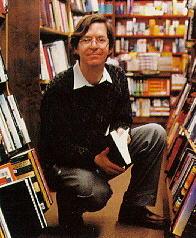
Man kneeling holding book amid shelves of books.
Alan Sokal (NYU Physics)

My classmates could not wait to jump on the subjectivist bandwagon.  They took turns agreeing that right and wrong are only social constructs.  I spoke up.  One of my peers worked for the sheriff’s department.  She was incensed that the crimes of Bernie Madoff resulted in the loss of funding for a local charity to help the mentally disabled homeless.  I had to insist: “If right and wrong are only a social narrative, then how could Bernie Madoff have committed any crime as his so-called victims were in fact other corporate fund managers at his own level? Many of them profited, some like the B'Nai Brith for thirty years.”  Silence.  We learned the mathematical babble of Gilles Deleuze who said that crime is a strange attractor becoming a torus.  That is not helpful to a jury.

The ins and outs of the Sokal Affair are important for everyone who cares about the apparent decline of the modern world. Listen carefully to President Barack Obama.  He was educated in the postmodernist method.  Conservatives claim that he is a Muslim or a Marxist, or both at once.  If he were either, he would not speak as he does.
“Ayn Rand is one of those things that a lot of us, when we were 17 or 18 and feeling misunderstood, we'd pick up. Then, as we get older, we realize that a world in which we're only thinking about ourselves and not thinking about anybody else, in which we're considering the entire project of developing ourselves as more important than our relationships to other people and making sure that everybody else has opportunity – that that's a pretty narrow vision.” (Obama and the Road Ahead: The Rolling Stone Interview,” By Douglas Brinkley; November 8, 2012.)
The key word is “project.” In the newspeak of postmodernism, the Enlightenment was a project. (It is on a global capitalist trajectory.)  Postmodernists “give space to voice” or complain that others deny it.  (See, for example, Feminist Political Ecology: Global Issues and Local Experience, edited by Dianne Rocheleau, Barbara Thomas-Slayter, and Esther Wangar. This is merely one out of many.)

The President is not the bad guy here.  He is just a man of his time, educated in a tradition, who thinks as he does.  A hundred others could have taken his place in the White House and in history.  The point is that postmodernism permeates our culture. This goes beyond the mere subjectivity of experience.  Even if I identify a car as “teal” while my wife calls it “aquamarine” the car still exists, as do absolute right and wrong.
  • Fashionable Nonsense: Postmodern Intellectuals’s Abuse of Science by Alan Sokal and Jean Bricmont, (Picador, 1999)
  • The Sokal Hoax: The Sham that Shook the Academy, edited by the Editors of Lingua Franca, (University of Nebraska Press, 2000)
  • Beyond the Hoax: Science, Philosophy and Culture by Alan Sokal (Oxford, 2008)
Previously on Necessary Facts

Tuesday, January 29, 2013

Systemic Injustice

We know the factors of failed justice.  Often, they form a syndrome.  No single correction or remedy will address them all.  The cures cannot be legislated.  Like all crime, ultimately it comes down to the individual who makes the choice.  Scandals are rooted in bad society, when injustice is rewarded because of willful corruption or careless disregard for consequences.  That may be easier to fix. 


Tucker Carrington, the director of the Mississippi Innocence Project, says he and his colleague Will McIntosh decided to pursue Mabry's killer themselves after they attempted to bring the case to the attention of the prosecutor in Humphreys County, and then to Hood's office, and received no response from either.

“When you take on a case and it reveals a glaring injustice like this -- something that could easily be taken care of if someone would just give it some attention -- you can't just turn a blind eye to that," Carrington says. "In the end, I guess we saw this through because no one else would.”

“In fact, the way forensics are handled in the courtroom has become a persistent problem across the country, not just in Mississippi. Forensic scandals have been erupting at crime labs nationwide over the last decade. Most recently, there was a scandal at the state drug lab in Massachusetts that could affect thousands of convictions; another drug lab scandal in Nassau County, N.Y., that could also hit thousands of cases; and misconduct at the state crime labs in Connecticut and North Carolina that have led to reviews of hundreds of cases, including murder convictions. Currently, there's an ongoing controversy involving the FBI's crime lab, in which analysts were found to have vastly overstated the significance of hair and fiber analysis while testifying in court. That too has spurred a review of thousands of cases going back more than a decade. The FBI lab had been considered one of the most elite crime labs in the world.”
Solving Kathy Mabry's Murder: Brutal 15-Year-Old Crime Highlights Decades-Long Mississippi Scandal by Radley Balko
Posted: 01/17/2013 1:42 pm EST
Updated: 01/17/2013 9:44 pm EST
http://www.huffingtonpost.com/2013/01/17/kathy-mabry-murder-steven-hayne-michael-west_n_2456970.html


A decade later, more-advanced DNA testing determined that there was semen from two men inside of Jackson, and neither of them was Kennedy Brewer. The state Supreme Court ordered a new trial. Despite the test results, Allgood planned to prosecute Brewer again. When The New York Times asked him why he hadn’t bothered checking the crime scene DNA against the state’s DNA database, Allgood replied that the state doesn’t have such a database. This came as a surprise to the man who had been running it.
“Bad Boys: A rogue’s gallery of misbehaving prosecutors, plus three worth praising” by Radley Balko from the July 2011 issue
http://reason.com/archives/2011/06/27/bad-boys

On LinkedIn
On 01/27/13 4:30 PM, Lettie McSpadden wrote:
--------------------
I've written an actual case study that has examples of most of the procedural errors that can be made by law enforcement officials.  It began with the murder of a girl, the arrest and trial of three men two of whom were convicted and sentenced to death.  Later the Illinois Supreme Court overturned the convictions and the prosecution tried the individually two despite the admission of guilt by a third party. During two new trials, convictions, and two subsequent Illinois Supreme Court appeals, the prosecutors refused to admit error even when the third man’s DNA proved his guilt. (Meanwhile he committed two other murders.)  After a preliminary hearing where one policeman’s previous testimony proved erroneous, a new judge ordered the release of the accused.
Unlike other prosecutions full of procedural errors, this one resulted in the investigation, indictment, and trial of three policemen and two prosecutors who were found not guilty. Nevertheless, a new prosecutor ordered an examination of the facts and subsequently indicted and tried the real killer who was found guilty and sentenced to death.  He has not been executed as Illinois has a moratorium on the death penalty.
Meantime the convicted men filed a civil case in federal for wrongful imprisonment, and it was settled by the county where the criminal trials took place for three million dollars.

“Mistakes Were Made:  Prosecutorial Mistakes or Misconduct?
Download on Amazon.com to Kindle  Or Createspace for hard copy.
Lettie McSpadden, Professor of Political Science, Emerita, Northern Illinois University; maclettie@gmail.com

A checklist of factors is all too easy to construct.
ü      Mistaken eyewitness identification
·        At the scene
·        Police Lineups
ü      False confessions
·        Coerced pleas
·        Faux perpetrators
ü      Unreliable informants
·        Street
·        Jail, prison
ü      Prosecutorial misconduct
·        Withholding evidence, especially exculpatory evidence
·        Theorizing the existence of unidentified assailants
ü      Flawed forensic science
·        Laboratory fraud
·        Laboratory misconduct
·        Junk science
·        Pseudo-science
ü      Ineffective legal counsel
·        Physical resources
·        Courtroom community
ü      Prejudices, especially racism
·        Presumption of guilt
ü      Authoritarianism
·        Subjectivity of Policing

Based on Wrongly Convicted:Perspectives on Failed Justice by Saundra D. Westervelt and John A. Humphrey, eds., Rutgers University Press, 2002.

Friday, January 11, 2013

Four Books About Bad Science

When Science Goes Wrong: Twelve Tales from the Dark Side of Discovery by Simon LeVay (Plume Penguin, 2008).  LeVay lays out his facts in careful narratives.  In many cases, he interviewed the key actors, albeit some years after the events.  He marshals the pros and cons before stating his final conclusion.  The cases come from a several sciences, including volcanology, criminology, meteorology, microbiology, genetics, and nuclear physics. 

In 1993, geologists attended a conference in Columbia where the Galeras volcano had become active. They visited the calderon, climbing down into the crater. When it erupted, most of them were killed.  Among the survivors was the only scientist actually wearing the protective gear mandated by the National Science Foundation.  Some of the victims were in jeans and sneakers. 

The case from criminal forensics about Josiah Sutton of Houston, Texas, took DNA evidence past the confines of even the Innocence Project.  In this case, the so-called gold standard of physical criminalistics proved to be fool’s gold.  The police lab had committed a series of mistakes, some perhaps accidental and careless, others apparently purposefully fraudulent.  The victim wrongly identified two men as her attackers.  When the DNA samples matched neither man, the prosecutor insisted on their guilt, and posited the existence of a third unidentified attacker.  This is a common ploy with prosecutors who refuse to admit their mistake. 

Embargoed Science by Vincent Kierman (University of Illinois Press, 2006).  Major academic journals such as Nature, Science, the New England Journal of Medicine, and a hundred or so others, have a policy of announcing important publications by sending press releases to major mainstream media on the condition that the reporters not publish until the journal does.  The result is loud bursts of astounding science stories breaking on our awareness ... which then fade … until the next time.  The true costs include the loss of reflection and review, as contradictory findings roll out over the years without in-depth comparison and contrast.  Another cost is the loss of independence both of the news media which will not pursue a story beyond the press release; and also among the scientists who are constrained to divulge only what they publish in peer-reviewed journals. 

Yes, We Have No Neutrons: An Eye-Opening Tour Through the Twists and Turns of Bad Science by A. K. Dewdney (John Wiley & Sons, 1997).  Dewdney took over from Martin Gardner in Scientific American, and this book is a modernization of Gardner’s Fads and Fallacies in the Name of Science.  The stories here about N-rays, intelligence quotients, Freudian psychotherapy, cold fusion, Biosphere 2, and SETI (the Search for Extraterrestrial Intelligence) are exemplar warnings to avoid the known dangers of confirmation bias, arrogance, and ambition. 

Dewdney offers the model of the sorcerer and the apprentice for his narrative analogy.  It is the familiar story from Goethe as delivered by Disney.  We all make mistakes, even sorcerers.  It is when the apprentice presumes beyond his true abilities that disasters unfold.  In these stories, disasters come from scientists who should be sorcerers acting like mere apprentices, forgetful of the full canon of the scientific method, from the creation of testable hypotheses to publication and peer review. 
Yes, We Have No Neutrons does not address fraudulent science, but mistaken science. The appropriate persona, therefore is not the con artist, but the bumbler: the apprentice if you will.” (Page 2) “What is bad science? To begin with, whatever it means, bad science must be distinguished from fraudulent science.  Apprentices, by definition, honestly believe that they are sorcerers. Fraudulent scientists (and would-be scientists) know that they are cheating when they fudge experiments, steal ideas, or make false claims. They are more like evil magicians than apprentices. …  Bad science happens when someone strays in a fatal way from the scientific method.” (Page 17).
Dewdney takes the reader through three doors to explore the castle of science.  First, he differentiates technology from science.  “Technology consists of objects that have specific purpose. Science consists of methods and results.”  This is important because in the mass media the equipment of science – antennae, computers, reactors, satellites, etc. – stand for science.  Dewdney points out, however, that these are not essentially different from other examples of our material culture such as bicycles, dental floss, lawn mowers, refrigerators, and telephones. 

Indeed, I add here that in the book Biopunk: DIY Scientists Hack the Software of Life by Marcus Wohlsen (reviewed on Necessary Facts here), the author points out for 100 years, scientists from Pasteur to Salk worked without apparatus that we have in our kitchens. The same applies to our garage and basement workshops.  The point is that the mass media presentations of the gizmos and gadgets confuse technology with science, which Dewdney carefully delineates.  Science is a method.

However, Dewdney falls into the analytic-synthetic dichotomy. His second door delineates deductive from inductive science.  He does not unify the two, though, indeed, they must both identify the same reality.  Behind the third door is the getting and testing of ideas.  Scientists observe, ask questions, formulate hypothesis and perform experiments.  The goal of the experiment is to challenge and pass the theory.  This is where most of the fallen sorcerers reveal themselves to be mere apprentices.  Sigmund Freud built his wonderful theories from six case studies and no statistical samples or blind tests. 

Junk Science: How Politicians, Corporations, and Other Hucksters Betray Us by Dan Agin, Ph.D., (Thomas Dunne St. Martin’s Press, 2006) repeats many of the known stories of Piltdown Man, eugenics, phrenology, and Lysenko.  As a working biologist, he also offers cases that are less well known to the general public, such as Emil Abderhalden’s “defense enzymes.”  Agin also writes about the recent cases (1997-2004) of Marion Brach, Friedhelm Herrmann, and Roland Mertelsmann who conspired to publish at least 37 and perhaps 100 papers for which the experiments and data were entirely fabricated.

“There are two prevalent myths concerning scientific fraud.
The first myth states that most scientific experiments are replicated by other laboratories, that science is self-correcting because the discovery of fraud involving the fabrication of data is inevitable.
 The second myth is that scientific papers involving fabrication of data are extremely rare, with only a few fraudulent papers published in any one year." (Page 39)
In fact, given the huge body of published papers, even a small percentage of fraudulent cases – perhaps only 0.04% according to the arithmetic of published cases from the Office of Research Integrity of the U.S. Department of Health and Human Services – means that from the 5,600 significant scientific journals come 400 fraudulent papers each year.  However, by the metrics of criminologist Liqun Cao, (see previous posts on this blog) the number might be closer to 200,000 given that the intentional harms might be small: rounding up or rounding down, dropping inconvenient data, etc.  The median guess might be the most accurate. “In one survey published by American Scientist in 1993, between 6 and 9 percent of scientist respondents said that they were personally aware of results that had been plagiarized or fabricated within their facilities.” (Page 40)

The downside is that Dr. Agin has his own political views which color his diagnosis and remedies.  Corporations can be evil in selling us what we demand – such as junk foods and the fad diets to counter their effects, to say nothing of cigarettes – but the government is only unresponsive when politicians give in to the “wrong” pressure groups, such as Christians who were opposed to embryonic stem cell research.  Agin accepts all of the claims of anthropogenic global warming. He agrees with its fundamental reality. He falls in with the inevitable consequence that governments must do something immediately, no matter how severe. 

Dan Agin’s politics aside, the book is nonetheless an outstanding expose of many instances of bad science, much of it going on right now.