Showing posts with label philosophy of science. Show all posts

Wednesday, August 19, 2026

Waves Passing in the Night

In the history of astronomy, there was a conjecture in the 1760s that the planets orbit the sun in distances that can be described by a simple rule: 

Raise 2 to the power of the planet in sequence:

Multiply that by 3.

To that product add 4.

Divide that sum by 10. 

You get a measurement in “astronomical units” i.e., Earth-distances. And it is almost correct. After Mars, before Jupiter, there needs to be a planet Number 5. Then Jupiter is 6 and Saturn 7. Seeking Planet 5 led to the discovery first of Ceres in 1801, then Pallas (1802), Vesta (1807), and so on; and we are still finding asteroids in that gap. 

Today, the “Titius-Bode Conjecture” is ignored by serious astronomers. It is accepted as an accident of algebra that any small distribution can be described by some formula of arbitrary simplicity. 


Waves Passing in the Night:
Walter Murch in the Land of the
Astrophysicists; Bloomsbury, 2017.

Walter Murch found it compelling. Murch is a musician. He was born in 1943; his family was literate, artistic, and economically comfortable. Young Murch was fascinated by sound and by age 12 he had his own tape recorder. Decades later, he received Academy Awards for working on Apocalypse Now, The Godfather, American Graffiti, and other films. Murch found a deep truth in the Titius-Bode Conjecture. To him, it is evidence of the Music of the Spheres: something that we perceive caused by something deeper, more subtle, that we do not. 

Murch’s biographer, Lawrence Weschler, loves his subject. Weschler is more than fair to Murch’s detractors. No serious astronomer agrees with him. They will not even read his papers to refute them. This is not about medieval geometry: Murch has extended his theory to include wave mechanics as applied to gravity. That led one scientist to ask: “Why do our interplanetary spacecraft not detect such disturbances?” It is a cogent question. 

I snagged this book from my city library’s “De-acquisitioning Bookcase.” (25 cents each, all with their library call numbers on them. What would Eratosthenes say to that?) I took it down because of the title, but it fell open to Ernst Chladni and his waves in sand on a vibrating steel plate. When I worked at the Hands-On Museum in Ann Arbor, this was a learning station in the gallery. I referred to it often when explaining fireworks in the kitchen to mixed audiences. I would say, “We can imagine electrons as little balls with minus-signs orbiting a nucleus, but it is more helpful to think of them like those standing waves of sand, as probability distributions.” 

So, the book seemed complex, over-arching, challenging, and probably wrong, but certainly interesting. And it is all of that. 

Weschler lets Murch do his own advocating. Aside from the necessary explanations, Weschler just points the reader to Murch’s website and other works. For a thin book (150 pages), it stands on eight pages of references. It seemed like a good way to get lost and if I had more time, I might follow that path. 

For now, I am happy to have reinforced my belief that the universe is not merely knowable, it is comfortable. And there is sound in space.

PREVIOUSLY ON NECESSARY FACTS

G. H. Hardy’s “Apology”

Elisha Loomis and the Pythagorean Proposition 

Imaginary Numbers are Real. Pegasus is not. 

The Man Who Loved Only Numbers 


Sunday, May 17, 2026

This Island Earth

Although some scholars find the roots of science fiction in ancient myths and fantastic poems such as A True Story by Lucian of Samosata, the fact is that science fiction depends on science which did not exist before the Enlightenment of the 18th century. The word “scientist” was invented by William Whewell in a moment of argument with Samuel Taylor Coleridge at a meeting of the British Association for the Advancement of Science on 24 June 1833. Coleridge insisted that these people did not deserve the title “natural philosophers” and Whewell replied with a parallel to art and artists: “We are scientists.” The first issue of Scientific American was published on 28 August 1845.

Mary Shelley’s Frankenstein is often cited but her own three versions tell only of Victor Frankenstein's explorations of medieval paradigms and the narrator is emphatic in not revealing his methods, lest they be duplicated with inevitably horrible consequences. Nobel laureate Steven Weinberg insisted in To Understand the World, that science depends on experiments which are purposefully unnatural arrangements to isolate the essential distinguishing actions of objects. Considering that thesis, we must grant that Victor Frankenstein pursued science, not mysticism. 


Jules Verne and H. G. Wells are commonly credited as the first narrators of adventures based on new scientific theories and their applications. Prior to them, John Leonard Riddell, chief melter at the New Orleans Mint, and a professor of chemistry at the New Orleans Medical College (which became Tulane University), published Orrin Lindsey's Plan of Aerial Navigation in 1847. Presaging the “golden age” of science fiction before the 1960s, the trip to the Moon is supported by laborious footnotes providing calculations, even for recycling breathable air by the same chemical methods used today. Riddell’s explanation of anti-gravity drive is necessarily sketchy though no more so than our faster-than-light warp drives. At a lecture at Michigan State University about 1976 or so, Gene Roddenberry said that when they need gravity on board a starship, they flip the gravity switch to On. 


In the book and movie, The Right Stuff, a news reporter first asks, “Do you know what makes these birds fly?” and an Air Force pilot starts to say, “Why the aerodynamics alone would take…” and he is cut off. “Funding,” is the reply. “No bucks, no Buck Rogers.” Every pilot at Pancho’s cantina knew exactly what was said. Later, the line is repeated by an astronaut arguing with a NASA administrator: “… and to the American people, we’re Buck Rogers.” 


This Island Earth is a 1955 American science fiction film 

produced by William Alland, directed by Joseph M. Newman 

and Jack Arnold, and starring Jeff Morrow, Faith Domergue, and Rex Reason.

The 1952 novel by [Raymond F.] Jones was originally serialized 

in the science fiction magazine Thrilling Wonder Stories as three 

related novelettes: "The Alien Machine" (June 1949), 

"The Shroud of Secrecy" (December 1949), and "The Greater Conflict"

(February 1950). Jones had taken the novel title from a line
in Robert Graves' 
poem "Darien":

It is a poet's privilege and fate
To fall enamoured of the one Muse
Who variously haunts this island earth

-Wikipedia — https://en.wikipedia.org/wiki/This_Island_Earth

This Island Earth (NASA)
one of hundreds of science and
engineering titles de-acquisitioned by
the Astronomical Society of the Pacific.


"This Island Earth. Edited by Oran W. Nicks. NASA SP-250. Washington, D.C.: Scientific and Technical Information Division, Office of Technology Utilization, National Aeronautics and Space Administration, 1970. x+182 pages. For sale by Superintendent of Documents, $6.00 (Library of Congress Catalog Card no. 73-608969).  Reviewed by Julian R. Goldsmith, University of Chicago, The Journal of Geology, Volume 80 Number 3, May 1972. Also reviewed in Science News, Vol.117, P. 348, 1980, among other citations.


Previously on Necessary Facts


From Texas to the Moon with John Leonard Riddell 

Fantastic Voyages: Teaching Science with Science Fiction 

Monsters from the Id 

Psychohistory from Asimov’s Foundation to Big Data 


Sunday, August 15, 2021

The Scientific Method

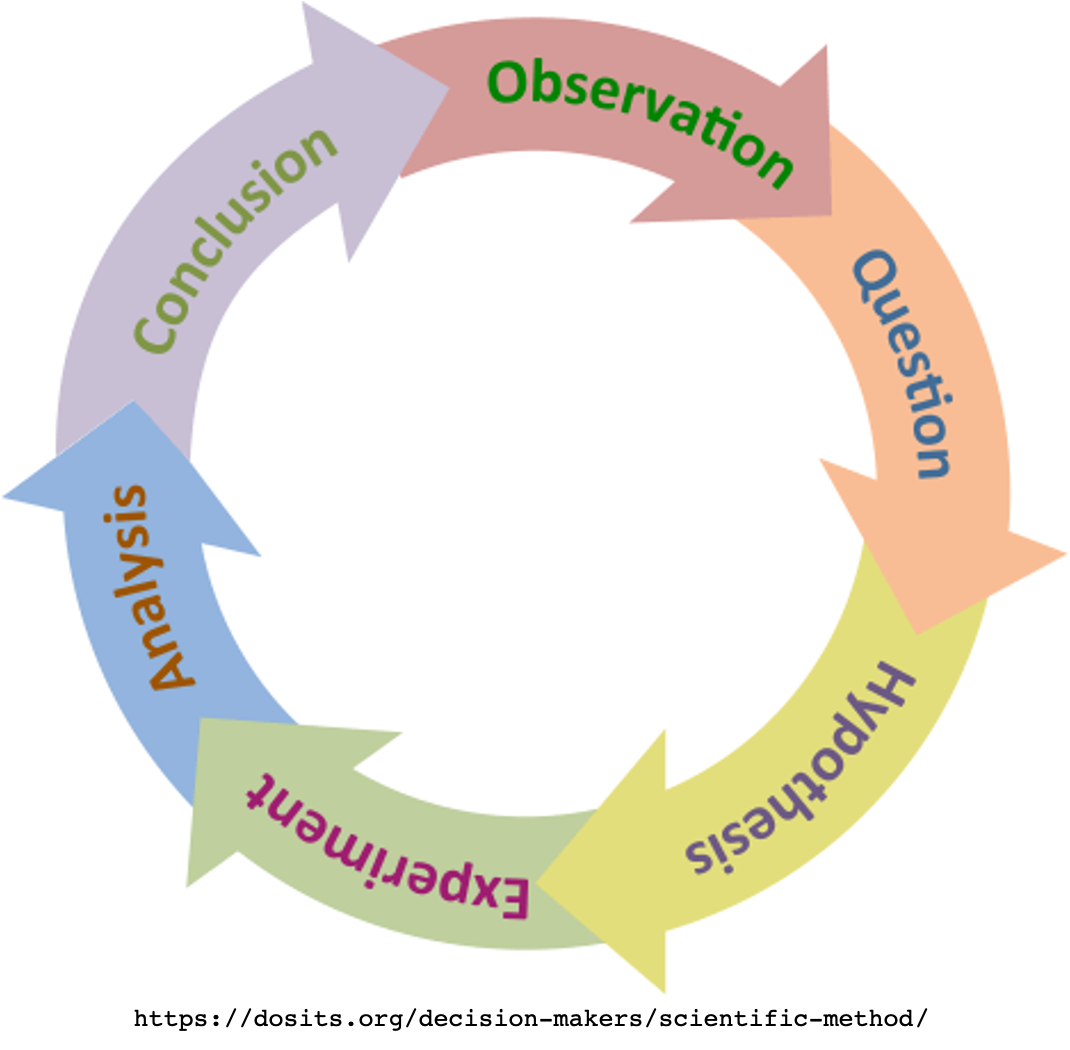
Emergency management, physical security, and information security are three disciplines in which the process of continuous improvement is a model for action. We have cycles of emergency-response-mitigation-remediation. Therefore, I found it interesting to have the Scientific Method presented as a cycle. 

Discovery of Sound in the Sea (DOSIS) is a website created by the University of Rhode Island and the Inner Space Center, here: https://dosits.org


Copyright © 2002-2021 
University of Rhode Island and Inner Space Center. 


Among their website pages is a self-quiz on Facts and Myths. 
1. The greatest uncertainty in understanding the effects of anthropogenic underwater sound on marine animals is understanding how sound propagates.
See the Answer - This is a MYTH
There are many factors that contribute to the uncertainty of how underwater sound impacts marine animals. These include ... 

22. One way to arrive at “scientific truth” is to conduct an opinion poll of scientists.
See the Answer - This is a MYTH
An opinion is a personal judgment or belief, not necessarily based upon fact. On the other hand, “scientific truth” is arrived at through the scientific method, which is an orderly and very well-established process for asking questions about the natural world and testing the answers. Hypotheses that have been consistently validated through observations or experimentation can eventually be advanced to the status of theory. A theory is a thoroughly substantiated explanation of some aspect of the observable world. Theories come as close to objective truth as possible.

PREVIOUSLY ON NECESSARY FACTS

Wednesday, June 30, 2021

Morality and the Philosophy of Science

Science is consistent and integrated because reality is real. Contradictions do not exist. When we meet an empirical fact for which no explanation exists, it is called an “anomaly” until we understand more and integrate the fact into a new or wider abstraction. Astronomy advanced as neutron stars, quasars, and pulsars were discovered. Even the rings of Saturn attest to this in the 250 years between Galileo’s sighting and Maxwell’s complete theory. Against that, scientists feel that it is unjust that private investors will not fund their Christmas shopping lists. So, they turn to requests for tax dollars. The laws of economics are denied as an inconvenience.

The physicists who worked on the Manhattan Project were later to worry about the horrors they enabled. (Edward Teller seems to have been an exception.) As the best known among them Albert Einstein was asked to sign Leo Szilárd’s petition to the American government to build an atomic bomb. They feared that Germany was on the same program. That the Nazis should command a weapon of such destructive power was not merely consequential but existential. So, they gave it to the United States which did what Germany never could have. From the USA, nuclear weapons spread to the USSR, the United Kingdom, France, China, India, Pakistan, Israel, and (ultimately) Iran. The lesser of two (or twenty) evils remains evil. 

The problem of the Manhattan Project intersects two facts: 

(1)  The Nazis could never have completed a program in nuclear energy. Any progress that they could have made could only have come from giving them what they could not create. Ultimately, it is a fact of metaphysics, epistemology, politics, and economics that regardless of incremental achievements, the final goal was beyond their abilities. 

(2) The small gains came only because people of great ability lacked a correct philosophy to provide moral and ethical guidance. It is a fact of life that you should not work for your own destruction: you should not deliver your mind to your destroyers.


Muscle Mystics

Whether fascists, communists, nationalists, socialists, or some other trending label such as antifa, collectivists deny the validity of human intelligence. Perhaps it is because they have no direct experience with it. The observed facts of history are that they all focus on seizing existing goods or compelling the continuation of existing services. Karl Marx epitomized the mindset of collectivism when he declared that capitalism had solved the problem of production and “now” (1848) was the time to distribute the goods—just when the first electric telegraphs were being adopted by transcontinental railroads, thirty years before the telephone, and fifty years before radios would direct aircraft, and a hundred years before people were putting televisions in their homes. Never knowing of penicillin, sulfa drugs, polio vaccine, open heart surgery, x-ray pictures, CAT scans, or MRI scans, Marx declared that we all could have everything we would ever need to be happy if we just took it from other people. A truly radical sociologist would have asked what is the source of improvement, innovation, invention, and discovery. 


The muscle mystics expect possession of physical objects to imbue them with the knowledge to use the tool. To produce steel, they only need to seize a steel mill. 


Of course, that plan failed. During World War II, the USA shipped to the USSR thousands of tons of raw materials, thousands of vehicles and other manufactured goods. It sat on rail sidings and rusted into uselessness. (See Victor David Hansen’s The Second World Wars  as well as The Wise Men: Six Friends and the World They Made by Walter Isaacson and Evan Thomas, both reviewed on this blog.) After World War II, the USSR uprooted and transported German factories. They did not make Russia rich. It takes at least a modicum of intelligence to follow a pre-defined routine earnestly and conscientiously, making trivial adjustments in response to minor variances. But no one is more conservative than a communist: varying the routine is dangerous. 


Standing Hegel on his head, as Marx claimed he did, still leaves you with Hegel; and Idealism was also the bedrock of fascism. The fascist man of action does not engage in bourgeois logic. He follows the instincts of his nation. Dialectic Materialism is not just a framework. It is dogma. So, Albert Einstein’s theories of general and special relativity were not accepted in communist China. (See “Organized criticism of Einstein and relativity in China, 1949–1989,” by Danian Hu, HSNS (Historical Studies in the Physical and Biological Sciences Volume 34, Issue 2 March 2004; and “The Reception of Relativity in China” by Danian Hu, Isis, Volume 98, Number 3, September 2007.) But it is known that the Nazis rejected “Jewish physics” and insisted on pursuing nuclear energy according to some theories different from quantum mechanics. 


Regardless of the destruction of the heavy water plant in Norway by British commandos, the Germans were never going to succeed at anything as complicated as nuclear weaponry. The United States succeeded only because LTG Leslie R. Groves ran interference for the geniuses. During World War II, all sides, each some variant of collectivism, only cashed in their intellectual bank accounts. Because American society was less regulated, we succeeded. Having the brightest minds from Europe on the project certainly was the engine, but the Manhattan project required very much more than a handful of Nobel laureates. And once they had the bomb, the government no longer needed J. Robert Oppenheimer or the others. Second-handers could follow in their footsteps.


But even that required another generation of people who were accustomed to thinking for themselves, following their own passions, making their own lives better by whatever personal philosophies they held explicitly or implicitly. That is different from the morality of collectivism. 

Today, as never in the 19th century or most of the 20th centuries formal, professional science is informed, guided, and ultimately controlled by a single ideology. I am an Amateur Affiliate member of the American Astronomical Society. I serve as an editor in the History of Astronomy Division where I am responsible for a monthly column. I also serve on a committee to develop collaborations between amateurs and professionals. The AAS is actively engaged in ensuring that you have the right to insist on your own personal gender pronouns. Your right to question the claims of anthropogenic global warming is somewhat less secure. As a backyard astronomer, I am sorry that my night skies are more degraded by light pollution than they were a year ago when we were shut down because of Covid. I also know that if you want really dark skies at night you can go to some wilderness or desert or North Korea. That fact has not been integrated into the sociological perspectives of the AAS which lobbies for dark skies and against constellations of communications satellites. The muscle mystics of science want the material benefits of industrialization without understanding the engine of creation which delivers them.


Murray N. Rothbard penned Power and Market: Government and the Economy (free as a PDF from the Mises Institute here: https://mises.org/library/power-and-market-government-and-economy). His thesis was that political decisions are necessarily unprofitable. Ignoring and denying the facts and theories of economics, political decisions are always net losses of value. 


The integration of knowledge in accordance with facts of reality requires that every scientist who is funded by government grants is making your life harder, shorter, and poorer.


Astronomy does have its uses. Timekeeping is fundamental to coordination of efforts across continents in a complex global society. Launching communications satellites is cheaper than laying wire over jungles and under oceans. Economic justifications for advanced scientific research do exist. 


And, personally, I understand the insight of John Arnold: “What comes out of a team or a committee is the most daring idea that the least daring man can accept.” (“Space, Time and Education,” Astounding Science Fiction, May 1953, pp. 9–25. Introductory remarks by John W. Campbell, Jr., editor, pp. 9–10.) But the government works largely by force (occasionally by fraud). Forcing people to give you money against their will makes you a thief. Taking it by fraud defines you as a con artist. When it comes to sales and marketing, it is a necessary fact that selling science is hard work because it requires using logic and evidence to appeal to people who live by logic and evidence.

PREVIOUSLY ON NECESSARY FACTS

Why Evidence is Not Enough
Politics and the Inverse Square Law
How I Found Freedom in an Unfree World


Saturday, June 26, 2021

An Objective Philosophy of Science

In framing her philosophy as capital-O Objectivism, Ayn Rand was following in the tradition of Enlightenment objectivism, which was never explicitly defined in its own time. Enlightenment objectivism broadly asserted an integration of two schools of thought, continental rationalism and British empiricism. We know it commonly as the scientific method: theories explain facts; facts test theories. You cannot have one without the other. 

Furthermore, necessary factual truths do not contradict each other. Whatever is true in biology, sociology, history, or aesthetics supports and is supported by truths in physics, chemistry, economics, or ethics. It is also true that facts are contextual. Breaking a rack of billiard balls is different from charging into a crowd on a street corner.


I find it frustrating and disappointing when experts to whom I turn for knowledge about astronomy blunder when they discuss philosophy. For me, the nadir has been Nobel laureate Steven Weinberg who praises Paul Feyerabend in Dreams of a Final Theory. Unfortunately, Dr. Weinberg is not alone in lacking an objective philosophy of science. It remains true that Steven Weinberg has much to teach about applying philosophy to science. 

The Philosophy of Science according to Steven Weinberg.
He is always interesting and not always wrong.
I also have his textbook on astrophysics.
(If he's wrong there, it's above my level.)


Ultimately—and here I side with Weinberg and not with my Objectivist comrades—even mathematics describes and explains physical facts, whether or not we perceive them. See “Imaginary Numbers are Real: Pegasus is Not” here on this blog. For Objectivists who adhere to the final writings of Ayn Rand, mathematics is the science of measurement. (See Introduction to Objectivist Epistemology.) Unpublished are any notes or journal entries from Ayn Rand on the tutorials that she took in mathematics late in life, even if they exist. Regarding the “hard realism” of mathematics, I offer my own theory, i.e., an integrated conceptual explanation of known facts, which differs from canonical Objectivism. My understanding was informed by Nobel laureate Steven Weinberg’s book, To Explain the World. Weinberg asserts a philosophical assumption that he calls “hard realism” when he demonstrates that the modern scientific method was discovered, not invented. It exists independent of the observer and is the same for anyone anywhere.


These are two aspects of the same reality.
No dichotomy exists.
Leonard Peikoff's doctoral dissertation on the 
Analytic-Synthetic Dichotomy is reproduced in
recent editions of Introduction to Objectivist Epistemology.

Weinberg allies himself with the scientists who are being assaulted in “culture wars” in which postmodernists like Paul Feyerabend claim that there is no such thing as “science” only a “scientistic narrative” that (in their terms) “privileges white males and denies space, voice, and agency to women and persons of color” who have been and are oppressed by “the Enlightenment project” of colonialism, imperialism, and capitalism. 


I suffered through a semester of that in my final graduate class in criminology in which our texts were Philosophy, Crime, and Criminology, edited by Bruce A. Arrigo and Christopher R. Williams (University of Illinois Press, 2006) and Essential Criminology Reader, edited by Stuart Henry and Mark Lanier (Westview Press, 2006). Pseudo-mathematical fashionable nonsense such as “crime is a torus” and “crime is a strange attractor” were offered along with denunciations of open-market economics and the Enlightenment. (For more about “fashionable nonsense” see The Sokal Affair and Reflections on the Sokal Affair on this blog.)


Among the many strengths of Ayn Rand’s essays on philosophy was her insistence on connecting the higher studies of aesthetics, politics, and ethics to fundamental truths in epistemology and metaphysics. The lack of such integration is evident in the opinions of scientists who endorse political solutions to anthropogenic global warming. Even if AGW were real, the integration of reason and reality indicates that market solutions offering valuable products and services would be more effective than legislation restricting human action.


I read it often enough to wear it out.
The one on the right has my marginalia.

The relationship between inspiration and proof is that based on your lifetime of experience, you can have an intuitive feeling that a course of investigation will be fruitful and reveal new facts and therefore perhaps deeper or wider truths. But you cannot convince another scientist by a heartful plea. You must provide evidence and your method must be repeatable. 


As a judge in regional science fairs for the past eleven years, I have seen the consequences of failing to hold to that standard. Quite simply, we reward creativity and originality and discount and even denigrate the mere repetition of a known experiment. It is true that careful work is expected as the baseline of performance. So, you do not get an award just for doing a good job. But we never see any of these bright youngsters challenging or refuting a previously accepted claim. 


I find that especially disappointing because I judge in behavioral and social science. Unlike the physical sciences, working social science researchers do test and challenge each other’s published works. Unlike the physical sciences, in my undergraduate curriculum, I had a 200-level class in research methods that required the critical examination of peer-reviewed journal articles. In graduate school, even though I steered to starboard, as long as I presented a coherent reply based on facts, my essays earned A grades. And in one class, I had a colleague whom I would describe as “to the right of the Kaiser” and he got A grades, also. On the other hand, serving on a committee of the American Astronomical Society, criticism of AGW is pointedly unfashionable. The subject came up because astronaut, geologist, and “climate denier” Harrison “Jack” Schmitt is scheduled to be a guest speaker at the Astronomical League conference in 2022.


In Dancing Naked in the Mind Field, Nobel laureate Kary Mullis described how the inspiration for polymerase chain reactions came to him while driving his sports car through the Sangre de Cristo mountains near Santa Fe, New Mexico. Whatever the personal inspiration, proof to others of the process required publishing repeatable results according to the scientific method. In that book, Mullis also mused about the validity of natal astrology when he noticed that many other scientists in his field were born about the same month as he. Astronaut Ed Mitchell attempted experiments with ESP. Any working scientist is in good company in denying or even denouncing astrology and ESP. However, absence of evidence is not necessarily evidence of absence. Lacking proof and making a claim is wrong but seeking proof according to the scientific method is not. On that note, I point out that we accept the electroencephalograph as a valid instrument and yet deny that people can communicate directly mind-to-mind. Maybe we just do not know how to measure it yet. 

On the problem of failed experiments, Edward W. Morley was not satisfied with the results of his famous tests and continued to pursue the luminiferous ether. This speaks to the fact that Ayn Rand called her philosophy Objectivism, not Absolutism. While many things in life are absolute, your choice of a career is not one of them. Morley was acting in his best interests by his best judgment when he continued to pursue empirical verification of the ether. He did not sacrifice everything, or even anything. He continued to be productive as a working researcher. His choice was objectively correct. 


In the AAS committee that I serve on to facilitate collaboration between amateurs and professionals, one of my colleagues suggested that we recommend that all of us who practice science engage in community outreach to teach critical thinking. I pointed out that Dr. Harrison Schmitt is not alone among my conservative comrades who are degreed engineers and who believe that they engage critical thinking when they deny climate change or endorse conspiracy theories. The attainment of objective knowledge requires more than doubting whatever you feel that everyone else believes.


In order to work successfully, scientists must implicitly accept the axioms of Objectivism: Existence, Consciousness, and Identity. These are colinear, not hierarchical. We accept that we possess consciousness, that something exists outside of our consciousness, that whatever we discover has a specific nature that we are capable of knowing. In Understanding Objectivism: A Guide to Learning Ayn Rand’s Philosophy, Leonard Peikoff addressed the fact that epistemology and metaphysics are interwoven. Many students of Ayn Rand’s works misunderstand the hierarchy of philosophy to mean that reasoning from the law of identity you can rationally derive the laws of epistemology. It cannot be done. That is the failure of philosophical rationalism from Plato to Descartes to Russell. The alternate choice of the false dichotomy is positivism going back to the ancient medical writers who treated diseases without attempting to understand their deeper causes. Objectivism integrates the mind and the body, our ideas with our experiences. 


Consider the moralistic handwringing of scientists awestruck and terrified by the atomic weapons they created and delivered to the political leaders of their world. Two of Rand’s novels address the question of who benefits from your work, The Fountainhead (implicitly) and Atlas Shrugged (explicitly). Rand wrestled with the problem earlier, as expressed in a play, Think Twice. I am not aware of anything like this in science education. I had a graduate class in ethics in physics. We were concerned more with adhering to the procedures of science than with the purposes to which it is put.


(To be continued.)


Previously on Necessary Facts

Gregory M. Browne’s Necessary Factual Truths 

The Influence of Ayn Rand’s Objectivism 

The Scientific Method

Harriman’s Logical Leap Almost Makes It 

That Goddam Ayn Rand Book 


Also on Necessary Facts

Patent Nonsense: Intellectual Property Rights and Non-Objective Law 

Four Books About Bad Science 

Another Case of Fraud in University Research 

Misconduct in Science and Research 

Junk Criminology as Pseudo-Science 

Criminalistics: Science or Folkway? 


Sunday, May 30, 2021

Steven J. Dick’s Discovery and Classification in Astronomy

Thomas Jefferson did not say that it “was easier to believe that two Yankee professors could lie than to admit that stones could fall from heaven.” But he could have because the celestial origin of meteors and meteorites was not established until 1863. Steven J. Dick (NASA Chief Historian, 2003-2009) calls earlier claims the “pre-discovery” phase. After discovery—the correct identification of an object—come classification, controversy, and consensus. 

Pre-discovery of the Sun, Moon, and stars begins with our hominid ancestors. Uranus and Neptune had pre-discovery phases because they were spotted and recorded as stars before they were identified as planets. Uranus was recorded (as a star) by British Astronomer Royal John Flamsteed six times in 1690. Galileo recorded Neptune (as a star) on December 28, 1612, and January 27, 1613. When William Herschel identified it as a planet, there was some controversy between 1781 and 1783 but the matter was soon settled. Pluto, on the other hand, stands as a counter-example. It had no pre-discovery phase. When discovered, it was accepted as a planet. Only later did controversy change its classification and a new consensus evolve. The catalyst for that change was understanding, and the process was an evolution.


The stars were even less tractable and nebulae all the more difficult to isolate into classes. At first astronomers expected that better telescopes would resolve all nebulae into fields of stars. That did happen with some. Others were found to be huge volumes of gas or dust that absorb or reflect or emit radiation. Still others eventually were identified as types of galaxies, again, with some controversies that are not yet entirely settled.

Discovery and Classification in Astronomy: Controversy and Consensus by Steven J. Dick (Cambridge University Press, 2013), is a taxonomic history. Dick alludes to parallels in the development of biology and chemistry which he offers as more mature paradigms. The periodic table of elements allowed predictions. Astronomy has nothing like it. Biology still has controversies but it has millions of species to consider. Astronomy has fewer than 100, 82 by his count. In most cases, each discovery was a thing-in-itself until improved understanding (usually through controversy) revealed others of its kind. 


The main narrative of 340 pages delivers a chronology by types from planets to quasars and then reviews the works and publications to reveal the patterns (Part IV) and the drivers of discovery (Part V). Part VI closes with The Meaning of Discovery.

“… discoveries end with a basic understanding of the fundamental properties of a class, but before mature understanding, as defined by knowing an object's place in an evolutionary scheme.” (page 331). The process can take centuries as with the planetary nebulae. Dick also believes that since 1960 or so we have come to a mature evolutionary scheme for the universe. (page 331). 


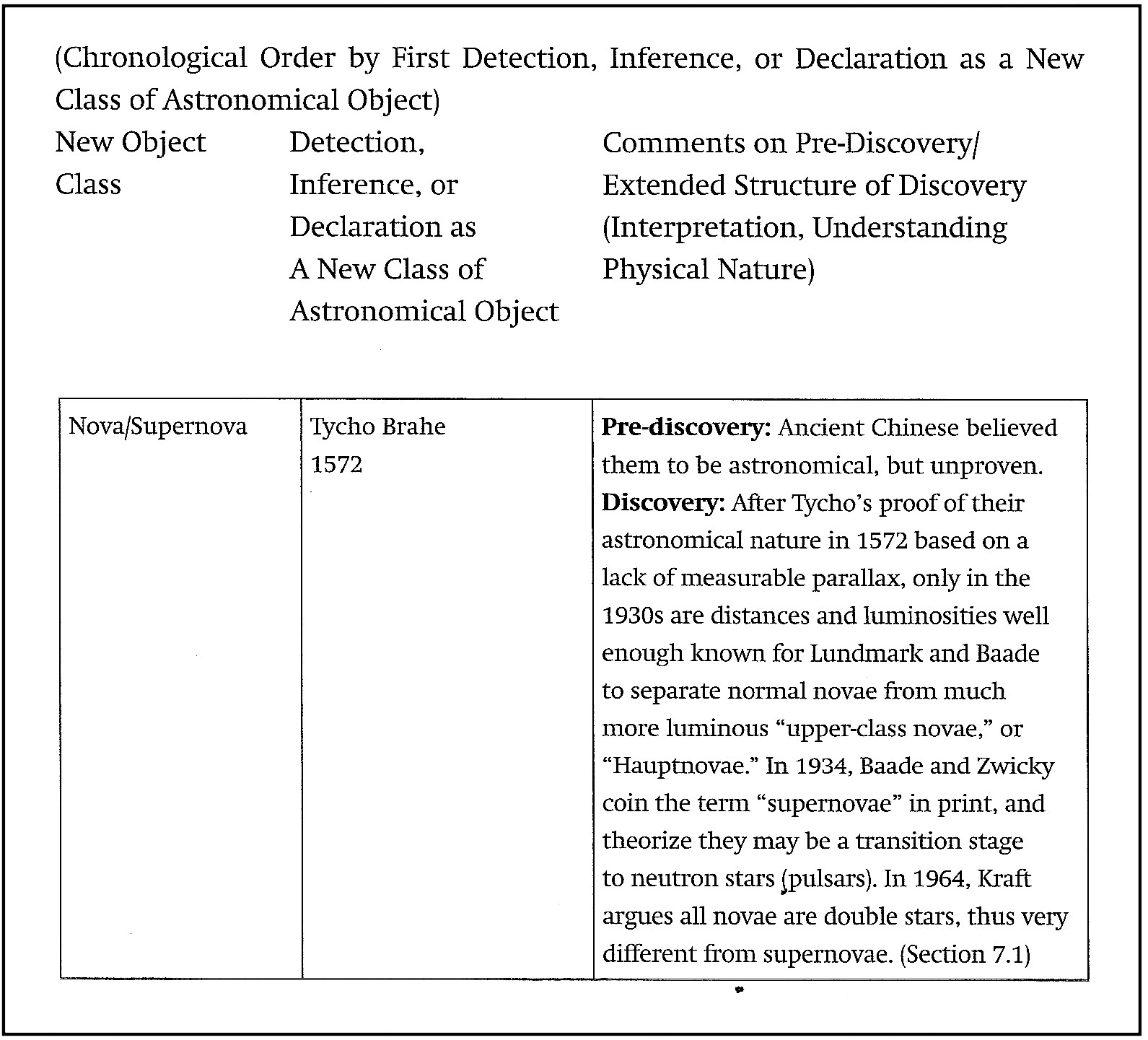
Having presented the facts, Dick then organizes them into a Three Kingdoms model: Planets, Stars, and Galaxies. It fits on two landscape pages as Appendix 1. Appendix 2 “Astronomical Discoveries and Their Extended Structure” is a detailed tabulation of 82 objects, from Novae through  Proto-Galactic Clouds, identifying the discoverer and citing the pre-discoveries. 


I got the book from the library because in our home we are of one mind on not acquiring more stuff. However, I bought it because it is more conceptual than a history of astronomy or, more narrowly, astrophysics (which I regard as the touchstone of astronomy) and it is more concrete than a philosophy of science. 

As valuable as I regard the work, I do differ from Dick on his metaphysics and epistemology, and I have some quibbles with his history. In the main, however, his assertions are supported by deep foundations of facts in their correct contexts. 

One oversight is in the history of meteorites. Dick makes no mention of the surviving commentaries by Plutarch, Pliny, and Diogenes Laertius about Anaxagoras of Klazomenai who allegedly tracked and found a meteorite and from that posited that the stars are hot rocks and that the Sun is such a hot rock, “larger than the Peloponnesus.” That being so, I still agree with Steven Weinberg and Alan Hirshfeld that as much as we can relate to the early savants, their hypotheses were not science. 


Dick also credits Edmund Husserl and phenomenology, requiring that understanding be identified with “the thing itself” in other words to understand and appreciate an object without regard to arbitrary—and perhaps false—contexts. For that, however, I look to Immanuel Kant’s “das Ding an sich.” 


“The thing itself” was a primary consideration for William W. Morgan who extended the Harvard classification system (O B A F G K M) by parameterizing luminosity classes for super giants, bright giants, normal giants, subgiants, and main sequence stars: V, IV, III, II, I. Underlying the system Morgan considered the ratios of stellar spectra, not just the lines themselves. William W. Morgan published the Atlas of Stellar Spectra, with an Outline of Spectral Classification with Philip C. Keenan and Edith Kellman in 1943. Dick explicitly examines the fact that Morgan cited Husserl, and then abandoned any phenomenological framework for that research.


As for Thomas Jefferson, the historians at Monticello have come to his rescue. See “Thomas Jefferson and the Meteorites,” posted November 14, 2008, as “Who is the liar now?” by 

Anna Berkes, at https://www.monticello.org/site/blog-and-community/posts/who-liar-now.  

From there you can find a lengthy review of A professor, a president, and a meteor, by Cathryn J. Prince. (Amherst, New York: Prometheus Books, 2011), at Meteoritics & Planetary Science 46, Nr 10, 1608–1616 (2011) by Ursula B. Marvin of the Harvard-Smithsonian Center for Astrophysics.

"Between 1794 and 1804 an astonishing succession of new ideas, four witnessed falls of meteorites and chemical analyses of them, took place that established meteoritics as a new branch of science. Prince ignores this chain of events almost entirely. Her approach leaves such a gap in the founding of meteoritics that herewith is a brief sketch of the main events that are missing from her book.

"In April, 1794, Ernst F. F. Chladni of Wittenberg published the first modern book on meteorites and their origins. He began by discussing the Pallas Iron, a huge mass of metallic iron found on a high mountain in Siberia. After reasoning away hypotheses that it formed in the atmosphere, or was smelted from ore by lightning or by prehistoric men, he concluded that it, and other masses like it, must have fallen from cosmic space. This was a completely new concept at a time when space was ‘‘known’’ to be empty." The Meteoritical Society, 2011, at https://onlinelibrary.wiley.com/doi/pdf/10.1111/j.1945-5100.2011.01242.x


Thomas Jefferson only wrote in a letter: “It may be very difficult to explain how the stone you possess came into the position in which it was found. But is it easier to explain how it got into the clouds from whence it is supposed to have fallen?”  (Transcription from Lipscomb-Bergh 11:441-2 - the polygraph copy of this letter is online here.)

http://memory.loc.gov/master/mss/mtj/mtj1/040/1000/1084.jpg

The Thomas Jefferson Papers Series 1. General Correspondence. 1651-1827

Thomas Jefferson to Daniel Salmon, February 15, 1808

http://hdl.loc.gov/loc.mss/mtj.mtjbib018246 Image 1084 of 1330.


PREVIOUSLY ON NECESSARY FACTS


Gregory Browne’s Necessary Factual Truths 

The Philosophical Breakfast Club 

Harriman’s Logical Leap Almost Makes It 

The Big Whimper of Modern Philosophy 

New York City, Covid-19, and Conservative Business Interests