Showing posts with label astrophysics. Show all posts

Wednesday, April 1, 2026

Thursday, September 19, 2024

Tunguska, Chelyabinsk, Berlin, and New York

(See the previous post.) After my article on the Tunguska Event of 1908 was published, it was removed from This Month in Astronomical History (https://had.aas.org/resources/astro-history) because several members of the Planetary Sciences Division of the AAS sent this letter to the senior editors at the AAS Historical Astronomy Division. 

As senior members of the astronomy community who have spent much of our professional lives studying asteroid impacts and planetary defense, we are concerned by some of the misstatements and omissions in the short article on Tunguska from the AAS Historical Astronomy Division published in the AAS News Digest of 6 June. It fails to represent the currently understood risk from asteroid impacts and the considerable ongoing effort to protect our planet. We request that this article be re-evaluated and either withdrawn or modified to correct these misstatements.

The first half, which is basically a history of the Tunguska event and the early efforts to understand it, does not need much work, although the lengthy discussion of whether this was a strike by an asteroid versus a comet is misplaced; it was a cosmic event by an object in orbit crossing the Earth’s, and further detail hardly matters. There is no established evidence that we know of recovered meteorites associated with Tunguska, and we now know the frequency of impacts of this size. Tunguska was the largest such strike in history of a size expected every couple millennia, which played a critical role in alerting humanity to the real danger from cosmic impacts.

With the comments about the Chelyabinsk impact this story goes off-base. The statement that more than a dozen people were killed by Chelyabinsk we believe is false, and needs to be either documented or removed. The statement that Earth impactors are all on orbits interior to ours is incorrect, it should instead state that impactor orbits must cross the Earth’s orbit, thus are both interior and exterior in different parts of their orbit. Chelyabinsk was not detected by telescopes before impact, it came from close to the dirction [sic] of the sun and could not have been seen in the night sky. The writer seems to have conflated Chelyabinsk with the observations of asteroid 2018 LA, which was observed in the night sky by a survey telescope some hours before impact. In fact, by now 8 small asteroids have been discovered telescopically before impact, a tribute to our ever improving search capabilities.

The size (energy) of the Chelyabinsk impact should be noted, and that we expect something of this size (energy) to hit the Earth about once in a few decades, so it is not unusually large or energetic compared to the observed flux of impactors. It is important to tell readers that the Earth is under constant bombardment by NEOs (Near-Earth Objects, a term chosen to include both asteroids and comets), and that thanks to an international program to detect NEOs we know how often such strikes take place and have a fair chance of predicting the next big one. It is a disservice to imply that astronomers are neglecting this issue or don’t know how to calculate orbits. There is a robust international program studying planetary defense, and the DART experiment" "was notable as the first active defense experiment. The reference to the book “The Asteroid Hunters” is useful, but the other items mentioned at the end of the article are not needed. In particular, any means of diverting an asteroid from a collision course takes time (weeks or months minimum, or even years), so last-minute (or hour) detection cannot prevent an impact.

We are concerned not only by mis-statements of fact in this article, but by basic confusion about the asteroid impact hazard and how astronomers and others are dealing with it. That should be the real lesson of the Tunguska event.

Alan Harris (Former Secretary-Treasurer of DPS, 1995-2001)

David Morrison (Former Secretary-Treasurer of DPS, 1971-1977, and Chair, 1980-1981)

Clark Chapman (Former Chair of DPS, 1982-1983)

We have been further assisted in documenting Tunguska by Mark Boslough, who is not a member of AAS or any Division. We attach an abstract under preparation for an upcoming GSA meeting with him as first author, the other three of us as co-authors, and many additional experts in the field of impact dynamics."


First, I fixed the egregious error. I had accepted the initial news reports from Chelaybinsk at face value and did not go back and check. After the emergency responders worked the scene and victims were sent to hospitals, it was found that no one had been killed. 

I also clarified the language of the celestial mechanics to remove ambiguity. I had written: In addition, they orbit between the Earth and Sun and in the glare of our star are often lost to sight. They also identified the salient fact that the objects are lost to sight: "Chelyabinsk was not detected by telescopes before impact, it came from close to the dirction [sic] of the sun and could not have been seen in the night sky."  

They claimed, "There is no established evidence that we know of recovered meteorites associated with Tunguska..." It is true that no iron or nickel-iron meteorites have been recovered. However, they ignored 100 years of evidentiary reports from the USSR and  Russia.  Every criminologist knows the maxim of Edmond Locard: "Every touch leaves a trace."

It is from this point that the astronomers, as they say, "go off-base." They wrote: "The writer seems to have conflated Chelyabinsk with the observations of asteroid 2018 LA, which was observed in the night sky by a survey telescope some hours before impact." My grammar was quite clear. There was no conflation. I wrote: Asteroid 2018 LA exploded over Botswana (2 June 2018) and was only the second asteroid detected in space prior to impacting over land.17  And that is the plain truth. 

In an email to my editor, I said that from there, they sound like the government scientists in a science fiction movie. "We have this under control," they say, and then Godzilla comes out of the sea. The astronomers wrote: "In fact, by now 8 small asteroids have been discovered telescopically before impact, a tribute to our ever improving search capabilities." 

I confess that I soft-pedaled the re-write by acknowledging the work of NASA. 
[quote] On 21 January 2024, NASA’s Scout Impact hazard assessment system identified a meter-sized asteroid (later designated 2024 BX1) 95 minutes before it impacted the atmosphere over Germany, possibly leaving debris 60 km away in the Czech Republic.18 [close] 
I did not point out that the asteroid was first spotted by an amateur who reported it to the International Astronomical Union 27 minutes earlier. From there, NASA picked up the report and tracked the object. NASA did not detect it first. (See: "Asteroid 2024 BX1: From a Light in the Sky to Rocks on the Ground" by Bob King, Sky & Telescope, 26 January 2024 here: https://skyandtelescope.org/astronomy-news/asteroid-2024-bx1-from-a-dot-of-light-to-fireball-to-rocks-on-the-ground/.


https://au.news.yahoo.com/preparations-underway-as-planet-killer-
asteroid-the-size-of-cruise-ship-nears-earth-233328582.html

Their complaint of 12 June 2024 could not have predicted the explosion of a meteor over New York City on 16 July 2024.


As for planetary defense, there is no doubt that any mission would require preparation, which is lacking now. 

I had the good fortune to meet Dr. Claudio Bombardelli when he was a visiting researcher here at the University of Texas. I attended a lecture on the DROMO orbit plotting program. In that, he spoke of rescuing Mumbai by diverting a meteorite to strike in Kazakhstan, the lesser of two evils (absent a consultation from that government). What impressed me most was the synthetic (theoretical; mathematical) solution to orbit plotting with minimal data and minimal time. 

I sent my rewrite forward to the editorial committee of the AAS HAD and there was no reply from them or the Planetary Division. 

PREVIOUSLY ON NECESSARY FACTS

Monday, September 16, 2024

The Tunguska Event of 1908

[This article was accepted and published by the Historical Astronomy Division of the American Astronomical Society for webpages "This Month in Astronomical History" for June 2024. It was then pulled on the insistence of several members of the Planetary Sciences Division of the AAS. See above for September 19.]

Ten thousand kilometers from the blast site in central Siberia, particulates in the atmosphere rendered the night sky in London bright enough read a newspaper.1 Seismographs at Irkutsk and Kirensk (1200 km and 500 km distant, respectively) recorded the impact which was assumed to have been a meteorite.2 Nearly twenty years passed after that morning on 30 June 1908 before scientists could trek over 3000 km from Moscow to the Tunguska river area of what is today Krasnoyarsk Krai in the Evenk Autonomous Okrug. (See Fig. 1.) Expeditions and field work from 1927 to 1932 gathered remembrances from witnesses; occasional explorations into the 21st century still have provided little evidence to classify the impacting object as a meteor, asteroid, swarm, comet, or black hole.3,4,5,6,7,8,9 Parsimony and the standard of extraordinary evidence to support extraordinary claims have brought most astronomers to assert only that a stony meteoroid about 30 to 50 meters in diameter exploded 10 to 20 kilometers above the ground.10,11

Leonid Alexyevich Kulik led the first astronomical expedition to the region beginning in February 1927 and arriving in late March. Kulik found the blast site in June. The initial challenge was to identify the exact location. Sending his report to Moscow where it was read to the Russian Academy of Sciences by Academician Vladimir I. Vernadsky, Kulik wrote: “On account of the absence within hundreds of kilometers of any astronomical points and because of the complete unreliability of the maps available for this region, I can only approximately determine the place of the fall as lying in 61°north latitude and in 71° east longitude from Pulkovo.” (Pulkovo Observatory is 30° 19’ 54” east of Greenwich.) An earlier investigation (1924) by Vladimir Obruchev, who extensively explored Siberia, estimated the locale center as 60° 20’ north and 102° 0’ east.3  The fall site is now accepted as 60° 57’ north and 101° 57’ east.13

Although latitude and longitude were in some doubt, the site itself was unmistakable. Twenty years after the event, the fallen trees were radii pointing to a depression. The image is iconic. (See WikipediaEncyclopedia Britannica, etc.) Destruction covers 680 sq. km.3 and damage to the terrain covers 8000 sq. km.13 The blast site was obvious by inspection. However, finding the actual fall site, crater, or craters, and the attendant debris has proved less tractable. Over the past century, several expeditions and research projects have unearthed some evidence and more clues to support various theories—but little else.  

In 1988, Andrei E. Zlobin, visited the area, and he wrote: “During the expedition of 1988, in July 24 the author arrived at Pristan camp near the coast of the Khushmo River. He was there from July 24 to July 26. Before returning to Kulik's Zaimka main camp, the author investigated the shoal of the Khushmo River near Pristan with the purpose to find stones which looks [sic] like meteorites.”14 Zlobin collected 100 samples, three of which were strongly suggestive of being meteor fragments (Fig. 2). 

Approaching the centenary year, motivations were reinforced and another expedition was launched, headed by Luca Gasperini, a marine geologist from the Italian National Research Council. They were rewarded with a “magnetic anomaly” at the bottom of Lake Cheko, which itself has an intriguing conical cross-section.4,5Yet another exploration and reconsideration apparently dashed those hopes. Lake Cheko is not unique: other depressions in the area also filled with water share its geomorphology and age of 1200 years.15  Less surprising than the event itself, Gasperini, et al., quickly published a reply.16 The details of the Tunguska Event remain unsettled and open to continued investigation.

Another such event could be probable within our lifetimes, certainly within the next 200 to 1000 years.Smaller landfall strikes and near-surface impacts with the atmosphere are more common.

On 15 February 2013, a superbollide meteor in Chelyabinsk, Russia, injured over 1200 people. (Reports were has high as 1500.) The injuries are considered secondary, the result of broken windows and other debris, rather than from the meteor per se. Asteroid 2018 LA was the second asteroid detected in space prior to impacting over land17exploding over Botswana 2 June 2018. In that case, images had been captured by NASA’s Catalina Sky Survey eight hours earlier, although no determination of the path of asteroid had been computed. On 21 January 2024, NASA’s Scout Impact hazard assessment system identified a meter-sized asteroid (later designated 2024 BX1) 95 minutes before it impacted the atmosphere over Germany, possibly leaving debris 60 km away in the Czech Republic.18

Astronomer Carrie Nugent published her appeal, The Asteroid Hunters (TED Books Simon & Schuster, 2017) and recorded a TED Talks lecture. First, few researchers are actively scanning the solar systems for “Earth grazers.” Also, of necessity, the objects are small and therefore difficult to detect. Then, there is problem of what to do about any detection. NASA’s Double Asteroid Redirection Test (DART) of 8 October 2022 was successful19 but the Planetary Defense Coordination Office was created only in 2016 and this was its first proof of concept mission.20

Rapidly calculating the intersection orbits for such a mission is critical to any last-minute attempt to deflect an asteroid. Among the scientists working on new solutions to celestial mechanics is Claudio Bombardelli of the Universidad Politécnica de Madrid who in May and June 2024 was a visiting researcher in the Department of Aerospace Engineering and Engineering Mechanics at the University of Texas, Austin. (See Fig. 3). Bombardelli is a member of a team that developed a fast orbit propagator, called DROMO, a generalizable method, which makes use of high speed computers to solve complicated problems in orbital mechanics such as the interception of near-Earth objects.21 Their work allows energy-efficient, low-thrust solutions that can be critical to the rapid-deployment scenario of shepherding an asteroid away from contact with Earth.22


References

1.  Sagan, Carl. (1980). Cosmos: New York: Random House. page 73. 

2.  Bobrovnikoff, N. T. (1927). “A Remarkable Meteorite,” Publications of the Astronomical Society of the Pacific, 39, 382-384. 

3.  Astapowitsch, I. S., (Lincoln LaPaz and Gerhard Wiens, translators). 1940. “New Data Concerning the fall of the great [Tungusk] Meteorite on June 30, 1908, in Central Siberia,” Popular Astronomy. Vol. 48 p. 433- 1940 

4.  Gasperini, Luca; et al. (2007). “A possible impact crater for the 1908 Tunguska Event,” Terra Nova, 19: 245-251. https://doi.org/10.1111/j.1365-3121.2007.00742.x

5.  Gasperini, Luca; Bonatti, Enrico; and Longo, Giuseppi. (2008). “The Tunguska Mystery—100 Years Later,” Scientific American, June 30, 2008. https://www.scientificamerican.com/article/the-tunguska-mystery-100-years-later 

6.  Foschini, L; Gasperini, C; et al. (2018). “The atmospheric fragmentation of the 1908 Tunguska Cosmic Body: reconsidering the possibility of a ground impact,” arXiv:1810.07427v2 [astro-ph.EP]

7.   Gladysheva, Olga G. (2020). “Swarm Fragments from the Tunguska Event,” Monthly Notices of the Royal Astronomical Society, 496. 1144-1148.

8.   Gladysheva, O. G. (2023). “The Structure of the Tunguska Comet,” Earth and Planetary Science, 3(1), 1–8. https://doi.org/10.36956/eps.v3i1.924

9.  Jackson IV, A, A; Ryan, Michael P. 1973. “Was the Tungusk Event due to a Black Hole?” Nature, vol. 245. September 14, 1973.

10.  Chaisson, Eric; and McMillan, Steve. (2008). Astronomy Today, sixth edition. Pearson Addison Wesley.

11.  Murdin, Paul; and Penston, Margaret (eds). 2004. The Firefly Encyclopedia of Astronomy. Richmond Hill, Ontario: Canopus Publishing. 

12.  Kulik, L. 1935. “On the Fall of the Podkamennaya Tunguska Meteorite in 1908,” Meteor Notes, 1935A, 43. Translated by Lincoln La Paz and Gerhardt Wiens, Edited by Frederick C. Leonard and H. H. Nininger. Published originally in the Journal of the Russian Academy of Sciences, 1927A.

13.  Astapowitsch, Igor. S. (1938). “On the Fall of the Great Siberian Meteorite, June 30, 1908,” Popular Astronomy, Vol. 46, pg. 310, July 1938. 

14.  Zlobin, Andrei E. (2013). “Discovery of Probably Tunguska Meteorites at the Bottom of Khushmo River’s Shoal,” arXiv:1304.8070 [physics.gen-ph]

15. Rogozin, D. Y.; Krylov, P. S.; et al. (2023). ”Morphology of Lakes of the Central Tunguska Plateau (Siberia, Evenkia): New Information on the Problem of the ‘Tunguska Event 1908’, Doklady Rossijskoj akademii nauk., Number 510, May 2023. https://journals.rcsi.science/2686-7397/article/view/135850reported in “New evidence refutes the hypothesis that Lake Cheko is a result of the Tunguska Event,” Russian Center for Science Information, Federal Research Center, 25 May 2023. https://ksc.krasn.ru/en/news/Ozero_cheko/

16.  Gasperini, Luca; Bellucci, Luca Giorgio; et al. (2023) “Comment on Rogozin, et al., (2023), Morphology of Lakes in the Central Tunguska Plateau (Krasnoyarsk krai, Evenkiya): New Data on the Problem of the Tunguska Event of 1908.,” Seismology, Vol 513, p 1200-1203.  

17.  Jenniskens, Peter, et al. (2021) "The impact and recovery of asteroid 2018 LA," Meteoritics and Planetary Science, 56 (4), 844-893.

18.  https://www.jpl.nasa.gov/news/nasa-system-predicts-impact-of-a-very-small-asteroid-over-germany

19.  https://www.nasa.gov/news-release/nasa-confirms-dart-mission-impact-changed-asteroids-motion-in-space/

20.  https://science.nasa.gov/planetary-defense-dart/

21.  Bau, Giulio; Hunh Alexander; Urrutxua, Hodei; Bombardelli, Claudio; Peláez, Jesús. (2011). “DROMO: A New Regularized Orbital Propagator.” International Symposium on Orbit Propagation and Determination, 26–28 September 2011, IMCCE, Lille, France.

22.  Bombardelli, Claudio, et al. (2013). “The ion beam shepherd: A new concept for asteroid deflection,” Acta Astronautica,  Vol. 90, Issue 1.

Fig. 1. Relative distances from Tomsk (pop. 500,000) to Tunguska crater and from Kansas City, Missouri, to the Black Hills of South Dakota, about 12 hours by superhighway or two months by other means. 

Fig. 2. Zlobin’s Figure 2 showing three likely meteorites recovered from the region of the 1908 event. (“Discovery of Probably Tunguska Meteorites at the Bottom of Khushmo River’s Shoal,” arXiv:1304.8070 [physics.gen-ph])

Fig. 3. Claudio Bombardelli explains the DROMO system at the University of Texas (Austin), 9 May 2024. 


Wednesday, June 7, 2023

Globular Clusters

Despite the shorter nights, summer is great time to pursue globular clusters. Messier objects 4 and 80 are in Scorpius. M22 is in Sagittarius. The Hercules cluster M13 is high in the sky overhead at 11:00 PM about July 15. Under truly dark skies, M13 can be a naked eye object. On the other hand, from the city, even with a moderate telescope, M4 can be hard to obtain as will be the less well known M92 in Hercules. Even so, with the milder nights, if you want to stay up or go out early, you can catch M15 in Pegasus on the meridian about 4:00 AM on July 15. Whether easy or challenging to enter in your observation logs, better appreciation for the success of finding them comes from understanding what you are looking at. (This entry is from my notes collected for an article to appear in the June 9 issue of Sidereal Times of the Austin Astronomical Society.)

“Though the clusters show in their arrangement, a definite relation to the galactic plane, they are not concentrated close to it; indeed, there is a conspicuous absence of globular clusters near the central line of the Milky Way in the sky, and within about 2000 parsecs from the galactic plane in space. There is no known reason why globular clusters should not exist near this plane, and it is probable that those which are there are hidden from us.” [6]

“The globular clusters in the Milky Way are all estimated to be at least 10 billion years old and therefore contain some of the oldest stars in the galaxy. They contain an abundance of low-mass red stars and intermediate-mass yellow stars, but none greater than 0.8 solar masses. There are about 150 known globular clusters in the Milky Way. It is thought that globular clusters formed very early in the vast halo surrounding the nascent galaxy before it flattened to form the spiral disc. Star formation would have stopped in these clusters maybe 13 billion years ago, so only old stars are expected to be found there.” http://hyperphysics.phy-astr.gsu.edu/hbase/Astro/globular.html)

Excellent introductions to the hobby of observational astronomy such as NightWatch by Terence Dickinson all tend to give the same easy explanations. Of 150 or so globular clusters orbiting the Milky Way, about 30 are readily found by dedicated observers with telescopes of larger aperture under darker skies. When it was accepted that the Milky Way is just another galaxy the examination of other galaxies led to new understanding of the nature of globular clusters and to new questions about them. 

Globular clusters are far more prevalent in elliptical galaxies than in spirals and it is accepted as likely that many are in fact the cores of elliptical galaxies. [3.b] Elliptical galaxy M87 (Virgo A) is often available to 60-mm refractors, given dark skies suited to its 8.6 magnitude, second brightest in the Virgo Cluster. It has thousands of globular clusters.[3.b] [3.c] perhaps 15,000 [https://en.wikipedia.org/wiki/Messier_87]. Close studies of the motions of globular clusters have revealed tidal trails of stars being left behind. [3.b] Globular clusters are also known “in the field,” meaning in the otherwise unorganized free space between galaxies where they are detected by instruments seeking the farthest (oldest) galaxies. [3.c]

Blue Stragglers

In the dense cores of globular clusters, a typical star has a significant chance to undergo a collision. The velocity gradient within a globular cluster is one to two orders of magnitude less than escape velocity. Therefore, almost all of the mass in a collision is retained. Moreover, the velocities of the materials are less than the escape velocities from stellar bodies of the original masses. Therefore, the mass is retained to form the merged product. If the sum of the products is significantly large (more than 1 solar mass), the merged product will remain on the H-R main sequence but will be positioned bluewards on the turnoff from the Main Sequence. These have been labeled “blue stragglers.”[5] 

Blue Stragglers were first identified in 1953 by Alan R. Sandage. His data came from examination of Messier 3 and Messier 95, which are often available to small telescopes and M71 which usually is not. So far, over 400 Blue Stragglers have been identified in 20 globular clusters. They still do have a completely integrated theoretical explanation. Available data strongly suggests a causal link between the unperturbed evolution of binary stars and the existence of Blue Stragglers. [3] 

REFERENCES

1.     The Complex Lives of Star Clusters. David Stevenson. Springer. 2015.
2.    The Ecology of Blue Stragglers. Henry M. J. Boffin, Giovanni Carraro, Giacomo Beccari, editors. Springer. 2015.
3.    Extra-Galactic Globular Cluster Systems. M. Kissler-Patig, editor. Springer.. 2003. 
3.a “Globular Cluster Systems of Spirals” by Pauline Barmby
3.b. “Globular Cluster Systems of Spiral Galaxies Beyond the Local Group” by Katherine L. Rhode
3.c. “The Morphology of the Radial Velocity Distribution of Globular Clusters in NGC 1399” by Tom Richtler, Boris Dirsch, and D. Geisler.
4.     The Gravitational Million-Body Problem: A Multidisciplinary Approach to Star Cluster Dynamics. Douglas Heggie, Piet Hut. Cambridge University Press. 2003.
5.     Stellar Evolution at Low Metallicity: Mass Loss, Explosions, Cosmology. Henry J. G. L. M. Lamers, Norbert Langer, Tilt Nugis, Kaljiu Annuk, editors. Astronomical Society of the Pacific Conference Series volume 353. 2005.
6.     Astronomy: A Revision of Young’s Manual of Astronomy; volume II Astrophysics and Stellar Astronomy. Henry Norris Russell, Raymond Smith Duncan, John Quincy Stewart. Ginn and Company. 1927, 1938.
7.     Discovery and Classification in Astronomy. Steven J. Dick. Cambridge University Press. 2013.

FROM MY LOG BOOKS
Messier 4 - 14 July 2015, 11 and 13 June 2020, and 31 July 2021. 15 March 2022, 26 March 2022.
Messier 13 - 12 July 2015, 11 September 2021, 3 December 2021, 
Messier 22 - 14 July 2015, 15 March 2022, 26 March 2022
Messier 31 - 1 December 2018, 5 November 2020,
Messier 80 - 14 July 2015, 11 July 2020, March and 26 March 2022

PREVIOUSLY ON NECESSARY FACTS

Book Review - Seeing in the Dark: Your Front Row Seat to the Universe 

Measuring Your Universe: Alan Hirschfeld’s Astronomy Activity Manual 

Viewing Mars 

Hypatia of Alexandria 


Tuesday, February 7, 2023

Publications in Historical Astronomy

I joined the American Astronomical Society in order to apply for an opportunity to volunteer as an assistant editor for the Historical Astronomy Division’s web page, “This Month in Astronomical History.”  

https://aas.org/posts/news/2020/07/month-astronomical-history-june-2020

My responsibilities are mostly to proofread short (750 to 1500-word) submissions from professionals. The topics generally celebrate some notable date, typically birth and death dates of astronomers, as well as other memorable events. The contributing authors are usually college professors. Some are graduate and post-graduate students in university astronomy programs. A few are amateur affiliates, which is my own status within the AAS. 

https://aas.org/posts/news/2020/10/month-astronomical-history-october-2020

My editors have assigned topics to me. Also, my duties include finding authors, and when I cannot do that, I write the missing calendar entry. In every case, the work is passed upward to other editors, including an AAS publications committee. I always learn a lot, whether from reviewing the works of others or from the improvements made to my work.

https://aas.org/posts/news/2021/04/month-astronomical-history-march-2021

https://aas.org/posts/news/2022/02/month-astronomical-history-march-2022

https://aas.org/posts/news/2022/06/month-astronomical-history-june-2022

https://aas.org/posts/news/2022/08/month-astronomical-history-august-2022
https://aas.org/posts/news/2022/10/month-astronomical-history-september-2022


Most people do not know that researchers pay to have their works published. Our common understanding is that your good research findings are submitted to a professional publication which then submits them to other researchers for peer review. That is true. However, just being accepted as worthy is not enough. Therefore, university department budgets include money for subsidized publications, just as they pay for travel to conferences or research sites. That does not apply to the Historical Astronomy Division: we do not charge for publication; however, our platform is entirely electronic, not print; so our costs are minimal. 

https://aas.org/posts/news/2022/12/month-astronomical-history-december-2022

https://aas.org/posts/news/2023/01/month-astronomical-history-january-2023


Also not widely known, even among the literati, is that for the American Astronomical Society if you have a doctorate in astronomy or astrophysics and all you do is teach at university, you cannot (usually) be a full voting member: you are (only) an Educator Affiliate, more akin to an Amateur Affiliate or Alumni Affiliate. Full voting members are primary investigators, the ones who submit grant proposals and hire post-doctorate researchers, doctoral candidates, and other students.


PREVIOUSLY IN NECESSARY FACTS


Of Watches and Beaches and Atheists 

Cosmos: A Spacetime Travesty 

Sociology is a Science 

Is Physics a Science? 


Monday, March 28, 2022

Recent Astronomical Observing

We bought this home in part for its larger backyard and better views of the sky. Nominally, we are still under Bortle 7-8 conditions with the Milky Way not apparent naked eye. However, the high wall around the yard does block a lot of neighborhood lighting. 


Messier 47 First View (18 March)

I participate in the Cloudy Nights discussion board. Thanks to Voyageur responding to the topic "Underwhelmed" in the Beginner's forum, I found Messier 47 in Puppis, 18 March 2022 at 2047 CDT. I viewed it until 2120 using different oculars with my ES 102-mm f/6.47 refractor - 32mm and 14mm with and without a 2X Barlow. The 14mm (82 degrees) alone was best. I counted 40, then 50 stars. 


Initially, I was not sure if the target was M47 or M46. They are physically close. However, after I came in, I read Wikipedia and the two are distinctly different in view. I did sweep the area several times but did not find Messier 46 that night. I did find it later.


Messier 80 First View (20 March)


I found M80 where I expected it, below beta Scorpii (Graffias, a complex system that I see as a binary), and Antares, about halfway and somewhat inward to the body of the Scorpion. It stood out as a classic globular cluster, a "puffball" with a somewhat brighter center but not to be resolved into individual stars with the small aperture and low magnification (D=102mm; 32mm and 14 mm; 20.625 and 47.14 X). Nonetheless, it was a find and I attribute my success to beginner's luck. Also on the same morning, I first found the small open cluster NGC 6231 near zeta Scorpii. A week later, the mornings were warmer and I sketched the view.


The allegedly easier Messier 4 does not appear easily in my sweeps near Antares. Reviewing my logs I located it on 14 July 2015, 11 and 13 June 2020, and 31 July 2021. I found it again on 26 March.


I revisit familiar objects such as the open clusters Messier 44 (“Beehive”), Messier 7 (“Ptolemy”) and Messier 22, in addition to double stars such as Castor (actually six; only two are available for small telescopes), and mu Scorpii, among many others. I am happy to find again targets that I previously logged such as M6 (“Butterfly”) and Messier 28. 


Dubhe alpha Ursa Majoris (23 March) 

With 32 mm and 14 mm (20.6 X and 47.1 X) oculars I checked Dubhe one of the Pointers in the Big Dipper for a companion star because of the ambiguity in my references. Wikipedia says that it is a spectroscopic binary. Sue French (Celestial Sampler) says that it is "easily split" with the companion 380 arc-seconds away. 


At 20.6X using a 50-degree Tele Vue Ploessl eyepiece the active field of view is 2.42 degrees or 145 arc-minutes and I did see another star in the FOV. That was also true with the 82-degree Meade 14-mm  eyepiece (yielding 1.74 degrees = 104.5 arc-min). I thought that this was far too wide to be a gravitationally bound binary, but was only another star in the field. 

However, I had it all along. I just did not have an intuitive grasp of the measurements. I know that 380 arc-sec is 6'20" but I did not relate that to Mizar-Alcor which is an easy standard. Mizar and Alcor (“Horse and Rider”) are the center stars of the Handle of the Big Dipper. In a small telescope, they resolve easily to a three-star system with a binary companion close to Mizar. After using the 14-mm Meade (82-degree) and the 7-mm Nagler Series 1 (50 degree) and drawing those views, I put in a 40mm (SvBony Ploessl) which was a mere 16.5X and the companion was there. I checked Burnham’s Celestial Handbook and he provides an orbit and a separation of 12000 light years. 


Messier 46 First View (25 March)

I finally found Messier 46 at 2212 hours. After a half hour of sweeping the area where I expected to find it near Messier 47, I came inside and re-read the instructions in Sue French's Celestial Sampler. I had been making the same error as Messier: I was searching ENE instead of ESE. (The cluster was temporarily lost to the archives because Messier transposed two coordinates.) With the 32-mm TeleVue Ploessl ocular for 20.625X, I counted perhaps 20 stars in the center using averted vision to see some and another 20 all around the periphery. Overall, the open cluster is not as sparkly, bright, and attractive as Messier 47. But there it is.


Messier 22 in the east top of Sagittarius is a familiar target.


Messier 81 “Bode’s Galaxy” First View (27 March) 

 The sky was exceptionally clear for my location. The small, open cluster at the head of Orion, near lambda Orionis (Meissa) stood out. Knowing where it runs, I could almost see the Milky Way. Following instructions on Cloudy Nights posted by Migwan—diagonally across the Bowl of the Dipper, continue the same distance—it took about ten minutes to locate M81. It appeared as a bright-ish round patch with a bright-ish center. I viewed it until 2117. I did not find the nearby companion galaxy M82. When the sky clears later in the week, I will go out again and search. 


Observational astronomy has an epistemological foundation: understanding what you are looking at better enables you to see it. One comparison for myself is junior high school woodworking: cut with a saw; take it closer with a file; finish it with sandpaper.


Recent Astronomical Research

As an editor for the History of Astronomy Division of the American Astronomical Society, I usually dragoon other people into writing for the monthly webpage. Recently, I assigned myself several articles. "Planets Have Rings" (here) appeared earlier this month. I am now writing about Agnes Mary Clerke. In July my topic will be the discovery of stellar x-ray sources. 


I am awed by what we can achieve now versus what was being done 100 years ago. In Problems in Astrophysics (1903), Agnes Mary Clerke reported on the suggestion of "dark matter." So, even before quantum mechanics informed astrophysics, they were piecing together a coherent view of the cosmos. And they were doing so with instruments far inferior to today's commercial off-the-shelf technology. This photograph was captured by an amateur colleague. Expand the view and you can see a jet of light extending from the lower edge of the galaxy.


"The elliptical galaxy M87 is the home of several trillion stars, a supermassive black hole and a family of roughly 15,000 globular star clusters. For comparison, our Milky Way galaxy contains only a few hundred billion stars and about 150 globular clusters. … The jet is a black-hole-powered stream of material that is being ejected from M87’s core. As gaseous material from the center of the galaxy accretes onto the black hole, the energy released produces a stream of subatomic particles that are accelerated to velocities near the speed of light." -- https://www.nasa.gov/feature/goddard/2017/messier-87


PREVIOUSLY ON NECESSARY FACTS


Binary Star Project 

Red Shift: Six Years with Astronomy 

Astronomy 

Seeing in the Dark: Your Front Row Seat to the Universe 

Measuring Your Universe: Alan Hirshfeld’s Astronomy Activity Manual 


See also:

The Problem of Induction: Karl Popper and His Enemies 
Harriman’s Logical Leap Almost Makes It 


Sunday, May 30, 2021

Steven J. Dick’s Discovery and Classification in Astronomy

Thomas Jefferson did not say that it “was easier to believe that two Yankee professors could lie than to admit that stones could fall from heaven.” But he could have because the celestial origin of meteors and meteorites was not established until 1863. Steven J. Dick (NASA Chief Historian, 2003-2009) calls earlier claims the “pre-discovery” phase. After discovery—the correct identification of an object—come classification, controversy, and consensus. 

Pre-discovery of the Sun, Moon, and stars begins with our hominid ancestors. Uranus and Neptune had pre-discovery phases because they were spotted and recorded as stars before they were identified as planets. Uranus was recorded (as a star) by British Astronomer Royal John Flamsteed six times in 1690. Galileo recorded Neptune (as a star) on December 28, 1612, and January 27, 1613. When William Herschel identified it as a planet, there was some controversy between 1781 and 1783 but the matter was soon settled. Pluto, on the other hand, stands as a counter-example. It had no pre-discovery phase. When discovered, it was accepted as a planet. Only later did controversy change its classification and a new consensus evolve. The catalyst for that change was understanding, and the process was an evolution.


The stars were even less tractable and nebulae all the more difficult to isolate into classes. At first astronomers expected that better telescopes would resolve all nebulae into fields of stars. That did happen with some. Others were found to be huge volumes of gas or dust that absorb or reflect or emit radiation. Still others eventually were identified as types of galaxies, again, with some controversies that are not yet entirely settled.

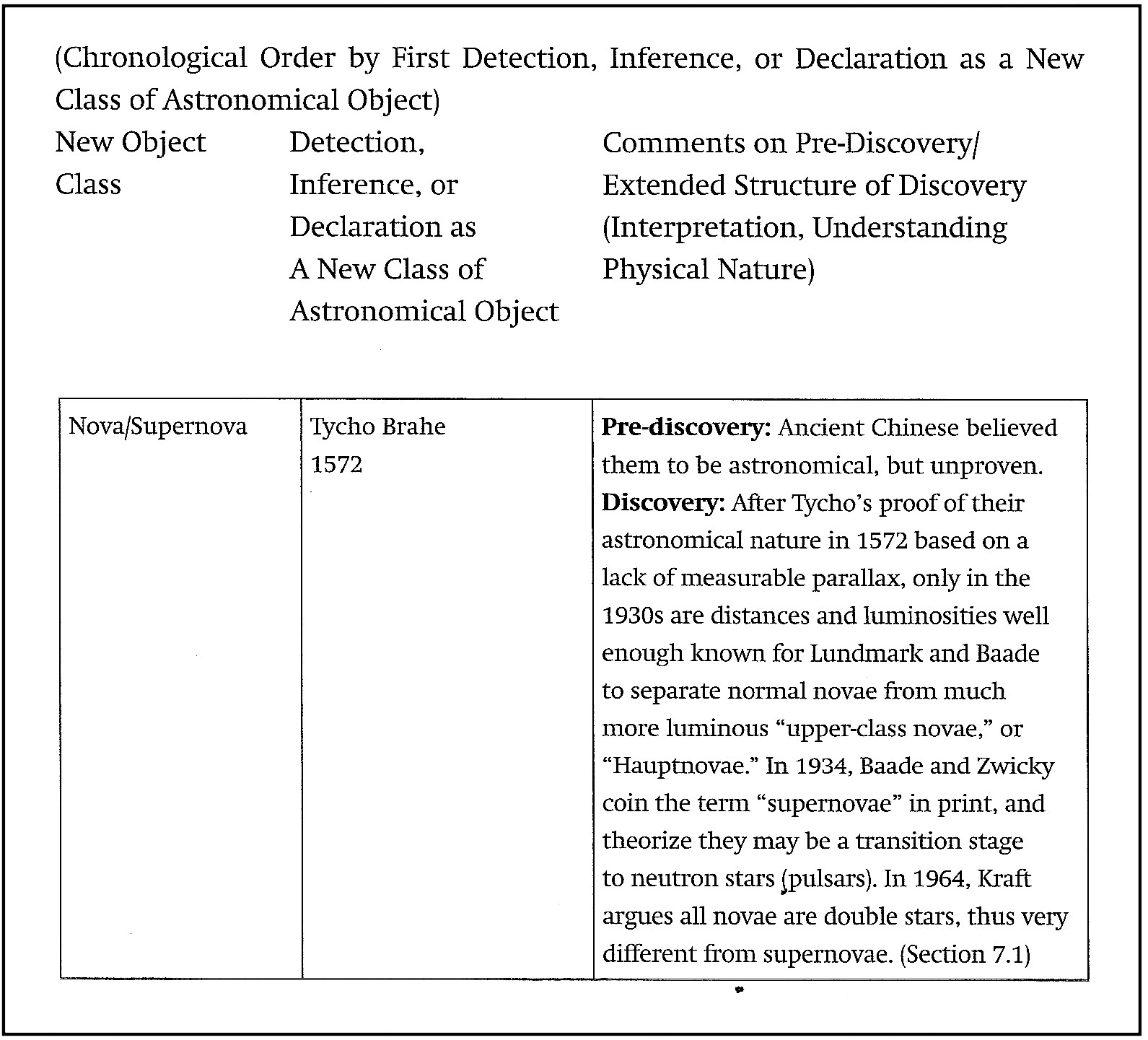
Discovery and Classification in Astronomy: Controversy and Consensus by Steven J. Dick (Cambridge University Press, 2013), is a taxonomic history. Dick alludes to parallels in the development of biology and chemistry which he offers as more mature paradigms. The periodic table of elements allowed predictions. Astronomy has nothing like it. Biology still has controversies but it has millions of species to consider. Astronomy has fewer than 100, 82 by his count. In most cases, each discovery was a thing-in-itself until improved understanding (usually through controversy) revealed others of its kind. 


The main narrative of 340 pages delivers a chronology by types from planets to quasars and then reviews the works and publications to reveal the patterns (Part IV) and the drivers of discovery (Part V). Part VI closes with The Meaning of Discovery.

“… discoveries end with a basic understanding of the fundamental properties of a class, but before mature understanding, as defined by knowing an object's place in an evolutionary scheme.” (page 331). The process can take centuries as with the planetary nebulae. Dick also believes that since 1960 or so we have come to a mature evolutionary scheme for the universe. (page 331). 


Having presented the facts, Dick then organizes them into a Three Kingdoms model: Planets, Stars, and Galaxies. It fits on two landscape pages as Appendix 1. Appendix 2 “Astronomical Discoveries and Their Extended Structure” is a detailed tabulation of 82 objects, from Novae through  Proto-Galactic Clouds, identifying the discoverer and citing the pre-discoveries. 


I got the book from the library because in our home we are of one mind on not acquiring more stuff. However, I bought it because it is more conceptual than a history of astronomy or, more narrowly, astrophysics (which I regard as the touchstone of astronomy) and it is more concrete than a philosophy of science. 

As valuable as I regard the work, I do differ from Dick on his metaphysics and epistemology, and I have some quibbles with his history. In the main, however, his assertions are supported by deep foundations of facts in their correct contexts. 

One oversight is in the history of meteorites. Dick makes no mention of the surviving commentaries by Plutarch, Pliny, and Diogenes Laertius about Anaxagoras of Klazomenai who allegedly tracked and found a meteorite and from that posited that the stars are hot rocks and that the Sun is such a hot rock, “larger than the Peloponnesus.” That being so, I still agree with Steven Weinberg and Alan Hirshfeld that as much as we can relate to the early savants, their hypotheses were not science. 


Dick also credits Edmund Husserl and phenomenology, requiring that understanding be identified with “the thing itself” in other words to understand and appreciate an object without regard to arbitrary—and perhaps false—contexts. For that, however, I look to Immanuel Kant’s “das Ding an sich.” 


“The thing itself” was a primary consideration for William W. Morgan who extended the Harvard classification system (O B A F G K M) by parameterizing luminosity classes for super giants, bright giants, normal giants, subgiants, and main sequence stars: V, IV, III, II, I. Underlying the system Morgan considered the ratios of stellar spectra, not just the lines themselves. William W. Morgan published the Atlas of Stellar Spectra, with an Outline of Spectral Classification with Philip C. Keenan and Edith Kellman in 1943. Dick explicitly examines the fact that Morgan cited Husserl, and then abandoned any phenomenological framework for that research.


As for Thomas Jefferson, the historians at Monticello have come to his rescue. See “Thomas Jefferson and the Meteorites,” posted November 14, 2008, as “Who is the liar now?” by 

Anna Berkes, at https://www.monticello.org/site/blog-and-community/posts/who-liar-now.  

From there you can find a lengthy review of A professor, a president, and a meteor, by Cathryn J. Prince. (Amherst, New York: Prometheus Books, 2011), at Meteoritics & Planetary Science 46, Nr 10, 1608–1616 (2011) by Ursula B. Marvin of the Harvard-Smithsonian Center for Astrophysics.

"Between 1794 and 1804 an astonishing succession of new ideas, four witnessed falls of meteorites and chemical analyses of them, took place that established meteoritics as a new branch of science. Prince ignores this chain of events almost entirely. Her approach leaves such a gap in the founding of meteoritics that herewith is a brief sketch of the main events that are missing from her book.

"In April, 1794, Ernst F. F. Chladni of Wittenberg published the first modern book on meteorites and their origins. He began by discussing the Pallas Iron, a huge mass of metallic iron found on a high mountain in Siberia. After reasoning away hypotheses that it formed in the atmosphere, or was smelted from ore by lightning or by prehistoric men, he concluded that it, and other masses like it, must have fallen from cosmic space. This was a completely new concept at a time when space was ‘‘known’’ to be empty." The Meteoritical Society, 2011, at https://onlinelibrary.wiley.com/doi/pdf/10.1111/j.1945-5100.2011.01242.x


Thomas Jefferson only wrote in a letter: “It may be very difficult to explain how the stone you possess came into the position in which it was found. But is it easier to explain how it got into the clouds from whence it is supposed to have fallen?”  (Transcription from Lipscomb-Bergh 11:441-2 - the polygraph copy of this letter is online here.)

http://memory.loc.gov/master/mss/mtj/mtj1/040/1000/1084.jpg

The Thomas Jefferson Papers Series 1. General Correspondence. 1651-1827

Thomas Jefferson to Daniel Salmon, February 15, 1808

http://hdl.loc.gov/loc.mss/mtj.mtjbib018246 Image 1084 of 1330.


PREVIOUSLY ON NECESSARY FACTS


Gregory Browne’s Necessary Factual Truths 

The Philosophical Breakfast Club 

Harriman’s Logical Leap Almost Makes It 

The Big Whimper of Modern Philosophy 

New York City, Covid-19, and Conservative Business Interests