Showing posts with label cities. Show all posts

Saturday, January 23, 2021

Against Dark Skies

We do not have the same perceptions with light that we do with sound. You can close your eyes. You cannot close your ears. So, we have laws against noise. We do need a rational theory of law to address noisy light. But not all light is pollution, any more than all noise is bad. After all, most people enjoy the sound of children playing and most so-called “light pollution” is equally benign.

Moreover, you can see a lot from the city if you know where to look. I live in the city of Austin, one mile from South Park Meadows, a major shopping center. From my backyard, I can show you the Andromeda Galaxy. On hobbyist discussion boards, I have shared my views of binary stars. This is an endeavor that many hobbyists pursue, seeking out stars that look like single points to the naked eye, but which a modest telescope will reveal to be two or even four. 


We backyard astronomers know the book, Turn Left at Orion by Guy Consolmagno, SJ, Ph.D. He had a doctorate from Harvard and taught at MIT, but never knew the sky the way an amateur does until a friend showed him the stunning yellow-blue double star known as Albireo at the head of The Swan (or the Foot of the Cross). His friend did that with a small portable telescope from within the glare of New York City in Fort Lee, New Jersey. Turn Left at Orion was written for the urban or suburban hobbyist. 


Some dark skies can be found in North America


One of our local leaders is a sun-watcher. With a special telescope costing four times more than a nice hobbyist instrument and ten times more than an entry-level telescope, he views our Sun, the closest star, and a very average star. Viewing in broad daylight, he never worries about light pollution.


Astronomers also complain about “constellations” of artificial satellites, clusters and strings launched by private companies for communications, natural resource monitoring, economic research, and disaster response. When disaster strikes, we all want our cellphones to bring the responders to our exact locations by GPS. That convenience comes with a cost. 


Not so dark in China; dark skies in North Korea.

Apart from the hobby, serious astronomy has been carried out for 50 to 70 years with radio telescopes, or “dishes.” First investigated by amateurs just before World War II, radio telescopes receive wavelengths that are not blocked by light pollution (or rain). Today, radio astronomy continues to be a pursuit for some amateurs. It is a spin-off of ham radio. 


Other leading edge research in astronomy is performed from orbiting platforms such as the Hubble and Hipparcos satellites. As enthusiasts of space exploration, the backyard astronomers do not complain about the consequences of building giant rockets to carry giant telescopes into orbit. 


Dark skies in central South America.

It is true that amateur astronomers collaborate with professionals. One way is by reviewing the data in computerized “warehouses” of numbers and images. We have more data than university professors can analyze. So, they turn to amateurs. Those hobbyists work from the comfort of their homes, consuming electrical power, and other resources, that also create light pollution.


Amateurs also build their own remote-controlled observatories and monitor the views on high-definition video screens. Those installations are hundreds of miles from their homes where the amateurs enjoy the benefits of civilization. 


Even deeper into the wilderness, some impassioned hobbyists travel to the darkest skies at state and national parks for their star parties. There, many of the instruments are custom-built, huge, complex telescopes, some of which need their own trailers to be hauled to the campsite. At those events, deep sky stargazers pursue “faint fuzzies” the galaxies and nebulas at the limits of viewing. For them, the planet Jupiter is light pollution. At a dark sky site, with no other competition, our solar system’s largest planet is bright enough to cast shadows. In the large “light buckets” built to gather the faintest glows from the farthest objects, the glare of Jupiter washes out the sky. So, one astronomer’s target is another astronomer’s light pollution. The same is true of the Moon. Some hobbyists do study it. It is not a dead world. But generally speaking most suburban hobbyists consider the Moon to be light pollution. 


I am not insensitive to the problem. I believe that a correct political analysis begins with considerations of property rights. A couple of years ago, I wanted to arrange the loan of a large hobby telescope to a co-worker who recently moved into a rural area. Sadly, he declined the offer because his neighbor had just installed a security light, a mercury-vapor spotlight that illuminated her land, his, and much else. If the light waves were sound waves, she would be blasting rock ‘n’ roll at 2:00 AM. That is a problem that is easy to understand and any number of local ordinances (if not common sense and common courtesy) would put a stop to it. 


We all want clear dark skies full of beautiful bright stars. Backyard astronomers also want telescopes, which are mass-production manufactured items, mostly from China. Even custom-made hobbyist telescopes two feet in diameter costing near $10,000 are built from precision glassware made in China. Backyard astronomers here do not mind if China's skies are polluted. 

Dark skies in central Africa, but not the Nile Valley.


I admit that it was at the Austin Astronomical Society's dark sky site 80 miles away from Austin that I first saw the Milky Way from horizon to horizon. It was worth the drive. There is no shortage of dark sky for anyone willing to make an effort, invest resources, and put up with some minor inconveniences. That being so, absent the amenities of civilization, daily life 80 miles from a Level One trauma center could be precarious should you break your arm or have a heart attack. Like telescopes, modern hospitals are another product of our industrial economy. What formal logic calls the law of the excluded middle is commonly expressed as, “You cannot have your cake and eat it, too.”


PREVIOUSLY ON NECESSARY FACTS

Seeing in the Dark: Your Front Row Seat to the Universe

Turn Left at Orion

Megacities

Anthropocene: A Bad Name for a Good Thing


Tuesday, August 18, 2020

Neighborhood Book Kiosks

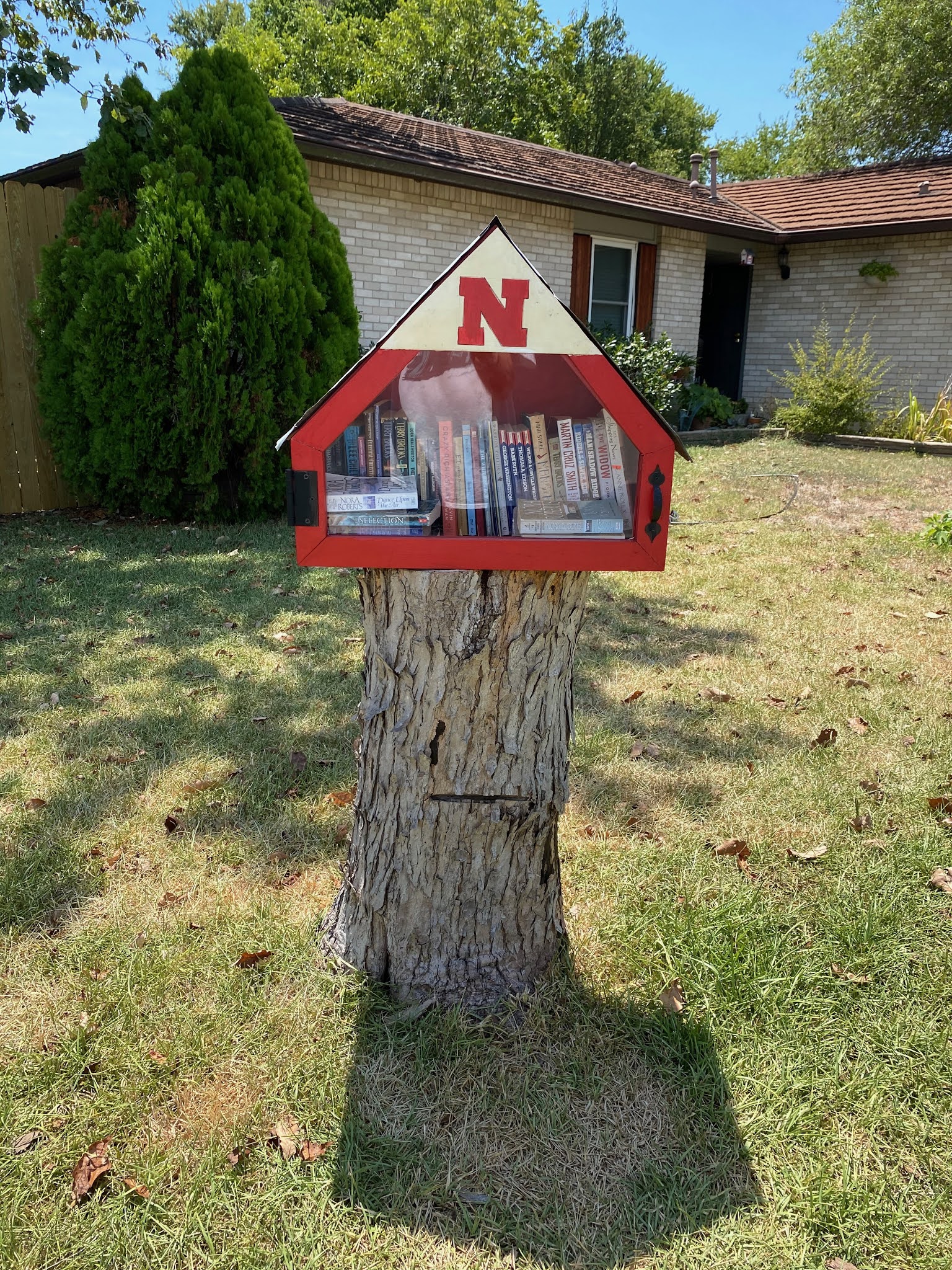
The first one in my neighborhood appeared in February and I thought that it was unique. I saw another one a bit farther from home. It finally occurred to me that this is a phenomenon. I like it as an example of spontaneous order, an axiom in Austrian economics. Reading on Wikipedia revealed that other people think the same way that I do. And not everyone else is happy with us.  

This is the one in my neighborhood.
It has four sides with two panels of books and it rotates.
(I don't know who owns the easement.)

From The Atlantic

U.S. -- The Danger of Being Neighborly Without a Permit

All over America, people have put small "give one, take one" book exchanges in front of their homes. Then they were told to tear them down.

Conor Friedersdorf

February 20, 2015

Since 2009, when a Wisconsin man built a little, free library to honor his late mother, who loved books, copycats inspired by his example have put thousands of Little Free Libraries all over the U.S. and beyond. ... 

I wish that I was writing merely to extol this trend. Alas, a subset of Americans are determined to regulate every last aspect of community life. Due to selection bias, they are overrepresented among local politicians and bureaucrats. And so they have power, despite their small-mindedness, inflexibility, and lack of common sense so extreme that they've taken to cracking down on Little Free Libraries, of all things.

https://www.theatlantic.com/national/archive/2015/02/little-free-library-crackdown/385531/


[Texans are a little more open to letting people do the right thing without permission from the government. Wells Branch is a neighborhood on the north side of Austin. Dell, HP, and others have campuses there.]


WBNA | Wells Branch Neighborhood Association

Little Free Library Boxes

Welcome to the Little Free Libraries Summer Scavenger Hunt!


Did you know there are currently 14 Little Free Libraries throughout Wells Branch?  LFLs are free book exchanges where anyone can “take a book, return a book.”  Join us in June for a LFL Scavenger Hunt.  You’ll have the opportunity to visit our neighborhood LFLs, find some great (free!) summer reads, and earn a chance to win a Barnes & Noble gift card.

http://wbna.us/community/library-boxes/


Posted to Nextdoor dot com serving our wider subdivision

[ I found out that the Little Free Library boxes were not the first of their kind. “Book Crossings” appeared about the turn of the millennium.] 


Leaving reading materials in public places when no longer needed has long been a silent means of communication and sociability amongst bibliophiles. Ron Hornbaker conceived the idea for what is now known as BookCrossing in March 2001[2] and enlisted business partners and co-founders Bruce and Heather Pedersen[3] to launch BookCrossing.com on April 21, 2001.[4]


After two years the website had over 113,000 members and by 2004 it was prominent enough to be referenced in an episode of the Australian soap opera Neighbours.[5] The same year it appeared as a new word in the Concise Oxford Dictionary,[6] although as of 2017 only Collins of the major online dictionaries retained it as a word.[7][8][9][10]

https://en.wikipedia.org/wiki/BookCrossing


On a busy backroad I take to the freeway.
It serves walkers well.
(Again, it seems to be on the property owner's
public easement.)

[From Wikipedia] Closely allied with the BookCrossing concept, the original public bookcases were conceived as artistic acts.[1] Very early examples are the creations of performance artist duo Clegg & Guttmann in 1991. Collections of bookcases were conceived as "free open-air libraries" in Darmstadt and Hannover in Germany in the late 1990s.[2]


Controversy and criticism[edit]

In 2003, BookCrossing was criticized by the astrologer and novelist Jessica Adams, who claimed that books were being "devalued" by the website as BookCrossing could lead to lower sales of books and, therefore, the reduction in royalties being paid to authors.[20] Most BookCrossers dispute this argument, however. They claim that the website introduces readers to authors and genres that they have not read before, that the website encourages more people to take up or reclaim reading as a hobby, and that some members, having read a book that they have enjoyed, will buy extra copies to distribute through BookCrossing.[21]


Another busy side road. 
You have to step up onto the property for this.

In March 2005, Caroline Martin, managing director of the publisher Harper Press, said in a speech that "book publishing as a whole has its very own potential Napster crisis in the growing practice of bookcrossing".[22] BookCrossers rebutted the link to Napster, saying that while music filesharing involves duplicating audio files countless times, BookCrossing doesn't involve duplicating books (and also does not involve violating copyright, as books can be sold or given away freely without permission of the publisher being needed). When BookCrossing was first launched, the founder of BookCrossing, Ron Hornbaker, originally wondered if people would make this comparison.[23]

https://en.wikipedia.org/wiki/Public_bookcase


[A related link on Wikipedia]

Give-away shops, freeshops, free stores or swap shops are stores where all goods are free. They are similar to charity shops, with mostly second-hand items—only everything is available at no cost. Whether it is a book, a piece of furniture, a garment or a household item, it is all freely given away, although some operate a one-in, one-out–type policy (swap shops). The free store is a form of constructive direct action that provides a shopping alternative to a monetary framework, allowing people to exchange goods and services outside of a money-based economy.


A neighbor told me about a different one.
I found this instead.
(Clearly on the front lawn.) 

[More from following the links in Wikipedia write-ups]

The anarchist 1960s countercultural group the Diggers[1] opened free stores which simply gave away their stock, provided free food, distributed free drugs, gave away money, organized free music concerts, and performed works of political art.[2] The Diggers took their name from the original English Diggers led by Gerrard Winstanley[3] and sought to create a mini-society free of money and capitalism.[4] Although free stores have not been uncommon in the United States since the 1960s, the freegan movement has inspired the establishment of more free stores.

https://en.wikipedia.org/wiki/Give-away_shop


Also on Necessary Facts

Money as Press and Speech 

Charles Lamb 

Frankenstein, Rayguns, and Bicycles 

Five Books About Books 


Wednesday, April 1, 2020

NYC Covid-19 and Conservative Business Interests

“People of the same trade seldom meet together, even for merriment and diversion, but the conversation ends in a conspiracy against the public, or in some contrivance to raise prices.” – Adam Smith, The Wealth of Nations, (Book I, X “Wages and Profit,” Part I)

Writing for The Savvy Street and cross-linked for discussion on Galt’s Gulch Online, Objectivist scholar Walter Donway identified New York City’s long history of business regulations as the root cause of its horrific Covid-19 death toll. Writing primarily for an audience that supports President Donald Trump’s populism, Donway sprinkled his essay with a pejorative use of “liberal” via the redundant “left-liberal.” But his facts would have been the same and more damning if he had called the failed political policies “service to conservative business interests.”
Donway wrote: “But the city is the most ideologically left-liberal city in America. ...  Here is the briefest rundown on the left-liberal ideological principles and policies that have left New York City spread-eagled, utterly vulnerable to violation by the new epidemic. It was inevitable, an accident waiting to happen. ...  Understand that almost every university, government agency, foundation, and think tank in New York City has a left-liberal bent, tending to support and further these housing policies....  NYC is the U.S. epicenter of the  coronavirus because it is the U.S. epicenter of left-liberal economic intervention that in every possible way has increased the cost and decreased the pace of building ordinary housing for ordinary people.”
Donway has two targets: rent control and labor unions. Donway conflates rent control and rent stabilization. NYC has only 22000 rent-controlled apartments. About half the housing in NYC is “rent stabilized.” 
NYC as seen by the New York Times
Onerous as the regulations are, though, realize that they are business regulations that benefit a special interest: renters. Many capital goods are leased: personal automobiles, taxicabs, semi-trucks and trailers, railroad engines and cars, construction equipment, aircraft, computers, telephones, and office space. If semi-truck rentals were subject to onerous government-mandated pricing, it would be wrong, but we would all know how to analyze the problem. It would be a business interest using civic legal authority for its own profits. And so it is with apartment renters. 

Rent-stabilized housing distorts those markets. Landlords seek and find escapes. Rentals become condominiums. Owners sell and go into other businesses that they hope to enjoy more. Tenants also could find escapes. My brother was an executive for a classical music label headquartered in the City. When I found out how little he paid his warehouse workers, I was shocked. “How can they afford to live in the City?” I asked. “They don’t,” he replied. “They live in New Jersey and take the train.” So did junk bond billionaire Michael Milken. Everyone knows that Warren Buffett enjoys his middle class home in Omaha. No one has to live in NYC, though Walter Donway himself is among the 20 million who choose to.

Labor unions are also businesses, no less than are our local chambers of commerce. Their members pay dues. The unions set up their own qualifications, including specialized training; and in that they are in the same category as university MBA programs. The political advantage that labor unions enjoy is a direct consequence of one-person-one-vote. But they are voting for their business interests. 
NYC as seen by the New York Post
 Among the business interests that Donway disparages—I say that he sleights it as left-liberal snobbery—is the explosion in “historical” properties. It may be true that zealous urban planners at city hall hunt for such opportunities, but largely, the historical marker plaque is sought, applied for, fought for, and won by the property owner who seeks a marketable cachet, whether for a building or a vacant lot. It is the hallmark of conservatism to find intrinsic value in that which went before and to fear change. So, we must preserve barns and tenements just as we protect markets and job titles.

In excoriating renters and laborers (and left-liberals), Donway engages in a strategy explained succinctly in The True Believer by Eric Hoffer. A mass movement can succeed without God, Hoffer noted, but none can succeed without a devil. In modern language, we “otherize” our enemies: they are essentially different from us and therefore essentially evil. I believe that in otherizing labor unions and renters as beneficiaries of left-liberal government intervention Walter Donway’s goal is to seduce pro-Trump conservatives into accepting Ayn Rand’s Objectivism. See his two essays on The Savvy Street, “The Unquiet Grave: Ayn Rand Declared Conservatism Dead in 1960,” and “The Unquiet Grave Part II : Edmund Burke’s Challenge for Objectivism.” He could have made the same argument that I just did: disasterous as such government interventions have proved to be, they were motivated by conservatism in service to business interests.

For context, remember that Ayn Rand was radically opposed to racism and that the central figures of her three novels were independent women. Moreover, she was in favor of open immigration. And she was proud of having gotten around the laws limiting her own immigration. In addition, she was also an atheist. No surprise, she advocated for a woman’s right to end her pregnancy. In her novels and in her own life, she rejected the social traditions of family as the foundation for society. And among all of the very many political interventions in the economy, she was opposed to tariffs. 

Even more to the point here, many of the villians in her novels are businessmen, some of inherited wealth, all with close ties to government regulators. On the other hand, when we first meet the architect Howard Roark, he is wearing blue jeans, sandals, and a shirt missing most of its buttons. Before going to the dean's office to be expelled, he tosses his long hair into a semblance of order. 
 
Ayn Rand on Wall Street
(Cover of The Virtue of Selfishness)
Those are all points of failure for anyone who wants to sell her utopia to conservatives. The reason why is fundamental. Conservatism absolutely requires other people for its practice because it is a social philosophy. Objectivism is a personal philosophy. If your neighbors play loud music at 3:00 in the morning, the conservative response is to call the cops because their anti-social behavior deprives you of your right to property. The Objectivist response is to move. Objectivist ethics of selfishness recognize that you might find it much easier (and satisfying) to call the cops. But that would be your choice based on your values and your decision on how best to minimize your losses and discomforts. You might take your guitar over there and join them. But the choice remains yours because Objectivism is a personal philosophy. 

Walter Donway's major premise is empirically undeniable: New York City's terrible losses from the novel coronavirus are a direct consequence of over-crowding. It is population density rather than population alone that spreads the infection. In response to Donway's discussion on Galt's Gulch, I posted these comparisions.

New York City Population 18 million (Metro area 21 million)
Covid-19 cases 40,900 (31 March)

Houston area: Population 7 million
2020 Estimate 2.4 million for the city proper
1,266 cases
12 dead
168 recovered
(31 March Fox News 26)

The City of Houston does not have zoning but development is governed by codes that address how property can be subdivided. The City codes do not address land use.-- Oct 1, 2018; Planning and Development - City of Houston at https://www.houstontx.gov/planning/De...

Corona Virus Cases Metropolitan Dallas-Ft. Worth
Total Population 7.5 million
Dallas Dallas County - 549
North Suburbs Collin County - 160
Northwest Suburbs Denton County 191
Fort Worth Tarrant County - 161
Dallas Metro total case: 1061 (31 March)

PREVIOUSLY ON NECESSARY FACTS


Monday, May 28, 2018

Superheroes Live in Cities

The easy narrative is that good guys protect cities because bad guys want to rule millions of people and that is hard to do by extending yourself over a thousand villages. But there is more to it. The Smallville stories underscore the fact that in order to maintain their dual identities, superheroes need the anonymity of the city. And there is more work in the city. Batman could clean up Traverse City, Michigan, or Rapid City, South Dakota, in one night. Then what? 
 
Austin: 6th Street facing west from the Littlefield Building
It is tautologous that the city is the center of civilization. Cities acquire populations from the surrounding countryside as much as they grow internally. The city offers opportunity. Coming from diverse local cultures, some close, many distant, the newcomers shed their folkways and adopt new amalgamated customs. The hallmarks today include pizza, burritos, stir fry, and kebap (appropriately being the German adaptation of the Turkish shish kabob).
 
Austin: Reflections in Frost Tower Southward
Metropolis - Superman (Clark Kent)
Gotham - Batman (Bruce Wayne)
Central City - 2nd Flash (Barry Allen)
Keystone City - 1st Flash (Jay Garrick) and 3rd Flash (Wally West)
Midway City - Hawkman (Carter Hall); 
and Hawkgirl (Shiera Sanders Hall, Kendra Saunders, others...) 
Star City - Green Arrow (Oliver Queen)
Coast City - Green Lantern (Hal Jordan)
Austin: Frost Tower
from the Parapet of 301 South Congress
 Fantastic Four – New York City, Baxter Building
Avenger Headquarters – New York City, Stark Tower
New York City is the hometown of Captain America (Steve Rogers). 
It changed in the telling from the borough of Brooklyn to Manhattan. 
Though Captain America is often on deployment, 
Spiderman lives and works there on a daily basis.
 
Austin: South from the Capital Factory
enterprise incubator
atop the Austin Center
Marvel Superheroes Who Basically Only Protect New York City
https://io9.gizmodo.com/marvel-superheroes-who-basically-only-protect-new-york-1797953197
"...Truth, Justice, and the American Way."
A Guide to the Fictional Cities of the DC Universe
https://www.hollywoodreporter.com/heat-vision/a-guide-fictional-cities-dc-861874
Downtown Cleveland looking east from Lakewood
Miami from Miami Beach

Fictional Towns in Comics
https://en.wikipedia.org/wiki/List_of_fictional_towns_in_comics

 PREVIOUSLY ON NECESSARY FACTS

Sunday, December 25, 2016

Against Gulching

"Gulching" refers to setting up a retreatist community of political conservatives. It is named after Galt's Gulch in Ayn Rand's Atlas Shrugged.

Saturday Night Live ran this in the wake of the GOP victory in the Presidential election of 2016:
In The Bubble, the election never happened.
View on YouTube here.
On the Objectivist discussion board, Rebirth of Reason, frequent contributor Luke Setzer posted a link to the video under the headline "Turning Galt's Gulch on Its Ear." In the discussion there, I said that no successful society is monolithic.

The defining attribute of fans of the Atlas Shrugged movies is that they are people who want to set themselves apart in a separate, isolated and hidden community of like-minded people. Many dream of a physical locale. Most enjoy online communities. In those discussions, the occasional reports of attempts at a “Galt’s Gulch” receive close attention.

Although the plot element of “Galt’s Gulch” served a poetic purpose, it was not a call to action. Ayn Rand was specific in stating that art is not didactic: a romance novel does not teach. When Ayn Rand had something to teach, she wrote essays and delivered lectures. Rand’s intention as a philosopher was to create and explain the ideas that can liberate individuals, human society in general, and the United States of America in particular.
 
New York City from ClassicHistory.com
Admirers of the works of Ayn Rand generally have two goals: to improve their own lives by living better; and to change the world. They intend to achieve the latter by spreading the ideas of Objectivism until they are accepted by (arbitrarily) “enough” other people. Their goal is a cultural shift more dramatic than the rise of classical Greece or the Renaissance.  Specifically:
(1) reason, science, and philosophy replace religion
(2) the ethics of egoism become as widely accepted as the tenets of altruism are today
(3) capitalism displaces socialism
(4) government is limited to basic functions of law and order by protecting the rights to  property.
(5) the observably dominant works of art (painting, sculpture, architecture, literature, theater) project rational people living in a knowable universe.
Cleveland's West Side Market indoor space.
(cleveland.com)
The inherent contradiction in “Objectivist culture” – the common interactions in-person and online among those who admire the works of Ayn Rand, perhaps just best called “Rand Fans” – is the dichotomy between reaching out to teach other people and walling yourself in with a group of individuals who claim to believe the same things that you do.
 
In the language of Objectivism, “in Atlas Shrugged, the heroes withdraw their moral sanction from their destroyers.” In other words, not only do they stop obeying the economic regulations of the government, they divorce themselves from anyone who would claim a right to any moment of their lives. They want nothing to do with looters and moochers. That is the active ideal of a Rand Fan in dealing with other people.

The problem that they cannot solve is that the capitalist who owns a gas station is a Muslim. The capitalist who owns a convenience store is a Hindu. It is a fact that Costco founder James Sinegal is an ardent Democrat.  The greatest capitalists of our age – George Soros, Bill Gates, Warren Buffett, and the entire list of global billionaires—are all condemned as “crony capitalists” traitors to laissez faire, who cause and amplify the oppressive laws, taxes, and regulations under which we suffer, but they, by the power of their privilege do not. Objectivism does have its own real-life capitalists. Three that stand out are T. J. Rodgers of Cypress Semiconductor, Ed Snider (1933-2016) of Comcast Spectacore, and John Allison of BB&T. Many others orbit in the pull of Ayn Rand. Mark Cuban (Dallas Mavericks) and Frederick W. Smith (FedEx) are among them. But Cuban supported Hillary Clinton for President. 

Cleveland's West Side Market outdoor space
from Delta Sky Magazine
As explained by Ayn Rand and her one-time colleague psychologist Nathaniel Branden, most people harbor unresolved personal contradictions. If the Muslim who owns a gas station were consistent in his philosophy, he would recognize that the principles that bring success in business – identifying facts, testing theories, treating customers fairly  - speak against the tenets of his religion. If the crony capitalists were consistent, they would deny their government subsidies and advance laissez faire.
 
I and M Bank Market, Nairobi 
What do you do when other people do not live up to your expectations for philosophical consistency?

For many Objectivists, as distinct from mere “fans of Ayn Rand,” the unworkable solution is to withdraw from those who disagree with you. So, it is ironic that the philosophers of the Ayn Rand Institute who do not speak to the philosophers of the Atlas Society probably buy their gasoline from Muslims and get their cars fixed by Christians and find great bargains at big box stores owned by Democrats all the while running Windows software on their computers.

The minor premise of "Gulching" and a theme that is easy to find among fans of Atlas Shrugged, is that in order for there to be a second Renaissance, civilization must collapse. They do not just predict it, they look forward to it with a millenarian fervor. 

The fact is that civilization is, literally, city life. Historically, people from disparate tribes left (and still leave) their homes to come to the places where strangers benefit themselves by exchanging value for value, whether or not they agree on any other fact, claim, or belief.  That cultural matrix is powerful. Examples of farming communities destroyed by crop failures are easy to find. Harder to uncover are cities that starved. Total war does bring that. Fortunately, such wars are exceptional. Examples from the Dutch wars of liberation from Spain show that when the city rulers attempted to control the price of food, the city went without and fell. Cities that let the price of food rise incentivized smugglers to run the Spanish lines. A farm feeds itself (theoretically), but a city is fed by the whole world.  It does not matter that the Chilean farmer whose grapes are on your table has a religious icon in his home. If you cut yourself off from him - and the global commercial network - you only have the grapes you grow yourself... if you grow grapes, rather than apricots, kiwi fruit, watermelon, coconuts, ...

ALSO ON NECESSARY FACTS
Megacities 
Cities 
City Air Makes You Free  
Vectures: Monetizing Urban Transportation  

Saturday, November 1, 2014

Vectures: Monetizing Urban Transportation

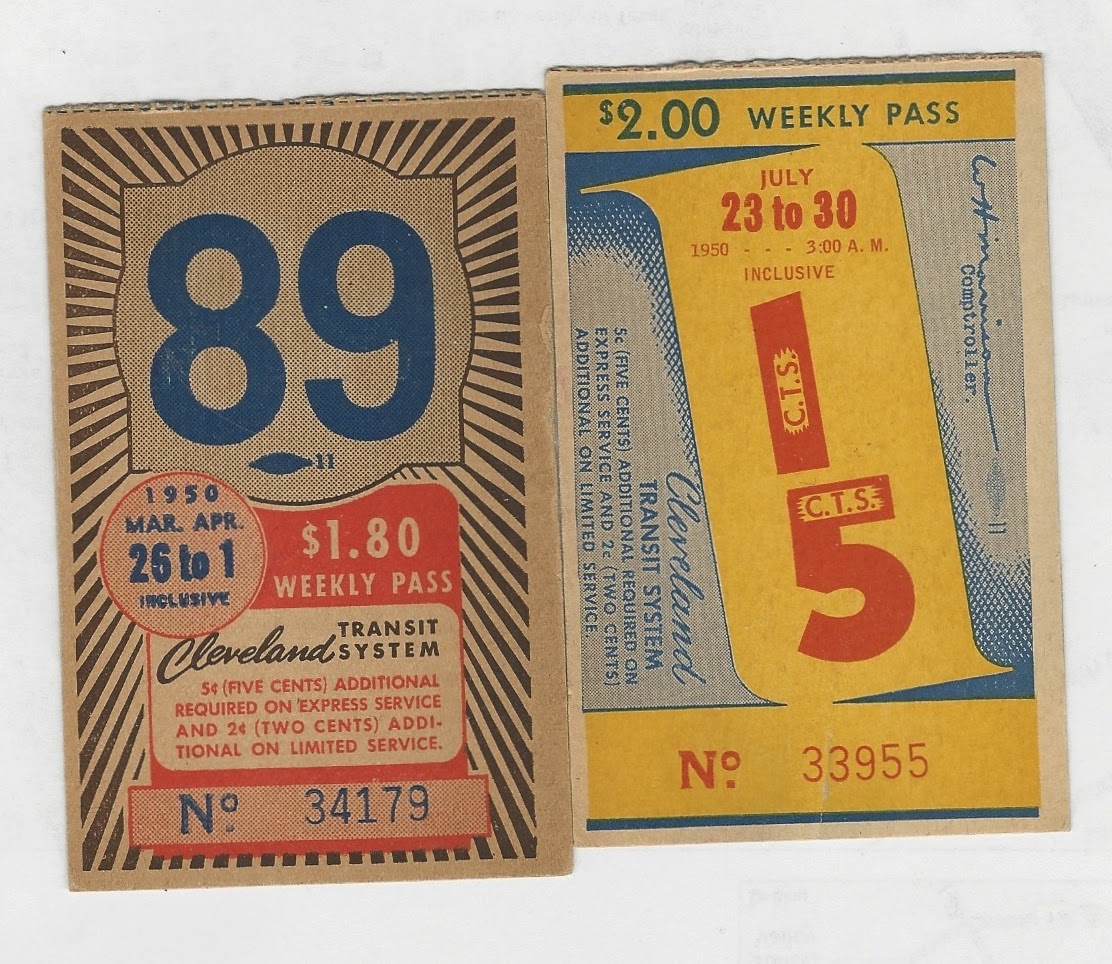
Vectures are the formal name for transportation tokens including coin-like payment for trolleys, buses, trams, and trains, as well as coin-like forms for parking, bridges, and ferries, as well as cards, tickets, and chits, including electronic formats.  In short, vectures are the numismatics of traffic and transportation. 
Courtesy card from the hotel for the tram
You can monetize anything.  Transportation tokens in all their expressions serve both sides of the transaction: they let riders pay for carriage, often at a discount if purchased in advance and in bulk, i.e., a weekly or monthly pass.  At the same time, they allow the transport authority or business to borrow money from patrons interest-free.  More subtly, they allow the monetization of a service.  
Cleveland, Ohio, 1950
Furthermore intra-urban transport represents a significant service to the commuter.  I do a lot of reading waiting for the bus and riding. Now, the express buses here in Austin have wi-fi, allowing me to work while I ride.  After January 1, 2015, it will be illegal to text and drive.  (The enforcement is more problematic than the authorities expect, but that is their problem, not mine.  I mean, I could be using my GPS, not texting...)  Be that as it may, the bus or the train allows you to do something else while you are being transported more or less safely and more or less conveniently.
Chicago 1976.
I jumped the turnstile to keep the ticket;
but I was on camera.
They let me go with a warning.
If you were sent back in time, how would you explain parking tokens to Leonardo da Vinci? Herbert Spencer might have understood.  He knew that social organisms evolve mechanisms and appendages.  The city of the modern era is not the city of the Middle Ages.
  
Roma, Italia. Face and Back of Metropole pass.

Consider the  Carrier's Case of 1473 (Wikipedia here).   We might imagine a science fiction story set in intra-galactic interstellar space in which the common carrier's point is carried forcefully.  However, here and now, it is hard to imagine that the bus driver could sell the contents of your cellphone while you ride.  

Coin-like tokens, attributed against the Atwood-Coffee catalog.
Prices have not changed in decades.
In the fantasy Lost in Austen, the 21st century viewpoint heroine caught in the Regency period comes from "Hammersmith" which to them is "outside" London.  "Well, yes," she says, "in your time..."  In the David McCullough biography of John Adams, villages outside of Boston are today neighborhoods within Boston.  "BosWash" has been the East Coast metroplex of science fiction for over seventy years.  Someday, some biometric will let you travel anywhere on Earth for a flat rate.

PREVIOUS ON NECESSARY FACTS

Tuesday, August 19, 2014

Megacities


“Today there are more than 20 cities with over 10 million inhabitants. Some are sleek, modern, and hightech; others are filled with slums. BBC journalist Andrew Marr visits five megacities: one of the oldest (London), the fastest-growing (Dhaka, Bangladesh), the largest (Tokyo), one of the most dangerous (Mexico City), and one that considers itself the new world capital (Shanghai).” From Athena Learning and Acorn Online  I believe that these three one-hour episodes can open a door, if not to the right answers, then perhaps to the right questions.  Though I disagreed some of narrator Andrew Marr's opinions, the presentation was important and timely.  

Episode 1: Living in the City
The need to strike a balance between community and efficiency is nowhere more apparent than in megacities. Marr examines Shanghai’s bursting-at-the-seams growth and the isolation of Tokyo. He also spends the night in a Dhaka slum—and despite its crime, pollution, and congestion, finds Mexico City an overwhelmingly friendly and livable place.

Episode 2: Cities on the Edge
How do you protect a city of 20 million people? Some of the dangers of the megacities are natural—earthquakes, floods, typhoons—while others are manmade. Marr takes an evasive driving course in the kidnap capital of the world and volunteers for the London police’s riot unit. In Tokyo, situated on three of the world’s most unstable geological fault lines, he learns how locals have planned for disaster.

Episode 3: Sustaining the City
Highways, roads, rail lines, and subway systems are the arteries of the megacity—and just like human arteries, they can become dangerously clogged. Marr pedals a rickshaw taxi in Dhaka, flies with Mexico City’s airborne traffic cops, and rides a high-speed magnetic railroad in Shanghai. He also finds out what London’s fast-food obsession is doing to its Victorian-era sewers.

I do note that "mega" is relative.  Today over 300 cities have over one million inhabitants. We live on an urban planet. On May 23, 2007, the population of Earth crossed to 50% urban (ScienceDaily). Most of us live in cities.  Are megacities just very large towns or really huge villages; or do they have social structures with special functions different from their predecessors—if indeed, the village is the ancestor of the city.  It may not be.

Historically, cities seem to have blossomed all at once, even as other places have remained villages for 8,000 years.  Sumer and Babylon are gone, but Athens, Rome, London, Shanghai, Tokyo, and even New York, have long continuous histories of almost-uninterrupted growth. 

But even they are not unrelieved deserts of concrete and steel. For a graduate class in Remote Sensing (2010), I wrote a paper on agriculture within megacities.  Moreover, about half of us urbanites are in small cities of fewer than half a million inhabitants. Only about 12% of us live in one of the 28 megacities.  (Christian Science Monitor here and National Geographic here.)
“Ugne Saltenyte, an analyst at the market research firm Euromonitor, recently calculated that 24 percent of the world's population over 15 years of age and with the equivalent of a two-year degree or more is concentrated in the world's 100 largest cities (report here). These same 100 cities — Saltenyte is counting full metropolitan areas here — are home to just 11 percent of the world's total population.” Washington Post here.

PREVIOUSLY ON NECESSARY FACTS
City Air Makes You Free
Capitalist Culture
Engines of Creation
The Genius of Design
Objectified