Showing posts with label comic books. Show all posts

Sunday, September 2, 2018

Captain America: the original is still the best

We watched Captain America: The First Avenger the other night. It was my fourth viewing. Yesterday, I brought home Winter Soldier, which I sat through a couple of months ago, and Civil War which I had not seen yet. The first movie continues to hold up well. The second was better than I remembered, but not stellar. The third installment was largely a waste of two-and-a-half hours.  

Serial fiction must identify and cross a boundary that separates the uninformed reader from the true fan. The theory of mythology insists that we know the characters: the warrior, the wanderer, the orphan, the magician… Some heroes are born that way and die still blessed even though fallen or taken down. Siegfried is an easy example. Others struggle their whole lives as did Heracles. When you have a boatload of them, as in The Iliad, Argonautica, and Star Trek, the narrator is under some burden. 
 
Captain America: The First Avenger reviewed here.
If you could travel through history you could take the story of Captain America: the First Avenger to just about any castle or camp. You would need more rhyming couplets to explain how Hydra infiltrated SHIELD. I had to consult the oracles at Google and Wikipedia to put Hawkeye in the Civil War and that was all: he was just a character with some attributes. He has no compelling backstory. Similarly, I know of Ant Man, but never followed him and was unaware that resizing himself and other objects is one of his super powers. (Where does the mass go or come from?) The Scarlet Witch, Vision, Black Widow, Rhodey/Rhodes,... they are just a bunch of people with special powers and could be anyone with any powers. That aspect of the movie was definitely for the true fans. But the same unmet challenge afflicts the Star Trek universe: if you do not know the crew before you see the movie, you are ignorant. On the other hand, for all of its flaws, the continuing Star Wars saga makes use of such disposable characters. 

That photojournalist Peter Parker uncritically accepted Tony Stark’s glib talk about Steve Rogers is disturbing. It would have been even worse if the kid had been approached by a wily Hydra salesman. 

The putative cause of the Civil War is the legalization, licensing, and control of “enhanced individuals,” a theme already developed in the Marvel universe through the X-Men. It was explored by The Watchmen. It even pitted Batman against Superman: “They sent me to bring you in.” “You always were a Boy Scout.” It was cited in Haldeman’s Forever War  (1974), where high-IQ kids were drafted first. The identification, nurturing, and therefore control of the gifted is known in public education from the turn of the previous century with the work of Lewis Terman. (See NecessaryFacts here.) It is an interesting theory, one too close to fact in an era of presidential doublethink and double talk. 

However, the “save the cat” school of screenwriting insists that every twisty turn lead to another twisty turn. In this case, in addition to the United Nations, we have one otherwise ordinary but understandably bitter man, Helmut Zemo. He tricks and overpowers a Hydra psychiatrist. (Hey, your shoe is untied!) On the other hand, Tony Stark has spent his life never finding out why his parents just never made it to the airport, as if they suffered a perpetual flat tire down a dirt road with no farm houses in sight. At least Helmut Zemo put two and two together. 
 ZemoMy father lived outside the city, and I thought we would be safe there. My son was excited. He could see the Iron Man from the car window. I told my wife, “Don't worry. They're fighting in the city. We're miles from harm.” And the dust cleared, and the screaming stopped. It took me two days until I found their bodies. My father still holding my wife and son in his arms... And the Avengers? They went home. I knew I couldn't kill them. More powerful men than me have tried. But if I could get them to kill each other... 
That the loss of innocent lives led to the Sokovia Accords to corral the super beings is no comfort (understandably). But did Spiderman sign them before he joined Ironman's team? As a minor, can he? What about the hundreds of other enhanced individuals? 

The middle story, Winter Soldier, held up better to a second viewing. The cast of characters is manageable. But the eye candy of Ragnarok escalates from cataclysmic conflicts in street traffic to the titanic destruction of three aerial carriers (each about ten times the area of football field or maybe 8000 times the volume of a stadium) that crash into the Potomac River without the inconveniently equivalent displacement of water. And it is the same amount that had to have been sucked into the submerged hangars when they opened to launch the helicarriers. 

The premise of Winter Soldier is purely Cold War. From our point of view, it was easy for Hydra to infiltrate the secret laboratories of the USSR. The Russians probably still feel the same way about us today. Pythagoreans, Freemasons, Jesuits, Dr. No, Thrush, Kaos, Dr. Evil … so many have trod that path that it is a superhighway with rest plazas.  

Captain America: The First Avenger must have its own problems. But they remain much smaller. The Red Skull flies toward New York and Chicago in his Valkyrie, a machine similar to the real XB-70 nuclear bomber of the same name wrecked in a collision on its maiden voyage in 1964. 

The original Captain America is lost to time because his world of 1940 is not ours now. As he said to Sam Wilson at the opening of Winter Soldier: “Well, things aren't so bad. Food's a lot better; we used to boil everything. No polio is good. Internet, so helpful.” But what we understand of him is constant, continuous, immutable. The problem is that he sometimes gets lost in the noise and confusion of computer graphics and franchise licensing. 

PREVIOUSLY ON NECESSARY FACT


Sunday, June 17, 2018

Rebels: A Well Regulated Militia

Rebels: A Well Regulated Militia by Brian Wood is a graphic novel that explores the lives of otherwise ordinary folk caught up in the extraordinary drama of the American Revolution. The main characters are fictional representations of real people. Historical figures pass through the narratives to add credence to the portraits of farmers, villagers, slaves, and natives. These stories span a lifetime, from the 1750s to 1800s, bringing the reader to Vermont, the Ohio frontier, the Carolinas, and the city of Boston.
Rebels: A Well Regulated Militia by Brian Wood
with Andrea Mutti, Matthew Woodson,
and other illustrators,
Collections of Rebels #1 through #10 inclusive
(Milwaukee: Dark Horse Comics, 2016).
 
 Anyone who can tell you much about the American Revolution is likely to be a political activist. Radicals, whether conservative or progressive, identify with the struggle for rights and independence, even as they find fault with it. On the left, the fact that the leaders were well-to-do merchants and lawyers explains the incomplete recognition of rights, the eventual three-fifths compromise, the Alien and Sedition Acts, and other betrayals of democracy. From the far right, libertarian science fiction author L. Neil Smith, who penned a set of Lando Calrissian stories, has an alternate universe in which Alexander Hamilton escaped to Prussia following a failed federalist coup to make George Washington king of America, leaving the republic to the true republicans.
Here, in essays apart from the graphic novel, author Brian Wood explains that he is a socialist. His passions for the commoner feed the compelling histories. The contextual events are real: Vermont’s war against New York, Breed’s Hill and Bunker Hill, Ticonderoga, and the Cowpens. The men and women who fought and suffered and died or survived are inventions of the author. 
“Creating Seth Abbot was partly to give myself a break – a fictional character allows us to tell the story we all want to tell without being trapped by historical facts and having my hands tied narratively. I mean, the Green Mountain Boys were real, as was Ethan Allen and the “noble train of artillery,” but I wanted to be control of the personal narrative of the main character. Seth needed to be a sort of everyman. I also wanted to be able to filter some of my own stories of Vermont childhood, the history that excites me, and the locations I know personally into that narrative.” – “Interview: Brian Wood Returns to Rebels with the Next Generation,” by Jeffrey Renaud in CBR Exclusives here. 
Within the ten stories is the continuing drama of Seth Abbott and his wife Mercy Abbott. He leaves her behind as he goes off to fight. The second time, he does not know that she is pregnant. He returns five years later. 


Among Seth Abbott’s adventures is his leading the team that brought the cannons from Fort Ticonderoga to Dorchester Heights. In that story, Brian Wood’s socialist preferences lead him astray. He draws Henry Knox as a soft sycophant, a bookseller with no military or other practical experience. A bookseller he was. He was also a street tough, a hoodlum who acquired the trappings of culture and sold them successfully until Boston was occupied. That remaining so, we slog through the mountain snow and valley mud with the farmers who hauled the cannons. For them, it was just more hard work. As one veteran told me about his view of Army life compared to his home life, “In other words, the Army was a lot like Tuesday.”  


Jane Franklin Mecom promises to tell the story of
rebel printer Silence Brght
“We actually have Washington in the story in issue No. 4 along with Benedict Arnold,” he revealed. “Later in the year we’ll see Jane Mecom, Ben Franklin’s sister. I think it’s a good idea to drop these people in from time to time for context, but part of the point of ‘Rebels’ is to not re-tell the same stories everyone’s heard about these famous people, but to find the untold stories, the stories behind the folktales, and tell those instead. So you can expect famous cameos, but no more than that. Those public figures of 18th century America are often referred to as “patriots” — a term that has been misused, misappropriated and/or misunderstood in recent years, he said. Exclusive preview: “‘Rebels’ writer Brian Wood explores the Revolutionary War” Hero Complex LA Times May 12, 2015 here. 
Brian Wood invented Sarah Hull and her husband, Captain Samuel Hull. She is the “Molly Pitcher” whose service to her country included hauling water for the cannons and for the men who fired them, and then loading and firing those guns with them.  The real Sarah Hull was just as interesting. 
"But if we paid you, we would have to pay all the women who served."
“Sarah Hull, the wife of Major William Hull, was one of those women who followed their husbands to the camp, resolved to partake their dangers and privations. She was with the army at Saratoga, and joined the other American ladies in kind and soothing attentions to the fair captives after the surrender. She was the daughter of Judge Fuller, of Newton, Massachusetts, and was born about 1755. At the close of the war she returned home; and when her gallant husband was appointed general of the county militia, did the honors of his Marquée, and received guests of distinction with a grace, dignity, and affability that attracted general admiration.” “Sarah Hull” at AmericanRevolution.org here. 
PREVIOUSLY ON NECESSARY FACTS

Monday, May 28, 2018

Superheroes Live in Cities

The easy narrative is that good guys protect cities because bad guys want to rule millions of people and that is hard to do by extending yourself over a thousand villages. But there is more to it. The Smallville stories underscore the fact that in order to maintain their dual identities, superheroes need the anonymity of the city. And there is more work in the city. Batman could clean up Traverse City, Michigan, or Rapid City, South Dakota, in one night. Then what? 
 
Austin: 6th Street facing west from the Littlefield Building
It is tautologous that the city is the center of civilization. Cities acquire populations from the surrounding countryside as much as they grow internally. The city offers opportunity. Coming from diverse local cultures, some close, many distant, the newcomers shed their folkways and adopt new amalgamated customs. The hallmarks today include pizza, burritos, stir fry, and kebap (appropriately being the German adaptation of the Turkish shish kabob).
 
Austin: Reflections in Frost Tower Southward
Metropolis - Superman (Clark Kent)
Gotham - Batman (Bruce Wayne)
Central City - 2nd Flash (Barry Allen)
Keystone City - 1st Flash (Jay Garrick) and 3rd Flash (Wally West)
Midway City - Hawkman (Carter Hall); 
and Hawkgirl (Shiera Sanders Hall, Kendra Saunders, others...) 
Star City - Green Arrow (Oliver Queen)
Coast City - Green Lantern (Hal Jordan)
Austin: Frost Tower
from the Parapet of 301 South Congress
 Fantastic Four – New York City, Baxter Building
Avenger Headquarters – New York City, Stark Tower
New York City is the hometown of Captain America (Steve Rogers). 
It changed in the telling from the borough of Brooklyn to Manhattan. 
Though Captain America is often on deployment, 
Spiderman lives and works there on a daily basis.
 
Austin: South from the Capital Factory
enterprise incubator
atop the Austin Center
Marvel Superheroes Who Basically Only Protect New York City
https://io9.gizmodo.com/marvel-superheroes-who-basically-only-protect-new-york-1797953197
"...Truth, Justice, and the American Way."
A Guide to the Fictional Cities of the DC Universe
https://www.hollywoodreporter.com/heat-vision/a-guide-fictional-cities-dc-861874
Downtown Cleveland looking east from Lakewood
Miami from Miami Beach

Fictional Towns in Comics
https://en.wikipedia.org/wiki/List_of_fictional_towns_in_comics

 PREVIOUSLY ON NECESSARY FACTS

Saturday, May 26, 2018

Captain America

Directed by Joe Johnston
I watched Captain America: The First Avenger expecting no more (and hopefully no less) than the other superhero movies. But I liked the character because we share the same virtues. I bought the movie on DVD. I also shopped the comic book stores and subscribed to a current series. I now have a shelf of Captain America stories; and I went through half a dozen graphic novels from the library. But I did not find the origin story that I was looking for. The origins are all the same, yet all different. From being a non-descript and anonymous teenager, he became an artist. He was reborn many times, at least once as the Red Skull. He grew old and was rejuvenated. He was replaced by Sam Wilson, Bucky Barnes, and then by his own son (by the Black Widow), James Rogers. None was the story told in the screenplay by Christopher Marcus and Stephen McFeely. 

Myths are not merely repetitions of traditional stories. The retelling changes as we change. The definition of fiction (from Aristotle) is that drama shows what could be. Moreover, the telling must be integrated, whereas historical events just happen, seemingly without reason (and therefore without rhyme). I believe that now, 2500 years later, we do demand and get integrated narratives from historians. That being as it may, the fact remains that enduring popular fiction changes to meet the needs of the audiences. According to Joseph Campbell that has always been true. In the retelling of myths, characters can be split off or merged. Some retellings transmogrify characters into their opposites. But always, the poet speaks to the audience of the moment.
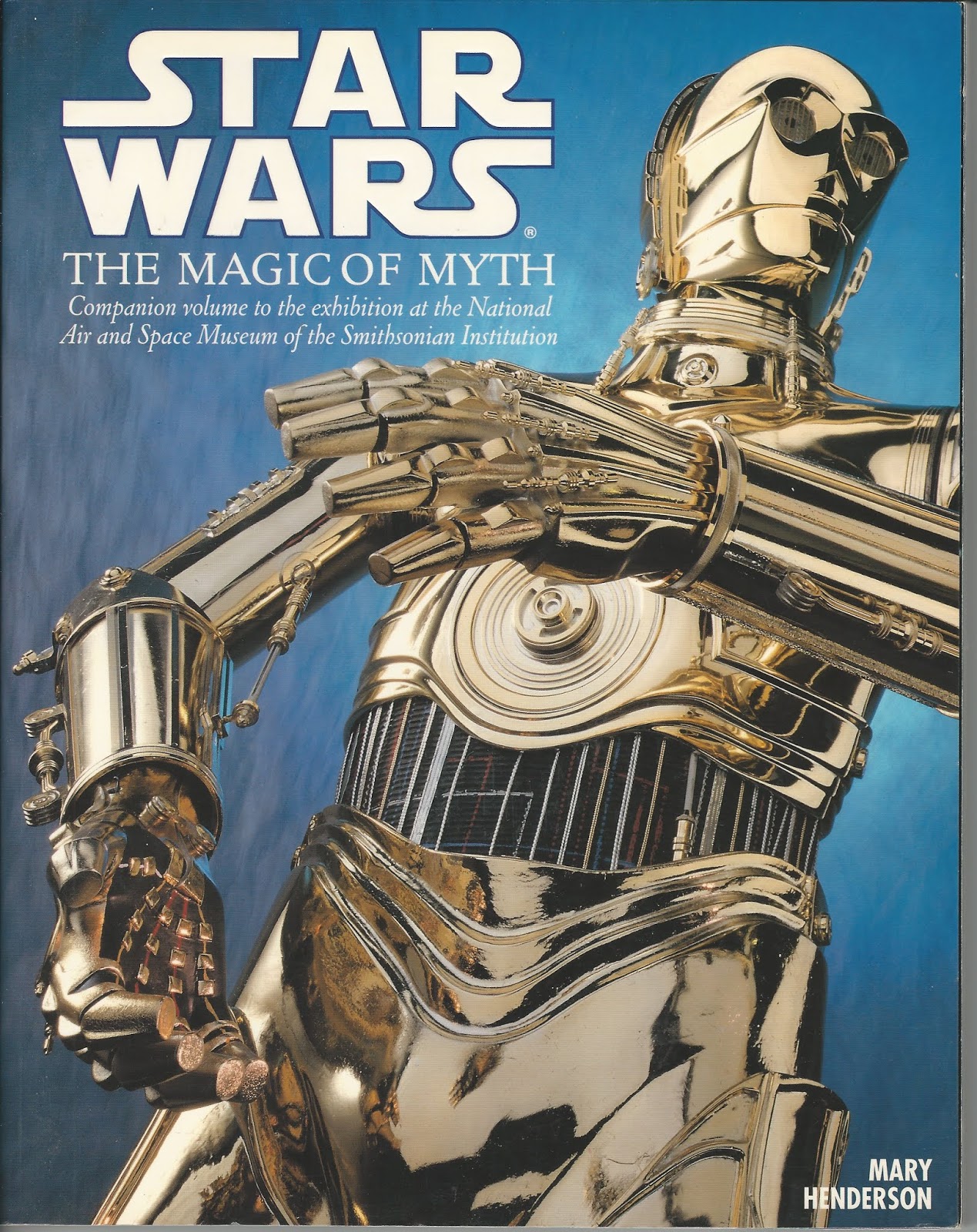
Star Wars: The Magic of Myth
by Mary Henderson
Bantam Books, 1997
Jospeh Campbell, Carl Jung, and more.
In The Virtues of Captain America: Modern Day Lessons from a World War II Superhero, Mark D. White argues for a continuity of character in The Captain despite the many authors who penned the narratives. Of course, he represents the best aspects of the nation he personifies. He does not just beat up bad guys – though he did a lot of that, and not much more, in the Silver Age of the 1960s. Nonetheless, he went to Vietnam twice, the second time to rescue a kind of Medecins sans Frontiers doctor. The Captain is honest, courageous, persevering, and loyal. Above all, he is honorable.

On the other hand, for many people, America is not inherently good; and, therefore, as its embodiment, The Captain is also flawed and perhaps evil. 

Captain America Complex: The Dilemma of Zealous Nationalism by Robert Jewett went through two editions (1973, 1984). It was reborn in 2003, co-authored with John Sheldon Lawrence, as Captain America and the Crusade Against Evil: The Dilemma of Zealous Nationalism. It garnered an accolade as a ForeWord Magazine Book of the Year Finalist. 

The Evolution of a National Icon: Captain America, Masculinity, and Violence by J. Richard Stevens also encircles The Captain with the negative energies of our culture. 

Despite their leftwing titles, both books are approximately objective, though selective, in teasing out the threads of a long-running story. What that story means depends on who you are.  
"We're not conquerors." 
The men in Washington are not impressed with the shield. 
They want The Captain to sponsor The Ameri-Gun.
Two scenes in the movie resonated with me. When Colonel Philips tossed out the dummy grenade, Steve Rogers threw himself on it. “Well, that’s what I’d do,” I said. “You would??” Laurel asked. It is not the sentiment of a Randian egoist. “Hand grenade comes into the foxhole, everyone’s dead anyway. You might as well do what you can to save the others.” It is not a rational decision but a heartfelt response. The other scene was the flag pole climb. I would not see the outside-of-the-box answer right away. I would have to sleep on it – which is why I am not a field commander or even a department manager-but it would be clear to me eventually that there is a better solution. 
The Captain was always man of his time 
Today, everything is complicated.
"An Allied superspy from World War II working with
a rogue Hydra cell. Now I really want to know what
went wrong on that mission."
(Man out of Time by Ed Brubaker, the longest-running writer.)


For one thing, though not 4-F, I was 1-Y in the draft. Like Sheldon Cooper and Leonard Hofstadter, I was never anyone’s choice to be in their squad in gym class. All I asked of my body was to carry my brain around. When I joined the Texas State Guard, my friends and family were surprised, if not shocked. I was never in favor of any of America’s military adventures. But the TXSG is not issued weapons; and we cannot be sent overseas. We are Texans serving Texas. The physical requirements are minimal but when I enlisted, November 22, 2014, having just turned 65, I found that I could do zero push-ups and zero sit-ups. Fortunately, I was always a walker. So, clearing the mile under time was the first win. Now, what I cannot do is 20 push-ups. This morning, I did 31 sit-ups. No serum. No vita-rays. Just the will to succeed and to do better the next time. That, too, is easy to find in the mythology of Captain America.

PREVIOUSLY ON NECESSARY FACT

Friday, May 25, 2018

Blaming Ayn Rand for the 2010 Financial Crisis

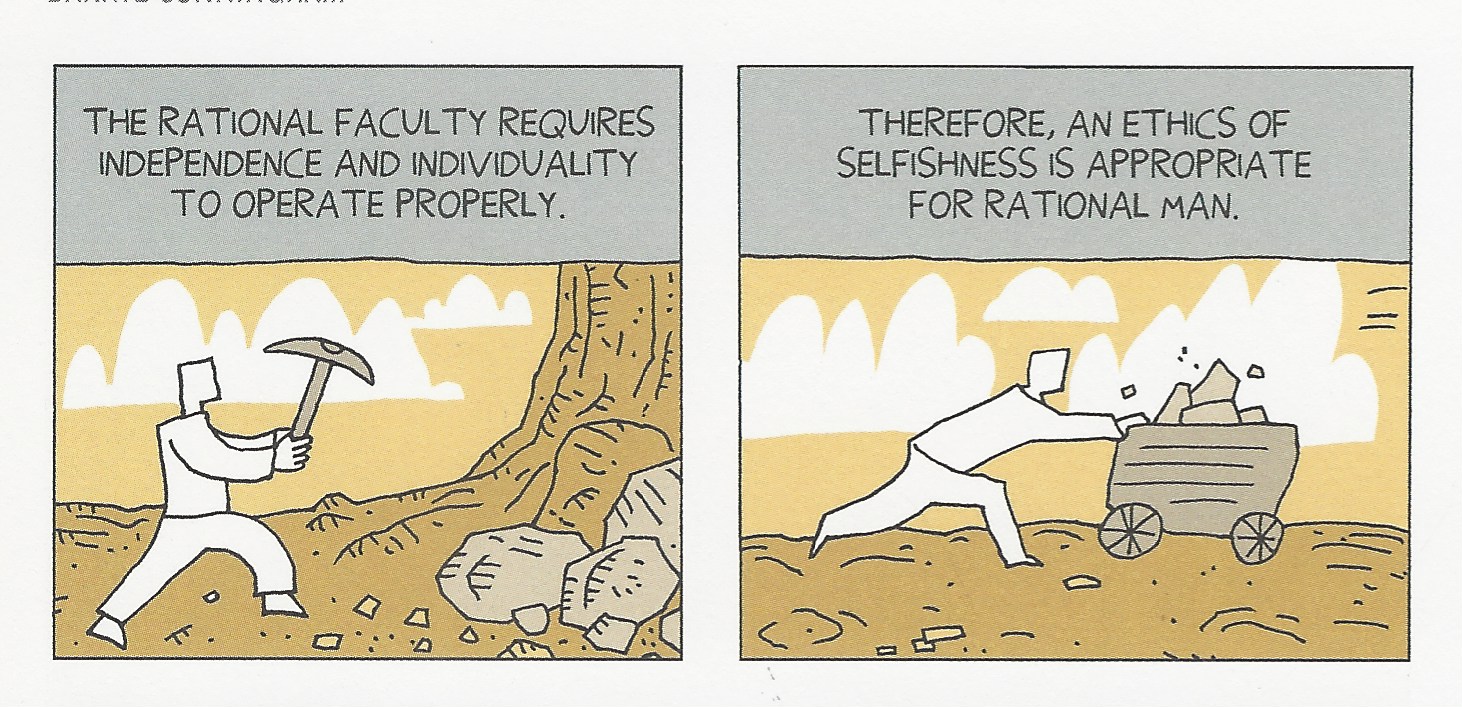
The Age of Selfishness: Ayn Rand, Morality, and the Financial Crisis by Darryl Cunningham (Abrams, 2015) is a closely written and tightly integrated misinterpretation of Ayn Rand’s life, her works, her philosophy of Objectivism, and the causes of the market collapses of 2007-2010. This book is a graphic novel because Cunningham is a cartoonist. His drawings can be crude, but are often essentialist and representational. He does sublimely capture people, often through their coiffeur and stance. But his work is never fine, detailed, or realistic. This book is largely a running monologue that needed no illustrations. The author claims that the popularity of Ayn Rand’s ideas among American (and British) conservatives caused the mortgage meltdown and subsequent bailouts.

Cunningham latches on to all of the negatives of Rand’s life and disparages the few successes that he acknowledges. 

What I find most interesting in this and similar attacks is that no one seems to be motivated to rip apart Karl Popper, Ludwig Wittgenstein, Jean-Paul Sartre, Jacques Lacan, or Richard Rorty for their foibles. We can condemn Thomas Jefferson’s relationship with Sarah Hemings without dismissing the Declaration of Independence as a hypocritical façade to justify the theft of lands owned by the British crown and its loyalists. Ayn Rand is different. 

Cunningham takes the time to make his case. The 231 pages begin with Ayn Rand’s life (Part One), explain the details of the financial contractions (Part Two), and then tie the first to the second (Part Three). His sources include biographies of Ayn Rand by her nominal admirers, Barbara Branden, Ann Heller, and Jennifer Burns. Ultimately, the thesis is not supported because the summary rests on omissions, flaws, and fallacies. Of necessity, the author contradicts himself. 

Cunningham does nod to the virtues of traditional conservatism, though he finds them not as powerful and promising as progressive liberalism. We need to be conservative in order to preserve the family, social order, and the freedoms we enjoy in our democracies. He presents World War II as an example of that. The error here is that Ayn Rand was not a traditional conservative. (And she was not alone in being less than sanguine about America's role in World War II.)  She called herself a “radical for capitalism” explaining that capitalism rests on a foundation of reason in acknowledgement of reality. Cunningham admits that Rand was opposed to the war in Vietnam, the draft, and laws against abortion. He fails to identify Rand as having been as “liberal” as she was “conservative.”  It would be possible to criticize Rand’s novels and her philosophy as an expression of unbridled liberalism.

Cunningham does not perceive the contradiction in his thesis.
Liberals actually share Rand's epistemology and
much of the "psycho-epistemology" of independence.
Conservatives attempt to advocate for the
consequential material gains, but deny reason and
independence.
Her heroes are socially disruptive. In AnthemThe Fountainhead, and Atlas Shrugged, the bad guys are the people in power who fear change. In the last two, the wealthy and powerful are mediocrities. The heroes also achieve wealth, but do not pursue power. (In The Fountainhead, the pursuit of power destroyed Gail Wynand who “was not born to be a second-hander.”) Her heroes famously stand on their own, especially in confronting adversity, a virtue that Cunningham identifies with children who grow up to be self-identified political liberals. 
In truth only six of the eight needed the bailout.
Moreover, all were forced to take it.
And all were forbidden to discuss it publicly
under threat of government retaliation.
Cunningham never grasps the fact that Objectivism is a personal philosophy. Rand’s heroes live sparsely; her villains are ostentatious. Ayn Rand’s heroes are more concerned with their own place in the physical world than in the society around them. Personally, I find that the conservatives who discovered Ayn Rand's works only through the Atlas Shrugged movies think that this is all about politics. Hank Rearden had a mansion to house his family, not himself. And it was his family that oppressed and exploited him. The government’s interference was just a footnote in his life. He cut the chains of government regulation only after he was able to get himself an apartment in the city. 
 
Cunningham is wrong.
The accepted story is that Ayn Rand was on the phone with
Isabel Paterson. Paterson insisted that Rand "owed it to her readers"
to follow The Fountainhead with another novel.
"What if I refused?" Rand asked.
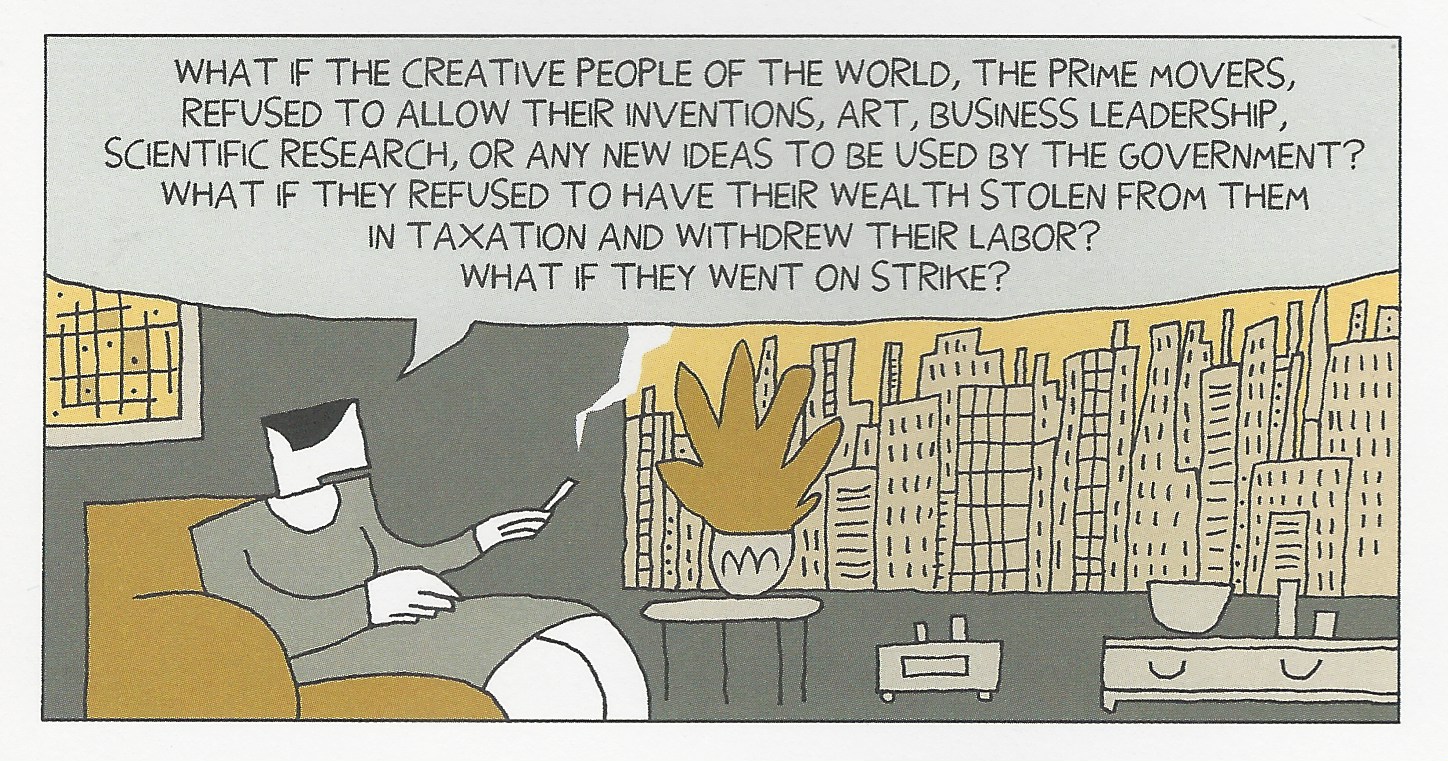
The Strike was about the cause of such demands.
Ayn Rand did not consider the government
to be metaphysically important.
The central failure of Cunningham’s thesis is that the personal morality of Objectivism would never suggest, support, justify, or excuse the acts committed by the people who caused and profited from the financial crisis of 2007-2010. Those men were portrayed in The Fountainhead as Homer Slottern the successful businessman who was terrified by religion and in Atlas Shrugged as Mayor Bascom of Rome, Wisconsin, who turned a quick profit buying and dumping the remains of 20thCentury Motors. The Fountainhead also has looter architects, among them the hooligan Gus Webb, just as Atlas Shrugged’s villains include Mr. Mowen and Orren Boyle among the businessmen with Washington connections. 

Cunningham’s story contains a kernel of truth. However, deeper than the mechanics of shady deals was the lack of integrity of the dealers. “Do you think integrity is the monopoly of the artist? And what, incidentally, do you think integrity is? The ability not to pick a watch out of your neighbor’s pocket? No, it's not as easy as that. If that were all, I'd say ninety-five percent of humanity were honest, upright men. Only, as you can see, they aren't. Integrity is the ability to stand by an idea. That presupposes the ability to think. Thinking is something one doesn't borrow or pawn.” Kent Lansing to Howard Roark in The Fountainhead (Chapter X, p. 333; via Wikiquote) “Honesty is the recognition of the fact that the unreal is unreal and can have no value, that neither love nor fame nor cash is a value if obtained by fraud...”– Galt’ Speech.  

PREVIOUSLY ON NECESSARY FACTS

Thursday, June 29, 2017

SUPERMAN: AMERICAN ALIEN


Canon exists. Once you stray from canon, you go from a slippery slope to a reductio ad absurdum in which all you have is an empty name. A Vegetarian Big Mac has no meat.  Alternately - and it is all about alternates - once a new poet recasts a myth, broad reception and acceptance can solidify that new interpretation into a classic. 

In the earliest saga of Sifrit, Brynhilda was a Valkyrie. In the Middle Ages, she was the Queen of Iceland; Hagan and his gang were Burgundians; and the curse of the Nibelungs was effected by Attila the Hun. Richard Wagner reanimated the older epic and made it the new canon. Clash of the Titans is no less canon than the re-imaged work of Apollonius of Rhodes who about 250 BCE borrowed from several ancient legends to build his Argonautica

The core of the Arthurian legends was a handful of separate stories. From them, Chretian of Troyes constructed a new epic for the court of Marie of Champagne, the half sister of Richard Lionheart. Four hundred years later, Sir Thomas Mallory reshaped the story for his own time - though we hardly know the difference between the two periods, both being only "medieval." In the 19th century, the romantic revolution provided the context for Alfred Lord Tennyson's Idylls of the King. Two generations later, they were presented as T. H. White's Once and Future King; and in another 20 years, the Broadway musical Camelot by Lerner, Loewe, and Hart came to stand for the Kennedy Administration.

How many times has Superman has been re-imaged? How many timelines and alternate universes exist? Even Bizarro Superman has re-instantiations.  And if Superman is variously vulnerable to the many forms of kryptonite, why is he never affected by his own costume, the space ship that brought him here, or Supergirl? (Riddle me that, Batman.)


In this version by Max Landis, Nick Dragotta, John Workman, and their collaborators, we meet a Superboy with whom Smallville is more or less adapted. Clark Kent's super powers still surprise him. Clark Kent's challenge after moving to Metropolis is to discover the range and limits of his abilities, and how to best use them--for his own good, and perhaps for a greater good. That greater good is also a challenge, though this version has no soul searching.


Superman and Clark Kent meet Batman and Bruce Wayne.  We have the wider field of vision, of course, perhaps even an x-ray vision by which we see their inner processes as they meet. But, again, Max Landis has written without the deep philosophizing of self reflection. As Montag said in Fahrenheit 451, inside each book is a man.

PREVIOUSLY ON NECESSARY FACTS

Monday, February 8, 2016

Green Lantern Outshines Green Hornet

The Green Lantern (2011, Martin Campbell) not only kept to the story line, it took itself seriously.  The Green Hornet (2011, Michel Gondry) failed to make use of a rich story line, and was a joke on itself. 

Movies like these are always made for the fans. Many of those - perhaps most- are established followers to some degree or other.  In addition, the producers always hope to draw upon the millions who do not know the story, and who are looking for something new. They will become the new fans for next release. 

 Of those who enjoyed Lord of the Rings, only a minority slogged through three volumes of elvish poetry and grammar, and only a minority of them read The Silmarillion.  I know for a fact that many of my conservative comrades on GaltsGulchOnline.com did not read Atlas Shrugged either before or after seeing the movies. And few who did have read The Virtue of Selfishness. 

While I knew about Kato, I did not know Lenore Case (a constant as Britt Reid’s secretary), or Michael Axford (a reporter in two movies in 1940 and 1941, now the editor, played by Edward James Olmos.)  However, Wikipedia is our common memory. That said, when I was about three, we had a Hudson Hornet and being green, I called it The Green Hornet, so I must have known the radio show. And, as a young adult, I learned that Britt Reid was a grandnephew of John Reid, the Lone Ranger.  I had some other tangential exposures to the story over the years.

When they first were on the market, I had the presence of mind to buy the Dark Knight series as gifts for my wife. But it was only a couple of years ago that I picked up on the Green Lantern and several other comics, and only because of Big Bang Theory. The library and comic stores were both big helps. So, I am not a trufan, I confess.

Not only did Michel Gondry and Seth Rogen (star and writer with Evan Goldberg) fail to make the best use of a developed narrative, they besmirched it. From radio into movies, television, and several comic publishers, the Green Hornet has had a complex career, and several incarnations. In this version, Britt Reid’s contempt for everyone around him, especially Kato, and Kato’s servility were sickening. Given the recorded history of Lenore Case since 1936, Cameron Diaz’s talent was wasted. In the year 2011, she could have come out early as the brains of the group. And she should not have needed to kick Britt in the nuts. By 2011, he should have been a better person.

The Green Lantern held true to the story, and was written and played as seriously as a comic book can be. Although Hal Jordan is a swaggering jet jockey, he is not an idiot. And he is not mean. And his serious side is evident from the first, so that when he is called upon to be heroic on an inter-galactic scale, it is believable in the context of the story.

"In brightest day, in blackest night,
No evil shall escape my sight.
Let those who worship evil's might,

Beware my power, Green Lantern's light !"

PREVIOUSLY ON NECESSARY FACTS