Showing posts with label future of the military. Show all posts

Thursday, July 16, 2026

U.S. Military Goes Back to the Future

President Dwight D. Eisenhower warned of the military-industrial complex in his "Farewell Address." 

In Power & Market Murray N. Rothbard showed that no publicly-funded enterprise will be profitable because anything you do for political reasons must result in an economic loss. 

Furthermore, economic calculations derive from the relationship between time and money. Therefore, political choices necessarily result in temporal losses. Whereas businesses plan for the future, governments live in the past. 

https://arstechnica.com/gadgets/2026/07/us-seeks-cheaper-hunter-killer-drones-after-iran-destroys-1b-worth-of-reapers/

https://arstechnica.com/ai/2026/07/us-military-sent-explosive-drone-boats-into-combat-for-the-first-time/

As a consequence of entropy, merging the military with corporate industries did not jump the military to a higher quantum state of better actions from better decision-making. Instead, the corporations became more averse to change and less invested in disruptions from entrepreneurs and "intrapreneurs". 

Jane Jacobs differentiated the guardian mode from the commercial (https://en.wikipedia.org/wiki/Systems_of_Survival) by contrasting 15 behaviors in each. Some of those are approximately analogous and others are obvious opposites.


Jacobs herself was a "democratic socialist" and she emigrated to Canada because Pres. Richard Nixon was elected. Therefore, it is significant that she recognized the Guardian Syndrome as a standard for socialist nations. She meant that normatively, not positively: statistically, not ethically. In other words, Jacobs described what she discovered, not what she sought. 

"What comes out of a team or a committee is the most daring idea that the least daring man can accept." John Arnold. "Space, Time and Education," Astounding Science Fiction, May 1953, pp. 9–25. Introductory remarks by John W. Campbell, Jr., editor, pp. 9–10.

Bob Gesking makes remote-controlled model boats: Home Hobbyist (gallery)

https://www.cleveland.com/insideout/2012/12/bob_gesking_makes_remote-contr.html

Communities of hobbyists have been building radio-controlled vehicles for the air, land, and water since the early 1950s. Brothers Walter and William Good built and flew their Big Guff in 1938. The idea of a radio controlled aeroplane was tested by the UK military during World War I. 

As political entropy decreases the energies of enterprise, the military becomes ever less advanced. And, generally and broadly considered, that is a good thing. However, that only reflects the more basic truth that we are all getting poorer because of political decisions being made in market contexts and markets being subsumed by political operations.

The best society separates power and market for the same reasons that it separates church and state. 

[13 April 2013] "The influential head of Google, Eric Schmidt, has called for civilian drone technology to be regulated, warning about privacy and security concerns. Cheap miniature versions of the unmanned aircraft used by militaries could fall into the wrong hands, he told the UK's Guardian newspaper.  Quarrelling neighbours, he suggested, might end up buzzing each other with private surveillance drones.  He also warned of the risk of terrorists using the new technology.  Mr Schmidt is believed to have close relations with US President Barack Obama, whom he advises on matters of science and technology.” -- BBC Technology News here Touted on Slashdot here


https://necessaryfacts.blogspot.com/2013/04/drones-are-everywhere.html

PREVIOUSLY ON NECESSARY FACTS

The Audacity of Enterprise

Why a Level Playing Field?

Leadership 

Shifting the Paradigm of Private Security


Tuesday, December 31, 2019

“Star Trek: Discovery” and the Conflict of Values

Star Trek: Discovery is an adventure story about conflicts of values. The characters act purposefully and in accordance with their values to achieve their goals. Following the theory of aesthetics proposed by Ayn Rand, I found that the storyline of the first year of this television series maintained an integrated plot, a well-defined theme, and a substantiated plot-theme. 

Rand defined plot as “a purposeful progression of logically connected events leading to the resolution of a climax.” (The Romantic Manifesto, Signet edition, page 47). The plot of Star Trek: Discovery is the story of a war of attrition between the Klingon Empire and the United Federation of Planets. 

Rand defined a theme as “the summation of a novel’s abstract meaning.” For Rand, the theme of Atlas Shrugged was “the role of the mind in man’s existence.” She identified the theme of Les Miseables as the injustice of society toward its lower classes. The theme of Gone with the Wind was the impact of the Civil War on Southern society. (Page 46). I found the theme of Star Trek: Discovery to be the role of values in choosing our actions. In that, I also found the series to be strongly and consistently within the Romantic tradition defined by Ayn Rand.

Adm. Katrina Cornwell takes the Captain's chair.
(I always find ambiguous command to be problematic.)
The concept of a plot-theme is unusual (if not unique to Rand). In The Romantic Manifesto, she wrote: “It is the first step in the translation of an abstract theme into a story without which the plot would be impossible. A “plot-theme” is the central conflict or “situation” of a story—a conflict in terms of action, corresponding to the theme and complex enough to create a purposeful progression of events. The theme of a novel is the core of its abstract meaning—the plot-theme is the core of its events. … The theme of Gone with the Wind is: “The impact of the Civil War on Southern society.” The plot-theme is: “The romantic conflict of a woman who loves a man representing the old order and is loved by another man, representing the new.” (page 51-52). 

I identify the plot-theme of ST:Discovery to be the experiential path of a woman who must identify the nature and extent of her own values.

Rand defines Romanticism as “a category of art based on the premise that man possesses the faculty of volition.” (“What is Romanticism?” pages 64-87) Bootleg Romanticism is popular fiction that implicitly accepts that premise, rather than explicitly. She put the early James Bond novels in that genre. She was also a fan of Star Trek: Original Series; and Gene Roddenberry was an admirer of her works. 
 
Emperor Philippa Augustus Georgio confronts Vulcan ambassador Sarek.
She is about to don the persona of her alter ego
the late Captain Philippa Georgio.
Cdr. Burnham and Adm. Cornwell watch.
It is important to understand the distinction between Rand’s own works and those she enjoyed. Her novels dramatized political conflicts. Others in that vein that she recommended to her admirers included the works of Allen Drury, such as Advice and Consent. Rand insisted that art is an end in itself. It exists to provide personal enjoyment. (page 14). So, whatever the conflicts of values acted out by the characters, we do not judge the value of the work itself by the specific political statements of the actors. Rand was a great fan of Victor Hugo. She wrote an Introduction to a Bantam Books edition of Ninety-three in 1962. The conflict of values and the integration of plot and theme center on the French Revolution.  However, Rand insists:

“The fact is that Ninety-three is not a novel about the French Revolution. To a Romanticist, the background is a background, not a theme. His vision is always focused on man –on the fundamentals of man’s nature, on those problems and those aspects of character which apply to any age and any country. The theme of Ninety-three—which is played in brilliantly unexpected variations in all the key incidents of the story, and which is the motive power of all the characters and events, integrating them into an inevitable progression toward a magnificent climax---is: man’s loyalty to values.” (p. 121)

I point out that in other writing, Ayn Rand was clear in her condemnation of the Southern culture of agrarianism in general and its basis on slavery in particular. But that had nothing to do with the artistic merits of Gone with the Wind. Similarly, Rand’s admiration for Crime and Punishment was not an endorsement of the police of imperial Russia. Today, many who claim to be admirers of Rand’s fiction confuse aesthetics with politics and economics. It can be interesting to discuss the extent to which science fiction writers who claim special imagination fail to envision any utopia more innovative than open-handed socialism. On that basis, the Star Trek franchise has been criticized by libertarians  But such complaints are wholly outside the realm of aesthetics. 

Star Trek: Discovery delivers a complex drama in which the values of the characters define the set and setting of conflict. Moreover, the integration of plot and theme provide a grand stage on which to see the consequences of values in the choices of action. 

In previous instantiations of Star Trek, the Klingons are just warriors. They have the pride of the honor and action evidenced by our own police and military in The Guardian Ethos, but their ideologies, such as they may be, are never clearly defined. Here they are. T’Kuvma’s opening speech is complete, succinct, and unequivocal. Moreover, that ideological framework is quickly betrayed and abandoned as a new leader arises. That results in internecine warfare at the expense of the Federation which finds itself fighting 24 separate wars, and is soon on the verge of annihilation. Peace is established (at once ironically and yet integrally) when that ideology is re-ignited by a true follower of T’Kuvma. 
 
In the mirror universe's agonizer booth, to be tortured to death,
Cpt. Gabriel Lorca has this planned carefully.
Cinema writing for the big screen and television has replaced the novel. TV writing today is much evolved over the work of Ayn Rand’s day. Unlike ST:OS and like most modern dramatic series Discovery follows a “story arc” a uniting narrative of action that plays out over many episodes. Here, that arc is the duplicity of Captain Gabriel Lorca. As the end approaches, we must condemn him. We can see even his best actions in a new (and worse) light. But his competence as a leader is never in question. Aligned to his values, his actions are purposeful, consistent, and thoughtful. We just reject his values. But he has them. And he knows what they are.

It is our viewpoint character, Commander Michael Burnham, who must confront hers. She is never without values. She is passionately committed to them and firm in her perception of them. The voyage of discovery she makes—hence, Star Trek: Discovery—is learning to understand the full range, depth, and meaning of those values. 

We are no longer on the eve of battle.
Even so, I come to ask myself the same question that young soldier asked the general all those years ago: "How do I defeat fear?" The general's answer: the only way to defeat fear is to tell it, “No.”
No. We will not take shortcuts on the path to righteousness.
No. We will not break the rules that protect us from our basest instincts.
No. We will not allow desperation to destroy moral authority.
I am guilty of all these things.
Some say that in life, there are no second chances. Experience tells me that this is true. But we can only look forward. We have to be torchbearers, casting the light so we may see our path to lasting peace. We will continue exploring, discovering new worlds, new civilizations.
Yes. That is the United Federation of Planets.
 
Cmdr. Michael Burnham's values are internally conflicted
because they derive both from her (adopted) Vulcan heritage
and her (achieved) Starfleet rank.
Does the show have flaws? Of course it does. I suggest that anyone who can do better should write their own novels and produce their own cinemas to demonstrate how it should be done (in their opinion). It is easy to criticize. Myself, with my limited training and experience in security and the military, I would never send the captain into hand-to-hand combat on an enemy vessel, no matter how convenient that is for Star Trek. But I did not write it. I write other stuff.

PREVIOUSLY ON NECESSARY FACTS


Monday, November 19, 2018

Soldier’s Heart by Elizabeth Samet

One of her cadets, now an officer, wrote to his former professor about his experience in the active military preparing for his combat assignment and wondering if his lack of faith in the mission was a sign of disloyalty. “When I decided to teach English, I did not anticipate that I would be in the business of dispensing this sort of advice—on scanning Alexander Pope, perhaps, or unpacking a metaphor in an Elizabethan sonnet—but not this.” (page 163)

I found the book in the used book sales racks of the Brigadier General John C. L. Scribner Texas Military Forces Museum at Camp Mabry in Austin. After finishing it the first time, I read it again, making extensive notes, both on stickies and as marginalia. There’s a lot to think about.  On almost every page, I found something to underline.

picture shows soldier in combat uniform laying down, relaxing, reading a book
 Dr. Elizabeth Samet (b. 1969) finished a BA in English at Harvard (1991) before earning her Ph.D. at Yale. She then joined the faculty of English and Philosophy at West Point (1996) and is now the chair of the English side of that department. The latest entry in her bibliography is an annotated edition of the The Memoirs of Ulysses S. Grant (Liveright Norton, 2019). She says in Soldier’s Heart that Grant’s Personal Memoirs was her gateway to the military. “I don’t remember who introduced us [in 1994 or 1995], but I can recall what an inspiring companion he proved to be after a few years on the obligatory graduate school diet.” (page 35)

At the end, she offers several pages of recommended reading. But recommended reading is actually the superstructure of the narrative, the framework of her coursework for West Point cadets. And she tells her story from several perspectives: Not Your Father’s Army; “Books are Weapons”; Becoming Penelope, the Only Woman in the Room; To Obey or Not to Obey; Bibles, Lots of Bibles; The Courage of Soldiers; The Anatomy of Sacrifice. Those spaces are arched by a Prologue (Year of the Plague) and an Epilogue (Ave Atque Vale). The stories stand alone, though some characters re-appear. 

“This is a story about my intellectual and emotional connections to military culture and to certain people in it, but the real drama lies in the way the cadets I teach and the officers with whom I work negotiate multiple contradictions of their private and professional worlds. … Because they serve at the bottom of a hierarchy not especially interested in their opinions, cadets, especially plebes, at once crave and fear the freedom to wonder. … Few people know this part of their story: the courage with which they challenge accepted truths; the nuanced way they read literature and culture; and the ingenious methods they have for resisting conformity in lives largely given over to rules and regulations. Our national fondness for celebrating the physical heroism of soldiers—the apparent readiness with which they sacrifice their lives to larger causes—eclipses the far less romantic displays of moral and intellectual fortitude that also distinguishes so many of them. In turning them all into heroes, we have lost the sense of the individuality they also fight to preserve.” (page 13) 

The title comes from one of the earliest descriptions of what we now call PTSD. It has been termed shell shock and battle fatigue. The diagnosis “soldier’s heart” followed the American Civil War. It mimicked cardio-vascular disease but insightful practitioners recognized that the problem was psychological, not organic. Samet extends that meaning by recording, reflecting on, and honoring the emotional hearts of soldiers. Though she does invest much in our unresolved relationships with and distinctions between the wounded and the dead (Chapter 7), this book is really a celebration to the living. It honors the young officers who choose the difficult and sometimes impassable roads to the moral high ground in a morally ambiguous world. 

“I often get the feeling that these officers have something they want to say but can’t. Perhaps they simply want to acknowledge the change, to resume a normal acquaintance, or to tell me about something that happened in the desert. Whatever they know cannot be pried loose by a lot of questions. It has to come voluntarily and perhaps only much later, when distance permits reflection. More often than not we end up talking about where they read a particular book and what they found in it that helped them better understand what they have been asked to do. Thus when people ask me about my ‘function’ I can’t answer so glibly because when I look out at those newly shorn plebes who appear so eager to please on the first day of the semester, full of good faith and idealism, I see not simply students of literature or numbed soldiers but citizens who are willing to make a very real sacrifice.” (page 15)

Writing in 2007, she called it the Long War (page 11). Soldiers now call it The Forever War after Haldeman’s book. In 2016-2017, the Texas State Guard assigned me a fulltime opportunity to work in the Domestic Operations Task Force of the Texas Military Department. My commanders included young lieutenants who never knew a time of peace and now are not likely to as they mature up the ranks. Consequently, this is a book for everyone who wants to understand their responsibilities as citizens in a republic that chooses to go to war.

Author:
Willing Obedience: Citizens, Soldiers, and the Progress of Consent in America : 1776-1898, Stanford Univ. Press, 2004. (This grew out of her doctoral dissertation.)
Soldier's Heart: Reading Literature Through Peace and War at West Point, Picador, 2008.
Leadership: Essential Writings by Our Greatest Thinkers: A  Norton Anthology, 2015.
No Man's Land: Preparing for War and Peace in Post-9/11 America, Picador USA, 2015.
The Annotated Memoirs of Ulysses S. Grant, Liveright W. W. Norton & Company, 2019. 

Contributor:
Thomas Jefferson's Military Academy: Founding West Point by Robert M. S. McDonald, University of Virginia Press, 2004.
Tolstoy on War: Narrative Art and Historical Truth in "War and Peace" by Rickie Allen McPeak, Cornell University Press, 2012.

PREVIOUSLY ON NECESSARY FACTS


Sunday, September 30, 2018

Robert Heinlein’s Starship Troopers

Arguably Heinlein’s last juvenile novel, the story is a shoot-‘em-up. I got lost in the jargon of military organization. I accepted at face value that as a corporal Juan Rico could not be promoted to assistant section leader over his platoon assistant leader, but I still have no idea what that means. Reading Heinlein’s philosophical arguments are the reward for being immersed in his futures. The movie version of Starship Troopers made the case more succinctly and forcefully than the book: When you vote, you call upon the full power of the state to do your bidding; and no one should do that who does not understand what it means. The Socratic dialog in the book that delivered the justifications for requiring military service as a condition of full citizenship was easy to jump in and argue against.

That theorem has a corollary: You cannot vote while you are in uniform. According to Heinlein's philosophy, until you complete your military obligation, you have not earned the right to vote. In real life, Ulysses S. Grant, Dwight D. Eisenhower, George C. Marshall, and George S. Patton refused to vote while serving in the Army. (See "I Fight for Your Right to Vote. But I Won't Do It Myself," by Maj. M. I. Cavanaugh in the New York Times for Oct. 19, 2016 here.)

The minor premise of Heinlein's command doctrine is interesting to consider, and we have come to absorb some of it: everyone who wants to serve has a role. After graduating from Annapolis (1929), Robert A. Heinlein was cashiered from the Navy (1935) for tuberculosis. He recovered and lived a normal active life. Today, although military fitness standards have just gotten tougher, amputees with prosthetics have been returned to active duty, even to combat. 

I saw the movie on disk a couple of years ago, but very many years after reading the book. So, I read it again. I was looking for the story of the senior Rico, Emilio, the hero’s father, who enlisted after Buenos Aires was nuked. Emilio Rico was a corporate CEO from Harvard Law School. But his portrait is a shadowgraph. My intent was to write his story as a project in placing and selling military science fiction stories. “Write what you know” is the basic rule. I know the old man who enlists late in life but the Harvard lawyer is an alien. 

Most of the book delivers Heinlein’s vision of the ideal boot camp. The infantry fighting is out of army field manuals. (Joe Haldeman's Forever War is the better ground battle.) Heinlein served aboard the aircraft carrier USS Lexington. Sgt. Juan Rico’s time aboard the Rodger Young is easy to understand and identify with. Write what you know.

PREVIOUSLY ON NECESSARY FACTS


Sunday, August 26, 2018

A Critic Meets the Military

Write about what you know. Every student of journalism, fiction, or poetry hears that from our teachers. Carol Burke was already a professor of English at UC Irvine when she wrote Camp All-American, Hanoi Jane, and the High-and-Tight: Gender, Folklore, and Changing Military Culture (Beacon Press, 2004). That was before she went to Iraq (2008) and Afghanistan (2010). Her experiences probably did not change her from a Democrat into a Republican. She did not become a better writer; her prose is beyond critique—which is why she became a professor of English. But something perhaps ineffable is obvious as a result of her experiences while imbedded with soldiers in a warzone. 


Her book, Camp All-American, is an anti-sexist anti-military diatribe. It was easy to agree with. Her criticisms were more than valid. She was on-target. But others had aced the same firing range. So, like any good marksman, her skill can be credited to her instructors. The problem with Camp All-American is that Burke does not explore the foundations and superstructure of the edifice of sexism. 

The subtitle is "... Changing Military Culture" and it has a double meaning. Sociologists tell a joke: How many sociologists does it take to change a lightbulb? The lightbulb does not need changing; it is society that must be changed. So, Prof. Burke is not chronicling the changes going on at that moment or before or to come, but her intention to change the military to be what she wants it to be. And what she wants is not bad or wrongful. In fact, it is the way the military has been headed since the first female chief petty officer in 1917 (Navy Live blog here).  


Even so, I agree with Burke's major premise: the military treats women differently from men in ways that have nothing to do with the objective requirements of the job. For instance, women are forbidden  from the high-and-tight. Female "short" hair styles must be at least one-quarter inch long. If the rationale of the military were accepted prima facie, every boot would get a buzzcut.  It is just one point among many that are easy to accept yet annoyingly shallow for want of analysis.

Exploitation has three excuses: gender, race, and class. They are braided, though in a particular time and place, one skein may be larger or dyed brighter than the others. Generally, in America, we are classless, sometimes with an unfortunate double meaning. We have been trying hard to get passed race; and, mostly, in the middle of the culture, we have been successful despite the agendas of guilt and hate (also intertwined) from the extremists of the left and right. And the fact is that the military followed baseball in racial integration, ahead of Brown vs. Board of Education and the marches in the south. Racial equality in the services should be a model for gender equality. Burke draws no parallels there.

Sex and gender have genetic roots that define the sociology, economics, and politics of sex and gender. Ultimately, the solution may be epigenetic. When gender enjoys the mobility and mutability of race and class, it will cease to be casus belli—at least for most people, though probably never for the radicals. 

Burke is not alone in her revulsion for the confluence of sex and violence among military men. She accepts it as a perceptual primary. So, she offers no conceptual causes.

She does soft soap Jane Fonda. I did not know that Fonda apologized for her "insensitivity" during the Vietnam war.  Several times. See here and here. But the problem is complicated and Burke does not follow all of the paths of inference. Jane Fonda's tourist visit to an anti-aircraft gun was not a momentary lapse, but a moment within an integrated life. All of her other choices seem to line up pretty well with that. Under the influence of Jane Fonda Ted Turner became a benefactor of the United Nations. 

To say that the military is “conservative” has little to do with the election strategies of Paul Ryan and Marco Rubio, except as they, too, reflect, a long, broad, and deep cultural matrix. We accept that military people are in families. To enforce Spartan barracks would seem unnatural (here and now). Yet, about 20,000 to 25,000 military families benefit from food stamps, and other federal family support subsidies. (See Military.com stories here and here.) Every soldier (sailor, airman) knows the cliché: If the Army wanted you to have a family, they would issue you one.

And barracks today are sexually segregated, just as they were separated by race until after World War II—and as they are still separated by class: officers sleep better than enlisteds, even in the very frontiersy Texas State Guard.

Statistical surveys of the military carried out by military leaders (on NecessaryFacts here) reveal an unsurprising geographical bias for the South and the West. The interplay between regional conservatism and military presence is hard to ignore. Per capita enlistments from Massachusetts are not what they were in 1776 or 1861. Only a well-defined liberal elite believes that the military could benefit from the traditional liberal education at university. Most people in America, Democrat and Republican, believe that it is good, right, and proper that the military stands aside, alone, and apart with its own ethical and moral standards.  

Nonetheless, it is paradoxical yet unsurprising that enlisted soldiers (sailors, airmen) are statistically aligned with the country at large. Forty percent feel this way; forty percent want the other thing; and 20% are undecided. Among officers, the story is different. And the higher you go, the farther to the right you drift. The more conservative you become, the better your chances are for promotion. Inevitably, liberals self-select themselves out after the first six to eight years.

So, attitudes about class, race, and gender linger in the highest echelons. Change erupts from below. As non-European non-men inevitably achieved rank and rating military culture changed. But it did not radically alter overnight. Nor could it. To expect that is to wish for the unreal. Yet change does happen. We have no lawful, legal nobility in America. And even in England nobles are now tried before juries of commoners.  Social change happens. But it happens one mind at a time.

I was no stranger to war. In December 2008 and January 2009, for two months before heading off to Afghanistan in 2010, where I served as a cultural advisor to two brigade commanders …
[…] 
We traveled to small villages, to the few remaining schools in the heavily Taliban-influenced district, and to the large local bazaar with its long line of dirt-floored stalls where over a hundred merchants sold farm supplies, veterinary medicines, motorcycles, materials for making I.E.D.’s (improvised explosive devices), drugs intended for the local clinic that had been mysteriously diverted to this makeshift drugstore, boots, plastic pails, decorated metal trunks, CDs that featured what some soldiers referred to as “the latest Taliban Fight songs,” naan, potatoes, raisins, produce in season, and freshly slaughtered lamb.
Rather than improving, security in this area became worse each month. When I had first traveled to the base, we could go twelve kilometers before encountering a tic, short for “troops in contact.” Within nine months, the circle of safety had shrunk to one kilometer.
A soldier in whose vehicle I often rode received a package from his young son, and amid the toiletries, candy and cookies was a five-inch plastic toy. At first, he simply propped the toy on his dashboard to remind him of his son, but after the first firefight from which he safely returned, the figure accrued talismanic meaning, and the soldier turned away the toy that he believed was his protection so that it no longer faced him, but instead looked out the windshield. It was as if, like a charm, it had the power to ward off the enemy’s evil eye.
Many personnel brought small tokens given to them by parents, children, lovers and fellow soldiers. Some were objects of faith —medals, rosaries, prayer beads, angels, crosses, gold and silver lockets with verses of the Quran tucked inside. Others acquired their significance from one’s relation to the giver. Still others accrued meaning along the way. What might be considered minor trinkets back home takes on a new meaning when one ventures into harm’s way. 
(“In the Event of My Death” by Carol Burke here: http://narrative.ly/to-be-read-in-the-event-of-my-death/)

Previously on Necessary Facts

Friday, August 10, 2018

Armadillocon 40, part 2

After a bit of lunch on Sunday, I went to "Once and Future Military SF" at 1300 hours. Moderator William Ledbetter has experience in the defense industry. Panelist David Afsharirad edits the military SF annual from Baen Books.  Lawrence Person writes the Battleswarm blog which is offers more right wing political commentary than military news. Several veterans sat in the audience. All in all, the panel opened doors to further thought and research. I asked them where they get their military news, citing Task & Purpose for myself, but they all agreed that they get their military news from mass media news stories. 

“Take and hold territory is a questionable axiom of military thinking.”

Military themes have long been a staple within science fiction. Autonomous robots for warfare followed stories about airplanes and tanks.  Lawrence Person pointed to a double misunderstanding in how we think about new technology: either it is not in the right place or it is in all places. In other words, for example, he said that an early recommendation for airplanes was to drop shipments of oats for the cavalry. But then came flying cars, and airplanes were everywhere. All technology goes through this, Person said. 

The panelists tossed ideas back and forth. David mentioned autonomous remote drones amd remote control and Lawrence said that the Predator from Kosovo has been retired and replaced by the Reaper. David suggested that we have the right to prevent the future.  Turning to asymmetrical warfare with non-state actors, David recommended The Last Good Man by Linda Nagata.

Ledbetter recommended Jerry Pournelle’s The Strategy of Technology. (Originally written together by Jerry Pournelle and Stefan Thomas Possony, this book has defined the evolution of modern warfare and laid the foundation to US military domination in the late 20th and early 21st century. Formerly required reading at the US War College, the book explains the necessity of technological innovation for the control of strategical and tactical operations since the dawn of war. Like the Art of War this text can be applied to general human systems including the business environment. Application of its principles has led to American hegemony in both the military and economic spheres of influence in our transnational world. It also explains the rise and fall of empires due to the increasing cost of military budgets through technological development and deployment. An issue as critical today as it was in its use during and through the end of the Cold War.” -- Gregory Alan Wingo, Amazon review.)

Everyone agreed that the last war remains the next war in the minds of planners. The fact is that the new targets will be – or are now – the financial sector, satellites, and the power grid.

A question from the audience suggested that we will have even more boots on the ground because autonomous automated support groups can carry supplies to troops. But that is what "Air Cavalry" was invented for and how it was deployed in Vietnam. (See We Were Soldiers Once... and Young  reviewed here.)

The name “Coyote Smith” came up and I found Dr. M.V. “Coyote” Smith on The Space Show website “… a professor of strategic studies at the Air University's eSchool of Graduate Professional Military Education. He retired from active duty in August 2016 while serving as professor of strategic space studies at the School of Advanced Air and Space Studies. Prior to this, he served as the Director of the Center for Strategy and Technology where he led PROJECT BLUE HORIZONS for the Air Force Chief of Staff.  Earlier, he served at the Pentagon as the Chief of “Dream Works,” which was the Future Concepts division of the National Security Space Office where he led the Defense Science Board and directed the Space-Based Solar Power Study.” https://www.thespaceshow.com/guest/dr.-m.v.-coyote-smith-col-usaf-ret

“Technology” is a broad word and it led to Ledbetter's mention of NineFox Gambit by Yoon Ha Lee, the first book in the Machineries of Empire triology. “... The trilogy follows the young infantry captain Kel Cheris and the traitorous general Shuos Jedao in a war among factions of a despotic interstellar empire, whose technology and power is based on the population's faith in the imperial calendar.” https://en.wikipedia.org/wiki/Machineries_of_Empire
  
PREVIOUSLY ON NECESSARY FACTS


Tuesday, January 30, 2018

Team of Teams

Team of Teams: New Rules of Engagement for an Empowered World by Gen. Stanley McChrystal (US Army, Ret). With Tatum Collins, David Silverman, and Chris Fussell.  
Portfolio/Penguin, 2015.


An enjoyable, erudite read, Team of Teams by Stanley McChrystal was written by a general for generals. McChrystal takes his time to make his points. He presents cogent evidence to support his assertions, but those would be easy enough to accept on the basis of his authority. His education and experience made him an expert.  From 2003-2008 he was in charge of the Joint Special Operations Command that was responsible for defeating the insurgency of Al Qaeda in Iraq (AQI), and neutralizing its leadership, including the death of Abu Musab al-Zarqawi. In order to achieve that, McChrystal had to reconfigure the way the Army usually operated.

The transformation was radical for the military, but familiar to the private sector. Information could not be held in organizational “silos” on a need-to-know basis. The office layout, while allowing adequate personal space, had to be open so that people could talk across desks, across islands of information and authority. This was only way that the allied joint forces could defeat AQI, which was decentralized, resilient, adaptable, flexible, and driven by the media of information exchange from the cellphone to the international news website.

The coordinating theme is the balance and integration of shared consciousness and empowered execution. Shared consciousness includes the physical perceptions brought in from information assets, either directly from soldiers in the field or indirectly from informants or remote sensors. It also includes the philosophy of the mission, an agreement on doctrine and rules of engagement. Given that, empowered execution allows those closest to a problem – taking a house or killing an enemy leader—to solve it in real time.

Early on, McChrystal establishes a baseline that he returns to repeatedly throughout the book. Frederick Winslow Taylor’s efficient organization defined not just the methods of production or the layout of the office, but the fundamental doctrinal premise of a civilization for 100 years.  Taylorist thinking led to the impenetrable (but immovable) Maginot Line that aircraft flew over. The coalition forces defeated Saddam Hussein because both sides were fighting the previous war. The Iraqi insurgency demanded new habits from new learning. It was time to take everyone’s brains out of their footlockers and put them all to work thinking, discussing, planning, and criticizing.

Chapter 10 “Hands off” contrasts the experiences of Commodore Matthew Perry and Gen. Ulysses Grant. Perry was on his own, over 6,000 miles from home. He had total control and no oversight. On the other hand, Grant issued meticulously detailed orders to his generals. McChrystal’s world was a strange mix of the two. While he enjoyed complete information input from assets in the field, soldiers, helicopters, and drones, he also insisted on letting the leaders on the ground make their own decisions, knowing, of course, that they were not alone at all. 
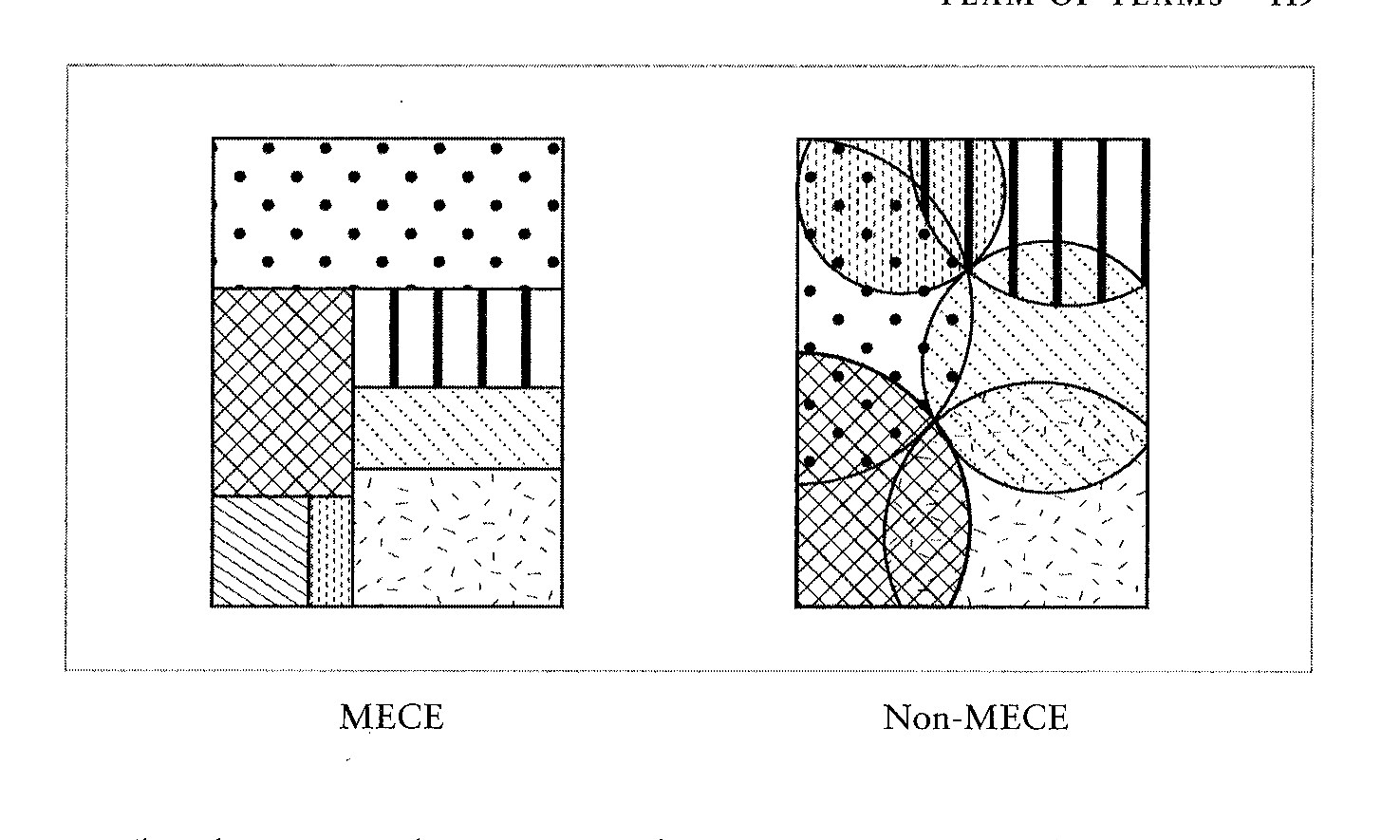
MECE: Mutually Exclusive and Collectively Exhaustive

McChrystal completed a master of science in International Relations from Salve Regina University. He has company. Maj. Gen. James W. Nuttall deputy director of the Army National Guard earned an MA at SRU. Gen. Peter Chiarelli completed an MA in national security strategy at SRU after earning an MPA from the University of Washington. After finishing a master's at Salve Regina, Gen. Anthony Zinni (USMC) earned another master's from Central Michigan University.

Perhaps making too much of his outside-the-box thinking, it is interesting to note that Gen. McChrystal recommended A Connecticut Yankee in King Arthur’s Court for Admiral Stavridis’s anthology, The Leader’s Bookshelf. Also, whether and to what extent such new age intuitions actually instantiated the doctrine of counter-insurgency outlined by David Galula may be putative. It may be that victory in Iraq such as it was came from doing what soldiers always do and that so-called “counter-insurgency” ultimately proved to be a failure because it could never have been a success. 


PREVIOUSLY ON NECESSARY FACTS