Showing posts with label women in the military. Show all posts

Sunday, April 18, 2021

Liza Mundy Breaks the Code and Misses the Message

Write about what you know. Write from your experience. Those two mandates are easily given to anyone who wants to write for a living. They apply to fiction and non-fiction. The rules were too easily ignored by Liza Mundy. Granting that Liza Mundy recorded well what people told her, it is obvious that before she wrote this book, she knew nothing about codes, the military, or World War II. 

 Languages change. I was born in 1949 and in my first grade classroom one of our phonics charts spelled waggon in the old British style, just as Abraham Lincoln wrote shew for show. I mention that because on page 112, Mundy says that Ruth Weston was “olive complected” and I learned “complected” to be regional American dialect and not proper American English. Whatevs.


Code Girls by Liza Mundy 
(Hatchette 2017)
More consequentially, Mundy does not understand why military people salute each other, who salutes whom, and the differences in rules for the customs and courtesies as followed by the Army versus the Navy. She says: “… but Bea Norman felt the Marines guarding each room ‘took pernicious pleasure’ in making the women salute over and over.” (page 169) 

But she also notes later that by the rules, as officers, the WAVES were entitled to salutes from enlisted men (page 191). They would be entitled to the courtesy from all enlisted personnel, regardless of sex, but that aside, the Marines may have been pushing some regulations. One fine point is that by Navy customs, you only salute the first time you see an officer because on board a ship you will see her a hundred times a day. Sailors and Marines would all be waving their arms all the time and in confined spaces. Also, unlike the Army, the Navy does not salute again after coming on deck (or inside a building). That being as it may, the bottom line is easy: If someone salutes you, you return the salute; it is that simple. But clearly, the salient facts are not military customs and courtesies but how many insults and injuries Mundy could find to curry sympathy for the women in the story. 

The irony compounds because in the Index, the women are listed by their married names despite the fact that we worked with them for three, four, or five years when they were single. Among the many people buried in the Index was Genevieve Grotjan who was instrumental in breaking the Japanese Purple cipher. After we follow her work as a cryptanalyst for five years, she is listed as Feinstein, Genevieve Grotjan because she got married on page 344.


The English and Americans broke the Enigma cipher machine in part because an early version of  a cracking machine was delivered to British intelligence by Polish intelligence agents after the German invasion. It was called a “bombe” or sometimes “bomba.” Mundy does not say this, but one story had it named after a chocolate cake because that was what the Polish mathematicians were eating at a restaurant when they outlined their theoretical solution to the German cipher back in 1932. Anyway, on page 135, it appears as a “bomby”—gratefully just that one time. It is an example of the many empty files in Mundy’s knowledge warehouse. 


Mundy says three times that making codes is “the best possible training for learning how to break them.” (page 75) That is not true. It is true that learning the history and application of codes and ciphers is basic to cryptology. But making up arithmetic problems will not teach you how to solve them. The fact is that experts break the codes and ciphers of amateurs specifically because tyros are inept at cracking. Mundy had never done the work herself. This was all new to her. 


So was World War II. We all commonly see this as the three Allied powers against the three Axis powers. We also accept the USSR as our ally and still consider the French to have been in “the free world” (page 308) even though French reactionaries had spent four years helping the Germans to round up Jews. Mundy never questions it, even in the context of a war in which the British and American intelligence groups did not always trust each other. As a recent ally of Germany, the USSR was never to be trusted. She mentions the America First movement only in passing. Therefore, Mundy does not explore the motivations of the women who asserted themselves to join the civilian government defense efforts before Pearl Harbor. 


I accept as an assumption that Mundy is not comfortable with firearms and she has never flown an airplane. So, she quickly passes over the firearms qualifications that several women earned, among them Louise Pearsall, (page 273), and Fran Steen (page 191) who also earned a private pilot certification while working as a cryptanalyst (page 191). The author just does not appreciate those accomplishments.


Unlike the reviewers for the mainstream media I spent two weeks with this book. Despite the many reasons to put post-its on pages, this was not painful. Mundy writes well. I was pleasantly surprised to learn that among the cryptanalysts were philosopher William Van Orman Quine, actor Tony Randall, classicist Richmond A. Lattimore, and contract bridge mavin Oswald Jacoby (page 181). It was also interesting to get the backstory on William Friedman. I always accepted his being the master cryptanalyst who singlehandedly broke Purple. In fact, Mundy says (and my wife concurs) that Elizabeth was the brains. She introduced him to crypto. And, of course, this book is the story of the women who really broke Purple. So, there is a lot here. 


But the untold story of the Code Girls was always hidden in plain sight. In 1996, when I was working for the US DoD back home in Cleveland, Nida Glick, my mother’s Latin teacher (who had been the language department chair when I went to the same high school), passed away. Her obituary in the May 6 Plain Dealer showed her in her Coast Guard uniform from World War II when she served as a codebreaker. 


Mundy’s experience with Politico, The Atlantic, and The Washington Post, and her work on behalf of Michelle Obama reflect her engaging and compelling narrative style. However, pop culture books and magazines are different from history books. I know from personal experience that as painful as it can be, a newspaper can always print a correction or even a retraction. With books, the errors and omissions are more permanent and revealing. 


Also, even if the New York Times and Kirkus were not pre-disposed to ladle praise on this work, the fact is that professional reviewers also bang out copy on deadlines. So, fact checking is not always possible, even if it is wanted by the editors.


Historians labor under a special conflict of norms different from the other sciences. (My Marxist professors easily convinced me that history is a science.) If a historian judges the people of the past by the standards of the present, no one looks good. If you accept the cultural standards of another time and place, then you fail to be objective. In anthropology that is called the error of going native. 


Mundy acknowledges that many of these women were born in or around 1920 when American society was changing. The social revolutions in norms of behavior were more dramatic than the material progress of the 19th century. These women left their old world in 1940 and then left it behind irretrievably in 1945. Some did well. Ann Caracristi became the first woman deputy director of the NSA. After years of peak experience, and then dumped into an environment where the only pressure was to conform, others suffered the same PTSD as other combat veterans and never reintegrated completely to civilian life. Some took the hard road down. Others recovered. It is a complex story and Mundy tells it well enough.


PREVIOUSLY ON NECESSARY FACTS

The Second World Wars by Victor Davis Hanson 

Codes and Coins 

A Successful Imitation of Alan Turing 

2nd Lt Frances Slanger: American Nightingale 

World War II Sweetheart Dance 

The Wise Men 


Wednesday, November 21, 2018

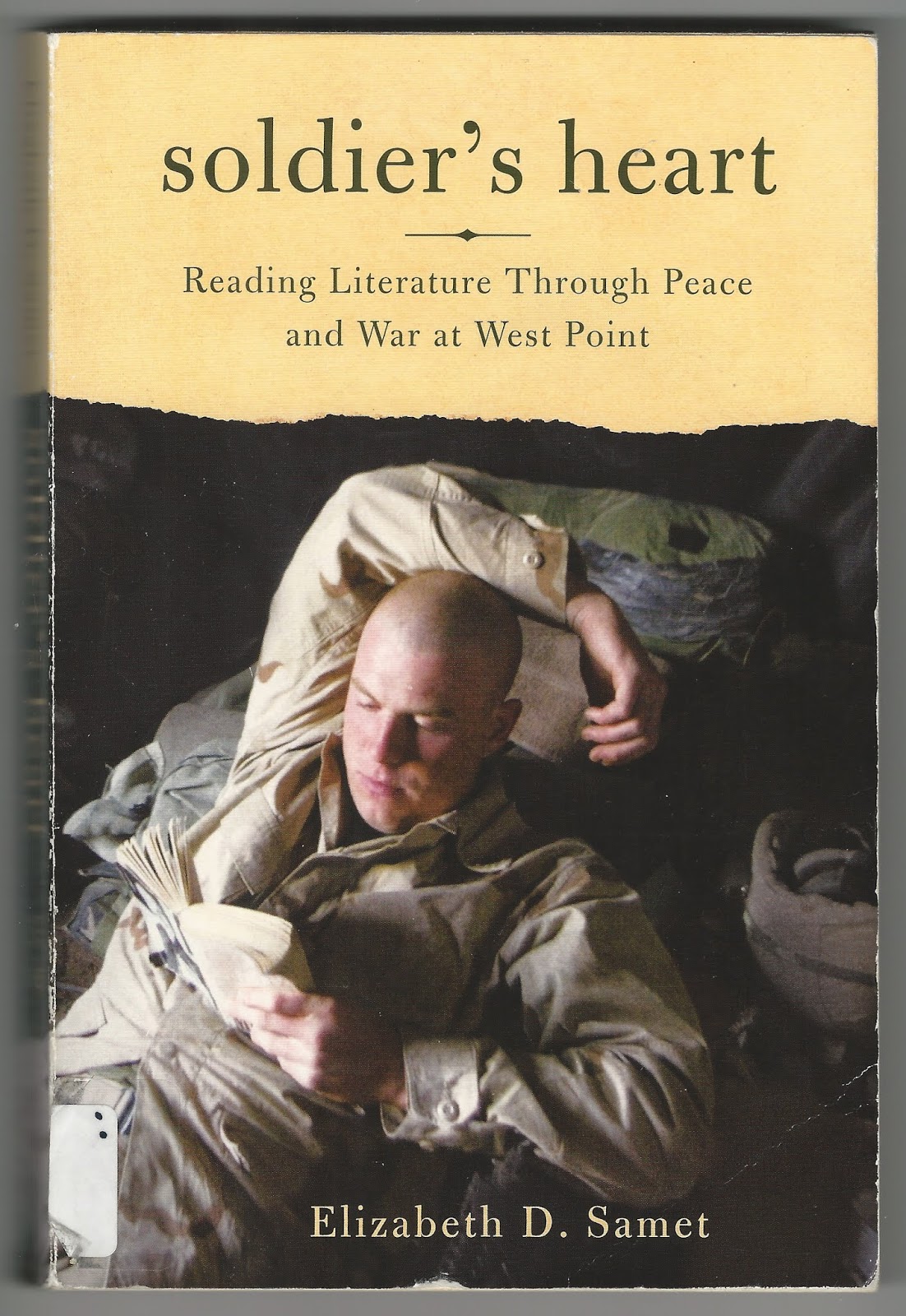
Thoughts on "Soldier’s Heart"

From my mother’s sleep I fell into the State,
And I hunched in its belly till my wet fur froze.
Six miles from earth, loosed from its dream of life,
I woke to black flak and the nightmare fighters.
When I died they washed me out of the turret with a hose.

Randall Jarrell’s poem reocurs as do several of the author's West Point cadet students and a few of her faculty colleagues. Of the students, Samet dubbed three “the Musketeers” for their inseparability. Throughout, she uses pseudonyms, and it is telling that she called one of the Musketeers Grant. Ulysses S. Grant’s Personal Memoirs affected her. Samet says that we know how to honor the dead but we do less well with and for the wounded. We do not think of Grant as wounded. But I do. 
Solider's Heart: Reading Literature
Through Peace and War at West Point

by Elizabeth D. Samet
(Farrar, Straus and Giroux, 2007)

When I worked for Coin World, I was assigned Grant as a feature story. There’s the $50 bill, of course, but quite a bit more is known to the numismatist. I bridled at the assignment: Grant was a drunken general who ordered other people to kill and die. However, it did not take much research to learn that he was significantly deeper than that. He would have preferred to teach mathematics at a girls’ school. And so, he understood the unremitting arithmetic of the War Between the States: The South simply could not keep paying the price. The personal price that Grant ultimately paid can only be guessed at.

When a firstie (senior class) once asked a colonel what he needed to succeed in the Army, the officer replied, “Show up on time and stay in shape.” (page 196)  I think that promptum et salutem makes a good motto. 

A far less weighty consideration is Prof. Samet’s solution for the problem of the pronoun. For myself, in technical writing, I choose “they” for everyone. Samet’s choice is to go back and forth between he and she, usually with the masculine, as most of the people in her life are men but often using the feminine as neutral for everyone or anyone.

Prof. Elizabeth D. Samet’s In-Text Recommended Reading
(This is just some of it.) 
Wilfred Owen
Edith Wharton
Li Po (Tang Dynasty poet)
Randall Jarrell’s “The Death of the Ball Turret Gunner”
Anne Sexton
T. E. Lawrence Seven Pillars of Wisdom
Edgar Allen Poe Poems, especially “The City in the Sea”
(That anthology was paid for by his West Point classmates.)
Antoine Saint-Exupéry
Ulysses S. Grant Personal Memoirs 
Artist Savile Lumiey
Alexander Pope Essay on Man
Jane Hirshfield
Jorie Graham
Shakespeare “Sonnet 73”
Shakespeare Henry V
Tennyson “Ulysses”
Ambrose Bierce, especially "One Kind of Officer"
Frost “Road Not Taken”
Attar** Parliament of Birds
Wallace Stevens
Movie: Jacob’s Ladder
Movie: The Four Feathers
Movie: The Roaring Twenties.
**(Abū Ḥamīd bin Abū Bakr Ibrāhīm c. 1145 – c. 1221; 
better known by his pen-names Farīd ud-Dīn and ʿAṭṭār—https://en.wikipedia.org/wiki/Attar_of_Nishapur)

Samet wrestles with the ethos of the military, especially when the military is set apart from the general public. “The rhetoric of the War on Terror has been from the first deeply inflected with messianic vocabulary that makes it easy for soldiers to conflate military and spiritual missions and that complements the military’s own sense of itself as a noble profession and a higher calling.” (page 158) 

Between the time he retired from the Marine Corps and became the Secretary of Defense, James Mattis directed a statistical survey of public attitudes about the military. His team found that across all sectors of America, only the “elites” believe that the military should share the same values as society at large. Most people across the political spectrum believe that the military has a different value system than everyone else in America–and this is good. (NecessaryFacts here.) 

I like to think that I have no illusions about human nature, but the fact is that when on base, I never lock my car; and if it is hot—as it often is here in Texas—I leave the windows rolled down. Samet herself reflects at length at how like a small town West Point is. This is good and bad, depending on the context. 

This opens the door to more of my own beliefs. I stood mute and smiled when a sergeant to whom I reported found by surfing that I posted to the Military Atheists website. (Foxhole Atheists here.) My certainty that the universe had no creator comes from the philosophical objectivism (with a capital-O) of Ayn Rand. Predicated on that metaphysics and epistemology, the ethics of egoism are not consonant with the warrior’s way. (How I correlate them is discussed elsewhere.) Based on Soldier’s Heart, I expect that Elizabeth Samet does not explicitly practice the virtues of selfishness. Neither is she a postmodernist. At least, she does not speak their vernacular of “trajectories” and “projects” and “giving voice.” And while she is scrupulous about not forcing her own morals on her students, she clearly has them; and as subtext they seem traditionally American. 

So, I agree with her that mixing the language of missionaries with the goals of military missions is highly problematic. At the same time, I found unsatisfying her apparent belief that civil law is the highest law. She is uncomfortable with the fact that as citizens our soldiers hold the state subservient to religion. I get her point. But I also see a profound and deep philosophical foundation to the fact that in customs and courtesies, the chaplain’s pennant can fly above the American flag while services are being held. Conquering as we must is predicated on our cause being just. The just war doctrine is another of the threads in this book. 

Though rejecting religion as a foundation for morality in Chapter 5 “Bibles, Lots of Bibles,” Samet does not follow that with anything as substantial. Chapter 6 “The Courage of Soldiers” is about the strength of will to stop and consider the hard choices and then select the right one. But all she offers, quoting Hemingway, is that doing the right thing makes you feel good (page 180). Citing Grant, Samet wonders about those “moments when moral courage comes at the expense of an opportunity to demonstrate physical valor.” (page 203)

Steadfast in her role as a civilian, Samet could not avoid assimilating military dialect and the thinking that requires it. Following 9/11 West Point operated under force-protection orders—without quotation marks or explanation (page 5).  Her prep school reunion was “garrisoned by white-gloved waiters” (page 96). She does explain “suspense” as the word for a deadline or expiration (page 229). Most consequentially, throughout, but explicitly in Chapter 6, Samet reflects on the fact that she shares the role of an officer in directing the actions of those under her command and holding herself responsible for the acts and the people who perform them. 

In that, Prof. Samet hints at much struggling, but has no final words for what affected her most to that time: the deaths of her colleagues, one by suicide; and the combat deaths of her former students. Ultimately, the entire book is about that.

Monday, November 19, 2018

Soldier’s Heart by Elizabeth Samet

One of her cadets, now an officer, wrote to his former professor about his experience in the active military preparing for his combat assignment and wondering if his lack of faith in the mission was a sign of disloyalty. “When I decided to teach English, I did not anticipate that I would be in the business of dispensing this sort of advice—on scanning Alexander Pope, perhaps, or unpacking a metaphor in an Elizabethan sonnet—but not this.” (page 163)

I found the book in the used book sales racks of the Brigadier General John C. L. Scribner Texas Military Forces Museum at Camp Mabry in Austin. After finishing it the first time, I read it again, making extensive notes, both on stickies and as marginalia. There’s a lot to think about.  On almost every page, I found something to underline.

picture shows soldier in combat uniform laying down, relaxing, reading a book
 Dr. Elizabeth Samet (b. 1969) finished a BA in English at Harvard (1991) before earning her Ph.D. at Yale. She then joined the faculty of English and Philosophy at West Point (1996) and is now the chair of the English side of that department. The latest entry in her bibliography is an annotated edition of the The Memoirs of Ulysses S. Grant (Liveright Norton, 2019). She says in Soldier’s Heart that Grant’s Personal Memoirs was her gateway to the military. “I don’t remember who introduced us [in 1994 or 1995], but I can recall what an inspiring companion he proved to be after a few years on the obligatory graduate school diet.” (page 35)

At the end, she offers several pages of recommended reading. But recommended reading is actually the superstructure of the narrative, the framework of her coursework for West Point cadets. And she tells her story from several perspectives: Not Your Father’s Army; “Books are Weapons”; Becoming Penelope, the Only Woman in the Room; To Obey or Not to Obey; Bibles, Lots of Bibles; The Courage of Soldiers; The Anatomy of Sacrifice. Those spaces are arched by a Prologue (Year of the Plague) and an Epilogue (Ave Atque Vale). The stories stand alone, though some characters re-appear. 

“This is a story about my intellectual and emotional connections to military culture and to certain people in it, but the real drama lies in the way the cadets I teach and the officers with whom I work negotiate multiple contradictions of their private and professional worlds. … Because they serve at the bottom of a hierarchy not especially interested in their opinions, cadets, especially plebes, at once crave and fear the freedom to wonder. … Few people know this part of their story: the courage with which they challenge accepted truths; the nuanced way they read literature and culture; and the ingenious methods they have for resisting conformity in lives largely given over to rules and regulations. Our national fondness for celebrating the physical heroism of soldiers—the apparent readiness with which they sacrifice their lives to larger causes—eclipses the far less romantic displays of moral and intellectual fortitude that also distinguishes so many of them. In turning them all into heroes, we have lost the sense of the individuality they also fight to preserve.” (page 13) 

The title comes from one of the earliest descriptions of what we now call PTSD. It has been termed shell shock and battle fatigue. The diagnosis “soldier’s heart” followed the American Civil War. It mimicked cardio-vascular disease but insightful practitioners recognized that the problem was psychological, not organic. Samet extends that meaning by recording, reflecting on, and honoring the emotional hearts of soldiers. Though she does invest much in our unresolved relationships with and distinctions between the wounded and the dead (Chapter 7), this book is really a celebration to the living. It honors the young officers who choose the difficult and sometimes impassable roads to the moral high ground in a morally ambiguous world. 

“I often get the feeling that these officers have something they want to say but can’t. Perhaps they simply want to acknowledge the change, to resume a normal acquaintance, or to tell me about something that happened in the desert. Whatever they know cannot be pried loose by a lot of questions. It has to come voluntarily and perhaps only much later, when distance permits reflection. More often than not we end up talking about where they read a particular book and what they found in it that helped them better understand what they have been asked to do. Thus when people ask me about my ‘function’ I can’t answer so glibly because when I look out at those newly shorn plebes who appear so eager to please on the first day of the semester, full of good faith and idealism, I see not simply students of literature or numbed soldiers but citizens who are willing to make a very real sacrifice.” (page 15)

Writing in 2007, she called it the Long War (page 11). Soldiers now call it The Forever War after Haldeman’s book. In 2016-2017, the Texas State Guard assigned me a fulltime opportunity to work in the Domestic Operations Task Force of the Texas Military Department. My commanders included young lieutenants who never knew a time of peace and now are not likely to as they mature up the ranks. Consequently, this is a book for everyone who wants to understand their responsibilities as citizens in a republic that chooses to go to war.

Author:
Willing Obedience: Citizens, Soldiers, and the Progress of Consent in America : 1776-1898, Stanford Univ. Press, 2004. (This grew out of her doctoral dissertation.)
Soldier's Heart: Reading Literature Through Peace and War at West Point, Picador, 2008.
Leadership: Essential Writings by Our Greatest Thinkers: A  Norton Anthology, 2015.
No Man's Land: Preparing for War and Peace in Post-9/11 America, Picador USA, 2015.
The Annotated Memoirs of Ulysses S. Grant, Liveright W. W. Norton & Company, 2019. 

Contributor:
Thomas Jefferson's Military Academy: Founding West Point by Robert M. S. McDonald, University of Virginia Press, 2004.
Tolstoy on War: Narrative Art and Historical Truth in "War and Peace" by Rickie Allen McPeak, Cornell University Press, 2012.

PREVIOUSLY ON NECESSARY FACTS


Sunday, August 26, 2018

A Critic Meets the Military

Write about what you know. Every student of journalism, fiction, or poetry hears that from our teachers. Carol Burke was already a professor of English at UC Irvine when she wrote Camp All-American, Hanoi Jane, and the High-and-Tight: Gender, Folklore, and Changing Military Culture (Beacon Press, 2004). That was before she went to Iraq (2008) and Afghanistan (2010). Her experiences probably did not change her from a Democrat into a Republican. She did not become a better writer; her prose is beyond critique—which is why she became a professor of English. But something perhaps ineffable is obvious as a result of her experiences while imbedded with soldiers in a warzone. 


Her book, Camp All-American, is an anti-sexist anti-military diatribe. It was easy to agree with. Her criticisms were more than valid. She was on-target. But others had aced the same firing range. So, like any good marksman, her skill can be credited to her instructors. The problem with Camp All-American is that Burke does not explore the foundations and superstructure of the edifice of sexism. 

The subtitle is "... Changing Military Culture" and it has a double meaning. Sociologists tell a joke: How many sociologists does it take to change a lightbulb? The lightbulb does not need changing; it is society that must be changed. So, Prof. Burke is not chronicling the changes going on at that moment or before or to come, but her intention to change the military to be what she wants it to be. And what she wants is not bad or wrongful. In fact, it is the way the military has been headed since the first female chief petty officer in 1917 (Navy Live blog here).  


Even so, I agree with Burke's major premise: the military treats women differently from men in ways that have nothing to do with the objective requirements of the job. For instance, women are forbidden  from the high-and-tight. Female "short" hair styles must be at least one-quarter inch long. If the rationale of the military were accepted prima facie, every boot would get a buzzcut.  It is just one point among many that are easy to accept yet annoyingly shallow for want of analysis.

Exploitation has three excuses: gender, race, and class. They are braided, though in a particular time and place, one skein may be larger or dyed brighter than the others. Generally, in America, we are classless, sometimes with an unfortunate double meaning. We have been trying hard to get passed race; and, mostly, in the middle of the culture, we have been successful despite the agendas of guilt and hate (also intertwined) from the extremists of the left and right. And the fact is that the military followed baseball in racial integration, ahead of Brown vs. Board of Education and the marches in the south. Racial equality in the services should be a model for gender equality. Burke draws no parallels there.

Sex and gender have genetic roots that define the sociology, economics, and politics of sex and gender. Ultimately, the solution may be epigenetic. When gender enjoys the mobility and mutability of race and class, it will cease to be casus belli—at least for most people, though probably never for the radicals. 

Burke is not alone in her revulsion for the confluence of sex and violence among military men. She accepts it as a perceptual primary. So, she offers no conceptual causes.

She does soft soap Jane Fonda. I did not know that Fonda apologized for her "insensitivity" during the Vietnam war.  Several times. See here and here. But the problem is complicated and Burke does not follow all of the paths of inference. Jane Fonda's tourist visit to an anti-aircraft gun was not a momentary lapse, but a moment within an integrated life. All of her other choices seem to line up pretty well with that. Under the influence of Jane Fonda Ted Turner became a benefactor of the United Nations. 

To say that the military is “conservative” has little to do with the election strategies of Paul Ryan and Marco Rubio, except as they, too, reflect, a long, broad, and deep cultural matrix. We accept that military people are in families. To enforce Spartan barracks would seem unnatural (here and now). Yet, about 20,000 to 25,000 military families benefit from food stamps, and other federal family support subsidies. (See Military.com stories here and here.) Every soldier (sailor, airman) knows the cliché: If the Army wanted you to have a family, they would issue you one.

And barracks today are sexually segregated, just as they were separated by race until after World War II—and as they are still separated by class: officers sleep better than enlisteds, even in the very frontiersy Texas State Guard.

Statistical surveys of the military carried out by military leaders (on NecessaryFacts here) reveal an unsurprising geographical bias for the South and the West. The interplay between regional conservatism and military presence is hard to ignore. Per capita enlistments from Massachusetts are not what they were in 1776 or 1861. Only a well-defined liberal elite believes that the military could benefit from the traditional liberal education at university. Most people in America, Democrat and Republican, believe that it is good, right, and proper that the military stands aside, alone, and apart with its own ethical and moral standards.  

Nonetheless, it is paradoxical yet unsurprising that enlisted soldiers (sailors, airmen) are statistically aligned with the country at large. Forty percent feel this way; forty percent want the other thing; and 20% are undecided. Among officers, the story is different. And the higher you go, the farther to the right you drift. The more conservative you become, the better your chances are for promotion. Inevitably, liberals self-select themselves out after the first six to eight years.

So, attitudes about class, race, and gender linger in the highest echelons. Change erupts from below. As non-European non-men inevitably achieved rank and rating military culture changed. But it did not radically alter overnight. Nor could it. To expect that is to wish for the unreal. Yet change does happen. We have no lawful, legal nobility in America. And even in England nobles are now tried before juries of commoners.  Social change happens. But it happens one mind at a time.

I was no stranger to war. In December 2008 and January 2009, for two months before heading off to Afghanistan in 2010, where I served as a cultural advisor to two brigade commanders …
[…] 
We traveled to small villages, to the few remaining schools in the heavily Taliban-influenced district, and to the large local bazaar with its long line of dirt-floored stalls where over a hundred merchants sold farm supplies, veterinary medicines, motorcycles, materials for making I.E.D.’s (improvised explosive devices), drugs intended for the local clinic that had been mysteriously diverted to this makeshift drugstore, boots, plastic pails, decorated metal trunks, CDs that featured what some soldiers referred to as “the latest Taliban Fight songs,” naan, potatoes, raisins, produce in season, and freshly slaughtered lamb.
Rather than improving, security in this area became worse each month. When I had first traveled to the base, we could go twelve kilometers before encountering a tic, short for “troops in contact.” Within nine months, the circle of safety had shrunk to one kilometer.
A soldier in whose vehicle I often rode received a package from his young son, and amid the toiletries, candy and cookies was a five-inch plastic toy. At first, he simply propped the toy on his dashboard to remind him of his son, but after the first firefight from which he safely returned, the figure accrued talismanic meaning, and the soldier turned away the toy that he believed was his protection so that it no longer faced him, but instead looked out the windshield. It was as if, like a charm, it had the power to ward off the enemy’s evil eye.
Many personnel brought small tokens given to them by parents, children, lovers and fellow soldiers. Some were objects of faith —medals, rosaries, prayer beads, angels, crosses, gold and silver lockets with verses of the Quran tucked inside. Others acquired their significance from one’s relation to the giver. Still others accrued meaning along the way. What might be considered minor trinkets back home takes on a new meaning when one ventures into harm’s way. 
(“In the Event of My Death” by Carol Burke here: http://narrative.ly/to-be-read-in-the-event-of-my-death/)

Previously on Necessary Facts

Monday, April 2, 2018

JAG: 10 Seasons of Military Bearing

Last week, Laurel and I viewed the final episode of the final season of the television series JAG. It took us about a year to work through the set. Laurel is a voracious reader, primarily of murder mysteries and computer documentation. As a writer and reader of non-fiction, I am informed by Ayn Rand’s theory of aesthetics expressed in The Romantic Manifesto. For being television, written, shot, and edited on a grinding production schedule by a large, changing staff of writers and directors, with the attendant holes in plot, character development, and theme, JAG held up well.

Ayn Rand based her theory of art on Aristotle’s maxim that fiction portrays people as they can and should be. Every work of art is “a selective recreation of reality according to an artist’s metaphysical value judgments.” (The Romantic Manifesto, Signet 1971, p. 19) An artist cannot present all of reality, so some aspect of it stands for the whole. Is the world hospitable or hostile or indifferent? Rand called this one's "sense of life."
Complicated pasts leave them internally
conflicted. Their moral lodestars are on
the far horizon. They eventually find home port
.

“Art is a concretization of metaphysics. Art brings man’s concepts into the perceptual level of his consciousness and allows him to grasp them directly as if they were percepts.” (RM p. 20) 

"Since man lives by reshaping his physical background to serve his purpose, since he must first define and then create his values--a rational man needs a concretized projection of these values, an image in whose likeness he will re-shape the world and himself. Art gives him that image; it gives him the experience of seeing the full, immediate, concrete reality of his distant goals." (RM p. 38)

A biography of Abraham Lincoln’s life could run six volumes, chronicling every detail, but the characterization of President Lincoln in a Civil War drama will subsume and encapsulate all of that and deliver it to the audience, according to the intent of the artists--the actor, writer, director, and the others in the team. Ultimately, someone has artistic control of the final product and it is that person’s vision of life that we receive.

Petty Thief to Petty Officer
Zoe McLellan played
PO1 Jennifer Coates
In this case, the controlling artist was the executive producer, Donald P. Bellisario. A Marine Corps sergeant, Bellisario also created the original Magnum, P.I., Airwolf, and Quantum Leap. That last reveals the most about Bellasario’s view of your place in the universe. Is history inevitable? To what extent can you make your own life? In JAG, there is no doubt that we all make choices and accept responsibility for those decisions. Sometimes, the characters are in circumstances that are very constrained, but “I had no choice” is met with “You always have a choice.”

(I perceived a hidden undercurrent from Quantum Leap in the re-enactment episodes. The story is carried forward by the same actors, though in costume. Season 5 Number 11 “Ghosts of Christmas Past,” take place in the Viet Nam war. Season 6 Episode 23 “Mutiny” is a re-creation of the Somers Mutiny. Season 9 Episode 14 “Each of Us Angels” is set in World War II. Season 9 Episode 18, “What if?” offered alternate stories launched when they read fortune cookies at a restaurant. In the world of Donald P. Bellisario, you always have a choice. Tangentially, I followed the historical clues offered in MutinyRead here)

Our viewpoint characters,
the normal couple.
Beset by life's hard losses,
they never lose their moral compass,
and so they persevere and thrive.
Of course, the show suffered from errors of fact and the fan base responded. You can read other foible finding on the  TVtropes.org wiki. Nonetheless, I benefited from keeping a handbook of military justice at the couch, just to help with the details. It is not the purpose of fiction to be didactic, but it is important not to make up everything, otherwise you are not even creating science fiction but are selling fantasy.

We bought most of the DVDs, borrowing a couple of seasons from the local library. We have not watched broadcast (cable) television since 2010 and we were never big consumers before that. But people recommend shows and we read about them. In this case, JAG was a back-filling of our NCIS collection. (NCIS was piloted in Season 8 of JAG.) We discovered NCIS sometime after 2006. We picked up Season 1 of The West Wing at a neighborhood Blockbuster just as that series was concluding. We eventually viewed Mark Harmon's portrayal of Secret Service Agent Simon Donovan and found it positive and realistic. That led us to NCIS

Just for contrast here, we did once watch most of an episode of CSI but could not tolerate more. In fact, we withstood two seasons of torture with 24, so we think we’re tough. As for politics, I did view half an episode of The Veep (reviewed here but I would rather clean the latrines after drill. 

PREVIOUSLY ON NECESSARY FACTS


Thursday, March 1, 2018

2LT Frances Y. Slanger: American Nightingale

After landing on Utah Beach on D+4, she was killed during an artillery barrage outside Elsenborn, Belgium, on October 21, 1944. Bob Welch delivers the life and death of Army nurse 2LT Frances Y. Slanger by weaving her early life from Lødz and Boston with narratives of World War II. Welch is a master at the craft of writing. Slanger also wanted to be a writer, but always struggled with English. Her incessant scribbling got better and she poured her heart into a letter to Stars and Stripes that was granted the front page by editors who did not know that she was dead.

It is 0200 and I have been lying awake for one hour, listening to the steady, even breathing of the other three nurses in the tent. Thinking about some of the things we had discussed during the day. The rain is beating down on the tent with a torrential force. The wind is on a mad rampage and its main objective seems to be to lift the tent off its poles and fling it about our heads.
The fire is burning low and just a few live coals are on the bottom. With the slow feeding of wood and finally coal, a roaring fire is started. I couldn't help thinking how similar to a human being a fire is; if it is allowed to run down too low and if there is a spark of life left in it, it can be nursed back...So can a human being. It is slow, it is gradual, it is done all the time in these Field Hospitals and other hospitals in the ETO.
We had read several articles in different magazines and papers sent in by grateful GIs, praising the work the nurses around the combat areas. Praising us--for what? I climbed back into my cot. Lt. Bowler was the only one I had awakened. I whispered to her. Lt. Cox and Lt. Powers slept on. Fine nurses and great girls to live with...of course, like in all families, an occasional quarrel, but these were quickly forgotten.
I'm writing this by flashlight. In this light it looks something like a "dive". In the center of the tent are two poles, one part chimney, the other a plain tent pole. Kindling wood lies in disorderly confusion the ground.. We don't have a tarp on the ground. A French wine pitcher, filled with water stands by. The GIs say we rough it. We in our little tent can't see it. True, we are set up in tents, sleep on cots and are subject to the temperament of the weather.
We wade ankle deep in mud. You have to lie in it. We are restricted to our immediate area, a cow pasture or hay field, but then, who is not restricted? We have a stove and coal. We even have a laundry line in the tent. Our GI drawers are at this moment doing the dance of the pants, what with the wind howling, the tent waving precariously, the rain beating dow, the guns firing and me with a flashlight writing. It all adds up to a feeling of unrealness.
Sure, we rough it, but in comparison to the way you men are taking it, we can't complain, nor do we feel that bouquets are due us. But you, the men behind the guns, the men driving our tanks, flying our planes, sailing our ships, building bridges and to the men who pave the way and to the men who are left behind--it is to you we doff our helmets. To every GI wearing the American uniform, for you we have the greatest admiration and respect.
Yes, this time we are handing out the bouquets...but after taking care of some of your buddies; seeing them when they are brought in bloody, dirty, with the earth, mud and grime, and most of them so tired.  Somebody's brothers, somebody's fathers and somebody's sons. Seeing them gradually brought back to life, to consciousness and to see their lips separate into a grin when they first welcome you. Usually they kid, hurt as they are. It doesn't amaze us to hear one of them say, 'How'ya, Babe' or 'Holy Mackerel, an American woman!' or most indiscreetly, 'Howabout a kiss?'
These soldiers stay with us but for a short time, from 10 days to possibly two weeks. We have learned a great deal about our American soldier, and the stuff he is made of. The wounded do not cry. Their buddies come first. The patience and determination they show, the courage and fortitude they have is sometimes awesome to behold. It is we who are proud to be here. Rough it? no. It is a privilege to be able to receive you, and a great distinction to see you open your eyes and with that swell American grin say, “Hi-ya babe!”—Stars and Stripes, November 7, 1944.

The story came to Bob Welch in December 2000 when he was a columnist for the Register-Guard in Eugene, Oregon. A reader had found a short biography of Slanger and asked Welch to pursue her story. He did. He got a call from Eugene resident Sallylou Cummings who had served with Slanger. She was then 82. The Greatest Generation was slipping away and Welch made one of the last grasps for it. He succeeded admirably.

Bob Welch has written nine books, spanning an impressive range of genres. Among them, listed and summarized for sale on his website (http://bobwelch.net/) are :
  • The Keyboard Kitten: Gets Oregonized
  • 52 Little Lessons from It’s a Wonderful Life
  • Resolve: From the Jungles of WWII Bataan, the Epic Story of a Soldier, a Flag, and a Promise Kept
  • Cascade Summer

Welch's biography of Frances Y. Slanger is both warm and objective. He brings her to life. She was an otherwise small person who had one great moment. Ultimately, we all are or Shelley would not have written “Ozymandias.” But Frances Slanger was also an individual representative sample from the self-generating process that is America. Not only has that system generated its own power, it generates selves. Born Freidel Yachet Schlanger, she remade herself according to an inner image that too few others in her life shared. Parents, teachers, and hospital supervisors were ignorant of her powerful potential energy. Welch found it. 

 Just as a chance encounter brought Slanger's story to Welch, so, too, did I find it in a minor reference about World War II. As a numismatist, I have some interest in Military Payment Certificates, part of a better developed curiosity about how people create and use money. Soldiering is life at the extremes. I subscribe to an occasional email list, the MPC Gram, written mostly by Fred Schwan, who with Joseph Boling, compiled the definitive guide to American military money of World War II. Schwan mentioned finding American Nightingale at a militaria show outside Toledo, Ohio. I requested the book from our city library and picked it up at my neighborhood branch. 
  • World War II Remembered: History in Your Hands, a Numismatic Study by C. Frederick Schwan and Joseph E. Boling, BNR Press, 1995. 864 pages.
  • Comprehensive Catalog of Military Payment Certificates by Fred Schwan, BNR Press, 2002. 400 pages.

An official history of 2LT Frances Y. Slanger here:
Another review here:

PREVIOUSLY ON NECESSARY FACTS

Sunday, December 3, 2017

THE FOREVER WAR

The combat veterans who recommended Joe Haldeman’s The Forever War to me spoke at length about a passing detail and failed to identify the important elements of the plot, the theme, or the setting. It is true that relativistic travel will transform you into a visitor from the past. As a soldier, you will be fighting with archaic weapons. But my officers provided more detail there than was found in the novel itself. And they left out the part where everyone in the future is gay.


“In my work, it always comes back to the jungle. Walking through the stillness with fear at your back but, paradoxically, the power of life and death in the chunk of metal in your hands. I’ve never been so weirdly alive, and everything I write is refracted through that lens of experience.” -- “Answering the Call,” by Joe Haldeman, Proceedings of the USNI, April 2011.

Haldeman was a combat engineer in Viet Nam. So, from the first appearance as a series in Analog in 1974, and through its republications, the story has been offered as being “about Viet Nam” and consequently “anti-war.”  It is true that the work was shaped by the author’s experience of war. It is also true that some of the elements of the war between Humans and Taurans reflect that earlier time and place. The Taurans are effective collectivists, willing to sacrifice large numbers in concerted actions. They do not invent new technologies but copy ours. Nonetheless, there’s a lot missing: the “bright shining lies” that victory is around the corner, that our local allies share our values, that our local allies are not as bad as or worse than the enemy; the dark truth that many of the people at home, and also many of the conscripts themselves, are actively opposed to the war. The easy wrapper is that the strengths and attractions of this story are transcendent of time and place.

The weaknesses are those elements that are inextricable from the author's own lifetime. In this future, soldiers are required to sleep in male-female pairs drawn by lot. The burden of orgy falls on the females. Although the army is half female, the only failures we see up close are theirs: one grunt panicking while trapped in rockslide; one officer whose command goes to her head. It is also true that you cannot fault the author for the book he did not write; and it is easier to see the future of 1974 from 2017.

PREVIOUSLY ON NECESSARY FACTS