Tuesday, June 21, 2022

Xi Scorpii

The otherwise visibly unremarkable star Xi Scorpii is in truth a set of five, two pairs traveling together and a fifth member orbiting one of those.

Many of the stars that we perceive as solitary points of light easily resolve into pairs and sets when viewed with a modest telescope. Some naked-eye interest in the night sky reveals the pair Alioth-Mizar in the middle of the Handle of the Big Dipper. Medieval astronomers knew the Beehive Cluster of 1000 stars as the Manger of seven stars, just as the Pleiades (also about 1000 stars) were the Seven Sisters to the ancient Greeks (among very many other traditions). The invention of the telescope and the advent of micrometrical recording expanded our understanding of space and time: some arrangements are accidental to our point of view; others move together temporarily locked into association by gravity. Amateur astronomers call them all “binary stars” and many are true pairs. The term also includes larger sets such as Xi Scorpii. 


After a first view on 19 June 2022 at 0038, 
I returned that night at 2357

I found Xi Scorpii from a new book by Agnes Clarke, Discovering Double Stars: Double Stars for Light-Polluted Skies (Transtextual Books, 2022). I met Clarke on the Cloudy Nights discussion board. They are listed by their Struve numbers STF 1998 and STF 1999 in An Anthology of Visual Double Stars by Argyle, Swan, and James (Cambridge, 2019). Being self-published on demand through a contractor, Clarke’s book is frequently updated. The Cambridge volume provides more astronomical and astrophysical data for each listing.


Earler in the week, I was working with the Celestron AVX computerized “goto” mount and tripod carrying an Explore Scientific 102mm achromatic refractor. However, for this, I used a 130mm reflector from Astronomers Without Borders and the ES102mm on manual mounts. 


I started at dusk, as soon as I could align the red-dot finders on Spica. I just kept checking stars for the familiar pattern. I refered to the Sky & Telescope Pocket Atlas to check my bearings relative to Yed Posteriori and Yed Priori in Ophiucus


Discovering Double Stars by Agnes Clarke.
She uses 5x and 8x finder scopes for measuring.

The easily visible pair has a period of only 44.5 years. They are about 2.7 billion km apart about the same as the distance from the Sun to Uranus. The fifth member of the set takes 1514.3 years to orbit them. 


The other pair is designated Struve 1999 and was originally considered separate but in modern times was computed to be traveling with the other three. They orbit so slowly – hence at a great physical distance –that no discernable change has been noted. The entire family is about 80 to 90 light years from us. According to the SIMBAD database they are coming to us at 36.33 km/sec (Burnham gave 20 mi/sec). So, we have about 700,000 years to make plans. 


From Argyle, Swan, and James.
The stars are near maximum separation.

The close pair AB are both subgiant F5 IV stars on the Hertzsprung Russell Diagram: OBAFGKM. They are on the main sequence, fusing hydrogen. Their temperatures are about 6700 kelvins (the Sun is 5,778 K) and they are about 2.4 times more luminous than the Sun. Metals are present. 


The wider pair are K-types, dK0 and dK3, meaning that they are dwarfs, smaller and cooler than the Sun. K0 mass 0.88 suns and 5270 K while K3 are smaller 0.78 suns and 4830 K. They are classified as orange though they did not appear so to me in either my 130mm reflector or my 102mm refractor over two different nights.


(What's funny about this is that I just wrote an article about Scorpius X-1 the first discovered stellar x-ray source. So, it has a symmetry:  ex-one, ex-eye.)


Previously on Necessary Facts

Parallax: The Race to Measure the Cosmos 

Copernicus on the Revolution of Heavenly Bodies 

Astronomy 

Jupiter-Mars Conjunction

M44 the Beehive Cluster 

Jupiter-Saturn Conjunction 

Viewing Mars

Binary Stat Project

A Good Night Observing

Recent Astronomical Observing 


Saturday, June 18, 2022

Messier 13: The Hercules Cluster

Last night, I learned how to find the Hercules Cluster. I selected Messier 13 from a menu on a Celestron AVX computerized telescope mount, and in a 102mm refractor I viewed it at 47x. I then spotted it in the red-dot finder scope. From there, I went to a 130mm reflector mounted on a manual drive and placed that red-dot finder in about the same location. And with the same 14mm ocular there it was at 46x, not noticeably smaller and yet a little brighter in the larger aperture. 

Taken with the NASA Harvard 6-inch
Maksutov f/3.47

 
An active amateur astronomer will tell you that it is easy to locate this huge sphere of stars. It is nominally a summer constellation near the zenith when the sky is finally dark from mid-June to mid-July though rising with nightfall from April and May and setting at sundown in October and November. That is nice to know. 

Midnight 18 June
(Philip's Planisphere Octopus Publishing
and Cambridge University Press 
(part of a set found at Half Price Books).
 

The fact remains that only four constellations look anything like what they are named for: Scorpius, Leo, Orion, and Taurus. We tell extended and involved stories about the others to help us remember them because otherwise they are just a dense random scattering of small lights. From the city, they are a thin random scattering. I once read that the southern sky is so dense with stars, including the lesser galaxies that we call the Magellanic clouds, that the Incas noted the dark lanes as more interesting. 


The stars are pretty at any magnification. I like to understand what I am looking at. Burnham’s Celestial Handbook provides four pages of history and explanation on M13 as an introduction to another four pages about globular clusters in general. 


 Octopus Publishing
and Cambridge University Press 
(part of a set found at Half Price Books).
 

They orbit above the pinwheel disk of our galaxy and are “extremely ancient.” William Herschel estimated 14000 stars in the Hercules cluster. A hundred years later, Mount Wilson doubled the estimate. But the central core is so dense that Burnham suggests one million stars as the upper limit. 


The Virial Theorem lecture from the École
polytechnique fédérale de Lausanne and edX

Newton’s powerful mathematics fails with three bodies. Modeling an extra-galactic globular cluster of stars works best by considering them as point masses in a gas cloud. The Virial Theorem allows us to analyze them from considerations of the temperature of a gas. That also works from the considerations of kinetic versus potential energy as the stars move about their common center of mass. 


PREVIOUSLY ON NECESSARY FACTS


An Online Class in Astrophysics 

In Suspect Terrain 

The Map that Changed the World 

Observing with NASA: A Platform for Citizen Science 

(Not) Observing with NASA and Harvard 


Tuesday, June 14, 2022

The Whole Nine Yards

We bought this home in December 2021 in part because of the above-ground swimming pool. As it turned out, we bought a pig in a poke. The pool had holes in it and was not laid in correctly. We took it down and dug a new foundation. We started about ten weeks ago and it is a work in progress.

We thought that we could to the work ourselves, a little at time each night.

At first, I was reminded of Alice's Retaurant
with its shovels and rakes and implements of destruction.

Soon enough, however, I was thinking more of
The Bridge on the River Kwai.

We got help, hiring two neighborhood guys,
one in high school, the other in college.

Then we had the sand delivered for the new foundation.
The sand was a lot easier to transfer than the work
to bust the sod.

 I had the guys come back for about
90 minutes each and did the last eight hours myself.

The new pool has been delivered. We still have to set the foundation. I figure that setting up the pool will be easy until the last section needs to be tensioned and secured. We have tiles for the footings and barriers for the edging. Mostly, we have a will to succeed and helpful neighbors looking for work.

PREVIOUSLY ON NECESSARY FACTS


Sunday, May 29, 2022

New Telescope Familiar Sights

As the proud owner of a 130-mm (5-inch) Newton reflector with tabletop Dobsonian mount from Astronomers Without Borders, I have been taking advantage of the clear nights to learn the new instrument. Collimating the mirrors was always a challenge for me. I will check them again one more time before going out tonight.

Geographically, I live in a suburb, but my skies are urban by definition: No part of the Milky Way is visible – Bortle 8/10. The last couple of nights and early mornings out, I counted about 60 to 70 stars. The brightest constellations, Leo and the Big Dipper, begin the tally, but only the top of Scorpius is available, though I have seen the stinger stars Lesath and Shaula. I have not seen Ptolemy’s Cluster (Messier 7) naked eye here lately though I often did in the city. (That sector of the sky was more available in the winter mornings because the zodiac was higher.)

National Geographic 76-mm Newtonian.
Not sure that it was worth $100.
 

I also bought a National Geographic 76-mm tabletop Newtonian. It has been a disappointment. I do have 70-mm refractors with which I have seen double stars and open clusters. This will not do that. I tried better oculars costing twice what this tube did but they were no help. And, on point, with those small refactors, I also tried the views with the cheaper default eyepieces—Huygens, Ramsden, and Kellner—and been successful, albeit not thrilled. Even so, I attached a small telescopic crosshairs sight to the Natl G 76mm Newt and it helps to find the targets. Found, they remain blurred and sparkly and no doubles were split. 


That being as it is, the AWB 130-mm has been an eye-opener.


I started in November 2014 with a 130mm Celestron reflector but after struggling repeatedly with collimation, I donated it to the Goodwill in early 2021 after buying myself a new refractor in October 2020. (On my blog here. ) I have been very happy with the Explore Scientific 102-mm achromatic refractor and it has been my “grab-n-go” these past 18 months. However, I am also a sustaining member of Astronomers Without Borders and they sell this tabletop Dobsonian*. Finally settled in our new home, I bought one. I am glad that I did.


First of all, it came with a collimation eyepiece and clear instructions, which I already know well enough (in theory). The default eyepieces are called SMA: Symmetric Modified Achromatic (Kellner), basically, a three lens design that reverses the order of the traditional Kellner so that the lens curves  face each other. They are fine for what they are. However, I have been using my very much better oculars from Nagler, Stellarvue, Vixen, and Meade. 


On the first night, 26 May 2022, I split delta Corvii, and then the Mizar-Alcor system, both easy targets.  I was pleasantly surprised to quickly find both Messier 80 and Messier 4 in Scorpius. The first, I logged several times already and noted that it appears when Messier 4 does not. (Such clusters are difficult under city lights.) However, M4 was right there were I expected it, west of Antares. Both gave sparkly hints of their central cores with dusty envelopes at the outskirts. 

The tabletop "lazy Susan" is fine for 
children 4 feet tall. With the integrated 
"Vixen" style mounting bar, I put it on an 
Explore Scientific First Light Nano and
then (now) on an ES First Light Twilight 
with slow-motion controls.


The next night, 27 May 2022, I split Castor and Algieba (gamma Leonis) with a 14mm eyepiece (46X), but found the collimation still off.


On the 28th, I recollimated in the afternoon. I checked the red-dot finder alignment on delta Corvii with a 7-mm (93X) eyepiece. I then performed a “star test” on Spica, running the focus far out so that the star was a very large circle showing the shadow of the secondary mirror and yielding symmetric Airy Disks at the diffraction limits. The collimation is still a little off-center but the viewing was acceptable. 


2215 hours: Gamma Corvii is a blue supergiant and it was very bright and very white. I did not find Messier 68 below Beta Corvii, a frequent source of disappointment with my refractor, also. 


2251 to 2309 hours: However, once Scorpius was up, I found Messier 80 and Messier 4 easily and spent time viewing them with a 4mm (165X) Stellarvue 82-degree eyepiece. Unfortunately, not much of Scorpius below Antares was visible.


2317: Lyra was not apparent as a constellation in the east though Vega was impossible to miss and from there both Zeta Lyrae and Epsilon Lyrae double star systems were accessible. Epsilon Lyrae is everyone’s favorite, a “double double” each star with a companion, and I noted them in my log book. 


2344 to 2353: Scanning Scorpius again, I found Mu Scorpii, a naked-eye double. Lesath and Shaula (Upsilon and Lambda Scorpii) were visible but there was no outline to the “Teapot” of Sagittarius, and I could not make Zeta Scorpii naked eye. I did not try for its open cluster which I have logged in the past. 


* [Note: It was the late John Dobson (1915-2014) who pioneered large reflector telescopes on wooden “lazy susan” swivel mounts. He ground the mirrors from porthole plate glass retrieved from ship salvage yards. After living in a Hindu monastery, he took his astronomy to the streets. See Wikipedia here: https://en.wikipedia.org/wiki/John_Dobson_(amateur_astronomer)  and YouTube here: https://www.youtube.com/watch?v=bVbX19kabNc ]


PREVIOUSLY ON NECESSARY FACTS


Seeing in the Dark: Your Front Row Seat to the Universe 

Steven Weinberg on Gravity Waves 

Galileo and Saturn: Epistemology not Optics

Binary Star Project 


Tuesday, May 24, 2022

Limerick

Unlike theorems in geometry and proofs in algebra the forms of speech and literature are open to ad hoc change by their users. Therefore, ultimately, human communication depends on context and analogy which then allow misunderstanding unless you are "in" with the in-crowd. Thus, we have weak verbs and strong verbs, regular and irregular.  In English grammar we learn “singular” and “plural” but our plural is only a dual: bird, birds; ox, oxen. English lost the true plural form (1-2-Many) though Russian and other Indo-European languages kept it. Over time some forms stabilize


The sonnet can be 12 lines (Petrarchan) or 14 (Shakespearean). See the Poetry Foundation at  https://www.poetryfoundation.org/learn/glossary-terms/shakespearean-sonnet


In English, the limerick is a stable poetic form. “Typically, the first two lines rhyme with each other, the third and fourth rhyme together, and the fifth line either repeats the first line or rhymes with it.” -- Academy of American Poets here: https://poets.org/glossary/limerick


There once was a gal from Nantucket. 

From the Nantucket Inquirer and Mirror.
She has a website: http://www.dorothydstover.com

 Previously on Necessary Facts


Forbidden Planet 

Linguistics Debate: What Colors Are Your Rainbow? 

As You Think So You Speak 

Spoken American Grammar 


Monday, May 23, 2022

Library Telescope Project

About a dozen local astronomy clubs have arranged for their city libraries to acquire telescopes that can be lent to patrons. The story comes from Sky & Telescope for October 2014: “Check Out This Telescope!” by John Jardine Goss. He tells of the Adams Library in Chelmsford, Massachusetts. They accepted an offer from the New Hampshire Astronomical Society (NHAS) which had been supporting this program in their communities for six years.

When we moved to Kyle in December 2021, I got a library card before I updated by driver’s license. (In 1990-1992, I served on the White House Commission on Libraries and Information Services. I held a taxpayer’s Michigan State University Libraries card for many years when we lived in central Michigan and I depended heavily on them while writing for the numismatic trade periodicals.) The Kyle City Library had two board seats vacant. So, I applied and was appointed by the city council on 12 April 2022. Bringing the telescope project seemed like a good way to serve.


In the Sky & Telescope story, the instruments were tabletop Dobsonian (“dob”) variety Newtonian reflectors. That choice was broadly supported by other clubs who took the idea to their community libraries. For one thing, the lack of a tripod is not a barrier and removes one set of problems. For another, these tend to be in the 4-inch (100 mm) range, which is more than sufficient to explore the Moon, the planets, large clusters, and other targets easily available in the cities and suburbs. 


The NHAS also developed a set of modifications to make viewing easier as well as to prevent tampering. Even so, in one case one telescope came back in pieces because the patron made the effort to disassemble it. There are a few other less horrible horror stories. Overall, based on internet chat group reports, perhaps as many as 200 of these telescope are being loaned from about 60 different libraries. Problems were exceptions. Nonetheless, lessons were learned. 


The library staff gets training on the instruments so that they understand their functions, pieces, and parts. And the staff is the first to borrow the new acquisitions. A check-out/check in form with a checklist helps to guide and audit the process. One discussion of projects similar to this one is in the Outreach forum of the Cloudy Nights board here: https://www.cloudynights.com/topic/568359-library-telescope-program/. The library programs are also suported by the Astronomical League here: https://www.astroleague.org/content/library-telescope-program


Among the very many impacts of Covid were the contraction of in-person patronage at the libraries and the collapse of the supply chain for astronomers. Our city library is back on track. However, I found that the makes and models popular in 2008-2019 are no longer on the market as product lines were consolidated. So, I went shopping.


https://shop.astronomerswithoutborders.org/collections/frontpage/products/awb-
onesky-reflector-telescope

Easiest for myself, I bought a 130-mm (5-inch) reflector from Astronomers Without Borders. I am a sustaining member of AWB and was their Person of the Month some time back. The AWB dob was created in partnership with Celestron which writes off a portion of their costs in order to allow maximum profits to the not-for-profit to carry out its international outreach. Nice as that all is, the open-truss configuration is problematic as a library loaner. It is too accessible to the overly curious patron. 

https://explorescientificusa.com/collections/national-
geographic-telescopes/products/national-geographic-
76mm-table-top-reflector-telescope


I also acquired a National Geographic 76-mm (3-inch) from Explore Scientific for $89. It was $20 cheaper from Adorama from Amazon but I chose to pay more because Explore supports the hobby in direct ways by sponsoring star parties and publishing a free online magazine and providing customer service. Their CEO Scott Roberts also serves on the board of Astronomers Without Borders. This model is more amenable to reconfiguration. For myself, I like finding the lower limits of power and have logged binary stars, nebulae, and other targets with 70-mm refractors. “What can you see with that?” is an honest question and I can give a strong answer. 


For both of these, I already have other tripods that can be put to use. The AWB comes with a Vixen-style bar which is nearly universal in the hobby. Each of these can sit on a round wooden plate bolted to a different Celestron camera tripod that I have.


These will help to inform the library board and the library director about the kinds of choices and their capabilities. The library loaner will need a “zoom” eyepiece. These oculars change their focus points and therefore their effective magnification. They are about twice as expensive (at least) as a good mid-range eyepiece but this is will make viewing easier for the patron and obviate the losses to the library. In any case, neither of these tabletop dobs comes with quality oculars. Today, the 4-lens Plössl eyepiece (also appearing as Ploessl or Plossl) is the baseline but these arrive with simpler Huygens, Ramsden, and Kellner configurations. 


For myself, I have seen nebulae and separated binary stars with the “value-priced” attachments, but the fact remains that better glass delivers more subtle details. Also, among the modern oculars are several series with much wider fields of view (FOV) than their 17th, 18th, and 19th-century ancestors. Right now, my preferred eyepieces are a 14-mm 82-degree FOV Meade Series 5000 and a 7-mm 82-degree FOV Nagler Type 1. They will do well in the new Dobsonians.


[Note: It was the late John Dobson (1915-2014) who pioneered large reflector telescopes on wooden “lazy susan” swivel mounts. He ground the mirrors from porthole plate glass retrieved from ship salvage yards. After living in a Hindu monastery, he took his astronomy to the streets. See Wikipedia here: https://en.wikipedia.org/wiki/John_Dobson_(amateur_astronomer)  and YouTube here: https://www.youtube.com/watch?v=bVbX19kabNc ]


PREVIOUSLY ON NECESSARY FACTS

Focus on Simon Ploessl 

Libraries of the Founders 

Copy Rights and Wrongs 

Another Example of Unlimited Constitutional Government 


Sunday, May 22, 2022

Product Review: Bresser EQ3 and 70mm f/10 Refractor

Keep the telescope. Throw away the mount.


This instrument is an embarrassment to the tradition of German engineering. Like very many other sellers of consumer optics – telescopes, binoculars, microscopes -- Bresser GmbH, Gutenbergstraße 2, 46414 Rhede, buys much of its production from China. This telescope, and especially its mount, betrays its Chinese origin with cheap engineering and poor production. The optics are fine. This telescope works as well as the other 70mm refractors that that I have from Meade and Celestron and the National Geographic label (all of them also made in China). Within the range of consumer goods, the optics are a given. It is the mechanics that fails. 


The first clue is the grease. Chinese routinely apply thick grease that hobbyists remove and replace with machine oil. 


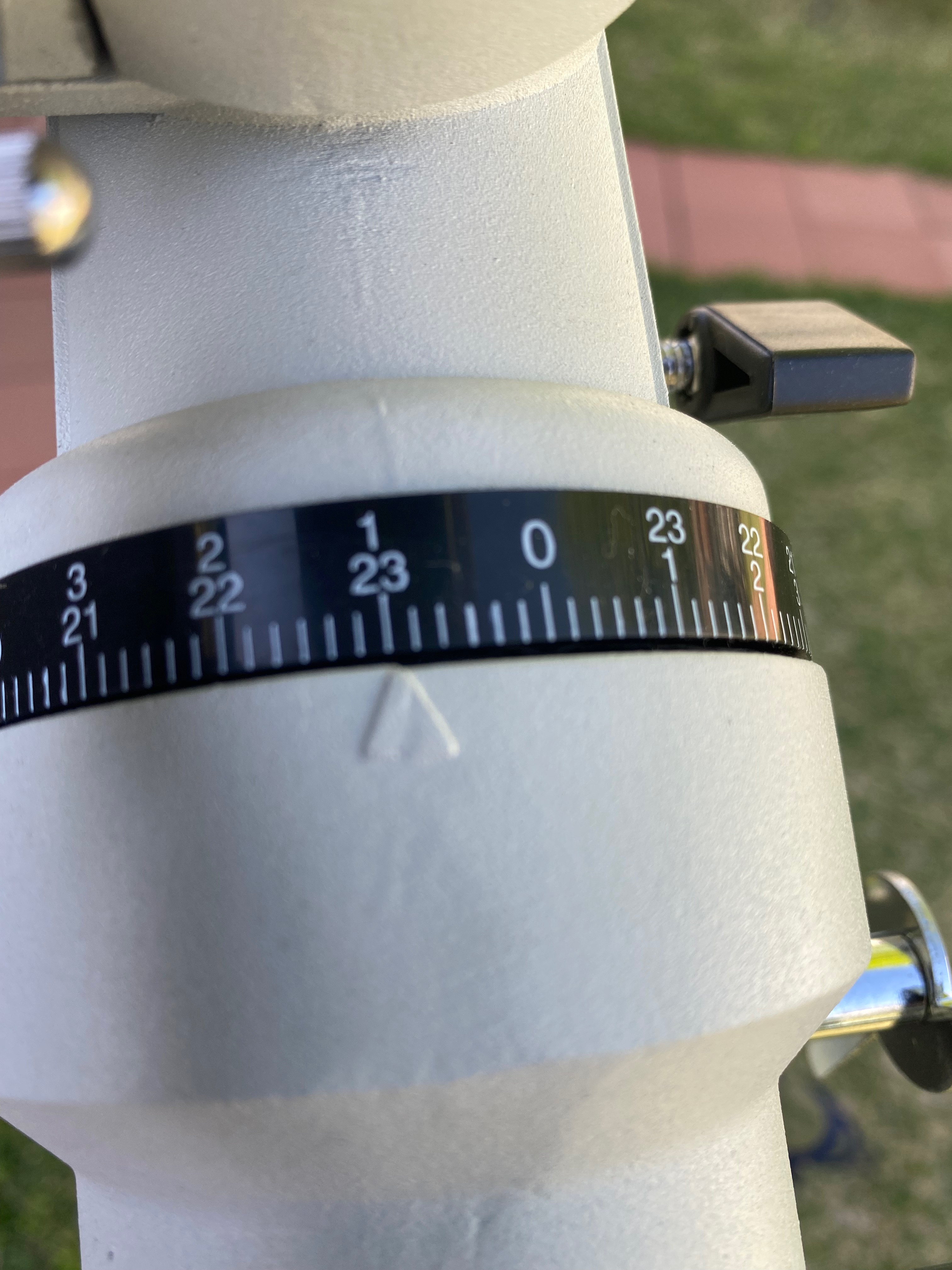
I bought the telescope and mount from Explore Scientific on 31 March 2022 and it arrived on 7 April. It was easy to assemble but I also could see that it had basic design problems. First and foremost, there was no way to orient the setting circles for Right Ascension and Declination. 


With the telescope aligned correctly to North,
the Right Ascension is wrong by 48 minutes.
The circle would not move, glued into place
with heavy grease.

When set to my latitude (30 degrees North) and aligned on Polaris the setting circles read 23 hours Right Ascension and 70 degrees North Declination. Polaris is at 2 h 31 m RA and 89° 15’  


With the telescope set correctly,
the declination is wrong by 20 degrees.
The circle could be hard-set at the factory
to 90 degrees. (89.25 degrees is more exact.)
But the circle should still be adjustable.


Regardless of any other movements or settings, the setting circles were fixed in place as if they are glued there. Indeed, they were: with grease. 


After several sessions over two months of taking this down and setting up and trying this and that, I finally pried the setting circles loose and washed them off with rubbing alcohol. (I have GooGone, but I did not want to risk damaging the circles.) Also, the axes would move some distance and then stop. If I slewed the telescope manually, I could get more motion and move easily some short distance in the opposite direction.


After the first failures on the first afternoon, I remounted the telescope on an Explore First Light Nano altitude-azimuth mount and tested its optics. I alternately used both the 25 mm and 9.7 mm Plössl oculars. After aligning the finder with Sirius, I quickly found the Messier 41 open cluster and then Messier 42 the Great Orion Nebula and its Trapezium asterism. I also split the binary Mintaka (delta Orionis). I located another asterism that I know, sigma Orionis. I was pleased with the result. The easier of the two binaries was distinct. The smaller pair gave only some hint and only because I knew what I was looking for an looking at. They are much clearer in my larger Explore Scientific 102mm achromatic doublet refractor. Viewing the waxing crescent Moon I also was happy to find that the focus did work well with two filters screwed into the oculars. I ended the test with Mizar-Alcor (zeta Ursae Majoris), easily and clearly revealing Mizar’s visual companion. The optics of this telescope are good. 


Problems with the Mount


The right ascension (RA: hours-minutes of arc from the peripoint of Aries) axis would move a little in one direction and then move back more in the other. If I rotated the telescope manually, the slow motion cable would move the RA axis more in one direction and then less in the other.


Five days later (12 April 2022) I set the telescope up again in my office so that I could work indoors during the day. The gears locked. With all clutches open, the counterweight shaft with the Dec scale 0-9-0 would not move. Using the motion control knob, the RA moved a little and then quit. This happened often when I first set up the telescope. At other times the declination axis (Dec) would behave the same way, not moving the axis while turning the knobs, though in those cases, the RA would move. Before it locked up the RA would alternately respond with large movements in one direction but only small motions in the opposite travel.  

  • I disassembled the Dec axis. 
  • I removed the three hex pins holding the collar. 
  • I removed the counterweight and its shaft. 
  • I removed the cover with the worm gear. 
  • I was able to turn the axis freely through several rotations. 
  • Using a locking pipe wrench, I was able to move the Dec axis.
I put it back together, noting that the shaft must be somewhat loose, looser than hand-tightened, in order for the circle to move relative to its pointer.
  

15 April 2022 18:30 I watched half a dozen YouTube videos and read four articles online. Most of them were useless, very basic, not at all mentioning any of my problems. One stood out. How to use setting circles on a small telescope (and why they don't work!) Astronomy and Nature TV here: https://www.youtube.com/watch?v=geQszAVWMok


At the 2:35 mark, he gives a “Bluffer's Tip” for setting the polar alignment. It was the missing piece of the puzzle. In reality, I have to do the same thing I have done for a computerized “go-to” mount: star alignment. After setting up the telescope mount in Latitude and Direction (with a compass or your cellphone, for example), use a reference to identify a known bright star and its Right Ascension and Declination. In this video, he uses Dubhealpha Ursae Majoris


That solved one basic problem. So, I hauled out the telescope again (in daylight this afternoon). I found that with all of the movement back and forth, assembly and disassembly, the setting circles are now loose enough to move by hand. 


The remaining problem is that after traveling in one direction, the setting circles RA and Dec stop moving. The slow motion cables do turn but the axes stop traveling. One or the other will turn and then not, but then travel in the opposite direction when the cable turn is so turned. The cables turn; the telescope does not travel.


7 May 2022 Before going out I made a table of prominent stars in my early night sky and continued testing the mount. 


The axes would not hold their settings.

I aligned on magnetic north with a compass, then re-aligned on True North with my cellphone.

1.     I located Polaris. The readings were 19h 30m and 0 instead of 02h 31m and 89 degrees. I set the Right Ascension wheel to 2h30m.

2.     Next, I turned to Arcturus. The readings were 9h 50.5m and 50 degrees. I reset the circles to 14h 15m and 19 degrees. 

3.     Finding Spica the readings were 15h and 10, close to the actuals of 13h25m and -11d  (11 South). The declination setting circles do not differentiate the two halves of the circumference.

4.     Locating Regulus the setting circles showed 6h 30m and 0d 20m, far from the actual values of 10h (10h 08m) and 12 degrees (11d 58m).  

I gave up for the night and viewed with an Explore Scientific 102-mm f/6.47 achromatic doublet on an Altitude-Azimuth mount.

PREVIOUSLY ON NECESSARY FACTS

Baader-Planetarium Micro-Guide Reticle 

$2500 Viewed Through a Telescope 

70-Millimeter Shootout 

Product Review: Celestron AVX (“Advanced AX”) Mount and Tripod 

Celestron AVX Mount: Twelve Nights of Viewing and Learning