Showing posts with label U.S. foreign policy. Show all posts

Sunday, March 6, 2022

Invite Russia to Join NATO

The problem with U.S. foreign policy is that we have no collective memory. The failures in Iraq and especially Afghanistan were evidence of that. Now, a war in eastern Europe came into the news like a tropical storm and newscasters are already impatient that it  has dragged on for a week. Basically, we do not know what it is like to harbor a 1000-year grudge. And that informs our weakness regarding China whose gerontocracy executes petty criminals in order to harvest their organs. China has a 300-year plan and the people who formulated it intend to see it through.

Old times there are not forgotten.
Saints Cyril and Basil brought Roman religion.
Alexander Nevsky defeated German invaders.

Meanwhile, in Europe, we Americans think that whatever the situation was in 1990 was set eternally even backward in time. We toss out proper nouns like “France” and “Germany” that obscure the histories of Burgundy and Champagne, Saxony and Swabia and a hundred other locations which themselves were only the places where nomads ceased wandering. Andulsia in Spain was the new home of Germanic Vandals (Vandalusia) and even today, in Spanish, your brother and sister are not rooted in the Latin (frater and soros) but hermano and hermana: your Germans. So, as much as I enjoyed sharing Yule Brenner as Taras Bulba with my Ukrainian chums in junior high school, I have to ask: What makes the Ukraine a nation? And what makes it worth killing and dying for? 


The extension of Russia in the 18th and 19th centuries

The long and deep truth is that Russia faces West because the East has little to offer, except stunning landscapes, Mongols and Tartars. When Constantinople fell to the Ottoman Turks, Moscow became the Third Rome. Peter the Great was a welcomed visitor in England (which was not yet Great Britain or the United Kingdom). He brought savants of all kinds, (Leonhard Euler for one) from Europe to his new capital. That continued in the 19th century. Friedrich Georg Struve of the Pulkovo Observatory also went by his Russian name: Vasily Yakovich Struve. That trans-national association continued even when another Struve was in charge of the McDonald Observatory in Texas. 

The Communist Revolution changed the relationship between Russia and the West. They set themselves apart as the enemies of capitalism and were not surprised when the UK and USA invaded. To get out of World War I, the Bolsheviks signed the Treaty of Brest-Litovsk, ceding the Ukraine and the Baltic States. That was superseded by the Versailles Treaty, though Lithuania, Latvia, Estonia, and Finland became recognized (by the Allies) as independent nations. Poland became a nation (again). Czecho-Slovakia and Jugoslavia were created from the Austrian empire. (They broke apart after 1990 because they had no reason to be unified.) Hungary, Croatia, Romania and Bulgaria had fascist or pro-Nazi governments. Hungary sent troops into Russia alongside the German invaders. With the defeat of Germany, Russia protected itself with a wall of puppet states. 


Borders are fluid.
Left to Right: 1914, 1942, 1945


In response, the USA and the UK created NATO, which, oddly enough included Turkey. Not bordering the North Atlantic, Turkey had been an ally of Germany and then technically neutral until August 1944, finally declaring war on Germany only on 23 February 1945. During the Cold War, the USA placed Jupiter missiles in Turkey. In response the USSR put missiles in Cuba. And America was outraged. 


It is important not to fall in to moral relativism or equivalency. It makes a difference who rules. Liberal democracy means free trade and free minds. The Ukraine was a relatively benign place once the Russian puppet Viktor Yanukovych was removed by the Revolution of Dignity. Russia has seldom been a benign place no matter who ruled. Benign neglect was the best that the Romanov tsars could deliver. 


In George Orwell’s 1984, the point is made that the incessant three-way wars are not intended for conquest or even victory, but as excuses to terrorize their own peoples into obedience. As O’Brien says to Winston Smith: “If you want a picture of the future, imagine a boot stamping on a human face—forever.” When Donald Trump was President, he was friends with Vladimir Putin and China was the enemy with virus bioweapons. I did not vote for Trump, but I knew that if Hillary Clinton were elected, Russia would become the new enemy and we would be friends with China. 

Russia has nothing to lose.


It just seems to me that the war in the Ukraine could have been avoided. Russia did not want the Ukraine to join NATO. That is easy to understand. One solution could have been to bring Russia into NATO. Open Russia to the West. It is really all they ever wanted.


PREVIOUSLY ON NECESSARY FACTS

Sergei Magnitsky 

War is Good for Absolutely Nothin’! 

Book Review: The Second World Wars by Victor Hanson 

Reflections on Haldeman’s “Forever War” 

Brian Krebs’ Spam Nation 


Monday, January 28, 2019

The Wise Men

Averell Harriman, Dean Acheson, and George Kennan were names that I grew up with, reading daily newspapers and weekly news magazines from the late 1950s through the late 1960s. I learned of the other three men—Robert Lovett, John McCloy, and Chip Bohlen—from this careful and objective though laudatory history. Isaacson and Thomas had established impressive bibliographies of their own before this collaboration. I found it engaging and informative.

William Averell Harriman and Robert Abercrombie Lovett grew up together because Lovett’s father, Robert Scott Lovett, was the chief counsel for railroad magnate E. A. Harriman. John Jay McCloy, Jr. and George Frost Kennan grew up poor. Their hard work took them to the Ivy Leagues and thence to the halls of power. Dean Gooderham Acheson met Averell Harriman at Yale. Charles Eustis “Chip” Bohlen inherited the fine social graces of his almost wealthy family and those skills took him to the Foreign Service where he met George Kennan. It is easy to perceive the six as symbolic of, if not identical with the Establishment (page 26). The popular catch-phrase “The Establishment” was coined by John Kenneth Galbraith speaking to a convention of the Americans for Democratic Action in 1966. But the privileged collective had long before enjoyed opposition from both the left and the right, liberals and conservatives, going back to Jonathan Edwards and Andrew Jackson and forward to Jimmy Carter and Ronald Reagan (page 29). 
 
The Wise Men: Six Friends
and the World They Made 

by Walter Isaacson and Evan Thomas.
Touchstone/Simon and Schuster, 1986
.
We may try to make the best of our opportunities. That is a two-part engagement. Many were born to inherit great  opportunities. Not many made the most of them. Starting as children and continuing through their teenage years, Harriman and Lovett accompanied their fathers on inspection tours of the railroad. (When he reached the Pacific coast E. A Harriman saw no reason to stop, and took his family to Siberia. That fact would be a trump card played more than once when Averell Harriman was the U. S. Ambassador to the USSR.) The son of an Episcopalian bishop, Dean Acheson took it upon himself in 1911 to join a Grand Truck Pacific Railway work crew in northern Canada. Before the United States entered World War I, Acheson volunteered as a Navy ensign. Meanwhile, Bob Lovett was only in his freshman year at Yale in 1914 when he enlisted. He was graduated in absentia while serving in the Army Flying Squadron. (Thirty years later, he served as a War Department expert on air forces.) After his senior year at Yale, Chip Bohlen signed on a US Steel cargo ship as crewman. Later head of the World Bank, John McCloy first met the upper classes when he worked as a chore boy at resorts. Even the four who were born to wealth knew from personal experience the relationship between money and work. 

Each had their own political preferences. Most were Republicans by birth, but adapted themselves to serve the government through the long decades of Democratic Party ascendance from 1932 to 1980. They were internationalists who saw no profit in war and only losses in surrender. They were among the first to push US foreign policy out of isolation and into alliance with the United Kingdom and France. It is no surprise that Ivy Leaguers are Anglophiles, but, in addition Chip Bohlen’s mother was from Louisiana and he visited France as a child. (On the other side of the ledger, his father’s in-laws included the Krupps of Germany.) Individually and in concert, they were early to warn the world of Stalin and the USSR, even as their Yale and Harvard classmates were still enthralled with the “ten days that shook the world.” 

But it would be just as wrong to characterize them has “hardliners” as to brand them as “appeasers” which the radical right did, from the McCarthy era through the years of the John Birch Society, the Nixon presidency, and the Reagan Revolution. As bankers and lawyers—only Bohlen and Kennan were professional diplomats--they knew how to evaluate facts, measure risks, create and analyze logical arguments. They were willing to admit their mistakes, to cut their losses, to change course to avoid a collision. They knew that the world is not run by gentlemen, and “certainly the Kremlin was not.” (Page 327.) 

On February 22, 1946, while chargĂ© d’affaires at the U.S. Embassy in Moscow, Kennan sent the 8000-word “Long Telegram” to Secretary of State George Marshall. It explained fully and succinctly the nature of the USSR and its relationship with the Western democracies.  Though it is discussed at some length (pages 352-356), it is never presented in full. You can find it online:
  • The Truman Library (here) where it is an image of a typewritten transcription
  • A modern typeface transcription at the Wilson Center (here)
  • A text-accessible PDF (here) from Nevada Technical Associates among other famous speeches.

“Marxist dogma, rendered even more truculent and intolerant by Lenin’s interpretation, became a perfect vehicle for sense of insecurity with which Bolsheviks, even more than previous Russian rulers, were afflicted. In this dogma, with its basic altruism of purpose, they found justification for their instinctive fear of outside world, for the dictatorship without which they did not know how to rule, for cruelties they did not dare not to inflict, for sacrifices they felt bound to demand. In the name of Marxism they sacrificed every single ethical value in their methods and tactics. Today they cannot dispense with it. It is fig leaf of their moral and intellectual respectability. Without it they would stand before history, at best, as only the last of that long succession of cruel and wasteful Russian rulers who have relentlessly forced country on to ever new heights of military power in order to guarantee external security of their internally weak regimes.” – The Long Telegram by George Kennan.

Successful in arguing for an immediate and full response in 1950 to North Korean aggression and its support from China, they nonetheless were less enthralled with McArthur’s posturing. Their experience in 1951 informed their opinions in 1965 when they pushed Pres. Johnson to increase US military action in Indo-China. But quickly, by 1966, they foresaw the inevitable American defeat ten years later. For that, they were vilified as defeatists. 

Yet, they continued to serve. Dean Acheson hated Richard Nixon, but honored the office of the Presidency as so few in that administration did. Acheson responded to President Nixon’s requests for advice and counsel. But Acheson had had the same relationship with President Roosevelt 40 years earlier. 

The choice of these six men as paradigms for the Establishment may be arbitrary. In their work, they formed friendships, alliances, and animosities with others of equal influence such as James Forrestal, Robert Oppenheimer, Lucius Clay, Harry Hopkins, and Paul Nitze. Their proteges included Henry Kissinger, Dean Rusk, and Robert McNamara who themselves were connected to still others, even to John Kenneth Galbraith. Thus, they were the Establishment and “the Architects of the American Century.” 

PREVIOUSLY ON NECESSARY FACTS


Tuesday, March 20, 2018

Gen. McChrystal’s Share of the Task

Unlike his operational handbook, Team of Teams, this book is an autobiographical review of Gen. Stanley McChrystal’s tours of duty as the task force commander in Iraq and Afghanistan. As such, while the technical details provide hard-won lessons in leadership that are broadly applicable to any challenge a reader might confront, they are contrasted against what he does not say. Also contrary to those teaching moments, nothing ages faster than current events. Even those who learn from the past are condemned to live among those who did not. Gen. McChrystal credits his team of teams for killing Abu Musab al-Zarqawi, and for winning the battle of Fallujah. However, the action here ends before the rise of ISIS.

My Share of the Task: A Memoir
by Gen. Stanley McChrystal
(Portfolio/Penguin, 2013)
 
McChrystal writes well but the book is targeted to a military audience. For example, he uses the word “guidance” in the special sense that has nothing to do with missiles. When you receive your commander’s guidance, as the 2-star Maj. Gen. McChrystal did from his 4-star general Abizaid, you are being given expectations, limits, and measures of success. But it is all verbal, often just a chat. You are supposed to fill in the blanks and know what to do and what not to do. McChrystal never explains that. He just says that he received guidance, and the story continues from there.

The military is a small community. Captain Stanley McChrystal was deep in Georgia, Fort Stewart, 20 miles up a country road, when he met CPT Dave Petraeus. They would serve together again. In that span, like other senior staff officers McChrystal’s career took him down several different roads – airborne, Green Berets, mechanized infantry, Rangers—which he credits to giving him a broader view than he would have had if he had specialized and stayed in one command structure. In those different billets, he worked with other people he would meet again as he rose in rank.

As a major, attending the Army’s command and staff course was required. Usually, that means Ft. Leavenworth, Kansas. Instead, McChrystal was sent to the Naval War College in Newport, Rhode Island.

“Sited in scenic Narragansett Bay, the Naval War College was academically stimulating beyond anything I’d yet experienced. Unlike more structured programs with long class hours, the Navy emphasized extensive reading punctuated by limited but focused seminars. I’d always loved to read, and the instructors pushed me into the works of Clausewitz, Homer, and others that helped build a firmer foundation of knowledge.” McChrystal did not mention that at the same time he also completed a master’s degree in international relations at Salve Regina University. (He does say so in Team of Teams.) Several other generals also earned advanced degrees at Salve Regina.

Later, McChrystal has little to say about the death by friendly fire of Ranger Specialist Pat Tillman. Tillman's death grabbed media attention because of his religion, or lack of it. Tillman was openly an atheist, which is less popular than being openly gay. McChrystal was the special operations commander. He renders no final judgement, but only delivers a brief outline of the event. Even the unusual fact that Tillman reeceived a posthumous Silver Star is delivered in one sentence with no personal observation.

When Iraq invaded Kuwait, on August 2, 1990, McChrystal was with the operations directorate of a joint task force at Fort Bragg. He was on maneuvers at Fort Bliss when the news came. His deployment to Kuwait to analyze SCUD missile attacks was brief. The war ended. He returned to the 82nd Airborne in 1994 and reported to Colonel John Abizaid. Six years later he returned again and Colonel McChrystal took over the post of assistant division commander from Colonel Petraeus. They met again, in the wake of 9/11, deployed to Afghanistan, where they set up their aluminum frame cots in their command offices.

The book dives deep into the creation and management of a joint force special operations directorate to retake Iraq from the insurgency. McChrystal also commands a similar force in Afghanistan. The details of the protracted, repetitive battles are less revealing of the man we have already come to know. He turns Task Force 714 from a “tribe of teams” into the “team of teams” needed to win the battle for Fallujah. Adaptable, open, intelligent, TF 714 becomes the “Entrepreneurs of Battle” needed to overcome a decentralized, information-driven, fanatically dedicated adversary. Some of the fighters fought each other, Shiite against Sunni and Sunnis in reprisal, or different Shia militia vying for control. But that merely complicated the picture without changing it.

Afghanistan was different. Slapping on his four-star Velcro insignia as his plane lands, McChrystal returns to Afghanistan to follow the thin guidance of his president. He never complains. He remains objective, operational, strategic, tactical. But our national motto conveys an ironic pun: E pluribus unum means to make one out of many, but it also means that from out of all of these many, here is yet one more. And Gen. Stanley McChrystal was just one more commander in what is not a seventeen-year war, but seventeen one-year wars.

PREVIOUSLY ON NECESSARY FACTS

Monday, December 4, 2017

Reflections on Haldeman’s Forever War

“Inside each book is a man,” said Fireman Montag in Fahrenheit 451.  The Forever War (reviewed below) was the work of Joe Haldeman as he was 1974. The story was modified by Joe Haldeman of 1997. The current edition, with a Foreword by John Scalzi and endorsements by William Gibson, Cory Doctorow, Greg Bear, and Stephen King, came out in 2008. Although George Lucas’s frequent repairs to Star Wars: The New Hope may offer a door into revisionism, ultimately the author stands by the work even though time is unkind.

The apocryphal middle third (Chapters 23, 24, and 25) delivers a world impoverished by war. Early in the story, Pvt. William Mandella explains that their IQs of 150+ put him and his team in the draft, the Elite Conscription Act of 1996. They suffer horrible attrition. No wonder the world is getting worse. We are killing off our own best and brightest.

More to the point, Haldeman apparently accepted the premise that war could be good for the economy. At the end, Maj. William Mandella paraphrases his final debriefing: “The fact was, Earth’s economy needed a war, and this one was ideal. It gave a nice hole to throw buckets of money into, but would unify humanity rather than dividing it.” The truth is that power and market are dichotomous, contradictory, and mutually exclusive. If you make economic decisions for military or political reasons, the result must be less than optimal: you will lose money; you will become poorer.

Haldeman's assumption rests on deeper beliefs in the efficacy of a command economy. In order to re-establish order, the UN takes over food. Calories (kilocalories: K) become the unit of money. It is not perfect, of course. The system has safety valves in unregulated farms and tolerated black markets. And for all of the authority evident, gangs run rampant; decent people hire body guards for trips to the grocery. But centralized authorities control what Lenin called “the commanding heights of the economy.” It might not be optimal, but it is better than mass starvation. Or so they claim. But the command economy leads to starvation, with those illicit safeties as the only brakes on the inevitable slide. That the novel took both Nebula (1975) and Hugo (1976) awards speaks to the fact that Joe Haldeman is not alone in his universe.

When the book came out, it was “obviously” supposed to be “about Viet Nam.” True enough, Viet Nam was Haldeman’s war experience. But the story does not parallel that war. The Taurans are, indeed, genetic collectivists; and they copy technology rather than inventing it. But Earth is on its own: we have no corrupt locals to defend. While there are hints of resentment, the streets are not filled with anti-war protestors. And no one in uniform questions the purpose for the war or the strategies for prosecuting it. So, this was not really Viet Nam.
Veterans of World War 1, and 2, and Korea and Vietnam are dying off, but the number of veterans of the current wars continue to rise for the next 30 years.
https://www.va.gov/vetdata/docs/QuickFacts/Population_quickfacts.PDF
But the idea of the forever war resonates within the ranks of American armed forces today. For them, it is GWAT (“gee-watt”): the Global War Against Terrorism. It is an accepted truth, a clichĂ©, that Afghanistan is not a 15-year war, but 15 one-year wars as troops cycle in and out, never to establish and develop the accumulated personal experiences that become institutional memory. We never learn from our mistakes. We never get a feel for how to do things right. For 70 years, the United States had bases in over 50 nations. Today, that includes a division – 1000 soldiers – of combat troops who are “advisors” in Niger. They are not coming home anytime soon.

PREVIOUSLY ON NECESSARY FACTS

Monday, February 27, 2017

From Pearl Harbor to 9/11


It might be said that the enemy is different, not a nation state but a dispersed and diffuse array of "lone wolves."

It might be said that we are different now, soft, frivolous, and self-involved with tweets.

It might be said that while the Japanese forces withdrew to new positions, the 9/11 perpetrators all died in the suicide attack: it was over as soon as it began.

It might be said defeating Japan was a military problem, whereas defeating Islamic fundamentalism is a philosophical problem or a cultural problem.

It might be said that both were contrived by conspiracies internal to the government of the United States.

It might be said that both were the result of failures to understand the enemy and the threat.

It might be said that both were the consequences of American actions that caused a reprisal from them that looked like an attack to us.

It might be said that the world of 1941 was not much different from the world of 1841, but that 2041 is going to be very much different.

PREVIOUSLY ON NECESSARY FACTS
Etruscans and Americans  
Counter-Insurgency  
The Syrian Quagmire 
War is Good for Absolutely Nothin'  

Sunday, January 22, 2017

War is Good for Absolutely Nothin’

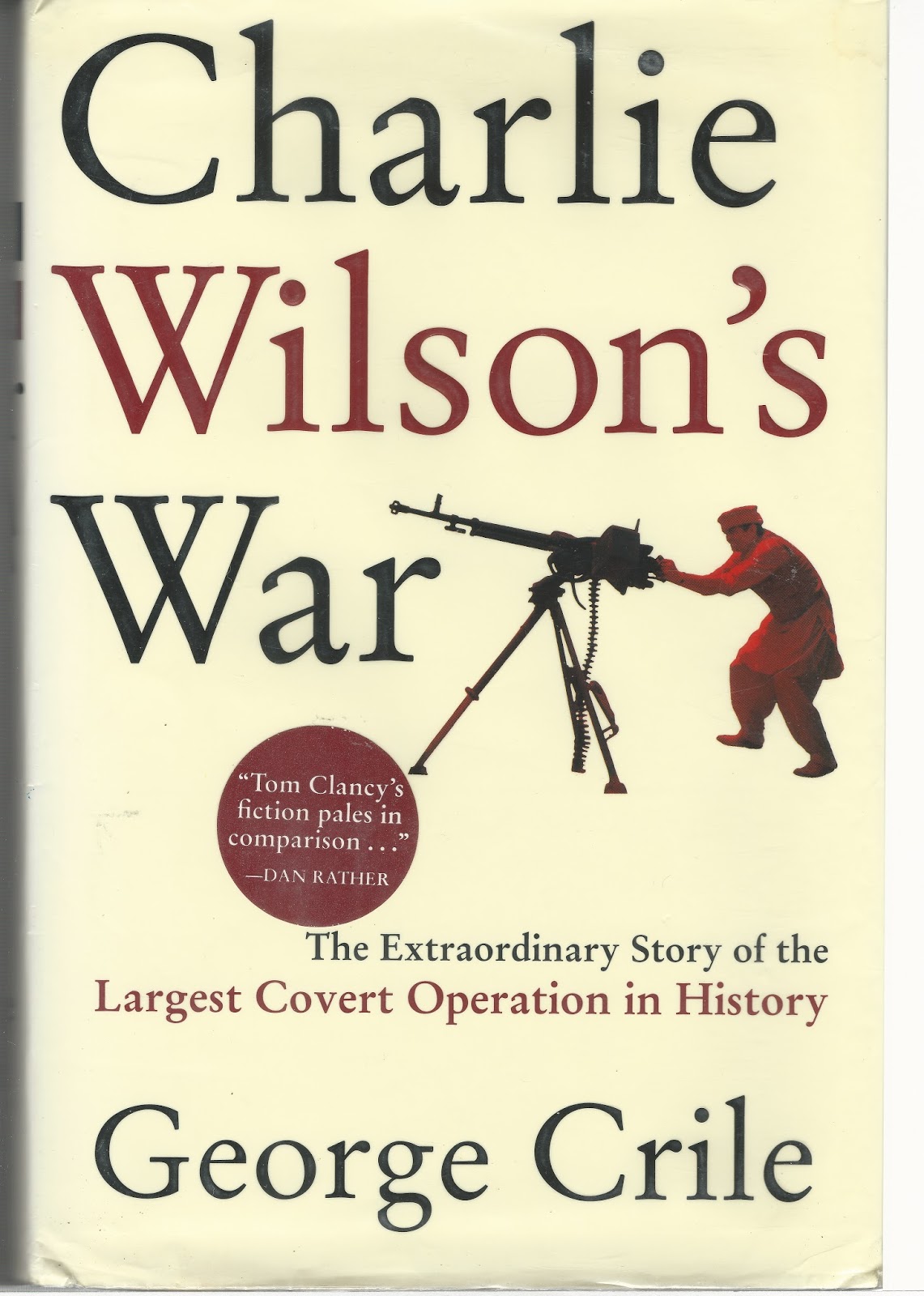
One person can make a difference. Whether that is for good or bad depends on much that is outside the control of that significant mover and shaker. In the cinema version of Charlie Wilson’s War, Gust Avrakotos tells the parable of the Zen master who at each turn of events deflects the popular wisdom with “We shall see.”  In other words, external events can bring unintended consequences to your choices. That is the truth brought forward by these two books. Charlie Wilson’s War is about Afghanistan, and Bright Shining Lie is about Vietnam. 
  • Book Review: Charlie Wilson’s War: the Extraordinary Story of the Largest Covert Operation in History by George Crile, Atlantic Monthly Press, 2003.
  • Book Review: Bright Shining Lie: John Paul Vann and America in Vietnam by Neil Sheehan, Vintage Books, 1988. (Material here is from a review first published as a class paper for HIST 586: The U.S. in World Politics, Dr. Kathleen Chamberlain, Eastern Michigan University, Fall 2009.) 

The foundation of each narrative is the nature of the complex person whose work was unperceived at the time. Not all of the damaged souls in our social world are capable of great feats. Not all of those who move the world or shake it wrestle with internal demons. Often they do. Perhaps that internal energy is the secret motor that powers achievement, certainly for them, forcing other people to give way or to follow, but always to succumb to the irresistible force of highly motivated charisma.

Charlie Wilson (1933-2010) was a Congressman from East Texas whose conservative and Baptist constituents repeatedly re-elected an alcoholic womanizing liberal. Fired up by a story about the mujahidin who fought against the USSR’s invasion of Afghanistan, Wilson made their fight his crusade, turning a $5 million dollar stream of 100-year old rifles into a $500 billion Noahtic flood that included Stinger missiles, cryptologic radios, satellite reconnaissance, Tennessee mules, and the uniting of Israel and Saudi Arabia in a common cause under the control of Pakistan.

The phrase “bright shining lie” comes from Vann’s own description of the press conferences for which he coached Gen. Huynh Van Cao to give optimistic projections for victory. While working for the RAND Corporation, Vann’s close friend, Daniel Ellsberg, discovered that for the first fifteen years of the Cold War, the USSR lacked the hardware for significant intercontinental strikes, raising questions about the origins of the Cold War. Another lie was that Vann’s military career was thwarted by his outspoken advocacy of his own cogent analyses, when, in truth, it was blocked by a charge of statutory rape, the outcome of just one of many infidelities. Thus, John Paul Vann is a symbol for America, outwardly heroic, but factually corrupt, nicely navigating the gray shades of ethics to maintain a towering jackstraw jumble of lies. Vann’s eight years “in country” were so important to the effort in Vietnam that he eventually was given immense military latitude, technically a civilian but with the trappings of a major general, another living lie, reflective of America’s ambiguous status in the war.


Like America, John Paul Vann was self-made. Illegitimate and poor, the son of an alcoholic floozy, Vann took the family name of the man who was his actual father years ahead of the formal adoption.  

The author admits early on that Vann had a detachment of mind that let him criticize his own assumptions. This gave him an intellectual edge over men too easily convinced by their own wishes. However, later Sheehan shows Vann caught in his own web – calling for air strikes, propping up corrupt officials, excusing the very policies he earlier opposed – but Sheehan never shows the transition, if there was one.

In fact, Sheehan says very little about the direct work that Vann did which Vann himself considered fundamental to the war effort. We never see Vann meeting with villagers, meeting with frontline military. We do know of his arguments with the top brass, but we never see the dialectic within his own mind.  In Charlie Wilson’s War, we do. 

A producer for Sixty Minutes, Crile invested years of continuous effort, interviewing the people in the story, constructing a coherent narrative of external events and internal thoughts.  The author takes us with Wilson into the Pakistan-Afghanistan borderlands, first to see the problem, soon to donate his own blood to the medical efforts (several times), and eventually to travel into Afghanistan on horseback, dressed as a local, to receive the thanks and praise of the mujahidin. We also hear the private reflections of the Congressman, the CIA chiefs (and their “Indians”), the Congressional leaders, even the President of Pakistan and the Crown Prince of Saudi Arabia, among very many others. 


As books go, I found Charlie Wilson’s War to be a pleasure to read. Whether Crile is a true master of good English or had good editors or both, I found none of the many little annoyances that plague modern literature. Better than the lack of negatives, Crile’s history is positively compelling, hard to set aside, always to be anticipated as a reward. I do have a quibble: he refers to the USSR and its soldiers as “the Soviets.” It is common and convenient, but wrong. I learned to avoid that mistake in 2008 from Dr. Pamela Graves (a good Marxist) when taking HIST 456: Modern Europe 1945-Present.

Ultimately, both Vann and Wilson failed. The government of South Vietnam was incapable of prosecuting the war because it was incapable of earning the trust of its populace.  Just as bad for us was the victory we brought to the mujahidin, and our consequential involvement there and in Iraq, and now in Syria.

Ayn Rand pointed out repeatedly that US foreign policy in opposition to the USSR was doomed to fail as long as our government failed (refused) to acknowledge that America’s moral superiority is built on reason, individualism, and capitalism. All through those decades, our government yielded the moral high ground to the USSR, which claimed scientific history, altruism, and collectivism, all of which our own government did not contradict, but in fact endorsed.  Therefore, we failed in Vietnam. And the successful defeat of the USSR in Afghanistan only brought us Abrahamic co-religionists who destroyed the World Trade Center – and who now carry out acts of horror in offices, shopping malls, and airports. 

In the 1960s and 70s, the USA and the USSR competed in Afghanistan by building roads, hospitals, and schools.  Modernism never was strong in Afghanistan. Its reformist monarch Amanullah Khan and the liberal nationalist intellectual Marmud Tarzi had their zenith in the 1920s.  Yet, whatever its many flaws, the one thing that Russian socialism had to offer was modernism founded on public education for everyone.  But the USSR abandoned that path in Afghanistan, resorting to brute force against an enemy that lived for it – and believed that brutality toward one’s Earthly enemy is the path to heaven.  That the USSR pushed an officially atheistic secular humanism only guaranteed an irreconcilable conflict. If the USA had kept to its earlier course in Afghanistan, investing in infrastructure and education, rather than arming the resistance, it is difficult to imagine an alternate history worse than the real one.

Previously on Necessary Facts


Monday, October 5, 2015

The Syrian Quagmire

If the United States ever sought to build a pro-Western, democratic government in the Arab/Islamic matrix, Syria could have been a good place to start.  The Assad governments have always been secularist. That was why Syria had no problem accepting military aid from the USSR. The Muslim Brotherhood was opposed to Hafez al-Assad, the father of the current president, Bashar al-Assad, because he liberalized trade and commerce, opening up economic opportunities. (Wikipedia here).  Dr. Bashar al-Assad was practicing pediatric ophthalmology in London when his brother was killed in a car crash. (Wikipedia, here.) So, he returned home to take over the family business, running Syria. Instead of supporting his government, the United States made an enemy out of a man who had been dedicated to bringing eyesight to blind children by means of science. 

Apparently, the “strategy” from the U.S. State Department these past ten years has been to foster uprisings of democratic elements within Arab/Islamic nations to topple dictatorships, and bring those peoples into the global community of free trade and open borders.  For a while, the news media called it “Arab Spring.”  The failures are evident everywhere in the Middle East and southwest Asia: Libya, Tunisia*, Egypt, Syria, Iraq, Bahrain, Yemen, Iran, Afghanistan … And no change has come to our good, close, personal, and very royal friends in Saudi Arabia where the few protests were brutally crushed (BBC here and BBC here).

 "President Reagan meeting with Afghan Freedom Fighters 
to discuss Soviet atrocities in Afghanistan. 2/2/83.” 
— Ronald Reagan Library C12820-32.
Just as the failure in Viet Nam was one consequence of a wider and deeper problem, today’s news from Syria demonstrates the results of bad philosophy.  Fifty years ago, the United States attempted to fight a “Cold War” without a specific ideology, and to do so against an enemy that had one.  Independent of President Reagan’s rhetoric, the ultimate failure of communism was an internal problem. Soviet socialism was unworkable. So, too, today, is the United States attempting to defeat a reactionary mysticism in the Arab/Islamic complex, while not identifying explicitly our own ethical virtues – or their metaphysical foundation. That was why, in opposing communism, the Reagan Administration hosted the Taliban in the White House. In hindsight (always 20/20), it would have been better to partner with the USSR to modernize Afghanistan.

As with Viet Nam, the first level of failure was the lack of a democratic tradition within the culture. People are people; and every village and every empire has its checks and balances rooted in popular approval. That is not the same thing as cultural individualism.

The famous Normam Rockwell propaganda painting for World War II, Freedom of Speech, exemplified the American political tradition. We used to say, “Stand up and be counted.” The secret ballot is the Australian Ballot. In colonial America, you could voice a different opinion without guaranteed reprisals from your neighbors.  It was not perfect. Speaking out can always be risky. But, largely, in colonial America, there came to be a tradition of open debate. It took about 150 years to develop. Through those five generations, local government at the village level and the colonial level were the warp and woof of civic affairs. When the British crown seized the colonial administrations, and violated the Bill of Rights of 1689, the fabric was torn.

The so-called “American Revolution” had taken place in the minds of the people in the generation before the Revolutionary War. That war began a year before the Declaration of Independence.

If the U.S. government had a plan or even a vision, it seems to have been that reading manifestos in the streets would rally people to throw off 500 years of isolation and stagnation in order to embrace multiculturalism, diversity, and fusion cuisine.

Since then, the immediate “strategy” of arming so-called moderate rebels in Syria also has failed. The American-sponsored Harakat Hazm surrendered itself and its American weapons to al-Qaeda affiliate al-Nusra (Telegraph UK here and USA Today here). 

Of course, no such vision existed.  We cannot even say the word “capitalism” aloud, though now we can say “homosexual” in most places.  We have yet to explicitly identify and endorse the cultural trajectory of the Enlightenment that gave birth to our Republic: reality, reason, self-interest, tolerance, initiative, and wealth-production.  Some of those have tendrils within Islamic culture, but nourishing them would take time, perhaps five generations, even after they were identified.

(See “Finding Common Interests with Russia in Syria” by Cmdr. Daniel Dolan, USN (Retired) on the US Naval Institute site here.)

(9 Oct '15: Four Tunisians received the Nobel Peace Prize. "President of the Tunisian employers union Wided Bouchamaoui, Secretary General of the Tunisian General Labour Union, Houcine Abassi, President of the Tunisian Human Rights League Abdessattar ben Moussa and the president of the National Bar Association, Mohamed Fadhel Mahmoud." -- Reuters. Demographically, illiteracy is high, calling into question the basis for democracy there, at least as we understand it. The nation has no democratic tradition.  Tunisia suffered two jihadi massacres, one at the Bardo National Museum, the other on the beach and inside the Riu Imperial Marhaba Hotel.)

ALSO ON NECESSARY FACTS