Saturday, June 8, 2024

Fan Fic by ChatGPT (Part 3)

 Write a story in which the character of Temperance Brennan from the televisions series “Bones” meets the character of Sherlock Holmes as played by Benedict Cumberbatch in the television series “Sherlock.” They are separately on vacation in Austin, Texas. They meet on a tour of the Lady Bird Johnson Wild Flower Center. While admiring the plants and other wildlife, they see a foot under a bush and discover a body. They are kidnapped. They outwit their captors.

One of the assistant directors in my department made this our “Mental Spa Day” task  for the month of April 2024.

Assignment:  Watch this course and send me the certificate of completion:

LinkedIn Learning  Introduction to Generative AI with GPT by Jonathan Reichenta. 

1.   Choose a topic to search in both Google and ChatGPT: How did the results differ? What were you looking for and which one gave you the information that you needed?

2.   Have Chat GPT write a short story or poem with the following parameters: 

·               Use a favorite character from two of your favorite tv shows/movie/book – so, you have two characters; 

·               Have them meet while on vacation in ____________(location of your choosing); 

·               Have them describe the location surrounding them; 

·               Have them go on two adventures. 

Send me the story.

The first task was trivial and I took care of that. Then for Step 2, I started with the stories posted here earlier as Fan Fic 1 and Fan Fic 2.  I wanted to see how ChatGPT would respond. Then, I created the assignment here about Temperance Brennan meeting Sherlock Holmes. That was a three-step process: They meet and find the body. They are  kidnapped. They escape.

[24 January 2026: About a month after I posted this, I went back and edited the work of ChatGPT. With iterative effort, I can make it sound like me. An astrologer would say that this  opposition of ideas must be considered from all possible aspects.]

ChatGPT—Botanical Bones: An Unexpected Encounter

In the heart of Austin, Texas, the Lady Bird Johnson Wildflower Center sprawled with vibrant colors and the fragrant scents of nature. Temperance Brennan, a forensic anthropologist known for her meticulous attention to detail, found herself on vacation in the Lone Star State, seeking solace amidst the blooming wildflowers expansive and variegated arrays of blooms.

Meanwhile, Sherlock Holmes, the enigmatic detective with a penchant for deduction, had chosen Austin as his destination for a much-needed break from the hustle and bustle oppressive noise of London.

Their paths converged unexpectedly on a guided tour of the Wildflower Center where they found themselves admiring the indigenous flora and fauna. Insert: As they strolled along the meandering paths, each purposefully drifted incrementally away from their tour, until they are alone, apart, and nonetheless together. Brennan's keen eye caught sight of something out of place beneath a bush. She knelt down for a closer look, her forensic instincts kicking in.

“What do you see?” Holmes inquired, his curiosity instantly piqued by in response to Brennan's sudden focus.

Brennan gestured towards the bush. “There's something under there. It looks like a foot.”

Holmes raised an eyebrow. intrigued by her observation. Without hesitation, he crouched on all fours beside her, his triplet magnifier in his hand. joined her. his keen powers of deduction were already at work thoroughly engaged. Together, they carefully moved aside the foliage to reveal a grim discovery a human body, partially incompletely (and therefore hastily) concealed beneath the undergrowth.

Brennan's forensic mind immediately went into overdrive highly trained and deeply practiced routine catalogued the as she assessed the scene, noting the position of the body and any potential its forensic context. His need for self-control was defeated by his compulsion to state the obvious. Holmes, ever the astute observer, took in every detail with a sharp eye, his mind racing through the possibilities  “Murder, undoubtedly,” he remarked, his tone matter-of-fact.

Brennan nodded in agreement. already mentally cataloging the clues surrounding them. “Yes, and the state of decomposition suggests the body has been here for some time for about 36 hours but we will know more after we examine the bones.”

Their unexpected encounter had turned into a collaborative investigation, as they worked together to piece together the puzzle of the victim's identity and the circumstances surrounding their demise. [Yes, someone should write that part.] As they delved deeper into the case, Brennan's scientific approach complemented Holmes' deductive reasoning, resulting in a formidable partnership. Despite their differences in methodology and demeanor, they shared a mutual respect for each other's abilities, recognizing the value each brought to the investigation. Together, Temperance Brennan and Sherlock Holmes embarked on a quest for truth amidst the wildflowers of Austin, unraveling secrets hidden beneath the beauty of nature. [Show. Don’t tell.]

And as they uncovered the dark truths lurking beneath the surface, they forged a bond forged in the crucible of investigation—a bond that transcended the boundaries of time and spaceThey discovered the rare pleasure of being in the presence of an intelligence and passion for truth equal to—if not surpassing—their own. For in the world of crime-solving, where logic met intuition, anything was possible.

[Editing stops here.]

However, before they could make any further progress, a sudden commotion erupted nearby. Without warning, masked assailants emerged from the surrounding foliage, their faces shrouded in darkness.

Brennan and Holmes barely had time to react before they were surrounded and forcibly restrained, their hands bound behind their backs.

“What's the meaning of this?” Holmes demanded, his voice laced with authority.

But the assailants remained silent, their intentions shrouded in mystery. Before Brennan or Holmes could formulate a plan of action, they were blindfolded and whisked away, leaving behind the tranquil beauty of the Wildflower Center for the unknown depths of danger that awaited them.

As the blindfolds were secured over their eyes and the kidnappers led them away, Temperance Brennan and Sherlock Holmes exchanged a glance, wordlessly communicating their resolve to overcome whatever obstacles lay ahead. 

Despite their precarious situation, Brennan's analytical mind raced, cataloging every detail of their surroundings—the texture of the ground beneath her feet, the sounds of their captors' footsteps, the faint scent of the surrounding foliage. Holmes, ever observant, listened intently, his sharp senses attuned to the slightest nuances of their environment. With each step, he pieced together clues, formulating a plan of action. 

As they were ushered into what seemed to be a dimly lit building, Brennan and Holmes remained outwardly calm, biding their time until an opportunity presented itself.  Their chance came when they were left momentarily unattended in a small room, their captors seemingly preoccupied with other matters.

With practiced efficiency, Brennan began to work on loosening her restraints, her fingers deftly manipulating the knots. Holmes, meanwhile, surveyed their surroundings, searching for any potential means of escape. His keen intellect assessed every angle, every possibility, until finally, he spotted a ventilation grate near the ceiling.

“Up there,” he murmured to Brennan, nodding towards the grate. “I believe that may be our way out.” 

Brennan nodded in agreement, her fingers working faster as she redoubled her efforts to free herself from her bindings. With a final tug, Brennan succeeded in loosening her restraints, silently urging Holmes to follow suit. As Holmes wriggled free, they exchanged a silent nod of determination before Brennan hoisted herself up towards the ventilation grate, her muscles straining with effort. With Holmes' assistance, she managed to pry the grate open, revealing a narrow passage beyond.

Without hesitation, they crawled through the cramped space, their hearts pounding with anticipation as they edged closer to freedom. Emerging on the other side, they found themselves in a deserted corridor, the faint sounds of their captors' voices echoing in the distance. With stealth and precision, they navigated their way through the labyrinthine corridors, avoiding detection at every turn.

Finally, they reached the building's exit, the cool night air washing over them as they stepped out into the open. With a shared glance of triumph, Brennan and Holmes knew that they had outsmarted their captors, turning the tables on those who had sought to imprison them. As they disappeared into the darkness, their minds already racing towards their next move, they knew that no obstacle was insurmountable when faced with the combined intellect and determination of Temperance Brennan and Sherlock Holmes.

For in the world of crime-solving, where danger lurked at every turn, their partnership was an unstoppable force to be reckoned with.  And as they vanished into the night, they left behind a trail of mystery and intrigue, their adventure far from over.

(To be continued...)

[Not to be continued. This is worse than Neil Simon’s Murder by Death.]


Trite as the product is, it is no worse than some that I read for the ArmadilloCon Flash Fiction contests last year (2023) and this (2024). It leaves me wondering whether some of those were also the products of AIs. Like ChatGPT, a couple of them displayed the same flaw with a significant descriptor (adjective or adverb) that was repeated. My understanding is that flash fiction for a writing class is produced “hot pen”—you sit and write here and now and you have 45 minutes. In this case, however, the writers had at least one week’s notice. If they were paying attention they had two weeks. Either way, it was plenty of time to review the work, catch mistakes, and submit a better draft. Few seemed to have given the assignment that much care. Only now that I have worked with ChatGPT do I question who actually wrote the flash fiction that I judged for ArmadilloCon. And that raises other, deeper, problems.

PREVIOUSLY ON NECESSARY FACTS

World Peace Through Massive Retaliation 

Nerd Nation 2.0: Natalie Portman, Danika McKellar, Felicia Day.

Where All the Children are Above Average 

Observable Genius 


Friday, June 7, 2024

FanFic by ChatGPT (Part 2)

User: Write a 1250 word scene in which the character Charlie Epps from the TV show NUMB3RS meets the character Abby Sciuto from the television show NCIS.

ChatGPT

Title: “When Math Meets Forensics: A Meeting of Minds”

The fluorescent lights flickered overhead as Charlie Epps, the brilliant mathematician from CalSci, walked through the bustling corridors of the Naval Criminal Investigative Service (NCIS) headquarters. He adjusted his glasses and glanced at the slip of paper in his hand, double-checking the room number. Today was the day he was meeting Abby Sciuto, the renowned forensic scientist he had heard so much about.

Entering the forensics lab, Charlie was immediately struck by the eclectic mix of equipment and the vibrant personality of Abby herself. With her raven-colored hair in pigtails, tattoos peeking out from beneath her lab coat, and vibrant energy, she was a force to be reckoned with.

Abby looked up from her workbench, a wide grin spreading across her face as she spotted Charlie. “Hey there! You must be Charlie. I've heard so much about you!”

Charlie returned her smile, feeling a surge of excitement at meeting someone with such a reputation for brilliance in her field. “Yes, that's me. It's a pleasure to finally meet you, Abby.”

They exchanged pleasantries before diving into the reason for Charlie's visit. He had been brought in to consult on a particularly perplexing case involving a series of cryptic messages left at crime scenes.

As they settled in, Abby pulled up the case file on her computer screen, displaying gruesome images of crime scenes and evidence. “So, Charlie, what do you think? Can you help us make sense of these messages?”

Charlie leaned in, studying the images intently. “Hmm, this is fascinating. It looks like there's a pattern to these messages, almost like they're encrypted.”

Abby nodded eagerly. “Exactly! That's what we thought too. But so far, we haven't been able to crack it. That's where you come in.”

Charlie's mind raced as he analyzed the data before him. He began scribbling equations on a nearby whiteboard, muttering calculations under his breath. Abby watched in awe as he worked, marveling at his brilliance.

After what seemed like hours of intense concentration, Charlie finally straightened up, a triumphant gleam in his eye. “I think I've got it.”

Abby leaned in closer, eager to hear his findings. “What did you discover?”

Charlie pointed to the whiteboard, where a series of numbers and symbols were scrawled in his neat handwriting. “Each message contains a hidden code, but it's not a traditional encryption method. Instead, it's based on a mathematical sequence.”

Abby furrowed her brow, trying to follow along. “A mathematical sequence?”

Charlie nodded. “Yes, exactly. It's a variation of the Fibonacci sequence, but with a twist. By applying certain mathematical operations to each number in the sequence, we can decode the messages.”

Abby's eyes widened in understanding. “That's incredible! But how did you figure it out?”

Charlie grinned. “It's all about recognizing patterns and thinking outside the box. Math is the language of patterns, and once you learn to speak it fluently, you can unlock all sorts of secrets.”

Abby nodded, impressed by his explanation. “You're amazing, Charlie. I never would have thought to approach it like that.”

Charlie shrugged modestly. “It's just a matter of perspective. We all have our own unique way of looking at the world, and that's what makes collaboration so powerful.”

Abby smiled, feeling a newfound sense of appreciation for the power of collaboration. “Well, I'm certainly glad you're on our team. With your help, I'm confident we can crack this case.”

Charlie returned her smile, grateful for the opportunity to work alongside someone as brilliant and passionate as Abby. “Likewise, Abby. I think this is the beginning of a beautiful partnership.”

As they continued to work together, bouncing ideas off each other and delving deeper into the intricacies of the case, Charlie couldn't help but feel a sense of excitement building within him. This was more than just a consulting gig; it was a chance to push the boundaries of what was possible and make a real difference in the world.

Together, Charlie Epps and Abby Sciuto were a formidable team, combining their unique talents and perspectives to unravel the mysteries that lay before them. And as they delved deeper into the case, they knew that nothing could stand in their way.

For when math met forensics, anything was possible.

(722 words)


PREVIOUSLY ON NECESSARY FACTS

JAG: 10 Seasons of Military Bearing 

Nerd Nation 

Nerd Nation 4.5 

Ayn Rand and Star Trek 


Thursday, June 6, 2024

FanFic by ChatGPT (Part 1)

Write a 1250 word scene in which the character of investigator Timothy McGee from the television show NCIS meets the character of Amita Ramanujan from the television show NUMB3RS.

ChatGPT

Title: "Bridging the Gap: When Investigator McGee Meets Amita Ramanujan"


Special Agent Timothy McGee, known for his tech-savvy prowess, stepped into the bustling corridors of California Institute of Science (CalSci). He adjusted his glasses and glanced at the room number written on the slip of paper in his hand. Today marked the day he would meet Amita Ramanujan, the brilliant mathematician he had heard so much about.

Navigating through the maze-like halls, McGee finally arrived at the designated room. Inside, he found Amita, surrounded by mathematical equations on a whiteboard, deeply engrossed in her work.


"Amita Ramanujan?" McGee asked, extending his hand with a friendly smile.

Amita turned, her face lighting up with recognition. "Yes, that's me! You must be Timothy McGee from NCIS. It's a pleasure to meet you."


They exchanged pleasantries before diving into the reason for McGee's visit. He had been brought in to consult on a complex case involving cybercrime, and he needed Amita's expertise in mathematics to help crack it.


As they settled in, Amita pulled up the case file on her computer screen, displaying lines of code and digital footprints left by the cybercriminal. "So, Timothy, what do you think? Can you help us track down this hacker?"


McGee leaned in, studying the code intently. "Hmm, this is quite sophisticated. It looks like the hacker is using a combination of encryption techniques to cover their tracks."


Amita nodded, her mind already racing with possibilities. "Yes, I noticed that too. But there's something about the pattern of their attacks that seems familiar."


McGee raised an eyebrow, intrigued by her observation. "Familiar? How so?"


Amita explained, her words tumbling out in a rush of excitement. "Well, the frequency and timing of the attacks follow a mathematical sequence, almost like they're part of a pattern. If we can identify the underlying formula, we might be able to predict their next move."


McGee nodded, impressed by her insight. "That's an interesting theory. But how do we go about finding this formula?"


Amita smiled, her eyes sparkling with determination. "We start by analyzing the data and looking for recurring patterns. Once we identify the pattern, we can use mathematical algorithms to extrapolate the formula."


McGee grinned, feeling a surge of excitement at the prospect of unraveling the hacker's scheme. "Sounds like a plan. Let's get started."


Together, they delved into the data, their minds working in perfect harmony as they searched for the elusive pattern. Hours flew by as they poured over lines of code and algorithms, each step bringing them closer to unraveling the mystery.


Finally, after what seemed like an eternity of intense concentration, Amita let out a triumphant cry. "I think I've found it!"


McGee rushed to her side, his heart pounding with anticipation. "What did you discover?"


Amita pointed to the screen, where a series of numbers and symbols were displayed. "This is the pattern I was talking about. It's a variation of the Fibonacci sequence, but with a twist. By applying certain mathematical operations to each number in the sequence, we can decrypt the hacker's code."


McGee's eyes widened in amazement. "That's incredible! But how did you figure it out?"

Amita shrugged modestly. "It's all about recognizing patterns and thinking outside the box. Math is the language of patterns, and once you learn to speak it fluently, you can unlock all sorts of secrets."


McGee nodded, feeling a newfound sense of respect for her expertise. "Well, I'm certainly glad you're on our team. With your help, I'm confident we can track down this hacker and bring them to justice."


Amita smiled, feeling a sense of pride at being able to contribute to the investigation. "Likewise, Timothy. I think this is the beginning of a beautiful partnership."


As they continued to work together, bouncing ideas off each other and delving deeper into the intricacies of the case, McGee couldn't help but feel a sense of excitement building within him. This was more than just a consulting gig; it was a chance to push the boundaries of what was possible and make a real difference in the world.


Together, Timothy McGee and Amita Ramanujan were a formidable team, combining their unique talents and perspectives to unravel the mysteries that lay before them. And as they delved deeper into the case, they knew that nothing could stand in their way.


For when technology met mathematics, anything was possible.


(743 words)


PREVIOUSLY ON NECESSARY FACTS

Monsters from the Id

Fantastic Voyages: Teaching Science with Science Fiction

A Moment of Science Fact as Science Fiction

ArmadilloCon 39


Sunday, June 2, 2024

ArmadilloCon versus Artificial Intelligence

In Star Wars: A New Hope, after we have already learned to like the robots, C3PO and R2D2, the bartender at the Mos Eisley spaceport cantina tells Luke Skywalker, “We don’t serve their kind here.” Luke accepts it and tells the robots to wait outside. But we have seen several aliens in the bar, some much less humanoid than others. That the intelligent robots are discriminated against is an example of the injustices in the imperfect galaxy that is so far away and yet so close to home. Therefore, it is ironic that by a new rule ArmadilloCon 46 has banned AI from the art gallery.

The rule was written by the ArmadilloCon Art Show Director, Scott Zrubek. The rule was accepted by the Board of FACT (Fan Association of Central Texas) which in May and June began crafting new rules for the convention that prohibit the participation of artificial intelligences. The convention and the art galley already have longstanding rules against plagiarism. Rule 5 says: 
“ArmadilloCon reserves the right to refuse the exhibition of any piece for any reason. Works that are judged to be libelous, plagiaristic, obscene, or detrimental to the value of trademarked characters will not be permitted. Likewise, no artwork from commercial patterns, kits or molds is permitted. If you have any questions, please contact me. If problems arise, you may be requested not to show a particular piece. (Very rarely do we ever have to invoke this rule.)”

Adam Link: Robot by Eando Binder, 
pen name for co-authors
Earl and Otto Binder
The Writer’s Workshop has no comparable prohibition. They do stipulate: 

  • Only one submission per workshop participant,
  • Only your own original work,

[…]

  • Please do not use pen names for workshop submissions, as it causes confusion.

So, if you have a co-author each must submit an independent work under their own name. Your collaboration will be on your own terms but offsite and  presumably unaffiliated with ArmadilloCon. The much more widely known and older Clarion writer’s conferences do publish collected works from their authors. ArmadilloCon does not. In fact, that limitation prevented the chief judge from sharing with me a story that was awarded first prize in the Flash Fiction contest. I read and critiqued six stories this year, but not that one. It was read aloud to us and I lost track of the storyline and wanted to read it for myself. That was not permitted on the grounds that the publication could not be shared without the author’s permission. How we were able to judge them all in the first place now seems muddled to me. 

The art show does not prohibit collaborations. It would be acceptable for a work in the traditional comic book genre to have an inker, a letterer, and a colorist – as long as one of them is not a robot because their kind is not allowed in here.

In the informal discussions after the Board meeting in May, another Board member told me that AI is prohibited because “ChatGPT just scrapes the internet and copies other people’s works.” That may well be true and it is a problem in that such work by an AI can exceed the bounds of fair use. After all, we can quote extensively when writing for publication a critical review of a literary work, whether a limerick or a novel. If copying stuff from the internet is wrong—and having had my own original work copied off the internet and presented by someone else, I grant that it can be—what are the guidelines? 

In music five notes are enough for a signature line that is protected by copyright: “Don’t Stand So Close to Me” and “I Want My MTV.”  

See Wikipedia https://en.wikipedia.org/wiki/Don%27t_Stand_So_Close_to_Me

And https://ultimateclassicrock.com/mark-knopfler-sting-money-for-nothing/ 

But then how do we evaluate Rachmaninoff’s “Variations on a Theme by Paganini”? And taken to its limit, there would be no more spaceships, no more robots, or vampires, or dragons because any writer who uses them is just scraping the literary database and cultural knowledge warehouse. 

For a science fiction convention to prohibit participation by an artificial intelligence is like prohibiting an astronaut from attending or presenting at a panel because we only want fictional space travelers, not real ones. Otherwise, we don’t serve your kind here.

PREVIOUSLY ON NECESSARY FACTS

All Volitional Beings Deserve Rights 

Invisible Cheating and Visible Rights 

ChatGPT and the Historical Forms of Dishonesty 

ArmadilloCon 44 Part 2 


Sunday, April 28, 2024

Remembering the Slide Rule

This came up as a thread in the “Off-Topic Observatory” of the Cloudy Nights discussion board for amateur astronomers. People have all kinds of hobbies and among the stargazers are skiers, rally racers, runners, and rock climbers, though understandably many more bird watchers, radio hams, and numismatists. Several of us collected slide rules accidentally or on purpose. In response to the topic, one poster just bought a circular slide rule to add to the collection. Aside from the engineer’s slipstick, my circular calculators are all for publishing to reduce or enlarge images and paper pages. 


Calculators - and I do use my phone, holding it sideways for the technical functions - give us a false sense of precision, when all you need is accuracy. In other words: will it fly? will it overflow the container? will it carry the load? For backyard stargazing, given that the atmosphere is a roiling ocean, what is the (approximate) limit of observable stellar magnitude with a 115 mm versus 102 mm refractor? The difference between pi=22/7 and pi=3.141 is 0.0018: two thousandths. Not much in life is that close. 

The one at the bottom was special because about 1988 or so, Pickett
(or their inheritors) found a large number of them in a warehouse
and in a publication (Scientific American or Science News or similar)
announced that they would give one (one) to everyone who
sent in a letter asking for one. (Email was not common back then),
after which, the instruments would be no longer available.
The one down from topmost came in a leather scabbard
with a fastener on the back so that you could wear it on your belt.
Long after those days, I wore it in to work.
"What's that?"
"This is the formal computing device of a Jedi,
from a simpler, more elegant time."

Clearly, the slide rule has been eclipsed by devices with storage and memory. Back in the 70s, I joined a round-robin newsletter called The Libertarian Connection, which was based on the medium known to science fiction fanzines. We sent in mimeograph stencils; the editors ran them off, collated the magazine, and mailed it out. Back when one ounce first class was 3 cents the saying was “a penny a day from coast to coast.” Then they went to photo-offset, which I enjoyed immensely. And here we are in the age of George Jetson, with a somewhat better BBS via integrated fiber optics into the house instead of a telephone dial-up at 300 baud. 


 The device is based on logarithms which allowed the transformation of multiplication and division into addition and subtraction. With a five-place or six-place tables of logarithms and trigonometric functions, you could achieve 100 times the precision of daily life. (Consider common retail pricing, for example.) That, in turn, allows efficiencies in engineering and production. Compared against working with tables, the slide rule traded speed for precision. You only get three places, but it is much easier, with the likelihood of errors reduced. If you need more precision, there were the books of tables, and an adding machine, then, later a comptometer.


The slide rule shows ratios and proportions so that you do not need to recursively enter numbers 4.1, 4.2, 4.3,… And it is designed to address basic problems involving circles and square roots. 


Even in the 1990s, engineers had AutoCAD and its competitors that let you draw something and the program would show the calculations off to the side. Would you rather start a fire with a BiC lighter or two sticks? Still, it is nice to get away from the computer, sit on a couch or chair, and move the numbers and see what is under the cursor or at the index


23 squared times Pi.
Set the Index to 23 on the D scale and
read the square at the Index on the A scale.
Set the cursor to Pi on the B scale and read the answer on the A scale.


For the telescope of diameter 115 mm, set the index on the D scale, read the square on the A scale and then set the cursor to pi, and you get 417 or close to. The calculator says 41,547.562843725015579. Ignoring all the noise, 415 is within half a percent. The 102-mm refractor has an area of about 327. Set either the AB or CD scales to 415/327 and the larger telescope has 127% the area of the smaller—and the calculator agrees: 1.27114… But you could do most that in your head anyway. 


In astronomy, the paradigm shifts in understanding the so-called “expansion of the universe” i.e., the Hubble Constant has been measured in orders of magnitude, not decimal places. 


PREVIOUSLY ON NECESSARY FACTS

Claude M. Watson (1922-2013) 

The Rational Optimist and The Grand Complication 

Celestial Mechanics 

Measuring Your Universe: Alan Hirshfeld’s Astronomy Activity Manual 


Saturday, April 27, 2024

ChatGPT and the Historical Forms of Academic Dishonesty

 In one criminology class, our professor said that 80% of people are honest 80% of the time; about 20% of the goods on the market have no clear title. 

Back in 1968, at my small liberal arts college, at the end of the school year, several of my classmates found themselves faced with a final paper in world history that some of them could not complete. At least one of them had done (most of) the work. He gave his pals his paper to copy, which they did, apparently verbatim in small or large passages. However, our school had an Honor Code, a Pledge, which was to be written in full at the top of each examination or paper. (Usually, for quizzes and such, we just wrote "Pledged" at the top.) Also, as it happened, the center of the conspiracy copied a section directly from the assigned textbook without attribution. The textbook was a reference for our benefit. We never read from it in class; we had no assignments from it. So, at least one of my classmates may have assumed that the professor would not recognize the passage or passages. In any case, it did not occur to them that their nearly identical papers would betray them. Of course, they should have been expelled and of course they were not. The story is not unusual in any way.

We have one day a month assigned away from the workplace and on that day, we receive a task from a manager. They call this "Mental Spa Day." My work away from work included completing an introductory class about ChatGPT and then having ChatGPT write a story. "Use a favorite character from two of your favorite tv shows/movie/book – so, you have two characters; Have them meet while on vacation in ____________(location of your choosing);  Have them describe the location surrounding them;  Have them go on two adventures." This is the result.

My instructions to ChatGPT: Write a story in which the character of Temperance Brennan from the televisions series "Bones" meets the character of Sherlock Holmes as played by Benedict Cumberbatch in the television series "Sherlock." They are separately on vacation in Austin, Texas. They meet on a tour of the Lady Bird Johnson Wild Flower Center. While admiring the plants and other wildlife, they see a foot under a bush and discover a body. Call this "Intro One."

Title: Botanical Bones: An Unexpected Encounter

Intro One: Lady Bird Johnson Wildflower Center

In the heart of Austin, Texas, the Lady Bird Johnson Wildflower Center sprawled with vibrant colors and the fragrant scents of nature. Temperance Brennan, a forensic anthropologist known for her meticulous attention to detail, found herself on vacation in the Lone Star State, seeking solace amidst the blooming wildflowers.

Meanwhile, Sherlock Holmes, the enigmatic detective with a penchant for deduction, had chosen Austin as his destination for a much-needed break from the hustle and bustle of London.

Their paths converged unexpectedly on a guided tour of the Wildflower Center, where they found themselves admiring the indigenous flora and fauna.

[Edit in: 7 June 2024. I rarely edit entry to this blog after a work has been posted. I sometimes fix typographical errors such as "its" for "it's" though most errors survive because that is the record. In this case, I removed the story so that I can edit it and post it on 8 June as "Fan Fic by ChatGPT: Part 3."] 

The work needs editing. Among the weaknesses was the use of the same key word in a sentence: "...they forged a bond forged in the crucible of investigation..." However, it is a good beginning for someone who does not want to create and needs to fill a requirement. I have several books of newly published science fiction like this purchased last summer on a whim. I got through half of one and cannot read the others. I did read two novels by Marion Zimmer Bradley and four short stories by H. G. Wells. To produce literature at that level would require training ChatGPT, which is the intent of its creators: you recursively teach the program to develop what you want. At that level, you might as well do all the work yourself, or, at least you will have the learning experience of teaching the subject. 

In 2008, I had a class in symbolic logic. Our first exercises were to program a logic engine to produce certain truths. After a few weeks, we were on our own: the homework was to solve this or show that or demonstrate some other. Well, I had the logic program to do that. I just entered the Boolean expressions and turned the handle. That worked fine until the problems got harder. I had to do a lot of paper-and-pencil to know what to give the machine. Eventually, although there was one that took me five hours, it was easier just to do the work myself. 

I recently read some discussions on Reddit among professors who were worried (or not) about how to test their students in the era of interactive AI. Here at the University of Texas Austin, they have large lecture classes assigned to teaching assistants: your "professor" is some kid two years older than you. At Eastern Michigan University, we did not have TAs. If your name was in the book, then you were the person in front of the class. Granted, you might not know every freshman in an auditorium of 200, but you should know every senior in your seminar.  

Addendum: April 28. 11:23 AM. For the more recent topic here on the slide rule, I was going to add a comment about calculators. Then, I realized that my phone will do that, of course. I seldom use an actual calculator any more. But how about math class? If you have a phone, you do not need to do any calculations. You enter “Bill can mow the lawn …” in your search engine and you get lots of answers. 

PREVIOUSLY ON NECESSARY FACTS

Goofing to a Meltdown? 

Engines of Creation 

Lost in Translation 

Invisible Cheating and Visible Rights 


Sunday, April 7, 2024

Hermann Zapf on Alphabets

Hermann Zapf's legacy remains today in the typefaces offered by Microsoft Word: Optima, Palatino, and Zapfino. Other platforms deliver Melior and Linotype Aldus. Searching Google for Hallmark Jeannette will not take you to the font he designed for the greeting card company. The Blogspot platform is woefully underpowered for typography. We make do with what we have.


The whole duty of Typography, as of Calligraphy, is to communicate to the imagination, without loss by the way, the thought or image intended to be communicated by the Author. – Thomas James Cobden-Sanderson. (Frontispiece.) 

[Thomas James Cobden-Sanderson (né Sanderson; 2 December 1840 – 7 September 1922) was an English artist and bookbinder associated with the Arts and Crafts movement. ... He was the godfather of Bertrand Russell. -- https://en.wikipedia.org/wiki/T._J._Cobden-Sanderson]


“While visiting the United States in 1954 and 1957, I often talked with friends about printing types and modern industrial design. It seemed odd to find ultra-modern folk there for whom a plane that needed nineteen hours to fly from Frankfurt to New York was already a hobbling vehicle, but who in their own printed works preferred the most old-fashioned types of the 19th century. How one wished to ask these fanatics of ‘progress’ whether they still drive cars built in 1900, or furnish home or office in turn-of-the-century style. […]

The type of today and of tomorrow will hardly be a faithful recutting of a 16th century roman of the Renaissance, nor the original cutting of a classical face of Bodoni’s time—but neither will it be a sans-serif of the 19th century. It will surely be said that most book printers and their customers demand the historical forms. But on the other hand most of the public, too, demands cheap imitations of Chippendale furniture, Renaissance writing tables and romantic reproductions. Nor is it always the little people for whom the modern forms lack appeal, since taste only too often fails to keep pace with the growth of the bank account. Progress always demands courage; and as the powers of conservatism were and are always in the majority, they will not stop the entire development, they can only retard it. But where do we stand today? There is much talk of modern design, but if we study the catalogues and promotional printing we often find late 19th century printing types used to promote these ‘modern forms’. Just to which point in the 19th century do our lives and endeavors seek to return? Can the second half of the 19th century, the time of stylistic confusion and historicism, offer any basis for a future development? One has only to think of railway stations with Doric columns of iron, and of neo-gothic churches, or simply the ample beards of our great-grandfathers.” – pg. 36-37.


And is it not an anachronism when Albert Einstein’s relativity theory, or works by Bertrand Russell, Pasternak, and other such are printed with types of historic design? Pg. 59-60


See also Hunt Roman: The Birth of a Type,
George H. M. Lawrence, ed., Pittsburgh Bibliophiles, 1965.
Zapf designed this face for the Hunt Botanical Library.
(See also 
https://typographica.org/typeface-reviews/hunt-roman/)

PREVIOUSLY ON NECESSARY FACTS


Words into Type 

Start the Presses! 

For the Glory of Old Lincoln High 

Money as Press and Speech 

Sunday, March 24, 2024

HOW TO KEEP TEENAGERS FROM READING AYN RAND

The Ayn Rand Institute created a guide book for high school teachers who want to bring Anthem into their classroom as an assigned reading. I can think of no better way to make sure that no one who deserves to read it actually will. 

Appendix: Teaching Anthem: A Guide for High School and University Teachers

Lindsay Joseph -- February 16, 2024 -- 24 min read

How can we help students understand Anthem with greater depth and clarity?

https://newideal.aynrand.org/appendix-teaching-anthem-a-guide-for-high-school-and-university-teachers/

“This essay is intended as a guide for teachers as they help their students understand Anthem with greater depth and clarity.

“Once students have achieved an integrated understanding of Anthem, they should be encouraged to relate their newfound knowledge to the world around them. Their knowledge is not useful if it is compartmentalized. The third part of this guide is designed to help students apply Anthem’s meaning to other areas of study, the real world, and their own lives.”

First of all, if the essay is a guide, then that is what it is. To say that it is intended as a guide denies the premise: perhaps it will not be accepted as a guide or be understood as a guide. If so, then the writer of the guide failed. More to the point, no one who reads Anthem needs to have it explained. If they do, then the writer of the story failed—and she did not. 


Back in the ‘60s, sometime after I read Anthem, I saw a social commentary comedian on Ed Sullivan. He said that people are upset at campus protests. He said that some people think that kids should spend more time in church. He said that perhaps the way to get kids into church is to put tanks in front of them and order the kids to stay away. That sort of sums up the message in Anthem. I did not need it explained to me. No one did. In fact, just as a classmate of mine had passed the book to me, I handed it off to a girl who took great exception to its message and marked it up with counter claims. Turns out, she was a Christian who understood the message quite well and disagreed with it quite clearly. She also did need not a study guide.


You want to keep kids from reading Ayn Rand? 

Order them to do it.


PREVIOUSLY ON NECESSARY FACTS

Anthem as a Graphic Novel 

The Girl Who Owned a City 

“Star Trek: Discovery” and the Conflict of Values 

Firefly: Fact and Value Aboard “Serenity” 


Sunday, March 17, 2024

Fossils and Stars

FOSSILS AND STARS

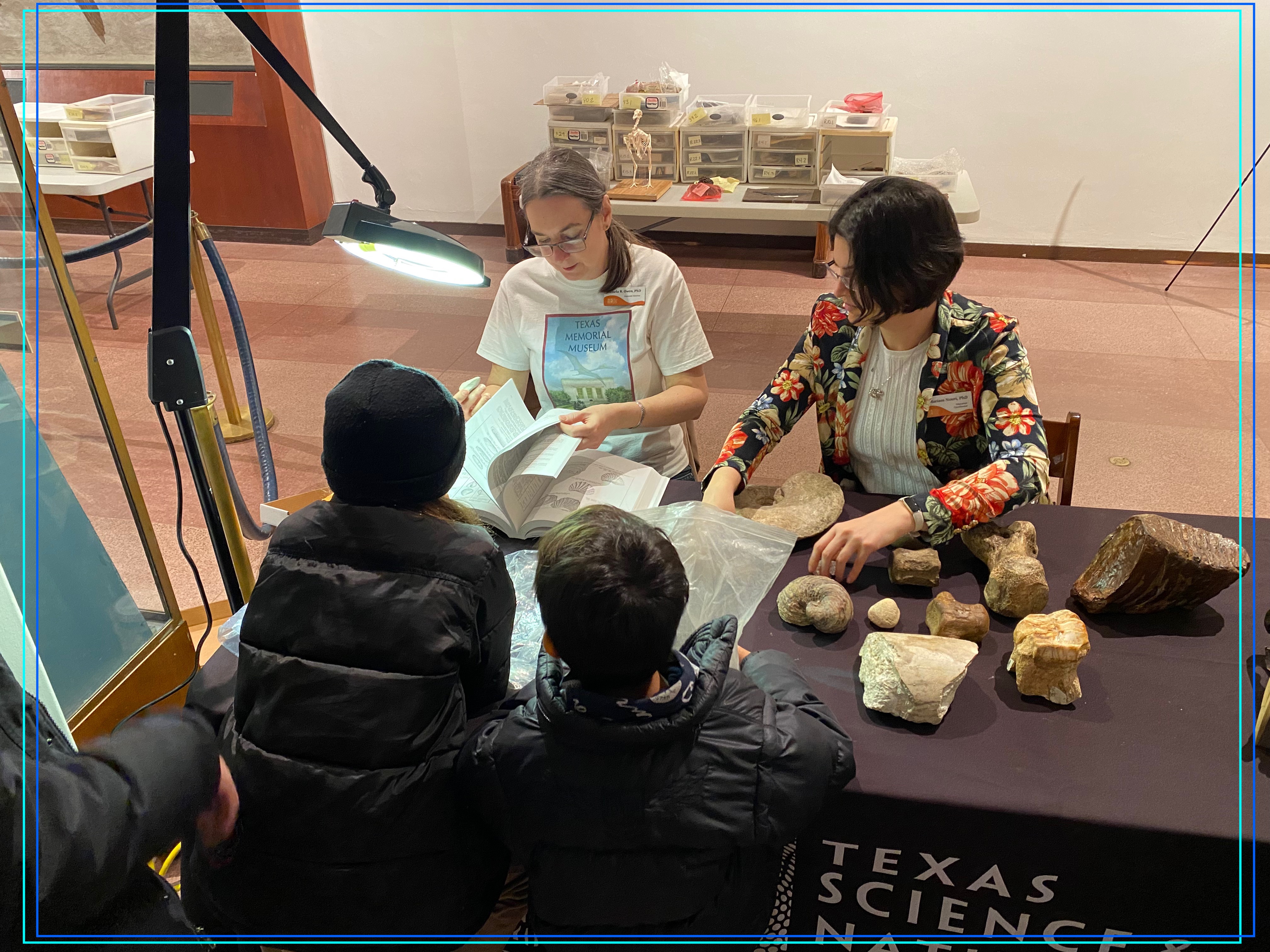
The Texas Science and Natural History Museum
held its 85th anniversary birthday party
on Sunday 21 January 2024 and we were happy to attend.
Invitees were encouraged to bring
their fossils and many did.
Museum Assistant Director Pamela Owen and
Education Coordinator Miriam Nouri identified them for us.

I bought the ammonite (black) at the Cincinnati Museum
of Natural History and Science back
in the 20th century. I lost the tag long ago and
did not know what it was. I was surprised to learn that
this is something that I know in its more common format.

On 27 January 2024, I found Messier 79 in Lepus.


Orion is a rich area of the sky and is near the meridian
for most of the winter from late November to mid-March.
Here, I sketched the stars marking the head of the Giant.

PREVIOUSLY ON NECESSARY FACTS

Fossils and Behaviors 

Before Darwin 

Pedernales Falls Public Star Party 

Globular Clusters