Nagyszüleim magyarok voltak. My grandparents were Hungarians. Actually, the empire being what it was, my grandmother's father was Croatian. Her maiden name was Kovanics (originally Covanic). My grandfather's passport to America said that he was "German-Hungarian." But I know nothing else about that. Growing up, English was the official language of the house. But you get some relatives together and someone says, "Please" and someone else says, "Thank you" and then "You're welcome." And everyone is speaking Hungarian... except the in-laws... and it goes back into English. (And we never hung out with the Marotta side of the family because they never got over the divorce.)
 |
Kálmán (Coloman) the Learned (b 1070 r. 1095-1116). The historians are mixed in the evaluation of Kálmán’s reign. Generally, they are favorable. His emphasis on learning and education easily stemmed from his own physical handicaps. He survived and ascended the crown on the basis of his wits, not his strength. 1 denar (Huszar 37)
Louis I of Anjou (b 1326 r 1342-1384). … he also confirmed the liberties of the Hungarian nobility at the Diet of 1351, emphasizing the equal status of all noblemen. At the same Diet, he …confirmed the right to free movement for all peasants. https://en.wikipedia.org/wiki/Louis_I_of_Hungary
The Saracen’s head on the obverse is supposedly a pun on the name of courtier Count Szerecsen. However, the etymology of the family name likely points back to “Moors” from Constantinople.
1 denar Obv :MONETA LUDOVICI. Rev: REGIS HVNGARIE
Maximilian II (1527-1576 r 1562-1576) “Though a Habsburg and a Catholic, he approached the Lutheran Imperial estates with a view to overcome the denominational schism,… He also was faced with the ongoing Ottoman–Habsburg wars and rising conflicts with his Habsburg Spain cousins… Maximilian failed to achieve his three major aims: rationalizing the government structure, unifying Christianity, and evicting the Turks from Hungary…
https://en.wikipedia.org/wiki/Maximilian_II,_Holy_Roman_Emperor
1 denier 0.52 grams 15.8mm 1568 Kremnitz
|
 |
1, 10, and 20 Poltura. The 1 is struck as expected. The 10 and 20 were rolled.
1 Obv Mary with Sword and Christ Child HVGARIAE PATRONA. Rev Coat of Arms POLTURA 1706. 10- and 20-poltura PRO LIBERTATE (date) Coat of Arms. The Malcontents were Hungarian nobles who sought to re-establish themselves after the Turks were pushed out of Hungary by the Hapsburg armies. Their leader was Prince Ferenc II Rákóczi. The “Rákóczi March” is best known from its use in Hector Berlioz’s Damnation of Faust(1846). It may date only to 1730, but always has been identified with Hungarian nationalism, especially in resistance to the Hapsburgs.
|
1848 Revolution
“When France sneezes, Europe catches cold.” Liberal, nationalist revolts broke out across Europe, the political expression of Romanticism that was typified by the music of Chopin and Liszt, and paintings of Eugene Delecroix, iconically, Liberty Leading the People(1830).
Left (six kreutzer; billon silver; .220 fine Craig 67)
Top
VALTO PENZ (“draft money”) 6 Coat of Arms K MAGYAR KIRALYI (of the Hungarian king).
Bottom
HAT KRAJCZÁR 1848
Right (20 Kreutzer silver Craig 69)
Obv: V FERD MAGY H T ORSZ KIRÁLYA ERD N FEJED (Ferdinand V, Hungarian, Croatian (Hrvetska) and Slavic (Toth) Countries King [and of] Transylvania (Erdély) Grand Prince.
Rev:MAGY.OR.VÉDŐJE 1848 SZ.MÁRIA IST. ANNYA (Hungary’s national protector 1848 Saint Mary God’s Mother) (These two legends and translations from Numista.com)
Ferdinand V actually abdicated in 1848, giving the crown to Franz Josef. As with other revolts, for example Texas against Mexico, the first claim was for a prior constitutional legitimacy.
 |
The Hapsburg Dual Monarchy.
Following the collapse of the 1848 Revolution, continued pressure for reform won the Hungarians special status in a sham dual monarchy in which their “king” was the crown prince of Austria. As Austria moved into the modern world of steam engines and indoor plumbing, the currency was reformed in 1892 from the Florin-Kreutzer (forint-krajczár) silver-copper to corona-heller (korona-filler; filler from German “vierer” = “fourer” or 4-penny groschen).
Left top left : obverse Ferenc Joszef I (Imperial Kaiser of Austria Czechs Transylvania Hungary Croatia Serbia Dalmatia Apostolic King) Right top left reverse Hungarian Kingdom 1879.
Left top Right: 4 Kreuzer coat of arms.
Left bottom Left: 1 korona on Latin Monetary system; about 20 cents US.
Left bottom right: MAGYAR KIRALYI VALTOPENZ (Hungarian royal draft money, i.e., base metal nickel token like a US 5-cent, nickel two of which get you a silver dime; in this case 100 copper filler to the silver korona ).
Right bottom right: 10 filler.
|
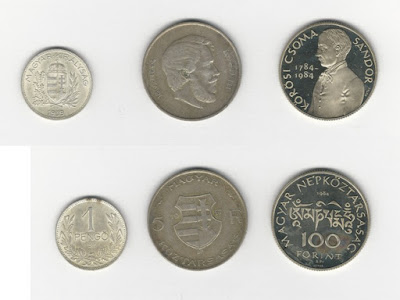
The Twentieth Century: Fascism... Communism...
Left MAGYAR KIRALYSAG (Hungarian Kingdom. Actually a fascist "regency" holding place for a missing king). 1 Pengö The word "pengö" while loosely derived perhaps from "pfennig" is an onomatopoeia for "bingle" meaning that it rang like silver versus collapsing like paper. This coin was 0.640 fine, 0.1029 troy oz actual silver weight.
Not that the Reds do not appreciate expediency. Center: Kossuth Lajos obverse; national coat of arms reverse. 5 Forint 1947 .1929 troy oz net silver as 12 grams 0.500 fine. (The coins of 1946 were 20 grams 0.835 fine Latin Monetary Standard but communism is expensive.) "MAGYAR KÖZTÁRSASÁG" (Hungarian Republic. But you need to understand the root word KÖZ as in "community" and "collective" and from there to "village" and thence "public" things.
Far right. Commorative for Sándor Csoma de Kőrös who taught himself philology and then walked to Tibet in search of the ancestral home of the Hungarians. It was not there... but he did write the first western dictionary and grammar of the Tibetan language while in the employ of the British consulate. Reverse legend is MAGYAR NEPKÖZTÁRSASÁG (Hungarian People's Republic.)
When first issued in 1914, it was worth 50 korona, about $10 US.
They lost the war, but could have won the peace.
It was just that fascism got in the way.
10 Pengö 1936
Inflation after World War II. Tied to Germany by ideology, Hungary killed her Jews and Gypsies and sent her soldiers to the Eastern Front. When she signed a separate peace with the USSR in 1945 to forestall a Russian occupation, Germany invaded Hungary and finished the job. Assuming that you can always make soup from the bones that were picked clean, the Russians moved in. One Billion... One Billion Millions... and 100, 000 New Billions. Gotta give the engraver credit for working through hard times.
10 Forint 1969. Face: Sándor Petőfi, national poet, revolutionary from 1848. Ironic on many levels as he likely died in Russia, captured after the Battle of Segesvar, when the Russians came to the aid of the Austrian monarchy.
PREVIOUSLY ON NECESSARY FACTS


