Showing posts with label computers (future of). Show all posts

Sunday, October 19, 2025

FRANKENSTEIN, RAYGUNS, AND BICYCLES

I read for research. This past Christmas break, I read formal philosophy. From 2021 through 2024, I read a lot of astronomy, several of those books cover-to-cover. But I do try fiction. I do not always succeed. I read at bedtime and therefore the sprints are short. Perhaps more to the point, I prefer to read authors who write better than I do and I have no patience for anyone who cannot outdo me because I know that I am not that good at it which is why I do not write fiction. However, as Montag said in Fahrenheit 451, inside each book is a man. So, I give the author a fair chance. 

At ArmadilloCon 47 this past September 12-14, I was working in the Convention Suite and two of the fen (not “fans”) were chatting. “Of course, I read Frankenstein,” said the one. Replied the other, “The 1818 or the 1819 version?” I was loading ice so I missed the rest, but I did check out two editions from the UT Perry-CastaƱeda Library. The book is nothing like the movies. (I have not seen the newest release from Guillermo del Toro.) 

  • Frankenstein : the 1818 edition with related texts / Mary Shelley ; edited, with introduction and notes, by David Wootton. Shelley, Mary Wollstonecraft, 1797-1851, author.; Wootton, David, 1952- editor.
  • The annotated Frankenstein / Mary Wollstonecraft Shelley ; edited by Susan Wolfson and Ronald Levao. Shelley, Mary Wollstonecraft, 1797-1851.; Wolfson, Susan J., 1948-; Levao, Ronald. 2012.

The proper title is Frankenstein; or, The Modern Prometheus. In my opinion, Mary Shelly failed to complete the analogy. Moreover, that context was not explored in any of the editions or criticisms that I found at the UT library. 

Prometheus (Forethought) was tasked by Zeus with creating animals to inhabit the Earth. His brother, Epimetheus  (Afterthought), gave all of them the strength, speed, agility, powerful talons, fangs, hides, horns, etc., etc., leaving Man with not much else. Prometheus gave Man intelligence — and fire. For that, he was chained to a mountain in the Caucasus and his liver was torn out by a vulture, only to regenerate overnight and be torn out again. We experience the tremors of his suffering as earthquakes. Mary Shelley did not carry through the many possible parallels. 


What does project to the reader is the dual nature of the monster. He is completely innocent, teaching himself to understand language, speech first and then writing. He discovers music, first in birds then from the old man in the cottage. He is vegetarian, subsisting on roots, leaves, and berries, sometimes cooking them after he learns (by accident) fire. He wants to be liked and loved but his horrendous form—eight feet tall and made from inanimate matter brought to life—draws only terror, rebuke, revulsion, and violence from everyone around him. He pays the world back in kind, at first killing a child then turning his attention to Victor Frankenstein’s family. Frankenstein pursues the monster to the North Pole but dies and the monster drifts off on an ice flow, promising to immolate himself. By Aristotle’s theory, the fable must be a tragedy, a story about a being brought down by circumstances not of his own choice but of his own making. 


Rayguns over Texas was published in 2013 by FACT the Fandom Association of Central Texas. It contains 19 short stories and eight essays. I bought my copy at my first ArmadilloCon (39) in 2017. The book disappeared into storage boxes when we moved from Austin to Kyle. Looking for something else, I found it and I now know some of these authors. So, I started with those stories. 


“Texas Died for Somebody’s Sins But Not Mine” by Stina Leicht is another Frankenstein story. This retelling has been informed by decades of science fiction and political theory. This monster is a transgenetic clone labelled “Dallas” and called “Una” who works as a computer programmer and is the legal property of a corporation. She is harmless and truly a victim. She escapes the software factory for one night of selfish pleasure. When she slips back in, she learns that she had been discovered. It does not matter on two grounds: this project is closing, so she was going be erased and reprogrammed with different skills anyway; and against that she knows that she had her own life for a short time, even though she will not remember any of it. 


I believe that “Operators are Standing By” by Rhonda Eudaly is a personal story told through aliens. Set in a galactic sales call center, it is about belonging. If you saw Boiler Room or Wall Street, you get the picture. Moreover, Fahrenheit 451’s Montag would say that this is autobiographical and is on a narrative level forbidden in his society. 


Of these first three stories, I found "Jump the Black" by Marshall Ryan Maresca to be the most emotionally engaged. The viewpoint character is an illegal alien, a Terran seeking to get off the Deathplanet which we turned Earth into. Imagine a world of homeless people, living on whatever is left of the streets, paying smugglers to get them anyplace else. Many die along the way. That’s how it is. Keep moving. 


After I finished the three-part review of ArmadilloCon 47 last month, I left messages in the contact pages of the websites of the vendors, authors, and fans whom I mentioned. Panelist Lauren Teffeau replied with corrections to my blog post. Reading her website, I discovered the Solar Punk subgenre in which home-brew solutions remediate some of the environmental sins of our time. From the libraries at the University of Texas (Austin), the City of Austin, and the City of Kyle, the closest I could come was Bike Topia: Feminist Bicycle Science Fiction in Extreme Futures, volume 4 of the Bikes in Space series from Microcosm Publishing. 


The narrative style of “Riding in Place” by Sarena Ulibarri is matter-of-fact, unadorned writing. So, I just followed the story and I did not foresee the (surprise) conclusion. It is another smuggled alien story told from an outside viewpoint as we follow our human corporate worker on an industrial space station orbiting Earth. I was reminded of Bruce Sterling’s Islands in the Net which opens with a middle class corporate office work gang ripping up old telecom lines and patching the landscape.They do the job they are given but they don’t have much enthusiasm for it: “it’s community work,” they say. In Sarena Ulibarri’s utopia of megacity biking trails and parkways, everybody gets assigned some tough jobs and working on the space station is one of them. Hence the bicycles to maintain bone strength. 


Maddy Spencer’s "Meet Cute" is a graphic flash story with neither narration nor dialog. The pictures tell the story. Montag would have read this before he discovered books. 


"Portlandtown" by editor Elly Blue weaves the threads of self-discovery within a tapestry of complex future sociology told as history. 


The stories in BikeTopia are fresh. The plots are the ones we know from The Bible and The Iliad and Shakespeare. The tellings are new and now. 


PREVIOUSLY ON NECESSARY FACTS

Books Read and Not Read in 2023

The Great Gatsby: An Alternate View and an Alternate History

Science Fiction Recent Reads 

Dealers Make the Show: ArmadilloCon 41 Day 3 


Saturday, April 11, 2020

No One Needs a Computer in Their Home

“No one needs a computer in their home.” -- Ken Olsen, 1977.
What is really funny about that is the way Snopes debunked it back in 2004.  
Quote: “What Olsen was addressing in 1977 was the concept of powerful central computers that controlled every aspect of home life: turning lights on and off, regulating temperature, choosing entertainments, monitoring food supplies and preparing meals, etc. The subject of his remark was not the personal use computer that is now so much a part of the American home, but the environment-regulating behemoth of science fiction. Digital historian Edgar H. Schein described it thusly:‘What Olsen [was focusing on was] that in the 1950s and 1960s there existed the notion that the computer not only could but would control all aspects of our lives. Images of the fully computerized home that automatically turned lights on and off and that prepared meals and controlled daily diets were popular. And the fear that computers might, as in the movie 2001: A Space Odyssey, even try to take charge altogether was widely experienced.’ ”  -- https://www.snopes.com/fact-check/ken-olsen/
 On the eve of the Hall Process, Napoleon III served his most important state guests on aluminum dinnerware while dignitaries of lesser status ate from gold or silver. Our best hobby telescopes today in the $10,000 range would have been the envy of an observatory. Our dobsonian "light buckets" ten to 16 inches costing between $500 and $1000 would have been unthinkable to amateurs whose 3-inch refractors would be considered toys ($50 to $100) today. 

Your kitchen has appliances that would have been found only in laboratories of 1950, among them the variable high speed blender, microwave, and coffee filters.

If no one needs a computer in their home, do they need one in their pocket, to stream video chats, play music and movies, bring the news, and (functions I actually use) be a map accurate to ten feet, a directional compass, and a carpenter's level? 

Pundits of science tell us that the universe is beyond our imagination. I find it more compelling that our own civilization challenges our easy assumptions about what is possible--and what is helpful, useful, and ultimately necessary in common daily life.

PREVIOUSLY ON NECESSARY FACTS


Friday, October 24, 2014

LASCON 2014

OWASP (the Open Web Application Security Project) sponsors LASCON, the Lonestar Application Security Conference.  This year's two-day assembly brought together cutting edge vendors, theoreticians, and developers.  It was my privilege to be the introductory speaker serving KUNAL ANAND of Prevoty and KSENIA DMITRIEVA of Cigital.  The general session guest speakers included Martin Hellman, co-inventor of Public Key Cryptography, and Kelley Misata, formerly of Tor, now with Suricata.
Martin Hellman (right)
"The Open Web Application Security Project (OWASP) is a 501(c)(3) worldwide not-for-profit charitable organization focused on improving the security of software. Our mission is to make software security visible, so that individuals and organizations worldwide can make informed decisions about true software security risks." - www.OWASP.org


Ksenia Dmitrieva of Cigital answers questions
after her presentation
"Everyone is free to participate in OWASP and all of our materials are available under a free and open software license. You'll find everything about OWASP here on or linked from our wiki and current information on our OWASP Blog. OWASP does not endorse or recommend commercial products or services, allowing our community to remain vendor neutral with the collective wisdom of the best minds in software security worldwide. We ask that the community look out for inappropriate uses of the OWASP brand including use of our name, logos, project names and other trademark issues." -- OWASP.


Keynote Speaker Kelley Misata spoke on behalf of Tor.
Misata is now working with the CERIAS project of Purdue
and Suricata, an Open Source Foundation partner
.
Martin Hellman worked directly with Whitfield Diffie to realize public key cryptography. They then discovered that Ralph Merkle had independently submitted papers some months earlier.  Merkle's work was rejected for openly running contrary to the mainstream of cryptographic theory. ("Secure Communications over Insecure Channels" on his website here.) They published congruent ideas but under a less contrarian article title, "New Directions in Cryptography." (On his own pages here and archived widely, including here.).  Also,  Hellman was a professor. (Diffie was his doctoral student). On the other hand, Merkle was working on his doctorate; and he had no support for his theories from his own mentors.  So Hellman brought more social status to the supposedly impartial peer-review process.  He also brought Merkle to Stanford from Berkeley.

Kelley Misata had been cyber-stalked for eight years. She watched while her computer was taken over and worked remotely. Trashy emails were posted in her name from cuts and pastes from her own Facebook pages. She could not apply for a job without her stalker knowing it and intruding.  She figured out who he was.  However, the FBI said that they were powerless, and a judge refused to issue a restraining order, both because the stalker hid behind Tor and could not be identified.  So, she took her MBA and her experience in marketing to Tor where she advocated for privacy and security. She now helps the Center for Education and Research in Information Assurance and Security (CERIAS) while working on her doctorate at Purdue.

Appropriately, the front of the vendor's hall was held by White Hat Security of Santa Clara.  All of the sellers were satisfied to have made good contacts. While setting up his talk, Kunal Anand underscored for me the importance of qualified leads to a start-up looking to scale its services. 


OWASP co-founder and Contrast Security CTO Jeff Williams 
Among the fifteen sponsors set up in the vendor hall were HP (both local and national sales offices), Contrast Security of Palo Alto, Trustwave, F5 Networks (headquartered in Seattle), Checkmarx from Chicago, Qualys (Redwood City), and K2Share from College Station. Texas.
Wade Williamson from Shape Security of Mountainview. 
OWASP conventions always include several security challenges, such as "capture the flag" and locksporting.  The convention name tags were puzzles with imbedded clues.  (Decipher the Roman numerals into an IP address and go from there.)  Winners received a challenge coin. "Capture the flag" lets would-be hackers attack knowledgeable defenders of a target computer.  Of course, all the firewalls do you no good if someone can pop the lock on your server cage. 


Jgor taught me how to pick a four-wheel combination lock.
After I felt successfully for the solution, he showed a slide
with a cutaway view of the internals . 
Over 40 different breakout sessions provided expert presentations on application security, rugged development, agile development, cryptography, IoT and mobile platforms, and an array of special case studies.  The two-day conference ended with giveaways and drawings. The top prize was a Pwn Phone from Pwnie Express.


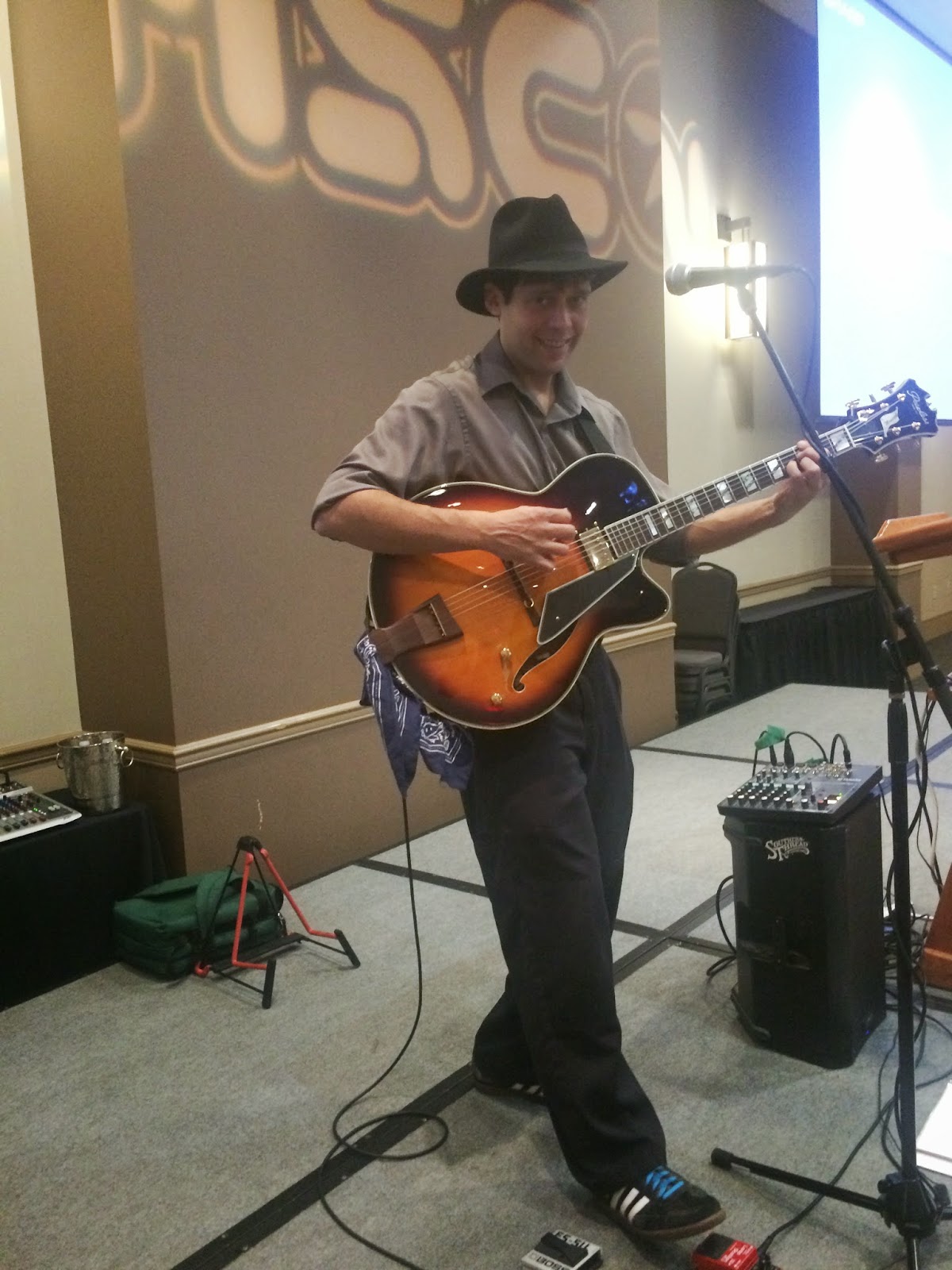
We enjoyed great guitar work from Chris Devore
at both lunches and the Thursday evening social.
ALSO ON NECESSARY FACTS
B-Sides 2013
Open Secrets
Fortune Cookie in Hex Code
The Eurion Project
Securing Your Viper Against Cylons

Friday, August 8, 2014

Contradictions in the Patentability of Numbers


A number can be patented.  The US Patent and Trademark Office will claim that this is not true, but has indeed given patents to numbers.

The title, “On Computable Numbers” (rather than “On Computable Functions”) signaled a fundamental shift.  Before Turing, things were done to numbers. After Turing numbers began doing things.  By showing that a machine could be encoded as a number, and a number decoded as a machine, “On Computable Numbers” led to numbers (now called “software”) that were “computable” in a way that was entirely new.” – Turing’s Cathedral: The Origins of the Digital Universe by George Dyson, New York: Pantheon, 2012.

Since 1880, the USPTO has not required an actual working model, but will grant a patent only based on the plans.  Therefore, without actually producing the working program as an array of gates on an integrated computer circuit (or “chip”), you could get a patent on the Gƶdelized code for the description: one number would contain all of the necessary information.  That is an extreme example.  Many more instances, all  mundane to computing are easy to find.

The binary number 00100000 = 20 in hexadecimal or base 16 is the same as 32 in base-10.  For a computer that is controlled by an Intel 80xxx processor, that number encoded on an integrated circuit “chip” will terminate the program process.  It is a “stop” command.   The number could be “burned in” and the logic gates would be permanent.  Most often, though, the integrated circuit chip is programmable and only holds a temporary configuration. 

A computer program is just a number.  At the level of human obviousness, a computer program is a string of numbers.   Here is a program.

10110100 00101100 11001101 00100001 10110000 01000110 11111110 11101110 00001010 00100000 00000001 10001001 11000010 10110100 00001001 11001101 00100001 11001101 00100000

That binary representation might seem esoteric, but to a programmer who knows Intel 80xxx processors and the MS-DOS (“Windows”) operating system, it is as “clear and open” as Morse code to an old Navy radioman.  Here it is in hexadecimal as a more human-friendly kind of computer code.

B4 2C
CD 21
B0 46
F6 EE
05 20 01
89 C2
B4 09
CD 21
BA 18 01
CD 21
CD 20

Here is what that means and what it does:

B4 2C    MOV AH,2C       Get the clock
CD 21    INT 21          execute
B0 46    MOV AL,46       Get the seconds
F6 EE    IMUL DH         multiply the DH by the Seconds   
05 20 01 ADD AX, 0120    add 120 to that
89 C2    MOV DX,AX       put that number in the DX register
B4 09    MOV AH,09       display to screen
CD 21    INT 21          execute
BA 18 01 MOV DX, 0118    end of line
CD 21    INT 21          execute
CD 20    INT 20          quit
If this were programmed into an integrated circuit chip it would be a Fortune Cookie device. (It would need the list of Fortunes, but those are plain text and easy to insert.)

Again, for the purposes of the USPTO, every computer is momentarily “hard wired” to be a machine with a specific purpose. Each program that it runs creates a new “machine.”  Every computer program creates a new mechanism, a new system of logic gates “burned” (temporarily) into an array of integrated circuits.

That is another fundamental contradiction in patent law.  If every program creates a new “machine” then so must every change order, every update, every bug patch.  

Would a bug patch release not invalidate the previous patent?  Patent law has no way to deal with an inventor’s invalidation of his own creation.

PREVIOUSLY ON NECESSARY FACT


Thursday, July 10, 2014

Cell Repair and Tissue Sales


Back in the 1980s, the "cyberpunk" science fiction genre touted personal technologies in the early 21st century.  Here we are.   In the stories of William Gibson, in particular, but also Pat Cadigan, Lewis Shiner, John Shirley, and others, biotech takes the down-front stage position, even as computering of all kinds provides a rich array of characters (maybe even the chorus).  After I took the picture here - and I am sure that it meant cellular telephone repair - I saw a sign at a Walgreen that said " $$ Tissue Sale $$".  Soon… soon…

Previously on Necessary Facts

Sunday, May 20, 2012

John Kemeny Knew: We Shall Have Computed

In Man and the Computer John G. Kemeny analyzed some aspects of society and a few institutions with suggested alternatives for them to be improved with the application of computers.  Many of Kemeny’s predictions were largely correct.  Some were very wrong. To be fair, the future of computers moved so fast that even William Gibson gave up cyberpunk for mainstream fiction. 

American Museum
of Natural History
Special Edition
Generally, John Kemeny failed to expect the invention of the microcomputer and the resultant home and office desktops and laptops that today are ubiquitous.  Although he wrote briefly about the advantages to video telephones, nothing he presented applies to the iPod. And much of what the iPod actually does –playing recorded music, taking pictures, giving directions to drivers – was not suggested for the video telephone. 

Throughout the book two complementary ideas frame the thesis: a regional network of mainframes will allow personal terminals for millions; this technology also will empower “social analysts” to attempt solutions to our problems.  Chief among those problems is traffic control in metropolitan centers.  But that only reflects the full range of challenges from overcrowding, over population and over consumption.  In short, John Kemeny was a fascist.  But a nice fascist.  He would never put anyone into a concentration camp for their beliefs, but he did see government authorities and academic experts as the central forces that can and should define and drive social progress.

Writing about business applications for computers, he outlined the power of management information systems.  He did not suggest that entrepreneurs would find computers helpful.  He certainly did not see a role for entrepreneurs in creating new modes of computing.  He did call for private entities to provide time-sharing mainframes and databases, but only to counterbalance the potential threat of government monopoly over information and access to it.  If John Kemeny read any Friedrich Hayek, it could only have appeared as an indecipherable alien language, written in Roman letters.

That aside though, this book was a seminal work and deserves attention for its positive attributes. 

Early on (35-37) he grants validity to the importance of games on the computer.  Gaming builds familiarity with the system, demystifying the computer. 
That describes my experience meeting my wife in 1977 in front of an HP 9830 on which our physics instructor at Lansing Community College, Claude Watson, taught “BASIC for Arts and Science.”
“At Dartmouth we do not consider these recreational uses frivolous. First of all, they are an important resource for recreation in a residential college environment. But, more importantly, for many inexperienced users the opportunity for playing games against a computer is a major factor in removing psychological blocks that frighten the average human being away from free use of machines.  Indeed, we are proud of the fact that one of the places that Dartmouth students take their dates to “show off” is the computation center.  While they are likely to play several games there, they are also quite likely to show off with programs that they themselves have written.” (35)

As a teacher, Kemeny’s insights into the value of computer-aided instruction were accurate.  (Ch. 7; 72-84; but also throughout) First, he acknowledged the importance of drill-and-practice.  Beyond that, he recognized that one of the best ways to learn something is to teach it and we do that when we write a program to carry out a task. The three best uses from an educator’s point of view are rapid calculation, information retrieval, and the creation of algorithms.  (80) 

Kemeny correctly identified the need for a society of autodidacts, people who can teach themselves what they want to know by accessing databanks, journal articles, and lectures. (81-82).  Books will remain important and pleasurable (83), but their content must be supplemented with interactive learning sessions. 

Imagining “The Library of the Future” (Ch. 8; 85-98), Kemeny paints a detailed portrait of the product while totally missing the delivery mechanism. Focused on fiche images stored in card files and indexed by100-word abstracts, he did not expect that I could put “John Leonard Riddell” into Google Scholar and be led directly to a PDF of a lost work, Riddell’s 1836 monograph Memoir on the Nature of Miasm and Contagion. While some PDFs are image-only, this one is word-searchable.  I can quote easily and exactly to show Riddell’s assertion that disease is caused by germs (“animiculae”). 
Thomas Kurtz (Mac)
 and John Kemeny (PC)

For all of the prognostication and soothsaying, Kemeny in 1972 vastly underestimated the length, breadth, depth, and flow of the information revolution he would live to see welling up before he passed away too early in 1992 from heart failure. He calculated limits expressed in transmissions of megabits per second, delivering pages of storage, for dollars of rental time.  Today we throw out computers with more capacity than the network he dreamed of in 1972 for 1980.

Of course, he could not see the limitations and contradictions that would evolve from within a successful informatic revolution.

Kemeny wrote about the need for “computer programmers.” We are all computer programmers, but like oncologists who have their moles removed by dermatologists, we are specialists, too often as limited in our skills with computers as our parents before us.  The other day at work, I saw two young managers scan receipts to JPEG files with their iPods to facilitate the filing of expense reports.  As their technical writer, I know that neither of them knows much about word processing software, or they would not have Arial in their Calibri and they would know what the red squiggly underline is trying to tell them.  I warrant that none of the 40 project managers on my current infrastructure integration project could write a program to translate Roman numerals into Arabic numbers, though many of them are certified for Microsoft Project. (Myself, in 2007, I completed an undergraduate requirement for “computer literacy” by taking a class in Java a kind of Basic done up in Rococo.)

This post comes with some irony.  As I read the book, I made notes in the front, a couple of words and a page number for each.  Then I copied the page numbers and tags into this Word document to start the article.  To get them into order, I highlighted and sorted. Seeing 111 ahead of 87, I went back and prepended zeroes to the two-digit integers. Then I resorted.  Like much else, technology stays the same the more it changes.

Finally, Kemeny outlines a problem in simulation (traffic control) at some depth (130-135). He is correct that the general purpose digital computer allows flexible creation and testing of models.  One promise not addressed was the testing of existing models.

Today’s controversies in anthropogenic global warming only bring this into the front.  A model is based on assumptions.  Data tests those premises.  Real validation or falsification can only come from new data not in the original model; or else from different models employing the original data.  Aside from some curve-fitting with least-squares, we seem not to do much of this, certainly not in the social sciences.  If the essence of John Kemeny’s apology for computing is to be accepted, then modeling – both making and testing – must become a requirement for informatic literacy.

Postscript -- Speaking of literacy, to check the grammatical future in English, I googled "english grammar future tense" and read a Wikipedia article, then paged forward and read more at www.lousywriter.com. John Kemeny knew.