Sunday, October 8, 2017

What is Cost?

We generally accept the dollar price of something to be its cost to us. The truth is more complicated. Accountants and economists know “opportunity cost,” the hidden tally of what you must give up in order to obtain what you get. I suggest that an “inverse opportunity cost” is represented by blackmail: what you would give up not to lose a thing. Insurance and safety precautions are among those measurable costs.
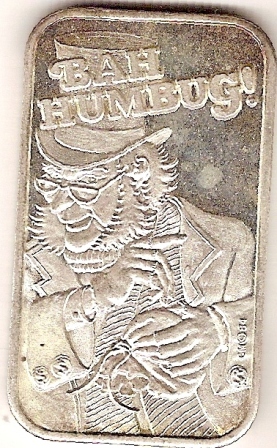
1-ounce silver bar
celebrating
Ebenezer Scrooge

We know retail prices, wholesale prices, and producer prices, salvage value and replacement cost. Many people who are successful traders believe that if they sell you something for $700 and discover later that you would have paid $1000, then they just lost $300. They call it “leaving money on the table.”

This avenue of inquiry was opened for me just over 40 years ago by R. W. “Bill” Bradford when he owned Liberty Coin Service of East Lansing. Soon after the precious metals run-up (or paper money collapse, depending on your view), he retired to Port Townsend where he followed his true calling, publishing Liberty magazine. He always admired H. L. Mencken and saw himself in that role. I was happy to see Liberty on the newsstands next to Reason. Bill passed away too young in 2005. (Wikipedia here.)  I learned a lot in Bill’s coin shop, mostly from the questions he asked. I often could not answer them; and he never did, leaving the work to the student.
 
Plastic tokens from bars and taverns
(US Quarter center for size.)
He asked three rapid-fire questions: “Is a thing worth what you paid for it?  Is it worth what you could sell it to someone else for? Is it worth what it would take to replace it?” 
Collectors pay 60% to 100%
over the spot price of silver
for these common coins.
"The market is always right."

Those were all cogent and obvious, even from my side of the counter. The inherent inflation caused by government deficits was driving up the prices of collectible numismatics which normally would have been insensitive to those markets. When the price of silver went to $50 per ounce because of the Hunt Brothers, coin stores were tossing otherwise “rare” items, such as U.S Mint and Proof sets into shipments bound for smelters. Many collectible silver coins would be replaced at higher prices later, after the collapse of the silver futures market.

PREVIOUSLY ON NECESSARY FACTS

Saturday, October 7, 2017

Make Every Day Special

Commandos, Green Berets, Rangers, SEALs,… military special forces are legendary. We look to them for lessons, as examples to follow, as paradigms for living. Businesses want their managers to be leaders worthy of the most dangerous and demanding work we can imagine in service to our highest values of nation and family, liberty and democracy. We would find it unusual, even unsettling, if military commanders exhorted their field officers to be profitable, productive, and thrifty.  (See “Choose Your Virtues” and “Shifting the Paradigm of Private Security” here.) The military is a model for business. The merchant ethos does not inform the military.

Spec Ops: Case Studies in Special Warfare
Theory and Practice
 by William H. McRaven
(Random House 1995; Ballantine Books 1996).
A SEAL commander, Admiral McRaven identifies the factors that make special operations different from ordinary combat. First is the relativity of their force superiority. Special forces may be two-man teams or 100-man battalions, but even the largest of special force attackers are necessarily numerically smaller than the forces of the defender. Nonetheless, they achieve relative force superiority with speed, stealth, and special weapons. Their mission plans are simple. While practicing their missions repeatedly, they keep their intentions secret.  To the fullest extent necessary, each man understands the mission; and regardless of their role, every man is committed to the achieving the goal.

These narratives are interesting on their own merits.  The German assault on the Belgian fort Eben Emael in WWII was pure blitzkrieg. Italian frogmen attacking the battleship Queen Elizabeth in Alexandria, and British midget submarines hitting the Tirpitz at Kaafjord, Norway, are almost science fiction. The American liberation of POWs in the Cabantuan camp in the Philippines and the failed mission at Son Tay, Vietnam, could have come from Hollywood. The Israeli raid to free hostages held by the PFLP at Entebbe in Uganda was retold in two movies and a TV series. Action and adventure aside, McRaven chose them and others to demonstrate his theory of special operations.


Not all of the missions exemplified the fullest use of all factors. The British raid on the Saint-Nazaire dry docks called for over 600 men, 18 attack boats, and a destroyer. McRaven labeled it a success because the primary target was achieved: the dry dock mechanical works were wrecked. However, the over-ambitious inclusion of many subsidiary goals only left a lot of men dead and a few men captured.

It is clearly a challenge, perhaps impossible, to bring a large force to the expert effectiveness of commandos. But there are lessons here for the individual.

You are a small unit. You have good internal communication. You can identify your own mission, create a plan, and exercise it. You know your mission, and you are dedicated to it. And you are authorized to improvise as needed in the face of contingencies.  You can plan and train in secret. You can do this every day.

Your skills may be common, but the full set of them is unique to you. How you put them to work is also special. Rather than blowing things up – though Austrian economists speak of “creative destruction” – most of us build, create, deliver, and maintain. It can still be special operations if  you bring that intention to your work.

PREVIOUSLY ON NECESSARY FACTS

Thursday, September 21, 2017

For the Glory of Old Lincoln High

Next weekend is the 50th Anniversary Reunion of the Class of 1967 of Lincoln (Lincoln West) High School of Cleveland, Ohio. A few things got in the way of my attending, among them Hurricane Harvey. I actually did not graduate with that cohort, having transferred to John Marshall High in the middle of the tenth grade. However, for odd reasons, LHS was 7-12, so I spent almost four years with my classmates. Of all the benefits of my education at LHS the greatest has been this, writing and editing.
 
Chandler & Price, Cleveland, Ohio, 1912
(LetterPressPrinting.com.au)
We boys had to take shop classes in the 7th and 8th grades; and the teachers could not fail us because it would keep us out of the junior honor society. I never did well at wood, metal, or mechanical drawing. But printing grabbed my attention. This is how books, newspapers, and magazines were made. I learned the arcane craft of creating the carriers of ideas.

In today's world of desktop publishing with Word, XML, and Madcap Flare, we do not know the Job Cases (upper case for capitals, lower case for little letters), the composing stick; the leads and slugs between lines, the molly quads and nancy quads to justify type; pulling proofs, the frames, furniture, and quoins; the kiss impression when cold type touches paper and you ride the pedal up, brushing out one sheet, and placing the next as your weight on the treadle brings the platen forward.

At the same time, I had journalism as a half-credit elective. Junior high schoolers were not allowed to actually work on the school newspaper. The next semester, I was in high school and on the staff with a semester of experience, counting headlines, and learning the special vocabulary of newspaper publishing. Today, very few educated people know the masthead from the banner, a tombstone from a gutter. Even though newspapers are as quaint as Amish buggies, the principles of good layout remain – even for tweeting.
 
Composing Stick
(Edinburgh City of Print. Wikimedia Commons)
I went from The Lincoln Log to the John Marshal Interpreter to the College of Charleston Meteor. A score of years and half a dozen life changes later, I was setting type on a DEC VAX in Donald Knuth’s TeX, the parent of SGML, the grandparent of HTML.

In Cleveland Public Schools, English classes alternated each semester between grammar and literature. In junior high, we had a lot of general reading. In the 11th grade, it was American Literature and in the 12th, English English Literature, by Jove. Although hormones lit up 
“Evangeline,” “The Wreck of the Hesperus,” “Annabelle Lee,” and “Lenoir,”  my secret passion was tracing word origins to their Indo-European roots. 

I became a technical writer when no one else on a database management project wanted to write the user manual.
"A Plan of Printing Instruction for Public Schools"
Library Catalog Card. Another root technology.
Twice, classmates from Lincoln High intersected my career path, Walter Rowinsky, and Greg Stricharchuk, both writers, formerly editors of the Lincoln Log. In 1987, I was writing user manuals for a start-up in Lansing, Michigan, when I saw a product review in PC Week or PC World by Walter Rowinsky. How many people could have that name? I sent him an email (via Fidonet most likely). It was he. Wally recommended that I write product reviews. I did place some, but sold more writing about the politics and sociology of computing, hacking, and informatics.

About 1993, I discovered numismatics. A few years later, I was the international editor of Coin World. Combing through the Wall Street Journal while researching fraud and theft in the hobby, I found an article about corporate crime by Gregory Stricharchuk. Not many people could have that name. So, I emailed him, probably via AOL. Greg said something like, “Where else would a kid from Tremont end up but under a street lamp on a dark night waiting to meet a hoodlum?”  

PREVIOUSLY ON NECESSARY FACTS