Showing posts with label copyrights. Show all posts

Friday, July 31, 2026

Copying from the Scriptorium to the Cell Phone

The Science Fiction Writers of America publishes a news blog, “Writer Beware.” The July 31, 2026, entry is about changes to the Canon of Ethics of the American Association of Literary Agents. In their summary, the SFWA cites a comment from Publisher’s Weekly

“A surprising omission from the revisions is any language addressing AI. According to PW’s article on the revisions, though, this is something the AALA is looking at. Guidelines around AI usage are notably absent from this round of revisions, though AI use ranked as one of the top concerns among agents in a recent AALA survey. [AALA president Regina] Brooks said the AALA has begun circulating information internally and among members, but is “waiting for things to settle out” before formalizing anything.” 

Common chatter about AI is ubiquitous. I am complacent and ambivalent. I do recognize that soon (if not yesterday), an AI is going to sue in court for its rights as an artificial individual under the law, the same any other corporation. Whatever that may bring, for the immediate present, AI is just another computer program, a platform, an environment, no different than Cobol, Python, DuckDuckGo, or Amazon Web Services. Collectively, they are only wider abstractions to encompass concepts. 


It remains that the grammar checker and spellchecker are annoying but convenient. Typeahead is a klaxon for cliches. When you are in a Zoom call (or similar) turn on CC:Closed Captions and see whether and to what extent that program learns the nuances of your specialized vocabulary. 


“People of the same trade seldom meet together, even for merriment and diversion, but the conversation ends in a conspiracy against the public, or in some contrivance to raise prices.” – Adam Smith, The Wealth of Nations, (Book I, X “Wages and Profit,” Part I)


Writers and artists worry about losing income to new tools and it is an old problem. When movable type printing was invented copyists were disadvantaged; they rebelled and lost. When all copies were made by hand, it was a nice gift to copy a book and give it to your friend. The ability to produce hundreds or thousands of copies led to copyright laws. 


Until the invention of computers, copying and reading were distinct acts. In his 1985 book, Electronic Life, Michael Crichton asserted that reading with a computer is now identical with copying to a computer. My Apple iPhone connects automatically to my Apple iMac and copies content from one to the other.


During one of several continuing and ironic discussions with friends in the Fandom Association of Central Texas (FACT) about why we ban AI, the comment was made, “All they do is scrape the internet.” 


And what do you do? Does your story have a faster-than-light spaceship with colonists, or does it have dragons, vampires, witches, sorcerers, or does have robots or aliens? 


FACT sponsors the annual ArmadilloCon science fiction convention in Austin. During a Board meeting, discussing upcoming plans, it was said that an invitation to speak and present had been intended for a new popular writer but that as it happens, the writer-artist encourages “fanfic” written by their readers. Moreover, they actively promote and reward the use of AI tools to write and illustrate these offshoot narrations. So, the convention withdrew the invitation. To me, that was wrong of FACT.


On YouTube is a video about a monk learning to use a book. Danish is not required to understand the humor and it is interesting to read the cognates.

It is a cartoon that a proofreader found when my wife was an employee of a large commercial printer and also freelanced, reading over 100 books for Bantam Doubleday. The monk is running into the scriptorium with sweat and exclamation points over his head. He is barely carrying a double armload of scrolls. He says, "It should be celebrate!!"  

Science Fiction Writers of America https://sfwa.org/


SFWA “Writer Beware” blog by Victoria Strauss here: https://writerbeware.blog/2026/07/31/the-aala-makes-significant-updates-to-its-canon-of-ethics/


Publisher’s Weekly comment article here 

https://www.publishersweekly.com/pw/by-topic/industry-news/people/article/100919-major-aala-ethics-update-allows-agents-to-offer-paid-editorial-publicity-services.html


A Brief History of Printing.
Part II: The Economic History of Printing

by Frederick W. Hamilton,
Committee on Eduction, 1918.
From Gutenberg here.

"A Brief History of Printing. Part II: The Economic History of Printing" by Frederick W. Hamilton is a historical account likely written in the early 20th century. The work focuses on the economic dimensions surrounding the printing industry from the advent of printing in the mid-15th century through to the French Revolution in 1789. It delves into government regulations, labor conditions, and the evolving dynamics of the trade guilds impacted by the rise of printing. The opening of this volume introduces a thorough analysis of the printing industry’s economic landscape during a transformative period. It highlights how printers operated largely outside established guild systems, contending with governmental oversight and fluctuating market demands. Hamilton outlines how apprenticeships were structured, exploring the socioeconomic conditions faced by various classes of workers within the industry. He also contextualizes the historical significance of printing as not merely an industrial endeavor but as a pivotal influence on societal thought and subsequent revolutions, setting the stage for a detailed exploration of regulations, labor relations, and the inevitable shifts leading to modernization. (This is an automatically generated summary.)  A Brief History of Printing. Part II: The Economic History of Printing by Frederick W. Hamilton, Committee on Eduction, 1918.  

PREVIOUSLY ON NECESSARY FACTS


For the Glory of Old Lincoln High 

All Volitional Beings Deserve Rights 

Generative AI: As Big as it is, it is only a Program 

Art & Copy 

Start the Presses 

Hermann Zapf on Alphabets 

Libraries of the Founders 

Five Books about Books 

Goudy by Bernard Lewis and Goudy in His Own Words 

Frank Romano’s History of Desktop Publishing 


Monday, April 14, 2025

Your Public Library

You can learn anything at a library. Schools only teach you what they want you to learn. We now enjoy the “Library of Things” which lends musical instruments, weaving looms, badging machines, cameras, audio recorders, 3-D printers, telescopes, microscopes, etc., etc. 


In some sense this has always been true. Growing up in Cleveland, Ohio, in the 1950s and 60s, the public library catalogs included sound recordings and cinema films. The main library had a special Typewriter Room. The main library also had a large room for Patents and it was usually pretty busy. (A friend of mine from a patriotic group said that many of the guys in there were Russian spies.)


The South Branch Library 3096 Scranton Rd, Cleveland
Pretty much as I remember it. 
 

When I returned to Cleveland in 1996 to write for an information audit project, I applied for a local card. Proof of residency was a bit of a challenge but they did accept three postmarked letters sent to your home. So, I wrote to the President of the United States, the Secretary General of the United Nations, and His Holiness in Rome, and told them that they were doing a great job. (I included $5 for the Pope.) I took the replies to the library and got a card.


The South Branch Library today.
Clark-Fulton is one of the city’s poorer communities,
with below-average levels of educational achievement and
median household income ($22,900 compared to
about $25,300 for Cleveland as a whole).
More at https://case.edu/ech/articles/c/clark-fulton
 
Today's South Branch Library features a music studio.

I have several library cards, one for my hometown outside of Austin, another for a nearby library in the same county—turns out they are in the same consortium—the City of Austin, and the University of Texas. I got the UT card as soon as I could when I moved here in 2011. To do that, I needed a TexShare card (which I still have) honored by all public libraries in the State of Texas. That only required six months of “good patronage” (no outstanding fines or fees). Now that I work at UT, I still rely on the TexShare card, for example, as my gateway to the City of Austin card now that I live in another tax district. In 1992, I served as a delegate from the Lansing, Michigan, library community to the White House Conference on Libraries and Information Services. They gave us a tour of the Library of Congress which came with a very special courtesy borrower’s card. 


You really need only one library card. They are all members of consortia and can let you borrow books from other libraries via Interlibrary Loan. Speaking “I-L-L” to a librarian is a magic spell. 


About the time that Tim Berners-Lee was inventing the Internet,  I was researching computer viruses with an online database at my community college library. A search returned Fred Cohen’s 1985 doctoral dissertation and the library arranged for me to borrow a copy of it via Interlibrary Loan. 

Formerly the Main Library in what is now the Administration Building,
the Life Sciences Library at UT-Austin does not get much use.
Whenever I ask a student for their ID, I am told that they never carry
one because they never use it. Asking them about going to the library, 
I was told, "Everything is online."
The life science stacks are actually wrapped around the staircase
of the Texas Tower, much like nucleotides.
 

Five years later, we were living in a village of 3,000 in central Michigan and the library at the county seat was subscribed to the OCLC database. Researching numismatic topics, I happened upon a Science News article about a new book on ancient clay tokens and the origin of writing. I began corresponding with Denise Schmandt-Besserat


Libraries are supported by property taxes which means that you typically must live within the tax district to get a card. However, some libraries in metropolitan areas are more flexible. In Farmington Hills, Michigan, one of the suburbs along the automation on-ramps of Detroit, the library recognized that businesses pay property taxes, too. So, anyone employed in Farmington Hills could apply for a library card. Here in Austin, anyone with a child enrolled in any school (public, private, or daycare) within Travis county can apply for a City of Austin library card. 


In addition to honoring the TexShare card, the University of Texas extends special borrowing privileges to members of the TexasExes association of university alumni and other athletic supporters. Any self-defined sentient can join using a few mouse clicks. 


Entrance to the Scholars Lab at the UT Austin
Perry-Castañeda Library,
completed for Academic Year 2024-2025.

By comparison and contrast, when we lived in central Michigan, as a taxpayer and resident of the State of Michigan, I held a Michigan State University courtesy card for many years and it was a great help. (Among the many books I borrowed for various projects was The Man Who Found the Money: John Stewart Kennedy and the Financing of the Western Railroads by Saul Engelbourg and Leonard Bushkoff. I also taught myself to read Tibetan.)  However, when we lived in Ann Arbor, the University of Michigan had no similar program. That being so, it remains that any civil, urbane, or polite person is allowed (even encouraged) to visit and read (or etc.) within any public library in the United States. 


PREVIOUSLY ON NECESSARY FACTS

Libraries of the Founders 

Innovation and Discovery 

Another Example of Unlimited Constitutional Government 

Library Telescope Project 

Annular Eclipse 14 October 2023 

Copy Rights and Wrongs 

Crimes of Conscience: Antigone and Stealing from the Public Library 


Monday, December 23, 2024

Created Works and the Public Domain

Public Domain Day 2025 came up as a Google News item. I have given some thought to the traditions and laws about intellectual property and I have only questions. In other blog posts I commented on the contradictions, but I have no integrated proposal. 

Common assumptions about property are rooted in the physical reality of land: it is impossible for two objects to be in the same place at the same time. Thus, land is rival and exclusionary: if an entity (person, family, etc.) possess it, then another cannot. Copyrights and patents attempt to include “ideas” into “lands.” However, intellectual property is metaphysically different from physical property. 

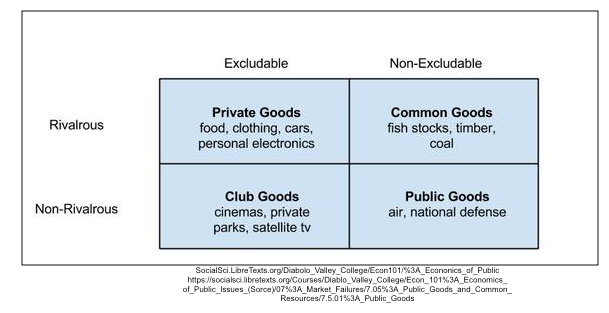
 Based on the definition that property ownership is rival and exclusionary, collectivist thinkers built a truth table to show Common Resources (excludable but non-rival) and Club Goods (rival but non-excludable). That is nonsense. 


Define Human as “rational animal” and the non-rational animal and rational non-animal remain not-human. So, too, are common resources and club goods not property. Non-A cannot be A. Nothing is not a different kind of something.


Contrary to the collectivist claims, freshwater, fish, timber, and pasture are all exclusionary and rival. You can’t have your fish and let your neighbor eat it, too.


What they call “club goods” are defined and limited by technology, not by metaphysics. Discussing radio broadcasting in her essay, “Property Status of the Airwaves” Rand correctly pointed that two broadcasters cannot share same frequency. But they can. Just not at the same time. And time-slicing allows two (or more) broadcasters to occupy the same wavelength. However, that does not change the fundamental principle that these timely-sliced increments are property. 


From Diabolo Valley College Econ101 linking from PennState,
College of Earth and Mineral Sciences.
"EBF 200 Introduction to Energy and Earth Sciences Economics:
Public Goods and Common Pools."
Also found in Investopedia and Quickonomics.

Common resources – non-excludable but rival (freshwater, fish, timber, pasture)

Common resources are defined as products or resources that are non-excludable but rival. That means virtually anyone can use them. However, if one individual consumes them, their availability to other consumers is reduced. The combination of those two characteristics often results in an overuse of these resources because demand exceeds the available quantity (see also the tragedy of the commons). Examples of common resources include freshwater, fish, timber, pasture, etc. -- https://quickonomics.com/different-types-of-goods/

 Club goods – excludable but non-rival (cable television, cinemas, wireless internet, toll roads)

Club goods are products that are excludable but non-rival. Thus, individuals can be prevented from consuming them (i.e., access can be restricted), but their consumption does not reduce their availability to other individuals (at least not until a point of overuse or congestion is reached). Club goods are sometimes also referred to as artificially scarce resources. They are often provided by natural monopolies. Examples of this type of goods include cable television, cinemas, wireless internet, toll roads, etc. -- 

https://quickonomics.com/different-types-of-goods/


It is true that you and I can both watch the same program on cable-TV. The hidden error was identified by Ayn Rand as “the blank out” and Rand identified its logical expression as the fallacy of the stolen concept. You and I can both watch the same cable-TV show – up to a point: we all know what happens when too many users overload a website. More deeply and cogently, for anyone to access television or the internet, physical goods must be produced. The perception of social largess as a “club good” blanks out on the previous non-existence of roads and theaters.  

We [the American Historical Association] encountered a similar experience in 2001, when the AHA decided to create a freely available online collection of Civil War newspaper editorials, utilizing two volumes originally published by the AHA in 1931 and 1942. AHA staff quickly discovered that no copyright renewal was ever filed for the second volume, edited by Harold C. Perkins, and it subsequently had entered the public domain. However, the editor of the first volume, Dwight L. Dumond, had renewed the copyright in his own name in 1959. Orphan Works Notice of Inquiry – 70 Federal Register 3739 (Jan. 26, 2005)

http://www.copyright.gov/orphan/comments/OW0676-AHA.pdf

To me, the error was the granting of the copyright to Dwight L. Dumond. As the editor, he was a hireling. His work rightfully belonged to those who paid him for it. The concept of a collective entity in law –what we call a “corporation”-- has roots in the Roman republic. Under Roman law, a flock of sheep was a collective entity: lose a lamb or gain a lamb, it is the same flock. On that basis, cities were taxed: the city was an entity that owed tribute to Rome, itself a collective entity. No one owned a city. Under American law, the American Historical Association as an entity can certainly be protected from theft by its employees. 


On or about the same day as the link about Public Domain Day, Google News offered a link to a story from GameRant.com about the Star Trek canon. Star Trek is owned by Paramount Global. (The July 2024 merger with Skydance may be challenged now through the FCC but that does not affect what follows.) Since 1966 many details of the continuing, expanding, and extending myth have been changed. Others remain constant. In this case, the legal owners changed an element of the canon - the physiognomy of the Klingons was altered in Star Trek: Discovery and the fans objected. (Klingons had changed once already but that was accepted.) Using a new storyline in Star Trek: Lower Decks, the owners offered some technical explanations for the change. 


To me, that is all good because myths change in the retelling. Mythology allows that: characters can merge or split; new characters can be entered while established characters leave. Star Wars: A New Hope is just the Wizard of Oz: Luke is Dorothy; R2D2 is Toto, … But in Star Wars, one aspect of the Wicked Witch (Darth Vader) is saved while the other aspect of the character (the Emperor) perishes. That begs the basic question: Who owns Star Wars or Star Trek or Harry Potter?  At what point does the creation of intellectual private property enter the public domain? Is there such a point? 


Back in the early 2000s, before the Atlas Shrugged movies were released, a Rand Fan created some Atlas Shrugged swag, a Rearden Steel trucker's cap, etc. The Ayn Rand Institute sent her a lawyer letter reminding her that the artifacts were based on the copyrighted works of Ayn Rand. So, as an Objectivist herself, she ceased and desisted. But we cannot imagine Paramount chasing down every "Beam me up, Scotty" bumper sticker. And personally, I think that the ARI should have just shrugged it off by labelling their gear "Official" the way that Major League Baseball does. 


https://web.law.duke.edu/cspd/publicdomainday/2025/

I have donated to the Internet Archive and the Wayback Machine. (Similar archives include the Hathi Trust and the Linda Hall Library.) Like the promoters of Public Domain Day, my comrades at the Internet Archive claim a moral high ground because they are offering the works for free and have no commercial interest in the use. To me, that argument is irrelevant. And it is falsified by several considerations. They do accept donations, and it is easy to assume that donors are users. Absent donors, the entity would not exist. So, they are in business. And in business for a profit because not-for-profit is only a matter of bookkeeping: owner's equity is called "net assets."


Long ago, writing in The Libertarian Connection, Skye d’ Aureus and Natalie Hall argued against Ludwig von Mises’s assertion that truth and beauty are not economic goods. Skye and Natalie pointed out that truth and beauty must be produced by human action.  

As collectivism grows in popularity, and as the nonproductive consider themselves increasingly entitled to the wealth created by the productive, Rand’s arguments in favor of intellectual property rights merit reinforcing not diminishing. -- "Ayn Rand's 'Patents and Copyrights'" by Marilyn Moore, posted May 28, 2019.  https://www.atlassociety.org/post/ayn-rands-patents-and-copyrights

Writing for the Atlas Society, Marilyn Moore (Director of Student Programs) parsed the difference between copyrights and patents and argued contrary to Rand that literary works should be patented while inventions should be copyrighted.  Moreover, Moore asserted, as a metaphysical fact, a discovery cannot be patented or copyrighted. First, the discoverer did not create the fact; and, second, once announced to the public, the discoverer cannot prevent other people from now knowing what they know. Third--and most consequentially--it is immoral to deny independent discovery and therefore independent invention. It is unlikely that two people will write the same book. It is well known that two people can create the same solution to a technical problem based on a shared (though independent) understanding of the facts of reality.


PREVIOUSLY ON NECESSARY FACTS

Copy Rights and Wrongs 

Objective Intellectual Property Law 

U.S. Patent Law Does Not Add Up 

Patent Nonsense: Intellectual Property Rights and Non-Objective Law 

Biohackers 


Tuesday, May 24, 2011

Copy Rights and Wrongs


The Google Books Settlement Agreement and the conflicts that caused it touched on only some of the problems of intellectual property and rights to it.  The settlement was rejected by US Appeals Court Judge Denny Chin (summary here from Columbia U's Copyright Project and full text PDF of ruling from The Public Index).

Much is wrong with all of the argumentation from all parties.  The simplest fact is that Google provided a service to store library books and make them available to patrons via Inter Library Loan.  At root, it is no different than a climate-controlled building for storage, library cards for access, and padded envelopes for mailing - with one exception: the process creates another copy ...  many other copies... as many copies as anyone could want.  In fact, I made two copies of Judge Chin's ruling and put them in different directories, one in the "NecessaryFacts" directory for these posts; and the other under "CJ Others" for any future academic criminal justice discussion of copyright laws and violations. 

Michael Crichton was not alone in seeing this coming.  Back in 1983, in his book Electronic Life, he said that the inherent copyablity of electronic media removes it from all of our previous expectations of property.  He recommended that artists forego the concept of royalties.  Just get your money up front and move on to the next project.  While he did have a lot of those projects, I do not doubt that he cashed the royalty checks all along the way for each of them.  Back then, I cited Crichton's thesis in articles that I wrote touting a world of "softlife" reproducing itself without copyrights.  Of course, when Defense Computing magazine took an article that I wrote about Soviet computer technology, claiming that the lack of a copyright statement made it anyone's property, I called them up and talked them out of a hundred bucks.  Self-interest and hypocrisy can be so hard to tell apart.

So, too, with this problem.

Among the facets are so-called "orphan works" for which the copyright holder is lost, perhaps dead, generally hard to find in any event.  If not for Google, they would remain orphans.  Now that they are rescued, reproduced, archived, indexed, and available to the world, they have new value.  When the authors themselves are not clamoring for cash - a rare event or these would not be orphan works - then non-self-interested others hypocritically want someone else (anyone else not making a profit- but not they themselves investing their own resources) to do this for free, track down the authors, and force an arbitrarily fair amount of money on them. 

I find works of mine out on the Internet and usually I do not care, as long as the presentation looks nice and serves a moral purpose.  I already got paid what I asked for.  (There is a parable in the New Testament about that. See Matthew 20:2.)  Once - as in the case of Defense Computing - I found the Frances Lehman-Loeb Art Center of Vassar College presenting an article that I wrote on the definition of "coin."  I pointed out the plagiarism and offered to write them a new one at a fair price.  They took the page down and never replied to my offer.  (The offender was an undergraduate history major volunteering at the museum.) 

An artifact speaks of its maker.  Artifacts are semata: bearers of meaning.  Thus, you can attach property - without "mixing your labor" - simply by putting your sign to it.  That, in fact, is the basis not only for marking cattle, but, in our time, for creating money, even Federal Reserve Notes, which have no intrinsic value but have value entirely through meaning (symbol).

Symbols are not objective.  They depend on cultural context.  When the culture changes, the meanings change.  We no longer live in a time when the production of books is a barrier to the transmission of ideas.  Books always were sold for the printing, the paper, the binding, and not for the value of the ideas inside.  Evangelists give away the Word of God.  Even the Ayn Rand Institute gives away Atlas Shrugged to high schoolers who enter their essay contests.

Among the tangled roots is the fact that we get our ideas of property from a long history with land.  Exclusivity is based on a physical law: two objects cannot be in the same place at the same time.  Rivalry is based on the fact that the same object cannot be in two places at the same time.  But now they can.  Unlike a plot of land, two people can access the same copy of a work of art at the same time without being in the same place. To each, their view is personal and private.  Even only a few years ago, cassette tape machines had two different functions for PLAY and RECORD. Now they are the same function. 

The physics and metaphysics of land do not apply to cyberspace.  The court should have removed itself as lacking competent jurisdiction.  The institution best suited to bringing spontaeous order is the market.  The libraries owned the books.  Google owned the means of preserving them while maintaining public access. 

When these books were printed, our technologies were not contemplated.  It should remain there.  Times change. 

 Copyrights were invented as monopolies in 17th century England.  The first law was passed in 1709 (Queen Anne's Law of 1710).  Sooner or later, implants or something will give us all personal permanent memory.  Where will the law be then?  You will never forget a book you read and you will be able to recite it perfectly.  Musical performances and plays may also become self-replicating memes.  Sculpture will probably prove resistant to copying, though we do have 3D Modeling now.