Showing posts with label Kepler. Show all posts

Saturday, August 8, 2020

Measuring Your Universe: Alan Hirshfeld’s Astronomy Activity Manual

This guide to hands-on learning instilled me with a sense of confidence about my ability to perform the basic mathematics of astronomy. The exercises start with measuring shadows to track the sun as evidenced by stone age monuments. Before the last one, the learner estimates the expansion rate of the universe according to Hubble’s Law. The learning does not end there. Prof. Hirshfeld is a good instructor, and the assignments come full circle. Having started with the Sun and Moon, the book ends by assigning the calculations to estimate the relative masses of Sirius and its dwarf companion. (Just to note: This is from the first edition of the book (2009); the second edition (2018) is a bit different; and a third edition is promised.)

The stars are pretty at any magnification. It is most important to understand what you are looking at. Following these structured exercises, I gained an intuitive understanding of how astronomy developed historically, and (more importantly) of my location in the universe.
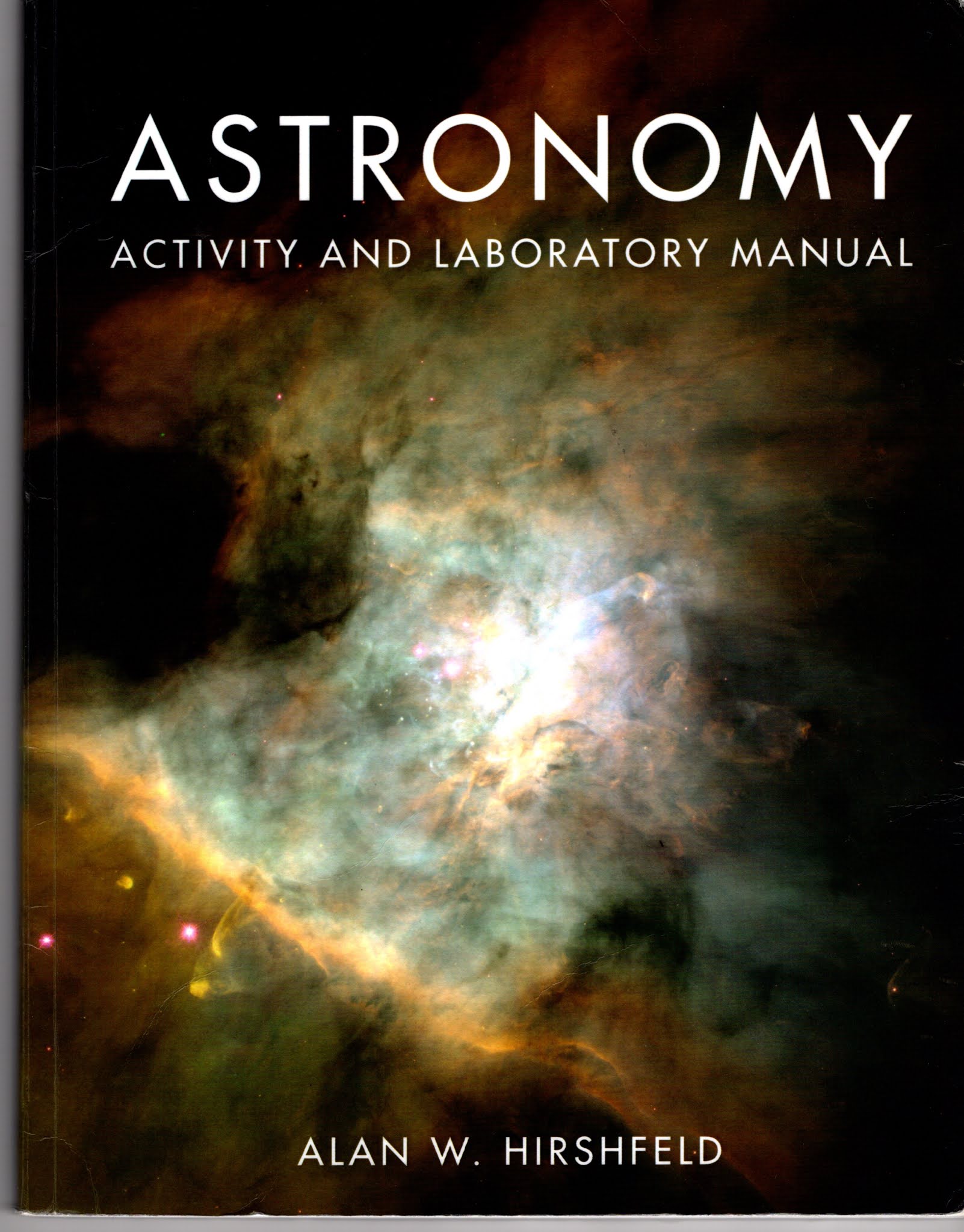
First Edition. 2009.
 

It starts with the gnomon, basically a vertical stick in the ground. At the end of the shadow, you place a stone. In Chapter 2, several thousand years or generations later, you come to the conclusion that the angle of the Sun in the sky at mid-day is directly related to the length of the shadow relative to the height of the stick. Theta equals arctan(L over H). 


Hirshfeld provides good, simple explanations of the math, though not in depth. At the back is a tutorial on basic trigonometry. Neither is a substitute for a semester of trig. Hirshfeld just gives you the number 57.3 without telling you where it came from. Similarly, it is true that although you do not need much mathematics to benefit from the hands-on calculations, you do need some. Even so, Hirshfeld steps you through work that you will come back to again. The same basic formulas are applied repeatedly to new problems from measuring the diameter of the Earth to measuring the distances to the Moon and Sun and then to the stars.  


Even if you are completely math-phobic, you can still get a lot out this by at least reading through the exercises to appreciate how the Greeks, Galileo, Kepler, Newton, and the astronomers of the 19th and 20th centuries came to their conclusions. If all of the arithmetic and algebra is “digital” then “Activity 15: Picturing the Universe—How Photography Revolutionized Astronomy” is “analog.” 


I put off the central exercise of “Activity 14: Parallax” until I finished the rest of the book. I could have just worked through it on paper, but I wanted to set up a yardstick in the doorway between the kitchen and the living room in order to take my own measurements. Alan Hirshfeld is the author of Parallax: The Race to Measure the Cosmos; W. H. Freeman & Co., 2001. So, I wanted to give him his due and take my time with the work before reading the book.


Activity  1  The World's First Skywatcher - YOU!

Activity  2  Shadowland

Activity  3  Shadowland - the Sequel

Activity  4  Shadowland Follow-up

Activity  5  The Phases of the Moon

Activity  6  Eratosthenes Measures the Earth

Activity  7  Aristarchus Measures the Size and Distance of the Moon

Activity  8  Aristarchus Measures the Size and Distance of the Sun

Activity  9  The Copernican Cosmos

Activity  10  Kepler's Third Law

Activity  11  Isaac Newton and the Moon

Activity  12  Galileo Measures a Mountain - on the Moon!

Activity  13  Precision Astronomy After Galileo - Stellar Aberration

Activity  14  Precision Astronomy After Galileo - Stellar Parallax

Activity  15  Picturing the Universe - How Photography Revolutionized Astronomy

Activity  16  How Bright is That Star? A Tutorial on the Magnitude System

Activity  17  The Realm of the Spiral Nebulae

Activity  18  Hubble's Law - in the Kitchen and in the Universe

Activity  19  The Herzsprung-Russell Diagram

Activity  20  Binary Stars and Stellar Motions.

Appendix  Mathbits


In the second edition, Activity 19 is about Dark Matter. In fact, while I found the second half the H-R Diagram helpful, the introduction about height and shoes sizes was obvious. Perhaps plotting the land speeds and weights of various mammals would have been more analogous to the relationships between spectral types and luminosities. The second edition also replaced the work on Sirius A Sirius B with your own reflective essay. I believe that was a loss. The reflective essay could help the instructor modify the class. I still think that it would have been best left as extra credit. The H-R diagram is important to modern astronomy.

Although I have a calculator on my iPhone and my computer, I bought a new one just for this, a basic scientific TI-30Xa. It was $8.95 which is like 89 cents in 1978 dollars when we bought our first TI-30 calculators. The universe may not be expanding, but the money supply is. Still, I worked several of these in my head by approximation, 3 for pi, and so on. 


PREVIOUSLY ON NECESSARY FACTS

In Support of the Entry-Level Telescope 

and

Defending the Hobby-Killer Telescope 

Problems with Pop Sci from Sky & Telescope (Part 1)

and

Problems with Pop Sci from Sky & Telescope (Part 2) 


Sunday, December 24, 2017

The Christmas Star

For about 1500 years, the story of the Star of Bethlehem was accepted as historically accurate because it was divine truth. Miracles were not questioned. With the Renaissance, a new way of looking at the world evolved. Over the centuries, the Christmas Star has been explained as a comet, a meteor or meteor shower, but the conjunction theory has been the most popular. 

In science, a good problem takes us far beyond the results of a single observation. The Christmas Star has been debated on many levels. The International Planetarium Society website (www.ips-planetarium.org) lists over 100 citations to the Star of Bethlehem. Some of those articles and letters were part of a multifaceted decades-long argument among at least five astronomers and one editor. Writing in Archaeology Vol. 51, No. 6 (Nov/Dec 1998), Anthony F. Aveni cited 250 “major scholarly articles” about the Star of Bethlehem.

The scholarly tradition of explaining the Star of Bethlehem with scientific evidence apparently began with Johannes Kepler who identified a triple conjunction as the likely event.

In 1604, he published The New Star in the Foot of the Serpent (De stella nova in pede serpentarii: et qui sub ejus exortum de novo iniit, trigono igneo…). In that tract, he examined a triple conjunction, as well as a nova, which he identified as the cause of the conjunction. He was not alone in that kind of a belief. Others expected the conjunction to cause a comet. Reviewing the facts in 1614, Kepler said that the Star of Bethlehem was a nova in 4 BCE caused by a triple conjunction in 7 BCE. (See “Common Errors in ‘Star of Bethlehem’ Planetarium Shows,” by John Mosley, The Planetarian, Third Quarter 1981.)
“On August 1, 3 B.C., Jupiter became visible above the predawn eastern horizon as the ‘morning star.’ Twelve days later, at about 4:00 a.m., a very close conjunction occurred between Jupiter and Venus, the space between them narrowing to only 0.23 degrees. Five days later Mercury emerged from the glare of the sun and came into conjunction with Venus on the morning of September 1, their minimum separation being only 0.36 degrees.
 “The fact that Jupiter became stationary among the stars on December 25 (and, by the way, directly midbodied to Virgo the Virgin) may well explain what Matthew meant in his Gospel when he said that the star came to a halt over the village Bethlehem…” (“The Star of Bethlehem Reconsidered: An Historical Approach,” John Mosley, IPS Planetarian Vol. 9 No. 2, Summer, 1980.)
According to Michael Walter Burke-Gaffney of the Royal Astronomical Society (also of the Society of Jesus), the popular tradition began with one Bishop Münter in 1831. It was Münter who first cited Kepler (wrongly), claiming a triple conjunction. The assertion lived on. Burke-Gaffney claimed that the popularizer Münter was widely read, though Kepler himself was not. (“Kepler and the Star of Bethlehem,” Burke-Gaffney, W., Journal of the Royal Astronomical Society of Canada, Vol. 31, p.417.)  Personally, I am not sure who did and did not read Kepler. As far as I know, unlike Shakespeare and Bach, Kepler’s writing never suffered a hiatus.

In 1999, Rutgers Press published The Star of Bethlehem: the Legacy of the Magi by Dr. Michael R. Molnar. In addition to his achievements as an astronomer, Molnar is a numismatist. He was attracted to a series of coins from Antioch in the first century of the present era. They show a star, a crescent moon, and a Ram, among other symbols and legends.

Jupiter underwent two occultations (“eclipses”) by the Moon in Aries in 6 BC. Jupiter was the regal “star” that conferred kingships a power that was amplified when Jupiter was in close conjunctions with the Moon. The second occultation on April 17 coincided precisely when Jupiter was “in the east,” a condition mentioned twice in the biblical account about the Star of Bethlehem. In August of that year Jupiter became stationary and then "went before" through Aries where it became stationary again on December 19, 6 BC. This is when the regal planet “stood over.” A secondary royal portent also described in the Bible. In particular, there is confirmation from a Roman astrologer that the conditions of April 17, 6 BC were believed to herald the birth of a divine, immortal, and omnipotent person born under the sign of the Jews, which we now know was Aries the Ram. Furthermore, the coins of Antioch and ancient astrological documents show that there was indeed a Star of Bethlehem as reported in the biblical account of Matthew.”
http://rutgerspress.rutgers.edu/product/Star-of-Bethlehem,1998.aspx and http://www.eclipse.net/~molnar/


A triple conjunction in 7 BCE occurred in Pisces. Some astrological lore identified that constellation with Judaea. Other traditions give Pisces to the Libyans, among others. However, back in the 1960s, at the Cleveland Museum of Science, planetarium director Dan Snow, told us of the connection between Pisces and Judea. So, for me, the Wise Men traveled to Judaea because of a rare conjunction in Pisces. 

Also, answering Molnar, as the precession of the vernal equinox - the peripoint of Aries - moved through the zodiac, the next sign would have been Pisces. This correlates to the coming of a new age, and the equivalency of the "sign of the fish" with the Greek initialization IXTHEOS: Jesus Christ Son of God Our Savior. And just to note, the first day of Spring is moving from the Age of Pisces to the Age of Aquarius. Make of that whatever you want. 

It is important to note that Jesus was not the only king, and his reign was not the only new age. Julius Caesar was assassinated March 15, 44 BCE. In May through July, a comet appeared, a singular event, not Halley’s or any other recurring comet. The people of Rome accepted it as obvious fact that the soul of Julius Caesar had ascended to the heavens. Julius Caesar was the first historical Roman deified by the Senate. His adopted heir, Gaius Octavius, became at once Gaius Julius Caesar Octavianus, and also Divi Filius.

Moreover, although he was born 23 September and therefore a Libra, Octavian Augustus took Capricorn as his personal symbol. Capricorn is the zodiacal sign of the winter solstice, of course, and therefore the symbol of the new year – ultimately, a new age.

Molnar’s book offers images of the Caesar Comet coin and Augustus’s Capricorn on a coin. The centerpieces, however, are the coins of Antioch (the Roman mint closest to Judaea) and the astronomical interpretation of them. It is important to understand that while some were struck during the accepted lifetime of Jesus, the series is broader than that. What was meant at the detail level to the people of the time must remain at least somewhat conjectural. They comprehended the images and inscriptions on coins the way we view headline news.

Ultimately, it may be best to accept or reject the story of the Christmas Star as a matter of faith. Even the relationship between faith and scripture is not as clear as many seem to believe (on faith). The literal truth of the Bible depends on which Bible you read. The “received text” of Christianity was never one set of books unerringly copied and preserved. Editions of the New Testament in Koine Greek are modern re-creations.

https://en.wikipedia.org/wiki/Textus_Receptus
https://en.wikipedia.org/wiki/Sacred_tradition
https://en.wikipedia.org/wiki/Textual_variants_in_the_New_Testament

No thinking believer is bothered by the fact that Jesus was not born on December 25. No thoughtful atheist hesitates to use Christmas as a good enough reason to give a present to a friend.