Showing posts with label military. Show all posts

Saturday, January 2, 2021

Ten Years of Necessary Facts

This blog was launched on 2 January 2011. It was inspired by Gregory Browne’s Necessary Factual Truths (University Press of America, 2001). I met Dr. Browne at Eastern Michigan University in the fall semester 2007. Waiting for a class in police operations, I was walking the halls and heard him lecturing. It was obviously a philosophy class and he sounded reasonable. I looked in and saw “Ayn Rand” on the blackboard closing an array of philosophers in historical sequence. A couple of weeks later, I heard him actually mention Ayn Rand. So, I introduced myself. And I bought the book format of his doctoral dissertation. It derives from a refutation by Leonard Peikoff of the Analytic-Synthetic Dichotomy. 

All-time Readership Frequency
(The anomalous spike is Hurricane Harvey)

All-time Readership Geography
At times Russia, India, or China dominated.

Before EMU, I was at Washtenaw Community College. Taking a class in symbolic logic (required for criminal justice majors), the instructor was Elizabeth E. Goodnick. She displayed a nervous habit typical of high-IQ children. So I took a Platonic interest in her and asked about her research. She said that she was pursuing David Hume even though she herself was a rationalist. I replied, “So you accept that A is A, but you are not certain that the sun will rise in the east tomorrow?” She said that was correct. That is the Analytic-Synthetic Dichotomy: rational versus empirical; logical versus real; theoretical versus practical; moral versus practical; art versus science. 


Reclaiming the worldview of Aristotle, Ayn Rand’s Objectivism is a modern instantiation of the rational empiricism of the Enlightenment. We commonly know it as the scientific method. Theories explain facts; facts validate theories. Contradictions do not exist. Existence is identity: to be is to be something. The senses are valid. Knowledge is possible because reason works. Moral actions are practical and money is a valid measure of moral action. It is not the only measure. 


Ten Most Popular Posts

Second Ten Most Popular Posts

After ten years posting 668 articles, resulting in 351,444 page views, I have seven followers. I stopped taking comments this year after a spate of spammers inserted their own links. I have had offers from search engine optimizers to help me monetize this blog. I turn them all down because here I write for myself. I do get paid to write what other people want and I am happy for those opportunities. For myself, writing here is research and development, or maybe just keyboard practice. Socially, for myself, this is like a concert violinist taking his guitar and a bottle of wine down to the park to jam, or Itzak Perlman playing klezmer. 


Speaking of music, though, I do not, or at least have not yet. That seems a curious lacuna.


A Partial Index of Ideas Within This Blog (2017)


PREVIOUSLY ON NECESSARY FACTS

General Topics:

Imaginary Numbers are Real: Pegasus is Not 

Sociology: A Defense and a Call for Reform 

The Economic Value in a Liberal Education 

Why Evidence is Not Enough 

Supplies and Demands 


Military:

Leaders are Readers 

Hurricane Tejas 


Criminology:

Integrating Criminologies 

Employee Theft 

20% of Scientists are Crooks 


Ayn Rand:

The Influence of Ayn Rand’s Objectivism 

Ayn Rand and Star Trek 


Science:

The Scientific Method 

Science in the Middle Ages 


Astronomy:

Seeing in the Dark: Your Front Row Seat to the Universe 

Asterisms 


Numismatics:

Numismatics: The Standard of Proof in Economics 

Numismatics: History as Market 


Linguistics:

Linguistics Debate: What Colors are Your Rainbow?  

Sándor Kőrösi Csoma 

The Living Fish Swims Under Water 


Popular Culture

Nerd Nation 4.5

She’s Such a Geek! 

World Peace Through Massive Retaliation 


Monday, June 29, 2020

This Knife Might Not Work Once

This Northwest Trail knife is built wrong. Clipped into your pocket, when you take it out, you have to flip it around before you can open it. You get what you pay for.

My neighborhood Walmart is my pharmacy and I enjoy walking the store while waiting for my presscription. The abundance of stuff speaks to our deep, broad, and wide prosperty, a direct consequence of the market economy. Free markets = free minds. Usually, as much as I like looking, I seldom buy. However, over the years, working in physical security and serving in the Texas Military Department, I have bought extra gear. I learned that lesson from a classmate in criminology. She looked into the trunk of my car and said, "You only have stuff for yourself. I always carry extra." 

And you can always use an extra knife. I never leave home without at least one knife and at least one way to make a fire. That was a lesson from a team-building exercise when I worked for Coin World. We had a series of monthly Monday morning meetings to get to know each other in order to improve our quality of worklife. There were about 40 of us from Coin World, Linn's, Scott's, the press operators, and pre-press at about six or eight tables. The last exercise was a survival scenario.

You are coming home from a vacation in South America with the team mates at your table. Your plane hits a storm and you go down. You crash land. The pilot is killed. The plane is unflyable. The radio does not work. You are all mostly all right. You have to come out together. This is an inventory of what you all packed on your vacation. Golf clubs... a bottle of rum... a .38-cal handgun with six bullets... a Christmas candle... and a bunch of other stuff I don't remember. Not everyone got out. One team gave up right away and decided to settle in place for the rest of their lives. The one press operator on our team said that she was going out on her own. I said that in real life I would join her and leave them behind, but we all have to come out togther, that's the rules. I told my team mates to leave the gun and the rum or not everyone is going to make it. They ignored that. One guy said to bring the gun so that we could fire it into the air to attract natives who would help us. I thought that was a bad idea on several levels. He asked why I wanted the Christmas candle. I replied, "To help make a fire." He said that we are in a jungle and can build a fire anytime. He said to bring the golf clubs. "Whatever for?" I asked. "To make a stretcher and carry someone who is wounded or to kill small game." The others saw the wisdom in both of those plans. You see, this guy was obviously the de facto leader, well known and well liked. It went on for about 45 minutes. Then they gave us the answer from the back of the book.

According to the Army Rangers, you stay with the plane for 72 hours. Someone knows you are missing. They will come looking for you. The plane is unflyable. If you hear help coming you can set it on fire as a signal. In any case, after 72 hours, set it on fire anyway and head out. Find a stream and follow it downhill. Somewhere near the water's edge, probably at the mouth of the river, you will find a village. Whatever you took, you always need a knife and a way to make fire.

Since that day in AD 2000, I never leave home without at least one knife and at least one way to make a fire. 

How many knives do you need? How many can you carry? As the public affairs officer for the Maritime Regiment of the Texas State Guard, I went out with our dive team several times. One time on shore, one of the divers was fussing with some line and needed to cut his knife free. He reached around left and right and went for the leg he was sitting on and then tried to lean over his tanks to grab his pack. I handed him one of mine. His unit leader saw that. "Don't you always have three knives?" he barked. "Well, yeah, but this one is tied up and ... " His leader shook his head and walked away. 

I do not know what I will do with the Northwest Trails knife. I won't toss it out, but I cannot have it for an everyday carry. My Victorinox is my EDC. When I retired from the TXSG, I stopped carrying the Benchmade that I always clipped to the right pocket of my ACUs. The Benchmade works the way a knife is supposed to. I still need a replacement for civilian life. (See, also Gibbs's Rule #9 from NCIS.) You can always use an extra knife; and in the worst case, it only has to work once.

When I was learning to fly, I was coming in a bit low, and the instructor pushed the yoke forward for a little more airspeed and lift. When we were done, he asked, "What you have done if you had come down in the bean field at the end of the runway?" I replied, "Stay with the plane 72 hours, then set it on fire and walk in to the terminal." 

PREVIOUSLY ON NECESSARY FACTS

Friday, November 29, 2019

Donating to the USO

The USO is the only military service charity that I donate to. Soon after I joined the Texas State Guard, I began getting solicitations from military and veteran charities. I ignored them all, as they are typically shot through with fraud, corruption, and self-serving executives and marketing staffs. When I was assigned to work as an operations analyst in the Texas Military Department, I asked my National Guard buddies about charities. They all endorsed the USO. 

The United Service Organizations, Inc. (USO) dates from 1941. It was founded as a civilian effort in preparation for America's entry into the world war of that time. Its history is famous. 

In our time, among its many services to those who serve, the USO maintains safe spaces in civilian airports where military personnel in transit can billet while they wait for connections. Sometimes, that can take days. Orders change. Orders lag. You wait. You text; you email; and you wait. And the USO is there for you and your buddies  in a lot of places around the world. 

I just sent $50 to Wikipedia for the first time in seven years. And as a professional writer, I depend on Wikipedia. I am much more generous far more frequently in answer to the solicitations from the USO. I do not respond to all of their requests. Some needs seem less immediate than others. Ask your own serving Soldiers, Sailors, Airmen, and Marines what they think.

PREVIOUSLY ON NECESSARY FACTS

Do You Know Your Military?
A Critic Meets the Military
President Trump and the Military
Thoughts on "Soldier's Heart"

Sunday, September 15, 2019

BAND OF BROTHERS

For me, the theme was leadership seen through the experiences of 2LT (eventually Major) Dick Winters. The corollaries included the importance of training, and the bonds that we form by facing challenges together. When my wife was out of town visiting relatives, I made the time to watch Band of Brothers. Then, I read the book. The movie was a good instantiation. The book provided more depth and detail. The advantage to the DVDs is being able to watch the words and run it back to catch what you missed. I renewed the book twice and checked it out again. And I still watch episodes again when I have the theater to myself. I cannot imagine seeing this once on HBO-TV and getting half as much from it. 


Producers Tom Hanks and Steven Spielberg hired good writers and directors who developed and projected additional dimensions from Stephen Ambrose’s history. But that history is the foundation. And Ambrose relies on other works such as The Face of Battle (John Keegan; Penguin), The Warriors: Reflections on Men in Battle (J. Glenn Gray, University of Nebraska Press), and Rendezvous with Destiny: A History of the 101stAirborne Division (Leonard Rapport and Arthur Northwood, Jr., Infantry Journal Press). In the Acknowledgements and Sources, Ambrose explains how the book came to be written in response to criticisms from the men of Easy Company. Ambrose was employed by the Eisenhower Center at the University of New Orleans. At the time he met the men of the 506thParachute Infantry Regiment, he was working on a biography of Richard Nixon. As a result of that initial meeting, Ambrose met the men many times to record and review the interviews that are the bedrock of the book and therefore the HBO series.

Actor Shane Taylor (b. 1974) portrayed
T-4 Eugene "Doc" Roe.
Based on the personal remembrances that highlight each episode, actor Damian Lewis (English, upper class, and Eaton according to IMDB here) did yeoman’s duty portraying Richard Winters. The other actors all created or re-created their characters well enough, even though I feel that they were all too old for their roles. Acting is hard work and it takes practice. So, finding competent teenagers for this was apparently impossible. But that’s who they were: kids.  By the time they jumped at Normandy, 1LT Dick Winters was 26. Their nemesis Capt. Herbert Sobel was thirty when he drilled them at Camp Toccoa.  

Capt. Sobel (Wikipedia here) gets better treatment in the book than in the movie. According to Wikipedia, it was his son, Michael, who came to his defense in the courtroom of history. In the book, some of the men of Easy Company say that his training at Taccoa kept them alive in Europe. In the movie, we see only the martinet who can neither read a map himself, nor allow his NCO to do it for him. That being as it may, even in the unarmed forces of the state guard, we fight as we train and we train as we fight. I know from personal experience that units who bust their humps together at drill are competent to serve the people of Texas. Individuals who sit around, drink coffee, and swap lies are hospitalized when the event surpasses their expectations. 
 
On another level, the men of Easy Company were just being reflective and gracious. No one had to specially thank Major Dick Winters because his leadership was humane, just, fair, forthright, foresighted, and insightful – and demanding. He was a good combat officer. But why was he? We can investigate all of the parameters of personality—all of the aspects of environment and heredity—and never reduce the problem to a single cause or even to a matrix of elements. The fact remains that he was. 

As an extreme circumstance, war sets the stage for drama, and every story is a mirror. Some reflect better than others. As an epic, the HBO production of Band of Brothers is a hallway of dark and light, metal and glass, orthogonal and angular. The book is a map of that concourse. 

PREVIOUSLY ON NECESSARY FACTS


Saturday, September 14, 2019

TURN THE SHIP AROUND

“Ahead two-thirds,” said the Captain. “Ahead two-thirds,” repeated the officer of the deck. The helm did nothing. They sat there, both of them, unable to comply. The Captain’s previous ship did, indeed, have a control input for two-thirds power. This newer submarine did not. The order could not be carried out. The real problem was that the officer of the deck and the two helmsmen all knew that, but would not contradict an impossible order. It was time to “turn the ship around” and turn followers into leaders.

For a class in Complex Organizations, taught by Ron Westrum in the summer of 2007, we were assigned It’s Your Ship by Capt. D. Michael Abrashoff (2002). Both commanders faced the same problems. The crews were under-motivated and as a result the ship was rated unsuccessful in operations.  Capt. Abrashoff  solved the problem in the best way he knew: he empowered his subordinates to take charge of their areas of responsibility. They were rewarded for being pro-active, rather than waiting for orders. When Abrashoff’s billet changed and the ship came under a new captain, it all pretty much fell apart and things went back to the bad old ways. On the other hand, Capt. Marquet claimed to have effected a cultural change on board which continued after he cycled out. The difference is that Capt. Marquet got passed empowerment.

Empowerment is top-down. It does not begin with the actor but with that agent’s controller. That manager is often several levels above; and no one between is empowered to make the changes at the lowest level of action. So, Capt. Marquet did not empower anyone. Rather, he let them take on their own chosen responsibilities. 

It was not easy. Missing from their experiences was an actual picture of what was required. No book or cinema they knew told them a story like the one they were expected to act out. All they knew was the U.S.S. Ustafish, the previous submarines they used to be on. So, when the Captain asked his chiefs – the frontline supervisors, chief petty officers, and others immediately above and below in rank—if they really wanted to be in charge of their areas, they all said, “Aye-aye!” without understanding exactly what would be required of them now.

Capt. Marquet made the time and effort to lay out what they would take on and give up. He underscored the fact that authority is not responsibility. You can delegate authority. You cannot delegate responsibility. 

Ultimately, when his chiefs failed (which they did early in the new process), the responsibility remained his alone. (See, also, the same lesson explained in detail in Extreme Ownership: How U.S. Navy SEALs Lead and Win by Winnick and Jocko reviewed here.) Marquet created the culture of authority aboard the Santa Fe by encouraging everyone to think out loud, to speak their thoughts. The new watchword was “I intend to…”. 

That was one of several procedural changes that Capt. Marquet initiated before the failure at the helm. He was moving in the right direction. 

It paid off during inspections. Operators occasionally attempted to perform the wrong action. Everyone makes mistakes. However, thinking out loud and not acquiescing to someone else’s error prevented mishaps. The Santa Fe passed her inspections and exceeded expectations. 

Learn to think like the next higher level was another lesson here. But it goes back a long way. Gen. Jim Matiss said it best: “The battlefield has its own accounting system.” In both the book and the movie of We Were Soldiers Once and Young (reviewed hereLt. Col. Hal Moore is training his mobile infantry; and as they deploy from a helicopter, he grabs the sergeant, throws him to the ground and yells, “You’re dead!” He then points to the astonished corporal and says, “You’re in charge!” Oh… now what…?  

Capt. Marquet found concrete methods to realize his theoretical intentions. When people gathered to discuss a problem, he would wait until they had it framed and then he would leave the room. He asked, “How would we know if the crew were proud of the boat?” At the beginning, ahead of their first inspection, he told them to use “three identifiers”: Identify the visitor; identify yourself; welcome them aboard the ship. At first only about a tenth actually did that (though it was noted very positively on the evaluation). By the last inspection, it was routine. They had become proud of the boat. 

That was an unintended consequence of another change in culture: embrace the inspection. Instead of suffering through it like everyone always does, ask the inspector: How did another ship solve this problem? 

For myself, the book had two other invaluable lessons. The first was Don’t train: learn. On board the Santa Fe, learning opportunities were everywhere every day. Instead of parceling training into a time slot to be checked off, everyone was encouraged to be curious, not just questioning. The other was Don’t brief: certify. In other words, beyond assuring your managers that everything is OK, prove to yourself that it is. 

PREVIOUSLY ON NECESSARY FACTS

Sunday, May 12, 2019

Regimental Public Affairs Officer

On May 4 and-5 May 2019, I attended training for public affairs officers in the Texas Military Department. The training was presented by public affairs professionals from the news media and from the military. Of necessity, some presenters wore both hats. Of course, the panel discussions and lectures were focused on news reporting for military public affairs. In addition, I picked up good pointers about writing for any market or audience.

The Introduction by LTC David Spanton set the context. “We have three goals,” he said. 
1.    Meet your peers. Make friends. 
2.   Recognition of our work.
3.   Professional development.
The morning sessions were on Crisis Management, Media Relations, and Social Media. In the afternoon, we covered Photo & Video, and Cracking the Awards. On the second day, we were reminded of the fundamental truths in career development. The seminar ended with an awards ceremony to recognize the writers, photographers, and videographers in the Texas Army National Guard, the Texas Air National Guard, and the Texas State Guard.
 
Texas State Guard Public Affairs
Maritime (left) and Army (right)
The first panel discussion on the first day was about Crisis Communications. The presenters were Bryce Dunbee (Austin Bergstrom International Airport), Natalie Bidnick Andreas (public relations consultant),  Caitlin Rourk (crisis management consultant).

Bryce recommended having a tagline that closes every statement: “As always, safety is our number one priority.”  Natalie said that crisis communication begins with an apology. She also emphasized the need for clear social media policies that apply to everyone from the CEO to interns. Caitlin encouraged us to find case studies of actual events. “Pick a crisis and then wordsmith a statement for it during your monthly drill as an exercise.” Look for bookmarkable case studies in crisis management.

They all insisted that public affairs officers need to reach out early and often to news media.  “Get your buy-in before the crisis…. Make your contacts in times of peace… Become part of the command staff equation. … Know your contacts in your legal affairs department.” And remember that today everyone is on a national stage.

Panel Sessions were held in 
the Audie Murphy Building
Natalie warned us to watch out for scope creep. You will have a client or stakeholder, a commander of some kind, who wants more services, whether that means more of your time or creating a new and better spin to the story. She recommended holding your ground. “You tell them: ‘I am duty bound and this is what I can do.’”  So, how do you push back to a client or a commander? You outline for them the reputational risk and give them a threat analysis. 

Crisis preparation is defining the “so-what” in a story. The numbers do not lie. Metrics speak. Tell the media not only why your organization is out there doing these things, but why your communications directors or spokespersons are saying these things. “We are continuing to investigate.” Tell them when you will have the information they seek.  

Have your speakers, your commanders, be prepared for the next question.  Reporters know that you are prepped for one or two responses. So, they keep asking more questions until they get to the one you are not prepared for.

At the end of the first day, the sixth panel was titled “Cracking the Awards” (SSG Will Reinier, Jordyn Fetter, and MSG Thomas Wheeler presenting). They did not say this, but it is a known cliché (perhaps from Napoleon) that a soldier will do anything for a piece of colored silk. Awards matter for the same reasons that publicity itself matters: recognition is important. So, how do you get recognized? 

Stick to the criteria. Follow the instructions. Look for categories with fewer entrants. It is pretty easy. 
 
Class Photo: Texas Military Department
Public Affairs Officers Seminar
I found value in their outline for any story. We are writing non-fiction. These are reports to the public. But it is best told as a story. 
Five elements of any story.
1.    Set the scene. Take a wide shot.
2.   Introduce the character. Root for or against.
3.   Find the conflict. Find the challenge.
4.   Conflict changes the character.
5.   Resolution.

Similarly, the first panel of the second day on Career Management (LTC David Spanton, MAJ Jose Perez) underscored truths that apply to all professions. Look for opportunities in education, training, promotions, and assignment. Follow up on continuing education whether that is the completion of certifications or accreditations or maintaining your society memberships.  

PREVIOUSLY ON NECESSARY FACTS


Wednesday, November 21, 2018

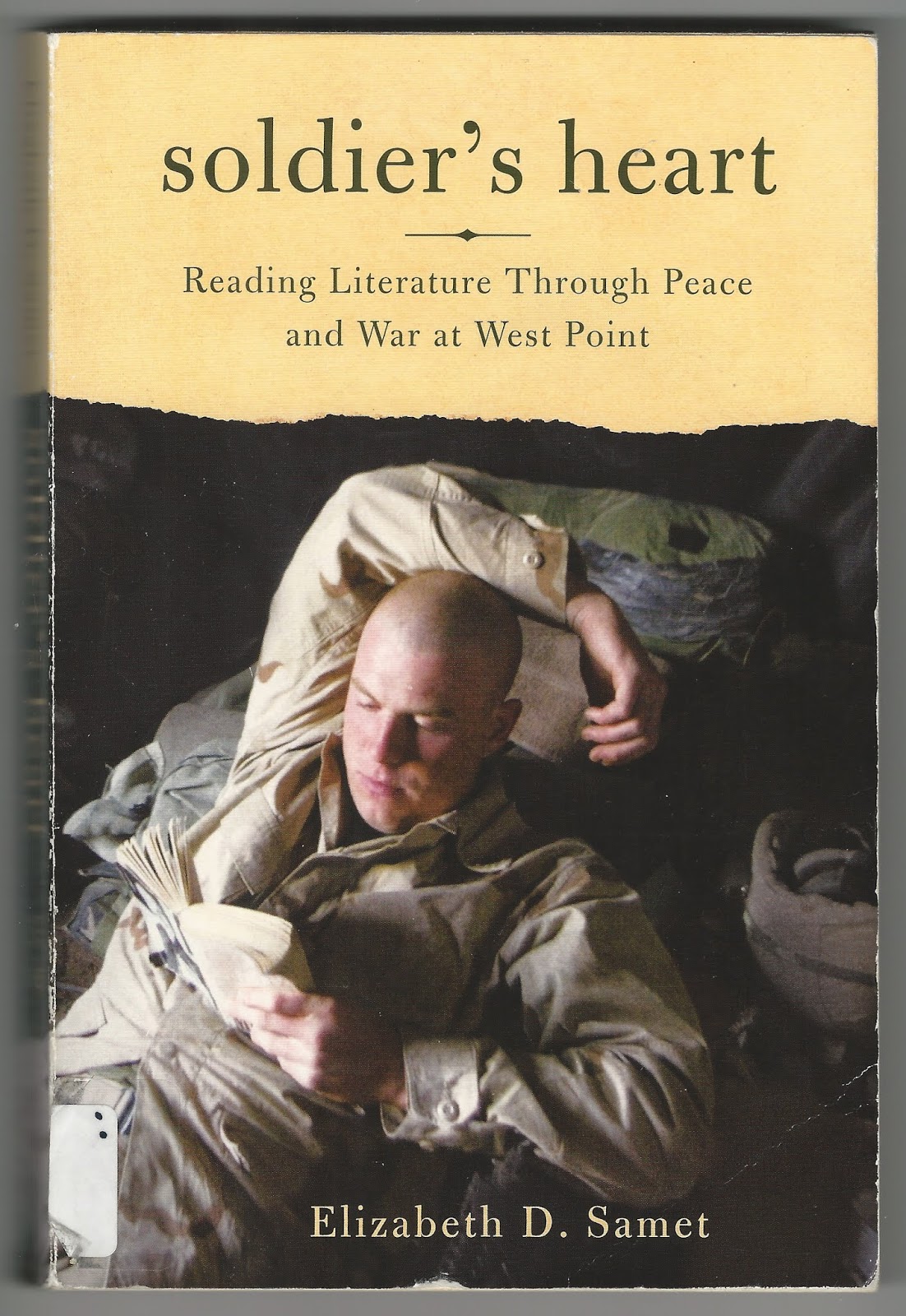
Thoughts on "Soldier’s Heart"

From my mother’s sleep I fell into the State,
And I hunched in its belly till my wet fur froze.
Six miles from earth, loosed from its dream of life,
I woke to black flak and the nightmare fighters.
When I died they washed me out of the turret with a hose.

Randall Jarrell’s poem reocurs as do several of the author's West Point cadet students and a few of her faculty colleagues. Of the students, Samet dubbed three “the Musketeers” for their inseparability. Throughout, she uses pseudonyms, and it is telling that she called one of the Musketeers Grant. Ulysses S. Grant’s Personal Memoirs affected her. Samet says that we know how to honor the dead but we do less well with and for the wounded. We do not think of Grant as wounded. But I do. 
Solider's Heart: Reading Literature
Through Peace and War at West Point

by Elizabeth D. Samet
(Farrar, Straus and Giroux, 2007)

When I worked for Coin World, I was assigned Grant as a feature story. There’s the $50 bill, of course, but quite a bit more is known to the numismatist. I bridled at the assignment: Grant was a drunken general who ordered other people to kill and die. However, it did not take much research to learn that he was significantly deeper than that. He would have preferred to teach mathematics at a girls’ school. And so, he understood the unremitting arithmetic of the War Between the States: The South simply could not keep paying the price. The personal price that Grant ultimately paid can only be guessed at.

When a firstie (senior class) once asked a colonel what he needed to succeed in the Army, the officer replied, “Show up on time and stay in shape.” (page 196)  I think that promptum et salutem makes a good motto. 

A far less weighty consideration is Prof. Samet’s solution for the problem of the pronoun. For myself, in technical writing, I choose “they” for everyone. Samet’s choice is to go back and forth between he and she, usually with the masculine, as most of the people in her life are men but often using the feminine as neutral for everyone or anyone.

Prof. Elizabeth D. Samet’s In-Text Recommended Reading
(This is just some of it.) 
Wilfred Owen
Edith Wharton
Li Po (Tang Dynasty poet)
Randall Jarrell’s “The Death of the Ball Turret Gunner”
Anne Sexton
T. E. Lawrence Seven Pillars of Wisdom
Edgar Allen Poe Poems, especially “The City in the Sea”
(That anthology was paid for by his West Point classmates.)
Antoine Saint-Exupéry
Ulysses S. Grant Personal Memoirs 
Artist Savile Lumiey
Alexander Pope Essay on Man
Jane Hirshfield
Jorie Graham
Shakespeare “Sonnet 73”
Shakespeare Henry V
Tennyson “Ulysses”
Ambrose Bierce, especially "One Kind of Officer"
Frost “Road Not Taken”
Attar** Parliament of Birds
Wallace Stevens
Movie: Jacob’s Ladder
Movie: The Four Feathers
Movie: The Roaring Twenties.
**(Abū Ḥamīd bin Abū Bakr Ibrāhīm c. 1145 – c. 1221; 
better known by his pen-names Farīd ud-Dīn and ʿAṭṭār—https://en.wikipedia.org/wiki/Attar_of_Nishapur)

Samet wrestles with the ethos of the military, especially when the military is set apart from the general public. “The rhetoric of the War on Terror has been from the first deeply inflected with messianic vocabulary that makes it easy for soldiers to conflate military and spiritual missions and that complements the military’s own sense of itself as a noble profession and a higher calling.” (page 158) 

Between the time he retired from the Marine Corps and became the Secretary of Defense, James Mattis directed a statistical survey of public attitudes about the military. His team found that across all sectors of America, only the “elites” believe that the military should share the same values as society at large. Most people across the political spectrum believe that the military has a different value system than everyone else in America–and this is good. (NecessaryFacts here.) 

I like to think that I have no illusions about human nature, but the fact is that when on base, I never lock my car; and if it is hot—as it often is here in Texas—I leave the windows rolled down. Samet herself reflects at length at how like a small town West Point is. This is good and bad, depending on the context. 

This opens the door to more of my own beliefs. I stood mute and smiled when a sergeant to whom I reported found by surfing that I posted to the Military Atheists website. (Foxhole Atheists here.) My certainty that the universe had no creator comes from the philosophical objectivism (with a capital-O) of Ayn Rand. Predicated on that metaphysics and epistemology, the ethics of egoism are not consonant with the warrior’s way. (How I correlate them is discussed elsewhere.) Based on Soldier’s Heart, I expect that Elizabeth Samet does not explicitly practice the virtues of selfishness. Neither is she a postmodernist. At least, she does not speak their vernacular of “trajectories” and “projects” and “giving voice.” And while she is scrupulous about not forcing her own morals on her students, she clearly has them; and as subtext they seem traditionally American. 

So, I agree with her that mixing the language of missionaries with the goals of military missions is highly problematic. At the same time, I found unsatisfying her apparent belief that civil law is the highest law. She is uncomfortable with the fact that as citizens our soldiers hold the state subservient to religion. I get her point. But I also see a profound and deep philosophical foundation to the fact that in customs and courtesies, the chaplain’s pennant can fly above the American flag while services are being held. Conquering as we must is predicated on our cause being just. The just war doctrine is another of the threads in this book. 

Though rejecting religion as a foundation for morality in Chapter 5 “Bibles, Lots of Bibles,” Samet does not follow that with anything as substantial. Chapter 6 “The Courage of Soldiers” is about the strength of will to stop and consider the hard choices and then select the right one. But all she offers, quoting Hemingway, is that doing the right thing makes you feel good (page 180). Citing Grant, Samet wonders about those “moments when moral courage comes at the expense of an opportunity to demonstrate physical valor.” (page 203)

Steadfast in her role as a civilian, Samet could not avoid assimilating military dialect and the thinking that requires it. Following 9/11 West Point operated under force-protection orders—without quotation marks or explanation (page 5).  Her prep school reunion was “garrisoned by white-gloved waiters” (page 96). She does explain “suspense” as the word for a deadline or expiration (page 229). Most consequentially, throughout, but explicitly in Chapter 6, Samet reflects on the fact that she shares the role of an officer in directing the actions of those under her command and holding herself responsible for the acts and the people who perform them. 

In that, Prof. Samet hints at much struggling, but has no final words for what affected her most to that time: the deaths of her colleagues, one by suicide; and the combat deaths of her former students. Ultimately, the entire book is about that.