Showing posts with label liberal education. Show all posts

Saturday, March 28, 2026

One Million Pageviews

Because I get paid to write what other people want, I write whatever I want here. And I am cognizant of the fact that other people read this. I put the URL on business contact cards and in email signature blocks. Lately, more hiring applications ask for links to portfolios and other social presence. Now, I more carefully inspect my attire before I step out into public spaces. Some market decision-maker might not like my opinions but they would find out the truth eventually. So, we are better off not starting a relationship. 

And I do take pride in writing what other people need. I love the craft of writing. I understand technical writing—procedures, plans, policies—as stories because if a machine operator has to call their boss at 4:00 AM, then reading a meter can be socially impactful, and maybe the best way to make the story stop is to hit ctrl-z. 


Last Seven Days Most Popular Posts and Locations


Last 30 Days Most Popular Posts and Locations


Last 12 Months Most Popular Posts and Locations


All Time Most Popular Posts and Locations


Top Referrering URLs Past 12 Months

One common phrase used against AIs is they are “scraping the web” and not being truly creative. “Scraping” sounds bad. I prefer the word “gathering.” The word “harvesting” implies “planting” or “seeding” and for that, we have no evidence, but gather—not scrape—is what they do. It is likely that many of the million pages viewed were touched by non-sentient programs, gathering information. Some of those might have been malicious seekers of exploitable vulnerabilities. That is why NecessaryFacts is closed to comments. I also rely on Google’s Red Team/Blue Team because when we lived in Ann Arbor, some of our colleagues in user groups touted their reward payments from Google for finding those vulns.


PREVIOUSLY ON NECESSARY FACTS


Supplies and Demands 

Money as a Crusoe Concept 

Mutiny Aboard the San Antonio 

Shifting the Paradigm of Private Security 


Sunday, April 20, 2025

Albeit they possess the Might ...

Nonetheless, we have the will.

Last Tuesday evening (April 15), after arriving home, feeding the cats, and changing out of my work clothes, I opened Google News to discover Harvard's resistance to demands by  President Trump's administration. Columbia's capitulation was easy to retrieve and I quickly built the presentation which I posted that night. 

Driving in to work the next morning and commuting home that afternoon, I decided to send a donation to Harvard. Right now, the check is in an envelope with a cover letter and a printout of that blog post. I will drop it into a Postal Service branch along tomorrow's commute in and it will move to a USPS regional point after 11:30 AM. It took almost a week because my days begin at 4:30 AM and by 5:00 PM composing literature is difficult. Admittedly, the letter betrayed little erudition. Plain speaking is fundamental to technical communication, validating the importance of the narrative. After a few edits, the letter carried my message. 

Originally, the post launched with a bold blue Helvetica kicker: "TANSTAAFL: There ain't no such thing as a free lunch." After a couple of days of reading and reviewing, I edited that out because it was too much message without context and delivering those precepts and conclusions would have detracted from the impact of the post. Silence is golden. 

My point then (and now) is that university researchers always believed that government money came with no other requirements than honesty. After a submitted proposal is accepted, following the norms of research were all that was required. The political progressivism of academia was never challenged by the granting agencies which largely shared those assumptions--and when not, they still gave out the money, lest they deny a valid inquiry for an invalid motive. 

That began with Vannevar Bush.  "In Science, The Endless Frontier, his 1945 report to the president of the United States, Bush called for an expansion of government support for science, and he pressed for the creation of the National Science Foundation." -- (https://en.wikipedia.org/wiki/Vannevar_Bush) As an inventor, and then director of the Office of Scientific Research and Development during World War II, Bush articulated well the fact that the ultimate rewards of original research are often not predictable at the moment of creation. So, the government should fund "everything" (within reason; subject to peer review). 

But there is no such thing as a free lunch. Finally, the government came to collect its due and what it wanted was less, not more. There was now a political price to be paid. The social agenda of the party in power is now the norm and there is no peer review. Lysenkoism and Aryan Physics were someone else's problems and now they are ours. 

Edward Jenner's small pox vaccines (1796) were predicated on over 50 years of general scientific reporting from Constantinople and other Asian entrepĂ´ts. This was the Enlightenment, the Age of Reason. Experiment, publication, discussion, and debate brought material progress which included the steam engine. But there was no theory of thermodynamics--and no germ theory of disease. For over 100 years, the "animicules" revealed by Anton Leeuwenhoek's microscope were accepted as a consequence of disease, rather than the cause. Common knowledge credits Louis Pasteur, Joseph Lister, and others with the proofs, but ahead of them, in 1847, John Leonard Riddell of the New Orleans Medical College argued well. (NecessaryFacts here .) 

Does inoculation have unintended consequences? How could it not? Exploring those, understanding them, and building a theory that can be tested is a scientific project. 

"Cloudy Nights" is a discussion board for amateur astronomers. Chatting about the recent discovery of dimethyl sulfide in the atmosphere of an exoplanet, I pointed out that DNA can edit and repair itself. My current library here in my office includes Genetics for Dummies. I make no pretense. And that is just one reason why I am not the U.S. Secretary of Health & Human Services.

PREVIOUSLY ON NECESSARY FACTS

Sunday, April 28, 2024

Remembering the Slide Rule

This came up as a thread in the “Off-Topic Observatory” of the Cloudy Nights discussion board for amateur astronomers. People have all kinds of hobbies and among the stargazers are skiers, rally racers, runners, and rock climbers, though understandably many more bird watchers, radio hams, and numismatists. Several of us collected slide rules accidentally or on purpose. In response to the topic, one poster just bought a circular slide rule to add to the collection. Aside from the engineer’s slipstick, my circular calculators are all for publishing to reduce or enlarge images and paper pages. 


Calculators - and I do use my phone, holding it sideways for the technical functions - give us a false sense of precision, when all you need is accuracy. In other words: will it fly? will it overflow the container? will it carry the load? For backyard stargazing, given that the atmosphere is a roiling ocean, what is the (approximate) limit of observable stellar magnitude with a 115 mm versus 102 mm refractor? The difference between pi=22/7 and pi=3.141 is 0.0018: two thousandths. Not much in life is that close. 
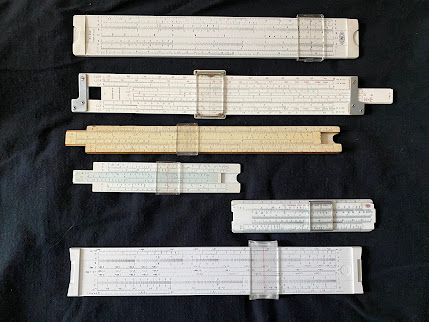
The one at the bottom was special because about 1988 or so, Pickett
(or their inheritors) found a large number of them in a warehouse
and in a publication (Scientific American or Science News or similar)
announced that they would give one (one) to everyone who
sent in a letter asking for one. (Email was not common back then),
after which, the instruments would be no longer available.
The one down from topmost came in a leather scabbard
with a fastener on the back so that you could wear it on your belt.
Long after those days, I wore it in to work.
"What's that?"
"This is the formal computing device of a Jedi,
from a simpler, more elegant time."

Clearly, the slide rule has been eclipsed by devices with storage and memory. Back in the 70s, I joined a round-robin newsletter called The Libertarian Connection, which was based on the medium known to science fiction fanzines. We sent in mimeograph stencils; the editors ran them off, collated the magazine, and mailed it out. Back when one ounce first class was 3 cents the saying was “a penny a day from coast to coast.” Then they went to photo-offset, which I enjoyed immensely. And here we are in the age of George Jetson, with a somewhat better BBS via integrated fiber optics into the house instead of a telephone dial-up at 300 baud. 


 The device is based on logarithms which allowed the transformation of multiplication and division into addition and subtraction. With a five-place or six-place tables of logarithms and trigonometric functions, you could achieve 100 times the precision of daily life. (Consider common retail pricing, for example.) That, in turn, allows efficiencies in engineering and production. Compared against working with tables, the slide rule traded speed for precision. You only get three places, but it is much easier, with the likelihood of errors reduced. If you need more precision, there were the books of tables, and an adding machine, then, later a comptometer.


The slide rule shows ratios and proportions so that you do not need to recursively enter numbers 4.1, 4.2, 4.3,… And it is designed to address basic problems involving circles and square roots. 


Even in the 1990s, engineers had AutoCAD and its competitors that let you draw something and the program would show the calculations off to the side. Would you rather start a fire with a BiC lighter or two sticks? Still, it is nice to get away from the computer, sit on a couch or chair, and move the numbers and see what is under the cursor or at the index


23 squared times Pi.
Set the Index to 23 on the D scale and
read the square at the Index on the A scale.
Set the cursor to Pi on the B scale and read the answer on the A scale.


For the telescope of diameter 115 mm, set the index on the D scale, read the square on the A scale and then set the cursor to pi, and you get 417 or close to. The calculator says 41,547.562843725015579. Ignoring all the noise, 415 is within half a percent. The 102-mm refractor has an area of about 327. Set either the AB or CD scales to 415/327 and the larger telescope has 127% the area of the smaller—and the calculator agrees: 1.27114… But you could do most that in your head anyway. 


In astronomy, the paradigm shifts in understanding the so-called “expansion of the universe” i.e., the Hubble Constant has been measured in orders of magnitude, not decimal places. 


PREVIOUSLY ON NECESSARY FACTS

Claude M. Watson (1922-2013) 

The Rational Optimist and The Grand Complication 

Celestial Mechanics 

Measuring Your Universe: Alan Hirshfeld’s Astronomy Activity Manual 


Sunday, August 5, 2018

Anti-Intellectualism in American Life

Nothing has changed in the fifty years since Richard Hofstadter chronicled the history of anti-intellectualism. The warning bell may seem muted because the names Billy Sunday, Carl McIntire, and J. Frank Norris no longer resonate. The value here is to learn and remember that today’s attacks on education are not momentary news but substantial tradition. Anti-intellectualism is not a quirk of the times; it is an abiding cultural context within which other phenomena can be understood. 

The irony of history is that we cannot see the day after tomorrow. So, publishing in 1962, Hofstadter could not write about the transformative generation that was about to enjoy a long life of broad, deep, and swift intellectual activity. But Hofstadter was prescient in identifying the long train of abuses against education launched by both nominal progressives and self-styled patriots. 

It is the patriots, in particular, who easily deny the Enlightenment that made possible the American Revolution and the political constitution that resulted from it. They did so in the 1800s and the 1900s, and do so today. But they are not alone. Radical progressives use physical force to deny access to campuses by those whose ideas they dislike. It is not just actual “hate speech”- though the Skokie Ruling long ago protected even that – but anything they seem to find worthy of their own hatred. 

Hofstadter examines the foundations of thought (or lack of it) that appear as outbursts in the common space. The newspaper editorials and Congressional hearings of the past exist today as blogs, websites, podcasts, and tweets. They all reflect deep assumptions within our culture. The insistence that university, high school, or elementary education serve “practical” goals of career or employment, community service or family responsibility can be found all along the course of American political history whether you look to the left or the right. 

“This distinction may seem excessively abstract, but it is frequently illustrated in American culture. In our education, for example, it has never been doubted that the selection and development of intelligence is a goal of central importance; but the extent to which education should foster intellect has been a matter of the most heated controversy, and the opponents of intellect in most spheres of public education have exercised preponderant power. But perhaps the most impressive illustration arises from a comparison of the American regard for inventive skill as opposed to skill in pure science. Our greatest inventive genius, Thomas A. Edison, was all but canonized by the American public, and a legend has been built around him. One cannot, I suppose, expect that achievements in pure science would receive the same public applause that came to inventions as spectacular and as directly influential on ordinary life as Edison’s. But one might have expected that our greatest genius in pure science, Josiah Willard Gibbs, who laid the theoretical foundations for modern physical chemistry, would have been a figure of some comparable acclaim among the educated public.”

The equivalents in our time are Steve Jobs, Bill Gates, Mark Zuckerberg, and Elon Musk. Admirable as their achievements have been, they upstage the work of the geniuses who discovered the general laws of cybernetics, informatics, and electronics by inventing the infrastructure of our civilization. A hundred years ago, classical Greek was ebbing out of high school education, as unnecessary. Fifty years ago, Latin retreated. Their demise may have been a loss only to a few, but they have not been replaced by new languages such as Java and C. The value in learning to program is not to win a lucrative career in computing – though that is predictable and desirable – but to open the mind to new ways of perceiving and creating ideas that can operate in the material world. In that, they are as important as drama, art, and music, which are academic offerings that also have suffered reduced budgets for want of “practical” value.

PREVIOUSLY ON NECESSARY FACTS


Sunday, November 5, 2017

President Trump and the Military

A recent poll by the Military Times supports academic studies by staff officers: Commissioned officers are a self-selected elite while non-commissioned officers and regular troops tend to more closely reflect the civilian population. Commissioned officers more often disapprove of the President and his policies. That gulf is even wider among Air Force and Navy officers.

"Overall, about 44 percent of all troops surveyed in the Military Times poll have a favorable view of Trump, while roughly 40 percent have an unfavorable opinion of him. That’s a stark contrast to opinion polls of the general public, which have shown Trump’s popularity at less than 40 percent and an unfavorable rating as high as 56 percent.
"Yet, the poll of more than 1,100 active-duty troops, conducted in September, shows a deep divide over service members’ opinions of the commander in chief, whose first nine months in office have been marked by military policies that have drawn both praise and concern from Pentagon leaders.
"While almost 48 percent of enlisted troops approve of Trump, only about 30 percent of officers say the same, the poll shows
."
 Officers have college degrees. Some enlisteds do, also, but officers are required to have completed bachelor's degrees. In the higher ranks, master's degrees are common. Many colonels and generals earned doctorates. Again, granted, among non-commissioned officers, especially master sergeants or senior chief petty officers (E-8) some also complete college or university degrees, but more often, regular troops who earn advanced diplomas become commissioned officers. So, the final tally is that President Trump enjoys less support among educated citizens--even (or especially) those who are self-identified as conservative or Republican.

On this blog in July, I reviewed three studies of political attitudes within and about the military. (See "Do You Know Your Military?") Gen. James Mattis, Lt. Col. James K. Dempsey, and Col. Heidi Urben all found that enlisted soldiers and sailors more closely reflect the populace from which they come while commissioned officers, especially staff officers, do not.

More to the point, President Trump enjoys only grudging support from the conservatives within the Republican Party. His populist programs on trade and immigration set him against those who favor free enterprise.

Similarly, while those in military service often adhere to traditional opinions about gender and sexuality, the fact is that the historical trend has been for the inclusion of any and all who volunteer to serve. With some notable exceptions, the realities of war first brought women in as nurses (Army 1901; Navy 1908). Beyond that the U.S. Navy accepted its first female petty officer in 1917. (The Army waited until World War II.) A parallel history applies to race: For 200 years, African-Americans served with distinction, honor, and bravery while suffering discrimination. President Truman desegregated the military in 1948. Now the discussion is about transgendering. (No one seems to be trans-racing.) The President is out of step with America's military leaders.

The Military Times poll also showed political support for the President to be weaker within the Navy and Air Force than within the Army and Marines. The easy explanation is that the Navy and Air Force require more technical ability and critical thinking.

ALSO ON NECESSARY FACTS
From Pearl Harbor to 9/11
Challenge Coins 
World War II Dinner and Dance
The Scientific Method

Sunday, December 15, 2013

CIRCUMFERENCE

Democritus of Abdera posited the existence of atoms. Aristotle accurately described the embryology of the chick.  Aristarchus put the sun at the center of the planetary system.  Yet nothing like “science” existed before the Renaissance. When Eratosthenes measured the circumference of the Earth by comparing shadows at noon on the summer solstice, remarkable as it was, and enduring as it would prove to be, his work was singular: neither a test, nor a disproof; neither a challenge, nor an argument.  It simply was.  But what was it?

St. Martin's Press, 2008.
 Nicholas Nicastro wrote five historical novels (three of them set in ancient times) before taking on this thin biography.  The life and works of Eratosthenes are mostly lost to us, destroyed when the Great Library of Alexandria and smaller collections across the world were looted and their  books burned as Hellenistic civilization collapsed. What we know about him is second-hand from Strabo, Polybius, the 10th century Suda, and similar sources.  Nicastro reconstructs as much as seemed relevant to the story here: how and why the librarian of Alexandria computed the size of the Earth as one element in his general geography.  In fact, Eratosthenes invented the word geography.

The Hellenistic world was very much like our own time: held in tension by science and superstition, commerce and war, ecumenism and parochialism.  Nicastro spans all of that because the known facts of the life and works of Eratosthenes are so few.  Much of the book is given over to calculations in various ancient stade measures (whence the modern "stadium").  Like many other technical reads for large audiences, the end notes are not keyed within the text.  Keep a bookmark there so that you can flip back and forth. 

Coin from Cyrene c. 480-435.
3.34 gr.  1.5 cm.
Zeus Ammon / Silphium.
Eratosthenes came from Cyrene, a city in what is today Libya near what is today Benghazi.  He studied philosophy in Athens before being appointed to the Great Library by Ptolemy III Euergetes.  Nicastro underscores the fact that contrary to our common opinions today, Athens was not a home to learning and philosophy until after its Golden Age and eventual downfall in the Peloponnesian Wars. Anaxagoras, Protagoras, and Socrates all had been tried for impiety.  Nicastro also argues that Eratosthenes probably did not travel to Siwa (Aswan) to see the sun overhead.  He might have sent an underling from the Museum to do that.  A single fragment letter from Archimedes to Eratosthenes suggests a long correspondence between the two.  

But Eratosthenes was more than a geometer.  Just as most of Newton’s writings were not about physics, so, too, did Eratosthenes mostly write on grammar, poetry, and history.  That was apparently the attraction for Nicastro. “[He] received a BA in English from Cornell University (1985), an MFA in filmmaking from New York University (1991), an M.A. in archaeology and a Ph.D. in psychology from Cornell (1996 and 2003).” (Wikipedia).  It takes one to know one.

ALSO ON NECESSARY FACTS
Indian English: Totally Legend Like Anything
Profits and Benefits in Learning a Foreign Language

Tuesday, April 9, 2013

The Science of Liberty


The Science of Liberty: Democracy, Reason, and the Laws of Nature by Timothy Ferris is excellent assembly of cogent essays is an extended argument for freedom and science. The scientific revolution and liberal democracy are inseparable.  To limit one is to defeat the other.  According to Ferris, the scientific method is the root of political freedom.  In that, he continues the case made long ago by Karl Popper in The Open Society and Its Enemies.  

Like Popper, Ferris misses the center of the target.  It is not “liberal democracy” but capitalism that enabled and was empowered by the Enlightenment philosophy of rational-empiricism that we know today as Objectivism. To be fair, though, Ferris does devote an entire chapter to “The Science of Wealth” where he praises both free market capitalism and Adam Smith’s Wealth of Nations.

Anyone who values freedom and science will find this book is well worth the time invested.  The essays are crisp, insightful, and backed by citation.  While Ferris does good work building up the material benefits of the scientific method and the human values in liberal democracy, the core of the book is a total demolition of claims that centralism and totalitarianism can lead to good science.  In one chapter, plus other material throughout, Ferris shows that Nazi Germany and Soviet Russia were scientifically bankrupt, and technologically inferior to the liberal democracies they opposed. 

In just under 300 pages, Ferris delivers a close and informative history of the scientific method, centered on Sir Francis Bacon's creation - and betrayal - of it.  Ancient Greeks such as Aristarchos and Demokritos, guessed correctly, reasoning well, that the Earth orbits the sun, and that matter is comprised of atoms.  But that was not science.  Science is a method of observation, questioning, investigation, tests, and reporting.  (To see why Aristotle's description of the chick embryo does qualify as science, see my review of Great Scientific Experiments, here.)  Science did not exist before the Renaissance; the creation of science led to the political Enlightenment. Like the chicken and the egg, of course, which came first is a moot point: you cannot have one without the other.  More to the point, Ferris argues well, the essence of liberal democracy, what it is that makes freedom work, is precisely the scientific method applied to social problems.

That said, Ferris is well aware of the essential weakness in liberal politics: experimental programs become permanent.  According to the scientific method as applied to civics, we, the people, vote on certain remedies, try them out, and if they fail, we pragmatically try something else.  Actually, that last never happens.  We go on to new attempts, but the old failures continue to be funded and staffed and enforced.  He has no solution for that.

Ferris does deliver a good history, especially of the American revolution as the triumph of citizen scientists.

In another chapter on “Academic Antiscience” Ferris reveals how Karl Popper’s theory of falsification and Thomas Kuhn’s theory of “paradigm” were misapplied at first innocently, and then wantonly, by “post modernists.”  Claiming that theirs was an agenda of liberation, Paul Feyerabend and those who followed him quickly moved on to demanding an end to science and an end to material prosperity.

Supplementing that demonstration is a chapter on Progress.  Post-modernists decry and deny it.  They claim that material progress leaves us spiritually impoverished.  Politically, they claim that progress is illusory, being only the looting of the poor by the rich. Ferris takes the second claim and shreds it with facts.  Even if the claim were true that the rich are evermore far richer than the poorest, the sheer numbers of the poor, multiplied by their material advantages today, bury any claims to injustice from progress.  The poorest are far better off than they were 50 or 100 years ago. 

The book closes with a chapter on global warming and the consequent ice age that will come “unless we do something.”  What is that “we” must “do” is less clear.  Once again, Ferris is mindful of the precarious state of the world’s poor.  Reducing greenhouse gases, however accomplished, must not come by taking their lives. Who can afford to make which sacrifices today in order to secure the future is a tough question for which Ferris has no answer.
“The point is that lightswitch ethics—pounding the table and insisting, “We must save the lives of our grandchildren” or alternately, “We must leave free enterprise alone”—are inadequate. … Responsible stewardship requires dealing in quantities and probabilties, with little recourse to comforting certitudes.” 
Ferris closes by comparing the universal, invariant nature of science with the universal and invariant nature of liberalism.  Both depend on and advocate truths that apply to all people in all times and places.

Sunday, August 12, 2012

Profits and Benefits in Foreign Languages

 Should we trust university professors who deny the value of a university education? In the past year, several prominent libertarian professors have been speaking out against college education.  On OrgTheory Fabio Rojas argues that humanities and fine arts produce no job skills.  (His guest blogger, Jennifer Lena, counters.) On EconLog, Bryan Caplan finds no economic value in foreign languages.  Ayn Rand warned that you should not hire a plumber who denies the validity of plumbing.

On EconLog, in reply, I wrote:

“David Henderson's comment about mathematics (Aug. 10 below) comes closest to explaining the true value in learning a foreign language in a general way for most people. Physical education knows the value in cross-training. Certainly, mental education cannot deny a similar claim. In my comment to the original post, I mentioned learning Fortran, Basic, and Java. In discussing the artistry in money with my numismatist friends, I speak in a vocabulary of line and space, with special words such as frost, luster, field, device, and toning. What makes English powerful is its nearly 1 million words, perhaps 90% of them borrowed. The more words, grammars, and syntaxes you know, the better your thinking... or so I claim. The opposite of that is Orwell's Newspeak, a restricted language designed to prevent thought, especially critical analysis and synthesis.”
On OrgTheory as here on Necessary Facts, I pointed out that economics and sociology are seemingly “useless” studies.  Consider an analogy to engineering.  You can complete a Ph.D. and before that be licensed by your state as a professional engineer.  That allows you to practice at the highest conceptual levels, teaching others, solving the hardest problems.

But you can have a master’s, a bachelor’s, or an associate’s, as well, and work at other problems, more limited, concrete, and known, all of which still offer challenge and reward reflected in the relative pay available.  You do not need a Ph.D. to work in HVAC, factory automation, electronic controls, computer networking, automotive repair, website design, or a thousand other occupations.  But an economist with an associate’s degree will not find ready employment.  Outside of college, no one hires sociologists to work as sociologists, certainly not with an associate’s degree.  Thus, the economists and sociologists on Org Theory must admit that their fields are useless.
When I was on KGO (a San Francisco radio station) a few years ago (circa 2006) to discuss that day's 400-point fall in the Dow-Jones Index, I pointed out that at the time it was about a 3% fall. Various financial pundits were saying that it was due to an even bigger fall in China's stock market. I didn't know enough to comment on that. At the end, one of two hosts asked me, "If you were giving a 12-year-old American kid advice on what languages to learn, what advice would you give?" I think he was expecting me to say "English and Chinese." I answered, "Two languages: English and math."
"Thoughts on Second Language" by David Henderson Aug. 11, 2012, on EconLog.
And, as above in my comments about numismatics, economics has its own special vocabulary, even its own special mathematics.  The classic supply-demand curves are examples of mathematical ignorance.  The independent variable, Price, is always on the ordinate (Y-axis).  This is just plain wrong. 


Yet, it works… demonstrating that the special vocabulary, grammar, and syntax of economics may serve a special important purpose (perhaps). 

We think in symbols and analogies.
The true value in learning foreign languages may not be the ones alleged by public education: utility on the job; exposure to culture; meeting people.  Like algebra, drawing, and music, learning to understand and express yourself in different modes expands your inner world.  Your inner experience is primary.  We say that language is a social artifact: you learn it from others and do not invent your own.  But alone on his island, Robinson Crusoe needed language.  Language is how we think.  We also can think in colors, shapes, spaces, sounds, and so on.  Language then – your own or a foreign one – is another cognitive tool.

When you stop and think about it, the fact is that every language is a foreign language.  You learn your first one in the womb.  But if people around you have other modes – music, for instance – that, too, will become a “native” language… which is probably why music is passed so easily.  Few people can play an instrument, but fewer still never hum, whistle, sing, or tap.  Is music education a waste of time because so few high school or college students go on to become professional musicians? 

The 2012 Olympic Games are closing today.  As a nerd, I often hated gym class but I always felt that it was the fault of the school because I liked running around, chasing balls, and jumping over stuff.  (Perhaps in a prior life I was a Labrador retriever.)  Being able to climb a ladder maybe more useful than learning to climb a rope.  But in my work, I stayed off the high iron because I knew how I did on the balance beam.  Would the professors argue that physical education is a waste of time and money because so few graduate to worldwide acclaim or professional status?

In 100 years we have gone from the steamship to the spaceship, but education still consists of one person speaking to a passive array of listeners.  Like Soviet agriculture, public education is doomed to minimal innovation and production – and for the same metaphysical reasons.  So, yes, education as we produce it is open to criticism – even from first principles. 

But we do have some competition: Ohio State versus Harvard; Stanford versus Mt. Holyoke; Antioch versus Phoenix.  And no one has come up with anything better than the liberal education: trivium and quadrivium – Grammar, Rhetoric, Logic; Arithmetic, Geometry, Music, Astronomy.  Today, that would be English composition, philosophy, foreign language, algebra (calculus, etc.), law, economics, music, and science.  Before you sign on as an apprentice and pursue a career, you need the fullest possible range of intellectual abilities.  And learning never stops. 

Previously on Necessary Facts:
The Economic Value in a Liberal Education
The Pretense of Sociology
Two Cheers for American Education
Another Cheer for American Education

Friday, July 27, 2012

The Pretense of Sociology

The Pretense of Knowledge: Of What Use is Sociology?

On the OrgTheory blog Jennifer Lena (bio here) replied with some numbers to Fabio Rojas’s continued complaint that people who do not major in STEM (science technology engineering mathematics) are wasting their tuition dollars because liberal arts majors have no job prospects.  But, of what use are sociology and economics?

True, large organizations hire some kinds of economists, but if economics really were useful, then you could get an associate’s degree in it and find a $40,000 a year job with a local employer.  After all, engineering, science, and technology work that way:  get a master’s in civil engineering or a doctorate in electrical engineering and you are only in a different place than your colleague with an associate’s in civil technology or industrial controls.  But you all have jobs at your level.  With sociology and economics that is not true.  No one (except colleges and universities) hires people with sociology degrees to work as sociologists.  By that standard, it is a useless field.

Moreover, Prof. Lena provides survey numbers to indicate that some to many fine arts majors – painting, sculpture, theater, dance – do at least nearly as well as STEM majors, and better than humanities majors at finding work in their fields after graduation.  The close ties between universities and museums, for instance, provides one path.To me, however, the most telling part of Jenn Lena’s work is reflected in the individual comments that show the lack of correlation between how the person feels about their fine arts education and where they are working today.  Whether a lawyer benefited from drama class depends on the lawyer, not the class. 
"Those most likely to work as professional artists at some point were majors in design, dance, music performance, and theater. The largest gaps (between those who intended to become artists and have never worked in this capacity) are among creative and other writing majors (28% gap) and architecture (14% gap). Of course, the higher a student’s degree, the more likely they are to work as a professional artist: 86% of those with an arts-related master’s degree do so, compared with 71% of those with an arts bachelor’s degree." ("Paid in Full" by Jenn Lena here.)

Perhaps the bottom line of whether and to what extent arts (and humanities) “pay off” by whatever measure can be derived from the biography of Steve Ditko on Wikipedia here:

Stephen J. "Steve" Ditko (born November 2, 1927) is an American comic book artist and writer best known as the artist and co-creator, with Stan Lee, of the Marvel Comics heroes Spider-Man and Doctor Strange.

Following his discharge [from the US Army], Ditko learned that his idol, Batman artist Jerry Robinson, was teaching at the Cartoonists and Illustrators School (later the School of Visual Arts) in New York City. Moving there in 1950, he enrolled in the art school under the G.I. Bill.
The ultimate question may be what science fiction author L. Neil Smith calls “Asimov’s Fallacy.”  In his Foundation trilogy, Isaac Asimov posited a science of psycho-history whereby the huge numbers of humans in the Galaxy allowed statistical predictions of future events.  The fallacy is that all such numbers depend on the actions of individuals with free will.  It may well be true that 47% of fine arts majors earn 61% less than 79% of business majors, but that says nothing about the success of any single artist … or of those who do not complete their college education at all, such as Bill Gates and Steve Jobs, though granted that the founder of Cypress Semiconductor, T. J. Rodgers earned his doctorate in electrical engineering by inventing MOSFET chips.

No sociologist or economist in 1950 predicted that there would be good jobs in comic books.  Moreover, the modern curricula in computer graphics and web design definitely raise serious questions about the predictive value of sociology and economics.

On this same subject here on Necessary Facts, is The Value of a Liberal Education.

Saturday, March 3, 2012

Another Cheer for American Education

A hundred years ago, an eighth-grade education was sufficient.  In 1910 only 5% of Americans entered high school.  Then, the “high school movement” began.  The fact that now 30% of Americans have earned post-secondary degrees (associate's and above) promises a renaissance in the coming generation.

 America invested millions of dollars (equivalent to billions today) in the construction of high schools, supported by taxes.  In addition to “operating levies” those property taxes stood behind the bonds that were sold to investors.  America took on a tremendous public debt.  Despite the Depression of the ‘30s and war of the 40s, by the 1950s, the high school education was a ticket to success in the job market.  More importantly, the general education level of the nation was raised.  Did it make a difference?  Daily newspapers still ran (and still run) horoscopes.  But they also ran crossword puzzles on the same page.  The general education level had been raised. 

Now, our high school students lag behind those of 20 other industrialized (informatized) nations.  But my test is this: What can you count on one hand?  Nokia did not come from the high math scores of Finland's gymnasium students.  What other companies are there in Finland?  Where is the economic growth in the Czech Republic? They are doing well, certainly but invention, innovation and enterprise are different from that.  Risks entail losses.  The Japanese are risk-averse.  How many Nobel Prize winners are in Japan?  Then we have to consider the people who never finished college, such as Bill Gates and Steve Jobs.  Of course, if Edison had Tesla's (incomplete) university education, he would have had the mathematics to get past direct current.  There are no easy answers, but overall, nothing bad can come from mass education.  A hundred years ago, we massively educated ourselves to the high school level. It worked out well enough. 
John D. Rockefeller’s family lived in Strongsville and he rented a room in a boarding house in Cleveland in order to attend Central High School 1853-1855.  He then enrolled in a ten-week course at Folsom's Commercial College to learn bookkeeping.  At sixteen,  he went to work for 50 cents a day.  He was 30 when he organized Standard Oil of Ohio. 
Master of Arts, Social Science, April 23, 2010
American high school students often need remedial mathematics classes in college -- but they take them.  That is the point.  In France, class content at university is less important than the "narrative" your education carries in the corporate and government bureaucracies.  In Japan, getting in to college is the important thing because the university you attend pre-determines the corporation you will work for.  They have a lot of C+ college students in Japan.  So do we.  The difference is that our society encourages individual choice.  Few others do.  So, their best and brightest come here for their university educations.  


The subject of useless college majors was extensively explored on OrgTheory a blog by professors of sociology.

  “I like ‘useless college majors,’ but debt undermines the humanities and other fields (like sociology!). People will rightfully resent education and the labor market. That’s what I’m worried about. When we make education into a high priced job placement test, it undermines the liberal arts. We need to stop that from happening further.” – Fabio Rojas on “Police Beat Unarmed Poet” here.  

 “As long as dance education is inexpensive, that’s not such a big deal. If people want to pursue the dream, that’s great. But huge college debt makes that choice hard to sustain.” – Fabio Rojas on “Dance Majors” here.

 Colleges are filled with people who are there because they think it will lead to jobs. So, then, why are job hungry students flooding non-vocational areas? The explanation is fairly simple.  ”Good” jobs require college degrees as a test of ability and emotional maturity (being able to sit and do work), even if the job itself requires no college level skills.  – Fabio Rojas on Useless College Majors here.

Another possibility is that the Department of Education statistics show humanities BAs have been a fairly stable percentage of degrees since 1971 (decline to mid-80s, more or less a slow rise since then) while there’s been a huge rise in business (peak in the late 80s, but still much higher than 1971) and “other” (which appears to include mostly professional/vocational degrees, and is at its highest point). Also, pre-law and pre-ed people often major in the humanities. It’s almost like those subjects have some use for them. – Andrew in reply
Per Andrew, above, the big jump since 1971 for BA degrees (other than business) has been in what NCES treats as a residual category:
"Includes Agrciculture and natural resources:
  • Architecture and related services;
  • Communication, journalism, and related programs;
  • Communications technologies; Family and consumer sciences/human sciences;
  • Health professions and related clinical sciences;
  • Legal professions and studies;
  • Library science;
  • Military technologies;
  • Parks, recreation, leisure, and fitness studies;
  • Precision production;
  • Public administration and social services;
  • Security and protective services;
  • Transportation and materials moving; and
  • Not classified by field of study.  
Without doing a lot of digging, the biggies appear to be Health and Communications.  The latter is a major that seems murky to me. I believe most institutions treat it as part of liberal arts; it would be interesting to know something about career outcomes.  I any event, both of these are overwhelmingly female dominated, matching the change in undergraduate demographics over recent decades.    Eweininger in reply.


I am not an enemy of humanities but I believe that higher education must be carefully managed. It’s not a problem if *some* people major in fields with poor job prospects. After all, novelists, artists, and other creative types improve the world in important ways. We should have institutions that support the arts. But it’s a big deal when when *lots* of people major in areas with poor job prospects. These people take out massive loans for skills they will never use. – Fabio Rojas on Useless College Majors here.

I think we overemphasize the importance of the kind of bachelor’s degree you get. Yes, type of undergrad degree helps you acquire job skills but isn’t a bachelor’s increasingly being used as a stepping stone for a graduate degree? I’m amazed by how many of the MBA students we teach have their undergrad degrees in “soft” majors, and yet they’re still able to get into a top business school. I think the mistake that Fabio is making in interpreting these numbers is assuming that these are terminal degrees and/or that future employers even care that much about what undergrad degree you have. – Brayden King in reply
ALSO ON NECESSARY FACTS
AMERICAN EDUCATION: AT LEAST TWO CHEERS
EDUCATING THE GIFTED AND TALENTED IN CLEVELAND, OHIO
WHERE ALL THE CHILDREN ARE ABOVE AVERAGE