Showing posts with label engineering. Show all posts

Sunday, April 28, 2024

Remembering the Slide Rule

This came up as a thread in the “Off-Topic Observatory” of the Cloudy Nights discussion board for amateur astronomers. People have all kinds of hobbies and among the stargazers are skiers, rally racers, runners, and rock climbers, though understandably many more bird watchers, radio hams, and numismatists. Several of us collected slide rules accidentally or on purpose. In response to the topic, one poster just bought a circular slide rule to add to the collection. Aside from the engineer’s slipstick, my circular calculators are all for publishing to reduce or enlarge images and paper pages. 


Calculators - and I do use my phone, holding it sideways for the technical functions - give us a false sense of precision, when all you need is accuracy. In other words: will it fly? will it overflow the container? will it carry the load? For backyard stargazing, given that the atmosphere is a roiling ocean, what is the (approximate) limit of observable stellar magnitude with a 115 mm versus 102 mm refractor? The difference between pi=22/7 and pi=3.141 is 0.0018: two thousandths. Not much in life is that close. 

The one at the bottom was special because about 1988 or so, Pickett
(or their inheritors) found a large number of them in a warehouse
and in a publication (Scientific American or Science News or similar)
announced that they would give one (one) to everyone who
sent in a letter asking for one. (Email was not common back then),
after which, the instruments would be no longer available.
The one down from topmost came in a leather scabbard
with a fastener on the back so that you could wear it on your belt.
Long after those days, I wore it in to work.
"What's that?"
"This is the formal computing device of a Jedi,
from a simpler, more elegant time."

Clearly, the slide rule has been eclipsed by devices with storage and memory. Back in the 70s, I joined a round-robin newsletter called The Libertarian Connection, which was based on the medium known to science fiction fanzines. We sent in mimeograph stencils; the editors ran them off, collated the magazine, and mailed it out. Back when one ounce first class was 3 cents the saying was “a penny a day from coast to coast.” Then they went to photo-offset, which I enjoyed immensely. And here we are in the age of George Jetson, with a somewhat better BBS via integrated fiber optics into the house instead of a telephone dial-up at 300 baud. 


 The device is based on logarithms which allowed the transformation of multiplication and division into addition and subtraction. With a five-place or six-place tables of logarithms and trigonometric functions, you could achieve 100 times the precision of daily life. (Consider common retail pricing, for example.) That, in turn, allows efficiencies in engineering and production. Compared against working with tables, the slide rule traded speed for precision. You only get three places, but it is much easier, with the likelihood of errors reduced. If you need more precision, there were the books of tables, and an adding machine, then, later a comptometer.


The slide rule shows ratios and proportions so that you do not need to recursively enter numbers 4.1, 4.2, 4.3,… And it is designed to address basic problems involving circles and square roots. 


Even in the 1990s, engineers had AutoCAD and its competitors that let you draw something and the program would show the calculations off to the side. Would you rather start a fire with a BiC lighter or two sticks? Still, it is nice to get away from the computer, sit on a couch or chair, and move the numbers and see what is under the cursor or at the index


23 squared times Pi.
Set the Index to 23 on the D scale and
read the square at the Index on the A scale.
Set the cursor to Pi on the B scale and read the answer on the A scale.


For the telescope of diameter 115 mm, set the index on the D scale, read the square on the A scale and then set the cursor to pi, and you get 417 or close to. The calculator says 41,547.562843725015579. Ignoring all the noise, 415 is within half a percent. The 102-mm refractor has an area of about 327. Set either the AB or CD scales to 415/327 and the larger telescope has 127% the area of the smaller—and the calculator agrees: 1.27114… But you could do most that in your head anyway. 


In astronomy, the paradigm shifts in understanding the so-called “expansion of the universe” i.e., the Hubble Constant has been measured in orders of magnitude, not decimal places. 


PREVIOUSLY ON NECESSARY FACTS

Claude M. Watson (1922-2013) 

The Rational Optimist and The Grand Complication 

Celestial Mechanics 

Measuring Your Universe: Alan Hirshfeld’s Astronomy Activity Manual 


Monday, September 7, 2020

The Pencil: History, Design, and Circumstance

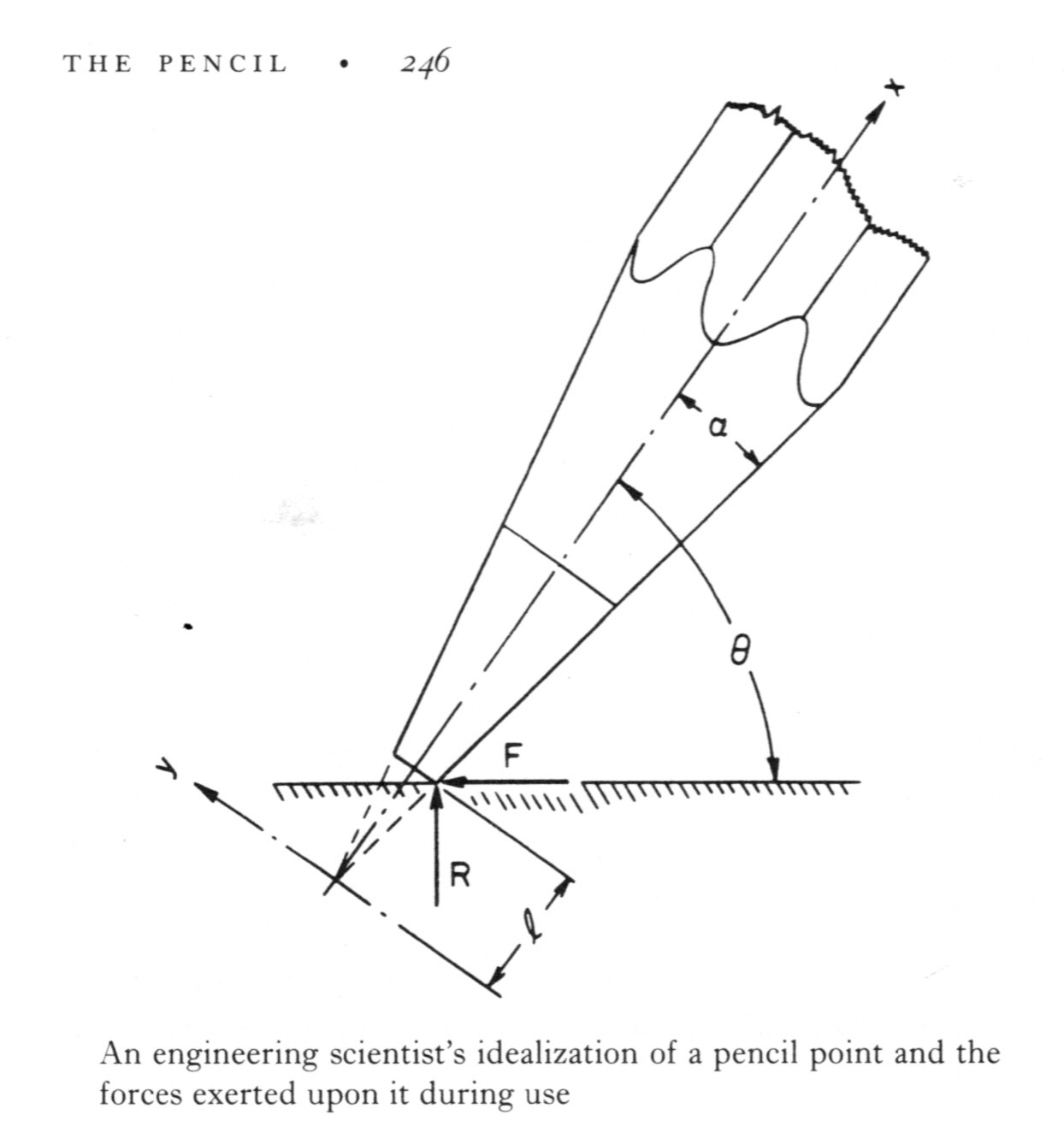
The book opens and closes with the fact that the pencil’s ubiquity rendered it invisible. On pages 5 and 346 the author tells of being unable to find old pencils in antique stores or museums. Shops that specialize in classic craftsman’s tools keep the compasses, but throw out the pencils. They value the carpenter’s levels, but discard the trade’s signature pencils. They curate the surveyor’s drafting pens, but not the pencils that laid out the guidelines that made inking possible. If that is received as incongruous, then consider that very little engineering is ever recorded. The work is the story. How it came to be is locked and lost in the mind of the inventor. The engineering drawing delivers its thousands of words. The engineer seldom records any of the words that gave birth to the plans and procedures. And as central as is the precision drawing, the pencil that made it has been ignored.

The Pencil: A History of Design and Circumstance by Henry Petroski (Alfred A. Knopf, 1990) is a paean to engineering with the pencil as its metonym. Being a professor of civil engineering, the author frequently compares the creation of pencils with the development of bridges. The allusion is not deep. The focus is the pencil, not the truss or suspension, though both are mentioned as needed for context.
  

We are told too easily that scientific theories become applied as engineered structures or machines. In truth, it is the other way around: theories explain what engineers develop by intuition, insight, trial and error, craft, and trade secret. When those are formalized into mathematics, then engineering science can improve the product or the process by analysis, seeking and eliminating limitations, flaws, defects, and oversights.


People were happy with metallic scribers made of lead, tin, or silver, and pens cut from reeds or feathers. The discovery in the 16th century of “black lead” or “plumbago” or “British lead” that we now call “graphite” radically altered writing and drawing, both for fine art and engineering. For three hundred years, the best graphite came from a single district in England. France’s wars with England led to the Conté crayon, a secret mixture of clay and graphite. Closed out of France, German firms developed their own secret formulas with graphite from Bavaria and Bohemia. Suitable graphite was found in New England and pencils were the family business for Henry David Thoreau. A new lode was discovered in China, giving rise to the yellow color we assume for the default and trade names such as “Mongol.” 

Alongside the rapid successive innovations of the 19th and 20th centuries, pencils were still sharpened with penknives. The first pencil sharpeners date to the 1890s and did not achieve the forms we accept today until after the 1930s. (Wikipedia has more to say about their development.) Into the 1980s, if not still a practice today, drafters at their drawing boards sharpened their pencils with sandpaper. I had mechanical drawing classes in junior high school (1962) and college (1978 and 1984) and that is how I was taught. 


Through all of that and into our time, the challenges have been to make consistent pencil leads in predictable grades, tough, strong, resilient, pliant, black (or other colors), and cheap; and do so by the millions, eventually billions. Graphite mixed with clay will not make a pencil. Only a few species of trees—mostly cedars—will do. The wood must be treated. The leads must be prepared. They are both in their ways shaped, formed, baked, boiled, heated, coated, stripped, and glued. While mechanical pencils—known since the 18thcentury—solve the problem of the wooden casing, they bring their own limitations. 


As a result of this book, I have been buying pencils, driving to office supply and art supply stores, giving long minutes to reading the pencils themselves, comparing their imprinted names and grades with the notecard I made for the purpose. I think that for myself, a 2-½ H or F would be best, but I cannot find them locally. Amazon has two brands, Mirado and Ticonderoga. I may have to give in and buy there.


PREVIOUSLY ON NECESSARY FACTS

Start the Presses! 

Art & Copy 

For the Glory of Old Lincoln High 

Dealers Make the Show: Armadillocon 41 Day 3 Part 2 


Sunday, October 13, 2019

Nerdvana: Working with Engineers (and a Scientist)

Since mid-July, I have been working for an industrial manufacturing firm. We make machines that make things. Of course, everything runs on software. So, we have a lot of the usual folks, but in addition to them, we have real engineers, and even a physicist.

Entertaining moments can be as simple as dropping a disk magnet down a copper tube and watching it float to the bottom. 

One of the guys has been collecting and disassembling microwave ovens in order to re-purpose the induction coils. With enough of them, he can make an array of electro-magnets to lift a person off the ground. (We are still waiting on that.) One of  the first projects was a spot welder. The cellphone charger does not work very well; I suggested that he should hook it to one of the Xebex machines in the gym. The other day, we went out back and watched him burn wood. 

More than you ever wanted to know about Figure 2B on Quora here:

PREVIOUSLY ON NECESSARY FACTS


Saturday, May 25, 2019

The Great Lakes Maritime Academy

On Friday, May 17, I was granted a tour of the Great Lakes Maritime Academy at Northwestern Michigan College in Traverse City. It was arranged by my sister-in-law, an administrative assistant there. (She served in the Royal Navy.) Although their students were out on the water for training, I had about an hour with one of their instructors, Cary Godwin (CDR USCG Ret). While the simulator ran its program, we talked about training methods and methodologies. Sue then led us through the classrooms and laboratories. 


GLMA cadets are in a four-year program that requires 360 days of active shipboard assignment. In fact, it begins on the water. 

Students work hard at basic skills from the sextant and paper charts up through the newest technologies. Their training includes piloting 1000-foot ore ships and rowing small boats.  
 
The first class graduated in 1979.
Cadet David E. Weiss died when the Edmund Fitzgerald was lost,
November 10, 1975.
Engineer Paul C. Powell, class of 1999, perished in an incident
aboard the Edward A. Carter, July 14, 2001.
 
It all comes down to people.
Cadets graduate as deck officers or engineering officers. In addition, the GLNA has a US Naval Reserves program.


The students master diesel mechanics and electricity generation and control. For those who decide that life on the water is not for them, the school maintains a BS degree program in power systems that qualifies graduates to work in a wide range of industries. The GLNA shares their building with a culinary institute; so, they also train and graduate ship stewards. 
 
Just follow the rules.
 I learned the difference between an allision and a collision. (At home, I discovered that many dictionaries consider "allision" to be obsolete. Reading the US Naval Institute Proceedings since 2015, I soon learned that engines can be casualities, no less than engineers. See NOAA's discussion of allision here.) 

Previously on Necessary Facts

Friday, July 17, 2015

Engineers and Jihadi

Mohammad Youssuf Abdulazeez, who killed a sailor and four Marines at a supply depot in Chattanooga, after opening fire on a recruiting office in a strip mall, was different from most other American jihadi. However, he was typical of the terrorists within the Arab/Islamic cultures of the old world: he was an engineer. 
  • “Engineers of Jihad” by Diego Gambetta and Steffen Hertog. Sociology Working Papers, Paper Number 2007-10, Department of Sociology, University of Oxford , Manor Road, Oxford OX1 3UQ www.sociology.ox.ac.uk/swp.html available online here
  • “Engineers of Jihad” by Steffen Hertog, and Marc Sagemen; Christopher Boucek (Moderator), the Carnegie Endowment for International Peace, Tuesday, September 1, 2009, Transcript by Federal News Service Washington, D.C. here
"In early September 2007 Iranian president Mahmoud Ahmadinejad – one of the country’s most radical politicians with a PhD in transport engineering from Teheran’s Science and Technology University and the author several of scientific papers –delivered a speech to Iranian academics, which exudes those features to such an extent that we cannot resist quoting him at length:

In some discussions I told them [those inside Iran pressing for compromise over fears the United States could launch a military strike because of the nuclear standoff with the West]: “I am an engineer and I am examining the issue. They do not dare wage war against us and I base this on a double proof’” […] [First] I tell them: “I am an engineer and I am a master in calculation and tabulation. I draw up tables. For hours, I write out different hypotheses. I reject, I reason. I reason with planning and I make a conclusion. They cannot make problems for Iran.” [Second] “I believe in what God says. God says that those who walk in the path of righteousness will be victorious. What reason can you have for believing God will not keep this promise?” (AFP, 3 September 2007)." (Gambetta and Hertog, note 52, page 49.)
"Whether American, Canadian or Islamic, and whether due to selection or field socialisation, a disproportionate share of engineers seems to have a mindset that inclines them to entertain the quintessential right-wing features of “monism” – ‘why argue when there is one best solution’ – and of “simplism” – ‘if only people were rational, remedies would be simple’. "(Gambetta and Hertog page 50)

"The Carnegie survey reveals an even more surprising fact, hitherto unnoticed, that strengthens the suspicion that the engineers’ mindset plays a part in their proneness not only to radicalise to the right of the political spectrum but do so with a religious slant: engineers turn out to be by far the most religious group of all academics – 66.5 per cent, followed again by 61.7 in economics, 49.9 in sciences, 48.8 per cent of social scientists, 46.3 of doctors and 44.1 per cent of lawyers, the most sceptical of the lot. Engineers and economists are also those who oppose religion least (3.7% and 3.0%), and, together with the humanities, those who more strongly embrace it (Table 16)." (Gambetta and Hertog page 51)

"So what about the distribution of degrees? I think it’s interesting here: By far, the dominant group is people who have engaged in engineering studies – 78 out of 178 cases whose subject we know. And the runners-up are less surprisingly Islamic studies, and after that, medicine, business, economics, and sciences. And then a number of smaller subjects that are not listed and detailed here."

"So the engineers are more than twice as large as the second-largest group. And interestingly, there are only seven scientists in the sample. And the anecdote that was around was always that people with science and technical education are overrepresented among Islamists, and that doesn’t seem to be true. It’s, in fact, only people with technical education; with applied science education."

"So there’s an interesting presence of scientists among nonmilitant groups and a much stronger presence of engineers among the militant groups." 
(Hertog and Sagemen, pp. 4-5.) 

I note that the lack of engineers in left-wing groups is measurable. The exceptions are always interesting. In Palestine in the 1970s, for example, engineers were more prevalent than now in left-wing extremist groups. Significantly, however, those groups were Marxist, not Islamist. (see, Gambetta and Hertog, page 32)

“In the US extreme right, whose ideology often has a strong religious and millenarian underpinning (Handler 1990) and whose members are generally poorly educated, engineers have played a significant role as leaders of several groups: out of seven individuals for whom we were able to establish the degree, four were engineers. For instance, Dick Butler, the founder of Aryan Nation, was an aeronautical engineer and Wilhelm Schmitt, leader of the “Sheriff's Posse Comitatus” (a militant antigovernment group with an anti-tax agenda and extremist Christian views) before being sentenced to 26 years in prison was an engineer with Lockheed Martin …” (Gambetta and Hertog, page 30).

ALSO ON NECESSARY FACTS

Sunday, September 28, 2014

WHEN OLD TECHNOLOGIES WERE NEW


I reasoned that there must have been telegraph hackers and sought to find them in the written history.  The telegraph came first.  Before hams broadcast in the ether, long before the telephone was regulated by the Federal Communications Commission, before Hermann Hollerith founded IBM, there must have developed prototypes of the things we take for granted in computing. 

Originally published online 4-SEP-1990 via USENET and Fidonet.  VERSION 0.75 August 26, 1990 -- A History of Early Cyberspace by mercury@well.sf.ca.us = MERCURY@lcc.edu (c) 1990 by Michael E. Marotta. published by The World GRID Association, P. O. Box 15062, Lansing, MI 48901 USA. You can copy this.
Box cover for VHS tape showing two teenagers at a computer about 1982.

Consider an anti-Western Union song from the July 20, 1883 meeting of the Brotherhood of Telegraphers at Clarendon Hall, in New York City that boasted, “We've left our keys...Let Jay Gould walk the floor...The wires are full of bugs...”(1) Though the term "bug" later referred to a semi-automatic sending key, the context is clear.  I had always accepted the story of Grace Hopper scotch-taping an errant fly into her log book.

Today's keyboarder suffers from carpal tunneling and a telegrapher would get a "glass arm" from too much sending.(1)

Box cover for DVD movie showing two teenagers above a computer screen with a scullThis summer [1990] we saw Mitch Kapor and Steve Wozniak invest their money in the Electronic Frontier Foundation, in part to aid the defense of hacker Craig Neidorf. The Strike of 1883 was supported by Thomas Edison who gave $300(1) or $700(2) at Clarendon Hall. 

Telegraphers were generally regarded as intelligent, clean, and quiet; and women worked as equals to men -- equal in ability, though not pay.(1,2,3).  And there was turnover. "Boomers", operators who hopped a train for the next horizon, filled in for boomers who had just left for the next horizon.  One major difference is that Western Union enjoyed a monopoly that would be the envy of IBM.

Some similarities are too obvious.  The computer, according to Carolyn Marvin, is a telegraph with a prodigious memory.(3)  There is no doubt that the early electric age presaged our own.  Experts defined their own status, “users” were abused with jokes about their ignorance of technology, and preposterous predictions about the complete and permanent improvement of humanity were superabundant.(3)

So where are the hackers?  Thomas Edison was the foremost telegrapher, the ultimate hardware hacker, duplexing and quadriplexing messages on the same wire.  Telegraphers played checkers and pursued romances, though, it is asserted, "not on company time". During the Strike of 1883, union loyalists within the company used the lines to keep members nationwide informed.(1)  They used a secret code,(1) though it is obvious that an operator could send anything at all in the presence of Jay Gould, whose skills lay in other areas. 

Sources:
(1) The Telegraphers: Their Craft and Union,Vidkunn Ulriksson, Public Affairs Press, 1953.
(2) The American Telegrapher: A social history, 1860 - 1900, Edwin Gabler, Rutgers University Press, 1988.
(3) When Old Technologies Were New, Carolyn Marvin, Oxford University Press, 1988.

Notes:
  • "Of all the marvelous achievements of modern science, the Electric Telegraph is transcendentally the greatest and most serviceable to mankind.  It is a perpetual miracle, which no familiarity can render commonplace.  This character it deserves from the nature of the agent employed and the end subserved.  For what is the end to be accomplished, but the most spiritual ever possible?  Not the modification or transportation of matter, but the transmission of thought.  To effect this an agent is employed so subtle in its nature that it may more properly be called a spiritual rather than a material force." -- Charles F. Briggs and Augustus Maverick The Story of the Telegraph and a History of the Great Transatlantic Cable, Rudd & Carleton. New York: 1858.
  • "Redeeming Charles Babbage's Mechanical Computer" by Doron D. Swade, Scientific American, February 1993.  (A successful effort to build a working, three-ton Babbage calculating engine suggests that history has misjudged the pioneer of automatic computing.)
  • "The Electric Telegraph" a poem, anonymous. from Chamber's Papers For the People.  Long.  The chorus is "Sing who will of the Orphean lyre/Ours the wonder-working wire."   And much more of the same on this and other topics.  (Telephones for the poor... do wireless transmissions harm operators... does use of the telephone cause deafness in the left ear...)
ALSO ON NECESSARY FACTS


Saturday, April 12, 2014

Galileo's Two Sciences


Dover Books specializes in the reproduction of classic works whose copyrights have expired.  This translation by Henry Crew and Alfonso de Silvio from 1914 was based on a rendition into modern Italian by Antonio Favoro. That work was part of the National Edition of Galileo’s compiled works published in 1913. It was a time of rising nationalism that would bring a worldwide war and fascism. However, Galileo’s work belongs to anyone who seeks the truth.

The Two Sciences here are what we now call “Statics” and “Dynamics” in freshman engineering curricula.  He also discusses problems from modern engineering college textbooks in strength of materials – and he gets a few things wrong, but that does not detract from the overall presentation.

Missing from Dialogues Concerning Two New Sciences is any mention of the Leaning Tower of Pisa.  Nonetheless, many times throughout, Galileo does refer to experiments with falling bodies. With extreme patience, he teased out the truth.  Galileo considered balls rolling down inclined planes and pendula of different arcs with bobs of different weights. His work foreshadowed Rayleigh on aerodynamics, but Galileo had no quantitative answers for his questions about air resistance; he knew nothing about the relationships among viscosity, cross section, and velocity. That would come 250 years later. Yet, he knew the variables…. And he knew much else.

Mean proportion
of velocity of
a falling body
 Dialogues Concerning Two Sciences is one of those books that we all “know” but never read.  With over an hour on public transportation every morning and another plus a quarter or half at night, I had the time to read this.  I recommend it highly to anyone who wants to discover science for themselves, rather than taking someone else’s word for it. 

Again, in this Galileo makes no mention of the Leaning Tower of Pisa.   But he does argue at length about the fact that two bodies of different weight fall with just about the same final velocity. Newton admitted to standing on the shoulders of giants.  Galileo depended on the “mean proportion” that was developed by the Oxford Calculators of the 13th century.  It is sadly very easy to posit that if Galileo had worked in the Middle Ages instead of the Counter-Reformation and wars of religion, his labors would have been embraced by the Church that opposed him in his own time.

Galileo also offers complex geometric proofs that I had to read past to get through. Even though algebra was over 300 years old by the time he wrote, like Isaac Newton (who was born the year that Galileo died), he proved his points with geometry.  We no longer learn it.  Yes, we have a year in high school; but even Richard Feynman had to admit defeat because he could not retrace Newton’s steps.  We are geometrically illiterate.  Still, it is obvious that Galileo was setting the foundation for his later demonstrations.  Deepest and chief among them are previews of what we call “calculus.”  Galileo showed that the instantaneous is an expression of the infinite.

ALSO ON NECESSARY FACTS