Showing posts with label invention. Show all posts

Sunday, April 12, 2026

Rory Sutherland’s 10 Rules of Alchemy

Rory Sutherland is a vice president at Ogilvy in the UK. His YouTube videos advertise and promote the powers of myth, emotion, creativity, and passion. He tells good stories. He nods to reason, logic, and rationality because those are the proof of known, workable solutions. Sutherland’s thesis is that if we have a problem now it must be logic-proof or it would already have been solved and would not now exist. 

This is my summary. I recommend that you watch the video for yourself with CC:Closed Captions on. 


Rory Sutherland’s 10 Rules of Alchemy

  1. The opposite of a good idea can be another good idea. When we narrow down all options to the single rational choice, if it fails, no one can be blamed because they followed the data and the model. In fact, problems often have multiple solutions, different alternatives for other people whose values are not our own. 
  2. Do not design for the average. Look for the extreme. The average person will reject the unknown until other people make it a trend. Go for those other people.
  3. It does not pay to be logical when everyone else is logical. To overcome your competition in the market, find the errors in their models and meet those needs. He points out that every military seeks to design and implement surprises. 
  4. The nature of our intentions is the source of our internal tensions. His example is extreme though telling. His best hotel experience was in an East Berlin pad that must have been a police cell. If you were looking for a Ramada Inn you were going to be disappointed, but he wanted the experience of an East Berlin vacation and he was ecstatic. Know your true intentions and it will minimize your emotional tensions.
  5. A flower is just a weed with an advertising budget. Nature rewards and invests in reproductive strategies that are effective, even when seemingly inefficient. 
  6.  Logic kills off magic. The payoff for magic is the change in perception. Apple changed the perception of the computer. 
  7. A good guess plus empirical observation is still science. You can have a lucky guess and be right. **See below.
  8. Test the counter-intuitive things because nobody else will. Businesses must mainly follow the rational and logical and the data-driven because that is what is known to work. You still must set aside space—I take that to mean organizational as well as physical—to test random journeys.
  9. Rationality is a tool. If it is your only tool, then you are playing golf with just one club.
  10. Dare to be trivial. The butterfly effect is that a small change can have a large consequence. Add one sentence to the script of a call center and see what change it brings. 
  11. Do not limit yourself to ten rules. Rational people are everyone else. So, if there is a problem not solved now, it is logic-proof or would not exist. Be creative.
  12. Dare to look stupid. “Why do people dislike standing up on trains?” In fact, some prefer it for a moderate ride of 20 to 30 minutes because they have been sitting in a chair all day. If you notice, some people still stand even after sufficient seats have been vacated. For others, it might be the physical challenge of juggling one’s kit after you are already latched on to a pole. Ultimately, now we have privileged window seating perhaps with a tray or armrest and so on, and with others forced to stand in the middle with not much to do. He asks, what if, instead, we had rows of seats in the middle with the spaces near windows specially designed for restful standing, perhaps with cellphone chargers as well. Now, it looks different.
  13. Create net utility with a multivariate choice. Give people choices that optimize or minimize more than one variable and in disproportion so that whatever the outcome for the individual, you bring less regret. This is adaptive preference formation, a narrative for the support of choices.

** (Rory Sutherland cites Paul Feyerabend in asserting that advances in science have not come from applications of the scientific method but from intuition and insight. What the postmodernists ignore and would have us ignore in their program against reason is that you can only prove that your intuitive insight is truly scientific by following the scientific method so that you first and then others can test and replicate your work. Otherwise, you have nothing. The flash of insight and awareness can only be a reward for the rational, logical, empirical, experiential modes of learning as the preparation for better understanding and, ultimately, therefore, material abundance.) 


PREVIOUSLY ON NECESSARY FACTS


Entrepreneurship 

Innovation and Discovery 

The One Percent are the Atlases 

Shrugging the Stigma of Success 


Monday, September 1, 2025

AMERICAN LABOR DAY 2025: Why I Work

These quotations are from The Fountainhead by Ayn Rand, most of them spoken by the story's hero, Howard Roark. 

 “I have, let’s say, sixty years to live. Most of that time will be spent working. I’ve chosen the work I want to do. If I find no joy in it, then I am only condemning myself to sixty years of torture. And I can find the joy only if I do my work in the best way possible to me. But the best is a matter of standards—and I set my own standards. I inherit nothing. I stand at the end of no tradition.”  (Plume Edition, 1994. Page 16)


“An open car drove by, fleeing into the country. The car was overfilled with people bound for a picnic. There was a jumble of bright sweaters, and scarf fluttering in the wind; a jumble of voices shrieking without purpose over the roar of the motor, and overstressed hiccoughs of laughter; a girl sat sideways, her legs flung over the side of the car; she wore a man’s straw hat slipping down her nose and she yanked savagely at the strings of a ukulele, ejecting raucous sounds, yelling, “Hey!” These people were enjoying a day of their existence; they were shrieking to the sky their release from work and the burdens of days behind them; they worked and carried burdens in order to reach a goal—and this was the goal. (Plume Edition, 1994. Page 131)


 “… There will be thousands passing by your house and by the gas station. If out of those thousands, one stops and see it—that’s all I need.”

“Then you do need other people, after all, don’t you, Howard?”

“What are you laughing at?”

“I’ve always thought that you were the most anti-social animal I’ve ever had the pleasure of meeting.”

“I need people to give me work. I’m not building mausoleums. Do you suppose I should need them in some other way? In a closer more personal way?” (Plume Edition, 1994. Page 158)


DefCon 512 June 2013

“Why are you a good architect? Because you have certain standards of what is good, and they are your own, an d you stand by them. I want a good hotel, and I have certain standards of what is good, and they’re my own, and you’re the one who can give me what I want. I’m doing—on my side of it—just what you’re doing when you design a building. Do you think that integrity is the monopoly of the artist? And what, incidentally, do you think integrity is? The ability not to pick a watch out of your neighbor’s pocket? No, it’s not as easy as that. If that were all, I’d say ninety-five percent of humanity were honest, upright men. Only, as you can see, they aren’t. Integrity is the ability to stand by an idea. That presupposes the ability to think. Thinking is something that one doesn’t borrow or pawn. And yet, if I were asked to chose a symbol for humanity as we know it, I wouldn’t choose a cross nor an eagle nor a lion and unicorn. I’d choose three gilded balls.” – Kent Lansing. (Plume Ed., 1994. Page 321)


“I love doing it. Every building is like a person. Single and unrepeatable.”

(Plume Edition, 1994. Page 480)


“From different states, from unexpected parts of the country, calls had come for him: private homes, small office buildings, modest shops. … The story of every commission he received was the same: “I was in New York and I liked the Enright House.” “I saw the Cord Building.” “I saw a picture of the temple they tore down.” It was if an underground stream flowed through the country and broke out in sudden springs that shot to the surface at random, in unpredictable places. They were small, inexpensive jobs—but he was kept working.” (Plume Edition, 1994.  Page 533)

Austin Astronomical Society
13 October 2023


“Three quarters of them don’t know what it’s all about, but they’ve heard the other one-quarter fighting over your name and now they feel they must pronounce it with respect.  Of the fighting quarter, four-tenths are those who hate you, three-tenths are who feel they must have an opinion in any controversy, two-tenths are those who play safe and herald any new ‘discovery,’ and one-tenth are those who understand.” (Plume Edition, 1994. Page 536)


“One cannot collaborate on one’s own job. I can co-operate, if that’s what they call it, with the workers who erect my buildings. But I can’t help them to lay bricks and they can’t help me to design the house.” (Plume Edition, 1994.  Page 569)


American Numismatic Association
Rosemont (Chicago) 2019


“Roark got up, reached out, and tore a thick branch off a tree, held it in both hands, one fist closed at each end; then, his wrists and knuckles tenses against the resistance, he bent the branch slowly into an arc. “Now I can make what I want out of it: a bow, a spear, a cane, a railing. That’s the meaning of life. … Your work.” He tossed the branch aside. “The material the earth offers you and what you make of it.” (Plume Edition, 1994.  Page 577)


American Numismatic Association
Chicago Virtual 4 August 2020

“But first, I want you to think and tell me what made me give years to this work. Money? Fame? Charity? Altruism?... You see, I’m never concerned with my clients, only with their architectural requirements. I consider these as part of my building’s theme and problem, as my building’s material—just as I consider bricks and steel. Bricks and steel are not my motive. Neither are the clients. Both are only the means of my work. Peter, before you can do things for people, you must be the kind of man who can get things done. But to get things done, you must love the doing, not the secondary consequences. The work, not the people. Your own action …”  (Plume Edition, 1994.  Page 604)


PREVIOUSLY ON NECESSARY FACTS    

Money as a Crusoe Concept

Mutiny Aboard the San Antonio 

Recent Astronomical Observing 


Sunday, December 6, 2020

Focus on Simon Georg Ploessl

The Ploessl ocular (“eyepiece”) is easily the most popular design in the hobby of astronomy. Regardless of focal length, from 40 mm to 4 mm, they are common because they are inexpensive and they reasonably support the limits of the largest amateur instruments. Better designs are available, but at a greater cost. A modest instrument under city skies usually will not benefit from the improved optics of an orthoscopic ocular. Thus, the Ploessl is the first choice, whether for a refractor, reflector, or catadioptric telescope. For all of its ubiquity, its inventor, Viennese optician Simon Georg Ploessl is not widely known among astronomers. 

Say it Right


Lithograph by Kriehuber
Wikicommona
First of all, he spelled his name Plößl and that almost rhymes with the English word “vessel.” 

The character that looks like a capital-B ß is a double-s. It is called an “Eszet” or “sharp-ess” (scharfes-Ess) from a time when German orthography spelled words like der Fuss (the foot) as der Fusz to show that it had a hissing-s sound, not the unvoiced fricative that we know in English as “sh” in “shoe” or “push.” 

The umlaut-o ö is sounded by rounding your lips to say English long-o, but instead, saying English long-a. If you did not grow up speaking German, then “Plessl” is close enough. That is because three consonants follow the vowel. Each one clips some time off the sounding. The word for “height” die Höhe sounds like an American calling their friend from across a room “hey-ya” not the short laugh “heh.”
 

The double-dots are a medieval shorthand for a little letter e that was placed over the o to show the shifted sound. Thus, the questionably undead cat is not as if in English long-o “Shro-din-jer’s” but umlaut-ö as if in English like “Shray-ding-er’s.” Ploessl also used the ligature Å“ (oe), a less common flourish.


If your typewriter has no umlaut vowels (ä ö ü) or a sharp-s (ß), you can use an e and a double-s. Thus, Plößl (which is how he spelled it) is accepted as Plössl or Ploessl, but spelling the name Plossl or saying it that way is wrong.


From the Microscopic to the Macroscopic


Georg Simon Plößl (1794-1868) was born in Wieden which had been an independent villa in the Middle Ages but by the 18th century already lay within Vienna’s shadow. He was the son of a cabinetmaker. And therefore an apprentice in his father’s shop, beginning as a lathe operator (turner). When he was 18, he left for the optical firm Voigtländer, starting on May 9, 1812 [5].


In 1823, he moved back to his father’s home and began his own laboratory and workshop for investigations into the production of optical instruments.[1] In 1828 he was open for sales [2]. At first, Ploessl made microscopes, and he soon became famous for them.


His company took off (and took a new direction) when he sold a microscope to Joseph Franz von Jacquin, professor of botany and chemistry at the University of Vienna. Von Jaquin introduced Ploessl to the astronomer Joseph Johann von Littrow for whom he built a telescope in 1830. 


Three-inch "dialytic" Refractor by Simon Georg Plößl


At Viennese industrial fairs in 1835, 1839, and 1845, Ploessl was granted gold medals in recognition of the exemplary products of his workshop. In 1847 another gold medal was bestowed by the Emperor Ferdinand. The emperor also commissioned him to build a telescope which was gifted to the Vizier of the Ottoman Empire.[6] (Some sources say that it was for the Sultan.) [5]


By 1850,  in addition to the microscopes which were the primary production of his firm Ploessl had delivered refractors to observatories in Romania (Iasi; 6.4 inches), Hungary (Biczke; 8.5 inches), Greece (Athens; 8 inches), and Russia (Pulkovo; 6.4 inches). In 1851 the firm delivered an 11-inch f/11.8 refractor to the Vizier. Delivering up to 610x magnification, it was said to divide gamma Coronae Borealis: 0.6 seconds of arc at 4th and 7thmagnitudes. (The above is from 19th century reports. A modern paper identifies the Athens instrument as 162-mm (6.37 inches) [1].) Other Ploessl instruments have been identified. He also built dipleidoscopes for determining the moment of high noon, 12 o’clock post meridian. 


All of his telescopes had objectives of crown glass. They followed the Fraunhofer design of a concave and convex lens pair, but did not use flint glass which was rarer in large, high-quality blanks. Consequently, the essential element in the design was the secondary lens system, a flint glass ocular that minimized chromatic aberration. That was Ploessl’s stellar achievement. 


The Ploessl Ocular Lens System


Two pairs of lenses, match convex and concave curves, and the pairs are separated by a gap. The concave lenses are at the extremes, the convex face each other in the center. This design was not a happenstance. The Voigtländer firm was founded in 1763 when Johann Christoph Voigtländer received a monopoly charter (“protection decree”) from the Austrian monarchy to produce mathematical instruments. Fifty years later, Ploessl studied mathematics and optical theory while rising from apprentice to journeyman. 

Star Ware: The Amateur Astronomer's Guide
to Choosing, Buying, and Using Telescopes
and Accessories, 4th ed.,
by Philip S. Harrington, John Wiley and Sons, 2007.

Three factors kept this system from becoming widely accepted. First, telescopes are durable goods. Better ones have been built since 1610, but the old ones still work. The Ploessl refractor in Athens served the university until 1940. Second, astronomy was a private pursuit for intellectuals of independent means. While Britain had its Royal Astronomer, few such public posts existed elsewhere. Ploessl built telescopes for state enterprises in Greece and Russia, but he built more for wealthy patrons in Hungary, Romania, and Italy. Only with the explosion of science in the 20th century was there any broad consumer demand for the instruments of empirical discovery. Third, as prosperous as the Ploessl firm was, it was a sole proprietorship. When Simon Ploessl was killed by a falling sheet of glass in 1868, there was no one to step into leadership. The firm continued until 1905, but there was no visionary to drive the effort.[*]


Enter Al Nagler


Al Nagler founded TeleVue. He gave an extensive interview to Astronomy magazine, which posted it as a blog and it is archived at http://cs.astronomy.com/asy/b/astronomy/archive/2015/10/13/the-evolution-of-eyepiece-developments-at-tele-vue.aspx The story is enjoyable and edifying. Briefly, he said:

While the Nagler was the first eyepiece I designed for Tele Vue, I feared entering the astronomy market as an unknown “kitchen-table” company with such an expensive eyepiece. This caution led me to produce a Plössl eyepiece first, to gain reputation, experience, and capital.[7]

References and Further Reading

[1] The Hellenic Archives of Scientific Instruments at http://www.hasi.gr/makers/ploessl-georg-simon

[2] https://de.wikipedia.org/wiki/Simon_Plößl

[3] Looking at the Skies for 175 Years: The 162-mm Ploessl Refractor and the 400-mm Gautier Refractor of National Observatory of Athens, Panagiotis, Lazos and Tsimpidas, Dimitrios; XXXVII Scientific Instrument Symposium, 3-7 September 2018, Leiden and Haarlem.

[4] https://en.wikipedia-on-ipfs.org/wiki/Bicske.html 

[5] “Plössl-Mikroskope - ein Vergleich mit modernen Geräten,” by E. Steiner and P. Schulz, ©Naturhistorisches Museum Wien, download from www.biologiezentrum.at

 [6] “The Achromatic Telescope, Dialytes, and Fluid Lenses--Nebula--Double Stars—Occultations” by the Rev. T. W. Webb, A.M., F.R. A. S., The Intellectual Observer, Groombrdige and Sons, London, No. XLIX, February 1866, 

[7] “The evolution of eyepiece developments at Tele Vue,” Posted by Michael Bakich on Tuesday, October 13, 2015, A guest blog by Al Nagler. Astronomy.


[*] Addendum 14 December 2020. I found evidence of this. To make a short story long, I borrowed a Meade 10-inch Ritchey-Chretien catadioptric telescope from the local club. Researching it, I discovered a legal kerfluffle among Meade and some others. A discussion on Cloudy Nights took me to the website of retired telescope maker R. F. Royce (http://www.rfroyce.com/). At the top of one of his pages is this quote: "If the pure and elevated pleasure to be derived from the possession and use of a good telescope of three, four, five, or six inches aperture were generally known, I am certain that no instrument of science would be more commonly found in the homes of intelligent people." - Garrett P. Serviss, Pleasures of the Telescope, 1901. So, I followed that track. In his time, Serviss was famous as a popularizer of science, especially astronomy. When he was a night editor at The Sun of New York, one of his lecture tours was subsidized by Andrew Carnegie. His passing was noted in a long obituary in Popular Astronomy (August-September 1929). The Pleasures of the Telescope was first published by Putnam in 1901, and then went through several re-publications. Google Books and Hathi Trust provide the 1915 printing by D. Appleton and Company. Serviss described two kinds of eyepieces: positive (Ramsden) and negative (Huygens). He does not mention the Ploessl. 


PREVIOUSLY ON NECESSARY FACTS

The Genius of Design

Raymond Loewy

The Perfect Machine

The Christmas Star

Eclipses?

Asterisms

Monday, September 7, 2020

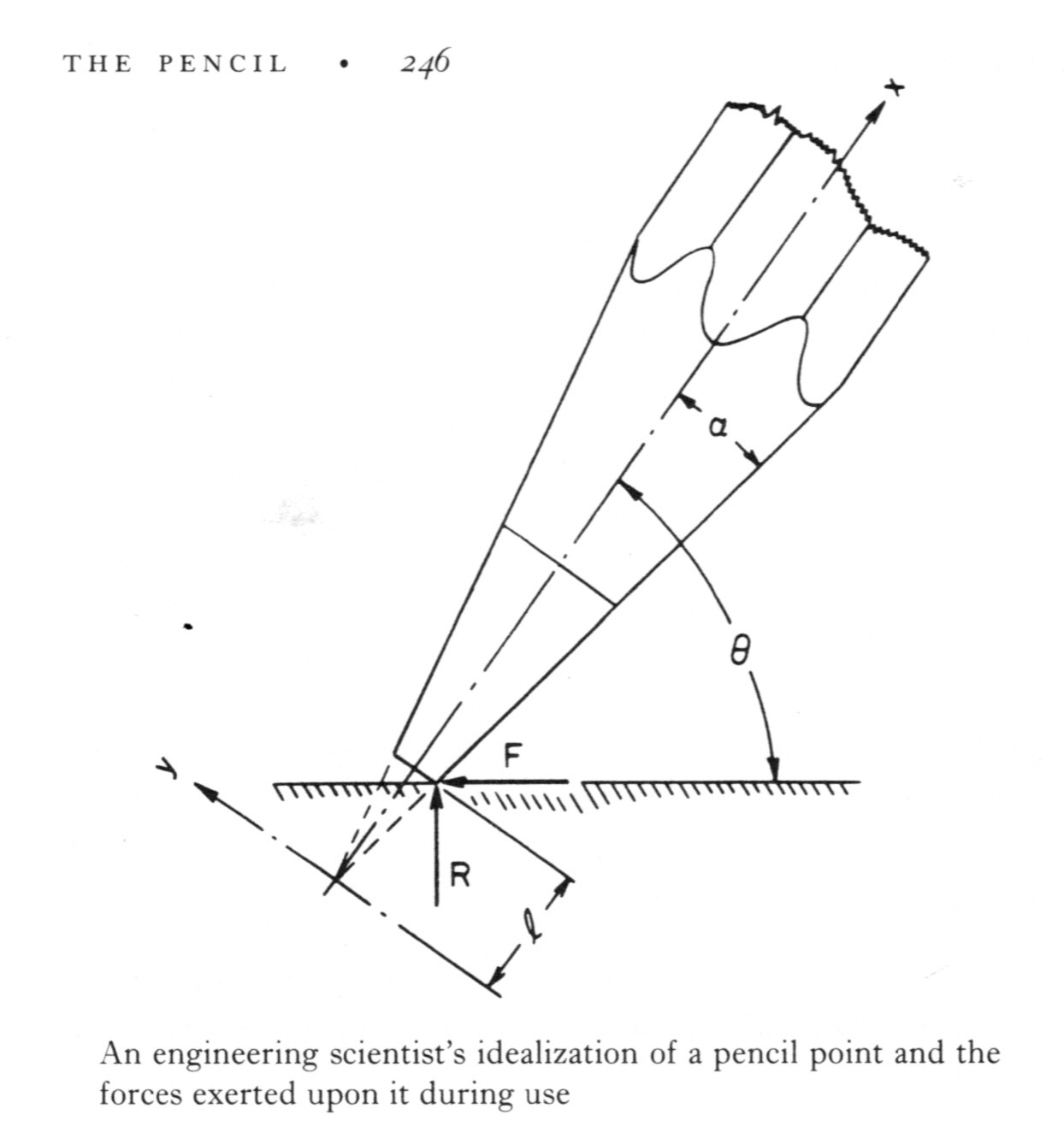
The Pencil: History, Design, and Circumstance

The book opens and closes with the fact that the pencil’s ubiquity rendered it invisible. On pages 5 and 346 the author tells of being unable to find old pencils in antique stores or museums. Shops that specialize in classic craftsman’s tools keep the compasses, but throw out the pencils. They value the carpenter’s levels, but discard the trade’s signature pencils. They curate the surveyor’s drafting pens, but not the pencils that laid out the guidelines that made inking possible. If that is received as incongruous, then consider that very little engineering is ever recorded. The work is the story. How it came to be is locked and lost in the mind of the inventor. The engineering drawing delivers its thousands of words. The engineer seldom records any of the words that gave birth to the plans and procedures. And as central as is the precision drawing, the pencil that made it has been ignored.

The Pencil: A History of Design and Circumstance by Henry Petroski (Alfred A. Knopf, 1990) is a paean to engineering with the pencil as its metonym. Being a professor of civil engineering, the author frequently compares the creation of pencils with the development of bridges. The allusion is not deep. The focus is the pencil, not the truss or suspension, though both are mentioned as needed for context.
  

We are told too easily that scientific theories become applied as engineered structures or machines. In truth, it is the other way around: theories explain what engineers develop by intuition, insight, trial and error, craft, and trade secret. When those are formalized into mathematics, then engineering science can improve the product or the process by analysis, seeking and eliminating limitations, flaws, defects, and oversights.


People were happy with metallic scribers made of lead, tin, or silver, and pens cut from reeds or feathers. The discovery in the 16th century of “black lead” or “plumbago” or “British lead” that we now call “graphite” radically altered writing and drawing, both for fine art and engineering. For three hundred years, the best graphite came from a single district in England. France’s wars with England led to the Conté crayon, a secret mixture of clay and graphite. Closed out of France, German firms developed their own secret formulas with graphite from Bavaria and Bohemia. Suitable graphite was found in New England and pencils were the family business for Henry David Thoreau. A new lode was discovered in China, giving rise to the yellow color we assume for the default and trade names such as “Mongol.” 

Alongside the rapid successive innovations of the 19th and 20th centuries, pencils were still sharpened with penknives. The first pencil sharpeners date to the 1890s and did not achieve the forms we accept today until after the 1930s. (Wikipedia has more to say about their development.) Into the 1980s, if not still a practice today, drafters at their drawing boards sharpened their pencils with sandpaper. I had mechanical drawing classes in junior high school (1962) and college (1978 and 1984) and that is how I was taught. 


Through all of that and into our time, the challenges have been to make consistent pencil leads in predictable grades, tough, strong, resilient, pliant, black (or other colors), and cheap; and do so by the millions, eventually billions. Graphite mixed with clay will not make a pencil. Only a few species of trees—mostly cedars—will do. The wood must be treated. The leads must be prepared. They are both in their ways shaped, formed, baked, boiled, heated, coated, stripped, and glued. While mechanical pencils—known since the 18thcentury—solve the problem of the wooden casing, they bring their own limitations. 


As a result of this book, I have been buying pencils, driving to office supply and art supply stores, giving long minutes to reading the pencils themselves, comparing their imprinted names and grades with the notecard I made for the purpose. I think that for myself, a 2-½ H or F would be best, but I cannot find them locally. Amazon has two brands, Mirado and Ticonderoga. I may have to give in and buy there.


PREVIOUSLY ON NECESSARY FACTS

Start the Presses! 

Art & Copy 

For the Glory of Old Lincoln High 

Dealers Make the Show: Armadillocon 41 Day 3 Part 2 


Monday, August 31, 2020

The Fountainhead: an exploded view of one scene

We lose the past too easily. Ayn Rand was born in 1905. In The Fountainhead, anyone of mature professional status 1922-1942 would have been a generation older. Rand studied in an architect’s office, working for free in order to understand the craft and the business. I was pleasantly surprised to be informed by another book of an underlying tradition in engineering design. It was an eye-opener.

From The Fountainhead:

“You will kindly explain yourself,” [said the Dean].

“If you wish. I want to be an architect, not an archaeologist. I see no purpose in doing Renaissance villas. Why learn to design them, when I will never build them?” [replied Howard Roark].

“My dear boy, the great style of the Renaissance is far from dead. Houses of that style are being erected every day.”

“They are. And they will be. But not by me.”

“Come, come, now, don’t be childish.”

“I came here to learn building. When I was given a project, its only value to me was to learn to solve it as I would solve a real one in the future. I did them the way I’ll build them. I’ve learned all I could learn here—in the structural sciences of which you don’t approve. One more year of drawing Italian post cards would give me nothing.” 


From The Pencil: A History of Design and Circumstance by Henry Petroski, Alfred A. Knoff, 1990:

Although orthographic projection was used in Albrecht Dürer’s 1525 book on the geometry of drawing, and theoretic foundations were laid down in Gaspard Monge’s 1795 book on descriptive geometry, the techniques and conventions derived from the work of these pioneers did not become universally employed in what has come to be known as mechanical or engineering drawing until the nineteenth century, when it became virtually indispensable for conveying information to machine shops and iron foundries. Up until about the middle of the nineteenth century, engineering drawing was learned in the long tradition of architectural drawing, and many early machines, such as large steam engines, were designed with iron structural elements cast in the forms of columns of the classical orders. Functional brackets were adorned with the classical motifs that students had learned in drawing classes, which consisted largely of copying increasingly complex architectural drawings, and one can only speculate on how much of what came to be known as Victorian architecture and structure was influenced by this practice. 


Through the middle of the nineteenth century architectural drawing was learned by most, though not all, draughtsmen by tracing. Hence technique was learned at the expense of theory. …  The mid-nineteenth century state of the art of engineering drawing was recorded succinctly in the preface to one of the earliest textbooks on the subject, An Elementary Treatise on Orthographic Projection, Being a New Method of Teaching the Science of Mechanical Engineering by William Binns. According to Binns…:

“… the usual mode of teaching… is from the ‘flat’—that is, from copy—the practice being to lay before each student of the class a drawing of some part or parts of a structure which he is requested to copy. This being done, another drawing, probably more elaborate, is laid before him; and the same course is pursued until he becomes tolerably expert with his instruments and brushes, and eventually able to make a very creditable or even highly finished drawing from copy. If, however, at the end of one or two years of practice the copyist is asked to make an end elevation, a side elevation and longitudinal section of his black-lead pencil, or a transverse section of the box containing his instruments, the chances are that he can do neither the one or the other.”


PREVIOUSLY ON NECESSARY FACTS

The Genius of Design 

Science Fair: A National Geographic Film 

Absolutes and Objectives 

There Really Are “Civil” Engineers 


Saturday, January 19, 2019

The Atlatl

The throwing stick was invented about 30,000 years ago. It extends the arm giving force (as range and speed) to a spear. Used widely across North and South America, it also is known from Europe, but more widely throughout Indonesia and Australia. The Aborigines call it the woomera and it can be the core of a “Swiss Army Knife” that serves many purposes.  
 
A Dog named “Moose” and his Mistress with Atlatl
The distribution of the atlatl opens discussions that can lead down intellectual rabbit holes into speculative wonderlands. It was not well-known across all of Europe and finds are centered in France. The bow-and-arrow became the dominant distance weapon in the Old World, though the atlatl continued alongside it in America. The bow was not imported to or invented in Australia. 

The word atlatl comes directly from the language of the Aztecs, Nahuatl. Nouns end in (a)tl. Cocoa is xocolatl. The jaguar is the ocelotl. The dog is the coyototl. And, yes, out there, where the gods came from is the Atlantic ocean. Make of it what you will, because the distribution of the spear thrower seems to be from West to East, across the Pacific to the Americas. The truth may be that like cotton the atlatl was imported to the Old World from the New in prehistoric times.

PREVIOUSLY ON NECESSARY FACTS


Thursday, October 30, 2014

The Status of ORIGINAL Property


Original property is newly invented or newly discovered.  It had no previous owner.  In fact, it did not exist – or its existence was not perceived – until the original inventor created it or the original discoverer found it.  How do we recognize such property?  What rights does the inventor or discoverer hold?  Are some or all of those those objective, absolute, or conditional? 

A sailor finds an uninhabited island.  Can she claim the whole thing for herself?  An astronaut lands on an asteroid, a moon, or a planet.  Can she claim the whole thing for herself?  A physicist discovers a new form of energy. Can she claim it all for herself?  A radio hacker finds that 1100 KHz AM is owned by a broadcast company. Can she use a chopper to parcel out nanoscopic slices of the wavelength for herself, given that her presence will never be detected and her presence will never interfere with their existing use of the wavelength?
The Ether did not exist for George Washington.
You could have had it all to yourself for all he knew.
Library of Congress.

It could be argued that the 1100 KHz frequency already belongs to someone.  However, the property is actually the amplitude modulated (AM) use of that frequency.  In theory, frequency modulated (FM) and phase modulated broadcasts are both possible on 1100 KHz without interference.  They are just not technologically useful today.  This is not new.  

(Actually, the property status is limited in space, as well.  That, too, is a different problem, caused by a misperception of the potentials in technology. One of the nice features of 550 to 176 meter wavelengths is the way the waves bounce off the ionosphere.  That was discovered as a by-product, entertaining teenagers who listened to far-away stations.  It could have been commercially exploited.)  

Thomas Edison was a telegraph hacker.  He discovered how to multiplex and quadriplex messages on the same wire.  Granted that the wire was someone’s property, it could, nonetheless have been leased out to different people using different blocks of time-passage on the same wire.  Also, in theory, it could have evolved that the telegraph wires would have been the broadcast source for what we call radio.

When a direct current circuit is closed and opened, a magnetic field is created and collapsed.  That is an alternating field.  That field could have been used to transmit information, as in fact, the “ether” was used by actual radio (initially called “wireless”).  So, you could have paid the telegraph company its tariff for sending messages, but have no concern for the literal transmission but been sending “open” and “close” signals to create a carrier wave for transmissions of your own.  Who would have owned that ether?
 
The Personal Computer Revolution
 saw the use of voice grade telephone lines
for data transmission.
(Wikipedia)


Lasers can carry messages.  It could have come that a network of  lasers made of ruby crystals doped with chromium and pumped by xenon flash would have been a continental system, point to point, with relays and amplifiers every 20 miles or so. Then, someone with a YAG (yttrium aluminum garnet) laser could have a network whose beams crossed those in space but without interference because the beams are of different frequencies.  Thus, no violation of property rights would have occurred. 

Original property brings a special challenge to the law because no previous legislation anticipated it.  Ayn Rand attempted to delineate the proper role of government in her essay "Property Status of the Airwaves."  Twenty years later, the Electronic Frontier Foundation was created to bring law and order to cyberspace.  Rand did not stray far from the mainstream.  Her essay never questioned the Federal Communications Commission - though she excoriated it in other writings - or the law that created it with power to rule by decree.  The EFF has been fighting a war of attrition while bunkered within the First Amendment.  The next new invention will leave them to defend an old technology without new ideas.

I believe that rather than looking to legislation or administration, these problems are best settled in courts.  The English system of justice works because of what American conservative complain about as "judicial activism."  The other way is the Continental theory of "civil law" in which the legislature spells out the law in detail and the courts only enforce it.  In other words, in the English system, the court fits the law to the case, making case law, whereas in the Continental system, the court fits the case to the law.  (In American today, the courts do both.  The court of original jurisdiction applies the law.  Appellate courts test the law.) The English system is better at protecting individual rights because those are the implicit foundation for judging the law and for making new rulings that create precedents.

ALSO ON NECESSARY FACTS