Showing posts with label industrial design. Show all posts

Thursday, October 21, 2021

DIY: Homebuilt Substitute for Vixen Mount

The Vixen Company, Ltd., of Saitama, Japan, (founded 1949) got the brilliant idea to make all of their telescopes compatible with all of their mounts. Today, the Vixen mount is a standard offered by most other makers. However, a new Vixen mount bar at $79.95 plus tax and shipping was wholly disproportionate to my needs. 

https://global.vixen.co.jp/en/


Four years ago, I bought a National Geographic 70-mm refractor used and abused from some kids down the street. Between Christmas and August they lost the eyepieces, center tray, guide handle, and cellphone attachment, and the dew shield was on backwards. (They said that they never had it outside.) I tested it with a 1.25-inch eyepiece against a traffic sign down the road and it was OK. So, I gave them $35 for it. 


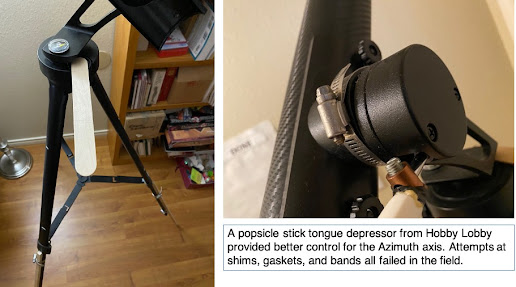
For four years, I did what I could with the mount, taking it apart and putting it back together but degreasers and lubricants, rubber bands and hose clamps never solved anything. 

All-in-all it has been a good little viewer and given the 70-mm limit not half bad for backyard stargazing. At that time, I also owned a Celestron EQ-130 Newtonian which I donated to the Goodwill earlier this year. 


Meanwhile, in October 2020, I bought myself an Explore Scientific 102-mm refractor. It comes on a First Light mount to keep the price down and I was never happy with the mount. It is difficult to control and somewhat underweight even for the 102. I was able to afford a Twilight I mount from ES, used and reconditioned with warranty. That has gone well for me. Now, I wanted to put the National Geographic on the First Light mount.


The easiest solution would have been to buy a Vixen mount, $79.95 plus tax and shipping, which was wholly disproportionate to my needs. 

I am not a fabricator. I have very few tools here. So, I went to Home Depot and searched for wood. I bought a 24-inch slat of quarter-inch poplar. 

With the saw blade on my Gerber pocket tool, I cut it in thirds and glued two pieces together. (I learned about Elmer's in junior high wood shop class.) 

The attachment screws on the telescope are mounted from the inside and I did not want to take those screws out. So, I used them to attach the new plate. Lacking drill bits, I used wood screws to make the holes. (We have an electric hand drill that my wife got as a door prize at a computer user meeting.) I ran a thin one in first, then widened it. 

Even though I measured more than twice, I was off by an inch the first time. I also split the wood once with a screw too large. After gluing (and curing) that, I wided the holes with my Swiss Army Knife. 

I secured the slat to the telescope with Gorilla glue. 

The best telescope is the one that gets used. 

I recently bought entry-level Celestron "First Scope" oculars ("eyepieces") to go with this so-called "hobby killer" that my astronomy colleagues denigrate for being a "department store telescope." OK: it is not an apochromatic rare earth triplet; the aperture (diameter) is not four inches or eight or ten. Nonetheless, I have seen the Messier 22 globular cluster, the Messier 44 "Beehive" open cluster, the Andromeda Galaxy (Messier 31), and, of course, Venus, Mars, Jupiter, and Saturn. Now, the telescope has a mount worthy of its optics.

PREVIOUSLY ON NECESSARY FACTS

(Mostly, the addenda links can be complementary or contrasting or off-topic. These are about observing with the National Geographic 70-mm refractor.)

Viewing Mars

M44 Beehive Cluster First Sighting

Astrophotography and Me

Jupiter-Saturn Conjunction 2020

Monday, August 31, 2020

The Fountainhead: an exploded view of one scene

We lose the past too easily. Ayn Rand was born in 1905. In The Fountainhead, anyone of mature professional status 1922-1942 would have been a generation older. Rand studied in an architect’s office, working for free in order to understand the craft and the business. I was pleasantly surprised to be informed by another book of an underlying tradition in engineering design. It was an eye-opener.

From The Fountainhead:

“You will kindly explain yourself,” [said the Dean].

“If you wish. I want to be an architect, not an archaeologist. I see no purpose in doing Renaissance villas. Why learn to design them, when I will never build them?” [replied Howard Roark].

“My dear boy, the great style of the Renaissance is far from dead. Houses of that style are being erected every day.”

“They are. And they will be. But not by me.”

“Come, come, now, don’t be childish.”

“I came here to learn building. When I was given a project, its only value to me was to learn to solve it as I would solve a real one in the future. I did them the way I’ll build them. I’ve learned all I could learn here—in the structural sciences of which you don’t approve. One more year of drawing Italian post cards would give me nothing.” 


From The Pencil: A History of Design and Circumstance by Henry Petroski, Alfred A. Knoff, 1990:

Although orthographic projection was used in Albrecht Dürer’s 1525 book on the geometry of drawing, and theoretic foundations were laid down in Gaspard Monge’s 1795 book on descriptive geometry, the techniques and conventions derived from the work of these pioneers did not become universally employed in what has come to be known as mechanical or engineering drawing until the nineteenth century, when it became virtually indispensable for conveying information to machine shops and iron foundries. Up until about the middle of the nineteenth century, engineering drawing was learned in the long tradition of architectural drawing, and many early machines, such as large steam engines, were designed with iron structural elements cast in the forms of columns of the classical orders. Functional brackets were adorned with the classical motifs that students had learned in drawing classes, which consisted largely of copying increasingly complex architectural drawings, and one can only speculate on how much of what came to be known as Victorian architecture and structure was influenced by this practice. 


Through the middle of the nineteenth century architectural drawing was learned by most, though not all, draughtsmen by tracing. Hence technique was learned at the expense of theory. …  The mid-nineteenth century state of the art of engineering drawing was recorded succinctly in the preface to one of the earliest textbooks on the subject, An Elementary Treatise on Orthographic Projection, Being a New Method of Teaching the Science of Mechanical Engineering by William Binns. According to Binns…:

“… the usual mode of teaching… is from the ‘flat’—that is, from copy—the practice being to lay before each student of the class a drawing of some part or parts of a structure which he is requested to copy. This being done, another drawing, probably more elaborate, is laid before him; and the same course is pursued until he becomes tolerably expert with his instruments and brushes, and eventually able to make a very creditable or even highly finished drawing from copy. If, however, at the end of one or two years of practice the copyist is asked to make an end elevation, a side elevation and longitudinal section of his black-lead pencil, or a transverse section of the box containing his instruments, the chances are that he can do neither the one or the other.”


PREVIOUSLY ON NECESSARY FACTS

The Genius of Design 

Science Fair: A National Geographic Film 

Absolutes and Objectives 

There Really Are “Civil” Engineers 


Thursday, December 1, 2016

Creature Comforts Show No End to History

It is a wonderful time to be alive.  We have become so used to material abundance that we have lost all perspective on where we are in the deep, broad, and swift flowing stream of history.  The best is yet to come, but the present is pretty good. 

My thoughts here were inspired by a discussion at work as a young lieutenant and an old sergeant wondered about the consequences of Star Trek transporter technology. The transporter is the basis for both the replicator and the holo-suite. Given those, why work?  Contrasting our lives with those of medieval serfs, I found lots of reasons to continue working.

My own discussion on this topic with a young captain started the day before, as a result of my buying a knife. On the recommendation of another young captain, I went to everyone's favorite tactical store and bought a Benchmade "Mini-Barrage." The next morning, I went online here at home and read about knives. "Why not a Gerber?" I asked at work. I got the same answer there that I found in an online forum for zombie hunters: the Gerber is a nice every day carry (EDC), but the best Gerber is about like the cheapest Benchmade both for price and quality. 

I was astounded at the content about pocket knives in four pages of links even before I got to the reviews of knives from Guns & Ammo magazine. My captain said that I could find people who know that much about luggage or briefcases.

PREVIOUSLY ON NECESSARY FACTS

Wednesday, January 14, 2015

The Perfect Machine

“Putting the observer inside the telescope had obvious advantages.”  The Perfect Machine: Building the Palomar Telescope by Ronald Florence (HarperCollins, 1994; HarperPerennial ppb 1995).  Author Ronald Florence grinds through the history to produce a polished narrative.  Unfortunately, as is too often true with popular reads, the chronology gets lost.  The book has an index and notes at the back.  Again, though, as a popular publication, the sparse notes are not tied directly to the text with numbers.  The work is entertaining, even compelling.  If this story of Mount Palomar excites you, then Internet references and websites for the great telescopes will give you even more to read.  This book will provide the context for those details.  

George Ellery Hale’s lifelong quest gave the world a set of telescopes, each larger than the previous. The 40-inch refractor paid for by Chicago entrepreneur Charles T. Yerkes was Hale’s first triumph, but not his first telescope.

“An astronomical telescope
is an impossible combination
of the scale of a battleship
and the precision of a microscope.”
Born in 1868, the eldest of three children, Hale grew up pursuing intellectual passions for machinery and tools, including microscopes.  His father made his money installing elevators as Chicago was rebuilt after the great fire of 1871; that gave George Hale access to local leaders. When Hale was fourteen he introduced himself to Wesley Sherburne Burnham, a court reporter and an avid astronomer.  Assisting Burnham, Hale was introduced to optician Alvan Clark, from whom he purchased a used four-inch telescope.  A decade later, Hale obtained from Clark the 40-inch glass blanks that became the Yerkes refractor.  
Next came the 60-inch reflector at Mount Wilson, then the 100-inch at Mount Wilson.  Hale died in 1938.  The 200-inch telescope at Mount Palomar was completed in 1948. It was more than the largest telescope.

“Gradually Anderson and Porter began looking at the scale of the telescope – the latest estimates were that the primary mirror would weigh close to twenty tons and the mounting more than five hundred – as an advantage.  The size of the telescope tube and the stability of the immense mounting meant that the auxiliary mirrors for the Cassegrain and Coudé  foci could be mounted in a permanent cell in the middle of the telescope tube, with gear-driven mechanisms to swing and lock them in place as needed.  The mirrors and cell, approximately six feet in diameter, would rob the central portion of the two-hundred-inch disk of only one-ninth of its area, an acceptable sacrifice. And since the telescope could tolerate a six foot cell, by extending the cell on the other side of the compartment that held the swinging mirrors, they had room for an observer to ride inside the telescope to use the prime focus.”

Also on Necessary Facts

Tuesday, November 5, 2013

Raymond Loewy

Today's Google Doodle celebrated the 120th birthday of Raymond Loewy, the father of industrial design. 


Raymond Loewy is called “the father of industrial design” for a reason.
He took ugly consumer items — pencil sharpeners, refrigerators — and made them beautiful.
He designed cars that were a decade or more ahead of their time.
He created kitchen appliances, crockery and furniture,
and did design work for Greyhound, the U.S. Postal Service and NASA.

(The website cataloging his work is here.) 
"I waited for the S-1 to pass through at full speed.
I stood on the platform and saw it coming from the distance at 120 miles per hour.
It flashed by me like a steel thunderbolt, the ground shaking under me,
 in a blast of air that almost sucked me into its whirlwind.
Approximately a million pounds of locomotive were crashing through near me.
I felt shaken and overwhelmed by an unforgettable feeling of power,
by a sense of pride at what I had helped to create.
I had, after all, contributed something to a great nation
that had taken me in and that I loved so deeply.
And I had come a long, happy way myself from my start in fashion advertising.
I had found my way of life."
Every artifact speaks to us, reflects us.  Loewy delivered the 20th century.  He was not alone but his sense of vision brought form to thousands of common items.  And they inspired a century of material progress that nurtured and rewarded the common (and largely unstated) belief that we can and will make a wonderful future.

PREVIOUSLY ON NECESSARY FACTS
The Genius of Design
Space is the Place: Come to the High Frontier
Jack Kemeny Knew: We Shall Have Computed
The Cure for a Failing Empire
The Science of Liberty


Thursday, October 31, 2013

Industrial Medals a Currency of Fame

Most people call it “coin collecting” but numismatics is the art and science that studies the forms and uses of money. That includes money-like objects, which we call “exonumia.”  Examples occupy the latitudes from merchant tokens and bus and bridge tokens to medals including military orders, such as the Congressional Medal of Honor.  The art medal was invented in 1439 by Antonio di Puccio Pisano (called “Pisanello”). The occasion was for the Emperor at Constantinople, John VIII Palaiologos, who came to Italian cities to negotiate treaties. (The standard reference is The Currency of Fame: Portrait Medals of the Renaissance by Stephen K. Scher, which is a catalog of the Frick Collection in the U.S. National Gallery of Art.)

The plethora of adverting exonumia has no easy taxonomy.  The Krause Standard Catalog of United States Tokens 1790-1900 by Russell Rulau assigns them to a dozen classes, but then must have another genus for mavericks. Within the classes – Advertising Checks, Counterstamped Coins, Poker Checks, Tool Checks, etc. – physical shapes exceed the limitations of Federal coinage: rectangles and hearts are statistical likelihoods.
41 mm reeded edge non-magnetic. 
Obverse: Durango Silveton Narrow Gauge Railroad.
(Steam from stack of engine with snow plow mounted at front.) 

Reverse: "Durango Rotary Club / Service Above Self /  
This coin is good for two dollars in trade at cooperating businesses 
in Durango through April 30, 1984. / High Noon Club” 
"Durango was founded by the Denver & Rio Grande Railway in 1879. The railroad arrived in Durango on August 5, 1881 and construction on the line to Silverton began in the fall of the same year. By July of 1882, the tracks to Silverton were completed, and the train began hauling both freight and passengers."The line was constructed to haul silver & gold ore from the San Juan Mountains, but passengers soon realized it was the view that was truly precious."This historic train has been in continuous operation for 131 years, carrying passengers behind vintage steam locomotives and rolling stock indigenous to the line. Relive the sights and sounds of yesteryear for a spectacular journey on board the Durango & Silverton Narrow Gauge Railroad."
All Aboard Magazine online here the official magazine of the Durango & Silverton Narrow Gauge Railroad.

 33 mm aluminum. Plain edge. 
1934 Chicago Century of Progress.
Obverse: Union Pacific Lucky Piece

Art deco Union Pacific engine.
Reverse legends: “Sample of the aluminum in the new Union Pacific train
built by Pullman Car & Mfg. Corp.” 

1929 trademark Norman shield with ACOA and ALCOA 
with stars in corners.
“Aluminum Company of America"

in exergue: "GREENDUCK, CHI"
Manufactured by Greenduck of Chicago (about that company here on E-Sylum of the Numismatic Bibliomania Society.)  One million given out at fair.

34 mm aluminum 4 mm height. plain edge
Obverse: Heavy machine press with BLISS name.
Legend: "Bettering the Standard of Value Since 1857"
Reverse: Standard US Bicentennial logo and legends.
Though he began building machines in 1857, E. W. Bliss founded his firm in 1867. Reorganized several times, a vestige still operates as Bliss Clearing Niagara in Hastings, Michigan, specializing in the repair and maintenance of industrial metal presses.  Bliss created primary production tools, machines that made other machines. They also produced military ammunition and a wide range of large and small containers made of sheet metal. For a short time around 1906, at their main office Brooklyn, New York, plant they manufactured an automobile.
E. W. Bliss Company on Wikipedia here:
“Walkabout the Lords of Owl’s Head” at the Brownstoner blog
See also the online sales catalog of the Sterling Machinery company.
(Not to be confused with Bliss Machines, founded 1987 outside Buffalo New York by Bill and RandyKanner.) 

J & L Steel. 35 mm non-magnetic plain edge. Spinner. 
Obverse: “YOU [up arrow]  WIN WITH J & L STEEL STOCKS” 
horseshoe and shamrock.
Reverse: “For dependable warehouse service 

call Walnut 1-0470.” J&L Steel in square.
 Every artifact gives evidence to the full context of its culture. A spinner is a coin struck with a raised center point. On the reverse side, an arrow points outward. “You pay” it says. Nicer variations such as “You win!” mean the same thing.

Founded in 1852 by B. F. Jones and Bernard Lauth as the American Iron Company outside Pittsburgh. James H. Laughlin bought out Lauth’s interest. Before 1861 and the firm was renamed in its new offices at Third & Ross in downtown Pittsburgh.  Growing up in Cleveland in the 1950s, our home was so close to the mills that late at night with the windows open, I could hear the yard engines working.  At its peak in the 1970s, the Cleveland facilities employed 4,000 people and produced 3 million tons of steel annually.
See also Wikipedia here

 Bronze 75 mm (3 inches). Extremely high relief.
Plain edge with incuse “Medallic Arts Company Bronze.”
Obverse: “Serving the Graphic Arts / 1906 – Fiftieth Anniversary – 1956”
“Pitman” (At left above P engraver’s name: Harold M).
Center: in Wreath: Camera, Press, Engraver’s hand with tool.
Reverse: three scenes: “Photo Engraving”: “Lithography”: “Rotogravure”.
Center triangle with center circle Camera and operator.
 
 Harold M. Pitman founded the company in Chicago in 1907. Starting out by himself, he made and sold steel dies and copper plates to engravers. Pitman celebrated its 100th birthday in 2007. Agfa Gevaert Group acquired Pitman for $80 million on July 15, 2010.  The Pitman brand is still seen at 16 sales and operations offices in the USA.

38 mm. Silver. Reeded edge.
Obverse: “Sierra Ball Pens” on Mountain. “Faber Castell / 1986” below.
Reverse modeled on Morgan Dollar.
Legends “
United States of America One Troy Oz. / .999 Fine Silver.”
"Faber-Castell, established in 1761 by the cabinet maker Kaspar Faber (1730-1784), is one of the oldest industrial companies in the world.  The company is the world’s leading manufacturer of wood-cased pencils with a varied range of products for writing, drawing and creative design, as well as decorative cosmetics. …  Today the eighth generation family member Count Anton-Wolfgang von Faber-Castell, who took over as head of the company in 1978, has been instrumental in new product development and the expansion of international activities."

"One of its biggest eco-initiatives came in the mid-1980s, when the company started a sustainable tree-planting project in Brazil. Developed on former grassland and nowhere near the Amazon River, the company-planted pine forest provides about 75% of Faber-Castell's wood. After the trees are cut down, they're quickly replaced with seedlings of fast-growing pine species.”

The application of steam engines and machine tools to coin production allowed industrial and commercial firms to celebrate their products, services, trades and crafts with coin-like objet’s d’art.  The first of these were the “British Provincial” series of the 1790s, mostly struck by the Soho Mint of James Watt and Mathew Boulton. In half-penny and penny size, they often promised to pay pounds sterling in return for 480 or 240 brought to London or Birmingham. Their beauty, consistency and cost-efficiency eclipsed anything from the Royal Mint. 

In America, private tokens of the Jacksonian Era spoke to the politics of the day.  They skirted the laws against private money. “Millions for Defense NOT ONE CENT for Tribute” was a common reverse legend.  Through the nineteenth century, thousands of taverns, restaurants, and general merchandise retailers issued “Good-for” tokens.  Essentially, these were ad hoc currencies backed by the goods and services of the issuers. 

In parallel to all of that, many coin-like items declared no value, but only announced the firm. Behind government money and private currencies, numismatics grants only a third place interest to these. Nevertheless, they continue a tradition from the Renaissance to honor oneself and to announce one's achievements to the world.

PREVIOUSLY ON NECESSARY FACTS

Monday, April 22, 2013

OBJECTIFIED

Objectified is a film by Gary Hustwit about design, designers, and the objects that they create.  Dieter Rams of Braun and Apple’s Jonathan Ive appear, of course. (See, The Genius of Design below.)  So do thirty other designers, and a couple of supportive critics, such as Paola Antonelli of the Museum of Modern Art.  IKEA and Target both get cameo roles as they deliver to us the magic of inexpensive mass produced items that ennoble us, their owners, with the spiritual benefits of good design.  You and I also appear in anonymous walk-ons because in the words of Andrew Blauvelt, “anything that is touched by man, is transformed by man, is by its very nature designed.” The human-built environment is design.

Dirt Devil by Karim Rashid

Karim Rashid works for the “techno-organic world.” As a teenager, he owned a Claritone stereo radio and a Braun alarm clock and through his teenage angst, looking at them alone in his room brought a sense of comfort.  He calls our time the “third technological revolution.” To him, our living room furniture is like a kitsch stage prop. “When I get up from my laptop and my iPod, do I get into a horse and carriage? No.”


Claritone stereo similar to Karim Rashid's.
According to Andrew Blauvelt, the design concept has three layers. First form begets form, the formal logic of form.  Then come symbols and symbolism, the cultural symbols.  From that comes the contextual symbolism of making coffee, for instance, the bigger scenario of the human-object relationship.  The little rituals define the fork and knife.  The vacuum cleaners from Dirt Devil and Dyson extended the horizons for a single-use product into designer goods for display. Ultimately, the Roomba programmable robot vacuum allowed an undreamed of level of hacking as user interaction.


Alice Rawsthorn of the International Herald Tribune points out that if you were a Martian and you came to Earth, you could pick up a spoon or a chair and pretty much get a feel for their purpose.  Now, the digital age removes that.  Objects can take any shape.  This leads to tensions and conflicts in design. 


But objects do not take just any shape.  Some seem intractably wedded to their pasts.


Three principals from IDEO of Palo Alto shared a common theme in their different experiences of design.  "I inherited my father’s leather briefcase and it got better with time and I look to passing it on.  I look to designing things for wearing in versus wearing out.  ... I designed the case for the GRiD “Compass” computer in 1987, the first laptop.  When I got it home I realized that the beautiful case and clever latches were irrelevant to the user experience, so I came to study software interfaces.  ...  "


"... because in that moment it moves you,
you have an emotion"
-- Hella Jongerius
Naoto Fukusawa designs hardware interaction. Subconscious actions develop the mind and soul: design dissolving in behavior. “A very important turning point for me was the term "obsessive sketch" by Takahama Kyoshi, the haiku master. When the poet’s sentences are overly visible the audience may become uncomfortable. Japanese ritual is the opposite.” 


Rob Walker of the New York Times Magazine asks rhetoically, when the hurricane is coming and you have twenty minutes to pack, what do you grab? Not the object that got a great review in some design magazine, but the object that means the most to you.

Paola Antonelli insists that “democritization of design is an empty slogan.” According to Paola Antonelli, “design takes revolutions and progress and makes it into objects that we can use.”


Speaking of his work on the MacBook Air and MacBook Pro, Jonathan Ive says that the curse of being a designer is always looking at everything and wondering “why does it have to be that way and not some other way?”
Ad hoc design: wine cork as doorstop

Ad hoc design: section of plastic cup as bicycle fender

I want things that do not exist, that you cannot go out and buy, what is going to happen, not what has happened. – Marc Newson.


Within Karim Rashid's apartment

ALSO ON NECESSARY FACTS

Sunday, April 21, 2013

The Genius of Design

“For industrial designers, the world is never enough. They give shape and texture to the world to make it livable—indeed, beautiful—for the rest of us. This fascinating five-part documentary examines the art and science of design and the stuff it shapes, from computer chips to cityscapes and everything in between. See the evolution from artisans’ workshops to industrial mass production, and the profound changes it has wrought in our economy, society, and environment.” – from the promotional.

In five episodes running 242 minutes, we meet some of the leading designers who gave us our material world.  They are not engineers. They are not scientists.  The Apple computer was the creation of Wozniak and Jobs, of course, but they did not give it the form we know.  Their Macintosh, their iPod, Sony’s Walkman, all of the furniture in an IKEA warehouse, and even the weapons of war achieved materiality because designers thought long and hard about how real people would use these common objects.

“Meet historians, critics, and legendary contemporary designers, including Dieter Rams (Braun electronics), J Mays (Ford), and Jonathan Ive (Apple), who reveal the thinking behind iconic products such as the VW Beetle, the Eames chair, and the computer desktop. Along the way, discover how design has influenced even the outcome of war.”

At a time when – surprising to us, today - German goods were called cheap AEG launched what may have been the first modern rebranding.  They hired Peter Behrens who created a new AEG typeface for both their advertising and their product labeling. From William Morris and the Arts and Crafts movement to Dieter Rams of Braun, from Henry Ford to Ford Motor’s J Mays, we meet the people and their works and their critics (mostly favorable).  Produced for Athena Learning by Tim Kirby’s team for Wall to Wall Media, the video is supported by the Athena website (here) which delivers biographies of Raymond Loewy, Margarete Schütte-Lihotzk, Henry Charles Eames, Alberto Alessi, and Philippe Starck.  The videos also show us Joe Columbo, Robin Day, Jock Kinneir and Margaret Calvert, Earl Silas Tupper, Verner Panton, Marc Newson, and Michael Graves, among many others.  You may not know the names, but if you ever read a highway sign or sat in a plastic chair, you know their work.  It is not always easy. The graphical user interface was first introduced in 1963.  


Supporting the presentation, the website also delivers a study guide for classrooms, and a booklet with more ideas centered on design failures. 
  •  Episode 1:  Ghosts in the Machine: What distinguishes good design from bad design in a consumer product?
  • Episode 2: Designs for Living: To what extent is the kitchen in your home “a machine for living”
  • Episode 3: Blueprints for War: The British Sten gun was designed as a cheap, easy to manufacture, and ultimately disposable weapon. The German “Tiger” tank was the finest quality motorized cannon possible – and because of that, it could not be produced in sufficient numbers.
  • Episode 4: Better Living Through Chemistry: Plastic, for better and worse. Steve Jobs famously said, “You know a design is good when you want to lick it.”
  • Episode 5: Objects of Desire: How do you think the challenges of sustainability and limited disposal will affect product design in the decades ahead? Glen Olver Low calls it “Crade to Cradle.”  Instead of being down-cycled, his concept of recycling returns material to the highest level of manufacturing processes.


Michael Graves found his inspiration - in part - at a flea market, where he saw a hand-made stopper, carved as a rooster which sang when the water boiled. The conical shape was dictated by the need to boil water as rapidly as possible.

Previously on Necessary Facts