Showing posts with label consumer goods. Show all posts

Sunday, May 22, 2022

Product Review: Bresser EQ3 and 70mm f/10 Refractor

Keep the telescope. Throw away the mount.


This instrument is an embarrassment to the tradition of German engineering. Like very many other sellers of consumer optics – telescopes, binoculars, microscopes -- Bresser GmbH, Gutenbergstraße 2, 46414 Rhede, buys much of its production from China. This telescope, and especially its mount, betrays its Chinese origin with cheap engineering and poor production. The optics are fine. This telescope works as well as the other 70mm refractors that that I have from Meade and Celestron and the National Geographic label (all of them also made in China). Within the range of consumer goods, the optics are a given. It is the mechanics that fails. 


The first clue is the grease. Chinese routinely apply thick grease that hobbyists remove and replace with machine oil. 


I bought the telescope and mount from Explore Scientific on 31 March 2022 and it arrived on 7 April. It was easy to assemble but I also could see that it had basic design problems. First and foremost, there was no way to orient the setting circles for Right Ascension and Declination. 
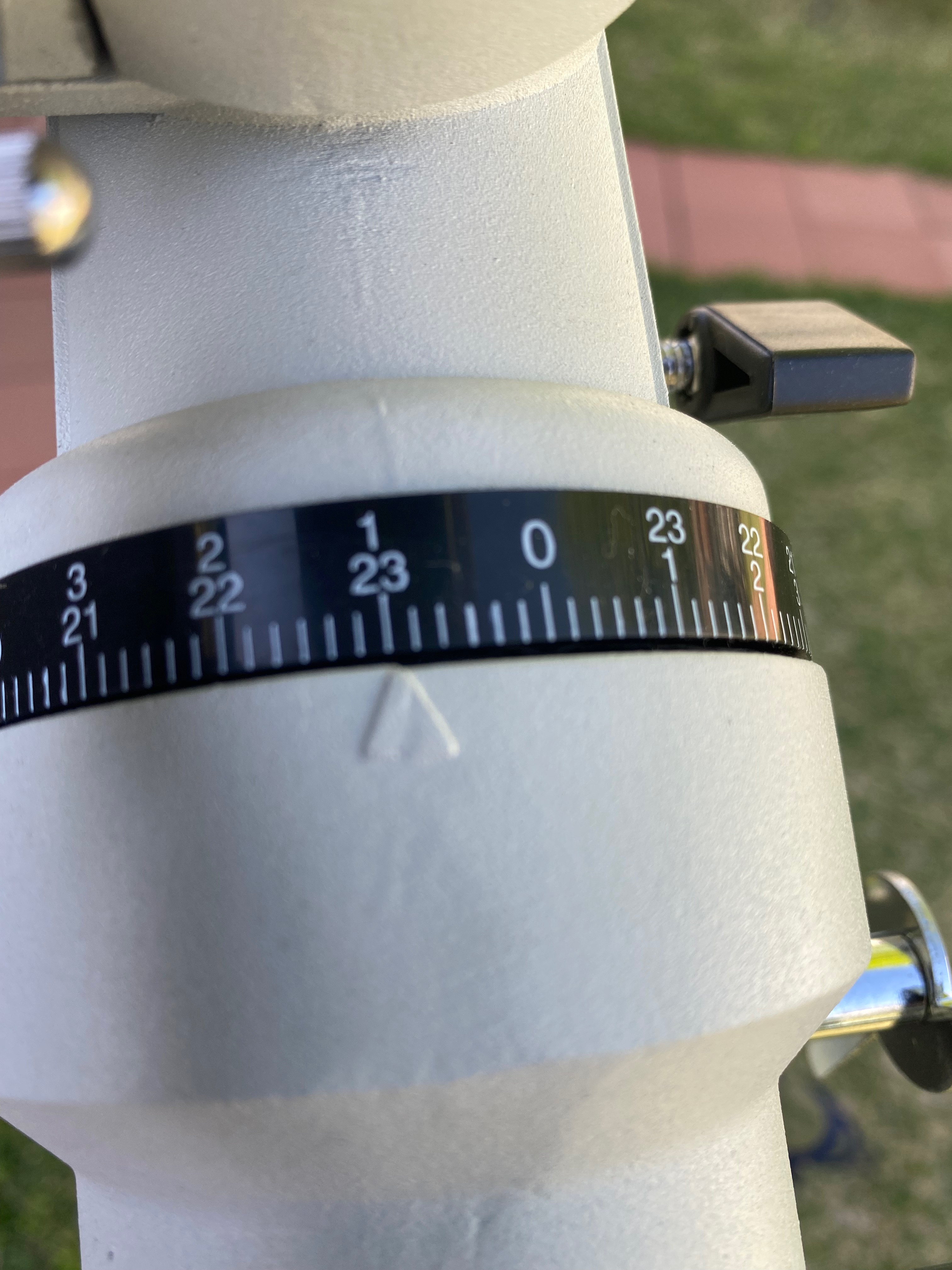

With the telescope aligned correctly to North,
the Right Ascension is wrong by 48 minutes.
The circle would not move, glued into place
with heavy grease.

When set to my latitude (30 degrees North) and aligned on Polaris the setting circles read 23 hours Right Ascension and 70 degrees North Declination. Polaris is at 2 h 31 m RA and 89° 15’  


With the telescope set correctly,
the declination is wrong by 20 degrees.
The circle could be hard-set at the factory
to 90 degrees. (89.25 degrees is more exact.)
But the circle should still be adjustable.


Regardless of any other movements or settings, the setting circles were fixed in place as if they are glued there. Indeed, they were: with grease. 


After several sessions over two months of taking this down and setting up and trying this and that, I finally pried the setting circles loose and washed them off with rubbing alcohol. (I have GooGone, but I did not want to risk damaging the circles.) Also, the axes would move some distance and then stop. If I slewed the telescope manually, I could get more motion and move easily some short distance in the opposite direction.


After the first failures on the first afternoon, I remounted the telescope on an Explore First Light Nano altitude-azimuth mount and tested its optics. I alternately used both the 25 mm and 9.7 mm Plössl oculars. After aligning the finder with Sirius, I quickly found the Messier 41 open cluster and then Messier 42 the Great Orion Nebula and its Trapezium asterism. I also split the binary Mintaka (delta Orionis). I located another asterism that I know, sigma Orionis. I was pleased with the result. The easier of the two binaries was distinct. The smaller pair gave only some hint and only because I knew what I was looking for an looking at. They are much clearer in my larger Explore Scientific 102mm achromatic doublet refractor. Viewing the waxing crescent Moon I also was happy to find that the focus did work well with two filters screwed into the oculars. I ended the test with Mizar-Alcor (zeta Ursae Majoris), easily and clearly revealing Mizar’s visual companion. The optics of this telescope are good. 


Problems with the Mount


The right ascension (RA: hours-minutes of arc from the peripoint of Aries) axis would move a little in one direction and then move back more in the other. If I rotated the telescope manually, the slow motion cable would move the RA axis more in one direction and then less in the other.


Five days later (12 April 2022) I set the telescope up again in my office so that I could work indoors during the day. The gears locked. With all clutches open, the counterweight shaft with the Dec scale 0-9-0 would not move. Using the motion control knob, the RA moved a little and then quit. This happened often when I first set up the telescope. At other times the declination axis (Dec) would behave the same way, not moving the axis while turning the knobs, though in those cases, the RA would move. Before it locked up the RA would alternately respond with large movements in one direction but only small motions in the opposite travel.  

  • I disassembled the Dec axis. 
  • I removed the three hex pins holding the collar. 
  • I removed the counterweight and its shaft. 
  • I removed the cover with the worm gear. 
  • I was able to turn the axis freely through several rotations. 
  • Using a locking pipe wrench, I was able to move the Dec axis.
I put it back together, noting that the shaft must be somewhat loose, looser than hand-tightened, in order for the circle to move relative to its pointer.
  

15 April 2022 18:30 I watched half a dozen YouTube videos and read four articles online. Most of them were useless, very basic, not at all mentioning any of my problems. One stood out. How to use setting circles on a small telescope (and why they don't work!) Astronomy and Nature TV here: https://www.youtube.com/watch?v=geQszAVWMok


At the 2:35 mark, he gives a “Bluffer's Tip” for setting the polar alignment. It was the missing piece of the puzzle. In reality, I have to do the same thing I have done for a computerized “go-to” mount: star alignment. After setting up the telescope mount in Latitude and Direction (with a compass or your cellphone, for example), use a reference to identify a known bright star and its Right Ascension and Declination. In this video, he uses Dubhealpha Ursae Majoris


That solved one basic problem. So, I hauled out the telescope again (in daylight this afternoon). I found that with all of the movement back and forth, assembly and disassembly, the setting circles are now loose enough to move by hand. 


The remaining problem is that after traveling in one direction, the setting circles RA and Dec stop moving. The slow motion cables do turn but the axes stop traveling. One or the other will turn and then not, but then travel in the opposite direction when the cable turn is so turned. The cables turn; the telescope does not travel.


7 May 2022 Before going out I made a table of prominent stars in my early night sky and continued testing the mount. 


The axes would not hold their settings.

I aligned on magnetic north with a compass, then re-aligned on True North with my cellphone.

1.     I located Polaris. The readings were 19h 30m and 0 instead of 02h 31m and 89 degrees. I set the Right Ascension wheel to 2h30m.

2.     Next, I turned to Arcturus. The readings were 9h 50.5m and 50 degrees. I reset the circles to 14h 15m and 19 degrees. 

3.     Finding Spica the readings were 15h and 10, close to the actuals of 13h25m and -11d  (11 South). The declination setting circles do not differentiate the two halves of the circumference.

4.     Locating Regulus the setting circles showed 6h 30m and 0d 20m, far from the actual values of 10h (10h 08m) and 12 degrees (11d 58m).  

I gave up for the night and viewed with an Explore Scientific 102-mm f/6.47 achromatic doublet on an Altitude-Azimuth mount.

PREVIOUSLY ON NECESSARY FACTS

Baader-Planetarium Micro-Guide Reticle 

$2500 Viewed Through a Telescope 

70-Millimeter Shootout 

Product Review: Celestron AVX (“Advanced AX”) Mount and Tripod 

Celestron AVX Mount: Twelve Nights of Viewing and Learning 


Saturday, October 24, 2020

New Telescope: Explore First Light 102 mm Refractor

The problem with consumer goods is that at the designers are not you. Everything is always a matter of trade-offs. The decisions that other people make for you might not be the ones you would make for yourself. 

I bought a new telescope to use in the backyard. As vice president of the Austin Astronomical Society, I invited Scott Roberts, the CEO of Explore Scientific, and Stuart Parkerson, publisher of Astronomy Technology Today, to be our guests for a panel discussion. Ahead of that, I shopped at Explore for my next backyard instrument. They answered three emails and then asked me to call them on the phone before I was a customer. And they talked me out of buying extra oculars until I used the telescope often enough to judge better what would suit my needs. I was impressed. 


The Explore Scientific First Light 102-mm refractor ($279) is a good instrument. Placing aside my cognitive dissonance, I made some minor modifications. 


Because the objective lens is so large and heavy, the telescope does not balance in the center of the dove-tail receptacle. It balances almost full-forward in the grip so that the ocular has more moment arm, like a child on a see-saw balancing a grown-up. 


The objective still has a tendency to dip into the tripod, so I attached two strips of foam under the front. 

The XYZ control is a single lever that I found too short. So, I added 6 inches of plastic tube to bring the control closer to the focus draw adjustment wheels. 


29 October: I removed the extension. It was too much leverage. It is easier to control the alignment by holding the frame. The action is still very tight: won't go--won't go--won't go--too far! I now know that I personally prefer gear-driven tracking. 


The only other payment for the price is that the very artistic mount has the elastic stability of a thin plate. Fortunately, it damps out quickly. 


The optics are good. The 102-mm (4-inch) objective brings in Jupiter, Saturn, and Mars well enough. The 660-mm focal length works best with my 17, 13, and 8 mm oculars. When the weather clears, I will use the Moon to try my 32-mm and the new 25-mm eyepieces. The final test will be the Pleiades, over my neighbor’s treetop after midnight and on the zenith before 03:00. 


I was never satisfied that I had properly collimated my Celestron 130 EQ reflector. After a final round of stargazing and finding Albireo on my own, I put it all back in its shipping cartons and stored it in the garage along with the Meade 10-inch Schmidt-Cassegrain telescope (SCT) that I have on loan from the Austin Astronomical Society. (I took that one out just once; and at 65 lbs to my 68 kg, I found it inconvenient.) I bought a used 8-inch Meade LX Classic SCT from the club. The circa-1995 on-board computer did not work, after being repaired twice. They asked $250 and I countered with $325. It was a nice scope, but the right ascension (XY-left right) locked up and I did not want to take it apart. So, I gave it to the Goodwill. They will fix it, pass it along, and make some money. 


My go-to scope has often been a 70 mm National Geographic refractor that I bought used from some kids down the street. They got it for Christmas and by July had lost the eyepieces, the cellphone adapter, the center plate, and the control rod for altitude (Z-up down). And the dew shield was jammed on backwards. (For all of that, they had never used it outdoors.) But it was a National Geographic brand; and I tested it on the street, and the objective seemed OK. It takes the standard 1.25-inch oculars. And it is an f/10 with a 700 mm focal length, which works well for higher magnifications: 13-mm ocular with 2x Barlow for 108x. So, for what it is, it has served me well in the backyard. But after three years, it is held together with rubber bands. So, I went shopping for a new go-to 'scope. The best thing about the Explore First Light 102 is the word “light.” All together I can carry it with one hand.


PREVIOUSLY ON NECESSARY FACTS

Problems with Pop Sci from Sky & Telescope 

Physics for Astronomers: the Works of Steven Weinberg 

The Asteroid Hunters by Carrie Nugent 

Backyard Astronomy (2) 

Backyard Astronomy (1) 


Thursday, March 30, 2017

Consume ... Consumer ... Consumed.

Capitalism is built on selfishness, but not every whim that pops into your head is in your self-interest. If you do not examine your philosophical premises, you can commit to grave habits without thinking. That lack of thinking - not any particular error in logic - is the root of all evil. 

I know from numismatics that it takes all kinds of people to make markets, and to make them work. In numismatics, we buy and sell money for fun. For many, it is a livelihood, a profession, a calling. Crooks are easy to find, people who knowingly sell counterfeit collectibles on the theory of caveat emptor. Their success comes "one customer at a time" because they never get repeat business.  Also common are true egoists who build and maintain their enterprises with good relations and healthy social ties.
At my neighborhood Whole Foods

The American Numismatic Association has a strong Young Numismatists program that brings the rich array of opportunities for learning to youngsters. Of all the ANA member clubs, the Michigan State Numismatic Society has the strongest YN program I have seen. They teach kids to be pages, running food orders for dealers at conventions  and getting paid in tips. They learn how to earn money before they learn how to spend it.

So, I have to wonder how many of these children - already flagged as habitual customers - are being raised by liberals, progressives, and socialists who think that reinforcing consumer behavior is the way to save the planet -- or perhaps they do not think about it.

PREVIOUSLY ON NECESSARY FACTS

Numismatics: History as Market 
The Influence of Ayn Rand's Objectivism  
Hail Merry Desserts  
The Genius of Design  

Thursday, December 1, 2016

Creature Comforts Show No End to History

It is a wonderful time to be alive.  We have become so used to material abundance that we have lost all perspective on where we are in the deep, broad, and swift flowing stream of history.  The best is yet to come, but the present is pretty good. 

My thoughts here were inspired by a discussion at work as a young lieutenant and an old sergeant wondered about the consequences of Star Trek transporter technology. The transporter is the basis for both the replicator and the holo-suite. Given those, why work?  Contrasting our lives with those of medieval serfs, I found lots of reasons to continue working.

My own discussion on this topic with a young captain started the day before, as a result of my buying a knife. On the recommendation of another young captain, I went to everyone's favorite tactical store and bought a Benchmade "Mini-Barrage." The next morning, I went online here at home and read about knives. "Why not a Gerber?" I asked at work. I got the same answer there that I found in an online forum for zombie hunters: the Gerber is a nice every day carry (EDC), but the best Gerber is about like the cheapest Benchmade both for price and quality. 

I was astounded at the content about pocket knives in four pages of links even before I got to the reviews of knives from Guns & Ammo magazine. My captain said that I could find people who know that much about luggage or briefcases.

PREVIOUSLY ON NECESSARY FACTS

Friday, May 1, 2015

Happy May Day, Comrades

"Defending Capitalism Against Ayn Rand" by Steven Farron on Liberty Unbound, the website successor to R. William Bradford's print magazine, challenges mainstream Objectivism on what it means to be a capitalist.  Farron's thesis is that Ayn Rand was deeply influenced by the grand ideas of the Bolshevik Revolution while capitalism is really concerned with the seeming trivialities of life such as soap and lipstick. 

The essay resonated with me because from my first reading of The Fountainhead in 1966, it was obvious that Howard Roark was some kind of beatnik.  "He pulled his clothes on: old denim trousers, sandals, a shirt with short sleeves and most of its buttons missing."  At one of several crossroads in the story, we meet his antithesis, Hopton Stoddard, a mushy man, terrified by religion, and successful in several lines of business including real estate and contraceptives.  

The heroes of Atlas Shrugged could have continued living materially very well from page one if they just put up with some inconvenient government regulations.  But as The Internationale tells us: "You have nothing if you have no rights."


The Internationale
modern English lyrics

Stand up, all victims of oppression,
For the tyrants fear your might.
Don't cling so hard to your possessions
For you have nothing, if you have no rights.

Let racist ignorance be ended
For respect makes the empires fall.
Freedom is merely privilege extended
Unless enjoyed by one and all.

Chorus:
So come brothers and sisters
For the struggle carries on!
The Internationale
Unites the world in song.
So comrades come rally
For this is the time and place!
The international ideal
Unites the human race!

Let no one build walls to divide us,
Walls of hatred nor walls of stone.
Come greet the dawn and stand beside us;
We'll live together or we'll die alone.
In our world poisoned by exploitation,
Those who have taken, now they must give.
And end the vanity of nations;
We've but one Earth on which to live.

And so begins the final drama
In the streets and in the fields.
We stand unbowed before their armor.
We defy their guns and shields.
When we fight, provoked by their aggression,
Let us be inspired by like and love.
For though they offer us concessions,
Change will not come from above.


You can find many montages on YouTube.  
This is my favorite so far.

Also on NecessaryFacts

Friday, May 31, 2013

Readability is the Only Metric

What you can measure, you can improve.  Whether you need creative content for e-commerce or step-by-step instructions for machine repair, you must reach your audience.   Microsoft Word offers metrics for readability, from the Grammar and Spelling checker, under Tools.   We have no quantified methods for creativity, invention, cleverness, or insight.  We can measure word length, sentence length, and sentences per paragraph.  

It is not perfect. In fact, it can be gimmicked, tricked, and gamed.  But it works.  On a project to develop a multiprocessor industrial controller, the other technical writer was a young guy from an advertising agency.  He did not know manufacturing, but he was good writer.  We enjoyed finding some of the many failings in the MS-Word readability scales. We still used them.  They proved that we documented the interactive debugger to a 6th grade reading level.  When the line is down, no one is looking for a literary experience. You need answers.


Texas Department of Information Resources
IT Policy - Originally at 12.9 reading level
Same IT Policy - Rewritten to 12.0 reading level.
Of the 300,000 main entries in the Oxford English Dictionary, only 3,000 are Basic English; and most of us speak only 10,000 distinct words.  The average college-educated American recognizes about 100,000 words.  Whether "fardels" in that list is putative.  So, Hamlet's rhetorical question might pass the readability score, but not carry meaning.  Whether "putative" is in your speaking vocabulary may be arguable.

The fact remains that we have an objective measure for readability. 

Also on Necessary Facts
Visualizing Complex Data
Documentation is Specification
The Art of Typography
 The Genius of Design
How to Hire a Technical Writer

Wednesday, September 14, 2011

The Family Business

The classic entities of businesses, households, and governments might be useful constructs for conceptualizing market operations, but, really, like planets, meteors, and stars, they all must obey the same same general laws – and distinctions among them can be blurred easily. In fact, every family is a business. The most successful family businesses are those that perceive themselves as such.  Academic economics - even from "free market" professors - teaches from false assumptions.

"Households produce goods and services for their own consumption and not for the market."
Firms have internal accountants, rather than hiring accounting firms – which they also do. Shipping and receiving, sales, etc., all could be contracted but are produced internally. If nothing else, households export labor – and capital goods such as the lawn mower and dishwasher enable that. Hans Rosling's TED Talk, "The Magic Washing Machine" (here) praises the liberating power of this capital good. We just moved from Ann Arbor to Austin. I have no idea how many fractional horsepower motors I packed – drills, sander, saber saws; mixer, blender. We have several computers networked here. I did not count the obsolete 5.25-inch diskettes I dumped. (My Carmen Sandiego and SimAnt were still pretty fresh.) The tax laws that allow businesses to write off obsolete capital do not apply to households, but they should.

"Households do not exist in an environment that could meaningfully be called competitive."
The Capulets and Montagues would disagree, as would the Rothschilds and Warburgs. They competed against each other and cooperated in joint ventures. Even the families that do not understand this at least must export labor. In that, they compete. 

The two axioms in bold come from a paper by Steven Horwitz and Peter Lewin, "Heterogeneous human capital, uncertainty, and the structure of plans: A market process approach to marriage and divorce," in The Review of Austrian Economics (2008; 21:1-21; available here.) The paper offers much to consider. It nonetheless repeated many of the basic flaws of academic economics, and did so from a middle American point of view. 

 It is true that the institution of marriage in modern America has changed over the past 100 years. However, the authors over-reached by ignoring the many folkways that define "family" and "family business" in other cultures. Dowery and bride price are real and functional economic considerations. In ancient China, a woman’s production of silk cloth was the creation of household savings – and she knew it. In rural America of the 19th-20th centuries, cash income from the sale of butter and eggs was the wife's own.

Feminists rightly pointed out that "women's work" i.e., housework is undervalued: washing, cooking, shopping, caring for children, cleaning, gardening, and all the other tasks are not income; and their costs of production are not tallied. Neither is "man's work." Mowing the lawn, cleaning the gutters, and the other chores are invisible to economists.

This reflects another error in academic economics: confusion about consumer goods and capital goods. Easily, capital goods are tools that are employed to create other goods or services. Of consumables, food is perhaps the paradigm. But food is also the primary capital good.

Capital goods such as machineries wear out; they are abandoned when obsolete.  Also, they can be reconfigured, recombined, or redeployed to other ends. A factory worker may require protective clothing, a capital good. But an office worker also requires special clothing. Yet, the prints and patterns, styles, fads, and fashions are not recognized for their productive power.

We all produce... and consume... The laws of economics are not to be ignored, no matter what convenient labels allow us to isolate actors and their actions.  Governments, businesses, and families are helpful concepts when considering markets, but they are not essentially different from each other in any economic sense.

ALSO ON NECESSARY FACTS