Showing posts with label communism. Show all posts

Sunday, February 27, 2022

Unscientific American

I did not renew my subscription to Scientific American because it has devolved into a platform for collectivism. It is not merely the political agenda. Politics rests on epistemology and Scientific American has abandoned the scientific method and replaced it with authority opinion. 

In fact, science was presented that way 100 years ago. A scientist (professional or amateur) submitted their paper and if the journal found merit in it, they published it. Footnotes and references are the modern style. It can get excessive. In my review of The Invention of Enterprise for the now defunct Libertarian Papers (reprinted here), I took issue with an avalanche of citations to validate an obvious fact. Erring in the other direction, authors in Scientific American assert the hypothesis rather than offering evidence and Scientific American now publishes empassioned pleas for an intellectually bankrupt political agenda.

I have been thinking this through for over a year. I subscribed in 2020 because Covid closed the University of Texas and I (among very many other independent scholars) lost my library privileges. Subscribing to Scientific American (as well as Sky & Telescope) bought access to their archives. For Scientific American that was highly important. 


Today's left wing slant was obvious and I just ignored it. The science articles were still respectable. Evidence of that was in the January 2022 issue, which carried an article about the Antikythera Mechanism by Tony Freeth. However, the same  issue carried “Inside America’s Militias” by Amy Cooter. The first was a technical report for the general reader who is interested in science but uninformed on this topic. The second was one person's self-validation of beliefs she formed before she began her university education. 
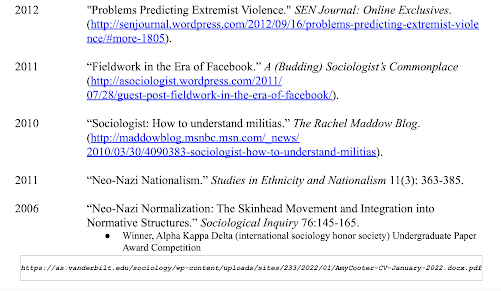
 

From Dr. Amy Cooter's curriculum vitae.

Both were personal narratives. Freeth has devoted decades to studying, writing, and lecturing about the ancient computer. His article in this issue included many references, citations, and pointers to the works of others. Freeth has puzzled over the Antikythera and invested careful, questioning thought to the many problems it presents.


Cooter cites two people who agree with her, or with whom she agrees. Unlike Freeth, she did not come to this research with an open mind. She is not necessarily wrong in her basic facts, only in how she weaves them into a scripted oratorio.


It is an easy claim that the militias, being traditionalist are also masculine. The affinity of men for weapons is obvious by inspection. Benign sexism is a consequence of that. As a guy who has served in uniform, I assure you that protecting women and children is not open to question. At that same time, I served with, alongside, and under the command of women. I never had a problem, though I did report up the chain to inform the leadership about other men who did need some corrective counseling on the subject.[1] It is a known situation.


Dr. Amy Cooter does admit that the right wing militias do have women in command. In her January 2022 Scientific American essay, she wrote: “There are a few women who fully participate in militias, and because of their activity they tend to be well respected and rise to leadership roles. (Jessica Watkins, leader of an Ohio militia who was arrested for her participation in the Capitol riot, is one example.) Still, most militia units have a culture suffused with casual misogyny.” Personally, with my master’s in social science, if I were considering a doctorate, I would find the subject of women in command of traditionalist militias more compelling research than the observable truth that boys like to camp out and play with guns.


Like Cooter, I grew up Republican. My introduction to libertarian versus traditional conservative ideology came at the 1965 convention of Young Americans for Freedom. There, I met conservatives who were opposed to the draft and to the war in Vietnam. I also had to come to grips with the fact that many of my comrades on the right were racists who believed that Negroes are substantially different from and inferior to us white folk. I found that attitude repugnant and distanced myself from the people who asserted it. 


So, when in college, I turned hard to the left, I also found it easy to parse the many, many varieties of socialist theory, including the distinctions among British Labour and Social Democrats, Lenin, Trotsky, Bolsheviks, Mensheviks, and the American Marxist, Daniel de Leon and his Socialist Labor Party. Much later in life, I came to understand how left wing syndicalists became the anarchists of the Spanish civil war and right wing syndicalism became fascism. 


Understanding those nuances led me to ask why the same people who decry the insurrection of 6 January 2021 were silent during Occupy Wall Street. I admit that it is a rhetorical question. 


The final failure came in a special supplement for March 2022. Under the rubric “How COVID Changed the World” by senior editor Jen Schwartz, the lead article was “A Microbe Proved That Individualism Is a Myth: Humans evolved to be interdependent, not self-sufficient” by Robin G. Nelson (biological anthropologist at Arizona State University). Nelson builds her hypothesis from an inventory of complaints: 


“For countless Americans, there was a dull but persistent pain to prepandemic life: high-priced housing, nearly inaccessible health care, underresourced schools, wage stagnation and systemic inequality. It was a familiar ache, a kind of chronic hurt that people learned to live with simply because they had no other choice. Faced with threadbare safety nets and a cultural ethos championing nationalist myths of self-sufficiency, many people did what human have always done in times of need: they sought emotional comfort and material aid from their family and friends. But when COVID-19 hit, relying on our immediate networks was not sufficient. Americans were gaslit into thinking that that are immeasurably strong, impervious to the challenges people in other countries face. In reality, our social and economic support systems are weak, and many people are made vulnerable by nearly any change in the capacity to earn a living. The fallout from the pandemic is an urgent call to strengthen our aid systems.”


The thesis fails from unnamed collectives: “countless Americans … people… many people… Americans… people in other countries… many people...” It offers not a single measure, no statistical survey, no validated polling. 


I point out that nationalism is not individualist. I might accept that the myth of personal self-sufficiency may be found nationwide. I must insist that nationalism denies personal self-sufficiency and insists on the integration (or total absorption) of the individual into the nation (as defined by its self-identified leaders). 


And individualism is not a myth; it is fact of life. 


"In his apologia for chemistry, The Same and Not the Same, (Columbia University Press, 1995) Nobel laureate Roald Hoffmann asserts that no two hemoglobin molecules are identical. So-called “identical twins” are not. Individualism is objectively real: both empirically knowable and rationally explainable." On my blog here.


People who receive intense family care and people who benefit from the highest levels of professional medical care in a hospital still die. They give up. The time comes when you decide. You make the choice that no one else has the right to make for you. And every moment of every living day, you decide to make the best of your life, regardless of your circumstances.[2] 


Moreover, during the pandemic, hobbyist markets have flourished. In amateur astronomy, we found sales exploding. Millions of other people returned to reading, walking, and other pastimes. These are personal pursuits, edifying and enjoyable. Millions of parents learned to get along with their own children and to appreciate the teachers on whom they previously had inflicted their brats. There was no shortage of the very family life which the collectivists had long complained that work outside the home was destroying. 


I confess that I had to read the introduction to Nelson's phillipic several times over several days before I understood “gaslit.” Then just to be sure, I googled it. It is a neologism, a trope from a 1944 movie that only became vernacular in popular writing from about 2016. (See https://en.wikipedia.org/wiki/Gaslighting.) That being the assertion, who then is the villain? Who is robbing the unnamed collectives and what is being taken from them? 


Ultimately, you can only steal from individuals. That speaks to a deeper fallacy: the stolen concept. You cannot have theft without property: even a landlord is debarred from transgressing the renter’s “quiet enjoyment.” Quiet enjoyment is an economic value that can be stolen. So, what is missing here? And while it is theoretically possible that lacking any other motivation except your pain your landlord could set up loudspeakers and blast Wagner into your home, it would be bizarre. Most landlords only do things that make them money or prevent losses. So, who is getting the money from gaslighting Americans into believing that we can make decisions that result in our happiness? Are the perpetrators Runner's World, Sky & Telescope, and Papercraft Essentials


Speaking to the deeper point, if engaging in new hobbies makes us happier and perhaps morally better, is it gaslighting? I think that we are being gaslit into believing that we are unhappy in order to rob us of money to pay college professors at public universities who tell us that we really are unhappy despite all evidence to the contrary. (For some point-counterpoint on the subject, put "happiness conservatives liberals" into your search engine.) 


Social facts being complicated, it is also true that many people did and do suffer from the strain on the healthcare system: the providers themselves. Their plight does not appear in Robin G. Nelson’s article. (See "The Forgotten Man of Socialized Medicine" by Ayn Rand.)


In a second illogical attack on personal freedom, Dr. Robin Gair Nelson strikes at the root of American exceptionalism by conflating our chosen virtues with our inherited sins. “
Since this country’s inception, the dominant ideologies here have encouraged not only individualism but also the dehumanization of certain groups, as evidenced by the enslavement of Black people and the displacement of Indigenous communities from their ancestral lands. This dehumanization continues today in the form of the bootstrap narrative—the myth that anyone can prosper if only they work hard enough—and in efforts to weaken relief programs for people who need help.”


She does not parse those dominant ideologies. One of them was collectivist. Way back then, correctly stated individualism would have ended slavery and recognized the property rights of the people who were here first. Collectivist thinking based on incorrect epistemology caused those evils and many others. In point of fact Article I Section Nine of the Constitution contemplated the end of slavery after 1808 and allowed the imposition of a tax on the importation of slaves until then. As the Supreme Court ruled in a different case: The power to tax is the power to destroy. Apparently, since this nation’s inception we were intent on destroying slavery, and that is why we eventually fought a civil war over it. 


As for the Native Americans, as long as the trespassers were only individuals who chose the harsh frontier over the comforts of village and city life, the Natives usually won any battles. They struck hard and terribly. The theft of their lands was possible only because of the collectivized action of a central government that had no intention of keeping its promises. That is quite different from the bourgeois ethics of individualism.


One way or another, we all have bootstraps. It is true that some inherit their very nice boots including four generations of wealthy African-Americans. (See Our Kind of People by Lawrence Otis Graham. In an episode of The West Wing, the staff writers are in a quandary over Republican resistance to escalating the estate tax because it also would penalize the first  generation of African-American millionaires.) Envying them and being jealous of their status will not provide you with the intellectual tools required to make your own or to pull yourself up by whatever you do have. Some of the answers are hidden in books like Think and Grow RichHow to Win Friends and Influence PeopleRich Dad Poor Dad and Benjamin Franklin’s collected aphorisms published as “The Way to Wealth.” You can read about Madam C. J. Walker, Maggie Lena Walker, Steve Jobs, or Steve Forbes. 


From reading the theories of the arch-capitalist economists of the Austrian School, I am willing to believe (provisionally) that financial success is ineffable: it must be learned and cannot be taught. Working hard is absolutely required and yet alone is not enough. Knowing the principles of accounting may be necessary but insufficient. Finding a thriving market or a floundering one that will reward nurturing may both be exploitable alternatives or failure modes. 


Nelson closes her complaint with a demand: “Committing ourselves to upholding our evolutionary mandate to help one another—not just the people we see every day but everyone everywhere—is the only thing that will save us.” 


If helping one another is our evolutionary mandate, then it must be beyond our choice. If it is not, then by what standard is it required by evolution? Evolution required that people who have diabetes live long enough to have children and we have people with family names like Drinkwater and Passwater. Yet we are investing billions of dollars to overthrow that evolutionary mandate. 

  • https://professional.diabetes.org/research-grants
  • https://pubmed.ncbi.nlm.nih.gov/26798117/

 And that is just Type 1. It may well be the case that the other types are remediable and preventable with common sense diet and exercise. Or would Professor Nelson prefer that we follow our evolutionary mandate to let the infirm die off lest they degrade the gene pool? In The Ascent of Man, Jacob Bronowski tells of the Bakhtiari tribe who even in modern times  leave behind any individual who cannot by their own power cross a swollen stream. The right answer to that question begins with the assumption of individualism: each individual is important to the survival of the tribe, including (and especially) the one who does not want to belong to any tribe.


Tribalism also underlays Amy Cooter’s essay. The militias are clearly tribal and define themselves in those terms of “we versus they.” Yet within that is a strong strain of individualism, self-dependence and self-sufficiency. Dowsing the militias with the individualism they recognize would defuse their desire for collective action. Instead of storming the Capitol, they would “go Galt” and just leave the society that has rejected their values. I suspect that Amy Cooter, Robin Nelson, and the editors at Scientific American would not be happy with that and would prefer that everyone just go along with their plans. 


Notes

[1] Reflexes speak. There was one time working security, we made regular bank deposits, pretty much the same time, same place, unarmed and unarmored. I was in the bank with my partner, being vigilant and the left side of my brain said, “If guys with guns came in right now, I would knock her to the ground and cover her with my body.” And the right side of my brain said, “Marotta, she would knock you down and cover you because is the better officer.”

[2] It is fully consistent and epistemologically integrative that Dr. Robin Gair Nelson extols the tribal values of the Navajo Nation for their immunization campaign. Apparently, those individuals were unable to make the right choices. Unlike the WEIRD people (Western, Educated, Industrialized, Rational, Democratic), the Navajo Nation has no tradition of individualism.


PREVIOUSLY ON NECESSARY FACTS


The Scientific Method 

The Science of Liberty 

Michael Schermer’s Moral Arc 

The Influence of Ayn Rand’s Objectivism 

Modes of Survival

Shifting the Paradigm of Private Security 


Sunday, June 28, 2020

Austin’s Homeless: Laissez Faire in a Mixed Economy

Here in Austin, Texas, the reductio ad absurdum of the city government’s policies toward the homeless is that you (and all your friends) can take over any public space for your own use. The city council and mayor have declared de facto privatization. I want a school. They are not being used now and I can make good use of one. Once in, I will be hard to extricate because schools are defensible fortresses. (See, for example, The Girl Who Owned a City.) Perhaps you would like a park or a sports arena. Just find one that is not being used and make yourself a home. 


Menchaca and Ben White Jan 2020 and June 2020 

Austin Statesman

City Council rescinds measures that critics say criminalize homelessness

By Elizabeth Findell 

Posted Jun 21, 2019 at 3:36 AM

Updated Jun 21, 2019 at 6:14 PM


The Austin City Council early Friday rescinded city prohibitions on sitting or sleeping in public and panhandling — measures social advocates said wrongly criminalized homelessness — after hours of emotional testimony from passionate residents on both sides of the issue.


The decisions, made after 2 a.m. during a meeting that started at 10 a.m., capped a long day of intense discussion surrounding several homelessness-related votes at City Hall.


https://www.statesman.com/news/20190621/city-council-rescinds-measures-that-critics-say-criminalize-homelessness


Ben White opposite Target Then 

Summary of Changes to the Ordinances

On October 17, 2019, the City Council made several revisions to the city ordinance that prohibits camping in public areas.  Other ordinances, including those prohibiting obstruction on sidewalks in the downtown area and aggressive confrontation, remain unchanged.  The ordinance changes went into effect on October 28, 2019.

https://www.austintexas.gov/department/council-direction-and-policy


The Texas Tribune

Greg Abbott says TxDOT could remove homeless camps from Austin's highway underpasses

BY DAVIS RICH OCT. 18, 2019


The governor has vowed to use state resources to clear Austin's homeless residents from public spaces since city officials began changing local ordinances dictating where people can and can't camp.


Gov. Greg Abbott's office said Friday the Texas Department of Transportation could force homeless Austin residents out from under bridges and overpasses where some of them live or camp if recent changes to city ordinances don't result in less feces and fewer needles by Nov. 1.


https://www.texastribune.org/2019/10/18/greg-abbott-says-txdot-will-remove-austin-homeless-under-highways/

Ben White opposite Target Now 
 

KVUE-TV (ABC)

After more downtown stabbings, Abbott says Austin's 'reckless' policies on homelessness 'must end now'

Author: Drew Knight, Luis de Leon

Published: 5:16 PM CST January 24, 2020

Updated: 8:16 AM CST January 25, 2020

AUSTIN, Texas — After a series of Downtown Austin stabbings overnight left three people injured, Gov. Greg Abbott released a pointed statement for the Austin City Council on Friday.

"City of Austin leaders have allowed lawlessness throughout the capital city that is resulting in violence against Austin residents, including those who are homeless," Gov. Abbott said in a statement released to KVUE. "Last night’s tragedy, leaving three injured, is just the most recent instance of this violence. This rise in violence has corresponded with the revocation of the camping ban that the Austin City Council passed in June. Public endangerment and murder can no longer be tolerated because of the actions – and inactions – by City officials. Mayor Adler and the city council should re-instate the camping ban and restore the rule of law in Austin. The City’s gamble on these reckless policies has been a loser and must end now."

https://www.kvue.com/article/news/local/gov-abbott-calls-austin-homeless-policy-reckless-after-stabbings/269-fe1bd9ab-d65b-4cff-a013-3edb295c4c1f


Fox-7 TV

Gov. Abbott working to override Austin homeless camping ordinance

By Steven Sarabia 

Published February 7 [2020]

Homeless Crisis FOX 7 Austin

While talking about Austin's homeless issues Wednesday, Abbott said on Twitter, "Next step should be to reinstate the ban on camping and work with non-profit organizations to assist with shelters. That's exactly what I will ask the Texas Legislature to do."

https://www.fox7austin.com/news/gov-abbott-working-to-override-austin-homeless-camping-ordinance


Wikipedia provided this definition from the Communist Party of Texas

LUMPENPROLETARIAT - German for "rag proletariat." Generally unemployable people who make no positive contribution to an economy. Sometimes described as the bottom layer of a capitalist society. May include criminal and mentally unstable people. Some activists consider them "most radical" because they are "most exploited," but they are un-organizable and more likely to act as paid agents than to have any progressive role in class struggle.  See https://www.cp-texas.org/glossary


Previously on NecessaryFacts


Workers’ Paradise Promised an End to Money 

Timothy Snyder’s On Tyranny 

Karl Marx and the Dustbin of History 

Furloughs for Freedom: Downsizing Government 

Toxic Leadership 


Monday, January 28, 2019

The Wise Men

Averell Harriman, Dean Acheson, and George Kennan were names that I grew up with, reading daily newspapers and weekly news magazines from the late 1950s through the late 1960s. I learned of the other three men—Robert Lovett, John McCloy, and Chip Bohlen—from this careful and objective though laudatory history. Isaacson and Thomas had established impressive bibliographies of their own before this collaboration. I found it engaging and informative.

William Averell Harriman and Robert Abercrombie Lovett grew up together because Lovett’s father, Robert Scott Lovett, was the chief counsel for railroad magnate E. A. Harriman. John Jay McCloy, Jr. and George Frost Kennan grew up poor. Their hard work took them to the Ivy Leagues and thence to the halls of power. Dean Gooderham Acheson met Averell Harriman at Yale. Charles Eustis “Chip” Bohlen inherited the fine social graces of his almost wealthy family and those skills took him to the Foreign Service where he met George Kennan. It is easy to perceive the six as symbolic of, if not identical with the Establishment (page 26). The popular catch-phrase “The Establishment” was coined by John Kenneth Galbraith speaking to a convention of the Americans for Democratic Action in 1966. But the privileged collective had long before enjoyed opposition from both the left and the right, liberals and conservatives, going back to Jonathan Edwards and Andrew Jackson and forward to Jimmy Carter and Ronald Reagan (page 29). 
 
The Wise Men: Six Friends
and the World They Made 

by Walter Isaacson and Evan Thomas.
Touchstone/Simon and Schuster, 1986
.
We may try to make the best of our opportunities. That is a two-part engagement. Many were born to inherit great  opportunities. Not many made the most of them. Starting as children and continuing through their teenage years, Harriman and Lovett accompanied their fathers on inspection tours of the railroad. (When he reached the Pacific coast E. A Harriman saw no reason to stop, and took his family to Siberia. That fact would be a trump card played more than once when Averell Harriman was the U. S. Ambassador to the USSR.) The son of an Episcopalian bishop, Dean Acheson took it upon himself in 1911 to join a Grand Truck Pacific Railway work crew in northern Canada. Before the United States entered World War I, Acheson volunteered as a Navy ensign. Meanwhile, Bob Lovett was only in his freshman year at Yale in 1914 when he enlisted. He was graduated in absentia while serving in the Army Flying Squadron. (Thirty years later, he served as a War Department expert on air forces.) After his senior year at Yale, Chip Bohlen signed on a US Steel cargo ship as crewman. Later head of the World Bank, John McCloy first met the upper classes when he worked as a chore boy at resorts. Even the four who were born to wealth knew from personal experience the relationship between money and work. 

Each had their own political preferences. Most were Republicans by birth, but adapted themselves to serve the government through the long decades of Democratic Party ascendance from 1932 to 1980. They were internationalists who saw no profit in war and only losses in surrender. They were among the first to push US foreign policy out of isolation and into alliance with the United Kingdom and France. It is no surprise that Ivy Leaguers are Anglophiles, but, in addition Chip Bohlen’s mother was from Louisiana and he visited France as a child. (On the other side of the ledger, his father’s in-laws included the Krupps of Germany.) Individually and in concert, they were early to warn the world of Stalin and the USSR, even as their Yale and Harvard classmates were still enthralled with the “ten days that shook the world.” 

But it would be just as wrong to characterize them has “hardliners” as to brand them as “appeasers” which the radical right did, from the McCarthy era through the years of the John Birch Society, the Nixon presidency, and the Reagan Revolution. As bankers and lawyers—only Bohlen and Kennan were professional diplomats--they knew how to evaluate facts, measure risks, create and analyze logical arguments. They were willing to admit their mistakes, to cut their losses, to change course to avoid a collision. They knew that the world is not run by gentlemen, and “certainly the Kremlin was not.” (Page 327.) 

On February 22, 1946, while chargé d’affaires at the U.S. Embassy in Moscow, Kennan sent the 8000-word “Long Telegram” to Secretary of State George Marshall. It explained fully and succinctly the nature of the USSR and its relationship with the Western democracies.  Though it is discussed at some length (pages 352-356), it is never presented in full. You can find it online:
  • The Truman Library (here) where it is an image of a typewritten transcription
  • A modern typeface transcription at the Wilson Center (here)
  • A text-accessible PDF (here) from Nevada Technical Associates among other famous speeches.

“Marxist dogma, rendered even more truculent and intolerant by Lenin’s interpretation, became a perfect vehicle for sense of insecurity with which Bolsheviks, even more than previous Russian rulers, were afflicted. In this dogma, with its basic altruism of purpose, they found justification for their instinctive fear of outside world, for the dictatorship without which they did not know how to rule, for cruelties they did not dare not to inflict, for sacrifices they felt bound to demand. In the name of Marxism they sacrificed every single ethical value in their methods and tactics. Today they cannot dispense with it. It is fig leaf of their moral and intellectual respectability. Without it they would stand before history, at best, as only the last of that long succession of cruel and wasteful Russian rulers who have relentlessly forced country on to ever new heights of military power in order to guarantee external security of their internally weak regimes.” – The Long Telegram by George Kennan.

Successful in arguing for an immediate and full response in 1950 to North Korean aggression and its support from China, they nonetheless were less enthralled with McArthur’s posturing. Their experience in 1951 informed their opinions in 1965 when they pushed Pres. Johnson to increase US military action in Indo-China. But quickly, by 1966, they foresaw the inevitable American defeat ten years later. For that, they were vilified as defeatists. 

Yet, they continued to serve. Dean Acheson hated Richard Nixon, but honored the office of the Presidency as so few in that administration did. Acheson responded to President Nixon’s requests for advice and counsel. But Acheson had had the same relationship with President Roosevelt 40 years earlier. 

The choice of these six men as paradigms for the Establishment may be arbitrary. In their work, they formed friendships, alliances, and animosities with others of equal influence such as James Forrestal, Robert Oppenheimer, Lucius Clay, Harry Hopkins, and Paul Nitze. Their proteges included Henry Kissinger, Dean Rusk, and Robert McNamara who themselves were connected to still others, even to John Kenneth Galbraith. Thus, they were the Establishment and “the Architects of the American Century.” 

PREVIOUSLY ON NECESSARY FACTS


Wednesday, March 14, 2018

President Trump to Meet Chairman Kim Jong-un

Donald Trump likely thinks of himself as a cut-throat negotiator, but Kim Jong-un has killed family members.

We often do not grasp immediately the consequences of capitalism, and peaceful coexistence is one of them. The age of reason and capitalism were causally connected. People do not kill or die for what they can sell or buy.
I am reminded of a line from The Right Stuff. I think that it was Trudy Cooper who was talking about a college reunion and how the other girls were going on about their husbands' careers "... on Wall Street and places like that. 'Dog-eat-dog competition' [she scoffs]. I wonder how they would feel knowing that there was a 25% chance their husbands would not come out of that board room." 
In Die Hard, Hans Gruber has no interest in corporate "green mail."
Million dollar negotiator Harry Ellis has no idea who he is dealing with.
We were watching The Edge starring Anthony Hopkins and Alec Baldwin. Hopkins plays Charles Morse a multi-millionaire in the fashion industry. (Seeking to run off with Morse's wife, Bob Green [Baldwin] tries several times to kill him.) They are on a photo shoot in the Canadian Northwest when their plane goes down, killing the pilot, leaving them stranded. (Great shot of Morse with his cell phone looking at an empty horizon.) Everyone flounders. Most of them die. But Morse is up for this. He is a voracious reader. When he spoke the line, "All my life I wanted to do one unequivocal thing." I said to myself in my head, "You ought to try landing a Cessna 185."

I learned to fly in the 1990s. Since 2014, I have been in a military unit working closely with the National Guard and Air National Guard. Many of them are combat veterans. Even the guy, who when you ask him, "What are you doing?" says, "Sharpening my bayonet and praying for war." is really a teddy bear: he cares about other people. He's a good soldier, a good leader. I would follow him into hell because he has already been there--three times. But that's the point: the horror of war made him a deeper person than he expected to become. That is true of all of them. No combat veteran I have met ever treated a subordinate with the callous disrespect that President Trump displays.

Donald Trump has never done anything of mortal consequence. His whole life has been one of very vocally making everything negotiable. That is why President Trump has no emotional understanding of Marshal Kim.

PREVIOUSLY ON NECESSARY FACTS

Monday, May 1, 2017

A Century of May Days

The Internationale
(Billy Bragg's Lyrics)

Stand up all victims of oppression,
For the tyrants fear your might.
Don't cling so hard to your possessions,
For you have nothing if you have no rights!
Let racist ignorance be ended;
For respect makes the empires fall.
Freedom is merely privilege extended
Unless enjoyed by one and all!
http://www.businessinsider.com/
garrett-bauer-matthew-kluger-arrested-insider-trading-2011-4

So come brothers and sisters
For the struggle carries on.
The Internationale 
Unites the world in song.
So comrades come rally
For this is the time and place.
The international ideal
Unites the human race.

http://www.berliner-mauer-gedenkstaette.de/en/
pix/bild_the_berlin_wall.jpg

Let no one build walls to divide us,
Walls of hatred nor walls of stone.
Come greet the dawn and stand beside us;
We'll live together or we'll die alone.
In our world poisoned by exploitation,
Those who have taken now they must give.
And end the vanity of nations
We've but one earth on which to live!

http://a.abcnews.com/images/International/2014-June-02-GTY_Tank_Tiananmen_Square_140602_16x9_992.jpg

And so begins the final drama
In the streets and in the fields.
We stand unbowed before their armor
We defy their guns and shields.
When we fight provoked by their aggression
Let us be inspired by like and love;
For though they offer us concessions
Change will not come from above!

Songwriters: Stephen William Bragg / Petrus Christianus De Geyter / Eugene Edme Pottier
The Internationale lyrics © Sony/ATV Music Publishing LLC

(I find it ironic that The Internationale is protected by intellectual property laws, and that the rights are not owned by Billy Bragg, but by Sony.  It's a brave new world.)

Previously on NecessaryFacts

Friday, May 1, 2015

Happy May Day, Comrades

"Defending Capitalism Against Ayn Rand" by Steven Farron on Liberty Unbound, the website successor to R. William Bradford's print magazine, challenges mainstream Objectivism on what it means to be a capitalist.  Farron's thesis is that Ayn Rand was deeply influenced by the grand ideas of the Bolshevik Revolution while capitalism is really concerned with the seeming trivialities of life such as soap and lipstick. 

The essay resonated with me because from my first reading of The Fountainhead in 1966, it was obvious that Howard Roark was some kind of beatnik.  "He pulled his clothes on: old denim trousers, sandals, a shirt with short sleeves and most of its buttons missing."  At one of several crossroads in the story, we meet his antithesis, Hopton Stoddard, a mushy man, terrified by religion, and successful in several lines of business including real estate and contraceptives.  

The heroes of Atlas Shrugged could have continued living materially very well from page one if they just put up with some inconvenient government regulations.  But as The Internationale tells us: "You have nothing if you have no rights."


The Internationale
modern English lyrics

Stand up, all victims of oppression,
For the tyrants fear your might.
Don't cling so hard to your possessions
For you have nothing, if you have no rights.

Let racist ignorance be ended
For respect makes the empires fall.
Freedom is merely privilege extended
Unless enjoyed by one and all.

Chorus:
So come brothers and sisters
For the struggle carries on!
The Internationale
Unites the world in song.
So comrades come rally
For this is the time and place!
The international ideal
Unites the human race!

Let no one build walls to divide us,
Walls of hatred nor walls of stone.
Come greet the dawn and stand beside us;
We'll live together or we'll die alone.
In our world poisoned by exploitation,
Those who have taken, now they must give.
And end the vanity of nations;
We've but one Earth on which to live.

And so begins the final drama
In the streets and in the fields.
We stand unbowed before their armor.
We defy their guns and shields.
When we fight, provoked by their aggression,
Let us be inspired by like and love.
For though they offer us concessions,
Change will not come from above.


You can find many montages on YouTube.  
This is my favorite so far.

Also on NecessaryFacts

Tuesday, May 1, 2012

Workers Paradise Promised an End to Money

From ancient times in western Europe the 1st of May has been a traditional holiday, often the first warm day of the year. In the 19th century international labor organizers turned it into “Labor Day.” In the old USSR, May Day parades were big events, as they had been with socialists all over the world. Since the publication of Das Kapital in 1867, radical communists, leftwing anarchists, and pale pink liberals all expected capitalism to be gone by May Day 2000.

While communism seems to have withered away, Marxist ideas still drive a lot of common assumptions about money, even in America.

Numismatic writers have hyped the 1804 dollar and other famous rarities to the point where millions of people believe that anyone can find a rare coin worth thousands if not millions of dollars just by checking their pocket change. Numismatic writers have nutured a myth that anyone can buy a coin today and hold on to it for 20 years and sell it at a huge profit. These errors in the philosophy of wealth stem from communist ideas about money.

In the popular science fiction series, Star Trek, only the Ferengi seem to enjoy money. Star Fleet and the Federation live without it. In fact, in one episode, Capt. Jean-Luc Picard tells a man from our time that in the future, people are more concerned with improving themselves than they are with the accumulation of things. This attitude, from a man in a uniform who commands some people and obeys the orders of others, begs a few questions.

In the absence of money, how does the Federation know whether to open a mining colony or build ships? This question has a moral dimension.  If it is more profitable to harvest subatomic particles, but the Federation in its non-monetary wisdom chooses to build a hospital, the seeming good deed actually must of necessity lower the quality of life within the Federation. That is what money tells us: how much something costs in the only terms that matter, human life.  

Money is a repository of human action. Action requires work, which is energy spent over time. Robinson Crusoe alone on his island needed money. He needed to know what actions would maximize his life. Whether and what to plant, whether and what to hunt are economic questions. Enter another person into the equation and money becomes more complicated. You now need money which is an accounting tool for someone else’s bookkeeping. Robinson Crusoe did not need complicated money even when Friday showed up because Friday had made himself Crusoe’s slave. That is the essence of communism.

It is a dichotomy that in our world slave nations have beautiful paper money while Americans put up with boring bank notes. Another way to look at it is that American money really is worth something, so it does not need three-dimensional see-through holograms. Even more, Americans design their own money. We are numismatists, applying theory to practice, when we choose the designs of our checks, or pick a charge card with a nice logo.

Silver Rouble: Proletarian shows Farmer the Dawn of a New Age
The core of American numismatic collectibles are the 19th and early 20th century coins that remind us of an earlier time. Karl Marx’s Communist Manifesto called for the establishment of public schools, an income tax, and centralized banking. U.S. gold, silver, and bronze coins with images of Liberties, eagles, and Indians on them remind us of an earlier time when education, the funding of national defense, and the operations of demand deposit savings accounts were all done differently.

Collectors labor under the burden of a secret guilt: we are greedy. Numismatists such as the curators at the British Museum or the Hermitage are supposed to be above these feelings. They enjoy a purity that comes from studying material they do not own. And that may be fine for them. For most collectors ownership rests on pride.

Those who work hard for their money have every right to enjoy the products and services their money can buy.

Yet, even in America, we harbor a suspicion that capitalists do not earn their money. Asset management seems more like gambling than it does like driving a truck. That is a communist attitude. Investment banking seems like gambling mostly to people who do not know how to drive a truck.

The attitude that wealth comes from lucky gambling is the root of the fallacy that you can buy the right coin today and sell it tomorrow for more without doing any work.The essence of such sloppy thinking is the quick slide over the word “right.” What is the “right” coin?

Knowing the right coin from all the other tens of trillions of coins in the world today requires a mental effort. It is an effort that the communists have not successfully made. Perhaps in the future they will.

ALSO ON NECESSARY FACTS
"Big Bang Theory" versus Post-Modern Philosophy
Karl Marx and the Dustbin of History
Mortality by Christopher Hitchens
Knowledge Maps