Showing posts with label World War II. Show all posts

Sunday, July 20, 2025

Casablanca

We viewed the perennial favorite over two nights for Bastille Day weekend. The story and its presentation hold up well over the years. There is no doubt that the Germans were the bad guys here, even if this were not a propaganda film, which it was. This time, I stepped back and took a historical perspective that was informed by the “Marseillaise” scene. 

First, we have lost some of the cultural context of 1940. Today, we see a direct line from Pearl Harbor to Normandy. However, “America First” isolationism was a barrier for the Roosevelt Administration. (For alternate histories, there are Philip K. Dick’s The Man in the High Castle (1962) and Philip Roth’s The Plot Against America (2004).) Given the partition of France and especially the widespread collaboration within Occupied France, it is important to separate French nationalism from French democracy. In the Marseillaise scene, Yvonne shouts “Vive la France! Vive la démocratie!” But today’s acceptance of democratic principles was not easily found in the world of 1940. 
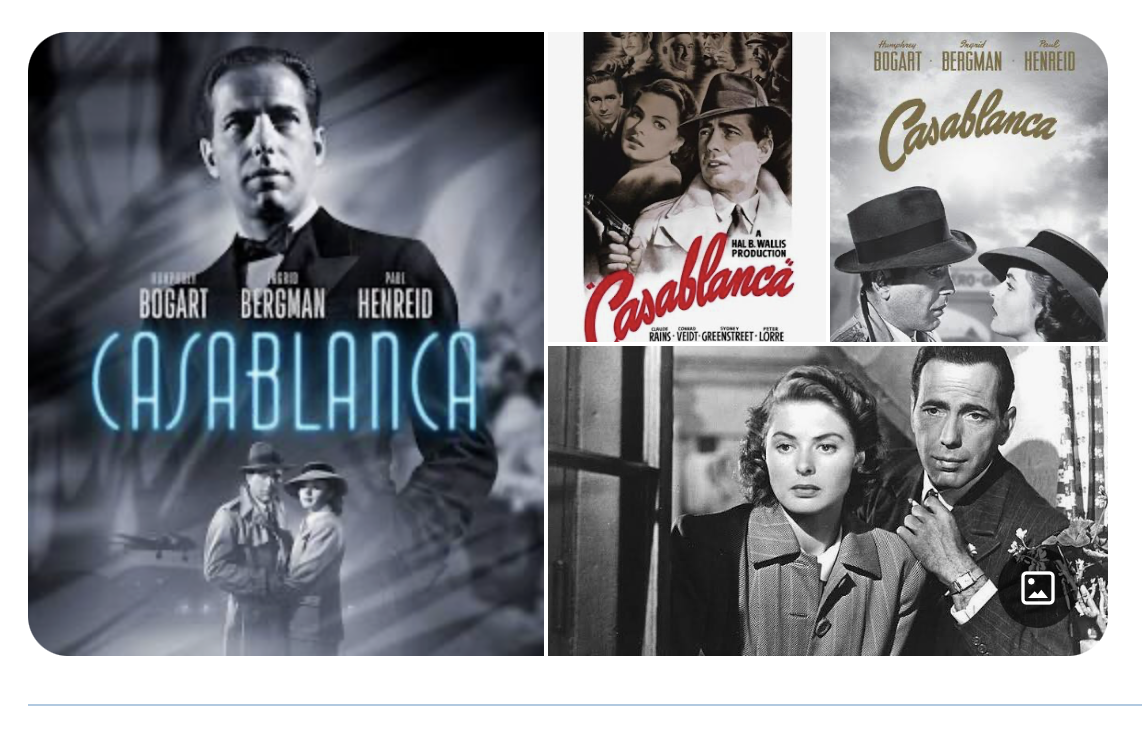

YouTube: Warner Bros. Classics

In the Minersville School District versus Gobitis 310 US 586, the US Supreme Court ruled that public schools could require the Pledge of Allegiance and the salute to the flag. It is significant that victims of the Nazi holocaust included “Bible students.” As the war developed, the narrative of democracy versus dictatorship crystalized. In 1943, the US Supreme Court reversed itself with West Virginia Board of Education versus Barnette 319 US 624, and supported the right of the individual to refuse to worship the government. 

The Overlook Press, 1973.

When the viewer meets Richard Blaine, he is playing chess by himself.  He is an intelligent, thinking man -- and a loner. Louis Renault claims that Rick is a sentimentalist, pointing out that Rick ran guns to the Spanish Loyalists and to the Ethiopians.  "I was paid well both times," Rick insists.  Renault counters, "The winning side would have paid you more."  Rick demurs.  "I'm a poor businessman." In that, we see that Richard Blaine is a practical man whose actions are guided by principles.  He also has a bitter sense of humor.


The "Marseilles" scene says even more.  Victor Laszlo orders the band to play La Marseilles. The band leader, however, looks to Rick.  (As Sasha says in a previous scene, "Yvonne, I love you, but Monsieur Rick, he pays me.")  Rick nods. They play.  It is Rick's Cafe Americain that the police bust up the next day.  Rick takes responsibility for his actions and he literally pays the price for Laszlo's defiance.  It is easy to see Laszlo as the brave idealist. I see Laszlo as an irresponsible idealist. When the bar is closed, Rick keeps everyone on full salary.  It comes out of his pocket, of course. 

1 Franc France 1940. 1 Franc Vichy 1942
Morocco 1/2 riyal (5 dirham) AH 1336/AD1918
Morocco 1 Franc AH1339/AD1921


The Marseillaise scene (also called “the dual of the anthems”) rested on a lost narrative. The Germans are not singing Deutschland über Alles but Die Wacht am Rhein. That was composed 1840 (poem) and 1854 (music) to solidify Germans across over 20 different polities to defend the Rheinland because in the 200 years between Louis XIV and Napoleon, the river region was politically French though culturally German. In that the city of Strasbourg was iconic. Family names along the Rhein alternated between Brückner and DuPont. The new rallying motto was “Unser Strom nicht unser Grenze.” (Our creek, not our border.) 


Another lost narrative centers in the tiny town of Niederwald, Texas, here in Hays County. They say on their city website that the town was named for the low-lying bushy trees here in the Hill Country: nieder = nether; wald = woods. In fact, Niederwald, Texas, was settled between 1877 and 1890 and was more likely named after the Niederwald Memorial in Hesse, built in 1877 and decorated with a goddess Germania, Iron Crosses, a tally of German victories over Napoleon, and the lyrics to Die Wacht am Rhein. (See https://en.wikipedia.org/wiki/Niederwald,_Texas, https://www.tshaonline.org/handbook/entries/niederwald-tx, and https://en.wikipedia.org/wiki/Niederwald_monument 


La Marseillaise has nothing to do with democracy and is all about fertilizing the farms with the blood of impure invaders. It got its name from a regiment which sang the song on their entry to Paris, but the song itself was composed in Strasbourg and was titled “Chant de guerre pour l’armée du Rhin.” The event which inspired its composition was France’s war against an alliance of Austria and Prussia. To take sides between France and Germany over the Rheinland is to choose between Poland and the Ukraine over who rules which banks of the Vistula. Nonetheless, we still hate the Nazis because without a doubt they were opposed to everything that defines America.


Previously on Necessary Facts

The Second World Wars 

2LT Frances Y. Slanger American Nightingale 

Liza Mundy Breaks the Code and Misses the Message 

Building a Team in Fact and Fiction 


Sunday, April 18, 2021

Liza Mundy Breaks the Code and Misses the Message

Write about what you know. Write from your experience. Those two mandates are easily given to anyone who wants to write for a living. They apply to fiction and non-fiction. The rules were too easily ignored by Liza Mundy. Granting that Liza Mundy recorded well what people told her, it is obvious that before she wrote this book, she knew nothing about codes, the military, or World War II. 

 Languages change. I was born in 1949 and in my first grade classroom one of our phonics charts spelled waggon in the old British style, just as Abraham Lincoln wrote shew for show. I mention that because on page 112, Mundy says that Ruth Weston was “olive complected” and I learned “complected” to be regional American dialect and not proper American English. Whatevs.


Code Girls by Liza Mundy 
(Hatchette 2017)
More consequentially, Mundy does not understand why military people salute each other, who salutes whom, and the differences in rules for the customs and courtesies as followed by the Army versus the Navy. She says: “… but Bea Norman felt the Marines guarding each room ‘took pernicious pleasure’ in making the women salute over and over.” (page 169) 

But she also notes later that by the rules, as officers, the WAVES were entitled to salutes from enlisted men (page 191). They would be entitled to the courtesy from all enlisted personnel, regardless of sex, but that aside, the Marines may have been pushing some regulations. One fine point is that by Navy customs, you only salute the first time you see an officer because on board a ship you will see her a hundred times a day. Sailors and Marines would all be waving their arms all the time and in confined spaces. Also, unlike the Army, the Navy does not salute again after coming on deck (or inside a building). That being as it may, the bottom line is easy: If someone salutes you, you return the salute; it is that simple. But clearly, the salient facts are not military customs and courtesies but how many insults and injuries Mundy could find to curry sympathy for the women in the story. 

The irony compounds because in the Index, the women are listed by their married names despite the fact that we worked with them for three, four, or five years when they were single. Among the many people buried in the Index was Genevieve Grotjan who was instrumental in breaking the Japanese Purple cipher. After we follow her work as a cryptanalyst for five years, she is listed as Feinstein, Genevieve Grotjan because she got married on page 344.


The English and Americans broke the Enigma cipher machine in part because an early version of  a cracking machine was delivered to British intelligence by Polish intelligence agents after the German invasion. It was called a “bombe” or sometimes “bomba.” Mundy does not say this, but one story had it named after a chocolate cake because that was what the Polish mathematicians were eating at a restaurant when they outlined their theoretical solution to the German cipher back in 1932. Anyway, on page 135, it appears as a “bomby”—gratefully just that one time. It is an example of the many empty files in Mundy’s knowledge warehouse. 


Mundy says three times that making codes is “the best possible training for learning how to break them.” (page 75) That is not true. It is true that learning the history and application of codes and ciphers is basic to cryptology. But making up arithmetic problems will not teach you how to solve them. The fact is that experts break the codes and ciphers of amateurs specifically because tyros are inept at cracking. Mundy had never done the work herself. This was all new to her. 


So was World War II. We all commonly see this as the three Allied powers against the three Axis powers. We also accept the USSR as our ally and still consider the French to have been in “the free world” (page 308) even though French reactionaries had spent four years helping the Germans to round up Jews. Mundy never questions it, even in the context of a war in which the British and American intelligence groups did not always trust each other. As a recent ally of Germany, the USSR was never to be trusted. She mentions the America First movement only in passing. Therefore, Mundy does not explore the motivations of the women who asserted themselves to join the civilian government defense efforts before Pearl Harbor. 


I accept as an assumption that Mundy is not comfortable with firearms and she has never flown an airplane. So, she quickly passes over the firearms qualifications that several women earned, among them Louise Pearsall, (page 273), and Fran Steen (page 191) who also earned a private pilot certification while working as a cryptanalyst (page 191). The author just does not appreciate those accomplishments.


Unlike the reviewers for the mainstream media I spent two weeks with this book. Despite the many reasons to put post-its on pages, this was not painful. Mundy writes well. I was pleasantly surprised to learn that among the cryptanalysts were philosopher William Van Orman Quine, actor Tony Randall, classicist Richmond A. Lattimore, and contract bridge mavin Oswald Jacoby (page 181). It was also interesting to get the backstory on William Friedman. I always accepted his being the master cryptanalyst who singlehandedly broke Purple. In fact, Mundy says (and my wife concurs) that Elizabeth was the brains. She introduced him to crypto. And, of course, this book is the story of the women who really broke Purple. So, there is a lot here. 


But the untold story of the Code Girls was always hidden in plain sight. In 1996, when I was working for the US DoD back home in Cleveland, Nida Glick, my mother’s Latin teacher (who had been the language department chair when I went to the same high school), passed away. Her obituary in the May 6 Plain Dealer showed her in her Coast Guard uniform from World War II when she served as a codebreaker. 


Mundy’s experience with Politico, The Atlantic, and The Washington Post, and her work on behalf of Michelle Obama reflect her engaging and compelling narrative style. However, pop culture books and magazines are different from history books. I know from personal experience that as painful as it can be, a newspaper can always print a correction or even a retraction. With books, the errors and omissions are more permanent and revealing. 


Also, even if the New York Times and Kirkus were not pre-disposed to ladle praise on this work, the fact is that professional reviewers also bang out copy on deadlines. So, fact checking is not always possible, even if it is wanted by the editors.


Historians labor under a special conflict of norms different from the other sciences. (My Marxist professors easily convinced me that history is a science.) If a historian judges the people of the past by the standards of the present, no one looks good. If you accept the cultural standards of another time and place, then you fail to be objective. In anthropology that is called the error of going native. 


Mundy acknowledges that many of these women were born in or around 1920 when American society was changing. The social revolutions in norms of behavior were more dramatic than the material progress of the 19th century. These women left their old world in 1940 and then left it behind irretrievably in 1945. Some did well. Ann Caracristi became the first woman deputy director of the NSA. After years of peak experience, and then dumped into an environment where the only pressure was to conform, others suffered the same PTSD as other combat veterans and never reintegrated completely to civilian life. Some took the hard road down. Others recovered. It is a complex story and Mundy tells it well enough.


PREVIOUSLY ON NECESSARY FACTS

The Second World Wars by Victor Davis Hanson 

Codes and Coins 

A Successful Imitation of Alan Turing 

2nd Lt Frances Slanger: American Nightingale 

World War II Sweetheart Dance 

The Wise Men 


Sunday, February 16, 2020

World War II Victory Dinner and Dance

Once again, the Texas Military Forces Museum and the Texas Military Forces Historical Foundation hosted their annual Valentine's Day Sweetheart Dance featuring the Sentimental Journey swing band with their front singers, the Memphis Belles. 

Just about all of the music was from the 1940s:
foxtrot, swing, jitterbug, and jive--and a waltz or two.
Sentimental Journey and Memphis Belles
play the Dorsey brothers, Glenn Miller, Harry James,
and Woody Herman, among others.
"Oh, Johnny" is a standard.

In addition to the photobooth, the dinner features
a silent auction. I won a 50-round blank fire with a
Thompson submachine gun.
Previously on Necessary Facts


Thursday, May 30, 2019

General Henri Guisan and Swiss Neutrality

Switzerland was surrounded and divided. Germany had annexed Austria. Italy was Germany’s ally. France had fallen. Denmark, Norway, Yugoslavia, and Greece also fell. Many Swiss were aligned to the German Nazi party. About 12,000 Germans of military age were in Switzerland in 1941; and they were organized under the German High Command. Germans and their agents carried out acts of sabotage. (Fifteen Swiss and two foreigners were executed for their crimes.) Others adopted an unsurprising and seemingly realistic and pragmatic attitude, accepting Germany’s domination of Europe. The central government of Switzerland was granted emergency powers to make laws without legislation. Any criticism of Germany by any newspaper was considered “unneutral conduct.” Independent journalism ceased.
  
Inside book cover text showing title, author, and publisher: Spying for Peace:  General Guisan and Swiss Neutrality  by Jon Kimche  (London: Weidenfeld and Nicolson, 1961).
Spying for Peace: General Guisan and Swiss Neutrality
by Jon Kimche (London:
Weidenfeld and Nicolson, 1961)
.
 
The meaning of “neutrality” evolved over 400 years. The oldest and easiest definition is that a state (and they were mostly small) did not take sides in a dispute between two other states. In the 16thcentury, the standard was not actively helping one side or the other. By the 18thcentury, it was merely being inactive. (Consider the inactions of Spain and France in the early years of our War for Independence, despite their granting various helps or not enacting hindrances to our conduct.) By 1899, the Hague Conference, which was reconvened in 1915, set 47 articles of neutrality. (The Hague and Geneva Conventions are archived at the Yale Law School’s “Avalon Project” here.) The rules included protections for non-combatants and civilians in general.

Gen. Henri Guisan wanted those rules suspended. All male Swiss citizens age 20 to 60 served in their armed forces (and still do). And they were mobilized to meet the German threat. Eventually, many were released back to civilian life, but all remained available. Meanwhile, over four years, from 1939 to 1943, Gen. Guisan issued a series of orders to create, first, a line of defense facing Germany, and then, ultimately, an interior “redoubt” (reduit), a fortified central command in the middle of Switzerland, which could hold out against the Wehrmacht and the Luftwaffe. Tunnels and bridges were armed to collapse, sealing the center of the nation. 

Gen. Guisan understood that however it was defined Switzerland's neutrality would be meaningless--in fact, it would be impossible--without Swiss independence.  Therefore, on July 25, 1940, he addressed his officers in speech known as the Rütli Rapport. Nascent nationalism in the 18th century established a historiography to explain Rütli as the site of the first Swiss Confederation. The Rütlischwur (lit: Rütli Swear = the Oath of Rütli) brought the cantons of Uri, Schwyz and Unterwalden into a common league traditionally dated to 1307. It was also associated with the legend of Wilhelm Tell, certainly as told by Friedrich Schiller.

"Everywhere, where the order is to hold, it is the duty of conscience of each fighter, even if he depends on himself alone, to fight at his assigned position. The riflemen, if overtaken or surrounded, fight in their position until no more ammunition exists. The cold steel is next. ... The machine-gunners, the cannoneers of heavy weapons, the artillerymen, if in the bunker or on the field, do not abandon or destroy their weapons, or allow the enemy to seize them. Then the crews fight further like riflemen. As long as a man has another cartridge or hand weapon to use, he does not yield. " -- from General Henri Guisan's order to Swiss troops, July 25, 1940. (http://www.swissworld.org) 

Germany held off. On the one hand, obviously, Switzerland would be a tough nut to crack. This is a nation of soldiers who hold shooting contests for fun and prizes, firing everything from crossbows to the most modern sniper rifles. On the other hand, Germany’s own fifth column assured them that rather than a tough nut, Switzerland was a ripe fruit, ready to fall into their hands. 
Swiss shooting Thaler - silver dollar sized coin celebrating a shooting match
"Swiss Shooting Thaler"
commemorative coin
1872 Shooting Festival Zuerich
(Some local issues are rare,
but there is no shortage of the kind.)
Civitas Galleries, Calgary.
Then came Allen Dulles. For Dulles, espionage and counter-espionage were more important than guns. By 1943,. Hitler had lost the confidence of his military command and an agent known as “Viking Line” provided intelligence to the Swiss, and through them to the Allies. As Victor Davis Hanson argued in The Second World Wars this was not a simple matter of Three of Us versus Three of Them. Some Germans held back-channel communications with the USSR, the UK, and the USA. In Yugoslavia, Marshall Tito, acting in accordance with Stalin’s instructions, was willing to throw in with the Germans in order to prevent an Allied landing across the Adriatic. Heinrich Himmler’s SS was willing to write off most of Italy, if they could hold the Alps as the ramparts of Festung Europa. To that end German agents in Switzerland negotiated through Swiss contacts with the Americans and British. Eventually, the American point of view was made clear and the German army in Italy surrendered unconditionally. Switzerland was safe and secure.

PREVIOUSLY ON NECESSARY FACTS

Sunday, February 17, 2019

World War II Sweetheart Dance (2019)

We had a great time at the Texas Military Forces Museum Valentine’s dance. This year, we prepared by taking dancing lessons. I signed us up for membership and four Thursday nights of foxtrot with Austin Ballroom Dancing, a social club organized as a not-for-profit. In addition, we attended their open dances on alternate Saturday nights and also accepted an invitation to dance to a live band at a City of Austin senior center on Friday nights. It all helped. 

The evening was in 1940s style, with the Sentimental Journey Orchestra playing the music of Tommy Dorsey, Glenn Miller, and others. They were fronted by The Memphis Belles trio. About a third of the 150 attendees were dressed in era style. The event included a silent auction and a “Heads or Tails” contest to win a ride in a tank and fire a howitzer at the next reenactment.  

America’s entry into World War II shifted our culture. By the end of the war, nearly a tenth (8.7%) of the total population was in the military. And that does not count those in the Red Cross, USO, and other support groups. 

World War II was brewing long before the UK and France declared war on Germany in response to the German invasion of Poland on September 1, 1939. The Fortified Forties followed the Thrifty Thirties. The worldwide economic downturn created an easy podium for demagogues of the left and right. Both sides declared that capitalism was dead. 

Leaders were everywhere. We all know the easy names: Hitler, Stalin, Mussolini, Franco. Other dictatorships ruled in Poland, Latvia, Lithuania, Estonia, Greece, Portugal, Romania, and Yugoslavia. Turkey was a one-party state especially tied to modernization and liberalization away from traditional Islamic culture. France proved that for them democracy was a failed experiment. In practice the French were embarrassingly cooperative with the Nazis until the success of D-Day made everyone a lifetime member of the underground. Adolph Hitler does not appear Aldous Huxley’s Brave New World, but Benito Hoover does, along with Mustafa Mond, Polly Trotsky, Lenina Crowne, and Bernard Marx. (For background on Huxley’s choices of character names based on Alfred Mond, Mustafa Atatürk, and others, see, for example, Shmoop here.) The future was collective. And the fact is that collectivism brings war. 

America gave the President a third term and the New Deal attempted broad government initiatives. However, American cultural traditions of individualism, self-assertion, private enterprise, and rule of law within a constitutional framework that promised both majority rule and individual rights were the stable foundation that withstood the shocks of war. (The American Political Tradition by Richard Hofstadter is reviewed here.)

That political tradition was necessarily accompanied by culture of innovation. The inventions of the 19thcentury easily led to utopian predictions of material progress and prosperity. However, ultimately, the American Century was defined by innovations in entertainment. Life has meaning when we have the liberty to pursue happiness. Winning World War II on the basis of our industrial capacity was necessary but not sufficient. Our cinema and music conquered the world. There was a war on, but the music was swing. Gershwin defeated Wagner.

PREVIOUSLY ON NECESSARY FACTS


Sunday, February 3, 2019

CODES AND COINS

Coins were invented about 600 BCE, about 3000 years after money (as we understand it) was invented. Within three generations, by 500 BCE, coins had acquired most of the attributes that associate with them today. Perhaps first among them, both in time and importance, was carrying a message. As signifiers or semata, coins paralleled the ascendance of writing over speech to extend the width and depth of communication. 

During World War II, Canada included a patriotic message on its 5-cent coins: We win when we work willingly. The slogan was in Morse code, flush along the rim of the reverse. While not obvious, neither was it intended to be secret. Rather, the message was an element of the propaganda effort. Another wartime effort was Canada’s use of tombac, an 88-12 alloy of copper and zinc to replace nickel on the 5-cent coins of 1942 and 1943.
dots and dashes represent Morse Code
WE WIN WHEN WE WORK WILLINGLY
In the United States, the 5-cent nickel became one-third (35%) silver from 1942 to 1945. The story was that we needed the nickel for armor plate. In truth, we got our nickel from Sudbury, Ontario, and it was plentiful. The new nickels had a large Mintmark over Monticello on the reverse.  The fractional coinage (“small change”) of the United State and Canada delivered constant reminders to the general population.
Two coins the same size but of different metals.
Canada 5-cent nickel (left) and 5-cent tombac (right)
war time issues with Morse code message at rim.
In our time, the US “Native American” (Sacagawea) dollars for 2016 honor the Code Talkers. At first, during World War I, Native American soldiers worked as telephone operators because it was unlikely that Germans (who did know English) would know their languages. In addition, the Americans quickly adopted slang of their own to add a layer of obfuscation. 

World War II was a much larger and longer engagement. In 1943, the total population of the USA was 136.7 million, of whom 9.2 million were in the armed forces. Although American civilians who were ethnically Japanese were placed in concentration camps, their sons were allowed to join the armed forces (and fight in Europe). So, of course, the military tapped a new generation of Native American Code Talkers.

Although the Navajo are best known from books and a recent movie, in fact, they came from over 30 communities and societies: Cherokee Nation, Cheyenne and Arapaho Tribes, Cheyenne River Sioux Tribe, Choctaw Nation, Comanche Nation, Crow Creek Sioux Tribe, Crow Nation, Fond du Lac Band of Lake Superior Chippewa Tribe, Fort Peck Assiniboine and Sioux Tribes, Ho-Chunk Nation, Hopi Tribe, Kiowa Tribe, Lower Brule Sioux Tribe, Menominee Nation, Meskwaki Nation, Muscogee (Creek) Nation, Oglala Sioux Tribe, Oneida Nation, Osage Nation, Pawnee Nation, Ponca Tribe, Pueblo of Acoma Tribe, Pueblo of Laguna Tribe, Rosebud Sioux Tribe, Santee Sioux Nation, Seminole Nation, Sisseton Wahpeton Oyate (Sioux) Tribe, St. Regis Mohawk Tribe, Standing Rock Sioux Tribe, Tlingit Tribe, Tonto Apache Tribe, White Mountain Apache Tribe, Yankton Sioux Tribe. (See the US Mint sales pages for special medals and medallions here.)
One dollar coin, tails, showing two army helmets and two eagle feathers
Reverse of US Mint 2016 Native American Dollar
honors the Code Talkers from two wars.
On the other side of the Atlantic the British were engaged in a “wizard war” against the Germans. Among their “boffins” were the codebreakers of Bletchley Park. The Imitation Game told the story of Alan Turing and his failed romance with Elisabeth Lowther Clarke (later Murray). Clarke was a brilliant mathematician, and an accomplished codebreaker. After the war, she took up a numismatics, largely as a result of her husband John Kenneth Murray’s collection of Scottish coins. In particular, several series of silver groats and gold “unicorns” were not well identified or sequenced as the weights and finenesses had changed during the reigns of James III and James IV. She figured it all out, publishing and delivering papers. (See “The Early Unicorns and the Heavy Groats of James III and James IV” in the British Numismatic Journal, Volume 40, Number 8, 1971 online here.)

For that work, the British Numismatic Society granted her a John Sanford Saltus Gold Medal in 1986. You can find a brief biography in Wikipedia, of course, but as Joan Clarke.  Lord Stewartby (Bernard Harold Ian Halley Stewart)one of her collaborators in the coinage of Scotland, wrote her obituary for the British Numismatic Journal Vol. 67 No. 13, pages 162-167, online here.)    

(See, also, my review of The Imitation Game with pictures of two computer security challenge coins in the E-Sylum newsletter of the Numismatic Bibliomania Society here.)

PREVIOUSLY ON NECESSARY FACTS

Monday, January 28, 2019

The Wise Men

Averell Harriman, Dean Acheson, and George Kennan were names that I grew up with, reading daily newspapers and weekly news magazines from the late 1950s through the late 1960s. I learned of the other three men—Robert Lovett, John McCloy, and Chip Bohlen—from this careful and objective though laudatory history. Isaacson and Thomas had established impressive bibliographies of their own before this collaboration. I found it engaging and informative.

William Averell Harriman and Robert Abercrombie Lovett grew up together because Lovett’s father, Robert Scott Lovett, was the chief counsel for railroad magnate E. A. Harriman. John Jay McCloy, Jr. and George Frost Kennan grew up poor. Their hard work took them to the Ivy Leagues and thence to the halls of power. Dean Gooderham Acheson met Averell Harriman at Yale. Charles Eustis “Chip” Bohlen inherited the fine social graces of his almost wealthy family and those skills took him to the Foreign Service where he met George Kennan. It is easy to perceive the six as symbolic of, if not identical with the Establishment (page 26). The popular catch-phrase “The Establishment” was coined by John Kenneth Galbraith speaking to a convention of the Americans for Democratic Action in 1966. But the privileged collective had long before enjoyed opposition from both the left and the right, liberals and conservatives, going back to Jonathan Edwards and Andrew Jackson and forward to Jimmy Carter and Ronald Reagan (page 29). 
 
The Wise Men: Six Friends
and the World They Made 

by Walter Isaacson and Evan Thomas.
Touchstone/Simon and Schuster, 1986
.
We may try to make the best of our opportunities. That is a two-part engagement. Many were born to inherit great  opportunities. Not many made the most of them. Starting as children and continuing through their teenage years, Harriman and Lovett accompanied their fathers on inspection tours of the railroad. (When he reached the Pacific coast E. A Harriman saw no reason to stop, and took his family to Siberia. That fact would be a trump card played more than once when Averell Harriman was the U. S. Ambassador to the USSR.) The son of an Episcopalian bishop, Dean Acheson took it upon himself in 1911 to join a Grand Truck Pacific Railway work crew in northern Canada. Before the United States entered World War I, Acheson volunteered as a Navy ensign. Meanwhile, Bob Lovett was only in his freshman year at Yale in 1914 when he enlisted. He was graduated in absentia while serving in the Army Flying Squadron. (Thirty years later, he served as a War Department expert on air forces.) After his senior year at Yale, Chip Bohlen signed on a US Steel cargo ship as crewman. Later head of the World Bank, John McCloy first met the upper classes when he worked as a chore boy at resorts. Even the four who were born to wealth knew from personal experience the relationship between money and work. 

Each had their own political preferences. Most were Republicans by birth, but adapted themselves to serve the government through the long decades of Democratic Party ascendance from 1932 to 1980. They were internationalists who saw no profit in war and only losses in surrender. They were among the first to push US foreign policy out of isolation and into alliance with the United Kingdom and France. It is no surprise that Ivy Leaguers are Anglophiles, but, in addition Chip Bohlen’s mother was from Louisiana and he visited France as a child. (On the other side of the ledger, his father’s in-laws included the Krupps of Germany.) Individually and in concert, they were early to warn the world of Stalin and the USSR, even as their Yale and Harvard classmates were still enthralled with the “ten days that shook the world.” 

But it would be just as wrong to characterize them has “hardliners” as to brand them as “appeasers” which the radical right did, from the McCarthy era through the years of the John Birch Society, the Nixon presidency, and the Reagan Revolution. As bankers and lawyers—only Bohlen and Kennan were professional diplomats--they knew how to evaluate facts, measure risks, create and analyze logical arguments. They were willing to admit their mistakes, to cut their losses, to change course to avoid a collision. They knew that the world is not run by gentlemen, and “certainly the Kremlin was not.” (Page 327.) 

On February 22, 1946, while chargé d’affaires at the U.S. Embassy in Moscow, Kennan sent the 8000-word “Long Telegram” to Secretary of State George Marshall. It explained fully and succinctly the nature of the USSR and its relationship with the Western democracies.  Though it is discussed at some length (pages 352-356), it is never presented in full. You can find it online:
  • The Truman Library (here) where it is an image of a typewritten transcription
  • A modern typeface transcription at the Wilson Center (here)
  • A text-accessible PDF (here) from Nevada Technical Associates among other famous speeches.

“Marxist dogma, rendered even more truculent and intolerant by Lenin’s interpretation, became a perfect vehicle for sense of insecurity with which Bolsheviks, even more than previous Russian rulers, were afflicted. In this dogma, with its basic altruism of purpose, they found justification for their instinctive fear of outside world, for the dictatorship without which they did not know how to rule, for cruelties they did not dare not to inflict, for sacrifices they felt bound to demand. In the name of Marxism they sacrificed every single ethical value in their methods and tactics. Today they cannot dispense with it. It is fig leaf of their moral and intellectual respectability. Without it they would stand before history, at best, as only the last of that long succession of cruel and wasteful Russian rulers who have relentlessly forced country on to ever new heights of military power in order to guarantee external security of their internally weak regimes.” – The Long Telegram by George Kennan.

Successful in arguing for an immediate and full response in 1950 to North Korean aggression and its support from China, they nonetheless were less enthralled with McArthur’s posturing. Their experience in 1951 informed their opinions in 1965 when they pushed Pres. Johnson to increase US military action in Indo-China. But quickly, by 1966, they foresaw the inevitable American defeat ten years later. For that, they were vilified as defeatists. 

Yet, they continued to serve. Dean Acheson hated Richard Nixon, but honored the office of the Presidency as so few in that administration did. Acheson responded to President Nixon’s requests for advice and counsel. But Acheson had had the same relationship with President Roosevelt 40 years earlier. 

The choice of these six men as paradigms for the Establishment may be arbitrary. In their work, they formed friendships, alliances, and animosities with others of equal influence such as James Forrestal, Robert Oppenheimer, Lucius Clay, Harry Hopkins, and Paul Nitze. Their proteges included Henry Kissinger, Dean Rusk, and Robert McNamara who themselves were connected to still others, even to John Kenneth Galbraith. Thus, they were the Establishment and “the Architects of the American Century.” 

PREVIOUSLY ON NECESSARY FACTS


Saturday, January 5, 2019

Book Review: The Second World Wars by Victor Davis Hanson

This book was a pleasant surprise and a disappointment. The premise offers an original context for understanding the events of the 1930s and 1940s. Not much else in this large book was new. 

Although he is a nationally renowned conservative commentator and college professor, I did not know of Victor Davis Hanson before this. I was surfing YouTube watching something else historical and the automatic offerings along the right showed “The Second World Wars.” The title was interesting. So, I watched it. The presentation was from Book TV (view here).  
  The lecture was delivered at the National Review Institute. In fact, Hanson has delivered nearly the same talk several times. The presentations are excellent summaries of his 600+ page book.  But the book can be considered and evaluated more carefully.
The Second World Wars:
How the First Global Conflict was Fought and Won 

by Victor Davis Hanson (Basic Books, 2017).

The premise is compelling. During the 1930s and into the 1940s, several different wars were fought by a dozen different belligerents. It was not until the summer of 1941 that the three Allied superpowers aligned against the three fascist aggressors. Note, of course, that among the Allies was the USSR, which had joined with Germany in attacking Poland, as well as carrying out a different war against Finland. The USSR also rolled over the three very small Baltic states. At the same time up to 1939 the USSR had engaged in border skirmishes with Japanese occupation forces in Manchuria and Mongolia. The conclusion of those hostilities put Russia and Japan into a neutral situation in the Pacific. That allowed US Lend-Lease materials to flow into the USSR on Russian flagged freighters that were not intercepted or harassed by the Japanese Imperial fleet–even though those supplies would be used by the USSR against Germany, which was nominally allied with Japan. 

Even more persuasive is Hanson’s accounting of industrial capacity. With clear 20-20 hindsight, Hanson demonstrates conclusively that the Axis lacked the ability to win. Hanson is not alone in that assessment. Dwight D. Eisenhower earned the equivalent of a master’s degree in military industrial management. The numbers were real. As long as the Allies maintained the will to fight, victory was assured. It was only a matter of time.

And cost. Hanson adds up the human toll. Unlike most other wars, the nominal winners suffered more than the obvious losers. About 80% of the casualties were not Axis citizens. And while not unique, it remains remarkable that only fraction of the 60 to 80 million dead were military combatants. 

All of that is worth remembering.

Most of the book consists of re-arrangements of known facts. In two of his lectures, Hanson says that his editor at Basic Books challenged him to come up with something new in a field that already offered 7,000 titles. Hanson organizes World War II into Ideas, Air, Water, Earth, Fire, and People before concluding with “Ends: Why and What Did the Allies Win?” With retrospective clairvoyance Hanson questions and perhaps disproves several articles of dogma asserted by military historians. Among those is the doctrine of air power. We do not live in the air. We live on land. And the only purpose of superiority in air power is to enable the conflict on land. The same is true of sea power. That said, the fact remains that without those, the Axis could not prosecute its land wars. The Axis had about a dozen aircraft carriers while the Allies floated ten times that number. The same applies to aircraft, the Axis lacking four-engine bombers and flocks of fighters to support them. On the ground, the Allies rolled out thousands of tanks and other artillery. We could because the United States of America alone far surpassed the industrial capacity of the Axis. In fact, says Hanson, the USA could have defeated Germany, Japan, Italy, the UK and the USSR combined. Unfortunately, he never identifies why. Hanson never refers to capitalism, free enterprise, or rights. As a conservative, Prof. Victor Davis Hanson is a traditionalist, not a libertarian. He fails to connect the material prosperity of a society with the right of the individual to the pursuit of their own happiness. 

PREVIOUSLY ON NECESSARY FACTS