Showing posts with label design. Show all posts

Thursday, October 21, 2021

DIY: Homebuilt Substitute for Vixen Mount

The Vixen Company, Ltd., of Saitama, Japan, (founded 1949) got the brilliant idea to make all of their telescopes compatible with all of their mounts. Today, the Vixen mount is a standard offered by most other makers. However, a new Vixen mount bar at $79.95 plus tax and shipping was wholly disproportionate to my needs. 

https://global.vixen.co.jp/en/


Four years ago, I bought a National Geographic 70-mm refractor used and abused from some kids down the street. Between Christmas and August they lost the eyepieces, center tray, guide handle, and cellphone attachment, and the dew shield was on backwards. (They said that they never had it outside.) I tested it with a 1.25-inch eyepiece against a traffic sign down the road and it was OK. So, I gave them $35 for it. 


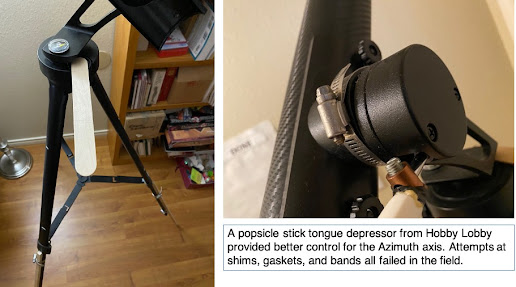
For four years, I did what I could with the mount, taking it apart and putting it back together but degreasers and lubricants, rubber bands and hose clamps never solved anything. 

All-in-all it has been a good little viewer and given the 70-mm limit not half bad for backyard stargazing. At that time, I also owned a Celestron EQ-130 Newtonian which I donated to the Goodwill earlier this year. 


Meanwhile, in October 2020, I bought myself an Explore Scientific 102-mm refractor. It comes on a First Light mount to keep the price down and I was never happy with the mount. It is difficult to control and somewhat underweight even for the 102. I was able to afford a Twilight I mount from ES, used and reconditioned with warranty. That has gone well for me. Now, I wanted to put the National Geographic on the First Light mount.


The easiest solution would have been to buy a Vixen mount, $79.95 plus tax and shipping, which was wholly disproportionate to my needs. 

I am not a fabricator. I have very few tools here. So, I went to Home Depot and searched for wood. I bought a 24-inch slat of quarter-inch poplar. 

With the saw blade on my Gerber pocket tool, I cut it in thirds and glued two pieces together. (I learned about Elmer's in junior high wood shop class.) 

The attachment screws on the telescope are mounted from the inside and I did not want to take those screws out. So, I used them to attach the new plate. Lacking drill bits, I used wood screws to make the holes. (We have an electric hand drill that my wife got as a door prize at a computer user meeting.) I ran a thin one in first, then widened it. 

Even though I measured more than twice, I was off by an inch the first time. I also split the wood once with a screw too large. After gluing (and curing) that, I wided the holes with my Swiss Army Knife. 

I secured the slat to the telescope with Gorilla glue. 

The best telescope is the one that gets used. 

I recently bought entry-level Celestron "First Scope" oculars ("eyepieces") to go with this so-called "hobby killer" that my astronomy colleagues denigrate for being a "department store telescope." OK: it is not an apochromatic rare earth triplet; the aperture (diameter) is not four inches or eight or ten. Nonetheless, I have seen the Messier 22 globular cluster, the Messier 44 "Beehive" open cluster, the Andromeda Galaxy (Messier 31), and, of course, Venus, Mars, Jupiter, and Saturn. Now, the telescope has a mount worthy of its optics.

PREVIOUSLY ON NECESSARY FACTS

(Mostly, the addenda links can be complementary or contrasting or off-topic. These are about observing with the National Geographic 70-mm refractor.)

Viewing Mars

M44 Beehive Cluster First Sighting

Astrophotography and Me

Jupiter-Saturn Conjunction 2020

Thursday, December 1, 2016

Creature Comforts Show No End to History

It is a wonderful time to be alive.  We have become so used to material abundance that we have lost all perspective on where we are in the deep, broad, and swift flowing stream of history.  The best is yet to come, but the present is pretty good. 

My thoughts here were inspired by a discussion at work as a young lieutenant and an old sergeant wondered about the consequences of Star Trek transporter technology. The transporter is the basis for both the replicator and the holo-suite. Given those, why work?  Contrasting our lives with those of medieval serfs, I found lots of reasons to continue working.

My own discussion on this topic with a young captain started the day before, as a result of my buying a knife. On the recommendation of another young captain, I went to everyone's favorite tactical store and bought a Benchmade "Mini-Barrage." The next morning, I went online here at home and read about knives. "Why not a Gerber?" I asked at work. I got the same answer there that I found in an online forum for zombie hunters: the Gerber is a nice every day carry (EDC), but the best Gerber is about like the cheapest Benchmade both for price and quality. 

I was astounded at the content about pocket knives in four pages of links even before I got to the reviews of knives from Guns & Ammo magazine. My captain said that I could find people who know that much about luggage or briefcases.

PREVIOUSLY ON NECESSARY FACTS

Tuesday, November 5, 2013

Raymond Loewy

Today's Google Doodle celebrated the 120th birthday of Raymond Loewy, the father of industrial design. 


Raymond Loewy is called “the father of industrial design” for a reason.
He took ugly consumer items — pencil sharpeners, refrigerators — and made them beautiful.
He designed cars that were a decade or more ahead of their time.
He created kitchen appliances, crockery and furniture,
and did design work for Greyhound, the U.S. Postal Service and NASA.

(The website cataloging his work is here.) 
"I waited for the S-1 to pass through at full speed.
I stood on the platform and saw it coming from the distance at 120 miles per hour.
It flashed by me like a steel thunderbolt, the ground shaking under me,
 in a blast of air that almost sucked me into its whirlwind.
Approximately a million pounds of locomotive were crashing through near me.
I felt shaken and overwhelmed by an unforgettable feeling of power,
by a sense of pride at what I had helped to create.
I had, after all, contributed something to a great nation
that had taken me in and that I loved so deeply.
And I had come a long, happy way myself from my start in fashion advertising.
I had found my way of life."
Every artifact speaks to us, reflects us.  Loewy delivered the 20th century.  He was not alone but his sense of vision brought form to thousands of common items.  And they inspired a century of material progress that nurtured and rewarded the common (and largely unstated) belief that we can and will make a wonderful future.

PREVIOUSLY ON NECESSARY FACTS
The Genius of Design
Space is the Place: Come to the High Frontier
Jack Kemeny Knew: We Shall Have Computed
The Cure for a Failing Empire
The Science of Liberty


Saturday, August 3, 2013

Visualizing Complex Data

Edward R. Tufte's classic works - Envisioning Information, Visual Explanation, and The Visual Display of Quantitative Information - are milestones in applied epistemology.  Drawings convey meanings across verbal barriers.  But at some level, they must be learned.  A Martian watching a baseball game could probably figure out about half of it in the first two innings. But the other "half" is actually the 90% that brings joy and sorrow to fans.  The classic No Parking sign seems universal, but could mean almost anything.  The Journal of Irreproducible Results published a textured, grainy, and striated image that could save you money by being included as an example in many kinds of research.  (Unfortunately, some scientists do re-use their data, and other people's data, in just such a manner.  See Misconduct in Scientific Research on this blog.)  Humor and fraud help define the limits of the acceptable interpretations of images.  Yet, like a linguistic gold standard, one picture remains worth 1000 words, no matter how many new words we invent.


Many philosophical Objectivists easily assert that in the hierarchy of knowledge metaphysics is the base upon which epistemology rests. However, Leonard Peikoff wrote that the two studies are dependent on each other.

With the Yin-Yang of Metaphysics-Epistemology at the core
the orbiting body could be ethics (morality)
and the field that it generates would be politics.


Computers store information and we connect them in many convenient topologies. Knowledge could be mapped the same way. 
Is the connection geology-geography-geophysics-physics-chemistry a ring or a tree or a mesh?
A Historical Map of Philosophers by Simon Raper at the "Drunks and Lampposts" blog. Raper used a mathematical visualization tool called gephi (see the website here). 
The Continental Tradition is green. Purple dots are British Empiricists 
(including those not actually from the UK such as William James).  
He derived his data from Wikipedia articles citing the influence of one philosopher's work from and then to others, as easily, Plato and Aristotle, Leibniz and Descartes (teal).

The Klein Bottle is to three dimensions what the Moebius strip is to two: it folds into itself, forming a continuous space (or surface).  Here, three Klein Bottles are interconnected. Could this map the way that planetary geology suggests the changes in weather and climate that alter ecological and economic possibilities, causing political changes in social organizations and institutions?


Although he claimed to distrust philosophy, Richard Feynman was not alone among the empirical scientists who suggested that what we perceive as "particles" or "statistical waves" are only the fields which are themselves manifestations of something "deeper" or "beyond." 
In business, firms merge and divest, departments are reorganized, investors take or sell off large interests. In the multi-party politics of Europe, alliances over issues come and go. Consequences that have not been foreseen might not be mappable until after the fact.  

Previously on Necessary Facts
Knowledge Maps
The Genius of Design
Objectified
Art and Copy
Start the Presses: Typeface

Friday, May 31, 2013

Readability is the Only Metric

What you can measure, you can improve.  Whether you need creative content for e-commerce or step-by-step instructions for machine repair, you must reach your audience.   Microsoft Word offers metrics for readability, from the Grammar and Spelling checker, under Tools.   We have no quantified methods for creativity, invention, cleverness, or insight.  We can measure word length, sentence length, and sentences per paragraph.  

It is not perfect. In fact, it can be gimmicked, tricked, and gamed.  But it works.  On a project to develop a multiprocessor industrial controller, the other technical writer was a young guy from an advertising agency.  He did not know manufacturing, but he was good writer.  We enjoyed finding some of the many failings in the MS-Word readability scales. We still used them.  They proved that we documented the interactive debugger to a 6th grade reading level.  When the line is down, no one is looking for a literary experience. You need answers.


Texas Department of Information Resources
IT Policy - Originally at 12.9 reading level
Same IT Policy - Rewritten to 12.0 reading level.
Of the 300,000 main entries in the Oxford English Dictionary, only 3,000 are Basic English; and most of us speak only 10,000 distinct words.  The average college-educated American recognizes about 100,000 words.  Whether "fardels" in that list is putative.  So, Hamlet's rhetorical question might pass the readability score, but not carry meaning.  Whether "putative" is in your speaking vocabulary may be arguable.

The fact remains that we have an objective measure for readability. 

Also on Necessary Facts
Visualizing Complex Data
Documentation is Specification
The Art of Typography
 The Genius of Design
How to Hire a Technical Writer

Monday, April 22, 2013

OBJECTIFIED

Objectified is a film by Gary Hustwit about design, designers, and the objects that they create.  Dieter Rams of Braun and Apple’s Jonathan Ive appear, of course. (See, The Genius of Design below.)  So do thirty other designers, and a couple of supportive critics, such as Paola Antonelli of the Museum of Modern Art.  IKEA and Target both get cameo roles as they deliver to us the magic of inexpensive mass produced items that ennoble us, their owners, with the spiritual benefits of good design.  You and I also appear in anonymous walk-ons because in the words of Andrew Blauvelt, “anything that is touched by man, is transformed by man, is by its very nature designed.” The human-built environment is design.

Dirt Devil by Karim Rashid

Karim Rashid works for the “techno-organic world.” As a teenager, he owned a Claritone stereo radio and a Braun alarm clock and through his teenage angst, looking at them alone in his room brought a sense of comfort.  He calls our time the “third technological revolution.” To him, our living room furniture is like a kitsch stage prop. “When I get up from my laptop and my iPod, do I get into a horse and carriage? No.”


Claritone stereo similar to Karim Rashid's.
According to Andrew Blauvelt, the design concept has three layers. First form begets form, the formal logic of form.  Then come symbols and symbolism, the cultural symbols.  From that comes the contextual symbolism of making coffee, for instance, the bigger scenario of the human-object relationship.  The little rituals define the fork and knife.  The vacuum cleaners from Dirt Devil and Dyson extended the horizons for a single-use product into designer goods for display. Ultimately, the Roomba programmable robot vacuum allowed an undreamed of level of hacking as user interaction.


Alice Rawsthorn of the International Herald Tribune points out that if you were a Martian and you came to Earth, you could pick up a spoon or a chair and pretty much get a feel for their purpose.  Now, the digital age removes that.  Objects can take any shape.  This leads to tensions and conflicts in design. 


But objects do not take just any shape.  Some seem intractably wedded to their pasts.


Three principals from IDEO of Palo Alto shared a common theme in their different experiences of design.  "I inherited my father’s leather briefcase and it got better with time and I look to passing it on.  I look to designing things for wearing in versus wearing out.  ... I designed the case for the GRiD “Compass” computer in 1987, the first laptop.  When I got it home I realized that the beautiful case and clever latches were irrelevant to the user experience, so I came to study software interfaces.  ...  "


"... because in that moment it moves you,
you have an emotion"
-- Hella Jongerius
Naoto Fukusawa designs hardware interaction. Subconscious actions develop the mind and soul: design dissolving in behavior. “A very important turning point for me was the term "obsessive sketch" by Takahama Kyoshi, the haiku master. When the poet’s sentences are overly visible the audience may become uncomfortable. Japanese ritual is the opposite.” 


Rob Walker of the New York Times Magazine asks rhetoically, when the hurricane is coming and you have twenty minutes to pack, what do you grab? Not the object that got a great review in some design magazine, but the object that means the most to you.

Paola Antonelli insists that “democritization of design is an empty slogan.” According to Paola Antonelli, “design takes revolutions and progress and makes it into objects that we can use.”


Speaking of his work on the MacBook Air and MacBook Pro, Jonathan Ive says that the curse of being a designer is always looking at everything and wondering “why does it have to be that way and not some other way?”
Ad hoc design: wine cork as doorstop

Ad hoc design: section of plastic cup as bicycle fender

I want things that do not exist, that you cannot go out and buy, what is going to happen, not what has happened. – Marc Newson.


Within Karim Rashid's apartment

ALSO ON NECESSARY FACTS

Sunday, April 21, 2013

The Genius of Design

“For industrial designers, the world is never enough. They give shape and texture to the world to make it livable—indeed, beautiful—for the rest of us. This fascinating five-part documentary examines the art and science of design and the stuff it shapes, from computer chips to cityscapes and everything in between. See the evolution from artisans’ workshops to industrial mass production, and the profound changes it has wrought in our economy, society, and environment.” – from the promotional.

In five episodes running 242 minutes, we meet some of the leading designers who gave us our material world.  They are not engineers. They are not scientists.  The Apple computer was the creation of Wozniak and Jobs, of course, but they did not give it the form we know.  Their Macintosh, their iPod, Sony’s Walkman, all of the furniture in an IKEA warehouse, and even the weapons of war achieved materiality because designers thought long and hard about how real people would use these common objects.

“Meet historians, critics, and legendary contemporary designers, including Dieter Rams (Braun electronics), J Mays (Ford), and Jonathan Ive (Apple), who reveal the thinking behind iconic products such as the VW Beetle, the Eames chair, and the computer desktop. Along the way, discover how design has influenced even the outcome of war.”

At a time when – surprising to us, today - German goods were called cheap AEG launched what may have been the first modern rebranding.  They hired Peter Behrens who created a new AEG typeface for both their advertising and their product labeling. From William Morris and the Arts and Crafts movement to Dieter Rams of Braun, from Henry Ford to Ford Motor’s J Mays, we meet the people and their works and their critics (mostly favorable).  Produced for Athena Learning by Tim Kirby’s team for Wall to Wall Media, the video is supported by the Athena website (here) which delivers biographies of Raymond Loewy, Margarete Schütte-Lihotzk, Henry Charles Eames, Alberto Alessi, and Philippe Starck.  The videos also show us Joe Columbo, Robin Day, Jock Kinneir and Margaret Calvert, Earl Silas Tupper, Verner Panton, Marc Newson, and Michael Graves, among many others.  You may not know the names, but if you ever read a highway sign or sat in a plastic chair, you know their work.  It is not always easy. The graphical user interface was first introduced in 1963.  


Supporting the presentation, the website also delivers a study guide for classrooms, and a booklet with more ideas centered on design failures. 
  •  Episode 1:  Ghosts in the Machine: What distinguishes good design from bad design in a consumer product?
  • Episode 2: Designs for Living: To what extent is the kitchen in your home “a machine for living”
  • Episode 3: Blueprints for War: The British Sten gun was designed as a cheap, easy to manufacture, and ultimately disposable weapon. The German “Tiger” tank was the finest quality motorized cannon possible – and because of that, it could not be produced in sufficient numbers.
  • Episode 4: Better Living Through Chemistry: Plastic, for better and worse. Steve Jobs famously said, “You know a design is good when you want to lick it.”
  • Episode 5: Objects of Desire: How do you think the challenges of sustainability and limited disposal will affect product design in the decades ahead? Glen Olver Low calls it “Crade to Cradle.”  Instead of being down-cycled, his concept of recycling returns material to the highest level of manufacturing processes.


Michael Graves found his inspiration - in part - at a flea market, where he saw a hand-made stopper, carved as a rooster which sang when the water boiled. The conical shape was dictated by the need to boil water as rapidly as possible.

Previously on Necessary Facts

Monday, September 24, 2012

Documentation is Specification

Good software design begins with documentation.  Write the user manual first.  The design documents specify the desired outputs, and the inputs, actions, and processes that cause them.  The library of design documents will include the experience interface, the online helps, the installation guide, training manuals and tutorials, and, of course, the programmer’s references.  

One of several bad designs discussed here
Overwhelmingly, that is not how software is designed; and that is why so much of it is unsatisfying. Even programs that we find useful have annoying bugs, quirky features, and unhelpful demands. It is true that software is complicated. It is an easy claim - sort of like Goedel’s Proof - that every non-trivial program has one bug. But that is not the problem. The pain we all endure - from impatience and annoyance to angst and anger -  comes from the overarching pride - hubris - of programmers at all levels who believe that they know better than you what you want and need.

This is an old problem. In Computer Power and Human Reason: from Judgment to Calculation (1976), Joseph Weizenbaum warned of hackers whom he compared to compulsive gamblers. Driven by the superstition that one more patch will fix their problems, they stay up late, bleary-eyed and disheveled, working ever more frantically on a program they began without any reference to the substantive literature in the field in which they claim to be working. They do not know first-hand the daily lives of their users.

Typically, a project manager or systems analyst finds out from meetings what the customer wants. They even “jad the users” referring to JAD the Joint Application Development process that is supposed to bring the customer into the process. The manager or analyst prepares “design documents” of a sort that define data structures, and meta-dictionaries, language requirements, interfaces, and many other nice things, none of which actually describes how the customer will engage the system.

Even 25 years ago, Dan Bricklin - the inventor of VisiCalc - created a rapid prototyping tool called Demo. Today, RoboHelp has competitors; but RoboHelp and its competitors are not perceived as design tools. They are add-ons, paste-ins, superstitious rituals that hackers in suits (“account executives”) call upon to cure problems caused by a fundamental ignorance of the goal.  The goal was never explicitly stated. 

The user experience, the installation guide, the training materials, the online helps, those define the goal. Without them, the best we have is a good guess by an insightful and benevolent technician who imagines what they would want if they were you... which they are not.

A strong design process begins with JAD sessions, of course. In our time, it is very easy to let a customer’s own design team drive the process of creating the user interfaces, menu and dialog choices, and the building of queries and reports. Our own development team brings to this their expertise based on hard-won wisdom. User experience design and user interface design are key skills in the creation of any system. Moreover, we know that experts working alone do better than peer groups of novices.  But "better" at what? And measured how?

No silver bullet solves the problem. The process of creating information systems that meet the actual needs of the client community requires the cooperation of all contributors at every stage. Among those contributors are the documentation experts who most often are called in only when the product is ready for shipment.    

Start the Presses! Typeface by Justin Nagan and Helvetica by Gary Hustwit

Programmers Night Before Christmas
I found this on a blog by Michael Boyd Clark (here) dated 10 December 1997, 1:56 pm. However, it goes back at least to the 1970s if not the 1960s. I edited some bugs.

'Twas the night before implementation and all through the house
not a program was working, not even a browse.
The programmers hung round their cubes in despair
with hopes that a miracle soon would be there.
The users were nestled all snug in their beds
while visions of inquiries danced in their heads.
When out of the tube there arose such a clatter
I sprang from my desk to see what was the matter.
And what to my wandering eyes should appear
but a super contractor with a six pack of beer.
His resume glowed with experience so rare.
He turned out great code with a bit-pushers flair.
More rapid than eagles, his programs they came -
He whistled and shouted and called them by name:
“on UPDATE, on ADD, on ENQuire, on DELete!On batch jobs,
on closing, on function complete.”
His eyes were glazed over, fingers nimble and lean
from weekends and nights spent in front of the screen.
A wink of his eye and a twist of his head
soon gave me to know I had nothing dread.
He spoke not a word but went straight to his work
turning specs into code; then he turned with a jerk
and laying his finger upon the enter key,
the system came up and worked perfectly.
The updates updated, the deletes they deleted,
the inquiries inquired, the closing completed.
He tested each whistle, he tested each bell,
and with nary an ABEND, all had gone well.
They system was finished, the tests were concluded,
the client’s last changes were even included.
And the users exclaimed with a snarl and taunted,
"IT’S JUST WHAT WE ASKED FOR, BUT NOT WHAT WE WANTED.”