Showing posts with label tokens. Show all posts

Tuesday, January 1, 2019

Neutron Irradiated Dimes

Today you can get rocks, fossils, gems, meteorites, astronaut ice cream, gyroscopes, and magnets at any museum store. Irradiated dimes were sold at Oak Ridge National Laboratory from 1949 to 1967. They speak from the heart of the atomic age. On the one hand, Oak Ridge was a secret town that officially did not exist. On the other hand, the actual use of the atomic bomb proved impossible to miss. 

What we call “Oak Ridge” today (ZIP Codes 37830 and 37831) was built by the federal government as part of the Manhattan Project. The under-developed area of eastern Tennessee had small farming towns—Edgemoor, Elza, and Robertsville, among others—but was largely uninhabited. The purpose of the new city, which grew to 75,000, was to separate fissionable uranium (U 235) from the other isotopes, mostly U 238. It also produced plutonium. In addition, the site manufactured other isotopes that have industrial and medical uses such as antimony (Sb 124). 
 
Case legends on irradiated dimes.
AMERICAN MUSEUM OF ATOMIC ENERGY NEUTRON IRRADIATED 
(in black)
ORNL – UCNC – OAK RIDGE NEUTRON IRRADIATED
AMERICAN MUSEUM OF ATOMIC ENERGY NEUTRON IRRADIATED 
(in blue)
Not shown: 
OAK RIDGE NATIONAL LABORATORY – NEUTRON IRRADIATED – 
(May be the earliest variety.)
The town was finally opened on March 19, 1949. The American Museum of Atomic Energy began the same year. It was re-dedicated as the American Museum of Science and Energy in 1978.  
UCNC is the Union Carbide Nuclear Company. 
The Union Carbide Corporation Nuclear Division operated 
the Y-12 separation plant at ORNL.  
The division apparently used the two names at different times. 
UCNC also operated a uranium mine in Emery County, Utah. 
See Western Mining History here.
This quote is most likely from a 1954 ORNL press release:
"One of the most popular exhibits in the American Museum of Atomic Energy is a “dime irradiator.” To date, more than 250,000 dimes have been irradiated, encased in plastic and returned to their owners as souvenirs. The irradiator works as follows: A mixture of radioactive antimony and beryllium is enclosed in a lead container. Gamma rays from the antimony are absorbed by the beryllium atoms and a neutron is expelled by the beryllium atom in the process.            
“These neutrons, having no electrical charge, penetrate silver atoms in the dime. Instead of remaining normal silver-109, they become radioactive silver-110. After irradiation, the dime is dropped out through a slot in the lead container and rests momentarily before a Geiger tube so that its radioactivity may be demonstrated. It is then encased in the souvenir container. Radioactive silver, with a half-life of 22 seconds, decays rapidly to cadmium-110 (In 22 seconds, half of the radioactivity in each dime is gone, in another 22 seconds half the remainder goes, and so on until all the silver-110 has become cadmium).  Only an exceedingly minute fraction of the silver atoms have been made radioactive." From “Irradiated Dimes - American Museum of Atomic Energy and New York World's Fair (1950s, 1960s)” At Oak Ridge Associated Universities website here. (ORAU operates the AMSE.)
Some typical eBay prices of the moment.
 The press release cites a figure of 250,000 dimes given out. By the time the program ended, the figure was close to 1,000,000. This summary from 9 November 2013 by CoinTalk user mrweaseluv was based on an article that I wrote for Coin World. (I visited ORNL twice in September 1999 to interview people and tour the museum and the city.). 
“A beryllium case was placed over small lump of [radioactive] antimony [Sb 124]. The antimony gave off gamma rays that excited the beryllium which emitted neutrons that struck the dimes. The half-life was 24.6 seconds. Some of the Ag-109 atoms became Ag-110. Giving off an electron, the Ag-110 became Cadmium (Cd-110), which is stable. Another 51.82% of the silver atoms became Ag-107, the remaining 41.18 of the silver remained Ag-109. Of the remaining 5% was comprised of other isotopes, the most stable of which is Ag-108 which remains radioactive for five years, though the amount in a dime is statistically unimportant at the human level. Dimes are also made of copper. Cu-63 and Cu-65 represent almost 69.17% and almost 30.83% of the mass and are stable. When they absorb a neutron, they become zinc. The remaining fraction of a percent is Cu-67 which is radioactive for two-and-half days. Only silver dimes could be used. When the government switched to cupro-nickel, it was only a matter of time before silver dimes became scarce. The program was discontinued in 1967. Ni-63 remains radioactive for 92 years, decaying much quicker than Ni-59 which has a half-life of 80,000 years.”  (Cited from CoinTalk dot com here. )
See also: 
MORE ON IRRADIATED DIMES
By Pascal Brock, Harold Levi, Bruce Perdue, Ken Berger, 
The following is taken from the TAMS Journal, Vol.14, No. 1, February 1974.
“The Neutron Irradiated Dime, Atomic Energy Commission, New York World's Fair, 1964-1965” by Stephen P. Alpert, TAMS # 2134.
The E-Sylum: Volume 14, Number 52, December 18, 2011, Article 10

“Antimony-124 is used together with beryllium in neutron sources; the gamma rays emitted by antimony-124 initiate the photodisintegration of beryllium. The emitted neutrons have an average energy of 24 keV. Natural antimony is used in startup neutron sources.”

“Gamma rays are ionizing radiation and are thus biologically hazardous. Due to their high penetration power, they can damage bone marrow and internal organs. Unlike alpha and beta rays, they pass easily through the body and thus pose a formidable radiation protection challenge, requiring shielding made from dense materials such as lead or concrete.”

“The decay scheme is rather complex, as it includes more than 25 β− transitions and about 70 γ transitions with energies spread between 148 keV and 2807 keV. However, only about a tenth of them have probabilities greater than 1 %.”
124Sb – Activity measurement and determination of photon emission intensities Part A – COMMISSARIAT A L'ENERGIE ATOMIQUE ISSN 0429 3460

Title: A Study of the Nuclear Radiations from Antimony and Arsenic
Authors: Mitchell, Allan C.; Langer, Lawrence M.; McDaniel, Paul W.
Publication: Physical Review, vol. 57, Issue 12, pp. 1107-1117
Publication Date: 06/1940

 I find that date revealing. We have a poor sense of history or at least I do. Obviously, research into the physics and chemistry of radiation had been continuing for almost 50 years. But we too easily see Hiroshima and Nagasaki as the dawn of the Atomic Age. In fact, Wilhelm Röntgen announced x-rays in 1895, and by 1906 they found medical applications. Admittedly, the first decade was a period of uneven and sometimes tragic results. 

PREVIOUSLY ON NECESSARY FACTS

Saturday, November 1, 2014

Vectures: Monetizing Urban Transportation

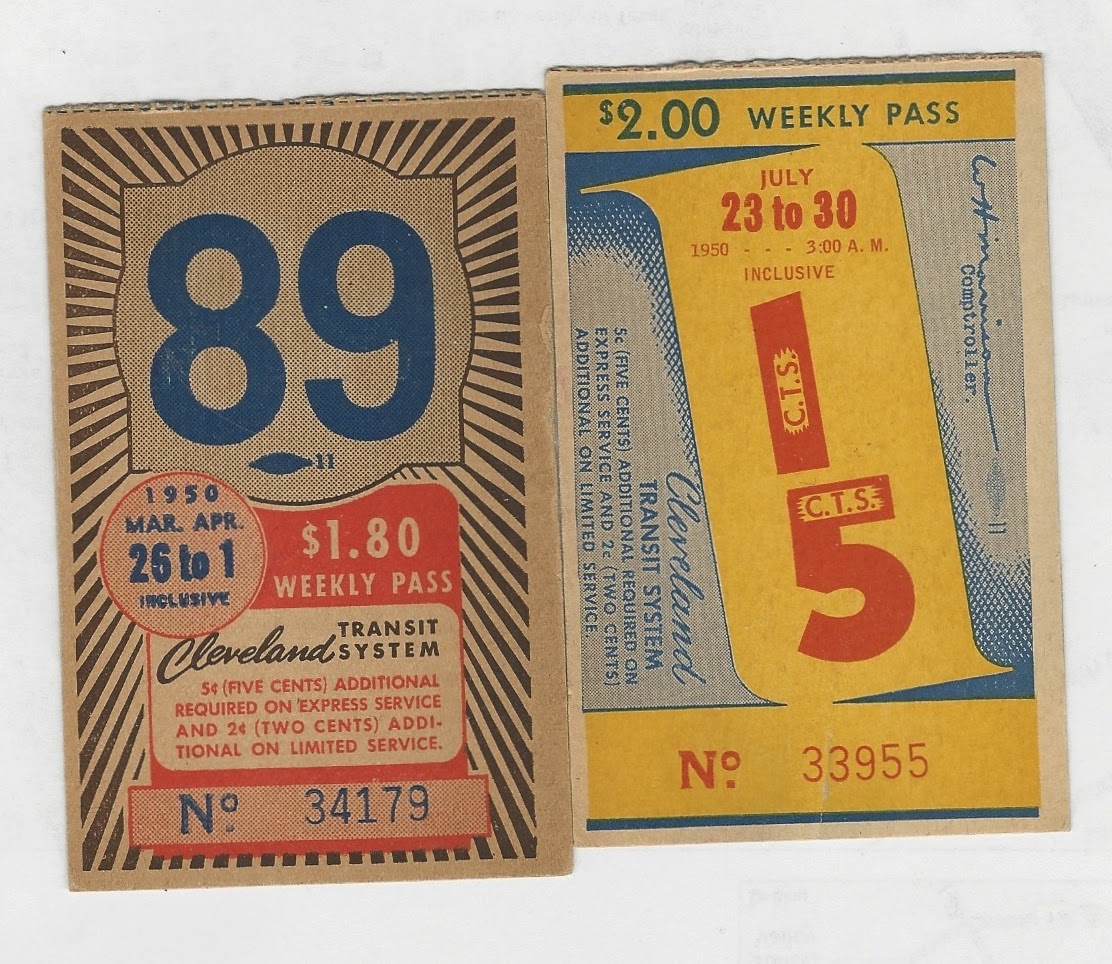
Vectures are the formal name for transportation tokens including coin-like payment for trolleys, buses, trams, and trains, as well as coin-like forms for parking, bridges, and ferries, as well as cards, tickets, and chits, including electronic formats.  In short, vectures are the numismatics of traffic and transportation. 
Courtesy card from the hotel for the tram
You can monetize anything.  Transportation tokens in all their expressions serve both sides of the transaction: they let riders pay for carriage, often at a discount if purchased in advance and in bulk, i.e., a weekly or monthly pass.  At the same time, they allow the transport authority or business to borrow money from patrons interest-free.  More subtly, they allow the monetization of a service.  
Cleveland, Ohio, 1950
Furthermore intra-urban transport represents a significant service to the commuter.  I do a lot of reading waiting for the bus and riding. Now, the express buses here in Austin have wi-fi, allowing me to work while I ride.  After January 1, 2015, it will be illegal to text and drive.  (The enforcement is more problematic than the authorities expect, but that is their problem, not mine.  I mean, I could be using my GPS, not texting...)  Be that as it may, the bus or the train allows you to do something else while you are being transported more or less safely and more or less conveniently.
Chicago 1976.
I jumped the turnstile to keep the ticket;
but I was on camera.
They let me go with a warning.
If you were sent back in time, how would you explain parking tokens to Leonardo da Vinci? Herbert Spencer might have understood.  He knew that social organisms evolve mechanisms and appendages.  The city of the modern era is not the city of the Middle Ages.
  
Roma, Italia. Face and Back of Metropole pass.

Consider the  Carrier's Case of 1473 (Wikipedia here).   We might imagine a science fiction story set in intra-galactic interstellar space in which the common carrier's point is carried forcefully.  However, here and now, it is hard to imagine that the bus driver could sell the contents of your cellphone while you ride.  

Coin-like tokens, attributed against the Atwood-Coffee catalog.
Prices have not changed in decades.
In the fantasy Lost in Austen, the 21st century viewpoint heroine caught in the Regency period comes from "Hammersmith" which to them is "outside" London.  "Well, yes," she says, "in your time..."  In the David McCullough biography of John Adams, villages outside of Boston are today neighborhoods within Boston.  "BosWash" has been the East Coast metroplex of science fiction for over seventy years.  Someday, some biometric will let you travel anywhere on Earth for a flat rate.

PREVIOUS ON NECESSARY FACTS

Thursday, October 31, 2013

Industrial Medals a Currency of Fame

Most people call it “coin collecting” but numismatics is the art and science that studies the forms and uses of money. That includes money-like objects, which we call “exonumia.”  Examples occupy the latitudes from merchant tokens and bus and bridge tokens to medals including military orders, such as the Congressional Medal of Honor.  The art medal was invented in 1439 by Antonio di Puccio Pisano (called “Pisanello”). The occasion was for the Emperor at Constantinople, John VIII Palaiologos, who came to Italian cities to negotiate treaties. (The standard reference is The Currency of Fame: Portrait Medals of the Renaissance by Stephen K. Scher, which is a catalog of the Frick Collection in the U.S. National Gallery of Art.)

The plethora of adverting exonumia has no easy taxonomy.  The Krause Standard Catalog of United States Tokens 1790-1900 by Russell Rulau assigns them to a dozen classes, but then must have another genus for mavericks. Within the classes – Advertising Checks, Counterstamped Coins, Poker Checks, Tool Checks, etc. – physical shapes exceed the limitations of Federal coinage: rectangles and hearts are statistical likelihoods.
41 mm reeded edge non-magnetic. 
Obverse: Durango Silveton Narrow Gauge Railroad.
(Steam from stack of engine with snow plow mounted at front.) 

Reverse: "Durango Rotary Club / Service Above Self /  
This coin is good for two dollars in trade at cooperating businesses 
in Durango through April 30, 1984. / High Noon Club” 
"Durango was founded by the Denver & Rio Grande Railway in 1879. The railroad arrived in Durango on August 5, 1881 and construction on the line to Silverton began in the fall of the same year. By July of 1882, the tracks to Silverton were completed, and the train began hauling both freight and passengers."The line was constructed to haul silver & gold ore from the San Juan Mountains, but passengers soon realized it was the view that was truly precious."This historic train has been in continuous operation for 131 years, carrying passengers behind vintage steam locomotives and rolling stock indigenous to the line. Relive the sights and sounds of yesteryear for a spectacular journey on board the Durango & Silverton Narrow Gauge Railroad."
All Aboard Magazine online here the official magazine of the Durango & Silverton Narrow Gauge Railroad.

 33 mm aluminum. Plain edge. 
1934 Chicago Century of Progress.
Obverse: Union Pacific Lucky Piece

Art deco Union Pacific engine.
Reverse legends: “Sample of the aluminum in the new Union Pacific train
built by Pullman Car & Mfg. Corp.” 

1929 trademark Norman shield with ACOA and ALCOA 
with stars in corners.
“Aluminum Company of America"

in exergue: "GREENDUCK, CHI"
Manufactured by Greenduck of Chicago (about that company here on E-Sylum of the Numismatic Bibliomania Society.)  One million given out at fair.

34 mm aluminum 4 mm height. plain edge
Obverse: Heavy machine press with BLISS name.
Legend: "Bettering the Standard of Value Since 1857"
Reverse: Standard US Bicentennial logo and legends.
Though he began building machines in 1857, E. W. Bliss founded his firm in 1867. Reorganized several times, a vestige still operates as Bliss Clearing Niagara in Hastings, Michigan, specializing in the repair and maintenance of industrial metal presses.  Bliss created primary production tools, machines that made other machines. They also produced military ammunition and a wide range of large and small containers made of sheet metal. For a short time around 1906, at their main office Brooklyn, New York, plant they manufactured an automobile.
E. W. Bliss Company on Wikipedia here:
“Walkabout the Lords of Owl’s Head” at the Brownstoner blog
See also the online sales catalog of the Sterling Machinery company.
(Not to be confused with Bliss Machines, founded 1987 outside Buffalo New York by Bill and RandyKanner.) 

J & L Steel. 35 mm non-magnetic plain edge. Spinner. 
Obverse: “YOU [up arrow]  WIN WITH J & L STEEL STOCKS” 
horseshoe and shamrock.
Reverse: “For dependable warehouse service 

call Walnut 1-0470.” J&L Steel in square.
 Every artifact gives evidence to the full context of its culture. A spinner is a coin struck with a raised center point. On the reverse side, an arrow points outward. “You pay” it says. Nicer variations such as “You win!” mean the same thing.

Founded in 1852 by B. F. Jones and Bernard Lauth as the American Iron Company outside Pittsburgh. James H. Laughlin bought out Lauth’s interest. Before 1861 and the firm was renamed in its new offices at Third & Ross in downtown Pittsburgh.  Growing up in Cleveland in the 1950s, our home was so close to the mills that late at night with the windows open, I could hear the yard engines working.  At its peak in the 1970s, the Cleveland facilities employed 4,000 people and produced 3 million tons of steel annually.
See also Wikipedia here

 Bronze 75 mm (3 inches). Extremely high relief.
Plain edge with incuse “Medallic Arts Company Bronze.”
Obverse: “Serving the Graphic Arts / 1906 – Fiftieth Anniversary – 1956”
“Pitman” (At left above P engraver’s name: Harold M).
Center: in Wreath: Camera, Press, Engraver’s hand with tool.
Reverse: three scenes: “Photo Engraving”: “Lithography”: “Rotogravure”.
Center triangle with center circle Camera and operator.
 
 Harold M. Pitman founded the company in Chicago in 1907. Starting out by himself, he made and sold steel dies and copper plates to engravers. Pitman celebrated its 100th birthday in 2007. Agfa Gevaert Group acquired Pitman for $80 million on July 15, 2010.  The Pitman brand is still seen at 16 sales and operations offices in the USA.

38 mm. Silver. Reeded edge.
Obverse: “Sierra Ball Pens” on Mountain. “Faber Castell / 1986” below.
Reverse modeled on Morgan Dollar.
Legends “
United States of America One Troy Oz. / .999 Fine Silver.”
"Faber-Castell, established in 1761 by the cabinet maker Kaspar Faber (1730-1784), is one of the oldest industrial companies in the world.  The company is the world’s leading manufacturer of wood-cased pencils with a varied range of products for writing, drawing and creative design, as well as decorative cosmetics. …  Today the eighth generation family member Count Anton-Wolfgang von Faber-Castell, who took over as head of the company in 1978, has been instrumental in new product development and the expansion of international activities."

"One of its biggest eco-initiatives came in the mid-1980s, when the company started a sustainable tree-planting project in Brazil. Developed on former grassland and nowhere near the Amazon River, the company-planted pine forest provides about 75% of Faber-Castell's wood. After the trees are cut down, they're quickly replaced with seedlings of fast-growing pine species.”

The application of steam engines and machine tools to coin production allowed industrial and commercial firms to celebrate their products, services, trades and crafts with coin-like objet’s d’art.  The first of these were the “British Provincial” series of the 1790s, mostly struck by the Soho Mint of James Watt and Mathew Boulton. In half-penny and penny size, they often promised to pay pounds sterling in return for 480 or 240 brought to London or Birmingham. Their beauty, consistency and cost-efficiency eclipsed anything from the Royal Mint. 

In America, private tokens of the Jacksonian Era spoke to the politics of the day.  They skirted the laws against private money. “Millions for Defense NOT ONE CENT for Tribute” was a common reverse legend.  Through the nineteenth century, thousands of taverns, restaurants, and general merchandise retailers issued “Good-for” tokens.  Essentially, these were ad hoc currencies backed by the goods and services of the issuers. 

In parallel to all of that, many coin-like items declared no value, but only announced the firm. Behind government money and private currencies, numismatics grants only a third place interest to these. Nevertheless, they continue a tradition from the Renaissance to honor oneself and to announce one's achievements to the world.

PREVIOUSLY ON NECESSARY FACTS

Tuesday, October 29, 2013

Tokens of Capitalism

In the popular adventure Pirates of the Caribbean: at World's End, Jack Sparrow and his friends must battle an array of bad guys headed by the British East India Company.  Like the Hudson Bay Company, the BEI certainly had a complicated past that inevitably included the evils of raw colonialism. On the upside, it was a venture; and venture capitalists profit from risks that no one else wants to take. (See Venture Capital on this blog.) Johnny Depp and Keira Knightley are attractive as freebooters. We denigrate the drudgery of billing department commerce; but, as Deirdre McCloskey famously reminds us, we are all bourgeois now.
British East India Company Rupee. 1840 Calcutta).
28 berries W. W. variety Craig 4a.  30.5 mm silver.
We get so used to seeing dead politicians on government money that we have a hard time imagining anything else. Excavations of Ice Age tombs reveal amber, jade, and shells, other objects of no practical use, hundreds of miles from their places of origin. 

Northumberland & Durham 6-pence Token  20 mm 
Payable by John Robertson
Newcastle on Tyne. 1811. (silver)
The stone ages ended about 8000 BC when copper was discovered. From about 3500 BC other metals (including silver and gold) were also found and worked. Cuneiform records from Mesopotamia at about 2400 BC tell of silver being weighed out in payment. This was indirect trade in a material that, like amber and cowrie shells, had no immediate use. Silver and gold are pretty, but not suited for agricultural or hunting tools. By 700 600 BCE, merchants were die-punching nuggets of electrum to mark them so they would not have to be reweighed. It was not long before monarchies and democracies minted coins

Ireland Bank Token. 10d. 22 mm. 1813. Silver.
Craig 9. Seaby 6618. K&M Tn5
Series ran 1760 to 1820.
In the mid to late 1300s life in England had improved to the point where luxury items were over-priced in terms of the smallest silver coins. So, bronze tokens ("counters" or "jetons") from Europe filled a need for small change. Foreign coins were joined by private issues. By the 1600s, the privately issued copper, tin, and lead tokens completely dominated neighborhood trade. It is not surprising, then, that undervalued copper tokens were among first coins minted for American commerce. For nearly 200 years in America, small purchases were carried out in a wild array of private and foreign coinages. Federal government money was not established in household shopping until the 1840s. Through the 1830s, merchants in the East kept their books in pounds-shilling-pence; and Mexican silver was legal tender until 1857. Counterfeit British copper half pennies from the colonial era circulated as money in western Appalachia through the 1830s.

Norfolk Norweb. Dalton & Hamer 23b (no date)
"Prosperity to Old England / More Trade Fewer Taxes"
so-called Vitriol bottle
Copper half penny
Edge: "Richard Tinmore and Son"
If you look back at history, you will see a curious pattern. We can assume that government money is the norm and that tokens are an interesting exception. However, in every time, a variety of moneys carried the needs of daily commerce.  Stores today to pass out "good-fors," aluminum or wooden coins good for some amount of money toward a purchase whether coffee, ice cream, pop corn, or beer.
Canada Maritimes
Charlton Brett 963. 8.16 grams. copper.
The August/September 1993 issue of Mother Earth News featured a cover story about the
"time dollars" of Ithaca, New York, a local currency still in use today.  People there trade services in units of an hour. The idea of denominating money in labor was suggested by anarchists and syndicalists in previous decades. Community money can be found in many towns, including Traverse City, Michigan, where "Bay Bucks" have been circulating for ten years.  
An interesting twist on "time dollars" comes from the policies of the conservative economic journal, The Freeman. Authors are paid 10 cents per word, plus a subscription. Authors can assign that subscription to anyone, thus commoditizing it.

Middlesex. Dalton & Hamer 1012E
from Erskine, Anderskine, and Gibbs
Law firm successfully defended accuseds on charges of treason.
"Erskine and Gibbs and Trial by Jury"
Two men with banners: "Magna Chart" / "Bill of Right"
"T. H. Hardy,  I. H. Hooke, T. Holcroft. I. A. Bonney, J. Joyce, 
S Rid, J. Thelwall, I. Richter. I Baxter
1794.
The shoemaker, Thomas Hardy, was the secretary to the London Corresponding Society. His outspoken support for the French Revolution – including his association with a play called "La Guillotine: or, George’s Head" brought him from his shop at 161 Fleet Street to Old Bailey Prison on charges of sedition.  He was acquitted by his peers and his lawyers struck a token to celebrate their skill and his good fortune.

This narrative was taken from "Money Without Banks and Governments" by Michael E. Marotta, published first by Practical Anarchy, 1994 and then archived at Lloyd Unlimited Numismatics.

PREVIOUSLY ON NECESSARY FACTS

Friday, October 12, 2012

Money is Speech

For over 2000 years, money has been a medium – sometimes the medium – of communication, especially political speech.  The German Democratic Republic honored Karl Marx on its 100 DM notes from 1971 until 1990.  On the other hand, the privately-owned Clydesdale Bank of Scotland issued a ₤50 note celebrating Adam Smith. 
In Bahrain, the half-dinar coins featuring the Pearl Monument have disappeared from circulation, as the government denies repression of dissidents.
Bahraini Half-Dinar (www.the-war-diaries.com)
In the Roman republic and empire, coins were common instruments of communication.  Julius Caesar boosted his political career by advertising his priesthood on the coins he and his allies issued.  The “Ides of March” denarius of Caesar’s assassin, Marcus Junius Brutus, is highly sought at auction today.  Over 2000 years ago, money was political speech in a life and death struggle for power.

Ides of March Denarius. Harlan J. Berk. Wildwinds.
The coins and paper of the American colonies, states, and central governments carried a host of political messages, from “Mind Your Business” to “We Are One.” 
In the 1790s, British merchants met the need for small change with an astronomical array of tokens.  They advertised their shops, touted their towns and made bold political statements.

  In 1794, the shoemaker, Thomas Hardy, was the secretary to the London Corresponding Society.  His outspoken support for the French Revolution – including his association with a play called "La Guillotine: or, George’s Head" brought him from his shop at 161 Fleet Street to Old Bailey Prison on charges of sedition.  He was acquitted by his peers; and his lawyers struck a token to celebrate their skill and his good fortune.  Today, it is catalogued as Dalton and Hamer Middlesex 204, and you can own one in uncirculated grade for about $150. 
Much Gratitude Brings Servitude
We Were Born Free and Will Never Be Slaves
Another British merchant token from the same time showed a spaniel: “Gratitude brings servitude,” it warns. We were born free and will not be slaves.”
            The abolition of slavery was one of the many topics in the popular series of “Hard Times Tokens” from the Jacksonian Era.  “Am I not a Man and a Brother” was first a British merchant token and then it and “Am I not a Woman and a Sister” were remade as American tokens. Other partisans heralded or lampooned Jackson – bluntly cartooned as a jackass – Webster, Van Buren, and Benton.  Such tokens are easiest to find in circulated grades because for ten years they were passed from hand to hand in daily commerce. 
            Civil War tokens fall into two broad categories: store cards and politicals.  These private issues filled a gap in commerce and carried strong messages.  Perhaps the most famous political token of the Civil War shows an American flag: “If anyone dares to tear it down, shoot him on the spot” 
That American federal government money now carries the message, “In God We Trust” comes from this same period.  It appeared first on the two-cent coins of 1863, then, on the Silver Certificates of 1954, as a thrust against the godless communists of the USSR.  Among the other political messages on our coins today are Liberty and E Pluribus Unum, with a slew of others courtesy of the 50 State Quarter Program.  Any denomination of current American paper money carries about 20 different phrases, sentences, and word sets.
Stored-value electronic card with non-political message
For over 30 years, privately-issued silver art bars have broadcast a wide array of political messages, starting with Watergate and continuing to the Clinton Impeachment and current war the on terrorism. 
According to University of Texas scholar, Denise Schmandt-Besserat, writing evolved from the use of clay tokens to keep track of livestock, beer, and other farm goods.  The tokens go back to 7500 BCE.  Eventually, the tokens were impressed on clay containers into which the tokens themselves were stored.  Cuneiform writing evolved about 3500 BCE from these symbols.  The oldest known writing on clay tablets are inventory lists and promises to pay.  The oldest known epic, the Gilgamesh, is dated to 1000 years later.  All of this is explained in How Writing Came About by Denise Schmandt-Besserat, which can be ordered from the University of Texas Press for less than $20. 

The Bank of England also commemorated Adam Smith on a ₤20 issue.  Founded in 1694, the Bank was nationalized in 1946, but achieved nominal independence in 1997.  Its governors and directors are appointed by the crown, making it much like the American Federal Reserve, a nominally private entity with close government supervision.  What would Adam Smith or Karl Marx have said about that?

ALSO ON NECESSARY FACTS
Accounting for Civilization  (Babylonian clay tokens and the origin of writing)
Debt: the seed of civilization (Further reflections on accounting)
When Writing Met Art (The structure of contracts ordered the narrative of art.)


Capitalist Culture (The business of coffee in Cairo 1600 AD)
Workers' Paradise Promised an End to Money (May Day!)
Valentine's Day: Love and Money (Contraceptives and Heart Shapes)


Monday, August 22, 2011

Numismatics: the Standard of Proof in Economics

Hayek, Mises, and Rothbard, and of course Friedman,  for all their passion, lacked any understanding of numismatics.  As a result, their theories wanted facts; ultimately, their predictions and prescriptions were weak.  Sometimes, they failed. 
Hayek's Denationalisation of Money relied on Murray Rothbard's flawed monograph, What has Government Done to our Money? which delivered one anemic academic citation on tokens.  Any active coin collector could deliver hundreds of examples of competing currencies, weak and strong, successful and disastrous. 

Most people call it “coin collecting” but numismatics is the art and science that studies the forms and uses of money. This includes stock certificates, bank drafts, military decorations and fine art medals as well as coins.  Numismatics is one of the last unregulated markets. In the USA, there are no government licenses or special regulation. There are few college courses on American campuses. Validation, such as it is, is by ad hoc standards of conduct set within the hobby by private organizations: the American Numismatic Society, the American Numismatic Association, the International Association of Professional Numismatists, and the Professional Numismatists Guild. These groups set standards far above any government laws. For instance an ANA dealer can be banned from membership for selling a single counterfeit item, and ignorance is not an excuse. Two complaints - complaints alone - are enough to cost a dealer his membership.  The ANA offers seminars on its Colorado Springs campus. They also provide a range of self-study materials and grant a master’s certificate in numismatics. 


Of the perhaps six million Americans who claim to "collect coins" only a couple dozen attend ANA seminars each year.  Numismatists are autodidacts. 

That is why academic economists overlooked the very study which tests, proves, or discards their theories.  As a hobby, the engagement is personal, direct, participatory.  There is no standard textbook.  As hobbyists, we allow ourselves whimsy which academics apparently misunderstand.  One of the foundation books about early American copper cents is called Penny Whimsy. The author, psychologist William Sheldon, was a charlatan and thief.  The leading research organization is a club called the Numismatic Bibilomania Society.  Their "journal" is the Asylum.  Their weekly email list is the E-Sylum.  The Paper Money Collectors of Michigan know more about the actual history, forms, uses, successes and failures of circulating notes than any coterie of bankers.  They call their 8-page newsletter The Ragpicker. Their current president, William Brandimore, is also an editor of one of the most authoritative compendiums of United States Paper Money.  

All is not lost.  academic economist George Selgin's work, Good Money: Birmingham Button Makers, the Royal Mint, and the Beginnings of Modern Coinage, 1775-1821, came out in 2008.  He provided a thrilling, yet accurate narrative, backed by citations. His research explains the catalog of facts long known from Dalton & Hamer's The Provincial Token-Coinage of the 18th Century (1910).  The standard compendium for American tokens was Lyman Lowe's Hard Times Tokens (1899), which has been continuously updated by new research by Russell Rulau.  Rulau also edits a more general book on American merchant tokens through the 19th century.  

Other specialists have devoted their passions to stock certificates, wildcat banknotes of Ohio, Indiana, Wisconsin, etc., ancient Greek, Roman, Jewish, Turkoman, and Celtic coins, as well as American and Canadian emergency scrip of the 1930s,  and, of course, the full array of U.S. government coins and notes.  From the copper crosses of Katanga to Chinese cash and Siamese gambling tokens, and the rich array of Arab-Islamic issues across 1000 years on three continents, even the monetary uses of woodpecker scalps and cacao beans have been studied and reported in print and at conventions by "coin collectors."  (Conventions feature judged, museum-quality exhibits touting arcane and abstruse subdisciplines.)

Hayek's Denationalisation of Money could have used some evidence.  He relied on Murray Rothbard's monograph, What has Government Done to our Money? which delivered one anemic academic citation on tokens.  Any active coin collector could deliver hundreds of examples of competing currencies, weak and strong, successful and disastrous.  


To be fair, numismatists could benefit from an infusion of free market economics.  It is true that our convention bourse floors put Wall Street to shame.  However, I stopped visiting one collecting discussion board when we had a disagreement first over Morgan-Stanley's naked shorts on silver futures, then over coal mine tokens. Some writers found general support for their declamations against greed, profiteering, and the exploitation of workers.  I was left the odd man out for defending speculators and industrialists.  I found that ironic in a hobby that buys and sells money.

New research continues.  Whitman Publishing and Krause Publications release new titles every month.  Their smaller competitors such as Stanton and Money Tree are active as well.  Some of these standard references, known now for 100 years, are sirens - at once lures and warnings - for the limitations of academic economics.  

Also on Necessary Facts: