Showing posts with label museums. Show all posts

Sunday, March 17, 2024

Fossils and Stars

FOSSILS AND STARS

The Texas Science and Natural History Museum
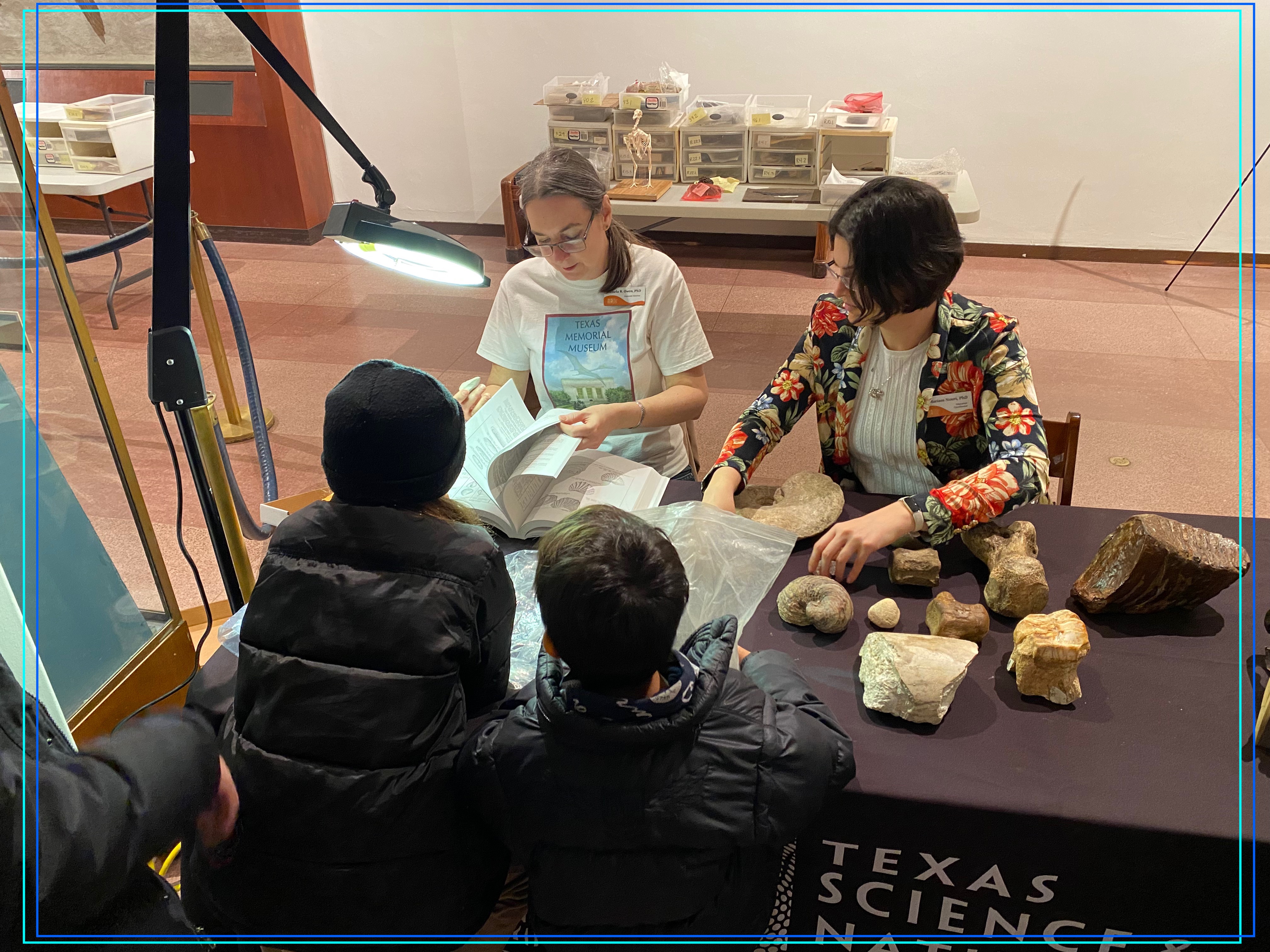
held its 85th anniversary birthday party
on Sunday 21 January 2024 and we were happy to attend.
Invitees were encouraged to bring
their fossils and many did.
Museum Assistant Director Pamela Owen and
Education Coordinator Miriam Nouri identified them for us.

I bought the ammonite (black) at the Cincinnati Museum
of Natural History and Science back
in the 20th century. I lost the tag long ago and
did not know what it was. I was surprised to learn that
this is something that I know in its more common format.

On 27 January 2024, I found Messier 79 in Lepus.


Orion is a rich area of the sky and is near the meridian
for most of the winter from late November to mid-March.
Here, I sketched the stars marking the head of the Giant.

PREVIOUSLY ON NECESSARY FACTS

Fossils and Behaviors 

Before Darwin 

Pedernales Falls Public Star Party 

Globular Clusters 


Thursday, November 30, 2023

30 Minutes with Dinosaurs

I made time during my campus patrols to visit the Science and Natural History Museum at the University of Texas at Austin. The collection is impressive, far surpassing what I grew up with the Cleveland Museum of Natural History, and also what I have seen over the years at other museums. It is emblematic of Texas that the museum had to be closed because it ran out of state funding. I am happy that it is open again.

Clearly, not my field. Judging by the rocks revealed by excavations at
construction sites here in Austin, I thought that this all was underwater
for the last 500 million years. 
The specimen drawers are arranged to encourage exploring.
For a good picture, you really need to stand far enough back
that it could not get you.

Just saying "Dimetrodon" is half the fun.

Who knew? Xenophora clean and attach to themselves random
bits off the floor. 
We have a rule in the house against more bric-a-brac
but the Selenite was calling to me.
So, I bought two. I also got a coffee cup for myself.

Previously on Necessary Facts

The Unremarkable Origin of Species 

Epigenetics and Evolution 

The Origin of … (What?) 

The Philosophical Breakfast Club

The Map that Changed the World 


Tuesday, January 1, 2019

Neutron Irradiated Dimes

Today you can get rocks, fossils, gems, meteorites, astronaut ice cream, gyroscopes, and magnets at any museum store. Irradiated dimes were sold at Oak Ridge National Laboratory from 1949 to 1967. They speak from the heart of the atomic age. On the one hand, Oak Ridge was a secret town that officially did not exist. On the other hand, the actual use of the atomic bomb proved impossible to miss. 

What we call “Oak Ridge” today (ZIP Codes 37830 and 37831) was built by the federal government as part of the Manhattan Project. The under-developed area of eastern Tennessee had small farming towns—Edgemoor, Elza, and Robertsville, among others—but was largely uninhabited. The purpose of the new city, which grew to 75,000, was to separate fissionable uranium (U 235) from the other isotopes, mostly U 238. It also produced plutonium. In addition, the site manufactured other isotopes that have industrial and medical uses such as antimony (Sb 124). 
 
Case legends on irradiated dimes.
AMERICAN MUSEUM OF ATOMIC ENERGY NEUTRON IRRADIATED 
(in black)
ORNL – UCNC – OAK RIDGE NEUTRON IRRADIATED
AMERICAN MUSEUM OF ATOMIC ENERGY NEUTRON IRRADIATED 
(in blue)
Not shown: 
OAK RIDGE NATIONAL LABORATORY – NEUTRON IRRADIATED – 
(May be the earliest variety.)
The town was finally opened on March 19, 1949. The American Museum of Atomic Energy began the same year. It was re-dedicated as the American Museum of Science and Energy in 1978.  
UCNC is the Union Carbide Nuclear Company. 
The Union Carbide Corporation Nuclear Division operated 
the Y-12 separation plant at ORNL.  
The division apparently used the two names at different times. 
UCNC also operated a uranium mine in Emery County, Utah. 
See Western Mining History here.
This quote is most likely from a 1954 ORNL press release:
"One of the most popular exhibits in the American Museum of Atomic Energy is a “dime irradiator.” To date, more than 250,000 dimes have been irradiated, encased in plastic and returned to their owners as souvenirs. The irradiator works as follows: A mixture of radioactive antimony and beryllium is enclosed in a lead container. Gamma rays from the antimony are absorbed by the beryllium atoms and a neutron is expelled by the beryllium atom in the process.            
“These neutrons, having no electrical charge, penetrate silver atoms in the dime. Instead of remaining normal silver-109, they become radioactive silver-110. After irradiation, the dime is dropped out through a slot in the lead container and rests momentarily before a Geiger tube so that its radioactivity may be demonstrated. It is then encased in the souvenir container. Radioactive silver, with a half-life of 22 seconds, decays rapidly to cadmium-110 (In 22 seconds, half of the radioactivity in each dime is gone, in another 22 seconds half the remainder goes, and so on until all the silver-110 has become cadmium).  Only an exceedingly minute fraction of the silver atoms have been made radioactive." From “Irradiated Dimes - American Museum of Atomic Energy and New York World's Fair (1950s, 1960s)” At Oak Ridge Associated Universities website here. (ORAU operates the AMSE.)
Some typical eBay prices of the moment.
 The press release cites a figure of 250,000 dimes given out. By the time the program ended, the figure was close to 1,000,000. This summary from 9 November 2013 by CoinTalk user mrweaseluv was based on an article that I wrote for Coin World. (I visited ORNL twice in September 1999 to interview people and tour the museum and the city.). 
“A beryllium case was placed over small lump of [radioactive] antimony [Sb 124]. The antimony gave off gamma rays that excited the beryllium which emitted neutrons that struck the dimes. The half-life was 24.6 seconds. Some of the Ag-109 atoms became Ag-110. Giving off an electron, the Ag-110 became Cadmium (Cd-110), which is stable. Another 51.82% of the silver atoms became Ag-107, the remaining 41.18 of the silver remained Ag-109. Of the remaining 5% was comprised of other isotopes, the most stable of which is Ag-108 which remains radioactive for five years, though the amount in a dime is statistically unimportant at the human level. Dimes are also made of copper. Cu-63 and Cu-65 represent almost 69.17% and almost 30.83% of the mass and are stable. When they absorb a neutron, they become zinc. The remaining fraction of a percent is Cu-67 which is radioactive for two-and-half days. Only silver dimes could be used. When the government switched to cupro-nickel, it was only a matter of time before silver dimes became scarce. The program was discontinued in 1967. Ni-63 remains radioactive for 92 years, decaying much quicker than Ni-59 which has a half-life of 80,000 years.”  (Cited from CoinTalk dot com here. )
See also: 
MORE ON IRRADIATED DIMES
By Pascal Brock, Harold Levi, Bruce Perdue, Ken Berger, 
The following is taken from the TAMS Journal, Vol.14, No. 1, February 1974.
“The Neutron Irradiated Dime, Atomic Energy Commission, New York World's Fair, 1964-1965” by Stephen P. Alpert, TAMS # 2134.
The E-Sylum: Volume 14, Number 52, December 18, 2011, Article 10

“Antimony-124 is used together with beryllium in neutron sources; the gamma rays emitted by antimony-124 initiate the photodisintegration of beryllium. The emitted neutrons have an average energy of 24 keV. Natural antimony is used in startup neutron sources.”

“Gamma rays are ionizing radiation and are thus biologically hazardous. Due to their high penetration power, they can damage bone marrow and internal organs. Unlike alpha and beta rays, they pass easily through the body and thus pose a formidable radiation protection challenge, requiring shielding made from dense materials such as lead or concrete.”

“The decay scheme is rather complex, as it includes more than 25 β− transitions and about 70 γ transitions with energies spread between 148 keV and 2807 keV. However, only about a tenth of them have probabilities greater than 1 %.”
124Sb – Activity measurement and determination of photon emission intensities Part A – COMMISSARIAT A L'ENERGIE ATOMIQUE ISSN 0429 3460

Title: A Study of the Nuclear Radiations from Antimony and Arsenic
Authors: Mitchell, Allan C.; Langer, Lawrence M.; McDaniel, Paul W.
Publication: Physical Review, vol. 57, Issue 12, pp. 1107-1117
Publication Date: 06/1940

 I find that date revealing. We have a poor sense of history or at least I do. Obviously, research into the physics and chemistry of radiation had been continuing for almost 50 years. But we too easily see Hiroshima and Nagasaki as the dawn of the Atomic Age. In fact, Wilhelm Röntgen announced x-rays in 1895, and by 1906 they found medical applications. Admittedly, the first decade was a period of uneven and sometimes tragic results. 

PREVIOUSLY ON NECESSARY FACTS

Thursday, October 4, 2018

Museum Receives Texian Navy Scrip

On September 26, 2018, the Texas Military Forces Museum at Camp Mabry received a gift of two pay warrants issued to sailors and marines of the Texian Navy. They are now part of the permanent collection of the Texas Military Forces Museum and will soon be on display. The pay warrants were donated by Michael E. Marotta and received by the Museum Director, Jeff Hunt


Like other Texas Republic paper money, the promissory notes quickly lost value and few were ever redeemed. These pay warrants were actually cashed in and cancelled. In April 1841, on the verbal orders of President Mirabeau Lamar, $200,000 in promissory notes were printed, signed, and handed out mostly to Texian Navy sailors at Galveston. 


However, the only money available came from $8,000 in silver coin paid to the Texian Navy by Mexican federalist rebels at Yucatan. Very few promises were honored. Most of the silver pesos from Yucatan went for much needed repairs to the ships. Also, Sam Houston was not a supporter of the Navy. As soon as he was re-elected President in December 1841, Houston repudiated the notes. Houston so distrusted the Navy that at one point in 1838 he declared them all pirates, ordering any lawful ship to arrest them and bring them to Galveston for trial. 


The notes are signed by the Comptroller, James R. Shaw, and the Treasurer, James W. Simmons. They are endorsed on the back by the men who whom they were given. Both notes are cancelled.
The $25 promise carries the endorsement of John Deziel. The $50 note was paid to a Navy Yeoman.
   
TMF Museum director, Jeff Hunt 
and museum supporter Mike Marotta, 
stand in front of a Texian Navy display 
with the pay warrants. 
(TMF Museum staff photo.)
PREVIOUSLY ON NECESSARY FACTS

Monday, June 29, 2015

Meteorites

You can own meteorites, the remaining pieces of the early solar system.  They are swept up by the Earth in its orbit, and survive the long fall to Earth's surface.  Some can be identified as coming from Mars, others from Luna.  Some are fragments of comets.  Most are relics of shattered planetoids.

For our ancestors, meteorites were at once harbingers of the gods, and the most ready form of iron.  We know now that some contain amino acids – the building blocks of life – and some of those are not known in native form on Earth. 
The popular beginner's book
by "fallen star" Richard Norton
You can find reputable dealers for buying and selling. If you have the opportunity for travel, you can find your own craters and fall sites and strewn fields. Rarely, but possibly, you can find a meteorite by paying close attention to the ground beneath your feet. Whatever your interest and resources, you can assemble your own museum.

First the Bad News

A New York Times article for April 4, 2011, called them “Black Market Trinkets from Space.”
“…chunks of meteorites, bits of asteroids that have fallen from the sky and are as prized by scientists as they are by collectors. As more meteorites have been discovered in recent years, interest in them has flourished and an illegal sales market has boomed — much to the dismay of the people who want to study them and the countries that consider them national treasures.
“It’s a black market,” said Ralph P. Harvey, a geologist at Case Western Reserve University who directs the federal search for meteorites in Antarctica. “It’s as organized as any drug trade and just as illegal.”
 
Paperback 288 pages
University of Arizona Press, 1997.
The trend is for modern governments such as Turkey, Egypt, and Libya, to sue other modern governments such as the United Kingdom and the Unites States of America, for the return of “cultural patrimony”. 

By comparison, in numismatics, dealers and collectors often find  themselves standing against the interests of museums, especially those operated by governments. The Ancient Coin Collectors’ Guild was formed to lobby Congress, and to sue in courts for the rights of collectors.  And it is not just about coins.  Coins do signal to metal detectors, but they are only the most common artifacts of any Western civilization since 500 BCE.  Where you find coins, you find oil lamps, amphoras, and other ceramic household goods.

Patrimonial claims open many doors. The American Museum of Natural History was sued by a Native American council that claimed that the Willamette Meteorite was sent by the gods to communicate with their people before the arrival of other people on this continent.
New York, New York - June 22, 2000 -- The American Museum of Natural History and the Confederated Tribes of the Grand Ronde Community of Oregon today signed a historic agreement that ensures access to the Willamette Meteorite, a world famous scientific specimen at the Museum, by the Grand Ronde for religious, historical, and cultural purposes while maintaining its continued presence at the Museum for scientific and educational purposes. The agreement recognizes the Museum's tradition of displaying and studying the Meteorite for almost a century, while also enabling the Grand Ronde to re-establish its relationship with the Meteorite with an annual ceremonial visit to the Meteorite.  (AMNH Archives here.
To my knowledge, no museum curator has spoken up for the numismatists.  However, the New York Times article cited above also included this quote: "We have a co-operative relationship with the collectors," said Monica Grady, a leading meteorite scientist at Britain's Open University. "We can't afford to go out and collect, but this small army of dealers will do it."

In 2012, the federal Bureau of Land Management created three licenses for people who want to hunt for meteorites on federally-held lands. 
                Casual collection of small quantities without a permit
                Scientific and educational use by permit under the authority of the Antiquities Act
                Commercial collection of meteorites through the issuance of land-use permits
(See Space.Com archives here.)

As with any collecting hobby, two axioms inform buyers and sellers alike: 
  1. Knowledge is king. 
  2. If you don’t know your material, then know your seller.  

Dealers formed the International Meteorite Collectors Association (here). In order to join the club, you must have recommendations from two members.  Their website is not completely clear on what that means, so I emailed an enquiry.  It means that you must have an established buyer-seller relationship with at least two of their members.  

The Meteoritical Society (here) was founded in 1933 by professional and amateur scientists in order to organize the study of meteorites and planets. 

Austin’s Russ Finney created a website to provide information. You can find others online.  Some dealers are members of several societies.  Again looking to numismatics as a reference point, if a dealer is a member of several societies, then that increases their social capital: they have more resources to lose if things go wrong. 

I bought my first meteorite about 20 years ago from an ANA member who advertised them under the “Other Collectibles” heading in the classified ads of The Numismatist. I received two more from a friend who teaches science.  She bought them from a mentor who opened a rocks and minerals store after he retired. 

Personally, I have not done business with any of the firms listed here. I offer them as benchmarks for the size of the hobby network. 
http://www.universaltreasures.com/
Aerolite Meteorites
(Note that while the site is in the Dot.Org domain, the firm is incorporated as a for-profit enterprise.  The owner, Geoff Notkin, also owns the label as an LLC.  The accounting rules derive from his many activities.
"I am a science writer, meteorite hunter, and photographer, television host and producer, and have had the good fortune to participate in exciting expeditions across much of the world, in search of meteorites and other natural history treasures. I am host the multi award-winning TV adventure series Meteorite Men on the Science Channel and won two Emmys for my work in educational television with STEM Journals. I am a member of The Explorers Club, The International Meteorite Collectors Association, The Association of Applied Paleontological Sciences, the Electronic Frontier Foundation, the International Dark-Sky Association, and the Society of Southwestern Writers."

https://www.meteorites-for-sale.com
http://www.meteorite.com
http://www.star-bits.com/index.html
http://outofabluesky.com
http://meteoriteman.com

PREVIOUSLY ON NECESSARY FACTS


Sunday, February 22, 2015

The Problem of Cultural Patrimony

From Agent Presse France 
via Al-Arabiya online here 
On February 18, 2015, news services (Reuters here) reported that a group of amateur undersea divers from Israel found 2000 gold coins from about 1000 CE, off the coast of the ancient city of Caesarea which is now in the modern state called Israel.  The coins were struck during  the Fatimid Caliphate.  Speculation by archaeologists from the Israeli Antiquities Authority included the suggestion that the coins were taxes collected for the ruling center of the time at Cairo in Egypt.  An alternate theory is that the coins came from a private merchant ship moving from port to port.  No article cited the problem of patrimony.
Fatimid dinars feature the names of the caliphs they were minted under, as well as the date and location where they were minted. "They're first-class historical documents," explains Robert Kool, curator of the IAA's Coin Department.  […] A cursory study reveals that the earliest coin from the hoard was minted in Palermo, Sicily, while the majority came from official Fatimid mints in Egypt and other parts of North Africa and date to the reigns of Caliphs al-Hakim (A.D. 996-1021) and his son al-Zahir (A.D. 1021-1036).  -- National Geographic News online here.
UNESCO (the United Nations Educational, Scientific, and Cultural Organization) has a broad mandate.  In the past fifteen years, it has arranged with national governments around the world – chief among them, the United States of America – for the passage of laws requiring that “cultural patrimony” be returned to the country of origin.  The Boston Museum of Fine Art and the Getty Museum are among the most newsworthy victims. Several problems haunt the laws. The problem of patrimony is multidimensional. The claims of UNESCO and their allies suffer from internal contradictions because they have no objective basis in epistemology: no standard of value exists for identifying right from wrong.

First, modern nations did not exist in ancient times.  The Boston Museum returned to Turkey a statue called “The Weary Herakles” from 200 BCE. But there was no “Turkey” in 200 BCE.   They called it “Helliades” – and you need to understand what that means.

In the Iliad and the Odyssey, the Greeks called themselves “Achaeans.”  About 400 years later, during the Hellenistic Era, they called themselves “Hellenes.”  Hellas is the modern Greek name for Greece.  But grammatically Helliades is much wider than Hellinike. 

Hellenike would be any Greek city with ties to the old homeland.  Tarentum in Italy was Taras; Naples (Napoli) was Neopolis.  Marseilles in France was Marsalla.  Benghazi in Libya was Berenike.  They were Greek cities.  Greeks built them; Greeks inhabited them.  Sicilians are not Italians.  Italy is a peninsula. Sicily is an island. They are different places.  The people of eastern Sicily are Greeks. In the west, they are Carthaginian.

However, after Alexander the Great, many cities of diverse ethnicities came into the Greek sphere. The orator Demosthenes said, “The name ‘Hellene’ no long applies to a race, but to a state of mind.”
 
Ancient Coin Collectors Guild
lobbied for the rights of private citizens
On that basis, should not every coin from Pakistan to Spain, from Egypt to England go back to Athens? In truth, as the laws are applied, coins from Greek cities of Sicily do not go back to the government museums of Greece: they go to the government museums of Italy. 

Consider the Roman Empire.  In addition to the central mint, coins were struck in what are today Tunisia, Egypt, Turkey, Bulgaria, Croatia, Germany, France, and England.   Moreover, Roman legions came from all across the empire, but could be stationed anywhere.  The legion name (cognomen) could reflect where they were drawn from or where they won a battle.  We have epigraphic evidence to show that Legio IX Hispanica served in England from 65 to 120 CE. Legio III Cyrenica (modern Libya) served in what are today Egypt, Syria, and Iraq. Legio III Italica was stationed in what is Regensburg for 200 years, from 165 CE.  Galba reorganized former marines into Legio I Adiutrix (“Rescuer”) in 68 AD, and stationed them in what is today Mainz.  However, for most of the second century (106 to 198) their base was in a town later known for many years as SzÅ‘ny in Hungary, but which is now called Komárom on the border with the Slovak Republic.  So, when a hoard of coins found in England contains the product of a mint from Croatia to pay Roman troops from Spain, whose patrimony is it?

Second, the assumption of UNESCO and the co-operating national governments is that the national public museums have a moral right to first claim.  Private collectors are rebuked as looters of protected sites. 

Old World traditions acknowledge the ruler as the owner of all property. The king could grant a title and land to go with it because all of his realm was his to dispose of as he saw fit.  In America today, that continues as eminent domain: the state can take what it needs.  So, when a farmer in Egypt or England finds an ancient coin on his land, it is not his at all: it belongs to the national government.  (England relaxed its “treasure trove” laws; but even that granting of latitude was from the rulers down to their subjects.) The governments of Turkey, Greece, Italy claim that these artifacts were "looted" from "historic sites" but it is easy to make any place historic if other people ever lived there before you did.  Historicity is just an excuse.  In their minds, private property does not exist.
“I’ve been reading only about the Italians and Greeks 
and how they’ve succeeded,’’ said [former Turkish 
cultural official Engin] Ozgen.  “This will show the world 
that the Turks are not ignorant anymore, that they will fight 
for their past and their heritage.’’ This statue is attributed 
as a Roman copy of a lost Greek work.  
It comes from the city of Antalya in modern Turkey.
The town was founded by Attalus II of Pergamon in 180 BCE. 
 Seljuk Turks entered the area about 1500 years later. 
The Boston Museum of Fine Art returned this 
statue of "The Weary Herakles" to the city of Antalya. 
Read here.
Third, why is a museum in Rome more entitled to these artifacts than I am?  It is my patrimony as well.  And, like most Americans, I have a lot of patrimony.  In addition to the Sicilians (Greeks), my mother’s side of the family was loosely identified as “Hungarian.” However, my maternal grandmother’s maiden name was Croatian.  The family just moved up the river inside of a large, multi-ethnic empire in central Europe.  My maternal grandfather’s immigration records identify him as German-Hungarian.  Are not the artifacts of the legions also my cultural inheritance?

Fourth and more to the point, I cite Demosthenes above: “Hellene” is a state of mind.  UNESCO and the national governments couch their claims in the language of race, ethnicity, and genetics.  The fact of the matter is that we are creatures of intellect living in a planetary society.  Seiji Ozawa (Japanese; born in China) and Yo-Yo Ma (Chinese; born in Paris) have as much right to buy Beethoven’s belt buckle as do any of the current inhabitants of Bonn.  

Fifth, national borders are fluid.  Economist Ludwig von Mises (1881-1973) and his brother, mathematician Richard von Mises (1883-1953), were born in a town called Lemberg in the Austro-Hungarian empire.  Treaty of Versailles put the town in the Ukraine, where today it is called L’viv.  According to the UNESCO theory of culture, the people there lost their patrimonic right to enjoy the artifacts of one milieu, but were given the consolation prize of another matrix of icons and exemplars. 

Coin of Sinope in modern Turkey, struck about 375 BCE 

when Diogenes the Cynic was mint master.  

Accused of debasing the coinage, he moved to Athens 
and became a philosopher. 
Under the eagle's wing DIO below the dolphin, SINO. 
The test cut shows that the coin was suspected 
of being false.
The ANA measured the specific gravity and found it 
to be only 
90% pure silver, acceptable to us, 

but debased to the ancients.

Ultimately, the ideological nationalization of museums contradicts the fundamental intention of a museum.  Every leading institution seeks to own and display as broad a collection as possible. That motivation derives from the liberal Enlightenment theory of humanity.  Growing up in Cleveland, Ohio, I benefited from time spent at the Cleveland Museum of Art. It seemed to me then – and is still supportable today – that the entirety of human culture was housed there. 

A hundred yards away, the Natural Science Museum displayed meteorites and dinosaur fossils.  Those, too, are arguably someone else’s patrimony. One of the displays about Humans was a panel explaining Culture. I do not know if the Jivaro would be culturally enhanced by the return of their shrunken heads, or if the Inuit need another old canoe; but I certainly am better for having studied them without trekking to Peru and Alaska.


ALSO ON NECESSARY FACTS