Showing posts with label leadership. Show all posts

Sunday, March 22, 2020

Toxic Leadership

“You’re fired!” Pres. Donald Trump not only cannot get along with the people he hires, he denies them afterward. He called Gen. Jim Mattis “over-rated.” If we did not know Donald Trump from his own publicity about his success in real estate (The Art of the Deal, Random House, 1987), then his rise as a media personality should have warned us that he is not someone to take responsibility for his actions. 

March 13, 2020. Remarks and Press Conference on the Coronovirus outbreak

Q    Thank you so much, Mr. President.  Dr. Fauci said earlier this week that the lag in testing was, in fact, “a failing.”  Do you take responsibility for that?

And when can you guarantee that every single American who needs a test will be able to have a test?  What’s the date of that?

THE PRESIDENT:  Yeah, no, I don’t take responsibility at all, because we were given a — a set of circumstances and we were given rules, regulations, and specifications from a different time.  It wasn’t meant for this kind of an event with the kind of numbers that we’re talking about.  And what we’ve done is redesigned it very quickly with the help of the people behind me.  And we’re now in very, very strong shape.


This is President Trump during an online meeting with state governors. Perhaps he had something else going on in his mind that made him feel defensive, but when I caught this image, he was listening to Gov. Larry Hogan, Republican, of Maryland, who was thanking him. 


GOVERNOR HOGAN:  Mr. President, Mr. Vice President, this is Larry Hogan, Chairman of the NGA.  First of all, I just want to thank you so much for this call today and I want to thank you for the great communication that you've had with all of the governors over the past few weeks.  It's been tremendous.

Mr. President, thank you for signing the second stimulus last night and for your ongoing efforts to mitigate the economic impact that we're all facing.  And thank you so much for appointing Vice President Pence, a former governor, to lead this crisis.  He has been terrific in working with all of us and reaching out to us.

THE PRESIDENT:  Thank you, Larry.

GOVERNOR HOGAN:  Yesterday, yesterday, we had a meeting of all of the governors at NGA, prior to this call.  And, you know, we were getting a lot--you're getting a lot of input--  you're being bombarded by 50 different people with different questions.  We try to consolidate it down to, kind of, a group of concerns that all of the governors agreed on were, sort of, our priorities.

https://www.whitehouse.gov/briefings-statements/remarks-president-trump-vice-president-pence-video-teleconference-governors-covid-19/
In the Middle Ages, military authority and civil authority were identical. As Europe reawakened, the military was subordinated to civilian control. Ever less often did dukes, kings, and emperors lead their troops into battle.The capture of Napoleon III at Sedan in 1871 was the dunce’s after school lesson. And military dictatorships are notoriously unsuccessful. So, the modern army carries out the orders it is given. The Second Gulf War was not just winnable: it was won. The fifth largest army in the world melted and evaporated. We then met them again in a new fog of war, a war that could not be won. Sometimes, being brilliantly intelligent is just not enough. (The Fourth Star previously on NecessaryFacts reviewed here.) 

But Pres. Donald Trump is not brilliant. People like him who become leaders need strong teams. Donald Trump never learned how to build a team. He just appoints people to jobs and fires them when they disagree with him. We are living through the consequences of that.

PREVIOUSLY ON NECESSARY FACTS


Sunday, September 15, 2019

BAND OF BROTHERS

For me, the theme was leadership seen through the experiences of 2LT (eventually Major) Dick Winters. The corollaries included the importance of training, and the bonds that we form by facing challenges together. When my wife was out of town visiting relatives, I made the time to watch Band of Brothers. Then, I read the book. The movie was a good instantiation. The book provided more depth and detail. The advantage to the DVDs is being able to watch the words and run it back to catch what you missed. I renewed the book twice and checked it out again. And I still watch episodes again when I have the theater to myself. I cannot imagine seeing this once on HBO-TV and getting half as much from it. 


Producers Tom Hanks and Steven Spielberg hired good writers and directors who developed and projected additional dimensions from Stephen Ambrose’s history. But that history is the foundation. And Ambrose relies on other works such as The Face of Battle (John Keegan; Penguin), The Warriors: Reflections on Men in Battle (J. Glenn Gray, University of Nebraska Press), and Rendezvous with Destiny: A History of the 101stAirborne Division (Leonard Rapport and Arthur Northwood, Jr., Infantry Journal Press). In the Acknowledgements and Sources, Ambrose explains how the book came to be written in response to criticisms from the men of Easy Company. Ambrose was employed by the Eisenhower Center at the University of New Orleans. At the time he met the men of the 506thParachute Infantry Regiment, he was working on a biography of Richard Nixon. As a result of that initial meeting, Ambrose met the men many times to record and review the interviews that are the bedrock of the book and therefore the HBO series.

Actor Shane Taylor (b. 1974) portrayed
T-4 Eugene "Doc" Roe.
Based on the personal remembrances that highlight each episode, actor Damian Lewis (English, upper class, and Eaton according to IMDB here) did yeoman’s duty portraying Richard Winters. The other actors all created or re-created their characters well enough, even though I feel that they were all too old for their roles. Acting is hard work and it takes practice. So, finding competent teenagers for this was apparently impossible. But that’s who they were: kids.  By the time they jumped at Normandy, 1LT Dick Winters was 26. Their nemesis Capt. Herbert Sobel was thirty when he drilled them at Camp Toccoa.  

Capt. Sobel (Wikipedia here) gets better treatment in the book than in the movie. According to Wikipedia, it was his son, Michael, who came to his defense in the courtroom of history. In the book, some of the men of Easy Company say that his training at Taccoa kept them alive in Europe. In the movie, we see only the martinet who can neither read a map himself, nor allow his NCO to do it for him. That being as it may, even in the unarmed forces of the state guard, we fight as we train and we train as we fight. I know from personal experience that units who bust their humps together at drill are competent to serve the people of Texas. Individuals who sit around, drink coffee, and swap lies are hospitalized when the event surpasses their expectations. 
 
On another level, the men of Easy Company were just being reflective and gracious. No one had to specially thank Major Dick Winters because his leadership was humane, just, fair, forthright, foresighted, and insightful – and demanding. He was a good combat officer. But why was he? We can investigate all of the parameters of personality—all of the aspects of environment and heredity—and never reduce the problem to a single cause or even to a matrix of elements. The fact remains that he was. 

As an extreme circumstance, war sets the stage for drama, and every story is a mirror. Some reflect better than others. As an epic, the HBO production of Band of Brothers is a hallway of dark and light, metal and glass, orthogonal and angular. The book is a map of that concourse. 

PREVIOUSLY ON NECESSARY FACTS


Saturday, September 14, 2019

TURN THE SHIP AROUND

“Ahead two-thirds,” said the Captain. “Ahead two-thirds,” repeated the officer of the deck. The helm did nothing. They sat there, both of them, unable to comply. The Captain’s previous ship did, indeed, have a control input for two-thirds power. This newer submarine did not. The order could not be carried out. The real problem was that the officer of the deck and the two helmsmen all knew that, but would not contradict an impossible order. It was time to “turn the ship around” and turn followers into leaders.

For a class in Complex Organizations, taught by Ron Westrum in the summer of 2007, we were assigned It’s Your Ship by Capt. D. Michael Abrashoff (2002). Both commanders faced the same problems. The crews were under-motivated and as a result the ship was rated unsuccessful in operations.  Capt. Abrashoff  solved the problem in the best way he knew: he empowered his subordinates to take charge of their areas of responsibility. They were rewarded for being pro-active, rather than waiting for orders. When Abrashoff’s billet changed and the ship came under a new captain, it all pretty much fell apart and things went back to the bad old ways. On the other hand, Capt. Marquet claimed to have effected a cultural change on board which continued after he cycled out. The difference is that Capt. Marquet got passed empowerment.

Empowerment is top-down. It does not begin with the actor but with that agent’s controller. That manager is often several levels above; and no one between is empowered to make the changes at the lowest level of action. So, Capt. Marquet did not empower anyone. Rather, he let them take on their own chosen responsibilities. 

It was not easy. Missing from their experiences was an actual picture of what was required. No book or cinema they knew told them a story like the one they were expected to act out. All they knew was the U.S.S. Ustafish, the previous submarines they used to be on. So, when the Captain asked his chiefs – the frontline supervisors, chief petty officers, and others immediately above and below in rank—if they really wanted to be in charge of their areas, they all said, “Aye-aye!” without understanding exactly what would be required of them now.

Capt. Marquet made the time and effort to lay out what they would take on and give up. He underscored the fact that authority is not responsibility. You can delegate authority. You cannot delegate responsibility. 

Ultimately, when his chiefs failed (which they did early in the new process), the responsibility remained his alone. (See, also, the same lesson explained in detail in Extreme Ownership: How U.S. Navy SEALs Lead and Win by Winnick and Jocko reviewed here.) Marquet created the culture of authority aboard the Santa Fe by encouraging everyone to think out loud, to speak their thoughts. The new watchword was “I intend to…”. 

That was one of several procedural changes that Capt. Marquet initiated before the failure at the helm. He was moving in the right direction. 

It paid off during inspections. Operators occasionally attempted to perform the wrong action. Everyone makes mistakes. However, thinking out loud and not acquiescing to someone else’s error prevented mishaps. The Santa Fe passed her inspections and exceeded expectations. 

Learn to think like the next higher level was another lesson here. But it goes back a long way. Gen. Jim Matiss said it best: “The battlefield has its own accounting system.” In both the book and the movie of We Were Soldiers Once and Young (reviewed hereLt. Col. Hal Moore is training his mobile infantry; and as they deploy from a helicopter, he grabs the sergeant, throws him to the ground and yells, “You’re dead!” He then points to the astonished corporal and says, “You’re in charge!” Oh… now what…?  

Capt. Marquet found concrete methods to realize his theoretical intentions. When people gathered to discuss a problem, he would wait until they had it framed and then he would leave the room. He asked, “How would we know if the crew were proud of the boat?” At the beginning, ahead of their first inspection, he told them to use “three identifiers”: Identify the visitor; identify yourself; welcome them aboard the ship. At first only about a tenth actually did that (though it was noted very positively on the evaluation). By the last inspection, it was routine. They had become proud of the boat. 

That was an unintended consequence of another change in culture: embrace the inspection. Instead of suffering through it like everyone always does, ask the inspector: How did another ship solve this problem? 

For myself, the book had two other invaluable lessons. The first was Don’t train: learn. On board the Santa Fe, learning opportunities were everywhere every day. Instead of parceling training into a time slot to be checked off, everyone was encouraged to be curious, not just questioning. The other was Don’t brief: certify. In other words, beyond assuring your managers that everything is OK, prove to yourself that it is. 

PREVIOUSLY ON NECESSARY FACTS

Sunday, July 15, 2018

After Action Report: Heartbreak Ridge

Heartbreak Ridge is a good action story with few leadership lessons. Dissenting for the sake of the task is one of the ethical standards that makes businesses (and scientists) successful. The guardian ethos rewards conformance to hierarchy and tradition. So, a story about an unorthodox soldier provides a context for thinking about values. In the case of Heartbreak Ridge, the hero’s values are ultra-orthodox. The complexity is delivered in the contrast between his military work and his successful attempt to re-unite with his ex-wife. When not firing an AK-47 at his men to teach them what it sounds like, GySgt Tom Highway is reading women’s magazines in order to eventually ask, “Do you think our relationship failed because of a lack of commitment?” 

As an actor, Clint Eastwood makes a good Marine. He has said that personally he is a libertarian conservative. He stays in great physical condition. He directed and produced the movie. The writer was James Carabatsos who created Hamburger Hill and Heroes. The story was gung-ho and left me feeling happy, but not any smarter. 

GySgt Highway is assigned to a reconnaissance platoon that has been allowed to lapse. This was 1986. The American military was not yet over Vietnam. “We are 0-1-1: no wins, one tie, and one loss.” The previous platoon sergeant was “retired on active duty.” The men are unmotivated. But that assessment and this assignment come from Maj. Malcolm A. Powers, who has been set up as the antithesis of our hero. Maj. Powers is an Annapolis graduate. He transferred to a combat regiment coming from supply and logistics. Although he expects GySgt Highway to get the platoon into shape, he calls the Gunny an anachronism with no role to play in the modern Marine Corps. In contrast to the martinet, we have 2LT Ring. Ring led his ROTC unit. He wears glasses. He excuses himself from an exercise to make a doctor’s appointment. Nonetheless, he supports GySgt Highway’s actions, speaking up to the Major to take responsibility for the Gunny. He tries hard. His heart is in the right place. He leads the men into combat. 

Under direct fire, the Lieutenant makes a bad choice and his radioman is killed. He is crestfallen. “You won’t make the same mistake again,” the Gunny says. We can believe that; and it might be interesting to write a story about Major Ring in Iraq during the Surge. 

Overall, Heartbreak Ridge charges through a barrage of intellectual bullets. The warrior ethos embraces fatalism. When 2LT Ring is floundering over the death of Private Profile the Gunny tells the Elltee that the man’s time was come and no matter how fast you run when it’s your time there’s nothing you can do about it. But that is not entirely true, or no reason would exist for GySgt Highway’s gung-ho training regimen and relentless pursuit of combat readiness. 

And that speaks to the problem of Maj. Powers. The story line denigrates him for coming from supply. He wants every form filled out, every bullet tallied. He is not the hard-charging Bionic Marine that GySgt Highway is. We get that. It is the story. But the fact remains that while good commanders know tactics and great commanders know strategy, winning commanders know logistics: an army moves on its stomach. But we do not get a lot of hero stories about the 4-shop.

Powers and Ring are college graduates whereas Highway “graduated” from Heartbreak Ridge when he and two others were the only survivors of three days of human wave assaults. (Highway was granted a Medal of Honor. That speaks to other problems with the story line, but let that go for now.) Although GySgt Highway is condemned as an anachronism, we see him learning to understand his ex-wife by reading women’s magazines. It is an emotional problem, not an intellectual one. The Gunny does outfox his wargame opponents by setting a better trap but it is range of the moment, concrete, not something you learn from a book. In point of fact, of course, it is exactly one of the many lessons in the books assigned to those who want to become leaders in combat. It is just that we did not sit with young Cpl Highway at the NCO school.

(For more on the differences between the commercial ethos and the guardian ethos see Systems of Survival: A Dialogue on the Moral Foundations of Commerce and Politics by Jane Jacobs, New York: Random House, 1992, which is cited in several other posts in this blog.)

PREVIOUSLY ON NECESSARY FACTS


Tuesday, March 20, 2018

Gen. McChrystal’s Share of the Task

Unlike his operational handbook, Team of Teams, this book is an autobiographical review of Gen. Stanley McChrystal’s tours of duty as the task force commander in Iraq and Afghanistan. As such, while the technical details provide hard-won lessons in leadership that are broadly applicable to any challenge a reader might confront, they are contrasted against what he does not say. Also contrary to those teaching moments, nothing ages faster than current events. Even those who learn from the past are condemned to live among those who did not. Gen. McChrystal credits his team of teams for killing Abu Musab al-Zarqawi, and for winning the battle of Fallujah. However, the action here ends before the rise of ISIS.

My Share of the Task: A Memoir
by Gen. Stanley McChrystal
(Portfolio/Penguin, 2013)
 
McChrystal writes well but the book is targeted to a military audience. For example, he uses the word “guidance” in the special sense that has nothing to do with missiles. When you receive your commander’s guidance, as the 2-star Maj. Gen. McChrystal did from his 4-star general Abizaid, you are being given expectations, limits, and measures of success. But it is all verbal, often just a chat. You are supposed to fill in the blanks and know what to do and what not to do. McChrystal never explains that. He just says that he received guidance, and the story continues from there.

The military is a small community. Captain Stanley McChrystal was deep in Georgia, Fort Stewart, 20 miles up a country road, when he met CPT Dave Petraeus. They would serve together again. In that span, like other senior staff officers McChrystal’s career took him down several different roads – airborne, Green Berets, mechanized infantry, Rangers—which he credits to giving him a broader view than he would have had if he had specialized and stayed in one command structure. In those different billets, he worked with other people he would meet again as he rose in rank.

As a major, attending the Army’s command and staff course was required. Usually, that means Ft. Leavenworth, Kansas. Instead, McChrystal was sent to the Naval War College in Newport, Rhode Island.

“Sited in scenic Narragansett Bay, the Naval War College was academically stimulating beyond anything I’d yet experienced. Unlike more structured programs with long class hours, the Navy emphasized extensive reading punctuated by limited but focused seminars. I’d always loved to read, and the instructors pushed me into the works of Clausewitz, Homer, and others that helped build a firmer foundation of knowledge.” McChrystal did not mention that at the same time he also completed a master’s degree in international relations at Salve Regina University. (He does say so in Team of Teams.) Several other generals also earned advanced degrees at Salve Regina.

Later, McChrystal has little to say about the death by friendly fire of Ranger Specialist Pat Tillman. Tillman's death grabbed media attention because of his religion, or lack of it. Tillman was openly an atheist, which is less popular than being openly gay. McChrystal was the special operations commander. He renders no final judgement, but only delivers a brief outline of the event. Even the unusual fact that Tillman reeceived a posthumous Silver Star is delivered in one sentence with no personal observation.

When Iraq invaded Kuwait, on August 2, 1990, McChrystal was with the operations directorate of a joint task force at Fort Bragg. He was on maneuvers at Fort Bliss when the news came. His deployment to Kuwait to analyze SCUD missile attacks was brief. The war ended. He returned to the 82nd Airborne in 1994 and reported to Colonel John Abizaid. Six years later he returned again and Colonel McChrystal took over the post of assistant division commander from Colonel Petraeus. They met again, in the wake of 9/11, deployed to Afghanistan, where they set up their aluminum frame cots in their command offices.

The book dives deep into the creation and management of a joint force special operations directorate to retake Iraq from the insurgency. McChrystal also commands a similar force in Afghanistan. The details of the protracted, repetitive battles are less revealing of the man we have already come to know. He turns Task Force 714 from a “tribe of teams” into the “team of teams” needed to win the battle for Fallujah. Adaptable, open, intelligent, TF 714 becomes the “Entrepreneurs of Battle” needed to overcome a decentralized, information-driven, fanatically dedicated adversary. Some of the fighters fought each other, Shiite against Sunni and Sunnis in reprisal, or different Shia militia vying for control. But that merely complicated the picture without changing it.

Afghanistan was different. Slapping on his four-star Velcro insignia as his plane lands, McChrystal returns to Afghanistan to follow the thin guidance of his president. He never complains. He remains objective, operational, strategic, tactical. But our national motto conveys an ironic pun: E pluribus unum means to make one out of many, but it also means that from out of all of these many, here is yet one more. And Gen. Stanley McChrystal was just one more commander in what is not a seventeen-year war, but seventeen one-year wars.

PREVIOUSLY ON NECESSARY FACTS
Tuesday, January 30, 2018

Team of Teams

Team of Teams: New Rules of Engagement for an Empowered World by Gen. Stanley McChrystal (US Army, Ret). With Tatum Collins, David Silverman, and Chris Fussell.  
Portfolio/Penguin, 2015.


An enjoyable, erudite read, Team of Teams by Stanley McChrystal was written by a general for generals. McChrystal takes his time to make his points. He presents cogent evidence to support his assertions, but those would be easy enough to accept on the basis of his authority. His education and experience made him an expert.  From 2003-2008 he was in charge of the Joint Special Operations Command that was responsible for defeating the insurgency of Al Qaeda in Iraq (AQI), and neutralizing its leadership, including the death of Abu Musab al-Zarqawi. In order to achieve that, McChrystal had to reconfigure the way the Army usually operated.

The transformation was radical for the military, but familiar to the private sector. Information could not be held in organizational “silos” on a need-to-know basis. The office layout, while allowing adequate personal space, had to be open so that people could talk across desks, across islands of information and authority. This was only way that the allied joint forces could defeat AQI, which was decentralized, resilient, adaptable, flexible, and driven by the media of information exchange from the cellphone to the international news website.

The coordinating theme is the balance and integration of shared consciousness and empowered execution. Shared consciousness includes the physical perceptions brought in from information assets, either directly from soldiers in the field or indirectly from informants or remote sensors. It also includes the philosophy of the mission, an agreement on doctrine and rules of engagement. Given that, empowered execution allows those closest to a problem – taking a house or killing an enemy leader—to solve it in real time.

Early on, McChrystal establishes a baseline that he returns to repeatedly throughout the book. Frederick Winslow Taylor’s efficient organization defined not just the methods of production or the layout of the office, but the fundamental doctrinal premise of a civilization for 100 years.  Taylorist thinking led to the impenetrable (but immovable) Maginot Line that aircraft flew over. The coalition forces defeated Saddam Hussein because both sides were fighting the previous war. The Iraqi insurgency demanded new habits from new learning. It was time to take everyone’s brains out of their footlockers and put them all to work thinking, discussing, planning, and criticizing.

Chapter 10 “Hands off” contrasts the experiences of Commodore Matthew Perry and Gen. Ulysses Grant. Perry was on his own, over 6,000 miles from home. He had total control and no oversight. On the other hand, Grant issued meticulously detailed orders to his generals. McChrystal’s world was a strange mix of the two. While he enjoyed complete information input from assets in the field, soldiers, helicopters, and drones, he also insisted on letting the leaders on the ground make their own decisions, knowing, of course, that they were not alone at all. 
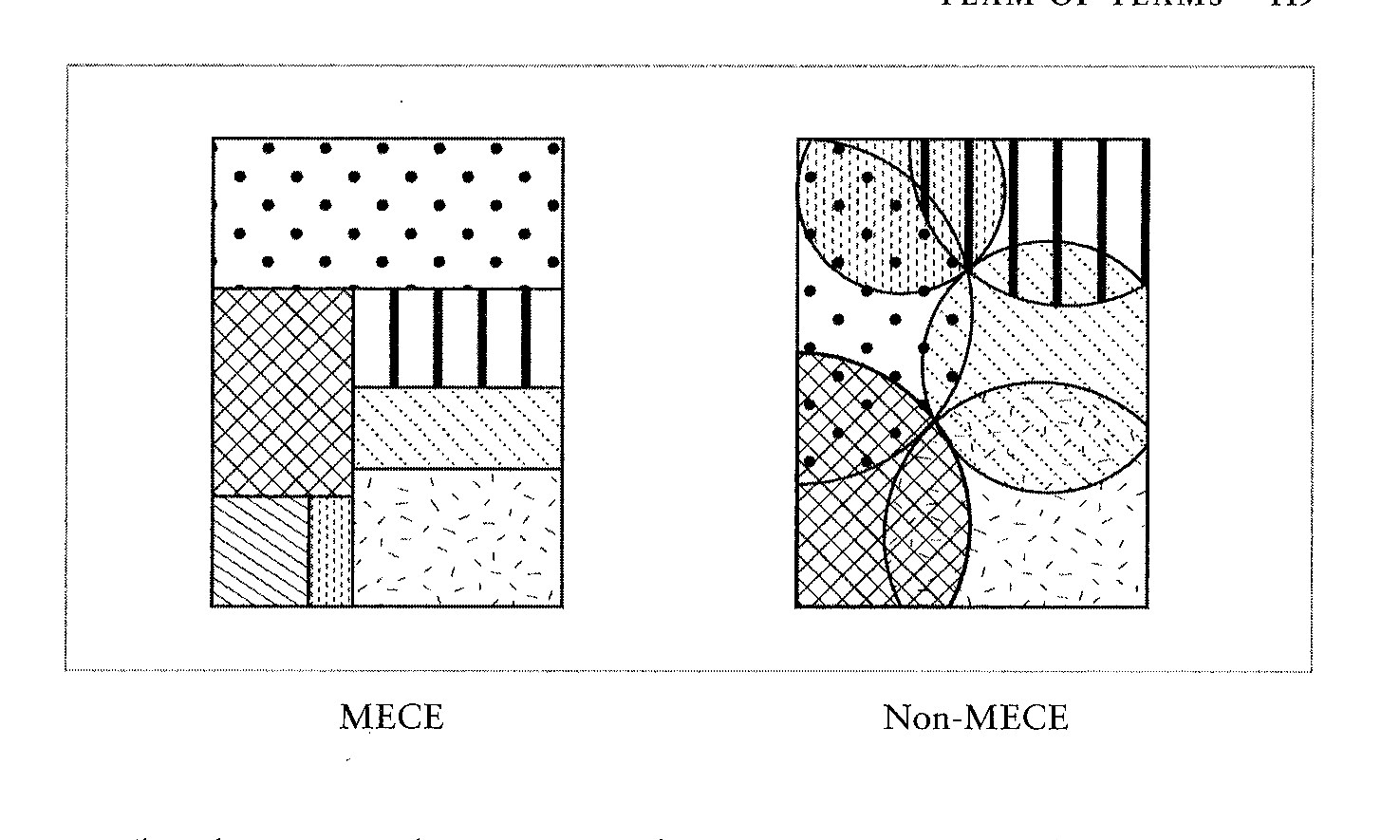
MECE: Mutually Exclusive and Collectively Exhaustive

McChrystal completed a master of science in International Relations from Salve Regina University. He has company. Maj. Gen. James W. Nuttall deputy director of the Army National Guard earned an MA at SRU. Gen. Peter Chiarelli completed an MA in national security strategy at SRU after earning an MPA from the University of Washington. After finishing a master's at Salve Regina, Gen. Anthony Zinni (USMC) earned another master's from Central Michigan University.

Perhaps making too much of his outside-the-box thinking, it is interesting to note that Gen. McChrystal recommended A Connecticut Yankee in King Arthur’s Court for Admiral Stavridis’s anthology, The Leader’s Bookshelf. Also, whether and to what extent such new age intuitions actually instantiated the doctrine of counter-insurgency outlined by David Galula may be putative. It may be that victory in Iraq such as it was came from doing what soldiers always do and that so-called “counter-insurgency” ultimately proved to be a failure because it could never have been a success. 


PREVIOUSLY ON NECESSARY FACTS