Showing posts with label organization. Show all posts

Tuesday, May 11, 2021

Westrum’s “Three Cultures” Organizational Typology

Ronald Mark Westrum’s typology of organizations is an investigation of information flow in order to understand how groups thrive, survive, or fail. He finds that generative organizations get the right information to the right people in the right context. Bureaucratic organizations do this when the environment is conducive to stability, but they fail to perform under stressful new challenges. Pathological organizations have no concern for their outcomes and are defined only by how successful their leaders are at hoarding and controlling information for personal gain.

He writes: "I created a typology in 1988 to compare the way that organisations processed information. … The idea was to characterise general ways of coping with information, especially information that suggests anomaly. Failures in information flow figure prominently in many major accidents, but information flow is also a type marker for organisational culture. In some organisations, information flows well, and elicits prompt and appropriate responses. In others it is hoarded for political reasons or it languishes due to bureaucratic barriers. This typology has proven useful in a variety of safety related fields, such as aviation, nuclear power, and, increasingly, medicine. 

"The underlying idea is that leaders, by their preoccupations, shape a unit’s culture. … These preferences then become the preoccupation of the organisation’s workforce, because rewards, punishments, and resources follow the leader’s preferences.

"Generative organisations get the needed information to the right person in the right form and in the right time frame. This behaviour is based on the leader’s emphasis that the most important goal is to accomplish the mission.

"By contrast, pathological circles tend to view information as a personal resource, to be used in political power struggles. It will be withheld, doled out, or used as a weapon to advance particular parties within the organisation. 

"When bureaucratic organisations need to get information to the right recipient, they are likely to use the standard channels or procedures. These standard channels and procedures are often insufficient in a crisis. They failed, for instance, in communications between New York police and fire departments on 11 September 2001. The police knew that the World Trade Center north tower was about to collapse, but failed to communicate this to the firefighters inside the tower, many of whom died. By contrast, in the same circumstances many generative organisations would cross departmental lines or use a back channel to get the information to where it was needed. The Apollo 13 space crisis shows an excellent example of a generative response. By contrast, the fumbling that led to the demise of Columbia space shuttle shows bureaucracy at its worst."
 “A typology of organisational cultures,” BMJ Quality and Safety, 2004;13:ii22-ii27. https://qualitysafety.bmj.com/content/13/suppl_2/ii22

 Ron Westrum was my professor for five of eight sociology classes at Eastern Michigan University 2005-2010 as I completed a BS in criminology and an MA in social science. Among those courses were Complex Organizations and the Sociology of Technology. He wrote Sidewinder: Creative Missile Development at China Lake (Naval Institute Press, 1999), which was my introduction to the U.S. Naval Institute of which I have been a member since 2015.


Studying information flow in airline cockpits, Westrum applied his reseach to hospital operating rooms. From there, his theories gained even wider acceptance. You can find the full text of the paper in many places online. “A Typology of Organisational Cultures” by R. Westrum. Quality and Safety in Health Care 13 Suppl 2 (suppl_2):ii22-7 January 2005 https://www.researchgate.net/publication/8150380_A_Typology_of_Organisational_Cultures  This work is widely cited. See “DevOps culture: Westrum organizational culture,” at 

https://cloud.google.com/architecture/devops/devops-culture-westrum-organizational-culture He has a stub in Wikipedia: https://en.wikipedia.org/wiki/Ron_Westrum


Dr. Westrum’s typology pinpoints the failure mode for a bureaucracy. However, in our class in complex organizations, we also examined its strengths. Bureaucracy is a pre-requisite to democracy, especially for a complex society. In a functioning bureaucracy, each piece of paper moves from desk to desk on its own merits regardless of the tribe, family, caste, religion, class, race, ethnicity, sex, gender, age, or wealth of its originator. America’s failure to establish democracy in Iraq and Afghanistan is attributable to the lack of functioning indigenous bureaucracies. A functioning bureaucracy does not necessarily bring democracy. We studied the Ottoman empire as a case in point. It is necessary, but not sufficient.


Our model for rescuing a bureaucracy was Capt. D. Michael Abrashoff’s It’s Your Ship: Management Techniques from the Best Damn Ship in the Navy (Warner, 2002). Since then, I believe that Turn the Ship Around!: A True Story of Turning Followers into Leaders by Capt. David L. Marquet (Steven R. Covey, 2012) took the lesson even farther. Proof of this is the fact that Marquet’s Santa Fe and its people continued to thrive after he left, whereas the USS Benfold did not continue the journey charted by its captain.


 PREVIOUSLY ON NECESSARY FACTS


Team of Teams

Centralization and the Inverse-Square Law

A Good Place with Inadequate Philosophy

Not Less Grammar Errors

Minimizing the Likelihood of Bad Cops


Tuesday, March 24, 2020

A Socratic Mob

Had every Athenian citizen been a Socrates, every Athenian assembly would still have been a mob. -- The Federalist No. 55

Another general remark to be made is, that the ratio between the representatives and the people ought not to be the same where the latter are very numerous as where they are very few. Were the representatives in Virginia to be regulated by the standard in Rhode Island, they would, at this time, amount to between four and five hundred; and twenty or thirty years hence, to a thousand. On the other hand, the ratio of Pennsylvania, if applied to the State of Delaware, would reduce the representative assembly of the latter to seven or eight members. Nothing can be more fallacious than to found our political calculations on arithmetical principles. Sixty or seventy men may be more properly trusted with a given degree of power than six or seven. But it does not follow that six or seven hundred would be proportionably a better depositary. And if we carry on the supposition to six or seven thousand, the whole reasoning ought to be reversed. The truth is, that in all cases a certain number at least seems to be necessary to secure the benefits of free consultation and discussion, and to guard against too easy a combination for improper purposes; as, on the other hand, the number ought at most to be kept within a certain limit, in order to avoid the confusion and intemperance of a multitude. In all very numerous assemblies, of whatever character composed, passion never fails to wrest the sceptre from reason. Had every Athenian citizen been a Socrates, every Athenian assembly would still have been a mob.

FEDERALIST No. 55
"The Total Number of the House of Representatives"
From the New York Packet
Friday, February 15, 1788. 
Alexander Hamilton or James Madison

PREVIOUSLY ON NECESSARY FACTS


Tuesday, January 30, 2018

Team of Teams

Team of Teams: New Rules of Engagement for an Empowered World by Gen. Stanley McChrystal (US Army, Ret). With Tatum Collins, David Silverman, and Chris Fussell.  
Portfolio/Penguin, 2015.


An enjoyable, erudite read, Team of Teams by Stanley McChrystal was written by a general for generals. McChrystal takes his time to make his points. He presents cogent evidence to support his assertions, but those would be easy enough to accept on the basis of his authority. His education and experience made him an expert.  From 2003-2008 he was in charge of the Joint Special Operations Command that was responsible for defeating the insurgency of Al Qaeda in Iraq (AQI), and neutralizing its leadership, including the death of Abu Musab al-Zarqawi. In order to achieve that, McChrystal had to reconfigure the way the Army usually operated.

The transformation was radical for the military, but familiar to the private sector. Information could not be held in organizational “silos” on a need-to-know basis. The office layout, while allowing adequate personal space, had to be open so that people could talk across desks, across islands of information and authority. This was only way that the allied joint forces could defeat AQI, which was decentralized, resilient, adaptable, flexible, and driven by the media of information exchange from the cellphone to the international news website.

The coordinating theme is the balance and integration of shared consciousness and empowered execution. Shared consciousness includes the physical perceptions brought in from information assets, either directly from soldiers in the field or indirectly from informants or remote sensors. It also includes the philosophy of the mission, an agreement on doctrine and rules of engagement. Given that, empowered execution allows those closest to a problem – taking a house or killing an enemy leader—to solve it in real time.

Early on, McChrystal establishes a baseline that he returns to repeatedly throughout the book. Frederick Winslow Taylor’s efficient organization defined not just the methods of production or the layout of the office, but the fundamental doctrinal premise of a civilization for 100 years.  Taylorist thinking led to the impenetrable (but immovable) Maginot Line that aircraft flew over. The coalition forces defeated Saddam Hussein because both sides were fighting the previous war. The Iraqi insurgency demanded new habits from new learning. It was time to take everyone’s brains out of their footlockers and put them all to work thinking, discussing, planning, and criticizing.

Chapter 10 “Hands off” contrasts the experiences of Commodore Matthew Perry and Gen. Ulysses Grant. Perry was on his own, over 6,000 miles from home. He had total control and no oversight. On the other hand, Grant issued meticulously detailed orders to his generals. McChrystal’s world was a strange mix of the two. While he enjoyed complete information input from assets in the field, soldiers, helicopters, and drones, he also insisted on letting the leaders on the ground make their own decisions, knowing, of course, that they were not alone at all. 
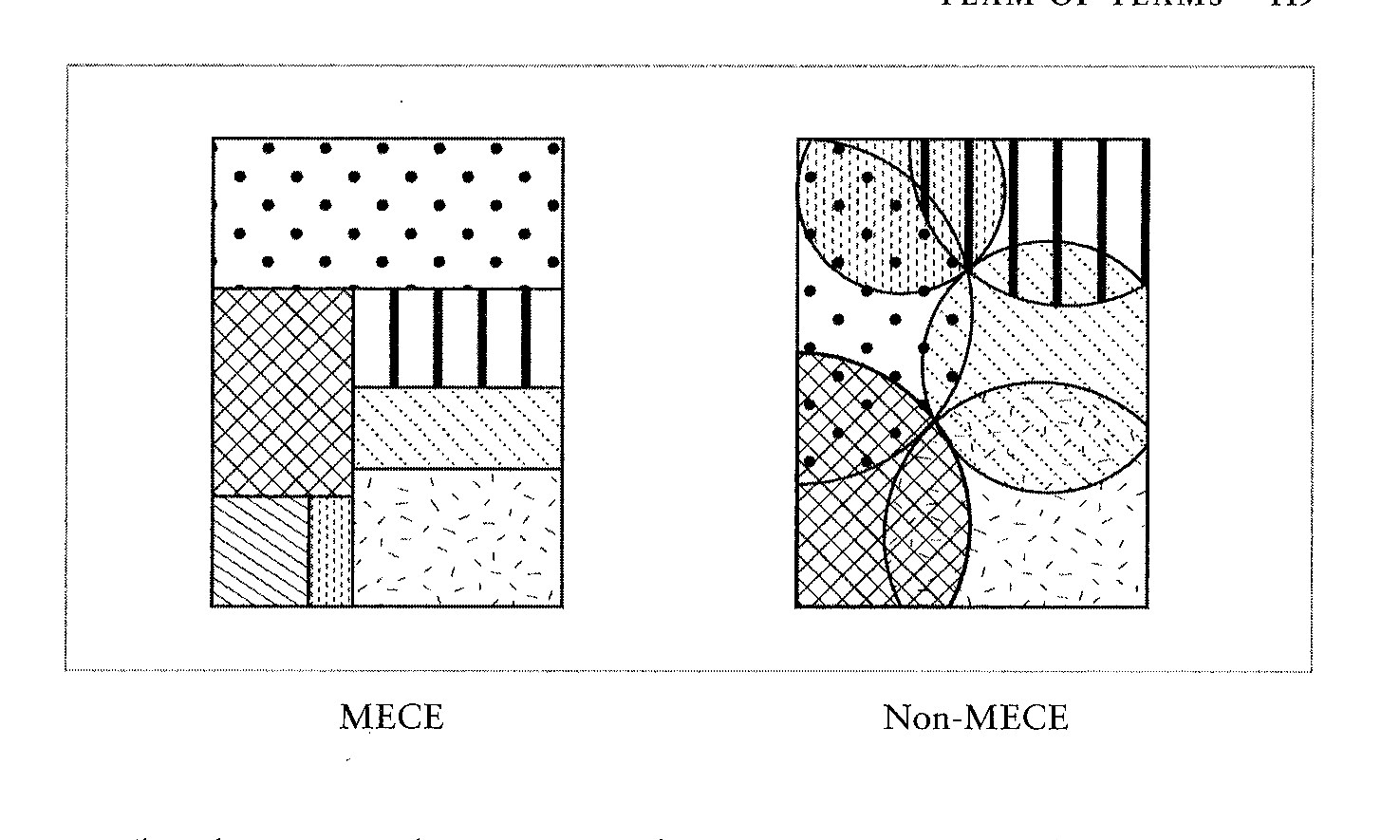
MECE: Mutually Exclusive and Collectively Exhaustive

McChrystal completed a master of science in International Relations from Salve Regina University. He has company. Maj. Gen. James W. Nuttall deputy director of the Army National Guard earned an MA at SRU. Gen. Peter Chiarelli completed an MA in national security strategy at SRU after earning an MPA from the University of Washington. After finishing a master's at Salve Regina, Gen. Anthony Zinni (USMC) earned another master's from Central Michigan University.

Perhaps making too much of his outside-the-box thinking, it is interesting to note that Gen. McChrystal recommended A Connecticut Yankee in King Arthur’s Court for Admiral Stavridis’s anthology, The Leader’s Bookshelf. Also, whether and to what extent such new age intuitions actually instantiated the doctrine of counter-insurgency outlined by David Galula may be putative. It may be that victory in Iraq such as it was came from doing what soldiers always do and that so-called “counter-insurgency” ultimately proved to be a failure because it could never have been a success. 


PREVIOUSLY ON NECESSARY FACTS