Team of Teams: New Rules of Engagement for an Empowered World by Gen. Stanley McChrystal (US Army, Ret). With Tatum Collins, David Silverman, and Chris Fussell.
Portfolio/Penguin, 2015.

An enjoyable,
erudite read, Team of Teams by
Stanley McChrystal was written by a general for generals. McChrystal takes his
time to make his points. He presents cogent evidence to support his assertions,
but those would be easy enough to accept on the basis of his authority. His
education and experience made him an expert.
From 2003-2008 he was in charge of the Joint Special Operations Command
that was responsible for defeating the insurgency of Al Qaeda in Iraq (AQI),
and neutralizing its leadership, including the death of Abu Musab al-Zarqawi.
In order to achieve that, McChrystal had to reconfigure the way the Army
usually operated.
The transformation
was radical for the military, but familiar to the private sector. Information
could not be held in organizational “silos” on a need-to-know basis. The office
layout, while allowing adequate personal space, had to be open so that people
could talk across desks, across islands of information and authority. This was
only way that the allied joint forces could defeat AQI, which was
decentralized, resilient, adaptable, flexible, and driven by the media of
information exchange from the cellphone to the international news website.
The coordinating
theme is the balance and integration of shared consciousness and empowered
execution. Shared consciousness includes the physical perceptions brought in
from information assets, either directly from soldiers in the field or
indirectly from informants or remote sensors. It also includes the philosophy
of the mission, an agreement on doctrine and rules of engagement. Given that,
empowered execution allows those closest to a problem – taking a house or
killing an enemy leader—to solve it in real time.

Chapter 10 “Hands
off” contrasts the experiences of Commodore Matthew Perry and Gen. Ulysses
Grant. Perry was on his own, over 6,000 miles from home. He had total control
and no oversight. On the other hand, Grant issued meticulously detailed orders
to his generals. McChrystal’s world was a strange mix of the two. While he
enjoyed complete information input from assets in the field, soldiers,
helicopters, and drones, he also insisted on letting the leaders on the ground
make their own decisions, knowing, of course, that they were not alone at all.
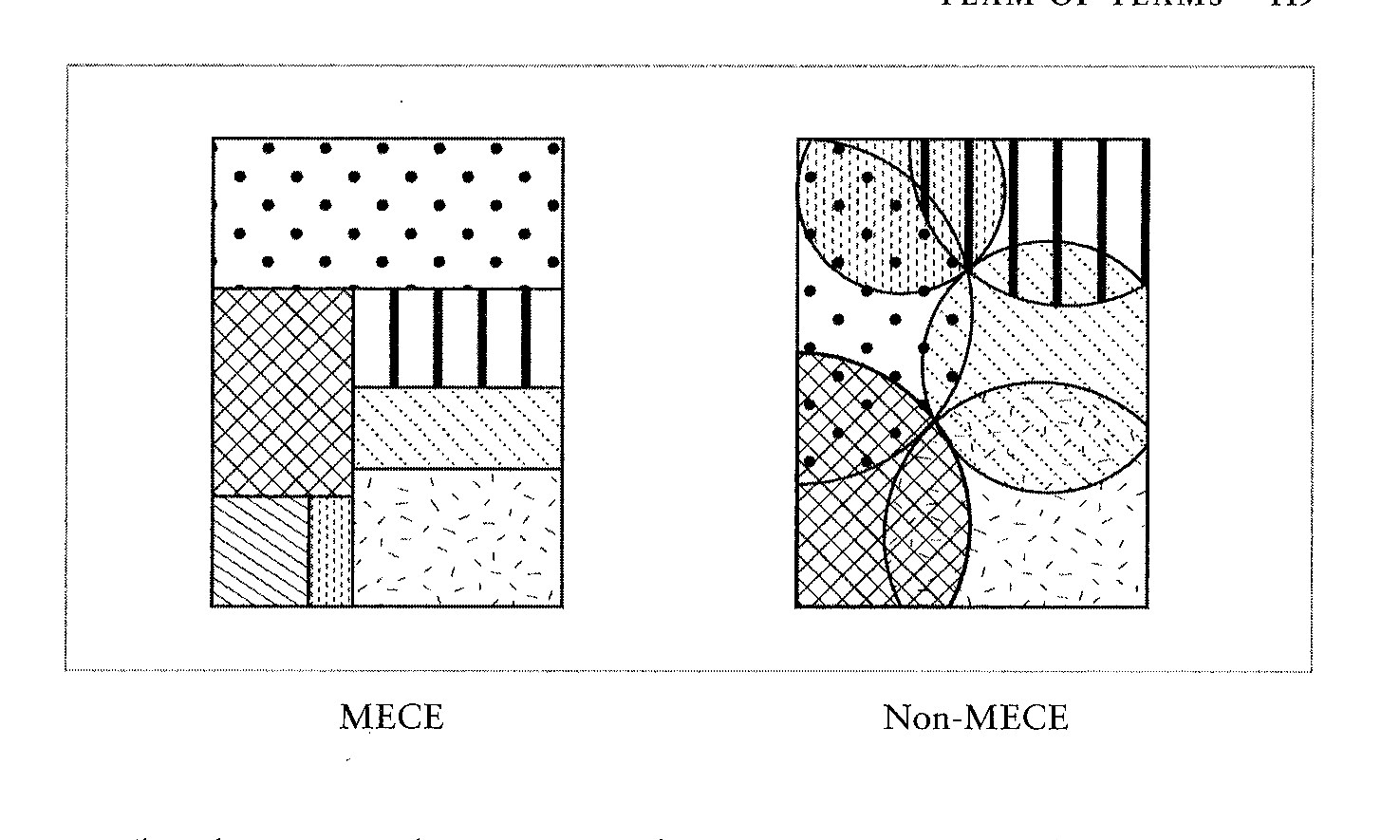 |
| MECE: Mutually Exclusive and Collectively Exhaustive |
McChrystal
completed a master of science in International Relations from Salve Regina
University. He has company. Maj. Gen. James W. Nuttall deputy director of the
Army National Guard earned an MA at SRU. Gen. Peter Chiarelli completed an MA in
national security strategy at SRU after earning an MPA from the University of
Washington. After finishing a master's at Salve Regina, Gen. Anthony Zinni
(USMC) earned another master's from Central Michigan University.
Perhaps making too
much of his outside-the-box thinking, it is interesting to note that Gen. McChrystal
recommended A Connecticut Yankee in King
Arthur’s Court for Admiral Stavridis’s anthology, The Leader’s Bookshelf. Also, whether and to what extent such new age
intuitions actually instantiated the doctrine of counter-insurgency outlined by
David Galula may be putative. It may be that victory in Iraq such as it was
came from doing what soldiers always do and that so-called “counter-insurgency”
ultimately proved to be a failure because it could never have been a
success.
PREVIOUSLY ON NECESSARY FACTS


