Showing posts with label military customs and courtesies. Show all posts

Wednesday, November 21, 2018

Thoughts on "Soldier’s Heart"

From my mother’s sleep I fell into the State,
And I hunched in its belly till my wet fur froze.
Six miles from earth, loosed from its dream of life,
I woke to black flak and the nightmare fighters.
When I died they washed me out of the turret with a hose.

Randall Jarrell’s poem reocurs as do several of the author's West Point cadet students and a few of her faculty colleagues. Of the students, Samet dubbed three “the Musketeers” for their inseparability. Throughout, she uses pseudonyms, and it is telling that she called one of the Musketeers Grant. Ulysses S. Grant’s Personal Memoirs affected her. Samet says that we know how to honor the dead but we do less well with and for the wounded. We do not think of Grant as wounded. But I do. 
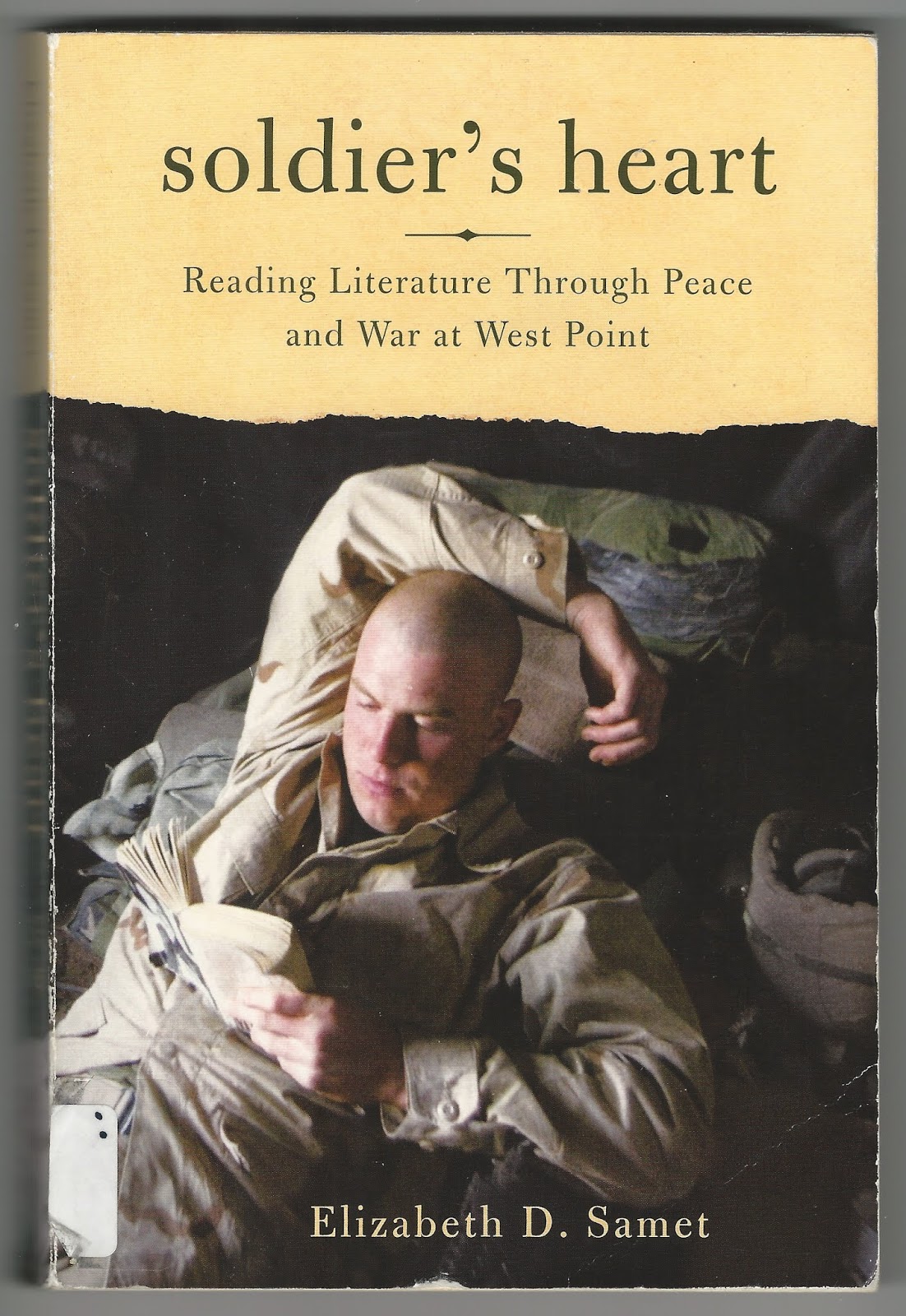
Solider's Heart: Reading Literature
Through Peace and War at West Point

by Elizabeth D. Samet
(Farrar, Straus and Giroux, 2007)

When I worked for Coin World, I was assigned Grant as a feature story. There’s the $50 bill, of course, but quite a bit more is known to the numismatist. I bridled at the assignment: Grant was a drunken general who ordered other people to kill and die. However, it did not take much research to learn that he was significantly deeper than that. He would have preferred to teach mathematics at a girls’ school. And so, he understood the unremitting arithmetic of the War Between the States: The South simply could not keep paying the price. The personal price that Grant ultimately paid can only be guessed at.

When a firstie (senior class) once asked a colonel what he needed to succeed in the Army, the officer replied, “Show up on time and stay in shape.” (page 196)  I think that promptum et salutem makes a good motto. 

A far less weighty consideration is Prof. Samet’s solution for the problem of the pronoun. For myself, in technical writing, I choose “they” for everyone. Samet’s choice is to go back and forth between he and she, usually with the masculine, as most of the people in her life are men but often using the feminine as neutral for everyone or anyone.

Prof. Elizabeth D. Samet’s In-Text Recommended Reading
(This is just some of it.) 
Wilfred Owen
Edith Wharton
Li Po (Tang Dynasty poet)
Randall Jarrell’s “The Death of the Ball Turret Gunner”
Anne Sexton
T. E. Lawrence Seven Pillars of Wisdom
Edgar Allen Poe Poems, especially “The City in the Sea”
(That anthology was paid for by his West Point classmates.)
Antoine Saint-Exupéry
Ulysses S. Grant Personal Memoirs 
Artist Savile Lumiey
Alexander Pope Essay on Man
Jane Hirshfield
Jorie Graham
Shakespeare “Sonnet 73”
Shakespeare Henry V
Tennyson “Ulysses”
Ambrose Bierce, especially "One Kind of Officer"
Frost “Road Not Taken”
Attar** Parliament of Birds
Wallace Stevens
Movie: Jacob’s Ladder
Movie: The Four Feathers
Movie: The Roaring Twenties.
**(Abū Ḥamīd bin Abū Bakr Ibrāhīm c. 1145 – c. 1221; 
better known by his pen-names Farīd ud-Dīn and ʿAṭṭār—https://en.wikipedia.org/wiki/Attar_of_Nishapur)

Samet wrestles with the ethos of the military, especially when the military is set apart from the general public. “The rhetoric of the War on Terror has been from the first deeply inflected with messianic vocabulary that makes it easy for soldiers to conflate military and spiritual missions and that complements the military’s own sense of itself as a noble profession and a higher calling.” (page 158) 

Between the time he retired from the Marine Corps and became the Secretary of Defense, James Mattis directed a statistical survey of public attitudes about the military. His team found that across all sectors of America, only the “elites” believe that the military should share the same values as society at large. Most people across the political spectrum believe that the military has a different value system than everyone else in America–and this is good. (NecessaryFacts here.) 

I like to think that I have no illusions about human nature, but the fact is that when on base, I never lock my car; and if it is hot—as it often is here in Texas—I leave the windows rolled down. Samet herself reflects at length at how like a small town West Point is. This is good and bad, depending on the context. 

This opens the door to more of my own beliefs. I stood mute and smiled when a sergeant to whom I reported found by surfing that I posted to the Military Atheists website. (Foxhole Atheists here.) My certainty that the universe had no creator comes from the philosophical objectivism (with a capital-O) of Ayn Rand. Predicated on that metaphysics and epistemology, the ethics of egoism are not consonant with the warrior’s way. (How I correlate them is discussed elsewhere.) Based on Soldier’s Heart, I expect that Elizabeth Samet does not explicitly practice the virtues of selfishness. Neither is she a postmodernist. At least, she does not speak their vernacular of “trajectories” and “projects” and “giving voice.” And while she is scrupulous about not forcing her own morals on her students, she clearly has them; and as subtext they seem traditionally American. 

So, I agree with her that mixing the language of missionaries with the goals of military missions is highly problematic. At the same time, I found unsatisfying her apparent belief that civil law is the highest law. She is uncomfortable with the fact that as citizens our soldiers hold the state subservient to religion. I get her point. But I also see a profound and deep philosophical foundation to the fact that in customs and courtesies, the chaplain’s pennant can fly above the American flag while services are being held. Conquering as we must is predicated on our cause being just. The just war doctrine is another of the threads in this book. 

Though rejecting religion as a foundation for morality in Chapter 5 “Bibles, Lots of Bibles,” Samet does not follow that with anything as substantial. Chapter 6 “The Courage of Soldiers” is about the strength of will to stop and consider the hard choices and then select the right one. But all she offers, quoting Hemingway, is that doing the right thing makes you feel good (page 180). Citing Grant, Samet wonders about those “moments when moral courage comes at the expense of an opportunity to demonstrate physical valor.” (page 203)

Steadfast in her role as a civilian, Samet could not avoid assimilating military dialect and the thinking that requires it. Following 9/11 West Point operated under force-protection orders—without quotation marks or explanation (page 5).  Her prep school reunion was “garrisoned by white-gloved waiters” (page 96). She does explain “suspense” as the word for a deadline or expiration (page 229). Most consequentially, throughout, but explicitly in Chapter 6, Samet reflects on the fact that she shares the role of an officer in directing the actions of those under her command and holding herself responsible for the acts and the people who perform them. 

In that, Prof. Samet hints at much struggling, but has no final words for what affected her most to that time: the deaths of her colleagues, one by suicide; and the combat deaths of her former students. Ultimately, the entire book is about that.

Monday, November 19, 2018

Soldier’s Heart by Elizabeth Samet

One of her cadets, now an officer, wrote to his former professor about his experience in the active military preparing for his combat assignment and wondering if his lack of faith in the mission was a sign of disloyalty. “When I decided to teach English, I did not anticipate that I would be in the business of dispensing this sort of advice—on scanning Alexander Pope, perhaps, or unpacking a metaphor in an Elizabethan sonnet—but not this.” (page 163)

I found the book in the used book sales racks of the Brigadier General John C. L. Scribner Texas Military Forces Museum at Camp Mabry in Austin. After finishing it the first time, I read it again, making extensive notes, both on stickies and as marginalia. There’s a lot to think about.  On almost every page, I found something to underline.

picture shows soldier in combat uniform laying down, relaxing, reading a book
 Dr. Elizabeth Samet (b. 1969) finished a BA in English at Harvard (1991) before earning her Ph.D. at Yale. She then joined the faculty of English and Philosophy at West Point (1996) and is now the chair of the English side of that department. The latest entry in her bibliography is an annotated edition of the The Memoirs of Ulysses S. Grant (Liveright Norton, 2019). She says in Soldier’s Heart that Grant’s Personal Memoirs was her gateway to the military. “I don’t remember who introduced us [in 1994 or 1995], but I can recall what an inspiring companion he proved to be after a few years on the obligatory graduate school diet.” (page 35)

At the end, she offers several pages of recommended reading. But recommended reading is actually the superstructure of the narrative, the framework of her coursework for West Point cadets. And she tells her story from several perspectives: Not Your Father’s Army; “Books are Weapons”; Becoming Penelope, the Only Woman in the Room; To Obey or Not to Obey; Bibles, Lots of Bibles; The Courage of Soldiers; The Anatomy of Sacrifice. Those spaces are arched by a Prologue (Year of the Plague) and an Epilogue (Ave Atque Vale). The stories stand alone, though some characters re-appear. 

“This is a story about my intellectual and emotional connections to military culture and to certain people in it, but the real drama lies in the way the cadets I teach and the officers with whom I work negotiate multiple contradictions of their private and professional worlds. … Because they serve at the bottom of a hierarchy not especially interested in their opinions, cadets, especially plebes, at once crave and fear the freedom to wonder. … Few people know this part of their story: the courage with which they challenge accepted truths; the nuanced way they read literature and culture; and the ingenious methods they have for resisting conformity in lives largely given over to rules and regulations. Our national fondness for celebrating the physical heroism of soldiers—the apparent readiness with which they sacrifice their lives to larger causes—eclipses the far less romantic displays of moral and intellectual fortitude that also distinguishes so many of them. In turning them all into heroes, we have lost the sense of the individuality they also fight to preserve.” (page 13) 

The title comes from one of the earliest descriptions of what we now call PTSD. It has been termed shell shock and battle fatigue. The diagnosis “soldier’s heart” followed the American Civil War. It mimicked cardio-vascular disease but insightful practitioners recognized that the problem was psychological, not organic. Samet extends that meaning by recording, reflecting on, and honoring the emotional hearts of soldiers. Though she does invest much in our unresolved relationships with and distinctions between the wounded and the dead (Chapter 7), this book is really a celebration to the living. It honors the young officers who choose the difficult and sometimes impassable roads to the moral high ground in a morally ambiguous world. 

“I often get the feeling that these officers have something they want to say but can’t. Perhaps they simply want to acknowledge the change, to resume a normal acquaintance, or to tell me about something that happened in the desert. Whatever they know cannot be pried loose by a lot of questions. It has to come voluntarily and perhaps only much later, when distance permits reflection. More often than not we end up talking about where they read a particular book and what they found in it that helped them better understand what they have been asked to do. Thus when people ask me about my ‘function’ I can’t answer so glibly because when I look out at those newly shorn plebes who appear so eager to please on the first day of the semester, full of good faith and idealism, I see not simply students of literature or numbed soldiers but citizens who are willing to make a very real sacrifice.” (page 15)

Writing in 2007, she called it the Long War (page 11). Soldiers now call it The Forever War after Haldeman’s book. In 2016-2017, the Texas State Guard assigned me a fulltime opportunity to work in the Domestic Operations Task Force of the Texas Military Department. My commanders included young lieutenants who never knew a time of peace and now are not likely to as they mature up the ranks. Consequently, this is a book for everyone who wants to understand their responsibilities as citizens in a republic that chooses to go to war.

Author:
Willing Obedience: Citizens, Soldiers, and the Progress of Consent in America : 1776-1898, Stanford Univ. Press, 2004. (This grew out of her doctoral dissertation.)
Soldier's Heart: Reading Literature Through Peace and War at West Point, Picador, 2008.
Leadership: Essential Writings by Our Greatest Thinkers: A  Norton Anthology, 2015.
No Man's Land: Preparing for War and Peace in Post-9/11 America, Picador USA, 2015.
The Annotated Memoirs of Ulysses S. Grant, Liveright W. W. Norton & Company, 2019. 

Contributor:
Thomas Jefferson's Military Academy: Founding West Point by Robert M. S. McDonald, University of Virginia Press, 2004.
Tolstoy on War: Narrative Art and Historical Truth in "War and Peace" by Rickie Allen McPeak, Cornell University Press, 2012.

PREVIOUSLY ON NECESSARY FACTS


Sunday, November 4, 2018

VETERANS DAY 2018

“Why My Brick” by Michael E. Marotta on behalf of SFC Edward M. Marotta 

I was drafted. They called it the peacetime Army, but the Korean armistice had just been signed and the Russians occupied Eastern Europe. They say that conscripts do not make good soldiers but I served nine years active duty and 15 years in the reserves. I was an average soldier. My medals were for good conduct and component readiness. My only war story is how a non-judicial punishment led to a promotion and assignment to be a colonel’s driver. In my off-duty time on base, I trained Soldiers in hand-to-hand combat and sent two to the Olympics to compete in boxing. My longest billet was to be a trainer in race relations and equal opportunity. For me, a trade school graduate, with no special purpose or direction, the Army was my equal opportunity to earn maturity, learn teamwork, and help to build the next generation of Soldiers. -- For the "Buy a Brick" campaign of the National Museum of the Army (here) of the Army Historical Foundation (here).

(The photograph is the only artifact of Dad in uniform in the possession of his second family. His DD-214 cites the second rocker for Sergeant First Class, not shown here. After his first re-enlistment expired in 1958, Dad's 15 years in the Ohio National Guard came only after the second set of boys was grown up and mostly gone. We all support our men in uniform; we do not all encourage them to join. "Why did you go, Michael? It was not your fight," said Don Corleone.)

PREVIOUSLY ON NECESSARY FACTS
Syriaphobia 
Soldiers of Peace 
Wooden Ships 
Leaders are Readers 

Sunday, September 9, 2018

On Saluting the Flag

When I leave home for drill, I am in uniform. I salute the flag when I step outdoors to load my vehicle; and I salute it again before I get into my car and drive off. When I come home, before I leave my vehicle, I put on my cover and I salute the flag before going indoors. Once inside, I change into civilian clothes and stand down the saluting as I unload my vehicle. I do not otherwise acknowledge Old Glory except to unfurl her if the wind has wrapped her around her pole. But what other people do is their own business.

When I joined the Texas State Guard, I took this oath of office: 
“I, MICHAEL MAROTTA , do solemnly swear 
that I will bear true faith and allegiance 
to the State of Texas 
and to the United States of America; 
that I will serve them honestly and faithfully 
against all their enemies whomsoever, 
and
that I will obey the orders 
of the Governor of Texas and the orders
of the officers appointed over me, 
according to the laws, rules and articles 
for the government of the Military Forces of Texas.”

Someone who does not salute the flag of the United States is not (necessarily) an enemy of the USA or Texas. They might be a citizen of Canada. They might have religious, philosophical, or personal reasons of their own. 
Flag salute. Jehovah’s Witnesses believe that bowing down to a flag or saluting it, often in conjunction with an anthem, is a religious act that ascribes salvation, not to God, but to the State or to its leaders. (Isaiah 43:11; 1 Corinthians 10:14; 1 John 5:21) One such leader was King Nebuchadnezzar of ancient Babylon. To impress the people with his majesty and religious ardor, this powerful monarch erected a great image and compelled his subjects to bow down to it while music, like an anthem, was being played. However, three Hebrews—Shadrach, Meshach, and Abednego—refused to bow to the image, even on pain of death.—Daniel, chapter 3.  Watchtower Online here 
You can read Billy Gobitis’s letter to the Minersville School Board, at the Library of Congress American Memory here

(Penn & Teller burn an American flag. One YouTube video is an out-take from The West Wing in which they burn an American flag in the White House. Penn Jillette gives a great defense. "Did you go to law school?" Josh Lyman asks. "No," Penn replies, "clown school.")

“And then Nate Boyer saw Kaepernick sitting and got mad.  Boyer is a former Green Beret who played football briefly with the Seattle Seahawks, and with the Longhorns at the University of Texas before that. After his initial anger of seeing Kaepernick sitting, he wrote the player a letter, saying he wished Kaepernick would stand up, but that he was willing hear him out about why he was sitting down.
“So I urged him to stand and then take action, because that's really how change will happen, and he said, “No, I'm committed to sitting until I feel that things are changing and that we're moving in the right direction.” And so through that conversation, I guess, we agreed on a middle ground of him taking a knee alongside his teammates.”
On why kneeling was better than sitting
“For me, that's a sign of reverence. You know, people take a knee to say a prayer. And then also, military personnel, it's very common to see an image of a soldier, or a marine, or an airman, or a sailor, take a knee in front of a fallen brother-in-arm's grave to pay respects. So, I just thought it was better, and it showed more about — that he's paying attention as well, he's not, in a sense, sitting it out. He's engaged.” Original NPR All Things Considered story from 17 October 2017 here.  Audio reply of 9 September 2018 ATC broadcast presenting further on the same subject.


This was how my mother learned to salute the flag in the 1930s. The Pledge of Allegiance was crafted by a socialist, Francis Bellamy. He also founded a magazine called The Nationalist

PREVIOUSLY ON NECESSARY FACTS


Sunday, August 26, 2018

A Critic Meets the Military

Write about what you know. Every student of journalism, fiction, or poetry hears that from our teachers. Carol Burke was already a professor of English at UC Irvine when she wrote Camp All-American, Hanoi Jane, and the High-and-Tight: Gender, Folklore, and Changing Military Culture (Beacon Press, 2004). That was before she went to Iraq (2008) and Afghanistan (2010). Her experiences probably did not change her from a Democrat into a Republican. She did not become a better writer; her prose is beyond critique—which is why she became a professor of English. But something perhaps ineffable is obvious as a result of her experiences while imbedded with soldiers in a warzone. 


Her book, Camp All-American, is an anti-sexist anti-military diatribe. It was easy to agree with. Her criticisms were more than valid. She was on-target. But others had aced the same firing range. So, like any good marksman, her skill can be credited to her instructors. The problem with Camp All-American is that Burke does not explore the foundations and superstructure of the edifice of sexism. 

The subtitle is "... Changing Military Culture" and it has a double meaning. Sociologists tell a joke: How many sociologists does it take to change a lightbulb? The lightbulb does not need changing; it is society that must be changed. So, Prof. Burke is not chronicling the changes going on at that moment or before or to come, but her intention to change the military to be what she wants it to be. And what she wants is not bad or wrongful. In fact, it is the way the military has been headed since the first female chief petty officer in 1917 (Navy Live blog here).  


Even so, I agree with Burke's major premise: the military treats women differently from men in ways that have nothing to do with the objective requirements of the job. For instance, women are forbidden  from the high-and-tight. Female "short" hair styles must be at least one-quarter inch long. If the rationale of the military were accepted prima facie, every boot would get a buzzcut.  It is just one point among many that are easy to accept yet annoyingly shallow for want of analysis.

Exploitation has three excuses: gender, race, and class. They are braided, though in a particular time and place, one skein may be larger or dyed brighter than the others. Generally, in America, we are classless, sometimes with an unfortunate double meaning. We have been trying hard to get passed race; and, mostly, in the middle of the culture, we have been successful despite the agendas of guilt and hate (also intertwined) from the extremists of the left and right. And the fact is that the military followed baseball in racial integration, ahead of Brown vs. Board of Education and the marches in the south. Racial equality in the services should be a model for gender equality. Burke draws no parallels there.

Sex and gender have genetic roots that define the sociology, economics, and politics of sex and gender. Ultimately, the solution may be epigenetic. When gender enjoys the mobility and mutability of race and class, it will cease to be casus belli—at least for most people, though probably never for the radicals. 

Burke is not alone in her revulsion for the confluence of sex and violence among military men. She accepts it as a perceptual primary. So, she offers no conceptual causes.

She does soft soap Jane Fonda. I did not know that Fonda apologized for her "insensitivity" during the Vietnam war.  Several times. See here and here. But the problem is complicated and Burke does not follow all of the paths of inference. Jane Fonda's tourist visit to an anti-aircraft gun was not a momentary lapse, but a moment within an integrated life. All of her other choices seem to line up pretty well with that. Under the influence of Jane Fonda Ted Turner became a benefactor of the United Nations. 

To say that the military is “conservative” has little to do with the election strategies of Paul Ryan and Marco Rubio, except as they, too, reflect, a long, broad, and deep cultural matrix. We accept that military people are in families. To enforce Spartan barracks would seem unnatural (here and now). Yet, about 20,000 to 25,000 military families benefit from food stamps, and other federal family support subsidies. (See Military.com stories here and here.) Every soldier (sailor, airman) knows the cliché: If the Army wanted you to have a family, they would issue you one.

And barracks today are sexually segregated, just as they were separated by race until after World War II—and as they are still separated by class: officers sleep better than enlisteds, even in the very frontiersy Texas State Guard.

Statistical surveys of the military carried out by military leaders (on NecessaryFacts here) reveal an unsurprising geographical bias for the South and the West. The interplay between regional conservatism and military presence is hard to ignore. Per capita enlistments from Massachusetts are not what they were in 1776 or 1861. Only a well-defined liberal elite believes that the military could benefit from the traditional liberal education at university. Most people in America, Democrat and Republican, believe that it is good, right, and proper that the military stands aside, alone, and apart with its own ethical and moral standards.  

Nonetheless, it is paradoxical yet unsurprising that enlisted soldiers (sailors, airmen) are statistically aligned with the country at large. Forty percent feel this way; forty percent want the other thing; and 20% are undecided. Among officers, the story is different. And the higher you go, the farther to the right you drift. The more conservative you become, the better your chances are for promotion. Inevitably, liberals self-select themselves out after the first six to eight years.

So, attitudes about class, race, and gender linger in the highest echelons. Change erupts from below. As non-European non-men inevitably achieved rank and rating military culture changed. But it did not radically alter overnight. Nor could it. To expect that is to wish for the unreal. Yet change does happen. We have no lawful, legal nobility in America. And even in England nobles are now tried before juries of commoners.  Social change happens. But it happens one mind at a time.

I was no stranger to war. In December 2008 and January 2009, for two months before heading off to Afghanistan in 2010, where I served as a cultural advisor to two brigade commanders …
[…] 
We traveled to small villages, to the few remaining schools in the heavily Taliban-influenced district, and to the large local bazaar with its long line of dirt-floored stalls where over a hundred merchants sold farm supplies, veterinary medicines, motorcycles, materials for making I.E.D.’s (improvised explosive devices), drugs intended for the local clinic that had been mysteriously diverted to this makeshift drugstore, boots, plastic pails, decorated metal trunks, CDs that featured what some soldiers referred to as “the latest Taliban Fight songs,” naan, potatoes, raisins, produce in season, and freshly slaughtered lamb.
Rather than improving, security in this area became worse each month. When I had first traveled to the base, we could go twelve kilometers before encountering a tic, short for “troops in contact.” Within nine months, the circle of safety had shrunk to one kilometer.
A soldier in whose vehicle I often rode received a package from his young son, and amid the toiletries, candy and cookies was a five-inch plastic toy. At first, he simply propped the toy on his dashboard to remind him of his son, but after the first firefight from which he safely returned, the figure accrued talismanic meaning, and the soldier turned away the toy that he believed was his protection so that it no longer faced him, but instead looked out the windshield. It was as if, like a charm, it had the power to ward off the enemy’s evil eye.
Many personnel brought small tokens given to them by parents, children, lovers and fellow soldiers. Some were objects of faith —medals, rosaries, prayer beads, angels, crosses, gold and silver lockets with verses of the Quran tucked inside. Others acquired their significance from one’s relation to the giver. Still others accrued meaning along the way. What might be considered minor trinkets back home takes on a new meaning when one ventures into harm’s way. 
(“In the Event of My Death” by Carol Burke here: http://narrative.ly/to-be-read-in-the-event-of-my-death/)

Previously on Necessary Facts

Friday, April 6, 2018

A Few Good Men: A Few Deep Flaws

Nominated for both an Academy of Motion Picture Arts and Sciences award ("Oscar") and a Hollywood Foreign Press Association (“Golden Globe”) award, the drama is compelling. The movie began as a Broadway play. Live theater is continuous rehearsal for the writer and director no less than for the cast. So, it came to the screen fully formed. But it does not stand up to repeated viewing. As a legal battle engaged in a courtroom, the intensity is irresistible. Contradicting that is the “naturalist” assumption that victory is impossible, that a draw is the best you can hope for.

Most of the $33 million in production costs went for salaries.  Tom Cruise got $12.5 million. Jack Nicholson was paid $5 million. Demi Moore accepted only $2 million for the chance to take on a “genderless” role. (One production insider wanted to know why if she is not going to sleep with the lead is the character a woman? Aaron Sorkin called that his worst experience as a screenwriter. That and more on Mental Floss here.) But any competent screen actors could have had the roles. In fact, Rob Lowe played the lead for a year on Broadway. Regardless of who played the parts, they would still have had to act like Sailors and Marines. Most of them failed at that and the fault lies with the director and producer, Rob Reiner.

Writer Aaron Sorkin and director Rob Reiner have no military experience and they apparently had no military support. So, the production projected an embarrassing lack of military bearing. Lacking US DoD support, Reiner apparently did not hire a military advisor. (Michael McClosky is credited as “Major Michael McClosky” but I found no corroboration for his military rank.) The most glaring evidence is in Demi Moore’s portrayal of LCDR JoAnne Galloway. We might accept LTJG Daniel Kaffee (played by Tom Cruise) whose hands are always his pockets in order to signal us that he is the cocky underachiever whose long string of successes came from plea bargaining. But there is no way that an investigator from the inspector general’ s office who is two grades above him would put up with that. Here is a rhetorical question: What do you do when you have your hands in your pockets? Answer: You better be taking something out of your pockets. It is completely unacceptable that LTJG Kaffee is eating an apple as he enters LCDR Galloway’s office. He might try it, but an IG investigator outranking him would give him a corrective interview immediately. Also unacceptable is her introducing herself as “JoAnne…, uh, Jo…”  On target is the reply from 1LT (MC) Jonathan Kendrick: “May I call you Jonathan?” “No, you may not. You may call me Lieutenant Kendrick because when we have to go somewhere to fight, you Navy boys always provide a nice ride.” That is a stock response, a cliché, and a fact of life. On the other hand, it was for the audience’s benefit that COL Jessep reprimands his executive officer, LTC Matthew Markinson. “Don’t ever contradict me in front of another officer,” is the kind of warning that (a) never would have needed to be said or (b) at worst, was settled between them three years ago.

Within the naturalist school of aesthetics, the universe is indifferent to human action. Technically, that is correct; and it is that which allows success. The universe is not hostile. However, aesthetic naturalism is disingenuous. The inherent indifference of the universe actually means that each victory must be balanced by an equal or greater loss: you can never win. It is not just that there is a cost. Of course, everything costs. But to naturalism the final costs always outweigh the temporary benefits. Therefore, in this story, the accused Marines are found not guilty of murder, but are dishonorably discharged. The slower of the two (LCP Harold Dawson) still does not understand the verdict as they are led away. In the final moment, as recompense, LTJG Kaffee tells PFC Downey that he does not need an armband (his chevrons) to have honor. In return, the Private calls himself to attention and salutes the officer—which he refused to do earlier when he felt that the Lieutenant was not honorable enough to defend him. But for the Private, the dishonorable discharge is the worst possible outcome at the moment. He and the Lance Corporal were willing to suffer life in prison rather than to betray the officers who ordered them to haze (and thereby accidentally kill) their barracks mate. They were willing to accept all of the consequence of following orders. The betrayals by those officers who gave the orders and sought to cover up the murder and their roles in it is not deeply explored but only held up to view for a moment. LTC Markinson’s suicide, hallmarked by a letter to the parents of the victim, would have been a better focal point for the drama. In the universe of aesthetic naturalism, no person or act is more important than another. Naturalism denies the heroic by trivializing it, and at the same time giving focus to the unimportant.

According to the media histories Aaron Sorkin based his screenplay on a real event at Naval Station Guantanamo Bay. Sorkin’s sister was in the JAG Corps, and she told him the story. After the play became a movie, four lawyers claimed that they were the models for the character of LTJG Daniel Kaffee.  (See “Four Lawyers Claimed …” New York Times, here.) See also the true story of the accused and exonerated Marine that came to light when his body was found in a riverbed (“Ex-Marine who felt 'A Few Good Men' maligned him is mysteriously murdered,” by Bill Glauber, Sun Staff Writer, Baltimore Sun, April 10, 1994, here).

Naturalism is supposedly an unvarnished, journalistic recounting. Fiction is a convenient medium for telling the truth. But that is not what happens. The truth is always complicated, and how you simplify it depends on who you are. The Romantic theory is that people come into conflict when their chosen values are opposed. Even the bad guys are purposeful. But evil is powerless. Therefore, the good guys win, even when (as always) victory is purchased at a cost. In the universe of Romantic fiction, that cost brings a value worth the price. In the universe of Naturalism, even if there are "a few good men" it is not clear who they are.

PREVIOUSLY ON NECESSARY FACTS


Monday, April 2, 2018

JAG: 10 Seasons of Military Bearing

Last week, Laurel and I viewed the final episode of the final season of the television series JAG. It took us about a year to work through the set. Laurel is a voracious reader, primarily of murder mysteries and computer documentation. As a writer and reader of non-fiction, I am informed by Ayn Rand’s theory of aesthetics expressed in The Romantic Manifesto. For being television, written, shot, and edited on a grinding production schedule by a large, changing staff of writers and directors, with the attendant holes in plot, character development, and theme, JAG held up well.

Ayn Rand based her theory of art on Aristotle’s maxim that fiction portrays people as they can and should be. Every work of art is “a selective recreation of reality according to an artist’s metaphysical value judgments.” (The Romantic Manifesto, Signet 1971, p. 19) An artist cannot present all of reality, so some aspect of it stands for the whole. Is the world hospitable or hostile or indifferent? Rand called this one's "sense of life."
Complicated pasts leave them internally
conflicted. Their moral lodestars are on
the far horizon. They eventually find home port
.

“Art is a concretization of metaphysics. Art brings man’s concepts into the perceptual level of his consciousness and allows him to grasp them directly as if they were percepts.” (RM p. 20) 

"Since man lives by reshaping his physical background to serve his purpose, since he must first define and then create his values--a rational man needs a concretized projection of these values, an image in whose likeness he will re-shape the world and himself. Art gives him that image; it gives him the experience of seeing the full, immediate, concrete reality of his distant goals." (RM p. 38)

A biography of Abraham Lincoln’s life could run six volumes, chronicling every detail, but the characterization of President Lincoln in a Civil War drama will subsume and encapsulate all of that and deliver it to the audience, according to the intent of the artists--the actor, writer, director, and the others in the team. Ultimately, someone has artistic control of the final product and it is that person’s vision of life that we receive.

Petty Thief to Petty Officer
Zoe McLellan played
PO1 Jennifer Coates
In this case, the controlling artist was the executive producer, Donald P. Bellisario. A Marine Corps sergeant, Bellisario also created the original Magnum, P.I., Airwolf, and Quantum Leap. That last reveals the most about Bellasario’s view of your place in the universe. Is history inevitable? To what extent can you make your own life? In JAG, there is no doubt that we all make choices and accept responsibility for those decisions. Sometimes, the characters are in circumstances that are very constrained, but “I had no choice” is met with “You always have a choice.”

(I perceived a hidden undercurrent from Quantum Leap in the re-enactment episodes. The story is carried forward by the same actors, though in costume. Season 5 Number 11 “Ghosts of Christmas Past,” take place in the Viet Nam war. Season 6 Episode 23 “Mutiny” is a re-creation of the Somers Mutiny. Season 9 Episode 14 “Each of Us Angels” is set in World War II. Season 9 Episode 18, “What if?” offered alternate stories launched when they read fortune cookies at a restaurant. In the world of Donald P. Bellisario, you always have a choice. Tangentially, I followed the historical clues offered in MutinyRead here)

Our viewpoint characters,
the normal couple.
Beset by life's hard losses,
they never lose their moral compass,
and so they persevere and thrive.
Of course, the show suffered from errors of fact and the fan base responded. You can read other foible finding on the  TVtropes.org wiki. Nonetheless, I benefited from keeping a handbook of military justice at the couch, just to help with the details. It is not the purpose of fiction to be didactic, but it is important not to make up everything, otherwise you are not even creating science fiction but are selling fantasy.

We bought most of the DVDs, borrowing a couple of seasons from the local library. We have not watched broadcast (cable) television since 2010 and we were never big consumers before that. But people recommend shows and we read about them. In this case, JAG was a back-filling of our NCIS collection. (NCIS was piloted in Season 8 of JAG.) We discovered NCIS sometime after 2006. We picked up Season 1 of The West Wing at a neighborhood Blockbuster just as that series was concluding. We eventually viewed Mark Harmon's portrayal of Secret Service Agent Simon Donovan and found it positive and realistic. That led us to NCIS

Just for contrast here, we did once watch most of an episode of CSI but could not tolerate more. In fact, we withstood two seasons of torture with 24, so we think we’re tough. As for politics, I did view half an episode of The Veep (reviewed here but I would rather clean the latrines after drill. 

PREVIOUSLY ON NECESSARY FACTS


Saturday, June 3, 2017

From Joint Force to Unified Command

No one asked me, but I believe that eventually the armed forces of the United States will become a single entity. Different services from the component down to the fire team will maintain identity and special esprit de corps. However, the uniforms and ranks will be unified, and all will share one name: the United States Armed Forces. The unarmed military forces – the Public Health Service and the National Oceanic and Atmospheric Administration – will continue apart from them, perhaps until the time when Earth benefits from a common government.
 
Marine Corps "Fat Albert" rocket-assisted take-off, one of the
Navy's "Blue Angels" team. (left) US Army C-12 Huron (right). 
We are already moving in that direction with the concept of the joint force. And it is nothing new. It is a common quip that the Army has more boats than the Navy and more aircraft than the Air Force.  It not quite true, but it does underscore the fact that all of the services have operated their own cross-environmental platforms. This probably originated with the Battle of Myle (260 BCE). The Romans defeated the Carthaginians when they changed a sea battle into a land battle by dropping planks so that their soldiers could cross onto the enemy ships.
US Armed Forces as a whole must be multi-mission capable; interoperable among all elements of US Services and selected foreign militaries; and able to coordinate operations with other agencies of government, and some civil institutions.Multi-Mission Capable. Our forces must be proficient in their core warfighting competencies and able to transition smoothly from a peacetime posture to swift execution of multiple missions across the full spectrum of operations. …
 Some situations demand the unique capabilities of only one Service, but most will call for capabilities from all Services. The skillful and selective combination of Service capabilities into Joint Task Forces provides US commanders great flexibility in tailoring forces to meet national objectives given specific circumstances.http://www.au.af.mil/au/awc/awcgate/nms/joint.htm
US Air Force Boats. The "Tyndall Navy" has provided electronic
support of missile tests since 1957. The USAF also floats
the Rising Star, a Thule-class tugboat.
 Joint Base San Antonio (JBSA) is a United States military facility located in San Antonio, Texas, USA. The facility is under the jurisdiction of the United States Air Force 502d Air Base Wing, Air Education and Training Command (AETC). The wing's three Mission Support Groups perform the installation support mission at the three bases that form JBSA.

The facility is a Joint Base of the United States Army Fort Sam Houston, the United States Air Force Randolph Air Force Base ,Lackland Air Force Base and Martindale Army Airfield , which were merged on 1 October 2010.  https://en.wikipedia.org/wiki/Joint_Base_San_Antonio
Joint Base Charleston … is a United States military facility located partly in the City of North Charleston, South Carolina and partly in the City of Goose Creek, South Carolina . The facility is under the jurisdiction of the United States Air Force 628th Air Base Wing, Air Mobility Command (AMC). The facility is an amalgamation of the United States Air Force Charleston Air Force Base and the United States Navy Naval Support Activity Charleston, which were merged on 1 October 2010.  https://en.wikipedia.org/wiki/Joint_Base_Charleston
US Army's Spearhead theater support vessel (TSV).
Commissioned 2002-2005. One of 127,793 Army vessels.
(https://en.wikipedia.org/wiki/List_of_ships_of_the_United_States_Army
 WASHINGTON (Army News Service, Oct. 2, 2009) -- An Army installation in New Jersey and two in Virginia officially transformed Thursday to become part of new joint bases.
 Near the nation's capital, the Fort Myer Military Community joined forces with the Marine Corps' Henderson Hall, Va., to form Joint Base Myer-Henderson Hall. The Army will manage installation functions there. The new joint base also includes Fort McNair in the District of Columbia.
 In central New Jersey, Fort Dix combined forces with Naval Air Engineering Station Lakehurst and McGuire Air Force Base to form Joint Base McGuire-Dix-Lakehurst. At the new "super base," the Air Force will run installation management operations, acting as a sort of city manager to control basic infrastructure functions.
 Finally, in southern Virginia, Fort Story joined up with Naval Mid-Atlantic Region at Naval Station Norfolk to form Joint Expeditionary Base Little Creek-Fort Story, with installation management provided by the Navy.
https://www.army.mil/article/28260
PREVIOUSLY ON NECESSARY FACTS