Monday, January 24, 2022

Cursing the Moon

Astronomers seem universally aligned against SpaceX Starlink. In point of fact, except for the selenologists who actually study the Moon, most astronomers, professional and amateur alike, consider the Moon to be light pollution. Some observational astronomers also find the planet Jupiter to be an inconvenience. 


The Moon is interesting. It is complex, rich, and textured. It is not a dead world. However, neither is it accepted as a living world. The existence of Transient Lunar Phenomena is both acknowledged (provisionally) and debated, even denied. (See Columbia University here and NASA here.) And note that direct views of meteor strikes are even less well attested. (See NASA here.) Nevertheless, if it were absolutely changeless (a metaphysical impossibility), the Moon would be all the more compelling. 


But it gets in the way. As the Moon waxes, it washes out the night sky. 


Amateurs call galaxies and nebulae “faint fuzzies.” The average entry-level telescope of 100 mm (4 inches), whether a reflector or a refractor, will reveal some of them easily, but they will appear small and indistinct. Unless you know what you are looking for and looking at you will miss them as you scan the sky. You can find them by star-hopping or by relying on a computerized “go to” mount with a database of coordinates. However you seek them out, galaxies, globular clusters, and nebulae are best viewed when the Moon is not up. And to observe them at all well, amateurs mostly rely on larger instruments, Dobsonian reflectors of 8 or 10 inches (200 to 250 mm) or more. 


Professional astronomers are no less inconvenienced, but are also more accustomed to planning and scheduling, and direct observations (usually photographic, seldom visual) are automatic. So, they work around the Moon. But it is a problem for them, as well.


At our Austin Astronomical Society December 2020 Winter Party (virtual), one of our members delivered a slide show about his trip to a deep woods star party at a national park in Wyoming. Many of the telescopes arrived on trailers or in mobile homes or domes of their own. He said that when Jupiter rose, people complained about the light pollution.


Even though the Moon gets in the way of most observing, astronomers have found special programs for it. As the Moon passes in front of other bodies, the occultation can be used to derive measurements of Lunar features or of the occulted body. The International Occultation Timing Association (IOTA at occultations dot org here) is an amateur organization founded in 1983. The Society for Popular Astronomy (UK, founded 1953; PopAstro dot com here) also has an Occultation section. The section director will prepare a spreadsheet of local observation events for SPA members. 


Previously on Necessary Facts


Seeing in the Dark: Your Front Row Seat to the Universe 

Viewing Mars 

Testing the Stellarvue Correcting Diagonal Prism 

Measuring Your Universe: Alan Hirshfeld’s Astronomy Activity Manual 


Sunday, January 23, 2022

Massive Constellations of Artificial Satellites: What if they were natural?

Many of my colleagues in astronomy, both professional and amateur, are vocal in their opposition to Starlink, the SpaceX project that is placing thousands of satellites in orbit. They complain that imaging and other data gathering has been harmed or ruined by the tracks of these devices.  

What if Earth had a ring and these tracks were a consequence of our natural situation? Would the astronomers curse the ring and demand its destruction?


They want it stopped. They want the UN to do something. They vilify Elon Musk. They call the satellites junk and pollution. This is not merely a matter of a difficult technical problem like the construction of the Panama Canal or going to the Moon. It is an emotionally motivated attack on material progress, capitalism, and one audacious entrepreneur. 


If no one wanted these things, they would not be launched. The project cost is estimated at $30 billion (Reuters here.) It could fail, ultimately. Enterprise entails is risk. In fact, absent risk, there would be no enterprise. (Against the Gods: the Remarkable Story of Risk by Peter L. Bernstein reviewed here.) However, the basic fact of a perceived market still exists. 


One of my first university classes in sociology studied the workplace in America. The professor was a nice enough guy but accepted the usual complaint that corporations advertise to motivate to buy and do things that we do not really want. I understand. I certainly was never motivated to buy and drink Mountain Dew though millions of people have been. So, I went out online and found some easy examples of famously failed products. When vitamin-enhanced bottled water was first introduced, it failed, and was mocked in the advertising trade magazines. Starlink could fail. 


But it is not the first communication satellite. That honor goes to OSCAR-1 launched for the Amateur Radio Relay League six months before AT&T’s Telstar. So, these satellites have been “polluting” astronomical images for sixty years. No one seemed to care.


I believe that the detractors of progress are privileged and satisfied, enjoying their own comforts, and now wanting to deny those benefits to others. Back in the 1960s, one mock on British Labour was “Sod you, Jack. I’ve got mine.” Ludwig von Mises sketched out well the anti-capitalist mentality (Mises Institute here) as being motivated by envy and jealousy.


What if Earth had a natural ring? Other planets do. The four giants, Jupiter, Saturn, Uranus, and Neptune have rings. Smaller planets do, also. The minor planet of Chariklo, Centaur 2006 Chiron, and trans-Neptunian minor planet Haumea all have rings. (See Caltech News here.)  Ontologically, Earth could as well. If we did and if views of the other planets, the stars, nebulae, etc., etc. were occasionally blocked or photographic plates captured their tracks what would be the response? 


Would astronomers wish for (or demand) a massive anti-satellite program? No one seems to be calling for weather modification to clear the sky of clouds on nights that astronomers want to work from their visual observatories. (Radio astronomy is not affected by clouds and rain.) 


PREVIOUSLY ON NECESSARY FACTS


Entrepreneurship 

Elon Musk and the Audacity of Entrepreneurship 

Supplies and Demands 

The Big Whimper of Modern Philosophy 

Saturday, January 15, 2022

The Invention of Enterprise

The Invention Of Enterprise: Entrepreneurship 

from Ancient Mesopotamia To Modern Times. 

David S. Landes, Joel Mokyr, William J. Baumol,. 

eds. Princeton, N.J.: Princeton University Press, 

2010. 

THIS ANTHOLOGY DELIVERS 17 authoritative essays by accomplished scholars, surveying the sweep of history as seen from the vantage point of trade and commerce. The presentations on ten cultures from 20 different researchers are necessarily varied in perspective. Uniting them are their answers to the question, “What is entrepreneurship?” 


This review originally appeared in 

Libertarian Papers Vol. 3, Art. No. 15 (2011).


In the Preface by William J. Baumol, three hypotheses are presented. First, entrepreneurs find practical application for new inventions. However, in addition to those obviously creative actions, corrosive enterprises enrich their operatives without apparent net benefit to others. That, too, is enterprise because (third) “the direction taken by entrepreneurial activity depends heavily, at any particular time and in any particular society, on the prevailing institutional arrangements and the relative payoffs they offer…” Of course, other definitions have been offered. Peter Schumpeter, Israel Kirzner, Frank Knight, and even John Keynes are referenced across the essays. But these three hypotheses frame those other views.

Little here will be challenging, except, perhaps by omission. The Babylonians are here, but their long distance trade with the Hittites is not. Michael Hudson (“Entrepreneurs: from the Near Eastern Takeoff to the Roman Collapse”) validates our belief that Plato and Aristotle, among other sources, show that merchants and craftsmen were held in lower esteem than farmers and soldiers. That does not explain the invention of coinage, nor the contemporary rise of the tyrants as self-made men, nor the vibrant commerce in goods such as wines and ceramics that were nominally available both at home and from abroad. It may be that our assumptions are defined only by the surviving works of a few writers whose opinions are too easily accepted by the would-be philosopher-kings of later academies and lyceums.

Similarly, Louis P. Cain (“Entrepreneurship in the Antebellum United States”) chronicles Robert Fulton and Robert Livingston without mentioning their competitor, Cornelius Vanderbilt. Senator Douglas Stevens and the Illinois Central are here, but James J. Hill and the Great Northern are absent from “Entrepreneurship in the United States, 1865–1920,” by Naomi R. Lamoreaux. The history of the computer revolution covered by Margaret B. W. Graham, feels the same as Cornella Wunsch’s telling of the Neo- Babylonians: as if the author researched it professionally, without actually living through it. If Steven Levy’s Hackers: Heroes of the Computer Revolution were condensed to a dozen pages, it would identify the salient moments and crucial decisions of the significant entrepreneurs, which this chapter did not.

The economic histories of the Islamic/Arabic matrix, China and India, are each covered in single chapters. They are like a view of the Earth from the International Space Station: admiring the geography is easier than finding the people. Nonetheless, from orbit, a telescopic lens on a commercial television camera reveals water wells in the desert, each no more than two meters across. And here, too, within the panoramic sweep are individuals.

In “The Scale of Entrepreneurship in Middle Eastern History: Inhibitive Roles of Islamic Institutions,” by Timur Kuran we meet Ismail Abu Taqiyya, a coffee merchant who was active 1580 to 1620. (His story is told fully in Making Big Money in 1600: The Life and Times of Isma’il Abu Taqiyya, Egyptian Merchant by Nelly Hanna, Syracuse University Press, 1998.) Like many innovators, Abu Taqiyya met social and religious resistance: coffee was considered an intoxicant; and so “black water” was opposed by clerics. Mobs attacked and burned coffeehouses. Finally, in a courtroom, it was demonstrated that people who drink coffee exhibit no signs of slurred speech, dull wit, or lethargy.

In fact, we know Abu Taqiyya only from court proceedings. Few merchants of the Middle East left any personal financial records. Certainly, as a class, they were literate. They must have kept track of their sales and expenses. However, unlike their counterparts in Florence and Flanders, they had no strong tradition of record-keeping.

That fact reflects the fundamental barrier everywhere outside Western Europe—and there as well, until modern times: the family and the partnership were the only available modes of collective action.

It was difficult to create an enterprise that outlived its founders. That was true not only for the Middle East, but also for India, and China. By contrast, both the Babylonians and the Neo-Babylonians, whose temples were economic actors, did leave evidence of contracts extending across years and lifetimes.

Yet those family partnerships enabled trust, which is essential for transactions across space and time. Louis P. Cain (“Entrepreneurship in the Antebellum United States”) outlines the extension and expansion of the post office and the telegraph, both of which empowered communication that carried business news. Cain explicitly cites the invention of specialized commercial newspapers transported by U.S. Mail at favorable tariffs. Unfortunately, he says nothing about the competitors to the federal postal service. He also leaves out the U.S. Mint which in this era adopted steam engines to produce millions of uniform objects to close tolerance on a tight budget. However, he does support his claim that entrepreneurs of the time brought fundamental innovations to three key infrastructures: law, transportation and communication, and finance.

It is easy to quibble with details and to criticize the book they did not write. Only when we take an “orbital view” of the history of enterprise do those large features stand out in patterns. The editors and authors of this anthology show that enterprise is a complex phenomenon. Entrepreneurs find uses for new inventions. They seek out inefficiencies and [they] profit by reducing or removing them. They create novelties that destroy the patterns of existing goods and services. And they seek and gain special favors from political authorities. Entrepreneurs profit from war; but they do so only when and to the extent that their culture denigrates the merchant. When, as in Rome, the richest men claim poverty while using slaves to run their affairs, what we call “rent seeking” becomes the highest expression of enterprise.

Within that big picture, this anthology provides a wealth of facts, often as contrasts. Although Islamic law did not generally allow the existence of a non-corporeal entity, the waqf was adapted to that need. Originally intended to allow social service based on real estate—a well, for example—the waqf was extended to the caravansarai and eventually to pure cash holdings. Despite the anti-capitalist ethics that dominated Germany and France, non-state enterprises succeeded there, as well. Across the essays, the authors provide specific narratives of common themes such as the the varieties of business organizations, including partnerships, joint-stock corporations, and cartels, the use (and abuse) of patents, innovations in accounting, the nature of debt, and the contradictory impacts of religions.

Societies that hold merchants in high esteem enjoy material benefits. Evidence for that in this book comes from “The Golden Age of the Dutch Republic,” by Oscar Gelderblom, as well as the chapters covering England, and the United States. The status of the merchant in ancient India and China and in modern Japan validates that assumption. The best the merchant could hope for was benign neglect. Japan eclipsed India and China when merchants were elevated in the culture, granted not merely political power (though therewas that), but status and respect.

Allowing for some problematic distractions, this book can serve as an excellent primary text for a university class in economic history or as a supplemental assignment for a business school survey course in entrepreneurship. Aside from the content itself, each of these articles suggests topics for further study. Anyone who has already invested serious research in the development of trade and commerce will have questions— perhaps challenges—of their own to illuminate the work here. Thus, this anthology provides a reliable foundation for understanding how modern entrepreneurship came to be; and it also delivers a provocative engagement for new research and further discoveries.

Readers of this journal may not immediately recall the content of Ayn Rand’s essay, “The Intellectual Bankruptcy of Our Age” but they will not be surprised that Rand wrote a tract with that title. In The True Believer, Eric Hoffer warned that followers of mass movements often feel that they have access to special, even arcane, knowledge unavailable to, or unrecognized by, the mainstream culture. With that caveat as an anchor, it remains that several of the otherwise fine works here are tarnished by a kind of academic decadence, “death by citation.”

In the chapter “Entrepreneurship in France,” Michel Hau writes: “The persecutions of Protestants by Louis XIV (Lüthy 1955–1961) and then the troubles under the Revolution (Perrot 1982; Bonin 1985; Crouzet 1989; Aerts and Crouzet 1990) had more or less weakened entrepreneurship in many parts of France.” The facts are known to all; and Hau speaks to the expected, not the unusual. Moreover, Hau’s sentence contains modifiers (weasel words) “more or less” and “in many parts.” Of course, each chapter has its own bibliography, lest we suspect these professors of invention. Michel Hau provides 178 references for his 26 pages, including Weber’s Protestant Ethic in the original German.

In the chapter “Entrepreneurship in the United States, 1865–1920,” Naomi R. Lamoreaux conjurs five citations to bolster this claim: “There was no higher goal for a young American male to pursue during this period than to be a ‘self-made man’—to make a great deal of money through dint of his own hard work and ‘pluck.’” Anyone who wishes to tout the Gilded Age as an Era of Altruism will need to see her five and raise her one.

PREVIOUSLY ON NECESSARY FACTS


Friday, December 31, 2021

Censorship in Cyberspace 1991-2021

I placed myself outside the accepted norms on two discussion boards for amateur astronomers, The Sky Searchers and Cloudy Nights. I withdrew from TSS though I still participate with CN. 


To me there is no doubt that the owners of the discussion boards can have any rules they want: it’s their property. My problem—and it is entirely my own—is that the privately-own spaces are marketed as forums for discussion and in those discussions I found myself marginalized for not sharing common though unstated assumptions.


On The Sky Searchers, I posted a negative review of The Science and Art of Using Telescopes by Philip Pugh (Springer 2009). I placed similar though somewhat different versions on Cloudy Nights and Stargazers Lounge. You can read another here on Necessary Facts. On TSS, I received a nastygram from a moderator demanding to know how I could “launch an unprovoked attack on one of our special authors.” (The quote is inexact. I no longer have access. My IP address is blocked.) I said that they would not have a problem in the future and deleted the review. When I went back to find the exact exchange, I found the block. 


Cloudy Nights LLC is a discussion forum for amateur astronomers. It is hosted by Astronomics, a second-generation family-owned retailer of telescopes and related instruments and accessories. The discussion board is now over 30 years old and has more than 115,000 unique usernames. Their policies and processes are time-tested and mature. However, they do include contradictory applications. 


They say that they do not allow discussions of religion and politics. And that’s fine with me, except that several people do quote the Bible in their signature fields. Psalm 19:1 is perhaps the most common: “The heavens declare the glory of God; and the firmament sheweth His handywork.” In fact, my Austinite neighbor, Ed LaBelle has an outreach called “Psalm 19 Astronomy” and he writes under that label for the local astronomy club newsletter as well as Cloudy Nights. They do work hard at urban sidewalk outreach taking their telescopes to the public and I applaud their successes.


On The Sky Searchers, when birthdays come around, one of the frequent contributors places her good wishes in an off-topic chat area. As it was November, I followed suit by quoting astrological forecasts for the day as a nod to other Scorpios. Those were pulled down by the moderator because astrology is not allowed on TSS. If that stricture is in the published rules, I missed it. In a wider context, however, astrology is a religious practice and I wonder if the moderator would have pulled down a Christian benediction. 

On Cloudy Nights, in the off-topic forum, I placed a version of my Christmas star essay, which in the past I placed in the Austin Astronomical Society newsletter. (Two versions are 2015 here and 2017 here on NecessaryFacts.)


The article was only a historical view of a popular problem. The International Planetarium Society website (www.ips-planetarium.org) lists over 100 citations to the Star of Bethlehem. Writing in Archaeology Vol. 51, No. 6 (Nov/Dec 1998), Anthony F. Aveni cited 250 “major scholarly articles” about the Star of Bethlehem. 


The moderator, csa/montana, pulled it because it discusses religion, which is not allowed on Cloudy Nights. And that would be fine, if people did not have Scriptural quotes in their  signatures. 


Cloudy Nights hosts a forum for discussing Light Pollution. The guidelines are very clear. They do not allow people to advocate shooting out lights with BB guns. 

LP Forum Guidelines - Please Read

Started by Glassthrower, Jan 21 2008 10:23 PM


Cloudy Nights wishes to foster a positive environment where the science of light pollution can be discussed. People seeking to learn more about light pollution should be able to come here, peruse the information available, discuss the issue, and walk away with something positive gained - and hopefully a new appreciation (or at least a curiosity) for starry dark skies the way nature originally intended them. 


We want to provide useful information that will help people take civic action on their own, or with local/national networks (like the IDA) - to implement dark-sky friendly regulations in their area. Working with local and state governments, zoning commissions, lighting boards, and utility departments can be an intimidating experience for the uninitiated - we'd like to offer a place for others to share their experiences and resources in this respect. But the politics of the day should always take a back seat to the academic and the science. Stick to the facts and leave the feelings out of it. 

Full statement here:

https://www.cloudynights.com/topic/150672-lp-forum-guidelines-please-read/

Personally, I believe that concerns about light pollution and the associated problem of new constellations of artificial satellites are mostly Luddite rants against progress. The recent launch of the James Webb Space Telescope dramatically caps 64 years of progress in placing sensors and recorders away from the Earth, its atmosphere, and lights. That said, I am not insensitive to the frustrations of ground-based astronomers. In fact, I share them. But I tally the convenience of electricity and night-time lighting as a diminutive cost to myself. (Against Dark Skies on NecessaryFacts here. and I Like Satellite Constellations here.


In response to a post, I quoted from those two essays. The moderator csa/montana closed the discussion saying that it had become political. So, it is appropriate to call for the United Nations to regulate the launching of satellites and further for your local government and the UN to debate whether and how to address light pollution. However, it is not allowed to question the need for those interventions.


http://www.phrack.org/archives/issues/38/2.txt

                                ==Phrack Inc.==

                 Volume Four, Issue Thirty-Eight, File 2 of 15

                          [-=:< Phrack Loopback >:=-]

                                By Phrack Staff


     Phrack Loopback is a forum for you, the reader, to ask questions, air problems, and talk about what ever topic you would like to discuss.  This is also the place Phrack Staff will make suggestions to you by reviewing various items of note; magazines, software, catalogs, hardware, etc.


Date: March 22, 1992

From: "Michael E. Marotta" <MERCURY@lcc.edu>

Subject: Censorship in Cyberspace

To: Phrack Staff


I have been hired to write an article about the control of information in

cyberspace.  We all know that Fidonet moderators and sysops devote their OWN resources for us to use.  There is no question about the "right" of the sysop or moderator to delete messages and users.  The practice of censorship is nonetheless newsworthy.


If YOU have experienced censorship on Fidonet or Usenet, Prodigy or CompuServe,or another BBS or network, I am interested in learning about your story.  If you can supply downloads of actual encounters, so much the better.


If you have ever been censored, send me physical world mail about the event.


               Michael E. Marotta

               5751 Richwood  #34

               Lansing, Mich. 48911


http://www.phrack.org/archives/issues/38/2.txt


http://cu-digest.org/CUDS5/cud514.txt

Computer underground Digest    Wed Feb 17, 1993   Volume 5 : Issue 14

                           ISSN  1004-042X


       Editors: Jim Thomas and Gordon Meyer (TK0JUT2@NIU.BITNET)

       Archivist: Brendan Kehoe

       Shadow-Archivists: Dan Carosone / Paul Southworth

                          Ralph Sims / Jyrki Kuoppala

       Copy Editor: Etaion Shrdlu, Seniur


Date: Thu, 11 Feb 93 20:17 EST

From: "Michael E. Marotta" <MERCURY@LCC.EDU>

Subject: File 5--Censorship in Cyberspace


Excerpts from "Censorship in Cyberspace" (c) 1993 by Michael E. Marotta the complete text (2000 words) appears in the ($5) 1993 Retail Catalog of Loompanics, P. O. Box 1197, Port Townsend, WA 98368. Founded in 1974, Loompanics, publishers of unusual books, features about 300 titles on privacy, underground income, self-defense, etc.

+++++

As Ayn Rand noted, when people abandon money, their only alternative when dealing with each other is to use guns.   Yet, the anti-capitalist mentality permeates cyberspace.  Most public systems and networks actually forbid commercial messages.  So, computer sysops and network moderators are reduced to cavalier enforcement of their personal quirks.


When Tom Jennings created Fidonet, Omni magazine called him an "online anarchist."  Since then, Fidonet has developed a governing council and lost Jennings.  Over the last two years, I have been banished from

these Fidonet echoes: 

         * Stock Market for saying that Ivan Boesky is a political

           prisoner

         * Virus for saying that viruses could be useful

         * Communications for saying that telephone service

           should not be regulated by the government

         * International Chat for asking "How are you" in Hebrew

           and Japanese.


Kennita Watson, whom I met on Libernet, told me this story:


         When I was at Pyramid, I came in one day and

         "fortune" had been disabled.  I complained to

         Operations, and ended up in a personal meeting with

         the manager.  He showed me a letter from the NAACP

         written to Pyramid threatening to sue if they

         didn't stop selling racist material on their

         machines.  They cited a black woman who had found

         the "...there were those whose skins were black...

         and their portion was niggardly.... 'Let my people

         go to the front of the bus'..." fortune, and

         complained to the NAACP.  I suspect that she (and

         the NAACP) were clueless as to the meaning of the

         term "niggardly".  I (as a black woman) was

         embarrassed and outraged. Because of the stupidity

         of a bunch of paranoid people, I couldn't read my

         fortune when I logged out any more. "


It is important to bear in mind that to the censor, censorship, like all evils, is always an unpleasant but necessary means to achieve a good result.  Robert Warren is a sysop who replied to an article of mine on Computer Underground Digest.  He said: ... People have a right to say what they want in public, but some don't care about the responsibility that comes with it. So you zap 'em."  Now, there is no argument with his basic premise: Since he owns the equipment, he has the final say in its use.  This is his right.  Likewise, the administrators of publicly-funded university computers also engage in censorship under a mandate to serve the people who pay taxes.  "All power tends to corrupt and absolute power corrupts absolutely," the historian John E. E. Acton said.  It is no surprise that this applies in cyberspace.


   Political and social freedom have little to do with constitutions or elections. Congress could choose a new prime minister every day or the people could elect the secretary of state to a three year term. The details are unimportant.  Some places are free and some places are controlled because the people in those places need freedom or accept oppression.  It always comes back to the individual.


   Dehnbase Emerald BBS is home to libertarian and objectivist discussions and is a vital link in Libernet.  The number is (303) 972-6575.  Joseph Dehn is not interested in enforcing rules.


   Albert Gore and George Bush agreed on the need for a "data superhighway."  The Electronic Frontier Foundation has recommended that this national network be open to commercial enterprises.  This is good.  An open market is the best protection against power and corruption.


------------------------------

Previously on Necessary Facts


The Science of Liberty 

The Sociology of Freedom 

Why Evidence is not Enough 

Jerry Emanuelson's Algebraic Proof of Ricardo's Law of Association

Tycoon Dough is Democratic 

Crimes Against Logic: Exposing Bogus Arguments  
  

Sunday, December 19, 2021

Cultured Carrot Fermented Foods

How do you get your kids to eat sauerkraut? For Kristin Simpson, the solution was to develop a line of fermented foods that their palates would accept. The resulting array of garnishes is now available in Austin and around Texas

They say about themselves: 

Kristin Simpson and
The Cultured Carrot
https://theculturedcarrot.com
Launched by two women in Austin, the Cultured Carrot has revolutionized ancient fermentation. While we were amazed at the exploding amount of information about the microbiome, gut health and the amazing benefits of fermented foods we knew there had to be a better way to get them onto our plate and into our families tummies. 

The Cultured Carrot was founded by Palak Sadarangani, a health coach practicing an Ayurvedic lifestyle and Kristin Simpson, a pharmacist with a holistic lifestyle approach. Both busy moms of young kids were blown away by the research and study of the microbiome. Up to 80% of our immune system is found in the gut. Eating fermented foods adds good bacteria to our guts to help maintain the balance we need for a healthy immune system.  A healthy microbiome was the key to our families overall health. We knew we had to get more probiotics from fermented foods into our families tummies. Currently all the fermented foods on the market were traditional kimchi, sauerkraut, kombucha, kefir, miso etc. Remembering to take these traditional fermented foods everyday became difficult. We had to create something that was convenient and part of our everyday palates. That's when the idea was born, to create fermented vegetable dressings for salads, marinates and sauces. This concept is the new revolution of fermentation, making traditional ferments more convenient and bringing them to today's busy modern tables. -- https://theculturedcarrot.com/pages/about-us

Kristin told me that she graduated with a degree in pharmacy and worked for local hospitals in Florida before moving to Texas and working in a hospital here. Her goal has always been to introduce healthful, natural alternatives to the over-prescription of synthetic antibiotics. 

Her products have a three-month shelflife. She said that refrigerating it keeps the biotics more potent through that time.

It was really nice to meet another vendor at the Wheatsville coop. We went about 18 months without visitors from among our local providers. 

PREVIOUSLY ON NECESSARY FACTS

Salsa Showdown: Jaime's versus Royitos

Biobash: Chamber Replicates Success

Biohackers

Epigenetics

Two Hot Mamas Salsa


Saturday, December 11, 2021

Merry Newtonmas 2021

Nature and nature's laws lay hid in night;

God said "Let Newton be" and all was light.


If your neighborhood is like ours, then, it started with Halloween which began about Labor Day: lights; people lit up their yards and houses with displays of icons and arrays of sparkles. As soon as Halloween passed, Christmas was launched. I believe that this is a reaction to the continuing Covid crisis. People are resisting despair and fighting back against both biological and social malaise with symbols of hope and good cheer. 


Around our neighborhood;
the unicorn is snorting shifting colors.


In Newton’s time, it was the Great Plague of 1665. That was followed by the great London fire of 1666. When the plague struck, Cambridge University was closed and Newton went home to Woolsthorpe. There, isolated with his own thoughts, he expanded his work in mathematics, optics, and gravitation. 


Two Newtonian reflectors:
my first Celestron Equatorial 130-mm and
my current Besser 208-mm. 
Reflectors have no chromatic aberration
and are easy to make very large.


We can only wonder if forty years from now we will have time travel and warp drive (perhaps the same phenomenon) because some genius was isolated by Covid-19. 


We accept today that Leibniz and Newton
developed the calculus independently.
We generally use the Leibniz notation 
though Newton's can be a convenient shorthand.


The American Numismatic Association granted a George Heath Literary Award (2002) to a feature article that I wrote about Sir Isaac Newton’s 30-year career at the Royal Mint, published in November 2001. Historian David Berlinski called that time “uninteresting” ending his biography with the publication of the Principia


Not many people read Philosophiae Naturalis Principia Mathematica today in any language and surely not in Latin. I have two editions, one translated by I. Bernard Cohen whose work I already knew from reading ancient sources when writing about numismatics. 


Newton’s ideas are easy to explain today, especially using algebra and the Leibniz notation for calculus. The proofs in the Principia are—and could only have been—delivered via geometry. We do not know it so well today. Richard P. Feynman intended to develop and present his own proofs to a class as a treat to relieve the stress of up-coming semester final examinations. He could not do it. He did not know enough geometry. 


The book is the Principia, opened to the page proving
Kepler's laws and central force motion.

The core of that work is Newton’s mathematical proof that Kepler’s laws of motion are required by logic and determined by the nature of central force motion as measured for timekeeping, navigation, and astronomy. They are necessary factual truths


Previously on Necessary Facts

Newton versus the Counterfeiter 

Measuring Your Universe: Alan Hirshfeld’s Astronomy Activity Manual 

Meteorites

Robert Heinlein's Starship Troopers 

Reminders of Newtonmas Past 

Tuesday, December 7, 2021

Funky Mello: Feel Good Marshmellows

We have not been treated to vendors at the Wheatsville Co-op since Covid started and it was a pleasant shock to see Delisa and Zach of Funky Mello set up in the front aisle

As kids we were obsessed with marshmallows,
but as adults our bodies couldn't handle
the unfriendly ingredients.
Determined to keep the beloved marshmallow in our lives,
we spent tireless hours in the kitchen
crafting a new kind of marshmallow.
Today, we are thrilled to bring happiness
back to marshmallows!

Their products are plant based, dairy-free, and gluten free. The three flavors--Vivacious vanilla, Satisfying strawberry, and Creamy cookie--also are free of the top eight allergens. Of course, the treats have no artificial colors or artifical flavors and have no genetically-modified organisms in their contents.

You can get read their story and get more details about their products on their website https://www.funkymello.com and you can find them on Instagram.  

Their website features recipes based on marshmellows.

They have developed an impressive presence at natural, organic, and alternatives retailers here in Texas and they have already established sales through stores in California, Colorado, Pennsylvania, New York, and New Jersey. The three-pack sample goes for $18.99 at the register. 

PREVIOUSLY ON NECESSARY FACTS

Coffee at the Co-op: Tradition and Novelty

Awesome Austin Foods at the Wheatsville Co-op

At Oryana Co-op I Took My Change in Bay Bucks

Hot Dang Vegie Burger Mix


Tuesday, November 30, 2021

Two Deep Sky Targets

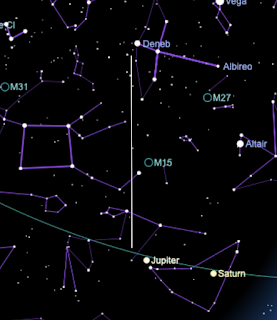
 On 28 November, I viewed the Double Cluster in Perseus for the first time. The following night, I was able to find the globular cluster Messier 15 in Pegasus.

I live on the southside of a city of 1.8 millions. So the northern sky is usually washed out with light. For example, as easy as it is to find Polaris, the other stars in Ursa Minor are not visible. I have readily found the double star eta Cassiopeiai with several small telescopes, and I have viewed the Andromeda Galaxay often. So, I measured out some distances and spent about 45 minutes seeking the double cluster catalogued as Caldwell 14. (It is not a Messier object.) Interestingly, it was noted as a permanent patch of light by Hipparchus circa 130 BCE. Guidebooks call it a naked eye target, but I have never seen it from here. 

The telescope was an Explore Scientific achromatic 102-mm refractor. The oculars were Celestron 32-mm Ploessl alone and with 2X Barlow and a Celestron 17-mm Ploessl for comparison, and then a 14-mm Meade 5000 with an 82-degree field-of-view. Both clusters fit within the 17-mm FOV of 1.34 degrees. 

The next night, I made a concerted effort to locate M-15. It took about 45 minutes and much referencing of star charts, but when it came into view, it was immediately perceivable. 

I had tried to mark it by its altitude compared to Altair but looking about halfway between Jupiter and Deneb in Cygnus worked better.

The best view was with the Meade 5000. I used a 7-mm Nagler Type 1 82-degree though at a modest 94X magnification the view was too close to appreciate and the wider view presented both better context and better contrast.

Also, the skies those two nights were exceptionally clear following some rain and I was able to see the double star gamma Capricorni also called Deneb Algiedi, Tail of the Goat, and I verified it in the telescope.

PREVIOUSLY ON NECESSARY FACTS

Eyewitness Testimony: Popper, Wittgenstein and the Innocence Project

Gregory M. Browne's Necessary Factual Truths

Bringing Philosophy to Athens: Aspasia of Miletos

Understanding Objectivism


Wednesday, November 24, 2021

Learning Lyra

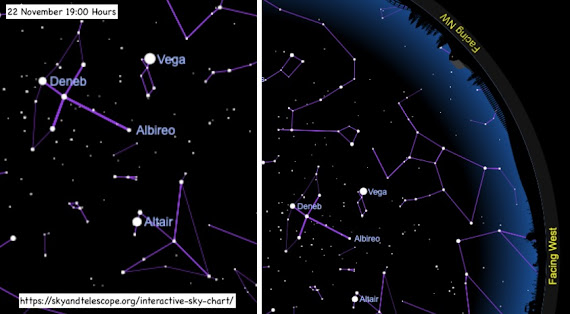
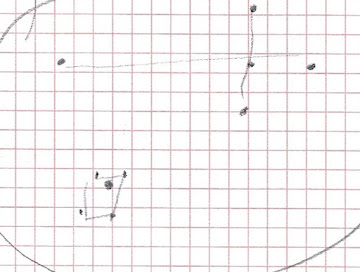
My spatial reasoning scores are always lower than my verbal acuity grades. Consequently, the standard star charts for Lyra, a simple quadrilateral constellation marked by one of the brightest stars in the sky, has been oddly difficult to navigate. Therefore, I returned to basic methods. I have not yet found everything that I mapped out for discovery, but I am confident about the first half of the picture.

What it is supposed to look like


What I mapped in the sky

Although Lyra is supposed to be above Cygnus, clearly, to me, it is not. Of necessity, finding the double stars epsilon Lyrae and zeta Lyrae was a challenge. I have viewed and recorded the famous "double double" epsilon Lyrae several times. It is a target that I know. It is easily above and to the right of Vega.  ("Viewing Epsilon Lyrae" and "Binary Star Project" on this blog.) 

Three of Lyra's stars near Vega are interesting doubles. Barely above Vega is 4th-magnitude Epsilon Lyrae, the Double-Double. Epsilon forms one corner of a roughly equilateral triangle with Vega and Zeta Lyrae. The triangle is less than 2° on a side, hardly the width of your thumb at arm's length.

Binoculars easily resolve Epsilon. And a 4-inch telescope at 100× or more should, during good seeing, resolve each of Epsilon's wide components into a tight pair.

Zeta is also a double star for binoculars. It's much closer and tougher, but is plainly resolved in a small telescope.

And Delta Lyrae, upper left of Zeta by a similar distance, is a much wider and easier binocular pair. Its stars are reddish orange and blue.

https://skyandtelescope.org/astronomy-news/this-weeks-sky-at-a-glance-november-12-20/

At first, I tried following the guides in support of my direct views in the telescope. But I came to understand that the rich star field offered other objects that could match the verbal descriptions.

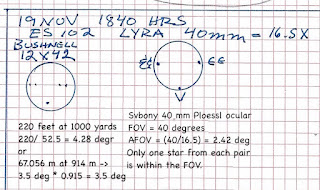
So, I lay down on a chaise longue with my binoculars and drew out the sky as it appeared to me. And while doing that, I also was able to identify the binary stars, zeta and (of course) epsilon.

  
The cellphone Compass app is handy and the app for Measure includes a Level which is accurate enough for my purposes.


I also made estimates of the separations based on the field-of-view (FOV) calculations for the 12x42 Buhnell binocular, as well as the telescope I was using, my Explore Scientific 102-mm f/6.47 achromatic refractor. 

That left me confident of those views though still open on the problem of locating delta Lyrae