Tuesday, October 26, 2021

A Good 70-mm Refractor

In a kerfuffle on the Sky Searchers astronomy discussion board, a couple of the stalwarts insisted contrary to the experiential reports of a newbie that “a good 70-mm refractor” can split the popular double-double star system epsilon Lyrae. I could not with my National Geographic 70 mm. (Previously on Necessary Facts.) So, I decided to find out. 

I have two new telescopes on order now from Mile High Optics, a Meade 70 mm StarPro AZ and a Celestron 70 mm AZ AstroMaster. I also ordered a new National Geographic 70 mm refractor from Explore Scientific on the likelihood that mine failed for material reasons apart from design and manufacture. The key word there is “apart” because I took the objective apart and had to try a few times to get it back together right. I am still not confident about that.

The three telescopes that I have coming for testing are all achromatic doublets. The design consists of objective lenses of two different kinds of glass to minimize chromatic aberration caused by the refraction of different wavelengths of light by using two slightly different different media. This is a solution known in the 18th century. Better still would be an apochromatic triplet. I have one, an Astro-Tech 115-mm refractor (reported last October here) but that is not part of this experiment.
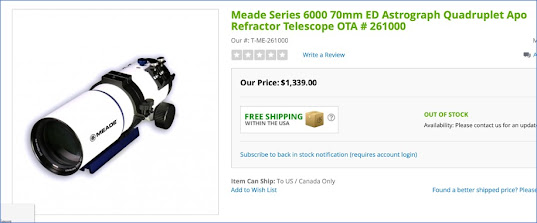
Meade Series 6000 at retail for $1339
for Optical Tube Assembly (OTA) only
in other words, just the telescope,
no diagonal, finder, lenses, etc.
Quadruple objective lens
for maximum chromatic correction
(Agena Astron Products, Cerritos, California)


My superpower is sleeping on a problem and waking up with the solution. (Sometimes, it takes a couple of days.) When I last viewed epsilon Lyrae with my Natl G 70, I was able to resolve the northeast pair, but not the southwest pair. (See also Viewing epsilon Lyrae here from last year.) The two couples are about the same visual distances, primaries from secondaries, and of about the same magnitudes. If one resolved then the other should have also. Based on that, I might take it apart again and rotate the two objective lenses by 90 degrees. 
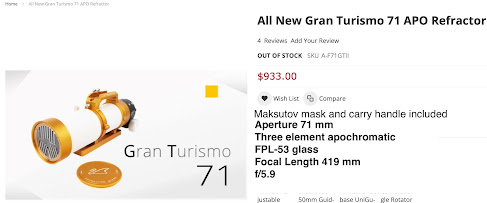

Williams Optics, Gran Turismo. $933.
OTA only, though with Bahtinov mask
for precise focus adjustment

Anyway, the instruments that I ordered are all modest: under $200 for the Celestron and about $150 for the Meade, and just over $100 for the National Geographic. I did not buy the Svbony at $86 because it seems under-developed based on the reports from my colleague on The Sky Searchers and it is a “fast” scope with a short focal length, which comes with other problems, the touchy focusing being first. 
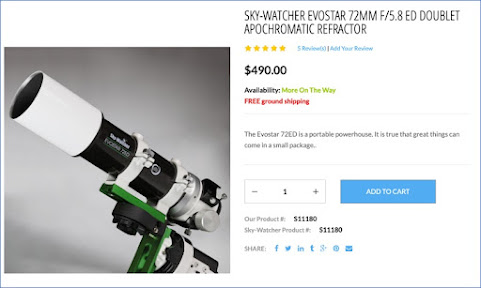

Sky-Watcher Evostar 72 mm "fast" Doublet. $490.
Rare earth (ED) glass meeting apochromatic standards.
(From Astronomics of Normal, Oklahoma.)
Made in Suzhou (Jiangsu), China, by 
Suzhou Synta Optical Technology Co., Ltd., of Taiwan.
OTA only, which is why the mount is in green
and no finder, diagonal and ocular are shown.
The focuser includes a fine adjustment.

Also, I did not buy the high-end 70-mm refractors because I accept as a matter of faith (for lack of a better word) that for the money, the optics would be good, and at the top of the line, fantastic. If the ones that I get cannot resolve the members of the quadruple system, then they fail the standard of “a good 70-mm refractor.”
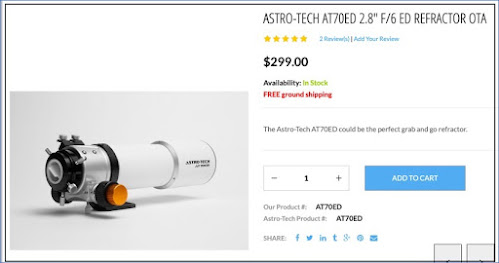
 

Astro-Tech 70-mm $299 
Extremely-low Dispersion (ED) glass
considered "near apochromatic."
f/6 includes dual-speed focuser. 
OTA only from Astronomics of Norman, Oklahoma.

The reason why is that the arithmetic demands that standard. The formula for resolution has several expressions, depending on the chosen units, English versus metric, linear or circular.
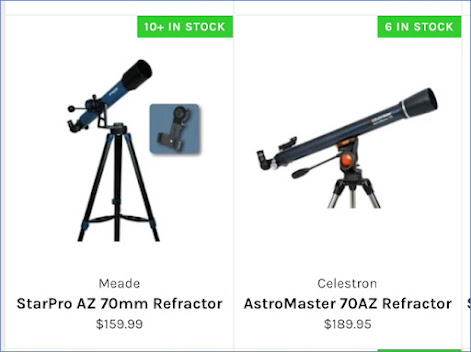

Entry-level 70-mm refractors from 
Meade and Celestron 
$159 and $189 respectively.
Meade is f/10 F=700 mm.
Celestron is f/13 F=900 mm.
from Mile High Astronomy, Denver, Colorado.

  • Angular resolution in micrometers = 0.25 times [wavelength in micrometers / aperture in meters] (bringing the orders of magnitude into conformance.)
  • Angular resolution in radians = 1.22 times [wavelength in micrometers / aperture in micrometers]
  • Angular resolution in arc-seconds = 0.25 * [wavelength in micrometers / aperture in micrometers]

For D=70 mm 

Green = 1.9 arc-seconds

Violet = 1.38 arc-seconds

Red = 2.43 arc-seconds

Mean = 1.9 arc-seconds

(A Student’s Guide to the Mathematics of Astronomy by Daniel Fleisch and Julia Kregenow, Cambridge University Press, 2013, 2020.)
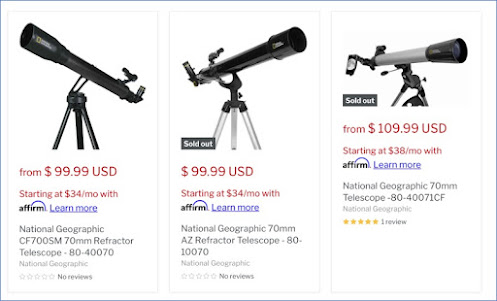


Actually, I ordered my new National G 70 from
Explore Scientific of Springdale, Arkansas,
a firm that I know and trust from interactions
within the hobby leadership community. 
Theirs on the top left was $119, not $99 as shown.
Note that the other two option packages
are both out of stock.
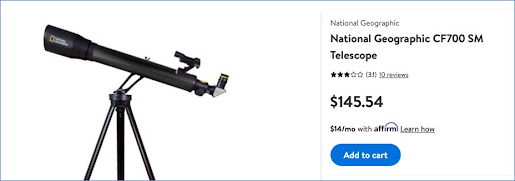
Above at $145 from Walmart.
I believe that this price will hold past the holidays.


Resolution = 5.45 / D inches

Resolution = 1.98 arc-seconds

(Star Ware: The Amateur Astronomer’s Guide to Choosing, Buying, and Using Telescopes and Accessories, 4thEdition, by Philip S. Harringon, John Wiley & Sons, Inc,, 2007, pages 6-9.


Smallest Resolvable Angle = [wavelength nanometers]/ [Diameter in nanometers] 

Smallest Resolvable Angle (arc-seconds) = [114/ Diameter in nanometers] 

for 70 mm = 1.6 arc-seconds

Observers Handbook 2021, Royal Astronomical Society of Canada, page 49.


The angular separations of the companion stars in epsilon Lyrae are given as 2.35 arc-seconds each or 2.4 and 2.5 arc-seconds respectively. "The component stars of ε1 have magnitudes of 4.7 and 6.2 separated by 2.6 (arc-seconds) ... Main components of ε2 have magnitudes 5.1 and 5.5 separated by 2.3 (arc-seconds) ...  " -- /https://en.wikipedia.org/wiki/Epsilon_Lyrae  


Therefore, based on the above, any 70-mm refractor ought to be sufficient. 
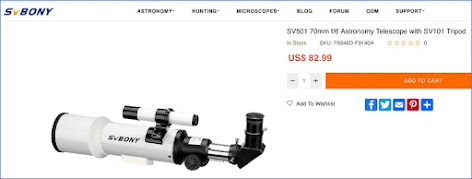

Svbony "fast" f/6 70-mm refractor. $82.90.
Comes with 5X finder scope, diagonal,
20 mm eyepiece, and tripod.
Made in Hong Kong, sold worldwide.

The Airy Disk

Astronomer Royal George Biddle Airy (1801-1892) modeled the visual telescopic image of a star in the course of his investigations of optics. The so-called “Airy disc” or diffraction disc is the small central portion of the false image of a star formed by a telescope at focus. Light not contained in the disc forms neat, concentric diffraction rings, or Fresnel rings surrounding the disc. The size of the star image is proportional to the wavelength of light, and inversely proportional to the aperture of a particular optical system. Thus, the larger the aperture, the smaller the Airy disc in stars of the same color.

            This ideal representation has confused some observers, who assume that their optics are flawed when stat images on the Airy model do not appear during routine sessions. … Due to atmospheric turbulence and “local seeing” disturbances in the air in and around the telescope, the model appearance is rarely glimpsed in the field. Typically, one sees an amorphous central discoid surrounded by a series of broken, shifting ring segments. […]

            In years of observing, the author has only experienced a handful of occasions when the atmosphere rendered a perfect Airy model visible—all in the wee hours of still, humid, subtropical mid-summer nights of marginal transparency. At times like this, planetary details stand out like the lines on a banknote, and doubles generally seen as barely split seem to have widened to admit an extra measure of black space between their components.” – Care of Astronomical Telescopes and Accessories by M. Barlow Pepin, Patrick Moore’s Practical Astronomy Series, Springer-Velag, London, 2005, page 24.

My goals for this project include keeping the Celestron 70 mm f/13 for its long focal length and deacquisitioning the two National Geographics and the Meade. I am also seeking a new Explore Scientific 102-mm f/9.8 F=1000 mm to replace my current one which is f/6.47 F=660 mm.


PREVIOUSLY ON NECESSARY FACTS

Reminders of Newtonmas Past 

Measuring Your Universe: Alan Hirshfeld's Astronomy Activity Manual 

Copernicus on the Revolution of Heavenly Bodies 

An Online Class in Astrophysics 


Saturday, October 23, 2021

National Geographic 70-mm Refractor Field Test

With a sturdy mount and tripod (see previous post), I was able to spend more time on targets that I know in order to determine the limits of this “hobby killer” department store telescope. My motivation was a discussion on The Sky Searchers board centered on another newbie who posted questions about the limits of his Svbony SV501 70mm f/6 (F=420 mm) refractor. Two stalwarts insisted that a “a good 70-mm” could split the famous double-double system epsilon Lyrae. He could not do that. I could not either with my 70 mm f/10 F=700 mm. So, the problem is: Is this “a good 70-mm”? My final judgement is that given the return-on-investment (ROI) for the price, it is good enough. 

[07 November. After working with two other 70-mm telescopes in the same price range, and after working with another, newly-purchased National Geographic, I believe that that product does not perform competitively.]

Three versions of the National Geographic 70 mm refractor
offered by Explore Scientific.
Walmart is not alone in pricing it at $145
and out-of-stock.

I started with two entry-level “First Scope” oculars from Celestron, a 12.5 mm and a 6 mm for 56X and 116.6+ respectively, both 50-degree field of view. I believe that these are Kellner designs, not Ploessl, (three lenses not four) just because they are inexpensive. I took one apart as far as I could conveniently, but never got down to the basic components and I left it at that. 

21 Oct 20:45 (CDT UT -5)

Venus. Noticeably just past quarter phase. Chromatic aberration (CA) red to right blue to left worse with these and less pronounced with Celestron 17-mm and 8-mm Ploessl. More CA with Celestron 2X Barlow and 17-mm. 

Jupiter. Less CA. Two bands. Four moons. No problems. But seeing is not good. Nominally clear but obviously poor sky high up. I quit early.


22 Oct 17:20 Forecast is clear through 03:00 hours.

Set up on Venus. CA depends on centering: blue to right, red to left; red to right purple to left. Worse with Kellners than Ploessls but both about the same and noticeably less than last night.


19:30 to 19:44. Jupiter.  12.5-mm Kellner. Planet and moons fill about one-third field of view (50 / 56 = 53.5 arc-min). Timed passages across FOV 2:01 min:sec and 1:55 min:sec. at 19:40 and 19:44 hours. Watching Jupiter, some detail in the south appears, another band, but broken, not distinct, comes and goes.

19:52 after some searching found Messier 22 in Sagittarius. Very faint. 

20:02 Albireo. Smaller blue on top of larger yellow. Yellow about twice the size of the blue. 


20:15 Test on epsilon Lyrae. No joy with both 12.5 mm and 6 mm oculars. I was able to see the first double, of course, but could not split their companions. 

20:29 switched to TeleVue Nagler 7 mm Series 1 eyepiece. This is a high value, wide view 82-degrees, that I acquired on close-out from Enerdyne in Suttons Bay. (It had been on the shelf unsold for four years and was now outdated by new designs from TeleVue.) No change. Same view as 6-mm Kellner.

(It is important to let your eyes left and right take long turns viewing as the sky changes, shimmering, clearing, worsening, etc.) 

Changed to 6-mm Kellner with 2X Barlow. (700/3 = 233.3+ X). 

Right pair is more pronounced. I can make out the companion above.

23:13 hours - Second companion is still not there. It should be to the left but is not.


23:13 Checked eta Cassiopeiai double star 12.5 mm (56X) with no problem. 


I spent the rest of the night not photographing the Moon and Jupiter with my Explore Scientific 102-mm refractor and my iPhone 11. I closed up shop at 02:00 on 23 October 2021. The ES 102 is a nice scope. It is my grab-n-go. But it has a design problem in that the draw tube does not allow a shorter focus with more than a basic lens in the diagonal. I had the same problem trying to view Venus with two filters to cut the glare. (The Natl G worked just fine.) So, none of the 50 snapshots was publishable. 


PREVIOUSLY ON NECESSARY FACTS

Four Books about Bad Science 

Science versus Common Sense 

The Philosophical Breakfast Club 

Science Fair: A National Geographic Film 


Thursday, October 21, 2021

DIY: Homebuilt Substitute for Vixen Mount

The Vixen Company, Ltd., of Saitama, Japan, (founded 1949) got the brilliant idea to make all of their telescopes compatible with all of their mounts. Today, the Vixen mount is a standard offered by most other makers. However, a new Vixen mount bar at $79.95 plus tax and shipping was wholly disproportionate to my needs. 

https://global.vixen.co.jp/en/


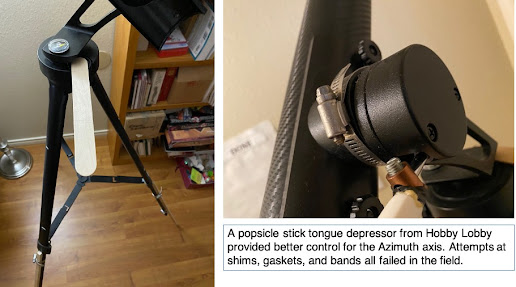
Four years ago, I bought a National Geographic 70-mm refractor used and abused from some kids down the street. Between Christmas and August they lost the eyepieces, center tray, guide handle, and cellphone attachment, and the dew shield was on backwards. (They said that they never had it outside.) I tested it with a 1.25-inch eyepiece against a traffic sign down the road and it was OK. So, I gave them $35 for it. 


For four years, I did what I could with the mount, taking it apart and putting it back together but degreasers and lubricants, rubber bands and hose clamps never solved anything. 

All-in-all it has been a good little viewer and given the 70-mm limit not half bad for backyard stargazing. At that time, I also owned a Celestron EQ-130 Newtonian which I donated to the Goodwill earlier this year. 


Meanwhile, in October 2020, I bought myself an Explore Scientific 102-mm refractor. It comes on a First Light mount to keep the price down and I was never happy with the mount. It is difficult to control and somewhat underweight even for the 102. I was able to afford a Twilight I mount from ES, used and reconditioned with warranty. That has gone well for me. Now, I wanted to put the National Geographic on the First Light mount.


The easiest solution would have been to buy a Vixen mount, $79.95 plus tax and shipping, which was wholly disproportionate to my needs. 

I am not a fabricator. I have very few tools here. So, I went to Home Depot and searched for wood. I bought a 24-inch slat of quarter-inch poplar. 

With the saw blade on my Gerber pocket tool, I cut it in thirds and glued two pieces together. (I learned about Elmer's in junior high wood shop class.) 

The attachment screws on the telescope are mounted from the inside and I did not want to take those screws out. So, I used them to attach the new plate. Lacking drill bits, I used wood screws to make the holes. (We have an electric hand drill that my wife got as a door prize at a computer user meeting.) I ran a thin one in first, then widened it. 

Even though I measured more than twice, I was off by an inch the first time. I also split the wood once with a screw too large. After gluing (and curing) that, I wided the holes with my Swiss Army Knife. 

I secured the slat to the telescope with Gorilla glue. 

The best telescope is the one that gets used. 

I recently bought entry-level Celestron "First Scope" oculars ("eyepieces") to go with this so-called "hobby killer" that my astronomy colleagues denigrate for being a "department store telescope." OK: it is not an apochromatic rare earth triplet; the aperture (diameter) is not four inches or eight or ten. Nonetheless, I have seen the Messier 22 globular cluster, the Messier 44 "Beehive" open cluster, the Andromeda Galaxy (Messier 31), and, of course, Venus, Mars, Jupiter, and Saturn. Now, the telescope has a mount worthy of its optics.

PREVIOUSLY ON NECESSARY FACTS

(Mostly, the addenda links can be complementary or contrasting or off-topic. These are about observing with the National Geographic 70-mm refractor.)

Viewing Mars

M44 Beehive Cluster First Sighting

Astrophotography and Me

Jupiter-Saturn Conjunction 2020

Wednesday, October 20, 2021

Celestron AVX Mount: Twelve Nights of Viewing and Learning

It is a poor workman who blames his tools. For all of the problems with the Celestron AVX mount and tripod recorded here last month, from the first night, as soon as it was aligned, it served as a teaching aid, modeled on a mentor rather than a book. Books are necessary for their factual expositions, but they do not work well in the dark. This does.

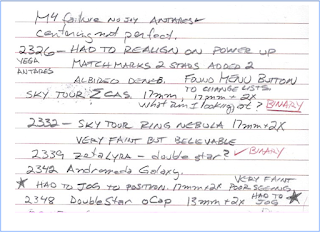
A citizen scientist
always keeps a lab notebook.
I began by testing just the computerized mount with my "grab and go" telescope. My motivation for testing the new telescope was somewhat different and I will write more on that later.

When setting up the new mount, I checked the computer against targets that I know, such as the double stars Albireo and eta Cassiopeia and the globular cluster Messier 22 in Sagittarius. I also tested with choices that I did not know. All of this involved learning the menu system by night and re-reading the user manual during the day. The mount has a database with over 40,000 objects available in two presentations: Identify (keypad 4) and Object Info (keypad 0).


Two refractors.
"Grab and go" 102-mm (4 inch) doublet (12 lbs) above
new 115-mm (4.5 inch) triplet (17 lbs) below


The new instrument is an Astro-Tech 115-mm extremely-low dispersion (ED) rare earth glass apochromatic (APO) triplet telescope. It is somewhat larger and more refined than my “grab and go” an Explore Scientific 102-mm achromatic doublet. In addition, I acquired two high-value oculars (“eyepieces”), a TeleVue 7-mm and a Meade 14-mm. Both offer 82 degrees of view and quality lens coatings. Obviously, the larger the objective and the better the glass, the more you see. 


A citizen scientist 
always keeps a lab notebook.

That said, the primary factor is the sky: good seeing trumps good glass. I live in the city and my sky is Bortle 7-8 meaning that the Milky Way is not visible naked eye. So, at the end of two weeks’ work, I packed up the mount and tripod and the telescope and will take them all out again after we move early next year.


Listed here are just the first views of stars and deep space objects (DSOs). I recorded other views and also tested a different telescope (returned to vendor) on known targets.


8 September 

2047 hours – 17 Cygni binary

2326 hours – sigma Cassiopeiae binary 

2332 hours – Messier 57 the Ring Nebula (very faint but acceptable)

2339 hours – zeta Lyrae binary 

2348 hours – omicron Capricorni binary


09 September

2257 hours – Messier 54, Messier 69, Messier 70 all in Sagittarius in quick succession, all faint but acceptable.

Continuing – Messier 11 in Scutum, Messier 27 in Sagitta, 61 Cygni binary.

2341 – failures on known objects; first eta Cassiopeiai and then Polaris. Had to use the handset (paddle) to slue the telescope (jog the robot) to the target. Powered down and re-aligned. Resumed sky tour of known objects.


10 September

02:31 hours – Jupiter far off center. Powered down and quit for the night.


11 September 

2051 hours – Messier 13 in Hercules.

2105 hours – Messier 6 and Messier 7 (already known to me as the Ptolemy Cluster)


16 September

2120 hours Messier 13 in Hercules (good viewing)

2248 hours – Messier 17, Messier 21, Messier 25


05 October

2017 hours – Algieda (alpha Capricorni) triple star

2020 hours –Dabih (beta Capricorni) binary


09 October – with the expensive kit and gear all back in their boxes and cartons, I went out with my 70-mm National Geographic refractor and two entry-level Celestron (“First Scope”) eyepieces and viewed Jupiter, Messier 22, Algiedi and Dabih. Better glass is a better view, but the best telescope is the one that gets used.


PREVIOUSLY ON NECESSARY FACTS

New Telescope: Explore First Light 102-mm Refractor 

Redshift: Six Years with Astronomy 

Backyard Astronomy (13 June 2020) 

Backyard Astronomy (4 July 2017) 


Sunday, October 10, 2021

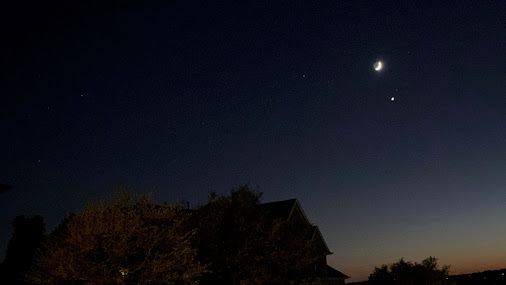
Moon-Venus-Antares Conjunction

 Astronomers Without Borders asked us to take snapshots of the sunset event. 

1949 hours Central US (UZ-5.5)
30d 10m N 97d 48m W
iPhone 11 (OS 14.7.1)
(
Click to enlarge.)

1953 hours Central US (UZ-5.5)
30d 10m N 97d 48m W
iPhone 11 (OS 14.7.1)
About a dozen stars visible in the original.
(See above. Click to enlarge.)

PREVIOUSLY ON NECESSARY FACTS

Observing with NASA: An Open Platform for Citizen Science 

Amateur Astrophotography is Baloney

The Perfect Machine: Building the Palomar Telescope

Seeing in the Dark: Your Front Row Seat to the Universe


Friday, October 8, 2021

Long ago Miletus was great.

In five generations from 650 BCE  to 500 BCE --a span from your grandparents to your grandchildren--civilization was transformed by the confluential inventions of democracy, mercantilism, coinage, and philosophy. Thales of Miletos exemplified the times, He is credited with predicting an eclipse, taking out futures contracts on olive presses and leasing them when the harvest came in, and developing the first formal proof in geometry. What we call the Socratic Method was the Milesian Way brought to Athens by Aspasia of Miletos.

Traditionally, cities had been ruled by kings. That story is in The Iliad and The Odyssey. Something changed. It probably happened in one lifetime. Tyrants replaced kings. We do not like tyrants and the word has a negative connotation but tyrants of the archaic world were self-made men on the rise who took over the affairs of their towns. And they could be overthrown, exiled or killed. That took planning and the conspirators became an oligarchy. Widen the ruling junto and you have a democracy. 

At this time, philosophy, argument by reason and evidence, was replacing religion as the informative narrative in the culture.

The citizens voted to go to wars in which they were the soldiers. That was not the traditional way. Rather than expendable masses of untrained farmboys, Greek mercenary armies were made up of bronze-clad hoplites. Your shield protected the man on your left whose right arm was raised with his spear. Social cohesian was critical to success. In return for victory, these armies were paid with the first coins. 

With armies outside their walls, sometimes citizens under the cover of darkness took their money and fled in their ships to found new towns. Thus, the coins of Abdera in Thrace mimicked the coins of their hometown, Teos in Ionia. Small silvers worth a day's wages from the anonymous towns of the Cheronesos peninsula in Thrace c 350 BCE copied the archaic designs of Miletos.


Miletos c. 550 BCE electrum sixth stater 2.37 grams (ex: Singer).
Recumbent lion / incuse punches.
SNG Von Aulock 1796
About 25 years ago, Dr. Gordon Andreas ("Andy") Singer 
was set up at the MSNS Thanksgiving show. 
His table displayed medieval coins.
I gave them some attention and started to walk past 
and he asked me what I was looking for and I said, "Archaic silver." 
And he replied, "Gold can be as cheap as silver." 
I read the tag and told him that 
the coin was misattributed to Phocaea when it was clearly Miletos. 
He said that it wasn't his specialty 
and the coin was mine at that price if I wanted it.

The failure of the Ionian Revolt was a lesson for the American revolutionaries of 1776. The Ionian Revolt started in 499 BCE in Miletos. The 12 cities were Miletus, Myus, Priene, Ephesus, Colophon, Lebedos, Teos, Clazomenae, Phocaea, Erythrae, Samos and Chios. As much as they shared in common culture, and even though they declared a central temple to Poseidon in Priene they never formed a political league and were re-conquered one at a time, in a string of defeats. It was over by 493. 

Unity did not come easily to the Americans. Proposed by Congress on 15 November 1777, the Articles of Confederation were not ratified until 1 March 1781. Contrast that with the fact that the Marine Corps was created on 10 November 1775 after the Battle of Bunker Hill 17 June 1775 and the Battle of Lexington and Concord 19 April 1775. 

I learned in high school that the "American revolution" was not the War for Independence. The revolution happened in the minds of the colonial leaders following the French-Indian War 1757-1763 when they realized that they were mostly on their own and their opportunities for full rights under English law--such as the Bill of Rights of 1689--were weak. The Albany Plan of Union (10 July 1754) was one of several compacts between and among the American colonies. Some attempts at unity were forceful, as when Massachusetts occupied New Hampshire (which it had to give back) and Maine (which it kept). Wars between New York and New Hampshire and Pennsylvania and Delaware were brief. 

Miletos electrum stater from the Rosen collection.

Golden ages come and go. Greek civilization was a complex. Common language and a plethora of independent city-states allowed the exchange of ideas. People interested in ideas gathered in Athens, then were induced to Alexandria. Syracuse was always available, as was Rhodes. And when Alexandria could no longer afford her librarians, the philosophers found homes in other cities, spreading the knowledge rather than hoarding it, though the great library did continue.  

When the first coins were struck, wealth was land and cows. Land was inherited. Coinage changed the form of wealth. More importantly, it allowed the creation of wealth by new means. Aristotle was not alone in opposing it. While livestock breeds naturally, to make money from money is unnatural. Many people today still believe that. 


British North America had no native gold or silver. Spain went bankrupt by looting the native Aztecs and Incas of their gold and silver. However, the British colonies created paper money and from that came roads, canals, railroads, airlines, telegraphs, telephones, and computers. 

Just as tyrants have a bad name today, so, too, do we denigrate sophistry. The ancient sophists were mercenary scholars who charged money for their lesssons. Plato did not like them, though he gave a fair hearing to Protagoras in one of the books of The Republic. 

Diogenes of Sinope was traveling when his ship was stopped and all aboard were taken to a slave market and sold. In those days, once apart from your city, you had no protection.

Obverse and reverse of a drachmon of
Sinope that could have been struck under
the authority of Diogenes who was later
accused of adulterating the coinage.


The ancient Greeks had a word for the person with no interest in politics: idiot. Concerned only with himself, he did not take part in civic life or at least did not come to the Assembly to argue and vote and take the responsibility of holding annual offices. When they attended the assembly, they paid themselves the same wages as a soldier in the field or a rower on a ship: one drachmon per day. The Spartans thought that this was evidence of the corruption of democracy, that the citizens voted themselves payments from the public treasury. In America, we do acknowledge civic engagement. However, our contribution to civilization is honoring the individual who minds their own business.

"Mind Your Business" Continental currency 1776 and Fugio cent 1787.

PREVIOUSLY ON NECESSARY FACTS

Sunday, September 19, 2021

Celestron AVX Product Review, Part 3

Friday night, the 17th, I intended to be out through dawn, the sky being clear, albeit with a nearly full Moon. However, after some frustration, I took it all down and brought it all in at 23:30. This morning, I went through the user manual again. I relied on the PDF editor to locate places in the hardcopy to make my own notes. I am a little smarter now. 

While working in the dark and wanting to actually view things, I have not always recorded the operations as I would if I were getting paid to write their user manual. This morning, I set it up (without telescope or counter-weight) to run through the menuing. 


It is easy to crash the software. 

  • I attempted to run a simple two-star alignment. 
  • I missed the second star in the menu, pressed Back too long, and found myself at Select First Star again. 
  • So, as I was already pretty close to Vega, I pressed Enter and Align. 
  • The mount stood on its head while it wrapped up the Declination cord and jammed one of the mount knobs into the Latitude knob as I furiously loosened screws. I should have just cut the power, of course. (Something like this happened the second time out, also, though it was not as dramatic. See the second review linked below.) 
  • Writing this, and checking my work, the same thing happened again twice. Fortunately, I was ready to flip the switch to Off. Also, fortunately, no instrument was mounted or it would have been a head crash, as when a robot manipulator bashes its own base. The lesson here is the same as it was in 1991: Always stand at the E-Stop when running the robot. 
  • And that is a design flaw here: The paddle has no Emergency Stop, no power cut-off.


Getting my facts straight to write this,
I found another interesting problem.
The documentation is wrong about the key pad.
 More to point, though,
the design of the user interface lacks consistency
because it lacks conceptual integration.
If the engineering were conceptually integrated,
 these contradictions would not exist.
 It is why as a technical writer
I rely heavily on Ayn Rand's theory
of objectivist epistemology
to inform the design process.

Running the test was easy because the mount has no internal power. The EEPROM (programmable memory) holds the last settings only. This morning, the onboard computer thought that this was still the night of the 17th. So, it was easy to program in 21:44:44 hours and today’s date. Considering the utility and cost of a wristwatch battery, I can only regard this as a major engineering oversight. 


I did verify an undocumented feature. Holding the Back key clears the current menu (sometimes).


I found that accidentally on the night of the 16th 20:21 hrs. I had three stars in the alignment but could not find a good fourth star in the Menu. So, I was stuck in menuland, pressing Back and Back and Back and not finding a good target until I accidentally held the key a little longer. Oh! Ah! It is not in the documentation that you can do that.


As noted, I do not know the faux Arabic names of the stars. Loving languages (see here), I can tell myself that Rasalgethi and Rasalhague are the heads of something or someone and Denebalgedi and Denebola are tails. The burden  remains with me to learn them as I learned Zubenelgenubi and Zubenalschemali because I am a Scorpio. Just to note: The Object Info database does have the common name and the Graeco-Latin designation as the two line header for each target in the Star Catalog. So, that will help with the learning.


Also, the documentation does clearly explain the difference between the Four (4) key Identify and the Zero (0) key Object Info. That was my problem the other night and a problem I recorded earlier. I lined up on a brighter star near along the ecliptic, pressed either Identify or Object Info and then Enter and nothing happened. So, I pressed Back and Enter and the telescope took off for the first item in the list, Achird (Eta Cassiopeia). 


PREVIOUSLY ON NECESSARY FACTS


Documentation is Specification 

Objectified: A Documentary About Design 

Celestron AVX Mount Product Review Part 1 

Celestron AVX Mount Product Review Part 2 


Wednesday, September 15, 2021

Social Stratification in the Academy

When I was completing my master’s in 2010, at home we were watching Battlestar Galactica on DVD. We viewed the episode “Dirty Hands.” (Wikipedia here. IMDB here. Battlestar Wikiclone here.). Before class started, I mentioned it to the professor, that in a society that was breaking down, children were inheriting the work of their parents. His daughter and I had been in the same freshman class and now she was completing her doctorate. Just to note: one summer, I carried 24 credits, 12 each at two different schools, two classes in each of two summer mini-semesters. But I could not work fast enough. She was going to inherit her job before I could earn mine. The professor said that it was common in universities now.

From the National Radio Astronomy Observatory:

Nine Children of NRAO Staff Among Recipients of 2021 AUI Scholarship


AUI [Associated Universities, Inc.] has selected the recipients of its 2021 AUI Scholarship, who each will be awarded a $3,500 renewable scholarship ($14,000 over four years to each scholar) to support their academic careers. Fourteen outstanding high school seniors were selected based on their academic achievement, community involvement, and leadership skills. 


Funded by AUI, the scholarship program recognizes the achievements of the children of full and part-time employees of AUI and its affiliated centers, and assists them with the ongoing costs of collegiate education. Recipients of this year’s award come from across AUI’s affiliated centers, including the National Radio Astronomy Observatory (NRAO), Green Bank Observatory (GBO), and AUI.


The AUI Scholarship program is conducted by International Scholarship and Tuition Services, Inc.

https://public.nrao.edu/news/children-of-nrao-staff-among-recipients-of-2021-aui-scholarship/


Back in 1967, in a high school history class, I learned that at the turn of the century then, one easy generalization about America was “Shirtsleeves to shirtsleeves in three generations.” Working class parents give their children all the advantages they can. The children become professionals, teachers, doctors, railroad executives, or steamship entrepreneurs. Then outcomes being what they are, the children might not maintain that status as they lack the attributes that made their parents and grandparents successful. Our teacher warned us that this was eroding, that America was developing a ruling class similar to Europe’s and England’s in particular. 


Previously on Necessary Facts

The Cure for a Failing Empire

The Roots of Poverty 

Sociology: A Defense and a Call for Reform 

The Pretense of Sociology 

Aging in America: Alternatives to Government Policies


Monday, September 13, 2021

Celestron AVX Mount Review (Part 2)

So far, after four nights, I am something less than sanguine. The smart drive mount works well enough, given some problems noted below. I have about 20 more pages of user manual to understand. That said, after the first engagements over four nights, the Celestron AVX go-to mount did the job after some angst and uncertainty. The "Information" and "Identify" buttons do make this a teaching tool, like an interactive planetarium with the actual sky above you right now as you see it. Tracking works well. I finally had the opportunity to sit in a chair and look at Jupiter for long minutes without having to turn a cable control knob. Not much happens quickly in the sky, but the rotation of Jupiter is one of them. 

I need to learn the faux Arabic names of the stars - Caph for beta Cassiopeia, Mirfak for alpha Persei, etc., etc. Some I know: Betelgeuse, Rigel, Deneb, maybe a dozen easy ones, on top of other common names such as Antares and Polaris. However, here the entire database of Named Stars does not allow inputs such as delta Scorp. You can, indeed, choose epsilon Lyrae or eta Cassiopeia and many others from the list of Double Stars. 


Celestron AVX Mount and Tripod 
with
Explore Scientific 102 mm
f/6.47 Achromatic refractor

With a computerized telescope, I am reminded of Jurassic Park: All the problems of a major zoo and a major theme park. Here, you have two servo controlled motors and a warehouse of information databases, and all of it under the same menuing on a telephone style keypad, going back to the overhead crane come-along paddles of the 1970s. The UI/UX (user interface/user experience) people make their best guess and you learn the system they deliver.


The mount and tripod do thread up well. The mount pre-locks into place with two screws that meet on a flange. They call it "fine setting for azimuth" but it puts the mount in place for the central shaft screw that (1) secures the mount to the tripod and (2) secures the leg brace and accessory plate.


 My other experiences included two large (8-inch and a 10-inch) Meade catadioptric telescopes. Integrated with the lens tubes as units, the mounts were difficult to set into the tripod. Getting the threaded rod into its threaded receptacle was a risky chore because I had to be careful not to lose control of the 35-lb telescope while tilting it and rocking it back and forth atop with one hand to find the engagement with the other while crouched below.


 I have taken this apart and set it up four times now and it always goes together easily. (A couple of years ago, I replaced the thermostat in my Civic and the one-hour job took eight over two days with two installs to get it right. So, I'm a tough test for mechanical procedures.)


I had some problems. With Arcturus still above the tree line to my west, I chose that star for the first alignment and the telescope slued about a 90 degrees wrong northward and 90 degrees wrong in altitude. I powered down and waited. While it was unpowered, I checked north again. I use my cellphone aligned on the telescope. This is my backyard. I have been here ten years. I have recorded Polaris as a binary. I know north. But okay, I did it again, then powered up again. 


10 September 2025 hours- I chose Arcturus again and this time it went well. 

2027 hours -  The next star was Antares. While jogging the instrument to align the star in the field of view, the paddle stopped responding. So, I waited, and five minutes later (2032) I selected Antares again and the mount aligned near the star and I brought the star into the center of the field of view at higher magnification. 

2032- I chose Deneb for the 3rd star. 


[Went in for dinner and to sleep and woke up about 3:00 AM.]


11 Sept 2021 0320 hours. Checked star charts before setting up because I could not see many stars up that I know by name. 

0406  hours Aligned on Hamal (alpha Arietis) and Aldebaran, which was finally above the tree line to the east. 


Chose the Solar System key on the pad and selected Uranus. Used magnifications 38, 77, 82 and 165 from 17mm and then 8mm both with and without 2X Barlow to repeatedly check the field, jog the instrument, select Uranus again, and again jog the putative target to center. If there was a planet in there, you could not prove it by me. The target offered was granted steadier and more circular than a star, but not by much. I have seen stars like that, especially when close the Airy limit. It was not much bluer. 

The heaviest attachments:
a 40 mm Ploessl ocular
atop a 5X focal extender.
Total instrument weight is
below 14.3 lbs (6.5 kg).
The mount is rated at 30 lbs
and that is an occlusion.
(See Part 1.)

11 September 2021 2013 hours - Set up.

2050 hours - Aligned on Antares and Arcturus. No problems. Added Deneb and Nunki (now that I know which one is Nunki). 


2051 - Chose the Deep Space key on the pad and then selected Messier, and entered 013.

2055 - Messier 13 the Hercules Cluster observed with 14mm and 2x Barlow for 94x. This was a win for me because I have been unable to find it on my own by star-hopping. 


My intent here is to learn the locations of this and similar targets from the computerized go-to and then use a manual mount with a different telescope to find the target by star-hopping.


2105 - Messier 6, an object that I know.

2107 - Messier 7 - Ptolemy cluster well I know from previous sighting and manual tracking. It is a naked eye target.


12 September 09:19 hours.

Finishing this report. Last night after the 0100 AM session, I brought in  the ocular kit, the power pack and the hand control. I covered the mount with a plastic garbage bag and covered that with a cloth-like water-resistant shower curtain. Nominally, the ambient temperature was 10 degrees F above the dew point, but weather is local and I know from previous sessions that my backyard gets wetter sooner. Celestron warns that the power pack in particular is not waterproof, and I take that to mean that nothing else is, either. This morning, the porch was damp to the touch, but the mount and tripod were dry. I brought them in.


After setting up in the living room, I used a Phillips screwdriver and a hex wrench to re-tighten the Right Ascension and then loosen and reset the Declination lock latch. 


The forecast is for clouds and rain this week.


PREVIOUSLY ON NECESSARY FACTS


 Misconduct in Science and Research 

 20% of Scientists are Crooks

 Retraction Watch 

 Four Books About Bad Science 

 Junk Criminology as Pseudo-Science 

 Criminalistics: Science or Folkway?