Showing posts with label astrophotography. Show all posts

Tuesday, December 31, 2024

Astrophotography Session

 My instrument was an Astro-Tech 115 mm apochromatic triplet (extremely low disperson glass) on a Celestron AVX mount and tripod. The ocular was a Tele Vue 32mm Ploessl 52-degree field of view for 25X. The camera was my iPhone 15 (iOS 18.11) mounted on a Celestron NexYX carrier. I was out from 1:05 to 2:30 AM. I shot 19 stills and movies.

Messier 42: the Orion Nebula

Mintaka: double star with companion

Messier 41 in Canis Major
The Pleiades: Messier 45

PREVIOUSLY ON NECESSARY FACTS

Observing with NASA: an open forum for citizen science

Astrophotography and Me

Astrophotography is a Lot Like Love

Lunar Eclipse 8 November 2022

Jupiter-Saturn Conjunction 2020

Monday, December 30, 2024

Solar Imaging

 We are approaching a sunspot maximum for 2024/2025 and already are above statistically likely events.


 Images with Explore Scientific 102mm achromatic refractor,  TeleVue 32mm Ploessl, iPhone 15 iOS18.11.  Explore Scientifc SunCatcher filter mounted on the objective. These are two of the best six of 13.


Friday, March 17, 2023

What Color is the Orion Nebula?

On the Cloudy Nights discussion board, the question of the nominally “true” color of Messier 42 as well as many other nebulae and stars has been tossed up for discussion. One frequent contributor to the board insisted that he could see pink in the Orion Nebula and, moreover, that anyone who could not suffered from defective vision. Another stalwart relied on standards that he derived from measurements made during daylight photography of other objects and from those defended his interpretive photographic processing. These are examples of confirmation bias: the operator is first pleased by an image and then finds objective reasons supporting the choice. 

At the same time, chatrooms across the internet, apparently starting at Reddit and soon including Gizmodo and Ars Technica, were abuzz about Samsung’s claim that its artificial intelligence learning algorithm enhanced a photograph of the Moon taken with a Galaxy S21 Ultra. In fact, the software recognized the object as the Moon and added details from other images. This was not an isolated example of artificial enhancement. 

When photography became available for astronomy, subjective experience was supposed to have been removed. Perhaps the best case was the Orion Nebula, first photographed by Henry Draper and Mary Ann Palmer Draper on 30 September 1880. (See “The Drapers’ First Photograph of Messier 42” here: https://aas.org/posts/news/2022/10/month-astronomical-history-september-2022 By that time, the Orion Nebula had been rendered in drawings for almost 200 years. One consequence of all the attention was that the representations tended to converge to a common understanding: they started to look alike. Now they do not.


https://phys.org/news/2013-03-astrophoto-beautiful-orion-nebula.html


To me, the most important fact is that astronomers explore and record Messier 42 and the rest of the universe in different wavelengths and we can only reproduce the very narrow visible band: x-rays, ultraviolet, infrared, and radio waves must be transduced into some false color presentation. The 3500 stars otherwise hidden by the dust and gas in the Orion Nebula were only revealed with infrared imaging. (See The Orion Nebula: Where Stars are Born by C. Robert O’Dell, Harvard University Press, 2003.) The nebula itself is a complex space of emissions and reflections. Therefore, many valid transductions are possible.


A more informative discussion would start with which species is doing the viewing. 

“In comparison, butterflies and mantis shrimp have a dozen classes
[of sensory cells] to cover a broader range of the spectrum
(from deep ultraviolet to far red light), which gives them hyperspectral vision.” 


Geographers call it "ground truth." When you have a photograph that shows yellow, is that reflection, subtraction, filtering, or emission? You do not know until you go there for yourself. I completed my master's degree in 2010 with two classes in geographic information systems. One of our projects was to present our university stadium. Our school colors were green and white. The concrete was painted green. So were the wooden seats. The field was artificial turf, also green. Surrounding the field were real living green plants, from grass and shrubs to trees. The assignment was to sort out the wavelengths of imaging and deliver an informative presentation.


PREVIOUSLY ON NECESSARY FACTS

Why Evidence is not Enough 

Galileo and Saturn: Epistemology not Optics 

Visualizing Complex Data 

Knowledge Maps


Tuesday, November 8, 2022

Lunar Eclipse 8 November 2022

This was the last total Lunar eclipse until 14 March 2025. I got out early and took my time. Other snapshots have gone better. 

These were taken with an iPhone 11 on a Celestron NexYZ adapter connected to an Explore Scientific 102 mm f/6.47 refractor with a Nagler 32-mm Plössl ocular at 20X. Snapshots with an iPhone 5 did not go well this time. I also relied on a Celestron 32-mm eyepiece. For both, the Neutral Density Filters (“Moon Filters”) were from Celestron. These are the best of 45 tries.


Snapshot 1 just before 50% in the penumbra.

I got out at 1:00 AM CST for the 2:00 AM start and set-up went well. I made time to observe naked eye and through the telescope between exchanges of attachments. At 4:50, I stopped adjusting the hardware and only observed. 


The photographs do not represent the image captured by the eye. Naked eye, the Moon was never completely dark. Totality did not look like this. Also, the color was never a full startling red, only a dusky red-gray. 


Snapshot 38 close to 50% in the penumbra.


As the Moon passed 50% into the penumbra, darkness brought out the stars, about 150 in all including the Hyades and Gemini. Through the telescope, I viewed Messier 42, Messier 41, and the Pleiades. Mars was high in the west and even at 20X the sky was clear enough and dark enough to show surface markings on the planet. Predicted clouds arrived at 5:20 AM.


The fans kept the dew off. 
Dew point and ambient were close all morning.


Also, as soon as it got noticeably dark, the world got quiet. Past 50%, I do not recall hearing an emergency vehicle siren for the remainder of the morning.


PREVIOUSLY ON NECESSARY FACTS

The Antikythera Device 

The Drunken Astronomers 

Eclipses? 

Astrophotography and Me 

Observing with NASA: An Open Platform for Citizen Science 


Monday, March 28, 2022

Recent Astronomical Observing

We bought this home in part for its larger backyard and better views of the sky. Nominally, we are still under Bortle 7-8 conditions with the Milky Way not apparent naked eye. However, the high wall around the yard does block a lot of neighborhood lighting. 


Messier 47 First View (18 March)

I participate in the Cloudy Nights discussion board. Thanks to Voyageur responding to the topic "Underwhelmed" in the Beginner's forum, I found Messier 47 in Puppis, 18 March 2022 at 2047 CDT. I viewed it until 2120 using different oculars with my ES 102-mm f/6.47 refractor - 32mm and 14mm with and without a 2X Barlow. The 14mm (82 degrees) alone was best. I counted 40, then 50 stars. 


Initially, I was not sure if the target was M47 or M46. They are physically close. However, after I came in, I read Wikipedia and the two are distinctly different in view. I did sweep the area several times but did not find Messier 46 that night. I did find it later.


Messier 80 First View (20 March)


I found M80 where I expected it, below beta Scorpii (Graffias, a complex system that I see as a binary), and Antares, about halfway and somewhat inward to the body of the Scorpion. It stood out as a classic globular cluster, a "puffball" with a somewhat brighter center but not to be resolved into individual stars with the small aperture and low magnification (D=102mm; 32mm and 14 mm; 20.625 and 47.14 X). Nonetheless, it was a find and I attribute my success to beginner's luck. Also on the same morning, I first found the small open cluster NGC 6231 near zeta Scorpii. A week later, the mornings were warmer and I sketched the view.


The allegedly easier Messier 4 does not appear easily in my sweeps near Antares. Reviewing my logs I located it on 14 July 2015, 11 and 13 June 2020, and 31 July 2021. I found it again on 26 March.


I revisit familiar objects such as the open clusters Messier 44 (“Beehive”), Messier 7 (“Ptolemy”) and Messier 22, in addition to double stars such as Castor (actually six; only two are available for small telescopes), and mu Scorpii, among many others. I am happy to find again targets that I previously logged such as M6 (“Butterfly”) and Messier 28. 


Dubhe alpha Ursa Majoris (23 March) 

With 32 mm and 14 mm (20.6 X and 47.1 X) oculars I checked Dubhe one of the Pointers in the Big Dipper for a companion star because of the ambiguity in my references. Wikipedia says that it is a spectroscopic binary. Sue French (Celestial Sampler) says that it is "easily split" with the companion 380 arc-seconds away. 


At 20.6X using a 50-degree Tele Vue Ploessl eyepiece the active field of view is 2.42 degrees or 145 arc-minutes and I did see another star in the FOV. That was also true with the 82-degree Meade 14-mm  eyepiece (yielding 1.74 degrees = 104.5 arc-min). I thought that this was far too wide to be a gravitationally bound binary, but was only another star in the field. 

However, I had it all along. I just did not have an intuitive grasp of the measurements. I know that 380 arc-sec is 6'20" but I did not relate that to Mizar-Alcor which is an easy standard. Mizar and Alcor (“Horse and Rider”) are the center stars of the Handle of the Big Dipper. In a small telescope, they resolve easily to a three-star system with a binary companion close to Mizar. After using the 14-mm Meade (82-degree) and the 7-mm Nagler Series 1 (50 degree) and drawing those views, I put in a 40mm (SvBony Ploessl) which was a mere 16.5X and the companion was there. I checked Burnham’s Celestial Handbook and he provides an orbit and a separation of 12000 light years. 


Messier 46 First View (25 March)

I finally found Messier 46 at 2212 hours. After a half hour of sweeping the area where I expected to find it near Messier 47, I came inside and re-read the instructions in Sue French's Celestial Sampler. I had been making the same error as Messier: I was searching ENE instead of ESE. (The cluster was temporarily lost to the archives because Messier transposed two coordinates.) With the 32-mm TeleVue Ploessl ocular for 20.625X, I counted perhaps 20 stars in the center using averted vision to see some and another 20 all around the periphery. Overall, the open cluster is not as sparkly, bright, and attractive as Messier 47. But there it is.


Messier 22 in the east top of Sagittarius is a familiar target.


Messier 81 “Bode’s Galaxy” First View (27 March) 

 The sky was exceptionally clear for my location. The small, open cluster at the head of Orion, near lambda Orionis (Meissa) stood out. Knowing where it runs, I could almost see the Milky Way. Following instructions on Cloudy Nights posted by Migwan—diagonally across the Bowl of the Dipper, continue the same distance—it took about ten minutes to locate M81. It appeared as a bright-ish round patch with a bright-ish center. I viewed it until 2117. I did not find the nearby companion galaxy M82. When the sky clears later in the week, I will go out again and search. 


Observational astronomy has an epistemological foundation: understanding what you are looking at better enables you to see it. One comparison for myself is junior high school woodworking: cut with a saw; take it closer with a file; finish it with sandpaper.


Recent Astronomical Research

As an editor for the History of Astronomy Division of the American Astronomical Society, I usually dragoon other people into writing for the monthly webpage. Recently, I assigned myself several articles. "Planets Have Rings" (here) appeared earlier this month. I am now writing about Agnes Mary Clerke. In July my topic will be the discovery of stellar x-ray sources. 


I am awed by what we can achieve now versus what was being done 100 years ago. In Problems in Astrophysics (1903), Agnes Mary Clerke reported on the suggestion of "dark matter." So, even before quantum mechanics informed astrophysics, they were piecing together a coherent view of the cosmos. And they were doing so with instruments far inferior to today's commercial off-the-shelf technology. This photograph was captured by an amateur colleague. Expand the view and you can see a jet of light extending from the lower edge of the galaxy.


"The elliptical galaxy M87 is the home of several trillion stars, a supermassive black hole and a family of roughly 15,000 globular star clusters. For comparison, our Milky Way galaxy contains only a few hundred billion stars and about 150 globular clusters. … The jet is a black-hole-powered stream of material that is being ejected from M87’s core. As gaseous material from the center of the galaxy accretes onto the black hole, the energy released produces a stream of subatomic particles that are accelerated to velocities near the speed of light." -- https://www.nasa.gov/feature/goddard/2017/messier-87


PREVIOUSLY ON NECESSARY FACTS


Binary Star Project 

Red Shift: Six Years with Astronomy 

Astronomy 

Seeing in the Dark: Your Front Row Seat to the Universe 

Measuring Your Universe: Alan Hirshfeld’s Astronomy Activity Manual 


See also:

The Problem of Induction: Karl Popper and His Enemies 
Harriman’s Logical Leap Almost Makes It 


Sunday, October 10, 2021

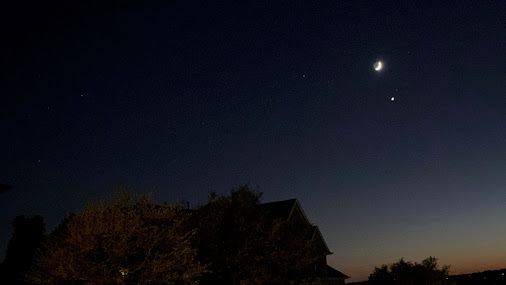
Moon-Venus-Antares Conjunction

 Astronomers Without Borders asked us to take snapshots of the sunset event. 

1949 hours Central US (UZ-5.5)
30d 10m N 97d 48m W
iPhone 11 (OS 14.7.1)
(
Click to enlarge.)

1953 hours Central US (UZ-5.5)
30d 10m N 97d 48m W
iPhone 11 (OS 14.7.1)
About a dozen stars visible in the original.
(See above. Click to enlarge.)

PREVIOUSLY ON NECESSARY FACTS

Observing with NASA: An Open Platform for Citizen Science 

Amateur Astrophotography is Baloney

The Perfect Machine: Building the Palomar Telescope

Seeing in the Dark: Your Front Row Seat to the Universe


Wednesday, July 14, 2021

Observing With NASA: An Open Platform for Citizen Science

Messier 51: 
The Whirlpool
taken 28 June 2021
Processed 9 July 2021
I have no problem with failure. I do not like failing, but I am not afraid of it. As a child, I took Minnows swimming three times before I was a Fish and then a Flying Fish, and I am really comfortable in the water and under it. I took freshman calculus three times to get an A (F, C+, A) and freshman physics three times: C+, B+, A. I just like to get it all right no matter what it takes. And so, I signed up to use the remote citizen science telescopes from NASA in order to practice taking and processing astrophotography images.

The telescopes are a collaboration project with the Harvard Center for Astrophysics and are labeled “Observing With NASA” because it is as if you had your OWN telescope and camera in a dark sky location. Their website is here:

https://mo-www.cfa.harvard.edu/OWN/index.html


They provide online training via YouTube and also have downloadable PDFs to explain the same material. 


Jupiter: a little shaky

I found the lectures easy to understand. In fact, I like it as a model for how such videos should go. I just finished a project where the subject matter experts (SMEs) did not want to be bothered, so they made videos for me to watch, and it was pretty much a waste of their time and mine. These talks were all excellent, even though the results were often disappointing. 


On the one hand, this takes some finesse and I am still developing that. Like opening the nut on a threaded fastener without bruising a knuckle, finding the right balances for the scales requires more practice. 


Astrophotography and Me (January 5, 2020)

Astrophotography is a Lot Like Love (July 15, 2020)

Amateur Astrophotography is Baloney (April 17, 2021)


That being so, it remains that the unattended instruments are not always locked on their targets for whatever reasons. I requested images of Jupiter, Jupiter's moons, and our Moon. All of them had problems, the Jovians worst. Our Moon was not centered on both of my requests.


However, they do provide a long list of existing image captures for practicing with. And that’s a plus.

Gray scale of Blue filter. Red
and Green did not come out so good.

The telescopes are 6-inch (152.4 mm) Maksutov designs with focal length 560 mm (therefore f/3.47) with 5.25-inch (133.3 mm) correctors and 1.875 (1-7/8) inch (47.6 mm) diagonal mirrors, or about 31% center field interference. The cameras are charged couple devices (CCD) Kodak KAF 1400 (1000 x 1400 resolution). They have two magnification modes for 1-degree and ½ degree field of view (FOV) with 5.0 or 2.5 arc-seconds per pixel respectively. 


You can read all of the details here:

“MicroObservatory Net: A Network of Automated Remote Telescopes Dedicated to Educational Use,” by Philip M. Sadler, Roy R. Gould, P. Steven Leiker, Paul R. A. Antonucci, Robert Kimberk, Freeman S. Deutsch, Beth Hoffman, Mary Dussault, Adam Contos, Kenneth Brecher & Linda French; Journal of Science Education and Technology, volume 10, pages 39–55 (2001), Published: March 2001.


They say:

Abstract

The Hercules Cluster M13 27 June 2021 
Many students have a deep interest in astronomy, but a limited opportunity to use telescopes to explore the heavens. The MicroObservatory Network of automated telescopes is designed to provide access to classroom teachers who wish their students to conduct projects over the World Wide Web. The intuitive interface makes it easy for even 10-year-olds to take pictures. Telescopes can be remotely pointed and focused: filters, field of view, and exposure times can be changed easily. Images are archived at the website, along with sample challenges and a user bulletin board, all of which encourage collaboration among schools. Wide geographic separation of instruments provides access to distant night skies during local daytime. Since “first light” in 1995, we have learned much about remote troubleshooting, designing for unattended use, and for acquiring the kinds of images that students desire. This network can be scaled up from its present capability of 240,000 images each year to provide telescope access for all US students with an interest in astronomy.

Full article from Springer for read-only here:


PREVIOUSLY ON NECESSARY FACTS

Ground Truth 

Physics for Astronomers: The Works of Steven Weinberg 

An Online Class in Astrophysics 

Turn Left at Orion 


Monday, May 31, 2021

Parallax: The Race to Measure the Cosmos

The writing is direct, intended for the interested and educated general reader. I learned a lot, of course, though I did have some quibbles with the details of culture and sociology. Eventually, even after the problem was nominally solved, and the distances to some stars were directly measured, ten new uses were found for parallax.

The title of the book could be a metaphor for the history of astronomy. We tend to view the history of astronomy as if through one eye: the arrangement of the universe, from the geocentric model to the heliocentric model, to the understanding that our own Milky Way is not the universe, but just one of billions of galaxies. Viewing the history of astronomy through the other narrative eye of measuring the size and scale of the universe reveals the depth of the problem and of the geniuses who attempted to solve it. 


Explaining Copernicus’s world of 1500, Hirshfeld writes: “Scholars communicated with one another freely, exchanging ideas that centuries earlier might have brought them to the stake.” In fact, the problem of Easter—identifying the first Sunday after the first full moon after the first day of spring—required reconciling the solar and lunar calendars. Using astrolabes and water clocks, Medieval astronomers knew that the geocentric model of Ptolemy required corrections. They had calculated the orbit of Saturn to be one billion miles from Earth and the stars immeasurably beyond that. That only reinforced the unimportance of worldly concerns and the grandeur of heaven. No one was burned at the stake in 1250 for worrying why the calendar was off by six hours, though they knew that it was. 


To earn a baccalaureate degree at a Medieval university, you had to complete seven classes in the Liberal Arts. First were the trivium: Logic, Grammar, and Rhetoric. Following that were the quadrivium: Arithmetic, Geometry, Astronomy, and Music. Even today a liberal arts degree requires classes in mathematics and science, in addition to the humanities of language and fine arts.


Parallax: The Race to Measure the Cosmos 
by Alan W. Hirshfeld, 
W. H. Freeman & Co., 2001. 
 
Alan W. Hirshfeld is 
Professor of Physics, 
and Director of the Observatory at the 
University of Massachusetts at Dartmouth, 
and an Associate of the 
Harvard College Observatory. 
He currently serves as the past-chair 
of the History of Astronomy Division 
of the American Astronomical Society.


Hirshfeld repeatedly blames Aristotle for an inventory of untruths that were not his fault. What were essentially Aristotle’s lecture notes had been transcribed and collated by his student, Theophrastus. The Macedonian royal family squabbled over the library and the books were stashed by being buried. Second-rate scholars reconstructed the worm-eaten scrolls. All of that aside, generally, Aristotle worked by gathering what was known or claimed by the savants before him. He then gave his opinion based on his assessments of the facts that he knew. He was an encyclopedist. Aristotle’s strongest writings were in biology because he worked first hand as an observer. His embryology of the chick remains an unassailed classic. But you can hold a hen, an egg, and a chick. Comets are intractable. Everyone was guessing.


“One issue that Ptolemy had to deal with was the patently nonuniform motions of certain celestial bodies. The Sun, for example, appears to move through the sky with varying speed depending on the time of year. Planets, too, appear to speed up and slow down as the months pass. But according to the writings of Aristotle, whose word was law in those days, heavenly bodies, in fact, move always at constant speed in circular orbits.” (page 24) 


Aristotle’s word was not law. He was just one philosopher among many. Cicero was an educated Roman and he gave more attention to the Epicureans and Stoics than to the Peripatetics of the Aristotelean tradition. In any case, there was no legal enforcement of any theories of natural philosophy. 


Looking back to the 12th century from the 21st century, Hirshfeld too easily collapses time, forgetting that decades mark lifetimes and a century envelopes three generations. He delivers a rich tapestry of evolving theory when he writes about astrophysics, yet he encapsulates ten lifetimes in the phrase “the Church of the Middle Ages” and fails to differentiate it from “the Church of the Counter-Reformation.” 


There’s always a better approximation and it is interesting that one correction to Hirshfeld came 20 years later from his collaborating editor at the History of Astronomy Division of the American Astronomical Society. Writing about the star Eltamin or gamma Draconis, Hirshfeld explains: “The name Eltamin derives from Al Ras al Timmen, ‘the Dragon’s head’… The more prosaic designation Gamma is first encountered in the beautiful Uranometria sky atlas drawn by German celestial cartographer Johannes Bayer in 1603. In Bayer’s system, a constellation’s brightest star is labeled Alpha, the second brightest Beta, and so on.” (page 136). That is a common claim. It does leave us with problems, however. 


Castor in Gemini is Alpha Geminorum but it is less bright than Pollux, which is Beta Geminorum. Other examples are easy to find. Some astronomers explain that the absolute magnitudes of stars can and do change over time. 


In fact, the answer is that “… Bayer divided the sky into strips and then identified the brightest stars within them. …It  was originally thought that the stars were assigned labels in alphabetical order according to their brightness. However, in many constellations the brightest star is labelled β, leading astronomers in the 18th century to speculate that many stars had changed in brightness from Bayer’s time. The 19th century German astronomer F. W. A. Argelander discovered that Bayer had used a north-to-south ordering system within magnitude bins.5 Once Bayer had run out of Greek letters, he switched to Latin letters.” [5: Babinger, F. 1915, “Johannes Bayer, des BegrĂĽnder der neuzeitlichen Sternbenennung,” Archiv fĂĽr die Geschichte der Naturwissenschaften und der Technik, 5, 108.] Cited in This Month in Astronomical History: September 2020, by Jason E. Ybarra, Bridgewater College.

https://aas.org/posts/news/2020/09/month-astronomical-history-september-2020


Of necessity, our macroscopic sense of place paralleled the discovery of the microscopic. The same lenses served both purposes. It is telling that Joseph Fraunhofer’s 1829 heliometer, the most exacting measuring telescope created up to that time, included a microscope for reading its extremely precise scale. 


Science is an integration. Internally consistent theories explain observable facts. It is how we know anything. More to the point, facts and theories do not exist in isolation. Seeming contradictions must be resolved or eliminated. That speaks to the problem of parallax. 


Herschel’s case, in particular, exemplified the exacting standards to which all scientists adhere. It can be hard to know when your very correct theory only awaits the predicted facts and when the discovered facts demand a new theory. 


Like Galileo and the savants who followed, Herschel expected that all of the stars are more or less arrayed at random, that the universe is uniform. Thus, stars that appear to be close to each other are not physical companions. This led astronomers to seek pairs of stars, one much brighter than the other in the expectation that the brighter was the nearer of the two and thus a good candidate for measuring parallax. After years of searching with a behemoth reflector, Herschel announced on July 1, 1802, that many double stars are indeed gravitationally locked. As the problem of parallax was attacked over the centuries, the attempts revealed other truths. Foremost, perhaps, was that many stars are systems of doubles, triples, and sets of them. 


Writing before 2001, Hirshfeld expected new measurements from missions that unfortunately were cancelled. 

  • DIVA: Double Interferometer for Visual Astrometry (uncertain)
  • FAME Full-sky Astrometric Mapping Explorer was cancelled in 2002.
  • SIM: Space Interferometry Mission was cancelled in 2010
  • GAIA is a space observatory of the European Space Agency (ESA), launched in 2013 aboard a Soyuz and expected to operate until about 2022.

Gaia has been successful and its empirical results are the foundation of new theories. At the 52ndmeeting of the Division for Dynamical Astronomy of the AAS, held May 17-21, 2021, eleven papers cited Gaia data.


PREVIOUSLY ON NECESSARY FACTS

Rescuing Aristotle and the Church 

Science in the Middle Ages

The Map that Changed the World 

Circumference 


Saturday, April 17, 2021

Amateur Astrophotography is Baloney


“Are visual observers a dying breed?” is a topic on The Sky Searchers discussion board. It does not refer to the book The Last Stargazers by Emely Levesque but to the trend among amateurs to invest in cameras and software for capturing and processing images. The work also requires a special telescope—now very common—generally a larger objective eight to 14 inches (200 to 350 mm) with an equatorial mount with a tracking motor to keep the instrument aligned to the target for hours. Some astrophotography (AP) enthusiasts use traditional 35 mm digital single lens reflex (DSLR) cameras though charge coupled devices (CCD) and single-chip cameras are also common. Then, there is the post-processing. After the computerized (or computer controlled) camera snaps hundreds of long exposures (one to three minutes each), the images are “stacked” in software. Then the images also are manipulated with color filters to create a pleasing depiction of the object. To me, that is art, not science.

They decide in advance what they want for the product and they manipulate the data to achieve the effects they desire.

The Journal of Irreproducible Results was a humor magazine for scientists. Launched as a mimeographed samizdat in 1955, it remained popular for over 45 years. “A Drastic Cost Saving Approach to Using Your Neighbor’s Electron Microscope” by Aalbert Heine offered a photomicrograph that was captioned “Fig. 1: A eutectic mixture of quartz and plagioclase … Fig. 2: A cross section through the skin of a peripatus … Fig. 3: The surface of a root hair of a quadruploid species of crabgrass. … Fig. 4: Fragment of a hickory ax handle. …” 

And, so too, could these pretty pictures be almost any kind of target. Without spectroscopic data—or even right ascension, declination, and local time—the reader, reviewer, or following researcher has no way to gauge the validity of the data. And, more to the point, no objective way to reproduce it. These are irreproducible results. 

Interpretations of the Rosette Nebula (Caldwell 49)

I do believe that photography is a powerful tool for the science of astronomy. On the same amateur discussion boards, some observers will post a snapshot along with their narrative. The photograph is a valid record. Early in its development spectroscopy came to depend on photography to provide the primary record. Photographic records of spectra have been replaced by digitized data, but analog images of the spectral lines remain important and valuable. 

The stars are pretty at any magnification.


On that basis, I just signed up for a class in astrophotography. As an observer without AP equipment, I paid the same price as the other client learners who will be bringing their gear to the night of classroom training (virtual), the night of observing at the Austin Astronomical Society dark sky site, and the follow-up class in post-processing. The cost was $250. By comparison, I also paid $130 for a class in astrophysics in order to learn the vocabulary and concepts of astronomy for my volunteer work as an editor with the American Astronomical Society.


PREVIOUSLY ON NECESSARY FACTS


Emily Levesque and The Last Stargazers 

Is Physics a Science? 

Backyard Astronomy 

Turn Left at Orion 

Redshift: Six Years with Amateur Astronomy 

The Perfect Machine 


Wednesday, November 25, 2020

Assign a Number to it, said Lord Kelvin

“When you can measure what you are speaking about, and express it in numbers, you know something about it; but when you cannot measure it, when you cannot express it in numbers, your knowledge is of a meagre and  unsatisfactory kind:  it may be the beginning of knowledge, but you have scarcely in your thoughts, advanced to the stage of science, whatever the matter may be.” – Sir William Thomson, FRS, FRAS, etc., “Electrical Units of Measurement,” May 3, 1883 in Popular Lectures and Addresses, MacMillan, London, 1893.

Oddly enough, for all of the numbers in the hobby of astronomy, we observers report very few of our own. We have the Bortle scale of relative darkness. And of course, stellar magnitudes are commonly referred to, mostly in the context of what is the dimmest you can see tonight? We know that for eta Cassiopeiae, the main star is +3.44 (apparent) and +3.45 absolute and that the companion is +7.51 because that is what is in the references, the same as their classes: G0 for eta Cass A and K7 for eta Cass B. But we do not measure them and report those facts ourselves. Someone might take a picture of them. No one subjects them to a spectroscopic investigation. I, too, am remiss: I only have noted visual impressions and subjective evaluations.

PREVIOUSLY ON NECESSARY FACTS