Tuesday, August 31, 2021

New Computerized Mount for Telescopes

On an astronomy forum I was chatting with another old guy about star-hopping, locating objects such as nebulas by knowing the constellations and moving from point to point. He said, “I agree, Mike, but you know what? At my age I want to spend my time looking at things, not looking for them.” That was a couple of months ago. Yesterday, I bought a Celestron AVX German Equatorial Mount and a power pack. I already was not a fan of Celestron's engineering, but I was also already a fan of their customer support: they make things right, or did by me. 

My first adult telescope was a Celestron EQ-130 Newtonian reflector, (130mm = 5 inches) with German equatorial mount. My wife and daughter bought it for me. I selected the make and model that was closest to the Criterion 4-inch reflector that I grew up with. But they don’t make ‘em like they used to. The control rods (“cables”) were not positioned well: the tube was always in the way. The setting circles were mere adornment. No screw was a thread longer than it needed to be. As a result of the screws lost to the grass in the backyard, I became a fan of the fasteners aisle at Home Depot. Now I have a little plastic bag with many measures of 5-mm and 7-mm hex head screws. It comes in handy, even though I donated the telescope to the Goodwill this past spring. (On the positive side, the red-dot finder failed. The rocker switch spring snapped inside. I emailed Celestron to find out about buying a replacement viewer and two showed up in the mail, one of each type for the telescope, without an invoice.)


Anyway, here and now, availability was also an issue. Eighteen months into Covid-19 and the supplies are just not in stock. I shopped online for a couple of weeks across eight or ten retailers looking for comparable and competitive alternatives.


The deciding factor here was the release of Explore Scientific's new EXOS-2 PMC Eight goto mount at the same price: $999. The new version requires an external device for a controller:

Explore Scientific's PMC-Eight GOTO system can be controlled wirelessly or wired with a tablet or PC, with Windows 8.1 or 10, Android, Amazon Fire, or iOS, with a free app called ExploreStars. Tablet must be purchased separately.

I am a fan of Explore Scientific. In addition a telescope and two mounts (tripods), I have a 5X focal extender, and other accessories. I was pre-sold on two occasions. When first I called them, the customer service representative listened to what I wanted, put me on hold, went into the warehouse, and came back with an alternative. It was Mom-and-Pop customer service. The second event was their CEO, Scott Roberts, speaking to our local astronomy club. Scott supports amateur astronomy with his own time. Explore Scientific sponsors “global star parties” both live (pre-Covid) and on YouTube. Scott Roberts is on the board of Astronomers Without Borders. 


That being as it may, I do not own a tablet or laptop that is compatible with the Explore Scientific EXOS-2 PMC Eight. So, that would be another expense. And the phone or pad introduces another source of light, dim it as you can. And I already do not use my iPhone with my telescope because it is a pain in the neck in the dark: touch the wrong thing, you get the wrong result. I have used the hand paddle type control before when I borrowed a computerized telescope from my local club. It was not the best interface, but it is a mode that I can live with. In fact, I sent a hardcopy letter in the mail (three pages with attachments, and my business card) to Explore Scientific asking them to hold for me the next used EXOS-2 previous version with paddle control that comes in. That was on August 18. I never received any acknowledgement of the letter. So, I moved on. 


I googled "Celestron AVX Problems" and followed the links.

The Celestron Advanced VX mount is sold as being capable of 30 lbs (13.5 kg). The saleslady at Woodland Hills Camera and Telescope (Telescopes.net) said that my 22-lb Bresser 8-inch Newtonian would be at the practical limit without an eyepiece or finder. However, my grab-and-go is an Explore Scientific 102mm refractor which weighs 13 lbs. Also, still in the carrying case, I have an Astronomics AT 115 ED (extremely low dispersion glass) APO (apochromatic triplet lens) at 17 lbs. So, both of those will work with this. 

I found Woodland Hills Camera and Telescope because they  sponsored a conference of the Society for Astronomical Sciences (website is not secure socket https: http://www.socastrosci.org.) This is a group of amateurs that works with "small telescopes" typically 12 inches to 20 inches or greater, enhanced with cameras and spectroscopes.  

 Also a positive consideration was that I know from my (limited) previous experience with a computerized "go-to" mount that it is not as easy or as much fun as one would like to believe. So, I bought this as much as a learning tool, something new to do under the stars. 


PREVIOUSLY ON NECESSARY FACTS


Observing with NASA: An Open Platform for Citizen Science 

New Telescope: Explore First Light 102 Refractor

$2500 Viewed Through a Telescope 

Testing the Stellarvue Correcting Diagonal Prism 


Sunday, August 15, 2021

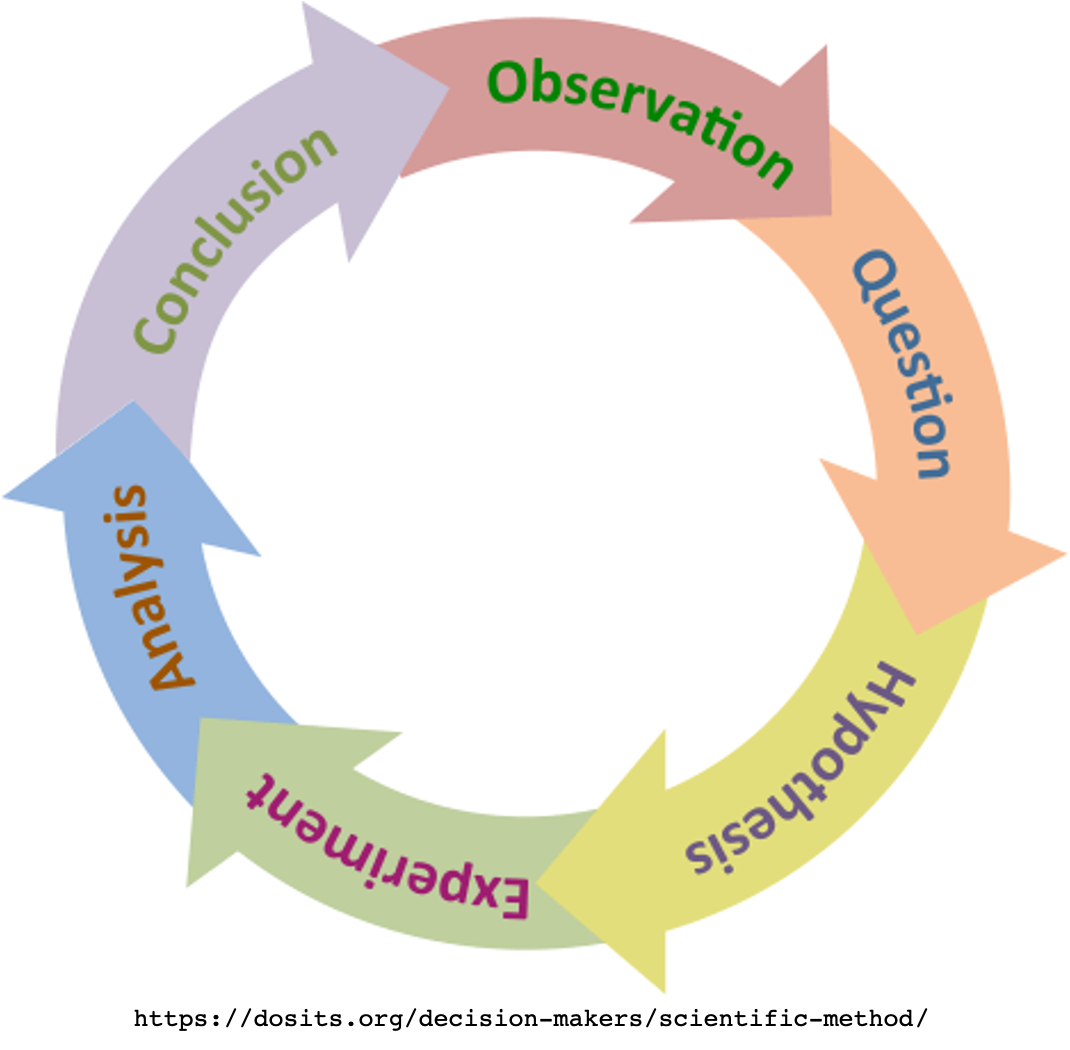
The Scientific Method

Emergency management, physical security, and information security are three disciplines in which the process of continuous improvement is a model for action. We have cycles of emergency-response-mitigation-remediation. Therefore, I found it interesting to have the Scientific Method presented as a cycle. 

Discovery of Sound in the Sea (DOSIS) is a website created by the University of Rhode Island and the Inner Space Center, here: https://dosits.org


Copyright © 2002-2021 
University of Rhode Island and Inner Space Center. 


Among their website pages is a self-quiz on Facts and Myths. 
1. The greatest uncertainty in understanding the effects of anthropogenic underwater sound on marine animals is understanding how sound propagates.
See the Answer - This is a MYTH
There are many factors that contribute to the uncertainty of how underwater sound impacts marine animals. These include ... 

22. One way to arrive at “scientific truth” is to conduct an opinion poll of scientists.
See the Answer - This is a MYTH
An opinion is a personal judgment or belief, not necessarily based upon fact. On the other hand, “scientific truth” is arrived at through the scientific method, which is an orderly and very well-established process for asking questions about the natural world and testing the answers. Hypotheses that have been consistently validated through observations or experimentation can eventually be advanced to the status of theory. A theory is a thoroughly substantiated explanation of some aspect of the observable world. Theories come as close to objective truth as possible.

PREVIOUSLY ON NECESSARY FACTS

Friday, August 13, 2021

Some Sociology of Academic Astronomy

You need a sense of humor and of all the puns, one-liners, walking into a bar, and knock-knock jokes that could be invented, the words of the practitioners themselves in all seriousness provide the insights we expect from good nightclub comics. 

The American Astronomical Society headquarters are in Washington, D.C., which sets the stage. As Edward Gibbon said in The Decline and Fall of the Roman Empire, sentiments in the West are different from those in the East. The AAS is run like a US Senate subcommittee with lots of rules that evolved in an environment favorable to process and procedure. The Astronomical Society of the Pacific is in San Francisco. Today and tomorrow, I am sitting in at online meetings of the Association of Lunar and Planetary Observers (ALPO) which was founded in Las Cruces, New Mexico. Their quarterly print newsletter is titled The Strolling Astronomer. I am also a member of the Astronomical League, which holds its annual conventions in Albuquerque and Phoenix, among other venues. 

In line with the academic community generally, the AAS has been very keen on encouraging people to declare their gender identies in their email signatures. You will see "Dale Evans (he/ him)", and "Stanley Livingston (she/ her)" and so on. Today, in an AAS sponsored message board, I met someone like "Altair Brightstar (she/they)." Apparently, she wants to be referred to in the third person feminine singular nominative, but the third person plural nominative for the objective. I take they at them's word.

I already knew an obscure campus joke from the olden tymes when all graduate students were in the same college and same lodgings. A sociologist sat down to dinner with some biologists. After some pleasant engagement, the biologists excused themselves, saying "We have to get back to the lab to start some cultures." That gave the social scientist pause: How does one start a new culture?

It came up at all because among the chatrooms on this AAS discussion board is one dedicated to "Climate." The AAS is as committed to fighting anthropogenic global warming (AGW) as they are to fighting gender discrimination. I am not. To me sex and gender, variable though they can be, are serious business, and objectively knowable (at least in context). AGW is totally different from that.

I am currently employed writing classroom instructions for factory technicians working with optics and lasers. Wanting to demonstrate that all wave phenomena can be described by the same principles, I was on an oceanography website sponsored by the University of Rhode Island: Discovery of Sound in the Sea (here: https://dosits.org). They provide teaching points on the scientific method. Their "Facts and Myths" page is in a self-test format. They offer this: "22. One way to arrive at “scientific truth” is to conduct an opinion poll of scientists." The answer: False. They say: 

"An opinion is a personal judgment or belief, not necessarily based upon fact. On the other hand, “scientific truth” is arrived at through the scientific method, which is an orderly and very well-established process for asking questions about the natural world and testing the answers. Hypotheses that have been consistently validated through observations or experimentation can eventually be advanced to the status of theory. A theory is a thoroughly substantiated explanation of some aspect of the observable world. Theories come as close to objective truth as possible."

I found that cogent because I have attended committee meetings of the AAS where "climate deniers" have been derided. Among those denigrated was Apollo astronaut Dr. Harrison "Jack" Schmitt who is scheduled to be a guest speaker at the Astronomical League Conference (ALCON) next year. That is relevant here because it is commonly cited that "90% of scientists" accept AGW. (See fact-checking on that published in Forbes here: https://www.forbes.com/sites/uhenergy/2016/12/14/fact-checking-the-97-consensus-on-anthropogenic-climate-change/  And read support for AGW consensus from NASA here https://climate.nasa.gov/scientific-consensus/ ) Opinion polls do not establish scientific truth. 

So when I saw the session on "Climate" listed under Dynamical Astronomy which usually studies orbits, celestial mechanics, and motion, I asked what the relevance of climate was.  I was directed to a webpage from the AAS Subcommitte on Professional Culture and Climate. https://dps.aas.org/leadership/climate It is really about "Diversity, Equity, and Inclusion." But as physical scientists, they ignored social science and just took the vernacular meanings of "culture and climate." Close enough... stars, planets, whatever.

PREVIOUSLY ON NECESSARY FACTS

Is Physics a Science?

Karl Marx and the Dustbin of History 

Reflections on the Sokal Affair 

Problems with Pop Sci from Sky & Telescope (Part 2)


Sunday, August 1, 2021

A good night observing

After an unusually long four months of clouds and rain, the skies have been clearing over the past week. On the 29th, I got my first view of the globular cluster Messier 22. Last night and this morning, I revisited targets that had not been attainable a week ago because of the poor seeing despite nominally “clear” reports from weather websites. I also observed Messier 21, a globular cluster in northwest Sagittarius. 


We amateurs speak of our “grab and go” instruments, smaller lightweight, that are easy to set up and transport. After borrowing three catadioptric telescopes weighing up to 65 lbs (30 kg)—and buying one of them—from the local club, portability was a consideration for me for all of my recent purchases. But “grab and go” does not work well for me. I like to do a lot of reading, planning, and arithmetic before I go out. And I prefer to be out for three or four hours, not just one. I got that opportunity. And last night’s work will allow me to plan better for my next viewing.  

I started with the intent to find M13 the Hercules Cluster, M51 the Pinwheel Galaxy, and the stunning double Albireo. I obtained only the last. The first two would have been new for me. I have seen Albireo often in the past (though not recently for the time of night, the poor seeing, and my neighbor’s trees). I also revisited other targets. For myself, I find that comforting, like meeting with friends. 


At 2145 hours CDT  I started by aligning on Mizar-Alcor. I worked out the arithmetic for the field of view (FOV) and drew a sketch. I then went inside for dinner. Returning at about 2300, I realigned and viewed Saturn to compare a 40mm ocular with a 5X focal extender against the simpler 8mm ocular alone. I thought that the 40mm with its wider exit pupil would give a better view than squinting down into the 8mm, but I did not see much difference. 


Then I went hunting for Messier 4 near Antares, a target I have been chasing for several nights, and again, recording “no joy.” I gave up at 2332 and turned eastward to Sagittarius, a rich area of the sky. I sought M22, a globular cluster that I recorded earlier, but just gave up for lack of patience with the scanning and panning and turned to “the Steam from the Teapot.” Like many constellations, Sagittarius has other folk identities. Above the “spout” are several Messier objects. At 2353 hours CDT, I found Messier 21, also catalogued as NGC 6531. 


I sketched its location and returned to it with different eyepiece arrangements. With the 32mm ocular and 2X Barlow almost all of the neighborhood was in the field of view. I counted about 30 stars, most easily about the same magnitude, but others dimmer that appeared clearer with averted vision. Just after midnight (0005 hrs), I used the 8mm with 2X Barlow to home in on the center of the cluster. Then (0010 hrs) I compounded the 32mm with the 5X focal extender to again count the stars there: about 24 the first time, about 30 the second. Boosting the magnification to 250X with the 13mm and 5X extender, I found the focus difficult despite the additional helical threads on the right-angle focal adapter.


I turned to Jupiter (0023) with the same 13mm 5X arrangement. It was big, with subtle brown and gray bands, but grainy with poor resolution. Still, the eye adapts and we see mostly with the brain. Ronald Stoyan “The Visual Astronomer” (not secure https, but here - http://visualastronomer.com/- anyway) says that no magnification is wasted and that the eye adapts to take advantage of moments of best seeing. Despite that encouragement I think that it is better to perceive details in clearer though smaller presentations.


Taking a break on the chaise longue with a binocular (12x42 Bushnell), Albireo was an easy find as was the “first double” Epsilon Lyrae. Mostly, I just looked up at the sky without the glasses. 


Typical notebook entry scaled to FOV.
At 0059 with a modest 17mm ocular (38.8X) alone and then the 17mm with 2X Barlow, I viewed Albireo down to its “Airy disks” of tightest focus. I noted the yellow and blue members of the visual (not physical) pair.  


Epsilon Lyrae is the “double double.” What the naked eye perceives as a single star, is easily a pair with the smallest of instruments. William Herschel is accepted as the first to have recorded the double-double in August 1779 (Burnham, page 1151). It is a favorite with amateur observers. All four stars are accepted as “white” though Burnham credits others with assigning colors “greenish-white and bluish white… red tint… yellow and ruddy.” At the highest power 8mm with 5X (ridiculous 400X), I noted them (larger first) as yellow and blue (northwest) and white and yellow (southeast). Just to note, also: at 253X (13mm with 5X), they filled two-thirds of the field of view though were not much improved.

That was my night. I can now prepare more accurate templates for recording these same targets again. 


PREVIOUSLY ON NECESSARY FACTS


Seeing in the Dark: Your Front Row Seat to the Universe 

An Online Class in Astrophysics 

Jupiter-Mars Conjunction 

Measuring Your Universe: Alan Hirshfeld’s Astronomy Activity Manual 


Thursday, July 29, 2021

JUPITER AT 1100x

As a child, though I owned telescopes, most of my instrument viewing was with microscopes. I learned well that more power does not make a better view because you lose resolution. Soon, you are viewing your own floaties. This applies to telescopes. However,… Magnification is seldom wasted. To split a close pair of stars, you only need two small circles of light. 

Also, as it happens with a telescope, with low power, you get less contrast: the background is brighter. With more magnification, you get a deeper black where the points of light are not.


I accept the limitations of my instruments. The system must be balanced. My telescopes work best below 110X. My 70mm National Geographic refractor is an f/10 F=700 mm and the Explore Scientific First Light 102mm refractor is an f/6.47 F=660mm. So, for me (or them), the limits are the 6mm ocular or the 13mm with a 2X Barlow. And those are limits. Practically, I work between 20X and 80X, though, as noted above, when pursuing binary stars and similar objects, I accept the degraded resolution. 


Then, I found interesting advice at Ronald Stoyan’s “The Visual Astronomer” webpages (here: http://visualastronomer.com/ -- but not https secure and not updated recently). During the last Mars opposition in October 2020, he posted this: “Most people tend to use a power that still renders a “sharp” image. I would like to encourage to go further: Even if the image does not look as good and is a bit soft, and turbulence is destroying definition most of the time, your eye will be able to make out more fine detail in the milliseconds of calm air as when looking at the sharper image at lower power. This requires a certain amount of patience, in many cases you’ll have to wait several tens of minutes to get glimpses of fine detail. But it will pay off eventually. Actually, there is no such thing as “empty” or useless magnification. Discard all obsolete rules!”


And so I did. With a 5X focal extender coupled to a 2X Barlow, I used a 6mm ocular in my F/660 telescope and viewed Jupiter at 1100 power. I was also encouraged in that by Don Pensack who does a bit of writing himself. Helping me to find M4 in Scorpius (still not found), in a chat on The Sky Searchers website, he wrote: “Higher magnification is the obvious answer, but only once it is in the field. Worry more about the magnification than the amount of glass. You have to diminish the brightness by 10% or more before it's even noticeable in a lab environment (10% is only 0.1 magnitude), and a Barlow does not do that. If the field is darker, it's because of magnification, not the number of glass elements in the focuser.” I had been reluctant to use more ocular than necessary to view. While I personally prefer the wider view of a 17 mm ocular with a 2X Barlow, I would nod to the fact that the 8mm ocular delivers the same view with less interference. Last night, I abandoned my vitrophobia, and went full bore. 


I can’t say that I learned much about the planet. But it was an interesting experience. I also viewed Saturn. Again, it has looked better farther away. But it was an interesting experience. And it led to a personal discovery: I observed the globular cluster Messier 22 (NGC 6656) in Sagittarius. (At left from Sky & Telescope reduced to approximate actual experience at 500X with an Explore Scientific First Light 102mm refractor.)


PREVIOUSLY ON NECESSARY FACTS


The Andromeda Galaxy 

The Beehive Cluster 

Assign a Number to It Said Lord Kelvin 

Baader-Planetarium Micro-Guide Reticle 


Saturday, July 24, 2021

Remote Work Before Covid

Going through some boxes from the garage, I found this. You can tell from the PDA (personal digital assistant) in his hand, from the fax machine at his foot, the monitor and the camera that this is from 1995-2000. 

Ahead of the 237th conference of the American Astronomical Society this past January, they brought in a coach to deliver a presentation on how to work a virtual conference. In some ways, it is easier and better than a live conference. One basic reminder: Wear your half suit.

Even earlier, back before 1985, I got from IBM a directory of software developers. Many of the firms were small, one or two employees, with annual declared incomes of $100,000 (probably the minimum checkbox on a survey), and remote, in places like Idaho and Oregon. 

PREVIOUSLY ON NECESSARY FACTS

Engines of Creation 

Goofing to a Meltdown? 

The Pretense of Sociology 

Jerry Emanuelson's Algebraic Proof of Ricardo's Law of Association 


Tuesday, July 20, 2021

60 Years Ago: Gus Grisson and Liberty Bell 7

We were on vacation in Daytona Beach, but had to come home on the 20th. So, we did not see any of the launch, except, of course, on television.

Topps cards circa 1961-1962.

Tom Wolfe had a soft spot in his heart for "Gruff Gus" and the movie portrayal delivered much of that. 
Jeff Bezos and Blue Origin: Another Worthy 2nd Place


PREVIOUSLY ON NECESSARY FACTS

Wednesday, July 14, 2021

Observing With NASA: An Open Platform for Citizen Science

Messier 51: 
The Whirlpool
taken 28 June 2021
Processed 9 July 2021
I have no problem with failure. I do not like failing, but I am not afraid of it. As a child, I took Minnows swimming three times before I was a Fish and then a Flying Fish, and I am really comfortable in the water and under it. I took freshman calculus three times to get an A (F, C+, A) and freshman physics three times: C+, B+, A. I just like to get it all right no matter what it takes. And so, I signed up to use the remote citizen science telescopes from NASA in order to practice taking and processing astrophotography images.

The telescopes are a collaboration project with the Harvard Center for Astrophysics and are labeled “Observing With NASA” because it is as if you had your OWN telescope and camera in a dark sky location. Their website is here:

https://mo-www.cfa.harvard.edu/OWN/index.html


They provide online training via YouTube and also have downloadable PDFs to explain the same material. 


Jupiter: a little shaky

I found the lectures easy to understand. In fact, I like it as a model for how such videos should go. I just finished a project where the subject matter experts (SMEs) did not want to be bothered, so they made videos for me to watch, and it was pretty much a waste of their time and mine. These talks were all excellent, even though the results were often disappointing. 


On the one hand, this takes some finesse and I am still developing that. Like opening the nut on a threaded fastener without bruising a knuckle, finding the right balances for the scales requires more practice. 


Astrophotography and Me (January 5, 2020)

Astrophotography is a Lot Like Love (July 15, 2020)

Amateur Astrophotography is Baloney (April 17, 2021)


That being so, it remains that the unattended instruments are not always locked on their targets for whatever reasons. I requested images of Jupiter, Jupiter's moons, and our Moon. All of them had problems, the Jovians worst. Our Moon was not centered on both of my requests.


However, they do provide a long list of existing image captures for practicing with. And that’s a plus.

Gray scale of Blue filter. Red
and Green did not come out so good.

The telescopes are 6-inch (152.4 mm) Maksutov designs with focal length 560 mm (therefore f/3.47) with 5.25-inch (133.3 mm) correctors and 1.875 (1-7/8) inch (47.6 mm) diagonal mirrors, or about 31% center field interference. The cameras are charged couple devices (CCD) Kodak KAF 1400 (1000 x 1400 resolution). They have two magnification modes for 1-degree and ½ degree field of view (FOV) with 5.0 or 2.5 arc-seconds per pixel respectively. 


You can read all of the details here:

“MicroObservatory Net: A Network of Automated Remote Telescopes Dedicated to Educational Use,” by Philip M. Sadler, Roy R. Gould, P. Steven Leiker, Paul R. A. Antonucci, Robert Kimberk, Freeman S. Deutsch, Beth Hoffman, Mary Dussault, Adam Contos, Kenneth Brecher & Linda French; Journal of Science Education and Technology, volume 10, pages 39–55 (2001), Published: March 2001.


They say:

Abstract

The Hercules Cluster M13 27 June 2021 
Many students have a deep interest in astronomy, but a limited opportunity to use telescopes to explore the heavens. The MicroObservatory Network of automated telescopes is designed to provide access to classroom teachers who wish their students to conduct projects over the World Wide Web. The intuitive interface makes it easy for even 10-year-olds to take pictures. Telescopes can be remotely pointed and focused: filters, field of view, and exposure times can be changed easily. Images are archived at the website, along with sample challenges and a user bulletin board, all of which encourage collaboration among schools. Wide geographic separation of instruments provides access to distant night skies during local daytime. Since “first light” in 1995, we have learned much about remote troubleshooting, designing for unattended use, and for acquiring the kinds of images that students desire. This network can be scaled up from its present capability of 240,000 images each year to provide telescope access for all US students with an interest in astronomy.

Full article from Springer for read-only here:


PREVIOUSLY ON NECESSARY FACTS

Ground Truth 

Physics for Astronomers: The Works of Steven Weinberg 

An Online Class in Astrophysics 

Turn Left at Orion 


Tuesday, July 13, 2021

Western Shoot-out: The Virginian versus Bonanza

We watch DVDs and do not subscribe to cable. We enjoyed some television drama from the 21st century such as Num3ersFireflyBones (earlier years), Grey’s Anatomy (earliest years), and Sherlock, and sometimes we return to an episode or two. We also dig back into classic TV. Most classic television does not meet current standards for writing. Those were simpler times. 

Working our way through the first season of The Virginian, we also tried a Bonanza compilation. Although it is touted as centering on moral dilemmas, Bonanza is slow on the draw. To be fair, as a 90-minute show, The Virginian had the long-range advantage for plot development and characterization. The plain truth is that that actors—James Drury, Doug McClure, Gary Clarke, and even Lee J. Cobb—were comfortable riding horses while the boys from the Ponderosa seldom dismounted smoothly though mounting usually went better. Much of The Virginian was shot outdoors with riding and roping in wide vistas, though the close-ups are often stage sets. (I believe, also, that they used some kind of movie screen background with overlays to blend close-up action supposedly taking place in the wilds.) Almost all of Bonanza was shot on a sound stage. The cowboys in The Virginian wear chaps because they work hard. We seldom see the Cartwrights work at all.


According to Wikipedia, citing “Bonanza Television Show – ONE” at www.onlinenevada.org, Bonanza “is known for presenting pressing moral dilemmas.” But that is the essence of all fiction from the romanticist school. Almost all TV drama and popular fiction in general centers on conflicts of values. Technically, a dilemma is not just any choice, but a pair of undesirable alternatives. That was seldom the core of a Bonanza drama, but, in fact, often the case in The Virginian. Although everything usually works out well enough for the better folks, life on the frontier is uncompromising and unforgiving. 


PREVIOUSLY ON NECESSARY FACTS

Back in the Saddle Again 

Firefly: Fact and Value Aboard Serenity 

When Old Technologies Were New

Ma Kiley: Railroad Telegrapher 

The Success of the WEIRD People 


Sunday, July 11, 2021

Virgin Galactic VX01 VX03

 A picture is worth a thousand words.


NASA-TV cut between its own feed and the press feed from Unity 22.
These are all sequential as presented by NASA.
Time and Altitude stamps show actuals.


PREVIOUSLY ON NECESSARY FACTS

Space is the Place: Come to the High Frontier 

The Virtues of Aviation Culture 

Armadillocon 41 Day 3 Part 1 

Entrepreneurship 

Wednesday, June 30, 2021

Morality and the Philosophy of Science

Science is consistent and integrated because reality is real. Contradictions do not exist. When we meet an empirical fact for which no explanation exists, it is called an “anomaly” until we understand more and integrate the fact into a new or wider abstraction. Astronomy advanced as neutron stars, quasars, and pulsars were discovered. Even the rings of Saturn attest to this in the 250 years between Galileo’s sighting and Maxwell’s complete theory. Against that, scientists feel that it is unjust that private investors will not fund their Christmas shopping lists. So, they turn to requests for tax dollars. The laws of economics are denied as an inconvenience.

The physicists who worked on the Manhattan Project were later to worry about the horrors they enabled. (Edward Teller seems to have been an exception.) As the best known among them Albert Einstein was asked to sign Leo Szilárd’s petition to the American government to build an atomic bomb. They feared that Germany was on the same program. That the Nazis should command a weapon of such destructive power was not merely consequential but existential. So, they gave it to the United States which did what Germany never could have. From the USA, nuclear weapons spread to the USSR, the United Kingdom, France, China, India, Pakistan, Israel, and (ultimately) Iran. The lesser of two (or twenty) evils remains evil. 

The problem of the Manhattan Project intersects two facts: 

(1)  The Nazis could never have completed a program in nuclear energy. Any progress that they could have made could only have come from giving them what they could not create. Ultimately, it is a fact of metaphysics, epistemology, politics, and economics that regardless of incremental achievements, the final goal was beyond their abilities. 

(2) The small gains came only because people of great ability lacked a correct philosophy to provide moral and ethical guidance. It is a fact of life that you should not work for your own destruction: you should not deliver your mind to your destroyers.


Muscle Mystics

Whether fascists, communists, nationalists, socialists, or some other trending label such as antifa, collectivists deny the validity of human intelligence. Perhaps it is because they have no direct experience with it. The observed facts of history are that they all focus on seizing existing goods or compelling the continuation of existing services. Karl Marx epitomized the mindset of collectivism when he declared that capitalism had solved the problem of production and “now” (1848) was the time to distribute the goods—just when the first electric telegraphs were being adopted by transcontinental railroads, thirty years before the telephone, and fifty years before radios would direct aircraft, and a hundred years before people were putting televisions in their homes. Never knowing of penicillin, sulfa drugs, polio vaccine, open heart surgery, x-ray pictures, CAT scans, or MRI scans, Marx declared that we all could have everything we would ever need to be happy if we just took it from other people. A truly radical sociologist would have asked what is the source of improvement, innovation, invention, and discovery. 


The muscle mystics expect possession of physical objects to imbue them with the knowledge to use the tool. To produce steel, they only need to seize a steel mill. 


Of course, that plan failed. During World War II, the USA shipped to the USSR thousands of tons of raw materials, thousands of vehicles and other manufactured goods. It sat on rail sidings and rusted into uselessness. (See Victor David Hansen’s The Second World Wars  as well as The Wise Men: Six Friends and the World They Made by Walter Isaacson and Evan Thomas, both reviewed on this blog.) After World War II, the USSR uprooted and transported German factories. They did not make Russia rich. It takes at least a modicum of intelligence to follow a pre-defined routine earnestly and conscientiously, making trivial adjustments in response to minor variances. But no one is more conservative than a communist: varying the routine is dangerous. 


Standing Hegel on his head, as Marx claimed he did, still leaves you with Hegel; and Idealism was also the bedrock of fascism. The fascist man of action does not engage in bourgeois logic. He follows the instincts of his nation. Dialectic Materialism is not just a framework. It is dogma. So, Albert Einstein’s theories of general and special relativity were not accepted in communist China. (See “Organized criticism of Einstein and relativity in China, 1949–1989,” by Danian Hu, HSNS (Historical Studies in the Physical and Biological Sciences Volume 34, Issue 2 March 2004; and “The Reception of Relativity in China” by Danian Hu, Isis, Volume 98, Number 3, September 2007.) But it is known that the Nazis rejected “Jewish physics” and insisted on pursuing nuclear energy according to some theories different from quantum mechanics. 


Regardless of the destruction of the heavy water plant in Norway by British commandos, the Germans were never going to succeed at anything as complicated as nuclear weaponry. The United States succeeded only because LTG Leslie R. Groves ran interference for the geniuses. During World War II, all sides, each some variant of collectivism, only cashed in their intellectual bank accounts. Because American society was less regulated, we succeeded. Having the brightest minds from Europe on the project certainly was the engine, but the Manhattan project required very much more than a handful of Nobel laureates. And once they had the bomb, the government no longer needed J. Robert Oppenheimer or the others. Second-handers could follow in their footsteps.


But even that required another generation of people who were accustomed to thinking for themselves, following their own passions, making their own lives better by whatever personal philosophies they held explicitly or implicitly. That is different from the morality of collectivism. 

Today, as never in the 19th century or most of the 20th centuries formal, professional science is informed, guided, and ultimately controlled by a single ideology. I am an Amateur Affiliate member of the American Astronomical Society. I serve as an editor in the History of Astronomy Division where I am responsible for a monthly column. I also serve on a committee to develop collaborations between amateurs and professionals. The AAS is actively engaged in ensuring that you have the right to insist on your own personal gender pronouns. Your right to question the claims of anthropogenic global warming is somewhat less secure. As a backyard astronomer, I am sorry that my night skies are more degraded by light pollution than they were a year ago when we were shut down because of Covid. I also know that if you want really dark skies at night you can go to some wilderness or desert or North Korea. That fact has not been integrated into the sociological perspectives of the AAS which lobbies for dark skies and against constellations of communications satellites. The muscle mystics of science want the material benefits of industrialization without understanding the engine of creation which delivers them.


Murray N. Rothbard penned Power and Market: Government and the Economy (free as a PDF from the Mises Institute here: https://mises.org/library/power-and-market-government-and-economy). His thesis was that political decisions are necessarily unprofitable. Ignoring and denying the facts and theories of economics, political decisions are always net losses of value. 


The integration of knowledge in accordance with facts of reality requires that every scientist who is funded by government grants is making your life harder, shorter, and poorer.


Astronomy does have its uses. Timekeeping is fundamental to coordination of efforts across continents in a complex global society. Launching communications satellites is cheaper than laying wire over jungles and under oceans. Economic justifications for advanced scientific research do exist. 


And, personally, I understand the insight of John Arnold: “What comes out of a team or a committee is the most daring idea that the least daring man can accept.” (“Space, Time and Education,” Astounding Science Fiction, May 1953, pp. 9–25. Introductory remarks by John W. Campbell, Jr., editor, pp. 9–10.) But the government works largely by force (occasionally by fraud). Forcing people to give you money against their will makes you a thief. Taking it by fraud defines you as a con artist. When it comes to sales and marketing, it is a necessary fact that selling science is hard work because it requires using logic and evidence to appeal to people who live by logic and evidence.

PREVIOUSLY ON NECESSARY FACTS

Why Evidence is Not Enough
Politics and the Inverse Square Law
How I Found Freedom in an Unfree World