Showing posts with label anthropogenic global warming. Show all posts

Sunday, August 15, 2021

The Scientific Method

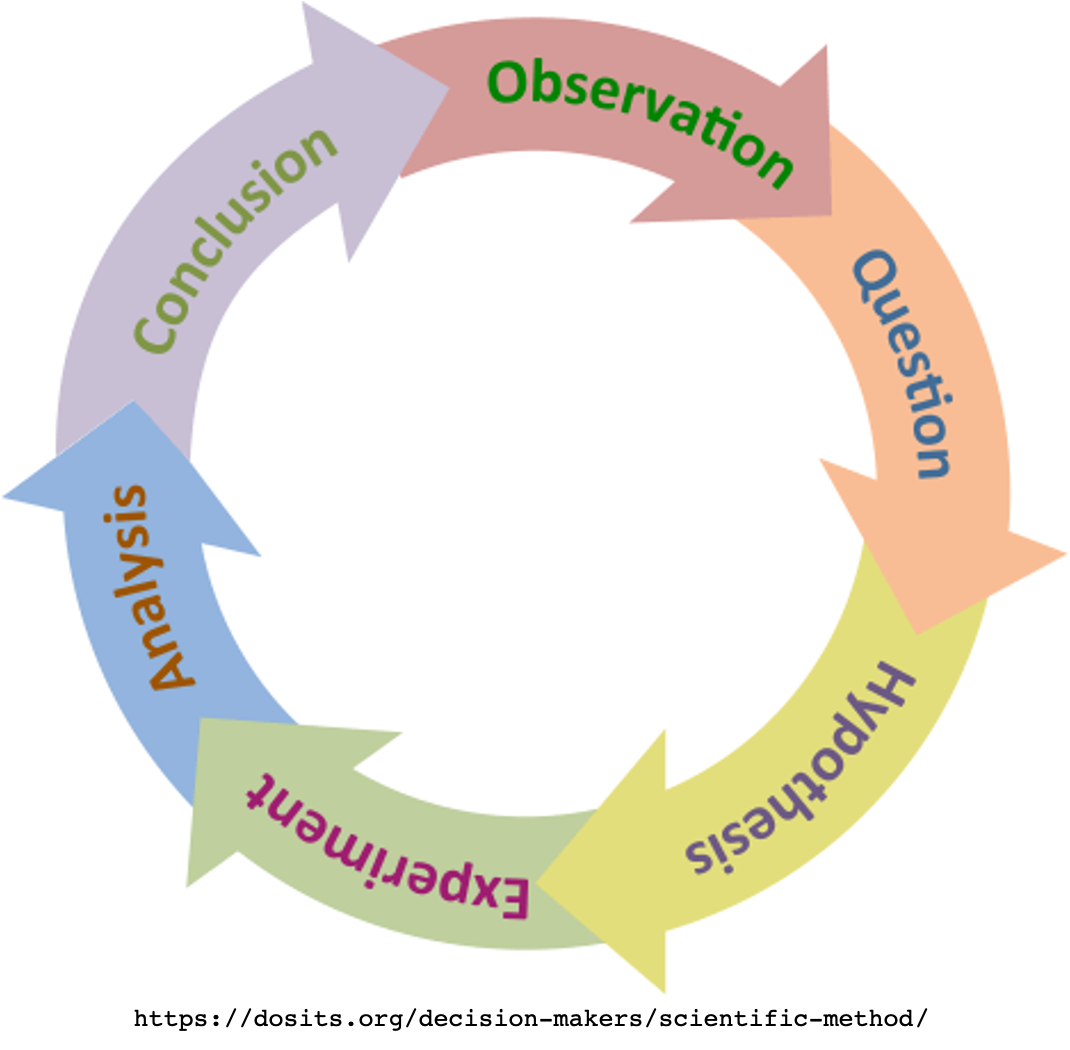
Emergency management, physical security, and information security are three disciplines in which the process of continuous improvement is a model for action. We have cycles of emergency-response-mitigation-remediation. Therefore, I found it interesting to have the Scientific Method presented as a cycle. 

Discovery of Sound in the Sea (DOSIS) is a website created by the University of Rhode Island and the Inner Space Center, here: https://dosits.org


Copyright © 2002-2021 
University of Rhode Island and Inner Space Center. 


Among their website pages is a self-quiz on Facts and Myths. 
1. The greatest uncertainty in understanding the effects of anthropogenic underwater sound on marine animals is understanding how sound propagates.
See the Answer - This is a MYTH
There are many factors that contribute to the uncertainty of how underwater sound impacts marine animals. These include ... 

22. One way to arrive at “scientific truth” is to conduct an opinion poll of scientists.
See the Answer - This is a MYTH
An opinion is a personal judgment or belief, not necessarily based upon fact. On the other hand, “scientific truth” is arrived at through the scientific method, which is an orderly and very well-established process for asking questions about the natural world and testing the answers. Hypotheses that have been consistently validated through observations or experimentation can eventually be advanced to the status of theory. A theory is a thoroughly substantiated explanation of some aspect of the observable world. Theories come as close to objective truth as possible.

PREVIOUSLY ON NECESSARY FACTS

Sunday, October 12, 2014

Anthropocene: bad name for a good thing


The Age of Man: humanity as a global culture; our cities a new environment, a new ecology, an invented eco-system.  It is inspiring.  But it is wrongly named. 

Recent articles from popular scientific literature delineate the problem.  “Is Civilization Natural?” by Adam Frank aired on NPR, September 26, 2014.  That is how I first learned the word in my car the following day.   

Reading the blog transcript, I followed the links and searched on my own.  I found a National Geographic story from 2011, “Enter the Anthropocene-Age of Man” by Elizabeth Kolbert.  In its January 2013 issue, Smithsonian Magazine asked rhetorically, “What is the Anthropocene; and are we in it?” by Joseph Stromberg. 

First, is the presence of human civilization remarkable in geologic time?  Second, if so, what is the proper name?  The second problem is only hinted at.  No one seems to have offered a better label.  As for the first, it depends on whom you ask. 
 
Earth from Space. Apollo 8.
No indication that it is inhabited.
According to National Geographic, the word “anthropocene” was invented spontaneously by Paul Crutzen, a Nobel laureate chemist. 
The conference chairman kept referring to the Holocene, the epoch that began at the end of the last ice age, 11,500 years ago, and that—officially, at least—continues to this day. "'Let's stop it,'" Crutzen recalls blurting out. "'We are no longer in the Holocene. We are in the Anthropocene.' Well, it was quiet in the room for a while." When the group took a coffee break, the Anthropocene was the main topic of conversation.”
 In truth, Crutzen has been thinking about this for about 40 years.  His first listing in JSTOR is “SST’s – A Threat to the Earth’s Ozone Shield” in Ambio, vol. 1 no. 2, April 1972.  SST refers to the Concorde supersonic transport, a commercial experiment that ran for 27 years, from 1976 until 2003.  Only 100 were ordered, 20 built, and seven put into service.  When Crutzen wrote in 1972, they were four years in the future.

Crutzen continued to research atmospheric chemistry, and was honored with a Nobel prize, in 1995, along with Mario Molina, and F. Sherwood Rowland, for his work on ozone depletion.  But he is not a geologist.

The –cene words all mean “recent.”  From the Tertiary Period through the Quaternary Period, the Epochs are called (oldest first):  Paleocene, Eocene, Oligocene, Miocene, Pliocene, Pleistocene, and Holocene.  They mean: oldest recent, dawn of the recent, slightly recent, more recent, most recent, and wholly recent.  (Idaho Museum of Natural History here.)
 
Earth at Night
Evidence is where you find it.
Stratigraphers define geologic layers by the rocks, of course, but also, more accurately, and precisely by the fossils.  (See The Map that Changed the World reviewed here on NecessaryFacts.) Some stratigraphers were not happy with the neologism “anthropocene” that popped up in the scientific literature.  Others may have settled themselves to it. It depends on whom you ask.  
“Many stratigraphers (scientists who study rock layers) criticize the idea, saying clear-cut evidence for a new epoch simply isn’t there. “When you start naming geologic-time terms, you need to define what exactly the boundary is, where it appears in the rock strata,” says Whitney Autin, a stratigrapher at the SUNY College of Brockport, who suggests Anthropocene is more about pop culture than hard science. The crucial question, he says, is specifying exactly when human beings began to leave their mark on the planet: The atomic era, for instance, has left traces of radiation in soils around the globe, while deeper down in the rock strata, agriculture’s signature in Europe can be detected as far back as A.D. 900. The Anthopocene, Autin says, “provides eye-catching jargon, but from the geologic side, I need the bare bones facts that fit the code.”  (Smithsonian Magazine.)
“At first most of the scientists using the new geologic term were not geologists. [Dr. Jan] Zalasiewicz, [University of Leicester] who is one, found the discussions intriguing. "I noticed that Crutzen's term was appearing in the serious literature, without quotation marks and without a sense of irony," he says. In 2007 Zalasiewicz was serving as chairman of the Geological Society of London's Stratigraphy Commission. At a meeting he decided to ask his fellow stratigraphers what they thought of the Anthropocene. Twenty-one of 22 thought the concept had merit.” (National Geographic)

(See, also, “The Anthropocene: a new epoch of geological time?” by Jan Zalasiewicz, Mark Williams, Alan Haywood, and Michael Ellis. Philosophical Transactions: Mathematical, Physical and Engineering Sciences, Vol. 369, No. 1938, (13 March 2011), pp. 1056-1084, by The Royal Society.)

Geologic stages are shorter than epochs and they tend to be named after the places where the layers were first explored, even if similar layers are found elsewhere: Piacenzian, Gelasian, Calabrian …  But the margins of error are still given as ± 0.005 million years, which means ± 5000 years, the time span of the so-called Anthropocene. 

Geologic time is not the only long wave.  The 1954 reference Earth as a Planet, edited by Gerard P. Kuiper, has no index entries for humans, animals, or plants.  About halfway through the 744-page work, in a chapter by G. E. Hutchinson of Yale, "The Biochemistry of the Terrestrial Atmosphere", is this passage:  “The carbon cycle, as it is commonly understood in biology, consists of the photosynthetic reduction of CO2 by green plants and a certain number of purple and green bacteria and the subsequent respiratory release by plants, bacteria, and a to a less extent of animals, of Co2 to the atmosphere.” (p. 379).

Man is the measure of all things.  But measurements must be appropriate.  The Moon is 384,403 km away, center to center, even though we do not travel from the center to the center.  Knowing that in millimeters does not give you much more information. 
 
Stars that have been touched by our
television signals
http://zebu.uoregon.edu/1996/ph123/l16c.html
Anthropocene means “Man recent”.  It violates the rules of nomenclature and is gendered.  Why not call this the Gynocene?  The word “people” ultimately comes from a doubling for intensity of the first syllable of “poloi” which means “many.”  (Pepper is another example: achoo!)   Linguists who theorize a common source for all Afro-Asiatic languages use the word “Nostratic” ultimately from the Latin nos for “we” and, so, “nostras” for we-folks, countrymen, natives, etc.  Homo-words carry too many other meanings. We have enough problems with homo erectus.  Civilization may be sine qua non of who we are.  It is not clear when, measured by paleontology, we became rational and self-aware, versus just being smarter apes.  And those may be two different events.  The recent discovery of cave paintings  in Indonesia that are 40,000 years old and similar to equally old works in Europe suggests much, but answers little. 

We have been radiating electromagnetic signals into space since 1840.  Voyager 2 has been on an “interstellar mission” since 1990.  Even though the sun will expand and burn the planet, some of our descendants may witness that.  And, just as we know Paleozoic millimeter-sized plants from their fossils, they too, may have evidence of our having been here now.  

ALSO ON NECESSARY FACTS

Sunday, December 4, 2011

Inconvenient Questions about Global Warming

Al Gore’s An Inconvenient Truth (Paramount Classics, 2006) suggests many questions about basic facts. 

From about 20 minutes in to about 25 minutes in, the presentation faltered from confusions of color and graphics. At about 00:20:34 the former US Vice President showed a graph of “temperature” over the past 650,000 years in Red.

I assume that this is Earth’s average surface temperature, but that was not explicit, nor was it explained how he knew. How CO2 was determined is also not clear. During the middle of the Pleistocene there was no US Weather Bureau to read thermometers. So, how do they know, perhaps from fossil trees or maybe from coal or peat bogs? I agree with the apparent fossil record, but it includes huge extinct beasts like the megatherium and glyptodon and little evidence of hominids and their campfires. What caused the end of the previous ice age if not anthropogenic global warming.

The first graph shows CO2 in blue. It gives Temperature in degrees F, showing a dramatic increase. The scale is 0, 0.5, 1.0 and the line rises from 0.0 to above 0.5.

Then the legend changes. The color scheme inverts. At about 21:00 minutes, the display shows 650,000 years of CO2 in Red. Temperature is in blue.

At about 00:21:35 the uncalibrated temperature over 650,000 years is shown together with with CO2. Then from 00:22:34 to 00:22:49 the Red CO2 at our current measure or level or amount goes up and off the scale but the blue Temperature does not. Should not the temperature have increased dramatically by half a degree or more?

If CO2 is increasing at alarming rates, that can only be important to us if temperature is also increasing, melting the ice caps, bringing citrus to Michigan, and so on. Apparently that is not the case. Even if atmospheric CO2 is increasing, Earth’s nominal average surface temperature seems not to be.

Sunday, August 14, 2011

Response to "Global Warming Cooling Off?"

I followed my bachelor's in criminology with a master's in social science because that let me tailor some cognate electives to my interests in global crime and modern criminology.  In addition to classes in international monetary systems and multinational enterprises, I had geographic information systems and remote sensing.  The other day, I met William F. Welsh, my professor for remote sensing, for brunch.  Bill directed me to the RealClimate blog which carried a rebuttal to the "Misdiagnosis" paper by Roy W. Spencer and William D. Braswell.  (See the post immediately before this one.) 

“Misdiagnosis of Surface Temperature Feedback”
Filed under: Climate Science— mike @ 29 July 2011
Guest commentary by Kevin Trenberth and John Fasullo

The paper’s title “On the Misdiagnosis of Surface Temperature Feedbacks from Variations in Earth’s Radiant Energy Balance” is provocative and should have raised red flags with the editors. The basic material in the paper has very basic shortcomings because no statistical significance of results, error bars or uncertainties are given either in the figures or discussed in the text. Moreover the description of methods of what was done is not sufficient to be able to replicate results. As a first step, some quick checks have been made to see whether results can be replicated and we find some points of contention.

About the site, it says: "RealClimate is a commentary site on climate science by working climate scientists for the interested public and journalists. We aim to provide a quick response to developing stories and provide the context sometimes missing in mainstream commentary. The discussion here is restricted to scientific topics and will not get involved in any political or economic implications of the science."

This Mastodon was found in Rush Township in 1944
and has been called the 'Owosso Mastodon'.
The bones are on display at the Exhibit Museum
at the University of Michigan in Ann Arbor Michigan.
Over the past year, Bill Welsh and I have had many short exchanges on this, but never been able either of us to lay out fully our understandings and questions.  Ultimately, it is complicated. 

That Earth's climate changes is obvious.  That weather patterns and weather cycles change is also true by observation.  That cities have microclimates different from the surrounding countrysides is fact.

Dr. Welsh remains committed to anthropogenic global warming.  I remain unconvinced.  Unlike others who debate this, we are able to have brunch and talk about other things, as well. 

Wednesday, August 10, 2011

Has Global Warming Cooled Off?

Despite record tempertures across the continguous USA, especially in the upper and lower Great Plaines, advocates of anthropogenic global warming (AGW) have been reticent.  With drought gripping Texas, the opportunity seems too good to miss.  Yet, the news is bare.  Perhaps the paper by Spencer and Braswell in Remote Sensing is the cause.  Perhaps the over-riding economic news pushed the story away.  Maybe, like climate and weather, the causes of this "hole in the reporting layer" are many, perhaps unrelated, and not well understood.

Apparently, there was a conference in Lisbon July 11-14.
"Evidences that global Earth temperature is on the rise are mounting together with signs that the Earth system may go through significant forcing. This offers a great opportunity to update the views about the Earth system, think globally, take a new look to old problems, seek for new ideas and solutions, challenge current paradigms of energy use, and of land and ocean resources exploitation."

More attention came to the paper by Spencer and Braswell in Remote Sensing.
"NASA satellite data from the years 2000 through 2011 show the Earth's atmosphere is allowing far more heat to be released into space than alarmist computer models have predicted, reports a new study in the peer-reviewed science journal Remote Sensing." New NASA Data Blow Gaping Hole In Global Warming Alarmism by James Taylor, Forbes, Wednesday, July 27, 2011.

That story from Forbes, linked from Yahoo News,  echoed loudly in conservative, libertarian and Objectivist blogs and discussion boards.  The article itself was less sanguine. 
From the Abstract: "Here we present further evidence that this uncertainty from an observational perspective is largely due to the masking of the radiative feedback signal by internal radiative forcing, probably due to natural cloud variations. That these internal radiative forcings exist and likely corrupt feedback diagnosis is demonstrated with lag regression analysis of satellite and coupled climate model data, interpreted with a simple forcing-feedback model."

In other words: We don't know.  No hole was blown in climate theories. Any of the AGW models theories may be right... or wrong...  The immediate data from Spencer and Braswell only suggest that more study is needed. 
It is concluded that atmospheric feedback diagnosis of the climate system remains an unsolved problem, due primarily to the inability to distinguish between radiative forcing and radiative feedback in satellite radiative budget observations.
In simple terms, radiative changes resulting from temperature change (feedback) cannot be easily disentangled from those causing a temperature change (forcing).
[A]ll of the IPCC models therefore exhibit net positive feedbacks. Also, since all climate models have net feedback parameters greater than zero, none of the climate models are inherently unstable to perturbations.
Note that the differences ... exist not just at zero time lag, which is where feedback estimates from these regression coefficients have previously been made, but for several months when radiative flux leads and lags temperature. Also, note the change in sign of the radiative imbalances ... depending upon whether radiation leads or lags temperature. As we will see, this behavior gives us clues about the relative roles of forcing versus feedback in the data.
[W]e are still faced with a rather large discrepancy in the time-lagged regression coefficients between the radiative signatures displayed by the real climate system in satellite data versus the climate models. While this discrepancy is nominally in the direction of lower climate sensitivity of the real climate system, there are a variety of parameters other than feedback affecting the lag regression statistics which make accurate feedback diagnosis difficult.
We hypothesize that changes in the coupled ocean-atmosphere circulation during the El Niño and La Niña phases of ENSO [El Niño/Southern Oscillation] cause differing changes in cloud cover, which then modulate the radiative balance of the climate system. ... [F]or the ocean-only data, the signature of radiative forcing is stronger over the oceans than in the global average, suggesting a primarily oceanic origin.
Read it for yourself.  "On the Misdiagnosis of Surface Temperature Feedbacks from Variations in Earth’s Radiant Energy Balance," Roy W. Spencer  and William D. Braswell, Remote Sensing,  2011, 3, 1603-1613. Online here.