Showing posts with label scientific method in criminology. Show all posts

Sunday, August 15, 2021

The Scientific Method

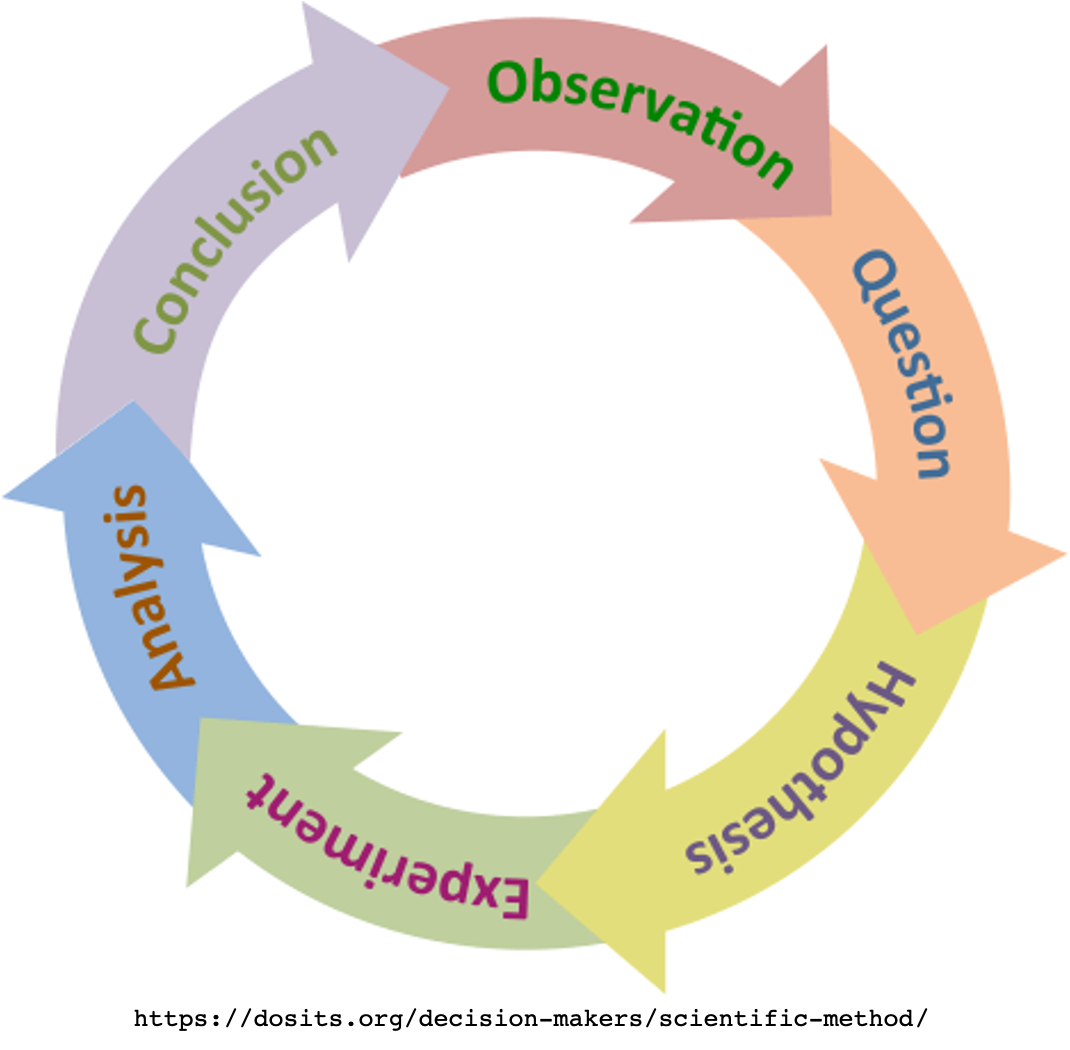
Emergency management, physical security, and information security are three disciplines in which the process of continuous improvement is a model for action. We have cycles of emergency-response-mitigation-remediation. Therefore, I found it interesting to have the Scientific Method presented as a cycle. 

Discovery of Sound in the Sea (DOSIS) is a website created by the University of Rhode Island and the Inner Space Center, here: https://dosits.org


Copyright © 2002-2021 
University of Rhode Island and Inner Space Center. 


Among their website pages is a self-quiz on Facts and Myths. 
1. The greatest uncertainty in understanding the effects of anthropogenic underwater sound on marine animals is understanding how sound propagates.
See the Answer - This is a MYTH
There are many factors that contribute to the uncertainty of how underwater sound impacts marine animals. These include ... 

22. One way to arrive at “scientific truth” is to conduct an opinion poll of scientists.
See the Answer - This is a MYTH
An opinion is a personal judgment or belief, not necessarily based upon fact. On the other hand, “scientific truth” is arrived at through the scientific method, which is an orderly and very well-established process for asking questions about the natural world and testing the answers. Hypotheses that have been consistently validated through observations or experimentation can eventually be advanced to the status of theory. A theory is a thoroughly substantiated explanation of some aspect of the observable world. Theories come as close to objective truth as possible.

PREVIOUSLY ON NECESSARY FACTS

Thursday, February 18, 2016

Retraction Watch

Let me tell you: 20% of scientists are crooks - and that includes me.  They lie about facts and figures. They steal from their graduate and post-graduate and post-doctoral assistants. They fail to inform subjects of consequences (because, in fact, they invented the subjects).


Retraction Watch reports the facts. (See  here: http://retractionwatch.com/)

My own sins: fewer and far between.  I publish the "same" article in multiple venues. Cognizant of the difficulty, I always make some small change and (usually) reference that fact. But I am aware of the fact. With informal writing, it is not a big deal. With Federally-funded scientific research it is a big deal. Even if the writing is new, re-using an illustration will force a retraction.

People have done to prison. Just put "researcher went to prison" in your search engine.

On my passive blog, CSI:Flint 2010, I was inspired to bring the Office of Research Integrity to middle school students who were interested in science and police work. "Don't waste your motivation on CSI," I said. "That is like the physics of Star Trek.  If you love science and want to do police work, go for the Office of Research Integrity."

ALSO ON NECESSARY FACTS
Science Fair Science Fraud
An Abundance of Talent
Monsters from the Id
Biobash: Chamber Replicates Success

Saturday, March 22, 2014

Incident Report


On Thursday, March 20, 2014, at 0725 hours, I was crossing the parking lot on the west side of the Texas Department of Public Safety complex at 5508 North Lamar Boulevard in Austin, walking from the CapMetro Rapid bus stop to the front door of the A Building, when my right foot struck a parking curb stone and I fell forward striking my left knee, my right knee, my left hand, left shoulder, and left side of my face on the pavement, in that order. 

The parking lot is not lit; and like all of the other areas, is designed for vehicular, not pedestrian, traffic.

I reported the incident to the security guard at the front desk who told me to contact my supervisor.  After cleaning up the superficial but conspicuous wounds, I reported for work, and told my supervisor what happened.  At 11:30 AM, I was taken to a contract clinic for a drug screen and other medical inspections.  

I have not had a tetanus shot in over ten years.  However, the clinic was out of tetanus serum, so I rode with their driver to another site. 

The technician there gave me a sheaf of papers to sign. One of the pages said that DTP (diphthera-tetanus-pertussis) serum is contra-indicated for children over seven, for juveniles, and for adults.  I asked her about that and she replied that I was not getting DTP.  I asked to see the vial. She said that she discarded it into a secure bin.  I asked for the lot number and she gave me that. 

I was released at 3:30 PM and reported back at work.

PREVIOUSLY ON NECESSARY FACTS


Tuesday, January 29, 2013

Systemic Injustice

We know the factors of failed justice.  Often, they form a syndrome.  No single correction or remedy will address them all.  The cures cannot be legislated.  Like all crime, ultimately it comes down to the individual who makes the choice.  Scandals are rooted in bad society, when injustice is rewarded because of willful corruption or careless disregard for consequences.  That may be easier to fix. 


Tucker Carrington, the director of the Mississippi Innocence Project, says he and his colleague Will McIntosh decided to pursue Mabry's killer themselves after they attempted to bring the case to the attention of the prosecutor in Humphreys County, and then to Hood's office, and received no response from either.

“When you take on a case and it reveals a glaring injustice like this -- something that could easily be taken care of if someone would just give it some attention -- you can't just turn a blind eye to that," Carrington says. "In the end, I guess we saw this through because no one else would.”

“In fact, the way forensics are handled in the courtroom has become a persistent problem across the country, not just in Mississippi. Forensic scandals have been erupting at crime labs nationwide over the last decade. Most recently, there was a scandal at the state drug lab in Massachusetts that could affect thousands of convictions; another drug lab scandal in Nassau County, N.Y., that could also hit thousands of cases; and misconduct at the state crime labs in Connecticut and North Carolina that have led to reviews of hundreds of cases, including murder convictions. Currently, there's an ongoing controversy involving the FBI's crime lab, in which analysts were found to have vastly overstated the significance of hair and fiber analysis while testifying in court. That too has spurred a review of thousands of cases going back more than a decade. The FBI lab had been considered one of the most elite crime labs in the world.”
Solving Kathy Mabry's Murder: Brutal 15-Year-Old Crime Highlights Decades-Long Mississippi Scandal by Radley Balko
Posted: 01/17/2013 1:42 pm EST
Updated: 01/17/2013 9:44 pm EST
http://www.huffingtonpost.com/2013/01/17/kathy-mabry-murder-steven-hayne-michael-west_n_2456970.html


A decade later, more-advanced DNA testing determined that there was semen from two men inside of Jackson, and neither of them was Kennedy Brewer. The state Supreme Court ordered a new trial. Despite the test results, Allgood planned to prosecute Brewer again. When The New York Times asked him why he hadn’t bothered checking the crime scene DNA against the state’s DNA database, Allgood replied that the state doesn’t have such a database. This came as a surprise to the man who had been running it.
“Bad Boys: A rogue’s gallery of misbehaving prosecutors, plus three worth praising” by Radley Balko from the July 2011 issue
http://reason.com/archives/2011/06/27/bad-boys

On LinkedIn
On 01/27/13 4:30 PM, Lettie McSpadden wrote:
--------------------
I've written an actual case study that has examples of most of the procedural errors that can be made by law enforcement officials.  It began with the murder of a girl, the arrest and trial of three men two of whom were convicted and sentenced to death.  Later the Illinois Supreme Court overturned the convictions and the prosecution tried the individually two despite the admission of guilt by a third party. During two new trials, convictions, and two subsequent Illinois Supreme Court appeals, the prosecutors refused to admit error even when the third man’s DNA proved his guilt. (Meanwhile he committed two other murders.)  After a preliminary hearing where one policeman’s previous testimony proved erroneous, a new judge ordered the release of the accused.
Unlike other prosecutions full of procedural errors, this one resulted in the investigation, indictment, and trial of three policemen and two prosecutors who were found not guilty. Nevertheless, a new prosecutor ordered an examination of the facts and subsequently indicted and tried the real killer who was found guilty and sentenced to death.  He has not been executed as Illinois has a moratorium on the death penalty.
Meantime the convicted men filed a civil case in federal for wrongful imprisonment, and it was settled by the county where the criminal trials took place for three million dollars.

“Mistakes Were Made:  Prosecutorial Mistakes or Misconduct?
Download on Amazon.com to Kindle  Or Createspace for hard copy.
Lettie McSpadden, Professor of Political Science, Emerita, Northern Illinois University; maclettie@gmail.com

A checklist of factors is all too easy to construct.
ü      Mistaken eyewitness identification
·        At the scene
·        Police Lineups
ü      False confessions
·        Coerced pleas
·        Faux perpetrators
ü      Unreliable informants
·        Street
·        Jail, prison
ü      Prosecutorial misconduct
·        Withholding evidence, especially exculpatory evidence
·        Theorizing the existence of unidentified assailants
ü      Flawed forensic science
·        Laboratory fraud
·        Laboratory misconduct
·        Junk science
·        Pseudo-science
ü      Ineffective legal counsel
·        Physical resources
·        Courtroom community
ü      Prejudices, especially racism
·        Presumption of guilt
ü      Authoritarianism
·        Subjectivity of Policing

Based on Wrongly Convicted:Perspectives on Failed Justice by Saundra D. Westervelt and John A. Humphrey, eds., Rutgers University Press, 2002.
Thursday, June 16, 2011

Junk Criminology as Pseudo-Science

Writing about the so-called "CSI Effect" Gregg Barack, Young Kim, and Donald Shelton focused on jurors.  Among the many challenging discoveries of their statistically valid investigation was the fact that less-educated people demand more physical evidence. The "CSI Effect" also runs strongly within professional criminal justice. 


Since the declaration of scientific criminology in the 19th century, police and prosecutors have sought out empirical evidence, relying on what were then new sciences such as  chemistry.  Cesare Lombroso claimed that scientific measurements could identify congenital  criminals. Dactylography (fingerprinting), graphology (handwriting analysis), polygraphs (lie detectors), and psychological profiling, were joined by laboratory analysis of fibers, hair, tissue, cloth, paper, ink, tire treads, shoe prints, typewriter keys, and just about everything else.

Sir Arthur Conan Doyle's Sherlock Holmes in the Strand Magazine became the public's model detective.  Not a mere rationalist Holmes's theories began with empirical evidence.  He studied cigar ashes. In his day, the electron was a theory.  Fifty years later high school students accepted it as basic knowledge.  Today, surgeons are guided by images created by positrons, the anti-matter analog of the electron.  Humans have been to the Moon; our cellphones depend on satellites.  We clone animals and  genetically modify vegetables.  It is not surprising that through this century, empirical evidence from the police laboratory is expected to reveal and convict perpetrators.  But not all science fiction becomes science fact. 

Shoe prints, tire prints, fiber analysis, hair analysis, handwriting analysis, and even fingerprints, all  lack scientific validation.  Scientific truths are statistically valid, large sample, peer-reviewed reports tested by double-blind experiments, explained by coherent theory for which there exists a standard of falsifiability.  The scientific method can be explained as three steps or 14, but it is always the creation and testing of a hypothesis by empirical methods.  A scientific truth is both rational (logically consistent) and empirical (known by perception).  


In the United States, the "Daubert Standard" amplifies and reinforces the Federal Rules of Evidence.  Flooded with expert witnesses in complicated civil and criminal cases, the courts needed a method for differentiating accomplished researchers in esoteric fields from charlatans.  It is bad enough that among the general public those who are less educated expect evidence that they are not equipped to evaluate.  The "CSI Effect" also runs strongly within the profession of criminal justice.  


 The "Criminology and Justice" blog (here) formed by European professionals centered on the Balearic Criminological Society has a recent series of "CSI" articles.  The latest touts the forensic efficacy of shoe prints.  Another is about the value of the forensic sketch artist.  It is true that a complete matrix of evidence can place the perpetrator with the victim at the time of the event.  It is also true that there exists no scientifically valid database of shoe prints; and police sketches of alleged assailants have been elements in wrongful convictions. These professional criminologists cannot differentiate rational-empirical methodology from pseudo-science.  And that is a crime.

The CSI Effect: A Bibliography
(Note that so far only the works of Shelton, Kim and Barack are statistically valid, applying appropriate mathematics to a large sample population.  Many other reports,  while informative, are largely anecdotal.)
  • “The CSI effect reconsidered: is it moderated by need for cognition?” Dante E. Mancini, North American Journal of Psychology 13.1 (March 2011): p.155.
  • “Examining the ‘CSI-effect’ in the cases of circumstantial evidence and eyewitness testimony: Multivariate and path analyses,” Young S. Kim,  Gregg Barak, Donald E. Shelton; Journal of Criminal Justice 37 (2009) 452–460
  • “An Indirect-Effects Model of Mediated Adjudication: The CSI Myth, the Tech Effect, and Metropolitan Jurors' Expectations for Scientific Evidence,” Hon. Donald E. Shelton, Young S. Kim, and Gregg Barak, Vanderbilt Journal of Entertainment and Technology Law, Volume 12 Fall 2009 Number 1.
  • "The 'CSI Effect': Does It Really Exist?" Donald E. Shelton, National Institute of Justice Journal 259. (17 March 2008) http://www.ojp.usdoj.gov/nij/journals/259/csi-effect.htm.
  • “A Study of Juror Expectations and Demands Concerning Scientific Evidence: Does a 'CSI Effect' Exist?” Donald E. Shelton, Young S. Kim, Gregg Barak, Vanderbilt Journal of Entertainment and Technology Law Vol 9 No 2
  • “The CSI effect: legitimate concern or popular myth?” Catherine M. Guthrie, Prosecutor, Journal of the National District Attorneys Association, Vol 41 No. 4 (July-August 2007): p.14
  • “The CSI Effect,” Richard Jones and Arthur Bangert,  Science Scope (Nov 2006): p.38.
MORE RECENTLY ON NECESSARY FACTS