Thursday, October 29, 2020

Clear Nights, Full Moon

The full Moon on the 31st is a problem, but the nights are clear and cold. So, I took out my Explore Scientific First Light 102-mm refractor. I also brought my old and overused National Geographic 70-mm refractor. I viewed Jupiter, Saturn, Mars, the Moon, and unsuccessfully chased what appeared to be open clusters near the zenith. I do not know what the atmospheric effect is--and it may be my early cataracts--but I see patches of faint, cloudy light in the open sky. The telescopes do reveal stars there, only not tight groups. 

With the ES-102, the Red Planet was green around white with all oculars. 

Encouraged by a how-to on The Sky Searchers, I tried all of the smaller eyepiece combinations, 17-mm, 13-mm, 8-mm, and 6 alone and with the 2x Barlow lens. The 8-mm alone is the limit and the best views are with the teens through the Barlow. One advantage to the 8-mm over the 17-plus-Barlow is that the 8 alone is just a little clearer because it is just a little less glass for the light to work its way through, but that could just be the result of my expectation.

The Moon was great. I used their 25-mm (with my red filter 15% passage) and my Celestron 32-mm (with Moon filter 14% passage). Almost like being there...

We just had a week of rain and by 11:00 PM stuff was getting wet from condensation. So, I brought everything in. I slept through until 4:30. Tonight I will set an alarm and get up at 01:00 to try the Pleiades.

PREVIOUSLY ON NECESSARY FACTS

New Telescope: ES 102 

The Perfect Machine

Seeing in the Dark

Saturday, October 24, 2020

New Telescope: Explore First Light 102 mm Refractor

The problem with consumer goods is that at the designers are not you. Everything is always a matter of trade-offs. The decisions that other people make for you might not be the ones you would make for yourself. 

I bought a new telescope to use in the backyard. As vice president of the Austin Astronomical Society, I invited Scott Roberts, the CEO of Explore Scientific, and Stuart Parkerson, publisher of Astronomy Technology Today, to be our guests for a panel discussion. Ahead of that, I shopped at Explore for my next backyard instrument. They answered three emails and then asked me to call them on the phone before I was a customer. And they talked me out of buying extra oculars until I used the telescope often enough to judge better what would suit my needs. I was impressed. 


The Explore Scientific First Light 102-mm refractor ($279) is a good instrument. Placing aside my cognitive dissonance, I made some minor modifications. 


Because the objective lens is so large and heavy, the telescope does not balance in the center of the dove-tail receptacle. It balances almost full-forward in the grip so that the ocular has more moment arm, like a child on a see-saw balancing a grown-up. 


The objective still has a tendency to dip into the tripod, so I attached two strips of foam under the front. 

The XYZ control is a single lever that I found too short. So, I added 6 inches of plastic tube to bring the control closer to the focus draw adjustment wheels. 


29 October: I removed the extension. It was too much leverage. It is easier to control the alignment by holding the frame. The action is still very tight: won't go--won't go--won't go--too far! I now know that I personally prefer gear-driven tracking. 


The only other payment for the price is that the very artistic mount has the elastic stability of a thin plate. Fortunately, it damps out quickly. 


The optics are good. The 102-mm (4-inch) objective brings in Jupiter, Saturn, and Mars well enough. The 660-mm focal length works best with my 17, 13, and 8 mm oculars. When the weather clears, I will use the Moon to try my 32-mm and the new 25-mm eyepieces. The final test will be the Pleiades, over my neighbor’s treetop after midnight and on the zenith before 03:00. 


I was never satisfied that I had properly collimated my Celestron 130 EQ reflector. After a final round of stargazing and finding Albireo on my own, I put it all back in its shipping cartons and stored it in the garage along with the Meade 10-inch Schmidt-Cassegrain telescope (SCT) that I have on loan from the Austin Astronomical Society. (I took that one out just once; and at 65 lbs to my 68 kg, I found it inconvenient.) I bought a used 8-inch Meade LX Classic SCT from the club. The circa-1995 on-board computer did not work, after being repaired twice. They asked $250 and I countered with $325. It was a nice scope, but the right ascension (XY-left right) locked up and I did not want to take it apart. So, I gave it to the Goodwill. They will fix it, pass it along, and make some money. 


My go-to scope has often been a 70 mm National Geographic refractor that I bought used from some kids down the street. They got it for Christmas and by July had lost the eyepieces, the cellphone adapter, the center plate, and the control rod for altitude (Z-up down). And the dew shield was jammed on backwards. (For all of that, they had never used it outdoors.) But it was a National Geographic brand; and I tested it on the street, and the objective seemed OK. It takes the standard 1.25-inch oculars. And it is an f/10 with a 700 mm focal length, which works well for higher magnifications: 13-mm ocular with 2x Barlow for 108x. So, for what it is, it has served me well in the backyard. But after three years, it is held together with rubber bands. So, I went shopping for a new go-to 'scope. The best thing about the Explore First Light 102 is the word “light.” All together I can carry it with one hand.


PREVIOUSLY ON NECESSARY FACTS

Problems with Pop Sci from Sky & Telescope 

Physics for Astronomers: the Works of Steven Weinberg 

The Asteroid Hunters by Carrie Nugent 

Backyard Astronomy (2) 

Backyard Astronomy (1) 


Thursday, October 22, 2020

Galileo and Saturn: Epistemology not Optics

It is commonly claimed that Galileo did not perceive the rings of Saturn because the telescope he was using was not capable of magnifying the image. That is not true. After Galileo, astronomers needed another 50 years to think about the problem and re-imagine it. They needed to ask the right questions. Christiaan Huygens was the first to perceive the structure as a ring. However, it was another 200 years before the ring was understood as a system of particles, rather than a rigid body. The problem was epistemology, not optics.

Galileo’s Images of Saturn 1610 and 1616
https://attic.gsfc.nasa.gov/huygensgcms/Shistory.htm

    “Galileo Galilei was the first to observe Saturn with a telescope in 1610. Because of the crudeness of his telescope, he couldn't determine what the rings were. He incorrectly guessed that there were two large moons on either side of Saturn. Two years later when he viewed Saturn again, the "moons" had disappeared. We know now this is because Galileo was viewing the rings edge-on so that they were invisible, but at the time it was very confusing to Galileo. After another two years, Galileo viewed Saturn again and found that the "moons" had returned. He concluded that the rings were “arms” of some sort.

            “Many years later, in 1659, a Dutch astronomer named Christiaan Huygens solved the mystery of Saturn's "arms." Because of improved telescope optics, he correctly deduced that the "arms" were actually a ring system. Huygens also discovered Saturn's moon, Titan, and for this reason, the probe exploring Titan is named after him.” 

From NASA’s Cassini-Huygens Mission website (no longer current) here https://attic.gsfc.nasa.gov/huygensgcms/Shistory.htm

Galileo’s Sketch of Saturn” 
from Galileo and the Scientific Revolution 
by Laura Fermi and Gilberto Bernardini,
Basic Books, 1961.

“When he turned his telescope on the planet Saturn, he found that this did not always look like a round body but seemed of strangely variable shape. He thought it to be “three-bodied; that is it … was an aggregate of three stars arranged in a straight line parallel to the ecliptic, the central star being much larger than the others.” His telescope was not sufficiently powerful to let him to distinguish the three, possibly four, rings we now know are around Saturn. It was the Dutch astronomer Christian Huygens (1625-1695) who discovered Saturn’s rings.” -- Galileo and the Scientific Revolution by Laura Fermi and Gilberto Bernardini, Basic Books, 1961.


“Galileo continued his telescopic observations from his new home in Florence. Here he discovered that Saturn sports a pair of curious appendages, but his telescope was not powerful enough to reveal their true nature. (They were Saturn’s rings.)” Parallax: the Race to Measure the Cosmsos by Alan Hirshfeld, W. H. Freeman and Company, 2001. 


“1610 - Galileo Galilei becomes the first to observe Saturn's rings with his 20-power telescope. He thought the rings were “handles” or large moons on either side of the planet. He said “I have observed the highest planet [Saturn] to be tripled-bodied. This is to say that to my very great amazement Saturn was seen to me to be not a single star, but three together, which almost touch each other”. 

“1612 - Galileo was astounded when he found that the rings he first observed a couple of years earlier had now disappeared. He wrote "I do not know what to say in a case so surprising, so unlooked for and so novel". The rings were, in fact, edge-on from Earth's perspective. Galileo inadvertently became the first person to observe a Saturn ring plane crossing. 

“1616 - Galileo now observes the rings as two half ellipses. He wrote “The two companions are no longer two small perfectly round globes ... but are present much larger and no longer round ... that is, two half ellipses with two little dark triangles in the middle of the figure and contiguous to the middle globe of Saturn, which is seen, as always, perfectly round.”

 From Views of the Solar System Copyright © 1995-2015 by Calvin J. Hamilton. https://solarviews.com/eng/saturnbg.htm


Museo Galileo, Florence
https://catalogue.museogalileo.it/indepth/SaturnsRings.html

“In some observations conducted in 1610, Galileo (1564-1642) saw Saturn as tricorporeo [three-bodied], i.e.,composed of a central body and two lateral bulges, which he mistakenly thought to be satellites. In 1655, Christiaan Huygens (1629-1695), thanks to a more powerful telescope, observed Saturn's rings for the first time. He described them accurately in Systema Saturni (The Hague, 1659). The Accademia del Cimento was concurrently investigating the nature of the rings. Between 1671 and 1684, Giovanni Domenico Cassini (1625-1712) discovered four satellites of Saturn, in addition to the one previously found by Huygens. Cassini also observed and studied the divisions between the rings. Recently, the Voyager space probes have revealed that the many concentric rings are thin bands consisting of countless rock and ice fragments that orbit the planet and reflect sunlight.”

© 2018 - 2020 Museo Galileo - Istituto e Museo di Storia della Scienza 

https://catalogue.museogalileo.it/indepth/SaturnsRings.html


https://www.bibliovault.org/thumbs
/978-0-8165-0829-7-frontcover.jp
g

“Telescopic studies of Saturn, its ring system, and its satellites from 1610 to about 1900 are surveyed. Early observations of the Saturn system and changing beliefs about the constitution of the rings are covered, showing that what an observer sees in the heavens depends not only on the quality of his instruments, but also on what he expects to see. The first observations of the Saturn system by Galileo, the development of the ring theory by Huygens, and the replacement of Herschel's and Laplace's solid ring theories by Maxwell's particle ring theory are recounted.” 

Saturn Gehrels, Tom; Matthews, Mildred Shapley (Editors). Tucson, University of Arizona Press, 1984, p. 23-43.


Introduction to Objectivist Epistemology
by Ayn Rand (2nd. edition)


In Introduction to Objectivist Epistemology, Ayn Rand asserted that a sensation must be identified to become a percept. A set of percepts, identified and integrated by common attribute becomes a perception. A set of perceptions integrated by their common characteristics are given a name and thereby made into a concept. Concepts are further abstracted by their essential distinguishing characteristics, according to objective context, into wider (and more powerful) ideas. Without identification, a sensation alone is meaningless. Not knowing what to expect, Galileo could not perceive the rings of Saturn correctly.


Just as it took time for the nature of Saturn’s rings to be teased out from the observations, so, too, did someone 400 years after Galileo finally put 2 and 2 together. In 2005, the science of epistemology informed astronomy.


“Saturn was first seen through the telescope by Galileo in the summer of 1610. In the ensuing half century, Saturn's strange appearances became a celebrated puzzle. The problem was often not the poor quality of telescopes: a number of observers drew images that we would interpret as showing a ring around the planet. It was also a problem of concepts because for several decades observers had the wrong model in mind when they observed the planet. Thus we could say that their telescopes could show them the ring, but their preconceptions did not allow them to see it. The manner in which Christiaan Huygens arrived at the solution, in the winter of 1655-56, shows that more than good telescopes were necessary, although for rhetorical reasons Huygens maintained the opposite. And Huygens's ring-theory, [elegant] as it was, had several shortcomings that were slowly fixed--often by others.” --  “Saturn through the Telescope: The First Century” by Albert Van Helden. American Astronomical Society, DPS meeting #37, Bulletin of the American Astronomical Society, Vol. 37, p.620. Pub Date: August 2005


Explore Scientific First Light 102
660 mm focal length


Last night, I went out with my telescope to see what Galileo could or could not have perceived, had he held the identifying concept. Admittedly, the 102 mm objective of my Explore Scientific refractor has 16 times the area of his. However, I am inside a city, a mile from a major shopping center. He was in Florence, a city with smoke, perhaps, but no arc vapor street lights. 


I tested three magnifications: 20.8x (32 mm), 26.4x (25 mm) and 38x (17 mm). At 21 power, it was a strong “maybe” given Galileo's patience. At 26.4 power the rings were discernable without question, and at 38x, they were undeniable. Although his 20x telescope was his primary instrument, it was not his only telescope. He had made a 30-power at the same time, but gave it to Cosimo Medici. I believe that Galileo’s instruments were good enough, but understanding of the taxonomy of the solar system required a conceptual leap that would have to wait for later astronomers.


PREVIOULSY ON NECESSARY FACTS


The Scientific Method 

Feynman's Rainbow 

Harriman's Logical Leap

Cosmos: a Spacetime Travesty 


Sunday, September 27, 2020

Celestial Mechanics

I first got interested in celestial mechanics in 1978. I enrolled in three independent study classes at two schools, New Mexico State University, then at Lansing Community College (1981, 1982). In 1981, I met an astronomer from Michigan State University who encouraged me to get this book on algorithms for calculators. He wanted it for himself and I was working for a publisher. So I ordered two. I used the routines as outlines for some BASIC programs but never went much further with it. 

[An earlier version of this essay was posted to The Sky Searchers discussion board in the Astrophysics forum.] 

Book cover Mathematical Astronomy with a Pocket Calculator by Aubrey Jones
John Wiley and Sons.
(c) Aubrey Jones 1978

My wife and daughter bought me a telescope for my birthday in 2014. In the past six years, I have enjoyed going out in the backyard (often) and to star parties (a few times) and verifying for myself that the universe is pretty much as described in the books. But what’s next?

I am not facile with mechanical tasks. Things come apart a lot easier than they go back together. That can be useful for documenting physical systems, but it suggests that photography and spectroscopy are not likely to be rewarding as hobbies complementing observational astronomy.  
 

On the one hand, in order to pursue celestial mechanics you really need to love mathematics. As much as I enjoy it, I took Calculus-1 twice to get a C+. I learned integration (usually Calculus-2) by taking a computer programming class and coding up the Midpoint Rule, Simpson’s Rule, and the Trapezoid Rule. The advantage to me is that it is easier to erase a mistake than it is to drive to Home Depot to buy another part (which I have to do to finish work on the backyard gate). 


McCuskey, Addison-Wesley, 1963
In the 18th and early 19th centuries, orbit plotting was the focus of astronomy. Following Sir Isaac Newton’s 
Principia, and the parallel work of Gottfried Wilhelm Leibniz, Pierre-Simon Laplace developed what we recognize today as the calculus of celestial mechanics. It allowed astronomers to establish the orbits of the planets and their newly discovered moons and the two new planets, Uranus and Neptune, and their moons. It also allowed astronomers to determine the physical arrangements of binary stars. With the advent of photography and spectroscopy, orbit plotting fell out of favor with researchers as those tools revealed deep and starling new truths. However, even as radio astronomy came to the fore in the 1950s, celestial mechanics regained some importance with the space age. 


But if you are not the person launching a satellite to Saturn, why grind through transcendental equations? My reply is the same as for any amateur pursuit, any hobby, or sport: You do it for yourself because it is at once rewarding and edifying. And unlike most other hobbies, astronomy is a study where amateurs and professionals collaborate. 


How fast does the Moon go around the Earth?

How fast does the Sun go around the Earth?

How fast do the stars go around the Earth?

And when will that comet come back?


If you have lived any arbitrarily long time, you know that our easy estimates – the Moon travelling through 360 degrees in 28 days; the Sun circling the Earth 360 days each year (plus 5 days for a long holiday "off the books"); the fixed stars moving westward one degree per night through the year -- have errors that accumulate. Can I make more accurate predictions?


Not only has the hard mathematics been done already, reducing the problems to the application of formulae, but I now have a computer and a spreadsheet. All I have to do is take the measurements and reduce the data.


(More later.)


PREVIOUSLY ON NECESSARY FACTS

Newton and Leibniz

Astrophotography is a Lot like Love 

Measuring Your Universe: Alan Hirshfeld’s Activity and Laboratory Manual

In Support of the Entry-Level Telescope 

John Kemeny Knew: We Shall Have Computed 


Thursday, September 17, 2020

Hail to the Spartan Victors?

I do not remember where I was driving when I saw this banner. The incongruity prompted me to stop and take a picture. I found it again in my archives but it had been edited and the date was too current now. 

We mostly lived in Michigan for about 30 years off and on from 1977 to 2011, almost 20 years continuously from 1979 to 1999. The hometown rivalries are between the Michigan State University Spartans (green and white) and the University of Michigan Wolverines (blue and maize). 


Never much for team sports and certainly not college football, the fact is that we lived in and around Lansing until 1999. My daughter and I made good use of the MSU campus. I had a community library card. We skated the grounds, rented canoes, and explored buildings when classes were out. 


But Laurel’s freshman year was at the U of M before we met. She returned to work at the University and take a graduate class when we were living in Ann Arbor and attending Eastern Michigan University 2005-2010. So, our loyalties are somewhat conflicted.


But, as I said, I don’t follow sports. So, there was one time I was working for a software firm in Lansing and some of the programmers were MSU graduates; everyone else was an MSU fan. I caught a cold the week of Thanksgiving and missed a day of work that Wednesday and spent the weekend in bed recuperating. The Michigan-Michigan State game was televised (oddly) and I caught snatches of the last quarter as I surfed the channels. When the game was over, the Green and White band came out and played “Hail to the Victors.” 


 The next Monday, they were talking about the game, and going to school, and learning the MSU fight song at orientation. And I said, “Hail to the Victors” and they said, “WHAT?!?!” And I explained that I caught the end of the game and the Spartan band played “Hail to the Victors.” And they said, “That’s because we lost. The band salutes the winner by playing their song.” Oh…


PREVIOUSLY ON NECESSARY FACTS

Hook ‘em Horns! 

Good-Bye Redskins 

Why a Level Playing Field? 

Big Bang Theory: More Friends than Seinfeld 


Tuesday, September 8, 2020

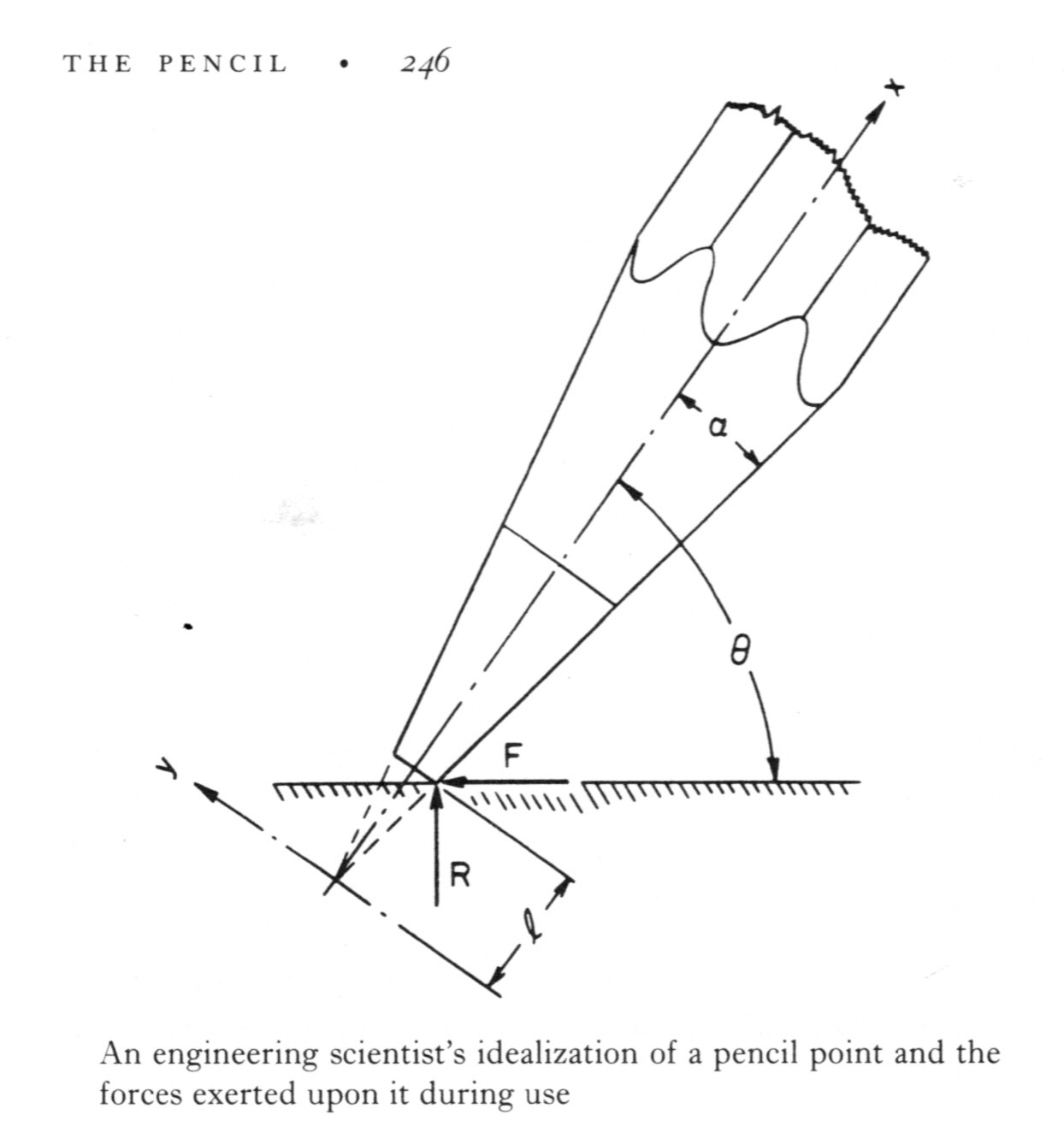
Pencil Notes: Reflections on Henry Petroski’s "The Pencil"

“Yet, perhaps in part because specialization was no doubt as common in ancient times as it is today, the written history of engineering is sparse. Even the most able and articulate of ancient engineers, whether they were known as artisans, craftsmen, architects, or master builders, might have had no more time or inclination or reason to articulate what it is they did and how they did it than do some of the most able of today’s engineers.” – page 17

That is why they hire technical writers. To me, it is a right-brain/left-brain situation. Engineers tend to be right brain thinkers. Technical writers bring that with them, also, the ability to read, edit, and create drawings, whether architectural plans or software flowcharts. Ultimately, though, the images get verbal explanations. That may explain why so many technical writers are women: the left and right hemispheres of the brain are connected by the corpus collosum, which tends to be more highly developed in females than in males.


It is difficult to be certain how this or that better design for a brush, plow, house, or sword evolved from its predecessors, for the process was at best sketched metaphorically in pencil and seldom if ever copied in pen. It is because of this that the ideas and artifacts of technology—the processes and products of engineering—are so very different from the creations and theories of literature, philosophy, and science. … The classics, even if superseded in factual or theoretical sophistication are considered models of thinking from which one can today still benefit by emulation, or at least inspiration. […] Curators of technological artifacts, industrial archaeologists, and historians of technology represent rather new careers…” – pages 20-21

  1. First, that is why we have industrial archaeology now, to recover and understand those earlier activities and artifacts. 
  2. Second, we have lost some mathematics. Richard P. Feynman wanted to demonstrate to his class how Newton proved Kepler’s laws, and he wanted to do it in Newton’s own language. He could not. Feynman could not recreate the geometry that was fundamental to the Principia. We have become so dependent on algebra and calculus that we have forgotten the admittedly more cumbersome tools of earlier mathematics.
  3. We also lost the machinery of the Antikythera Mechanism. It would be almost 1500 years before clocks were again so complicated, accurate, and precise.
  4. Fourth, and to Petroski’s point, antiquarians do inform the present. Though we had advanced past the hand-hammered methods of coinage, it is famous that President Theodore Roosevelt commissioned Augustus Saint-Gaudens to give America coinage as compelling as that of the ancient Greeks. 

Professional Coin Grading Service "Coin Facts" website
TOP: Half Dollar of Charles Barber imitating the work
of Oscar Roty for France. BOTTOM: Something better. 


“[Sir Isaac Newton’s] seashore metaphor allows that one shell (theory) may be prettier (more elegant) than another, and perhaps the searcher becomes less fond of the old shells as prettier ones are found, but the implication is still that the truths are whole in the ocean and it is just a matter of time before they are found thrown up on the shore.

“While pencils may be helpful in formulating abstract theories of motion and gravitation, abstract theories do not make pencils.” – page 74.


The history of modern physics may refute that. The mathematics describing atomic and nuclear processes energy became the design specifications. We did not tinker our way to nuclear power.


Of all the revelations and insights here, I was captivated by the story of Henry David Thoreau (Chapter 9: An American Pencil-Making Family). We recently watched the most recent remake of Little Women (Greta Gerwig director). We see Jo March’s ink-stained fingers and we watch her on the floor, scribbling in pen. But we all also know that the family was connected with the Transcendentalists, among them Henry David Thoreau. But who knew that his family made pencils? In his list of supplies taken to Walden Pond, mostly likely written with the pencil he carried, Thoreau omitted the pencil. Thoreau also billed himself as a surveyor and civil engineer, two professions that even in 1840 depended on good, reliable graphite pencils. 


I wrote here last week about the passage on pages 223-225 describing how engineers often were trained to draw by copying architectural treatments. It is, of course, how architects learned to draw. That opened up a new vista on an early passage in The Fountainhead. That being as it may, it is nonetheless true that to learn science, we recreate the important experiments of the past. We just do not slavishly recreate them with archaic beakers, wires, and flyball governors. I believe that it is a valid criticism of physics in particular, stated in Thomas Kuhn’s Structure of Scientific Revolutions, that we are handed science as a completed artifact and do not trouble ourselves much with discarded paradigms—or why we discarded them. (My review for this blog is here.)


“One desirable quality is often gained at the expense of another, for how the properties of complicated materials will change with changing ingredients and methods of preparation, whether they be pencil leads or concrete, is not always easily predictable. While a new mixture might give a stronger material, it might also give a more brittle one that will be greatly weakened by a small crack.”—page 236


“The stories of the Munroes and the Thoreaus and their pencils illustrate in microcosm the often conflicting objectives of real-world engineering and business: making pencils as fine as possible as an end in itself; making pencils better in quality or price than other pencil makers; making pencils secretly in order to have an advantage over the competition; making pencils overtly to conceal a more profitable business; making pencils for the social and cultural good of artists, engineers, and writers of all kinds. There is no such thing as pure engineering, whether in the artifact or in the abstract—for that would be nothing but irresponsibility or a mere hobby. Engineering, far from being applied science is scientific business.” – page 276-277.

It reminded me of the discussions among Austrian economists over what entrepreneurship essentially is. (See NecessaryFacts here.) Being rationalists  they seek one or a few axioms from which all of the remainder can be derived by pure reason. Do entrepreneurs bring new inventions to market? Do they arbitrage risk? Do they carry goods from where they have lower value to where they are valued more? Do they drive each other out of business by any means possible? Do they find cooperation where others find conflict? Do they take advantage of the unwary or do they profit from intelligent decisions? Mises pointed out at some length that the entrepreneur can be so self-centered that they invest all of their resources in a lost cause when a rational person would just get any good-paying job and keep it. There is no such thing as pure entrepreneurship unless it is a hobby. 


In 1933 [the Lead Pencil Institute] has ten members who together manufactured 90 percent of all American pencils. Thus the institute effectively represented the entire industry, which at that time included thirteen firms. They were roughly in order of size: Eagle Pencil Company, New York, N.Y.

Eberhard Faber Pencil Company, Brooklyn, N.Y.

American Lead Pencil Company, Hoboken, N.J.

Joseph Dixon Crucible Company, Jersey City, N.J.

Wallace Pencil Company. Brentwood, Mo.

General Pencil Company, Jersey City, N.J.

Musgrave Pencil Company, Shelbyville, Tenn.

Red Cedar Pencil Company. Lewisburg, Tenn.

Mohican Pencil Company, Philadelphia, Pa.

Blaisdell Pencil Company, Philadelphia, Pa.

Richard Best Pencil Company, Irvington, N.J.

Empire Pencil Company, New York, N.Y.

National Pencil Company, Shelbyville, Tenn.

(Page 293)


I found it disappointing that Petroski quoted John Middleton Murray at length on the poetry of being a pencil, but never mentions “I Pencil” by Leonard E. Reed.


The old meets the new. These pencil extenders are built
from STL files provided to 3-D printers

“Who today but a frugal draftsman would use a pencil down to such a stub? But our pencils, unlike many of those of the Victorians, have lead from end to end, and some engineers and draftsmen, when a good pencil’s stub is too small to hold even in a pencil extender, have been known to cut away the last of the wood case and use the left in their compasses.” – page 354


Previously on NecessaryFacts

Imaginary Numbers are Real but Pegasus is not 

Forbidden Planet 

Spoken American Grammar 

The Map that Changed the World 


Monday, September 7, 2020

The Pencil: History, Design, and Circumstance

The book opens and closes with the fact that the pencil’s ubiquity rendered it invisible. On pages 5 and 346 the author tells of being unable to find old pencils in antique stores or museums. Shops that specialize in classic craftsman’s tools keep the compasses, but throw out the pencils. They value the carpenter’s levels, but discard the trade’s signature pencils. They curate the surveyor’s drafting pens, but not the pencils that laid out the guidelines that made inking possible. If that is received as incongruous, then consider that very little engineering is ever recorded. The work is the story. How it came to be is locked and lost in the mind of the inventor. The engineering drawing delivers its thousands of words. The engineer seldom records any of the words that gave birth to the plans and procedures. And as central as is the precision drawing, the pencil that made it has been ignored.

The Pencil: A History of Design and Circumstance by Henry Petroski (Alfred A. Knopf, 1990) is a paean to engineering with the pencil as its metonym. Being a professor of civil engineering, the author frequently compares the creation of pencils with the development of bridges. The allusion is not deep. The focus is the pencil, not the truss or suspension, though both are mentioned as needed for context.
  

We are told too easily that scientific theories become applied as engineered structures or machines. In truth, it is the other way around: theories explain what engineers develop by intuition, insight, trial and error, craft, and trade secret. When those are formalized into mathematics, then engineering science can improve the product or the process by analysis, seeking and eliminating limitations, flaws, defects, and oversights.


People were happy with metallic scribers made of lead, tin, or silver, and pens cut from reeds or feathers. The discovery in the 16th century of “black lead” or “plumbago” or “British lead” that we now call “graphite” radically altered writing and drawing, both for fine art and engineering. For three hundred years, the best graphite came from a single district in England. France’s wars with England led to the Conté crayon, a secret mixture of clay and graphite. Closed out of France, German firms developed their own secret formulas with graphite from Bavaria and Bohemia. Suitable graphite was found in New England and pencils were the family business for Henry David Thoreau. A new lode was discovered in China, giving rise to the yellow color we assume for the default and trade names such as “Mongol.” 

Alongside the rapid successive innovations of the 19th and 20th centuries, pencils were still sharpened with penknives. The first pencil sharpeners date to the 1890s and did not achieve the forms we accept today until after the 1930s. (Wikipedia has more to say about their development.) Into the 1980s, if not still a practice today, drafters at their drawing boards sharpened their pencils with sandpaper. I had mechanical drawing classes in junior high school (1962) and college (1978 and 1984) and that is how I was taught. 


Through all of that and into our time, the challenges have been to make consistent pencil leads in predictable grades, tough, strong, resilient, pliant, black (or other colors), and cheap; and do so by the millions, eventually billions. Graphite mixed with clay will not make a pencil. Only a few species of trees—mostly cedars—will do. The wood must be treated. The leads must be prepared. They are both in their ways shaped, formed, baked, boiled, heated, coated, stripped, and glued. While mechanical pencils—known since the 18thcentury—solve the problem of the wooden casing, they bring their own limitations. 


As a result of this book, I have been buying pencils, driving to office supply and art supply stores, giving long minutes to reading the pencils themselves, comparing their imprinted names and grades with the notecard I made for the purpose. I think that for myself, a 2-½ H or F would be best, but I cannot find them locally. Amazon has two brands, Mirado and Ticonderoga. I may have to give in and buy there.


PREVIOUSLY ON NECESSARY FACTS

Start the Presses! 

Art & Copy 

For the Glory of Old Lincoln High 

Dealers Make the Show: Armadillocon 41 Day 3 Part 2 


Monday, August 31, 2020

The Fountainhead: an exploded view of one scene

We lose the past too easily. Ayn Rand was born in 1905. In The Fountainhead, anyone of mature professional status 1922-1942 would have been a generation older. Rand studied in an architect’s office, working for free in order to understand the craft and the business. I was pleasantly surprised to be informed by another book of an underlying tradition in engineering design. It was an eye-opener.

From The Fountainhead:

“You will kindly explain yourself,” [said the Dean].

“If you wish. I want to be an architect, not an archaeologist. I see no purpose in doing Renaissance villas. Why learn to design them, when I will never build them?” [replied Howard Roark].

“My dear boy, the great style of the Renaissance is far from dead. Houses of that style are being erected every day.”

“They are. And they will be. But not by me.”

“Come, come, now, don’t be childish.”

“I came here to learn building. When I was given a project, its only value to me was to learn to solve it as I would solve a real one in the future. I did them the way I’ll build them. I’ve learned all I could learn here—in the structural sciences of which you don’t approve. One more year of drawing Italian post cards would give me nothing.” 


From The Pencil: A History of Design and Circumstance by Henry Petroski, Alfred A. Knoff, 1990:

Although orthographic projection was used in Albrecht Dürer’s 1525 book on the geometry of drawing, and theoretic foundations were laid down in Gaspard Monge’s 1795 book on descriptive geometry, the techniques and conventions derived from the work of these pioneers did not become universally employed in what has come to be known as mechanical or engineering drawing until the nineteenth century, when it became virtually indispensable for conveying information to machine shops and iron foundries. Up until about the middle of the nineteenth century, engineering drawing was learned in the long tradition of architectural drawing, and many early machines, such as large steam engines, were designed with iron structural elements cast in the forms of columns of the classical orders. Functional brackets were adorned with the classical motifs that students had learned in drawing classes, which consisted largely of copying increasingly complex architectural drawings, and one can only speculate on how much of what came to be known as Victorian architecture and structure was influenced by this practice. 


Through the middle of the nineteenth century architectural drawing was learned by most, though not all, draughtsmen by tracing. Hence technique was learned at the expense of theory. …  The mid-nineteenth century state of the art of engineering drawing was recorded succinctly in the preface to one of the earliest textbooks on the subject, An Elementary Treatise on Orthographic Projection, Being a New Method of Teaching the Science of Mechanical Engineering by William Binns. According to Binns…:

“… the usual mode of teaching… is from the ‘flat’—that is, from copy—the practice being to lay before each student of the class a drawing of some part or parts of a structure which he is requested to copy. This being done, another drawing, probably more elaborate, is laid before him; and the same course is pursued until he becomes tolerably expert with his instruments and brushes, and eventually able to make a very creditable or even highly finished drawing from copy. If, however, at the end of one or two years of practice the copyist is asked to make an end elevation, a side elevation and longitudinal section of his black-lead pencil, or a transverse section of the box containing his instruments, the chances are that he can do neither the one or the other.”


PREVIOUSLY ON NECESSARY FACTS

The Genius of Design 

Science Fair: A National Geographic Film 

Absolutes and Objectives 

There Really Are “Civil” Engineers 


Tuesday, August 18, 2020

Neighborhood Book Kiosks

The first one in my neighborhood appeared in February and I thought that it was unique. I saw another one a bit farther from home. It finally occurred to me that this is a phenomenon. I like it as an example of spontaneous order, an axiom in Austrian economics. Reading on Wikipedia revealed that other people think the same way that I do. And not everyone else is happy with us.  

This is the one in my neighborhood.
It has four sides with two panels of books and it rotates.
(I don't know who owns the easement.)

From The Atlantic

U.S. -- The Danger of Being Neighborly Without a Permit

All over America, people have put small "give one, take one" book exchanges in front of their homes. Then they were told to tear them down.

Conor Friedersdorf

February 20, 2015

Since 2009, when a Wisconsin man built a little, free library to honor his late mother, who loved books, copycats inspired by his example have put thousands of Little Free Libraries all over the U.S. and beyond. ... 

I wish that I was writing merely to extol this trend. Alas, a subset of Americans are determined to regulate every last aspect of community life. Due to selection bias, they are overrepresented among local politicians and bureaucrats. And so they have power, despite their small-mindedness, inflexibility, and lack of common sense so extreme that they've taken to cracking down on Little Free Libraries, of all things.

https://www.theatlantic.com/national/archive/2015/02/little-free-library-crackdown/385531/


[Texans are a little more open to letting people do the right thing without permission from the government. Wells Branch is a neighborhood on the north side of Austin. Dell, HP, and others have campuses there.]


WBNA | Wells Branch Neighborhood Association

Little Free Library Boxes

Welcome to the Little Free Libraries Summer Scavenger Hunt!


Did you know there are currently 14 Little Free Libraries throughout Wells Branch?  LFLs are free book exchanges where anyone can “take a book, return a book.”  Join us in June for a LFL Scavenger Hunt.  You’ll have the opportunity to visit our neighborhood LFLs, find some great (free!) summer reads, and earn a chance to win a Barnes & Noble gift card.

http://wbna.us/community/library-boxes/


Posted to Nextdoor dot com serving our wider subdivision

[ I found out that the Little Free Library boxes were not the first of their kind. “Book Crossings” appeared about the turn of the millennium.] 


Leaving reading materials in public places when no longer needed has long been a silent means of communication and sociability amongst bibliophiles. Ron Hornbaker conceived the idea for what is now known as BookCrossing in March 2001[2] and enlisted business partners and co-founders Bruce and Heather Pedersen[3] to launch BookCrossing.com on April 21, 2001.[4]


After two years the website had over 113,000 members and by 2004 it was prominent enough to be referenced in an episode of the Australian soap opera Neighbours.[5] The same year it appeared as a new word in the Concise Oxford Dictionary,[6] although as of 2017 only Collins of the major online dictionaries retained it as a word.[7][8][9][10]

https://en.wikipedia.org/wiki/BookCrossing


On a busy backroad I take to the freeway.
It serves walkers well.
(Again, it seems to be on the property owner's
public easement.)

[From Wikipedia] Closely allied with the BookCrossing concept, the original public bookcases were conceived as artistic acts.[1] Very early examples are the creations of performance artist duo Clegg & Guttmann in 1991. Collections of bookcases were conceived as "free open-air libraries" in Darmstadt and Hannover in Germany in the late 1990s.[2]


Controversy and criticism[edit]

In 2003, BookCrossing was criticized by the astrologer and novelist Jessica Adams, who claimed that books were being "devalued" by the website as BookCrossing could lead to lower sales of books and, therefore, the reduction in royalties being paid to authors.[20] Most BookCrossers dispute this argument, however. They claim that the website introduces readers to authors and genres that they have not read before, that the website encourages more people to take up or reclaim reading as a hobby, and that some members, having read a book that they have enjoyed, will buy extra copies to distribute through BookCrossing.[21]


Another busy side road. 
You have to step up onto the property for this.

In March 2005, Caroline Martin, managing director of the publisher Harper Press, said in a speech that "book publishing as a whole has its very own potential Napster crisis in the growing practice of bookcrossing".[22] BookCrossers rebutted the link to Napster, saying that while music filesharing involves duplicating audio files countless times, BookCrossing doesn't involve duplicating books (and also does not involve violating copyright, as books can be sold or given away freely without permission of the publisher being needed). When BookCrossing was first launched, the founder of BookCrossing, Ron Hornbaker, originally wondered if people would make this comparison.[23]

https://en.wikipedia.org/wiki/Public_bookcase


[A related link on Wikipedia]

Give-away shops, freeshops, free stores or swap shops are stores where all goods are free. They are similar to charity shops, with mostly second-hand items—only everything is available at no cost. Whether it is a book, a piece of furniture, a garment or a household item, it is all freely given away, although some operate a one-in, one-out–type policy (swap shops). The free store is a form of constructive direct action that provides a shopping alternative to a monetary framework, allowing people to exchange goods and services outside of a money-based economy.


A neighbor told me about a different one.
I found this instead.
(Clearly on the front lawn.) 

[More from following the links in Wikipedia write-ups]

The anarchist 1960s countercultural group the Diggers[1] opened free stores which simply gave away their stock, provided free food, distributed free drugs, gave away money, organized free music concerts, and performed works of political art.[2] The Diggers took their name from the original English Diggers led by Gerrard Winstanley[3] and sought to create a mini-society free of money and capitalism.[4] Although free stores have not been uncommon in the United States since the 1960s, the freegan movement has inspired the establishment of more free stores.

https://en.wikipedia.org/wiki/Give-away_shop


Also on Necessary Facts

Money as Press and Speech 

Charles Lamb 

Frankenstein, Rayguns, and Bicycles 

Five Books About Books