Showing posts with label libraries. Show all posts

Monday, March 16, 2026

Generative AI and Pseudographic Feynmans

The ability to train generative AI to impersonate humans is an example of something that can be done now because of new technology but which perhaps should never be done. 

I watched part of a video that is allegedly a lecture by Richard Feynman on why it will be impossible for explorers to Mars to return to Earth. In fact, there are many of these fake Feynman lectures on YouTube. They apparently do identify in the first seconds that they are an AI generated voice or graphic. They also match Feynman’s spoken delivery style, his turns of phrase and lecture pacing. I now appreciate the problem in textual forensics that confronted medieval scholars when they sorted out Pseudo-Aristotle and Pseudo-Dionysius.


By Greg Alleman from LinkedIn to YouTube.
Alleman has a career as an aerospace engineer.

These fake videos are intentional falsehoods which by their nature will replicate themselves particularly and others in general by creating an ecosystem that supports those lifeforms. Based on what I know about the evolution of life on Earth, I can only say that while some generative AI may be beneficial and others neutral, the impersonation of real humans is toxic. Videos from writers using generative AI will thrive creating and nourishing populations of pseudographia. It is inevitable that students who want to learn from The Feynman Lectures on Physics will land on one of these pseudo-Feynman lectures.

Two More Fake Feynmans


Yet Another Pair of Fake Feynmans

It is also true that each of us is responsible for determining the truth or falsehood of any assertion, even of our own assumptions. I never saw a P. F. Chang’s until I moved to Austin in 2011. I thought that it was local. I first saw a parody of Edward Hopper’s Nighthawks as a hip or campy wall poster back in the late 1960s before I learned the original in an art history class at Case-Western Reserve University in the summer of 1969. The first YouTube video I saw was Weird Al Yankovic’s “White and Nerdy” in 2005. A classmate in a criminal justice class at Washtenaw Community College showed it to me and I really identified with it. The kids in the class explained the other half of it. 


One Archive of Genuine Old Feynman Videos

I enjoy surfing YouTube videos because I like to admire the creative works of others and I learn a lot from them. Looking for printing and typography, I found Elle Cordova’s “Fonts Hanging Out” and “Punctuation Marks Hanging Out.” I also watch Mathologer and Numberphile and I have been going to sleep with David Miller’s series, Quantum Mechanics for Scientists and Engineers in my earphones. (I am testing hypnopedia. I will post here when I can speak the vocabulary.) I also subscribe to Rob Words, Audiomachine, Microbe Hunter, Jordan B. Peterson, and to Dwarkesh Patel interviewing Sarah Paine, among a dozen others.  


A friend who got tired of the AI-created misrepresentations of historical fact warned me about YouTube. Now I understand.


Granted the warning, these simulacrae could prove valuable. Perhaps we cannot have too many copies or reconstructions. Civilization is fragile and literacy is even more delicate. 


Aristotle’s own library was regarded as a royal treasure by the Macedonian ruling family. When they fell out amongst themselves, the scrolls were buried to keep them from competing claimants to the throne. When they were recovered, they were found to have been eaten through. Later scholars reconstructed them, but not well. Fortunately, those were not the only copies; Christian monasteries had preserved others. The Renaissance began when Petrarch and Dante visited those scriptoria to recover the lost writings of antiquity. However, they started with Latin, which they could read. Greek texts did not reblossom until the Renaissance took root in Venice, where Greek was known. Since then, scholars have improved the correctness of our reconstructions. In addition, other works have been unearthed. Aristotle’s lecture “On the Athenian Constitution” was rediscovered among the Oxyrhyncus Papyri. Similarly, in our time The Archimedes Palimpsest was recovered and lately one more page was found astray. But all of that only provides more evidence about what we know to be a huge body of lost works. “Oxyrhynchus yielded a huge random mass of everyday papers — private letters and shopping lists, tax returns and government circulars ... maybe 50,000 in all.” — https://oxyrhynchus.web.ox.ac.uk/waste-paper-city The Archimedes Palimpsest is another recovery with story of several losses and rescues**. 

(https://archimedespalimpsest.org/). So, these AI simulations could prove valuable.


The reason that I listen to Prof. David A. B. Miller’s lectures on quantum mechanics is that I found the textbook in the stacks at the Kuehn Math, Physics, and Astronomy Library when I was working at the University of Texas. It was perfect for me, a good midrange guide for college sophomores with clear narratives that are integrated with the relevant and necessary mathematics and instructive problems. I looked for a video and found the series. 


Image from Amazon. The book is no longer available
from Cambridge Press. Miller has a new volume out,
Modern Physics for Engineers and Scientists 
https://purl.stanford.edu/hr256mp8317

On that basis, imagine that some catastrophe has erased much of our collective electronic memory. Disastrous as the losses would be, they could not be complete. A later generation could scan the books and other printed media and also use AI to rebuild  the videos from fragments. The future could enjoy reconstructions of significant portions of our achievements while inevitably deploring the losses which they know only from inferences. 


** On 6 March 2026, the Zeitschrift für Papyrologie und Epigraphik reported the discovery of a lost page of the manuscript, now held by the Musée des Beaux-Arts de Blois. The text corresponds to page 123 of the Palimpset's version of the On The Sphere and Cylinder, Book 1, Proposition 39-41. The reverse depicts a painting of Daniel surrounded by two lions.— https://en.wikipedia.org/wiki/Archimedes_Palimpsest


PREVIOUSLY ON NECESSARY FACTS

About Richard P. Feynman

Genius by James Gleick 

Feynman's Rainbow by Leonard Mlodinow 

Observable Genius 

Merry Newtonmas 2019 


About Generative Artificial Intelligence

All Volitional Beings Deserve Rights

ArmadilloCon versus Artificial Intelligence

Invisible Cheating and Visible Rights

Digital Literacy and Artificial Intelligence


Monday, April 14, 2025

Your Public Library

You can learn anything at a library. Schools only teach you what they want you to learn. We now enjoy the “Library of Things” which lends musical instruments, weaving looms, badging machines, cameras, audio recorders, 3-D printers, telescopes, microscopes, etc., etc. 


In some sense this has always been true. Growing up in Cleveland, Ohio, in the 1950s and 60s, the public library catalogs included sound recordings and cinema films. The main library had a special Typewriter Room. The main library also had a large room for Patents and it was usually pretty busy. (A friend of mine from a patriotic group said that many of the guys in there were Russian spies.)


The South Branch Library 3096 Scranton Rd, Cleveland
Pretty much as I remember it. 
 

When I returned to Cleveland in 1996 to write for an information audit project, I applied for a local card. Proof of residency was a bit of a challenge but they did accept three postmarked letters sent to your home. So, I wrote to the President of the United States, the Secretary General of the United Nations, and His Holiness in Rome, and told them that they were doing a great job. (I included $5 for the Pope.) I took the replies to the library and got a card.


The South Branch Library today.
Clark-Fulton is one of the city’s poorer communities,
with below-average levels of educational achievement and
median household income ($22,900 compared to
about $25,300 for Cleveland as a whole).
More at https://case.edu/ech/articles/c/clark-fulton
 
Today's South Branch Library features a music studio.

I have several library cards, one for my hometown outside of Austin, another for a nearby library in the same county—turns out they are in the same consortium—the City of Austin, and the University of Texas. I got the UT card as soon as I could when I moved here in 2011. To do that, I needed a TexShare card (which I still have) honored by all public libraries in the State of Texas. That only required six months of “good patronage” (no outstanding fines or fees). Now that I work at UT, I still rely on the TexShare card, for example, as my gateway to the City of Austin card now that I live in another tax district. In 1992, I served as a delegate from the Lansing, Michigan, library community to the White House Conference on Libraries and Information Services. They gave us a tour of the Library of Congress which came with a very special courtesy borrower’s card. 


You really need only one library card. They are all members of consortia and can let you borrow books from other libraries via Interlibrary Loan. Speaking “I-L-L” to a librarian is a magic spell. 


About the time that Tim Berners-Lee was inventing the Internet,  I was researching computer viruses with an online database at my community college library. A search returned Fred Cohen’s 1985 doctoral dissertation and the library arranged for me to borrow a copy of it via Interlibrary Loan. 

Formerly the Main Library in what is now the Administration Building,
the Life Sciences Library at UT-Austin does not get much use.
Whenever I ask a student for their ID, I am told that they never carry
one because they never use it. Asking them about going to the library, 
I was told, "Everything is online."
The life science stacks are actually wrapped around the staircase
of the Texas Tower, much like nucleotides.
 

Five years later, we were living in a village of 3,000 in central Michigan and the library at the county seat was subscribed to the OCLC database. Researching numismatic topics, I happened upon a Science News article about a new book on ancient clay tokens and the origin of writing. I began corresponding with Denise Schmandt-Besserat


Libraries are supported by property taxes which means that you typically must live within the tax district to get a card. However, some libraries in metropolitan areas are more flexible. In Farmington Hills, Michigan, one of the suburbs along the automation on-ramps of Detroit, the library recognized that businesses pay property taxes, too. So, anyone employed in Farmington Hills could apply for a library card. Here in Austin, anyone with a child enrolled in any school (public, private, or daycare) within Travis county can apply for a City of Austin library card. 


In addition to honoring the TexShare card, the University of Texas extends special borrowing privileges to members of the TexasExes association of university alumni and other athletic supporters. Any self-defined sentient can join using a few mouse clicks. 


Entrance to the Scholars Lab at the UT Austin
Perry-Castañeda Library,
completed for Academic Year 2024-2025.

By comparison and contrast, when we lived in central Michigan, as a taxpayer and resident of the State of Michigan, I held a Michigan State University courtesy card for many years and it was a great help. (Among the many books I borrowed for various projects was The Man Who Found the Money: John Stewart Kennedy and the Financing of the Western Railroads by Saul Engelbourg and Leonard Bushkoff. I also taught myself to read Tibetan.)  However, when we lived in Ann Arbor, the University of Michigan had no similar program. That being so, it remains that any civil, urbane, or polite person is allowed (even encouraged) to visit and read (or etc.) within any public library in the United States. 


PREVIOUSLY ON NECESSARY FACTS

Libraries of the Founders 

Innovation and Discovery 

Another Example of Unlimited Constitutional Government 

Library Telescope Project 

Annular Eclipse 14 October 2023 

Copy Rights and Wrongs 

Crimes of Conscience: Antigone and Stealing from the Public Library 


Monday, December 23, 2024

Created Works and the Public Domain

Public Domain Day 2025 came up as a Google News item. I have given some thought to the traditions and laws about intellectual property and I have only questions. In other blog posts I commented on the contradictions, but I have no integrated proposal. 

Common assumptions about property are rooted in the physical reality of land: it is impossible for two objects to be in the same place at the same time. Thus, land is rival and exclusionary: if an entity (person, family, etc.) possess it, then another cannot. Copyrights and patents attempt to include “ideas” into “lands.” However, intellectual property is metaphysically different from physical property. 

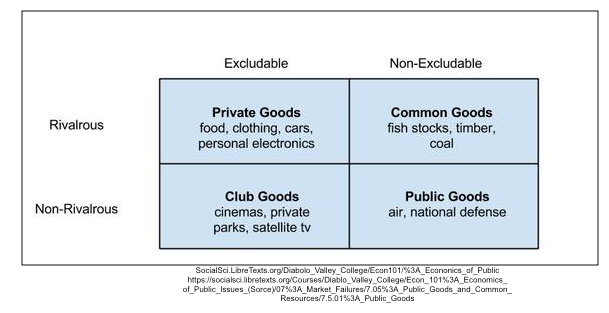
 Based on the definition that property ownership is rival and exclusionary, collectivist thinkers built a truth table to show Common Resources (excludable but non-rival) and Club Goods (rival but non-excludable). That is nonsense. 


Define Human as “rational animal” and the non-rational animal and rational non-animal remain not-human. So, too, are common resources and club goods not property. Non-A cannot be A. Nothing is not a different kind of something.


Contrary to the collectivist claims, freshwater, fish, timber, and pasture are all exclusionary and rival. You can’t have your fish and let your neighbor eat it, too.


What they call “club goods” are defined and limited by technology, not by metaphysics. Discussing radio broadcasting in her essay, “Property Status of the Airwaves” Rand correctly pointed that two broadcasters cannot share same frequency. But they can. Just not at the same time. And time-slicing allows two (or more) broadcasters to occupy the same wavelength. However, that does not change the fundamental principle that these timely-sliced increments are property. 


From Diabolo Valley College Econ101 linking from PennState,
College of Earth and Mineral Sciences.
"EBF 200 Introduction to Energy and Earth Sciences Economics:
Public Goods and Common Pools."
Also found in Investopedia and Quickonomics.

Common resources – non-excludable but rival (freshwater, fish, timber, pasture)

Common resources are defined as products or resources that are non-excludable but rival. That means virtually anyone can use them. However, if one individual consumes them, their availability to other consumers is reduced. The combination of those two characteristics often results in an overuse of these resources because demand exceeds the available quantity (see also the tragedy of the commons). Examples of common resources include freshwater, fish, timber, pasture, etc. -- https://quickonomics.com/different-types-of-goods/

 Club goods – excludable but non-rival (cable television, cinemas, wireless internet, toll roads)

Club goods are products that are excludable but non-rival. Thus, individuals can be prevented from consuming them (i.e., access can be restricted), but their consumption does not reduce their availability to other individuals (at least not until a point of overuse or congestion is reached). Club goods are sometimes also referred to as artificially scarce resources. They are often provided by natural monopolies. Examples of this type of goods include cable television, cinemas, wireless internet, toll roads, etc. -- 

https://quickonomics.com/different-types-of-goods/


It is true that you and I can both watch the same program on cable-TV. The hidden error was identified by Ayn Rand as “the blank out” and Rand identified its logical expression as the fallacy of the stolen concept. You and I can both watch the same cable-TV show – up to a point: we all know what happens when too many users overload a website. More deeply and cogently, for anyone to access television or the internet, physical goods must be produced. The perception of social largess as a “club good” blanks out on the previous non-existence of roads and theaters.  

We [the American Historical Association] encountered a similar experience in 2001, when the AHA decided to create a freely available online collection of Civil War newspaper editorials, utilizing two volumes originally published by the AHA in 1931 and 1942. AHA staff quickly discovered that no copyright renewal was ever filed for the second volume, edited by Harold C. Perkins, and it subsequently had entered the public domain. However, the editor of the first volume, Dwight L. Dumond, had renewed the copyright in his own name in 1959. Orphan Works Notice of Inquiry – 70 Federal Register 3739 (Jan. 26, 2005)

http://www.copyright.gov/orphan/comments/OW0676-AHA.pdf

To me, the error was the granting of the copyright to Dwight L. Dumond. As the editor, he was a hireling. His work rightfully belonged to those who paid him for it. The concept of a collective entity in law –what we call a “corporation”-- has roots in the Roman republic. Under Roman law, a flock of sheep was a collective entity: lose a lamb or gain a lamb, it is the same flock. On that basis, cities were taxed: the city was an entity that owed tribute to Rome, itself a collective entity. No one owned a city. Under American law, the American Historical Association as an entity can certainly be protected from theft by its employees. 


On or about the same day as the link about Public Domain Day, Google News offered a link to a story from GameRant.com about the Star Trek canon. Star Trek is owned by Paramount Global. (The July 2024 merger with Skydance may be challenged now through the FCC but that does not affect what follows.) Since 1966 many details of the continuing, expanding, and extending myth have been changed. Others remain constant. In this case, the legal owners changed an element of the canon - the physiognomy of the Klingons was altered in Star Trek: Discovery and the fans objected. (Klingons had changed once already but that was accepted.) Using a new storyline in Star Trek: Lower Decks, the owners offered some technical explanations for the change. 


To me, that is all good because myths change in the retelling. Mythology allows that: characters can merge or split; new characters can be entered while established characters leave. Star Wars: A New Hope is just the Wizard of Oz: Luke is Dorothy; R2D2 is Toto, … But in Star Wars, one aspect of the Wicked Witch (Darth Vader) is saved while the other aspect of the character (the Emperor) perishes. That begs the basic question: Who owns Star Wars or Star Trek or Harry Potter?  At what point does the creation of intellectual private property enter the public domain? Is there such a point? 


Back in the early 2000s, before the Atlas Shrugged movies were released, a Rand Fan created some Atlas Shrugged swag, a Rearden Steel trucker's cap, etc. The Ayn Rand Institute sent her a lawyer letter reminding her that the artifacts were based on the copyrighted works of Ayn Rand. So, as an Objectivist herself, she ceased and desisted. But we cannot imagine Paramount chasing down every "Beam me up, Scotty" bumper sticker. And personally, I think that the ARI should have just shrugged it off by labelling their gear "Official" the way that Major League Baseball does. 


https://web.law.duke.edu/cspd/publicdomainday/2025/

I have donated to the Internet Archive and the Wayback Machine. (Similar archives include the Hathi Trust and the Linda Hall Library.) Like the promoters of Public Domain Day, my comrades at the Internet Archive claim a moral high ground because they are offering the works for free and have no commercial interest in the use. To me, that argument is irrelevant. And it is falsified by several considerations. They do accept donations, and it is easy to assume that donors are users. Absent donors, the entity would not exist. So, they are in business. And in business for a profit because not-for-profit is only a matter of bookkeeping: owner's equity is called "net assets."


Long ago, writing in The Libertarian Connection, Skye d’ Aureus and Natalie Hall argued against Ludwig von Mises’s assertion that truth and beauty are not economic goods. Skye and Natalie pointed out that truth and beauty must be produced by human action.  

As collectivism grows in popularity, and as the nonproductive consider themselves increasingly entitled to the wealth created by the productive, Rand’s arguments in favor of intellectual property rights merit reinforcing not diminishing. -- "Ayn Rand's 'Patents and Copyrights'" by Marilyn Moore, posted May 28, 2019.  https://www.atlassociety.org/post/ayn-rands-patents-and-copyrights

Writing for the Atlas Society, Marilyn Moore (Director of Student Programs) parsed the difference between copyrights and patents and argued contrary to Rand that literary works should be patented while inventions should be copyrighted.  Moreover, Moore asserted, as a metaphysical fact, a discovery cannot be patented or copyrighted. First, the discoverer did not create the fact; and, second, once announced to the public, the discoverer cannot prevent other people from now knowing what they know. Third--and most consequentially--it is immoral to deny independent discovery and therefore independent invention. It is unlikely that two people will write the same book. It is well known that two people can create the same solution to a technical problem based on a shared (though independent) understanding of the facts of reality.


PREVIOUSLY ON NECESSARY FACTS

Copy Rights and Wrongs 

Objective Intellectual Property Law 

U.S. Patent Law Does Not Add Up 

Patent Nonsense: Intellectual Property Rights and Non-Objective Law 

Biohackers 


Sunday, December 31, 2023

Books Read and Not Read in 2023

This past summer, I read The Left Hand of Darkness and The Dispossessed. I also read The Time MachineThe Invisible Man, and The War of the Worlds in quick succession. I just finished Their Eyes Were Watching God by Zora Neale Hurston. Between those markers are several other science fiction novels left unfinished including The Iron Heel. James Joyce’s Ulysses was quickly abandoned. 

Curious Books in East Lansing.

Hurston was recommended to me by a co-worker, a garage attendant with a degree in English. I had no idea who Hurston was and reading about her was as compelling as her work. She was complicated. So, she is a Rorschach inkblot to every biographer. I will not add my uninformed opinions. I like Huston’s narration. 


“Seeing the woman as she was made them remember the envy they stored up from other times. So they chewed up the back parts of their minds and swallowed with relish. They made burning statements with questions, and killing tools out of laughs. It was mass cruelty. A mood come alive. Words walking without masters, walking together like harmony in a song.”


“They sat in the fresh young darkness close together. Pheoby eager to feel and do through Janie, but hating to show her zest for fear it might be thought mere curiosity. Janie full of that oldest human longing—self revelation. Pheoby held her tongue for a long time, but she couldn’t help moving her feet. So, Janie spoke.”


“Sop and his friends had tried to hurt her but she knew it was because they loved Tea Cake and didn’t understand. So she sent Sop word and to all the others through him. So the day of the funeral they all came with shame and apology in their faces. They wanted her quick forgetfulness. So they filled up and overflowed the ten sedans Janie had hired and added others to the line. Then the band played, and Tea Cake rode like a Pharaoh to his tomb. No expensive veils and robes for Janie this time. She went on in her overalls. She was too busy feeling grief to dress like grief.”


The City of Dreaming Books by Walter Moers (Harvill Secker, 2006. Set in Stempel Garamond), is a fantasy. As parody, it is a spoof and quickly became cloying. And yet, it remains interesting as I read night after night. It is a story about books, writing them, printing them, buying, selling, and collecting them. Our hero, Optimus Yarnspinner, is a dinosaur. This world is also inhabited by many other fantastic creatures. Their images were drawn by the author. 

Inhabitants of Bookholm.
 

Not being steeped in literature myself, many of the allusions went over my head. About halfway in, the anagrams leapt out at me because of a parody of “The Bells” written by Perla la Gadeon whose anagram I deciphered on sight. Much else fell into place. I already understood the bookstores and the other avenues of commerce and the inelegant pathways of earning a living by writing for readers. 


Bibliophiles who live underground.


I also found something that the author did not intend with his description of a book hospital where devoted cyclops creatures repair old books. “It’s where we restore worm-eaten or damaged books. We reconstruct texts and reprint them or repair the bindings. Books can be damaged in many ways,” explains the guide. It sounds benevolent but we just attended "The Long Lives of Very Old Books" at the Harry Ransom Center and among the displays were forgeries in which stolen books had been cut apart, pages reproduced (sometimes by hand lettering), and the books rebound, and sold to collectors. The British Museum bought a large inventory of its own former shelving.


Addendum 21 January 2024

I finished the book. I thought that Moers wrote it in English because I did not believe that the translator, John Brownjohn, is a real person. He is. Moers himself is secretly famous. 

Walter Moers on IMDb
Walter Moers in LibraryThing 
Walter Moers in TVTropes 
Walter Moers in Wikipedia 
The City of Dreaming Books in Wikipedia 

PREVIOUSLY ON NECESSARY FACTS

Start the Presses! 

For the Glory of Old Lincoln High 

ArmadilloCon 45 

Firefly: Fact and Value Aboard Serenity 

Libraries of the Founders 


Sunday, October 15, 2023

Annular Eclipse 14 October 2023

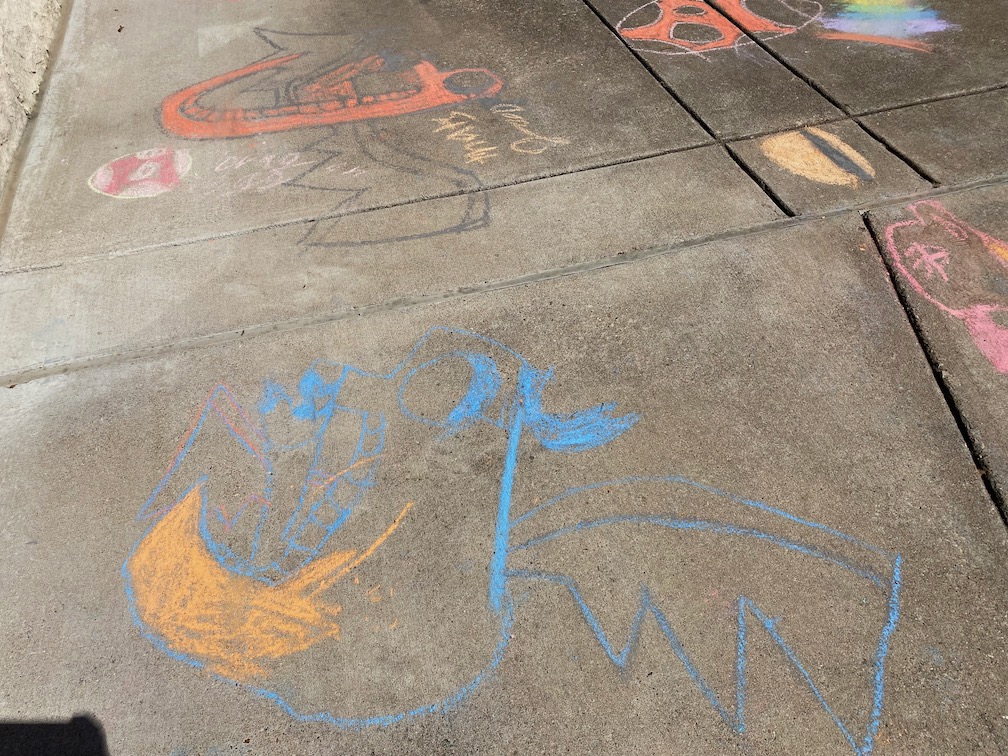
The City of Kyle Public Library Astronomy Club hosted viewing of the annular solar eclipse of 14 October 2023. The Library also pitched in with extra viewing glasses, a case of bottle water, and a bucket of sidewalk chalk. We gave out 22 pairs of glasses, 12 from the club and 10 from the library. About 30 people attended, many staying up to an hour past maximum.


From Kyle, Texas, we were not on the "Ring of Fire" path, but one of the viewers reading her cellphone reported that we would be at 88.9% coverage. 

Helping the crowd, I never got to take a photograph with my 102 mm refractor.


PREVIOUSLY ON NECESSARY FACTS


Lunar Eclipse 8 November 2022 

Jupiter-Saturn Conjunction 2020 

Redshift: Six Years with Astronomy 

Cursing the Moon 

Eclipses? 

An Amateur Astronomer’s Credo 

When Worlds Collide