Showing posts with label Galileo. Show all posts

Thursday, October 22, 2020

Galileo and Saturn: Epistemology not Optics

It is commonly claimed that Galileo did not perceive the rings of Saturn because the telescope he was using was not capable of magnifying the image. That is not true. After Galileo, astronomers needed another 50 years to think about the problem and re-imagine it. They needed to ask the right questions. Christiaan Huygens was the first to perceive the structure as a ring. However, it was another 200 years before the ring was understood as a system of particles, rather than a rigid body. The problem was epistemology, not optics.

Galileo’s Images of Saturn 1610 and 1616
https://attic.gsfc.nasa.gov/huygensgcms/Shistory.htm

    “Galileo Galilei was the first to observe Saturn with a telescope in 1610. Because of the crudeness of his telescope, he couldn't determine what the rings were. He incorrectly guessed that there were two large moons on either side of Saturn. Two years later when he viewed Saturn again, the "moons" had disappeared. We know now this is because Galileo was viewing the rings edge-on so that they were invisible, but at the time it was very confusing to Galileo. After another two years, Galileo viewed Saturn again and found that the "moons" had returned. He concluded that the rings were “arms” of some sort.

            “Many years later, in 1659, a Dutch astronomer named Christiaan Huygens solved the mystery of Saturn's "arms." Because of improved telescope optics, he correctly deduced that the "arms" were actually a ring system. Huygens also discovered Saturn's moon, Titan, and for this reason, the probe exploring Titan is named after him.” 

From NASA’s Cassini-Huygens Mission website (no longer current) here https://attic.gsfc.nasa.gov/huygensgcms/Shistory.htm

Galileo’s Sketch of Saturn” 
from Galileo and the Scientific Revolution 
by Laura Fermi and Gilberto Bernardini,
Basic Books, 1961.

“When he turned his telescope on the planet Saturn, he found that this did not always look like a round body but seemed of strangely variable shape. He thought it to be “three-bodied; that is it … was an aggregate of three stars arranged in a straight line parallel to the ecliptic, the central star being much larger than the others.” His telescope was not sufficiently powerful to let him to distinguish the three, possibly four, rings we now know are around Saturn. It was the Dutch astronomer Christian Huygens (1625-1695) who discovered Saturn’s rings.” -- Galileo and the Scientific Revolution by Laura Fermi and Gilberto Bernardini, Basic Books, 1961.


“Galileo continued his telescopic observations from his new home in Florence. Here he discovered that Saturn sports a pair of curious appendages, but his telescope was not powerful enough to reveal their true nature. (They were Saturn’s rings.)” Parallax: the Race to Measure the Cosmsos by Alan Hirshfeld, W. H. Freeman and Company, 2001. 


“1610 - Galileo Galilei becomes the first to observe Saturn's rings with his 20-power telescope. He thought the rings were “handles” or large moons on either side of the planet. He said “I have observed the highest planet [Saturn] to be tripled-bodied. This is to say that to my very great amazement Saturn was seen to me to be not a single star, but three together, which almost touch each other”. 

“1612 - Galileo was astounded when he found that the rings he first observed a couple of years earlier had now disappeared. He wrote "I do not know what to say in a case so surprising, so unlooked for and so novel". The rings were, in fact, edge-on from Earth's perspective. Galileo inadvertently became the first person to observe a Saturn ring plane crossing. 

“1616 - Galileo now observes the rings as two half ellipses. He wrote “The two companions are no longer two small perfectly round globes ... but are present much larger and no longer round ... that is, two half ellipses with two little dark triangles in the middle of the figure and contiguous to the middle globe of Saturn, which is seen, as always, perfectly round.”

 From Views of the Solar System Copyright © 1995-2015 by Calvin J. Hamilton. https://solarviews.com/eng/saturnbg.htm


Museo Galileo, Florence
https://catalogue.museogalileo.it/indepth/SaturnsRings.html

“In some observations conducted in 1610, Galileo (1564-1642) saw Saturn as tricorporeo [three-bodied], i.e.,composed of a central body and two lateral bulges, which he mistakenly thought to be satellites. In 1655, Christiaan Huygens (1629-1695), thanks to a more powerful telescope, observed Saturn's rings for the first time. He described them accurately in Systema Saturni (The Hague, 1659). The Accademia del Cimento was concurrently investigating the nature of the rings. Between 1671 and 1684, Giovanni Domenico Cassini (1625-1712) discovered four satellites of Saturn, in addition to the one previously found by Huygens. Cassini also observed and studied the divisions between the rings. Recently, the Voyager space probes have revealed that the many concentric rings are thin bands consisting of countless rock and ice fragments that orbit the planet and reflect sunlight.”

© 2018 - 2020 Museo Galileo - Istituto e Museo di Storia della Scienza 

https://catalogue.museogalileo.it/indepth/SaturnsRings.html


https://www.bibliovault.org/thumbs
/978-0-8165-0829-7-frontcover.jp
g

“Telescopic studies of Saturn, its ring system, and its satellites from 1610 to about 1900 are surveyed. Early observations of the Saturn system and changing beliefs about the constitution of the rings are covered, showing that what an observer sees in the heavens depends not only on the quality of his instruments, but also on what he expects to see. The first observations of the Saturn system by Galileo, the development of the ring theory by Huygens, and the replacement of Herschel's and Laplace's solid ring theories by Maxwell's particle ring theory are recounted.” 

Saturn Gehrels, Tom; Matthews, Mildred Shapley (Editors). Tucson, University of Arizona Press, 1984, p. 23-43.


Introduction to Objectivist Epistemology
by Ayn Rand (2nd. edition)


In Introduction to Objectivist Epistemology, Ayn Rand asserted that a sensation must be identified to become a percept. A set of percepts, identified and integrated by common attribute becomes a perception. A set of perceptions integrated by their common characteristics are given a name and thereby made into a concept. Concepts are further abstracted by their essential distinguishing characteristics, according to objective context, into wider (and more powerful) ideas. Without identification, a sensation alone is meaningless. Not knowing what to expect, Galileo could not perceive the rings of Saturn correctly.


Just as it took time for the nature of Saturn’s rings to be teased out from the observations, so, too, did someone 400 years after Galileo finally put 2 and 2 together. In 2005, the science of epistemology informed astronomy.


“Saturn was first seen through the telescope by Galileo in the summer of 1610. In the ensuing half century, Saturn's strange appearances became a celebrated puzzle. The problem was often not the poor quality of telescopes: a number of observers drew images that we would interpret as showing a ring around the planet. It was also a problem of concepts because for several decades observers had the wrong model in mind when they observed the planet. Thus we could say that their telescopes could show them the ring, but their preconceptions did not allow them to see it. The manner in which Christiaan Huygens arrived at the solution, in the winter of 1655-56, shows that more than good telescopes were necessary, although for rhetorical reasons Huygens maintained the opposite. And Huygens's ring-theory, [elegant] as it was, had several shortcomings that were slowly fixed--often by others.” --  “Saturn through the Telescope: The First Century” by Albert Van Helden. American Astronomical Society, DPS meeting #37, Bulletin of the American Astronomical Society, Vol. 37, p.620. Pub Date: August 2005


Explore Scientific First Light 102
660 mm focal length


Last night, I went out with my telescope to see what Galileo could or could not have perceived, had he held the identifying concept. Admittedly, the 102 mm objective of my Explore Scientific refractor has 16 times the area of his. However, I am inside a city, a mile from a major shopping center. He was in Florence, a city with smoke, perhaps, but no arc vapor street lights. 


I tested three magnifications: 20.8x (32 mm), 26.4x (25 mm) and 38x (17 mm). At 21 power, it was a strong “maybe” given Galileo's patience. At 26.4 power the rings were discernable without question, and at 38x, they were undeniable. Although his 20x telescope was his primary instrument, it was not his only telescope. He had made a 30-power at the same time, but gave it to Cosimo Medici. I believe that Galileo’s instruments were good enough, but understanding of the taxonomy of the solar system required a conceptual leap that would have to wait for later astronomers.


PREVIOULSY ON NECESSARY FACTS


The Scientific Method 

Feynman's Rainbow 

Harriman's Logical Leap

Cosmos: a Spacetime Travesty 


Saturday, August 8, 2020

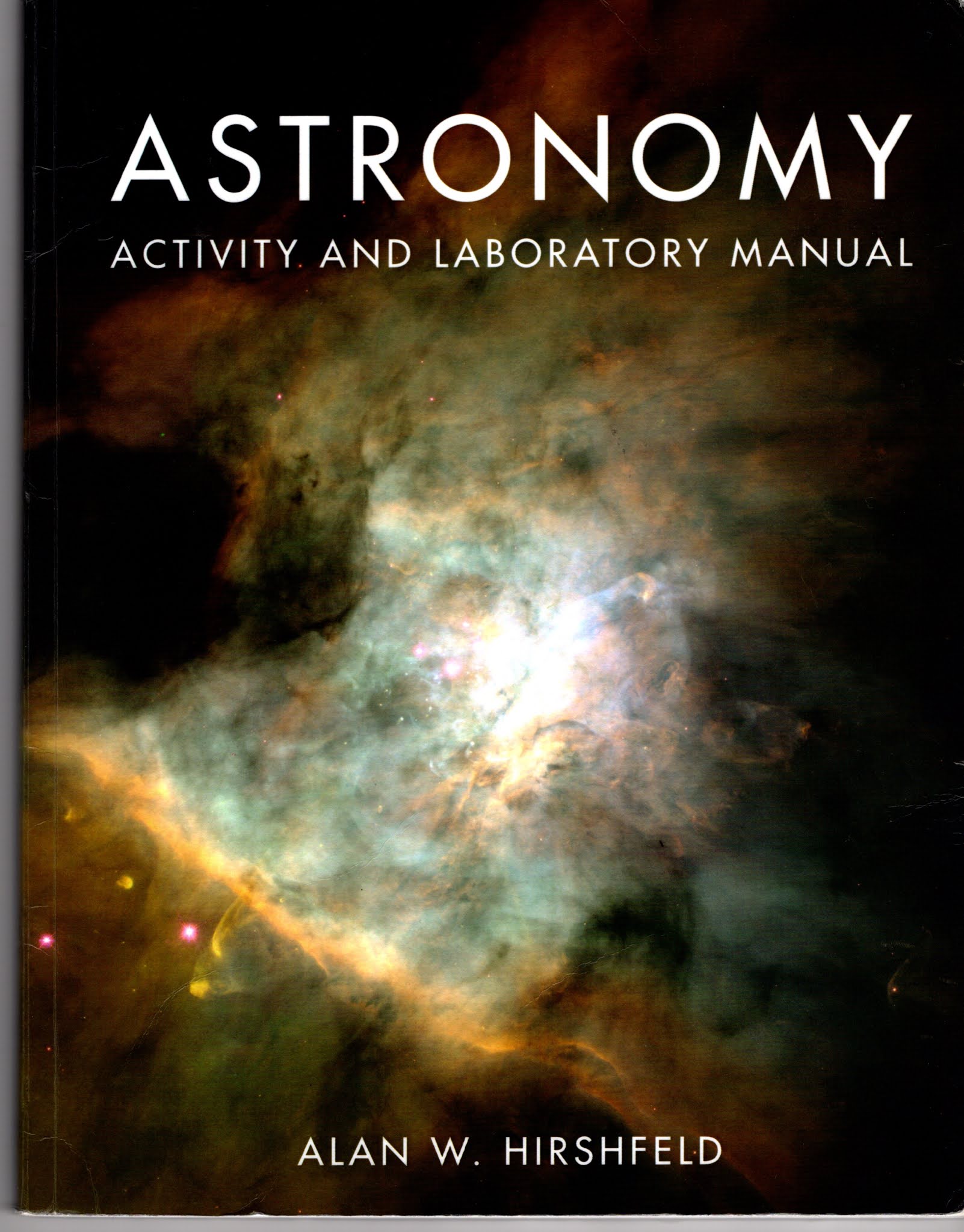
Measuring Your Universe: Alan Hirshfeld’s Astronomy Activity Manual

This guide to hands-on learning instilled me with a sense of confidence about my ability to perform the basic mathematics of astronomy. The exercises start with measuring shadows to track the sun as evidenced by stone age monuments. Before the last one, the learner estimates the expansion rate of the universe according to Hubble’s Law. The learning does not end there. Prof. Hirshfeld is a good instructor, and the assignments come full circle. Having started with the Sun and Moon, the book ends by assigning the calculations to estimate the relative masses of Sirius and its dwarf companion. (Just to note: This is from the first edition of the book (2009); the second edition (2018) is a bit different; and a third edition is promised.)

The stars are pretty at any magnification. It is most important to understand what you are looking at. Following these structured exercises, I gained an intuitive understanding of how astronomy developed historically, and (more importantly) of my location in the universe.

First Edition. 2009.
 

It starts with the gnomon, basically a vertical stick in the ground. At the end of the shadow, you place a stone. In Chapter 2, several thousand years or generations later, you come to the conclusion that the angle of the Sun in the sky at mid-day is directly related to the length of the shadow relative to the height of the stick. Theta equals arctan(L over H). 


Hirshfeld provides good, simple explanations of the math, though not in depth. At the back is a tutorial on basic trigonometry. Neither is a substitute for a semester of trig. Hirshfeld just gives you the number 57.3 without telling you where it came from. Similarly, it is true that although you do not need much mathematics to benefit from the hands-on calculations, you do need some. Even so, Hirshfeld steps you through work that you will come back to again. The same basic formulas are applied repeatedly to new problems from measuring the diameter of the Earth to measuring the distances to the Moon and Sun and then to the stars.  


Even if you are completely math-phobic, you can still get a lot out this by at least reading through the exercises to appreciate how the Greeks, Galileo, Kepler, Newton, and the astronomers of the 19th and 20th centuries came to their conclusions. If all of the arithmetic and algebra is “digital” then “Activity 15: Picturing the Universe—How Photography Revolutionized Astronomy” is “analog.” 


I put off the central exercise of “Activity 14: Parallax” until I finished the rest of the book. I could have just worked through it on paper, but I wanted to set up a yardstick in the doorway between the kitchen and the living room in order to take my own measurements. Alan Hirshfeld is the author of Parallax: The Race to Measure the Cosmos; W. H. Freeman & Co., 2001. So, I wanted to give him his due and take my time with the work before reading the book.


Activity  1  The World's First Skywatcher - YOU!

Activity  2  Shadowland

Activity  3  Shadowland - the Sequel

Activity  4  Shadowland Follow-up

Activity  5  The Phases of the Moon

Activity  6  Eratosthenes Measures the Earth

Activity  7  Aristarchus Measures the Size and Distance of the Moon

Activity  8  Aristarchus Measures the Size and Distance of the Sun

Activity  9  The Copernican Cosmos

Activity  10  Kepler's Third Law

Activity  11  Isaac Newton and the Moon

Activity  12  Galileo Measures a Mountain - on the Moon!

Activity  13  Precision Astronomy After Galileo - Stellar Aberration

Activity  14  Precision Astronomy After Galileo - Stellar Parallax

Activity  15  Picturing the Universe - How Photography Revolutionized Astronomy

Activity  16  How Bright is That Star? A Tutorial on the Magnitude System

Activity  17  The Realm of the Spiral Nebulae

Activity  18  Hubble's Law - in the Kitchen and in the Universe

Activity  19  The Herzsprung-Russell Diagram

Activity  20  Binary Stars and Stellar Motions.

Appendix  Mathbits


In the second edition, Activity 19 is about Dark Matter. In fact, while I found the second half the H-R Diagram helpful, the introduction about height and shoes sizes was obvious. Perhaps plotting the land speeds and weights of various mammals would have been more analogous to the relationships between spectral types and luminosities. The second edition also replaced the work on Sirius A Sirius B with your own reflective essay. I believe that was a loss. The reflective essay could help the instructor modify the class. I still think that it would have been best left as extra credit. The H-R diagram is important to modern astronomy.

Although I have a calculator on my iPhone and my computer, I bought a new one just for this, a basic scientific TI-30Xa. It was $8.95 which is like 89 cents in 1978 dollars when we bought our first TI-30 calculators. The universe may not be expanding, but the money supply is. Still, I worked several of these in my head by approximation, 3 for pi, and so on. 


PREVIOUSLY ON NECESSARY FACTS

In Support of the Entry-Level Telescope 

and

Defending the Hobby-Killer Telescope 

Problems with Pop Sci from Sky & Telescope (Part 1)

and

Problems with Pop Sci from Sky & Telescope (Part 2) 


Wednesday, July 15, 2020

Astrophotography is a Lot Like Love

It took five hours over four nights to figure out how to get an image with my new iPhone 11.  I gave up trying the smaller telescopes, a 2-3/4 inch refractor and a 5-1/4 inch reflector. Just attaching the phone knocked them far out of alignment and I had to retighten the bolts against the extra weight. So, I turned to a large 8-inch Maksutov catadioptric that I borrowed from the Austin Astronomy Club. That, at least, had good inertia. 

The next problem was focusing. The iPhone 11 makes a lot decisions for you. And it has a lot of options. It all just gets in the way.

Failed imaging with camera out of focus
When the night has been too lonely
and the road has been too long
And you think that love is only for the lucky and the strong

The Austin Astronomical Society featured a guest speaker a couple of months ago who talked about astrophotography. He kept waving his iPhone around saying, "All you need is one of these. All you need is one of these." Well, behind him was an electric guitar. So, this was a dextrous dude. No wonder he finds it easy. 

My current project is working my way through Astronomy Activity and Laboratory Manual by Alan W. Hirshfeld. The arithmetic, algebra, and trigonometry are easy, but real the fun is in following the logic and discoveries of the Paleolithic people, Aristarchus, Copernicus, and Kepler, up through Hubble, to measure the day, the distances to the Sun, the Moon, the planets, and beyond. 

Just remember in the winter,
far beneath the bitter snows
Lies the seed, that with the sun's love
in the spring becomes the rose

It is true that the telescope is a wonderful instrument. Last week, I again observed the star group catalogued as Messier 7, called "Ptolemy's Nebula." Ptolemy knew it as a permanent cloud, just as other ancients catalogued the Andromeda Galaxy as a fixed patch of something. The first telescopes allowed many of those sparkly patches to be resolved into collections of individual stars. 

Andromeda was not resolved into a flat disk until our century and it was not so much the 100-inch telescope as it was the photographic plates that made that possible. So, photography is important and useful. That being as it may, only in 1924 did Edwin Hubble rely on Henrietta Leavitt's work with Cepheid variables (1912) to demonstrate that Andromeda is another "island universe" 860,000 light years away.  

I distance myself from the hobbyists who stack images and photoshop the colors to produce artwork that is not science. Perhaps even more to the point, Astronomy magazine for August 2020 has a glowing review of the Stellina imaging telescope. This robotic camera "captures and stacks exposures to create ever-more-detailed celestial images." You do not even need to know a single star or constellation. The database does all the work. 


Saturday, April 26, 2014

De Magnete by William Gilbert


Apparently, no one had cut a magnet in half before.  Claims were made for the existence of gold magnets. Lodestone was a remedy for contrary medical symptoms.  Even the sailors who relied on lodestones wrongly called the poles of a magnet north and south for pointing north and south.  In 1600, while Galileo worked on mechanics in Padua, William Gilbert (or Gilberd) investigated magnetism in London. 

Galileo’s crime was questioning Aristotle.  Gilbert denounced Aristotle as a second-hander, a mere copyist for wives’ tales.  Galileo wrote in vernacular Italian. Gilbert wrote in Latin. Gilbert created new words for the new concepts he discovered: verticity for the tendency of an iron needle to point to a magnetic pole; versorium for an electroscope, i.e., a needle on a pivot to detect fields; coition for attraction because both bodies are mutually pulled to each other.  That last was a serious problem for the Victorian reader.  This Dover edition is a reprint of P. Fleury Mottelay’s 1889 translation. Mottelay nicely rendered this into an archaic kind of English, readable by moderns but spiced with older phrasings that perhaps more correctly delivered Gilbert’s own thinking.  Moreover, this edition is supported by copious footnotes from the author’s own research into the history of magnetics. 
  
You can find the original in Latin at the Lancaster University faculty projects archives here. Mottelay knows his science; and in translating, he does employ some modern terms, chief among them, "field."  In truth, Gilbert did not hypothesize fields. That thinking came later.

William Gilbert knew that the Earth is a magnet.  Earth’s magnetic field gives polarity to iron.  Heat a bar or needle of iron until it loses all attraction, then, place the bar aligned north and south and let it cool. It will acquire polarity. 

You can prove this for yourself, Gilbert enjoins you, by running the needle through a cork and floating it in a tub.  That is a simple apparatus; and he employed it over and over in different ways to tease out the facts about magnetism.

The beauty of this work is the intense and patient study behind it.  Gilbert was not publishing conjectures.  He was announcing empirical facts.  He called for experiments and observations in rejection of the compiling of authoritative citations from ancients.  In that, William Gilbert helped to nurture the Renaissance into the Age of Reason.   

He made some mistakes.  While clearly understanding that electricity is related to magnetism, he did not find evidence of electro-static repulsion.  He also claimed that magnetic variation is constant, though a generation later, it was measured as variable.  It is more important that he knew about variation, that the magnet aligns not quite true north-south, depending on the location on Earth.

Gilbert constructed models of the magnetic Earth, spheres of iron charged with polarity. He knew that bars and needles exhibit the phenomena better, but he had another point to make; and he did so repeatedly.  One of his spheres has a chunk missing. Another has a large protrusion. Thus, Gilbert demonstrated magnetic variation over the oceans and near mountains.

ALSO ON NECESSARY FACTS


Friday, August 3, 2012

Science in the Middle Ages

Objectivists value the scientific method as the cornerstone of the engineering achievements of our civilization from structural trusses and direct current to alternating current and cybernetics.  We too easily see the Middle Ages as a time of ignorance and barbarism in which learning was chained to (and by) theology.  The reality is more complicated.

“The Middle Ages was a period ruled by the Witch Doctor, in a firm, if mutually jealous alliance with Attila. The Witch Doctor controlled every aspect of human life and thought, while the feudal Attilas looted one another’s domains, collected material tributes from serfs – who worked, lived, and served in subhuman conditions – and maintained the power to burn heretics at the stake.
“Philosophy, in that era, existed as a “handmaiden of theology,” and the dominant influence was, appropriately, Plato, in the form of Plotinus and Augustine. Aristotle’s works were lost to the scholars of Europe for centuries. The prelude to the Renaissance was the return of Aristotle via Thomas Aquinas.” – Ayn Rand, “For the New Intellectual.”

Astronomy, in particular was not dormant, nor could it be.  The problem of Easter required bringing lunar and solar calendars into alignment.  Whether biology, botany, and medicine had any hint of modernism is a difficult question, but can only be answered with direct citations to contemporary works.  Like the revolution of the Earth on its axis and the orbit of the Earth about the Sun, proof contrary to spontaneous generation did not come until the 1840s. As with astrology versus astronomy, it is too easy to dismiss alchemy as not being "real" chemistry. While its paradigms are not ours, the practices were utilitarian: dying wool and leather were important crafts. Paints, pigments, and finishes also were consequential.

“Historians have long recognized that the rebirth of science in twelfth-century Europe flowed from a search for ancient scientific texts. But this search presupposes knowledge and interest; we only seek what we know to be valuable. The emergence of scholarly interest after centuries of apparent stagnation seems paradoxical. This book resolves that seeming contradiction by describing four active traditions of early medieval astronomy: one divided the year by observing the Sun; another computed the date of Easter Full Moon; the third determined the time for monastic prayers by watching the course of the stars; and the classical tradition of geometrical astronomy provided a framework for the cosmos. Most of these astronomies were practical; they sustained the communities in which they flourished and reflected and reinforced the values of those communities. These astronomical traditions motivated the search for ancient learning that led to the Scientific Renaissance of the twelfth century.” (Astronomies and Cultures in Early Medieval Europe by Stephen C. McCluskey. Cambridge University Press,  1997.) 

“Measurements by clepsydras prove … that although the earth is at the center of the universe, it is eccentric to the sun's orbit. At times the sun is borne at a greater distance from the earth than at other times. When the sun is climbing upwards in Cancer and Gemini, in the steeper tracts of its course, it takes longer, lingering 32 days in Gemini; but it requires less time in the lower tracts, 28 days in Sagittarius, the elapsed time for the other signs varying between those extremes (848-849) . “Dominant Traditions in Early Medieval Latin Science” by William H. Stahl, Isis, Vol. 50, No. 2 (Jun., 1959), pp. 95-124. 

Mean Speed from the Oxford
Calculators used by Galileo
"The sorry state of scientific studies at the close of the Roman Empire in the fifth century reflected Roman, not medieval, failures and short-comings." "How Science Survived: Medieval Manuscripts as Fossils” by Sharon Larimer Gilman and Florence Eliza Glaze. Science, New Series, Vol. 307, No. 5713 (Feb. 25, 2005), pp. 1208-1209.

“The dominant explanation of human behavior at this time was astrology.  Charles, like most of his contemporaries, ruled with the advice of the recognized social scientists of the day, the court astrologers. In this vein Oresme was ordered by Charles to translate Ptolemy's Quadripartitum from Latin into French. This order discharged, Oresme then attempted to debunk the popular conceptions in an attack on judicial astrology, Contra judiciaros astronomos (1360), which he later translated into French. There is no hint in the historical record that Oresme's efforts altered the predominance of astrology in the determinance of social policy; indeed, he returned to the attack ten years later with a treatise entitled Contra divinatores horoscopios, and in a series of Quaestiones (a stylized form of question and answer popular with academicians of the period).”
“Nicole Oresme and Medieval Social Science: The 14th Century Debunker of Astrology Wrote anEarly Monetary Treatise” by Kevin B. Bales, American Journal of Economics and Sociology, Vol. 42, No. 1 (Jan., 1983), pp. 101-111.

“WHEN historians and historians of science flatly state that Ptolemy's Almagest and Geography dominated the fields of astronomy and geography for fourteen centuries, they are apt to mislead unwary readers into supposing that Ptolemy was the supreme authority in Latin science during that period. Quite the contrary, his works might almost as well never have been written for all the influence they had in the Latin West until translations were produced from Greek or Arabic texts in Toledo and Sicily in the twelfth century.' If there was any dominant tradition of Latin science in the first thirteen centuries of the Christian Era, it was a stream of encyclopedic literature, the main course of which may be traced backwards through the Latin encyclopedist Varro and the Platonizing Stoic Posidonius; to trace sources beyond them is difficult indeed. In any case it is well to bear in mind that this stream of encyclopedic works skirts around Ptolemy without being appreciably influenced by him. We can trace its course through the extant writings of Pliny, Theon of Smyrna, Cleomedes, Geminus, and numerous others.

“Of the three, Martianus Capella offers the best account of encyclopedic science and will be discussed first. He seems to have flourished in the first half of the fifth century.  Martianus Capella wanted to produce an encyclopedia in the Varronian tradition and, by excluding two of Varro's disciplines, medicine and architecture, laid the foundation of the medieval trivia and quadrivia.

The first work of Archimedes translated into Latin was the Measurement of the Circle. It was translated from the Arabic twice in the twelfth century.' The first translation, which I have argued (but not surely) was done by Plato of Tivoli, was most inferior; just three manuscripts are known, only one of which is medieval. Apparently not long after this first translation the great translator Gerard of Cremona again used the Arabic text and rendered the Measurement of the Circle into Latin. This time the translation was quite accurate, and so before 1187 a faithful version of this short but important treatise became available. We are fortunate that this version was included in MS Bibliotheque Nationale, Fonds latin 9335, a handsome codex of Gerard translations. Incidentally, this manuscript is one of the best examples of intelligent copying of scientific works. It has marginal variant readings which cite alternate copies. The drawings are carefully made. Even more important the transcription of numbers - even of six places - is almost perfect. “The Impact of Archimedes on Medieval Science,” by Marshall Clagett, Isis, Vol. 50, No. 4 (Dec., 1959), pp. 419-429. 

"Among late thirteenth and fourteenth century philosophers, the Averroists have been particularly noticed by historians as advocates of the autonomy of the sciences. In arguing, for example, that physics might give an answer to the question of the eternity of the world different from the answer given in accordance with Christian belief, Boethius of Dacia based himself largely on a conception of physics as an independent discipline with its own principles, rational methods, and conclusions. This approach to the autonomy of the sciences was not, however, the only influential one in this period. Another basis for the autonomy of physics is found in the work of certain Oxford commentators on Aristotle's Physics, most prominently in William of Ockham's Expositio super octo libros Physicorum. This second approach makes physics autonomous by placing greatest confidence not in deductively and causally prior principles of physics, which some thought could be proved or made known by metaphysics, but rather in propositions accepted on the basis of experience, if not known in themselves. The primary evidence cited in the following paper." “The a Posteriori Foundations of Natural Science: Some Medieval Commentaries on Aristotle's Physics, Book I, Chapters 1 and 2” by Edith Dudley Sylla, Synthese, Vol. 40, No. 1, Jan., 1979, pp. 147-187.
 In The Logical Leap, Objectivist physicist and philosopher David Harriman denigrates medieval science. In Chapter 3 "The Mathematical Universe" under the subhead "The Birth of Celestial Physics" on page 85 (ppb), Harriman says that with the Ptolemaic Model, the relative sizes of the orbits of the planets could not be calculated.  That leads to an interesting contradiction.  If it is true that the Geocentric model prevents such calcuations, then they must have used some other model, because the relative sizes of the orbits were known.  On the other hand, perhaps the geometry and observations of the time did, indeed, allow them to make those calculations, even assuming the Geocentric model.  My reference for that is Astronomies and Cultures in Early Medieval Europe by Stephen McCluskey (Cambridge, 1998).  In fact, because of the religious viewpoint, the very scale of the measurable universe and the comparatively small size of the (spherical; not flat) Earth, were substantiating evidence to the relative unimportance of Earthly affairs. Saturn's orbit was estimated to be 72 million miles from Earth. (McCluskey, page 203).

Monday, July 9, 2012

Great Scientific Experiments

Thomas Kuhn’s work focused on paradigm shifts.  (Reviewed on Necessary Facts, here.) To Kuhn, paradigms define the puzzles that “normal science” pursues.  Kuhn stated that it is not the program of normal science to seek out troubling anomalies.  However, the pursuit of puzzles inevitably leads to just that: the more we discover, the deeper our new questions.  Rom Harré’s overview, Great Scientific Experiments (Phaidon Press, 1981) at once supersedes and supports Kuhn’s thesis.

Of the perhaps millions of discrete experiments recorded in the past 2500 years, what makes some “great”?  Different criteria recommend the selections here. Harré builds several structure to group these twenty experiments by what they demonstrate about methods, theories, and techniques.  Induction, inference, accident, null results, decomposition, and unification are subheads for the experiments of Faraday.  Pasteur, Berzelius, and the others.  Four aspects of Kuhn’s “normal science” appear here.  Harré first grants importance to experiments that are culturally famous to us.  Michelson-Morley is entwined with a paradigm shift in physics.  The second kind “were influential in their own times … and which have continued to reverberate through the subsequent development of a field of study.” Aristotle’s embryology of the chick and Theodoric of Freibourg’s investigation of the rainbow are among those. Elegance is represented by Robert Norman’s discovery of the magnetic field.  Finally, no experiment is truly isolated because all are part of the daily working life of a scientist. Therefore, the works of Faraday and Rutherford are offered as examples of the results of long lines of many small experiments.

Horace Romano Harré (Rom Harré)
is an adjunct professor at Georgetown.
Read his Wikipedia biography
Immersed in the sociology,
Rom Harré has a Facebook page 
and is on LinkedIn.

Kuhn says that often no agreed standard differentiates theories because scientists adhering to different paradigms talk past each other.  Harré offers three examples of experiments that helped us select from rival hypotheses: Robert Norman on the dip of the magnetic field; Stephen Hales on circulation in plants; and Konrad Lorenz on imprinting.  We know that happy accidents sometimes propel science. Pasteur's famous quote, "In the fields of observation, chance favors only the prepared mind." places his work here, along with Ernest Rutherford's study of transmutation.

(That last, too, reflects Kuhn's theory.  According to Harré, we do not know precisely when scientists abandoned attempts at transmutation of the elements.  In Kuhn's terms, the changes in culture we call the Enlightenment reinforced a new view in science that atomic corpuscles are elementary, in a new sense of the word "element.")

Harré’s Introduction explains three broad philosophies of science: inductivism, fallibilism, and conventionalism. The projects here also are evidence of these three in action.  Galileo’s inclined plane is one example of the inductive method (and also but one step preceded by a long line of previous experiments and reasoning).  The insightful experiments of Jacob and Wollman on the direct transfer of genetic material also exemplify the development of a theory by teasing out the causes of known events.

Harré relies as much as possible on original material, quoting heavily, while explaining for conciseness.  Life sciences stand with physical sciences. 

For all of its intended value, I personally found pleasant surprises in several of the works: science as we know it was practiced in the Middle Ages.  (See, also, Stephen McCluskey’s Astronomies and Cultures in Early Medieval Europe, Oxford, 1998.) Harré points to the theories and practices at Merton College, Oxford, 1328-1350, which served as the basis for Galileo’s investigations.  Even more, characters in modern science fiction often speak of “fields” but the term goes back to Robert Norman’s The Newe Attractive, published in 1581. 

ALSO ON NECESSARY FACTS