Showing posts with label autodidacts. Show all posts

Saturday, August 8, 2020

Measuring Your Universe: Alan Hirshfeld’s Astronomy Activity Manual

This guide to hands-on learning instilled me with a sense of confidence about my ability to perform the basic mathematics of astronomy. The exercises start with measuring shadows to track the sun as evidenced by stone age monuments. Before the last one, the learner estimates the expansion rate of the universe according to Hubble’s Law. The learning does not end there. Prof. Hirshfeld is a good instructor, and the assignments come full circle. Having started with the Sun and Moon, the book ends by assigning the calculations to estimate the relative masses of Sirius and its dwarf companion. (Just to note: This is from the first edition of the book (2009); the second edition (2018) is a bit different; and a third edition is promised.)

The stars are pretty at any magnification. It is most important to understand what you are looking at. Following these structured exercises, I gained an intuitive understanding of how astronomy developed historically, and (more importantly) of my location in the universe.
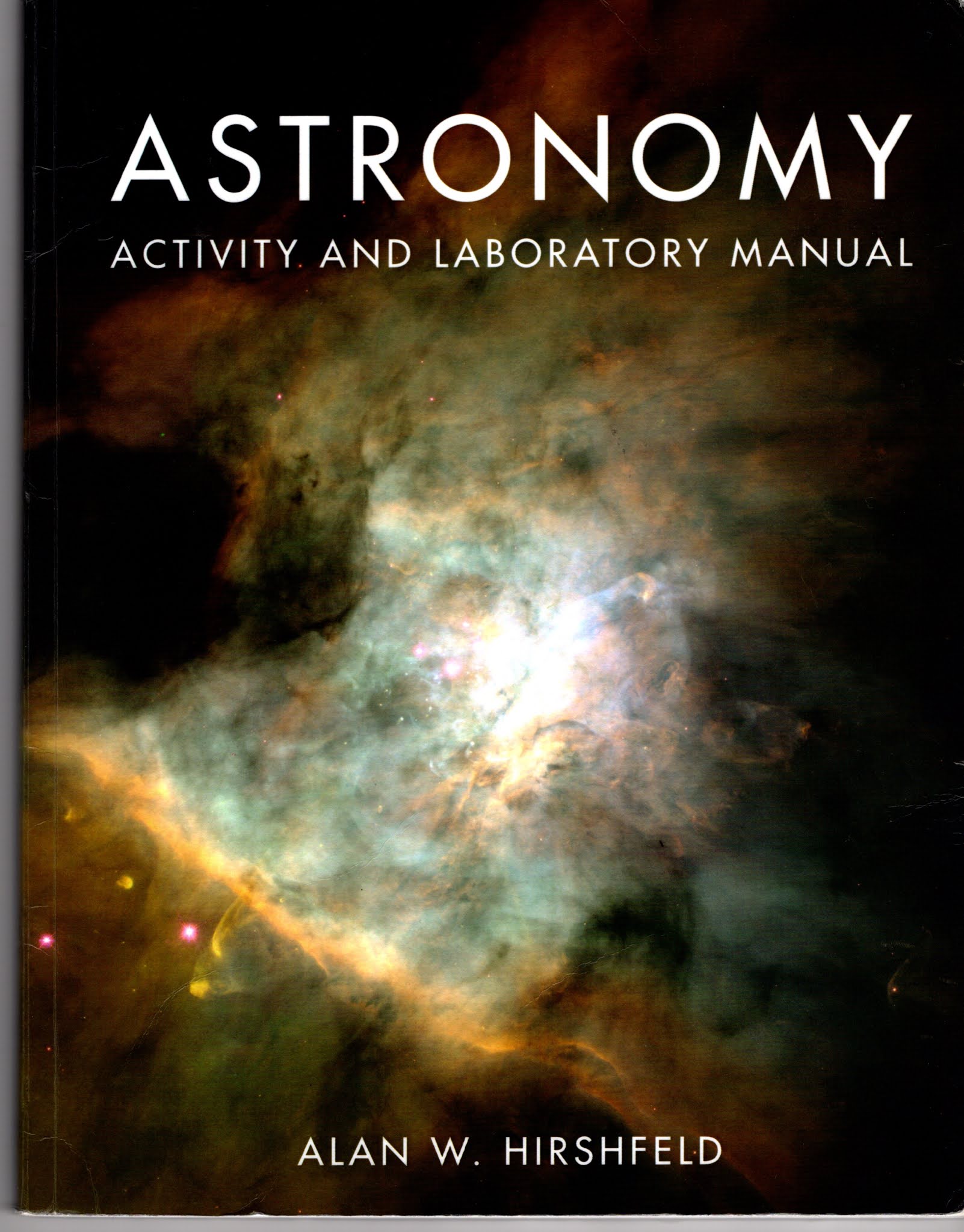
First Edition. 2009.
 

It starts with the gnomon, basically a vertical stick in the ground. At the end of the shadow, you place a stone. In Chapter 2, several thousand years or generations later, you come to the conclusion that the angle of the Sun in the sky at mid-day is directly related to the length of the shadow relative to the height of the stick. Theta equals arctan(L over H). 


Hirshfeld provides good, simple explanations of the math, though not in depth. At the back is a tutorial on basic trigonometry. Neither is a substitute for a semester of trig. Hirshfeld just gives you the number 57.3 without telling you where it came from. Similarly, it is true that although you do not need much mathematics to benefit from the hands-on calculations, you do need some. Even so, Hirshfeld steps you through work that you will come back to again. The same basic formulas are applied repeatedly to new problems from measuring the diameter of the Earth to measuring the distances to the Moon and Sun and then to the stars.  


Even if you are completely math-phobic, you can still get a lot out this by at least reading through the exercises to appreciate how the Greeks, Galileo, Kepler, Newton, and the astronomers of the 19th and 20th centuries came to their conclusions. If all of the arithmetic and algebra is “digital” then “Activity 15: Picturing the Universe—How Photography Revolutionized Astronomy” is “analog.” 


I put off the central exercise of “Activity 14: Parallax” until I finished the rest of the book. I could have just worked through it on paper, but I wanted to set up a yardstick in the doorway between the kitchen and the living room in order to take my own measurements. Alan Hirshfeld is the author of Parallax: The Race to Measure the Cosmos; W. H. Freeman & Co., 2001. So, I wanted to give him his due and take my time with the work before reading the book.


Activity  1  The World's First Skywatcher - YOU!

Activity  2  Shadowland

Activity  3  Shadowland - the Sequel

Activity  4  Shadowland Follow-up

Activity  5  The Phases of the Moon

Activity  6  Eratosthenes Measures the Earth

Activity  7  Aristarchus Measures the Size and Distance of the Moon

Activity  8  Aristarchus Measures the Size and Distance of the Sun

Activity  9  The Copernican Cosmos

Activity  10  Kepler's Third Law

Activity  11  Isaac Newton and the Moon

Activity  12  Galileo Measures a Mountain - on the Moon!

Activity  13  Precision Astronomy After Galileo - Stellar Aberration

Activity  14  Precision Astronomy After Galileo - Stellar Parallax

Activity  15  Picturing the Universe - How Photography Revolutionized Astronomy

Activity  16  How Bright is That Star? A Tutorial on the Magnitude System

Activity  17  The Realm of the Spiral Nebulae

Activity  18  Hubble's Law - in the Kitchen and in the Universe

Activity  19  The Herzsprung-Russell Diagram

Activity  20  Binary Stars and Stellar Motions.

Appendix  Mathbits


In the second edition, Activity 19 is about Dark Matter. In fact, while I found the second half the H-R Diagram helpful, the introduction about height and shoes sizes was obvious. Perhaps plotting the land speeds and weights of various mammals would have been more analogous to the relationships between spectral types and luminosities. The second edition also replaced the work on Sirius A Sirius B with your own reflective essay. I believe that was a loss. The reflective essay could help the instructor modify the class. I still think that it would have been best left as extra credit. The H-R diagram is important to modern astronomy.

Although I have a calculator on my iPhone and my computer, I bought a new one just for this, a basic scientific TI-30Xa. It was $8.95 which is like 89 cents in 1978 dollars when we bought our first TI-30 calculators. The universe may not be expanding, but the money supply is. Still, I worked several of these in my head by approximation, 3 for pi, and so on. 


PREVIOUSLY ON NECESSARY FACTS

In Support of the Entry-Level Telescope 

and

Defending the Hobby-Killer Telescope 

Problems with Pop Sci from Sky & Telescope (Part 1)

and

Problems with Pop Sci from Sky & Telescope (Part 2) 


Sunday, February 26, 2012

Education in America: at least two cheers

The greatest strength in the American system of education is that there is no system.  The pluralism of our society allows choices, options, and alternatives at every level.  The USA has more than 14,000 school districts (for primary and secondary education) and over 5,700 institutions of higher education (two-year and four-year colleges and universities).  These all serve 81 million client learners.  About 10% (5 million plus) attend private schools K-12.  Also, about 2 million are homeschooled. Peculiar to the USA, annually, about 65,000 unauthorized immigrants graduate from high school

We are a nation of autodidacts, self-taught learners.  Historically, most of the justices on the Supreme Court never went to law school and four of those sitting now hold bachelor degrees, not juris doctorates.  Perhaps we are best explained by the fact that Josiah Willard Gibbs earned a doctorate in engineering in 1863; Thomas Edison was home schooled; Nicola Tesla immigrated to the USA in 1884 after dropping out of university (twice).  In our time, while T. J. Rodgers of Cypress Semiconductor earned his masters and doctorate from Stanford by inventing VMOS chip technology, it is famous that Bill Gates and Steve Jobs found college less rewarding. 

But no one complains much about American university education.  Most of the world’s best universities are here: 35 of the top 50 and 55 of the top 100, according to Shanghai Jiao Tong University's Academic Ranking of World Universities (here).

The key is that our colleges all compete against each other: Harvard vs. Stanford vs. Ohio State vs. UCLA… Competition impels toward excellence.  And it allows diversity.  For over 100 years in America “academic freedom” came not so much from the First Amendment, but from the plethora of places to take your teaching.  That also applied to Europe, especially Germany, during the Middle Ages  and continuing until the rise of nationalism.  Once you alienated the king of France or England your goose and you were both cooked: “Play the man, Mr. Ridley and we shall this day by God’s grace light such a fire in England as shall never be extinguished.” 

Moreover, Americans seem to wake up in college: this is the real world, away from home.  As a result, according to Michigan State University's Jon Miller, Americans are slightly ahead of their European and Japanese colleagues in general scientific knowledge, though everyone has room for improvement. 

“A slightly higher proportion of American adults qualify as scientifically literate than European or Japanese adults, but the truth is that no major industrial nation in the world today has a sufficient number of scientifically literate adults,” he said. “We should take no pride in a finding that 70 percent of Americans cannot read and understand the science section of the New York Times.”
Approximately 28 percent of American adults currently qualify as scientifically literate, an increase from around 10 percent in the late 1980s and early 1990s, according to Miller's research. (Science Daily here.)
It is at the primary and secondary level that our pupils do poorly compared to others in the leading industrialized nations of Europe and Asia.  And there are no easy answers.  Those 14,000 school districts are government monopolies, but so are the schools of Finland.  Our teachers are typically union members, but so are others; and in some countries, they are civil servants.  Private schools may compete well (as in USA and Japan) or exist by permission of the state, or hardly exist at all.  Some nations (France, Germany, Japan) track children early and cull out those who are not college-bound.  Other nations (Singapore and the USA) educate all children.  In Singapore parents who allow their children to miss school are charged with a criminal offense.  Most of the leading nations are small, with unified cultures: the Czech Republic, the Slovak Republic, Slovenia.  The USA ranks closer to Russia and India.  But the leader is still Singapore, a variegated society. 

Money correlates only weakly: you do have to spend something; but beyond a basic investment, throwing money at education achieves little. This is known internationally and applies to the G20 nations. (here
For a parent, the most important thing you can do is simply to be involved.  This correlates  better than money or family status or neighborhood.  There is an old joke known to sales people about the two merchandisers assigned to a remote tropical village. One sent back the message that business was horrible because no one wears shoes. The other expected to sell out since no one yet had shoes. We all play the hand we are dealt. 
"Strong performers in PISA are those countries and economies that believe - and act on the belief - that all children can succeed in school. Among wealthier economies, those that prioritise the quality of teachers over smaller classes tend to show better performance. When it comes to money and education, the question isn’t how much? but rather for what?"  (OECD PISA here.)
Higher education does not guarantee economic development, progress, invention, or quality of life. In the USA, the areas with the highest percentage of people 25 years and over with a bachelor's degree are the District of Columbia, followed by Massachusetts, Maryland, Colorado, and Connecticut. Lack of higher education does correlate with diminished opportunities. The states with the lowest percentages are West Virginia, Arkansas, Mississippi, Kentucky, and Louisiana.

It may be wrong to look at states, when cities are the true generators of wealth (and learning). At least, that is the theory posited by the late Jane Jacobs, who educated herself with a wide range of classes at Columbia’s extension school while working as a stenographer in New York City.  Most of the cities with high educational percentages are college towns, of course. However, Seattle and San Francisco are among the complexes that draw highly educated producers. According to the Daily Beast, (here) the smartest cities are: Boston, Hartford, San Francisco, Raleigh-Durham, Denver, Seattle, Austin, Minneapolis-St. Paul, Washington DC, Rochester. The dumbest are: Las Vegas, San Antonio, Fresno, Houston, Memphis, Orlando, Tampa, Louisville, Miami, and GreensboroOn the US DoE National Assessment of Educational Progress, of necessity, some states were above average, and others below.  And of course scores vary even greater by local school district.  But education does not necessarily bring prosperity.  San Antonio (among the lowest) enjoys an economy as strong as here in Austin (among the highest). 
Chief Justice John Roberts: LLB Harvard; JD Harvard
Justice Antonin Scalia: AB Georgetown; LLB Harvard
Justice Anthony Kennedy: BA Stanford; LLB Harvard
Justice Clarence Thomas: AB Holy Cross; JD Harvard
Justice Ruth Bader Ginsburg: BA Cornell; LLB Yale
Justice Stephen Breyer: AB Stanford; BA Magdalen College, Oxford; LLB Harvard
Justice Samuel Alito: BA Princeton; JD Yale
Justice Sonia Sotomayor: BA Princeton; JD Yale
Justice Elena Kagan: ABPrinceton; MPhil Worcester College, Oxford; JD Harvard.

ALSO ON NECESSARY FACTS
Another Cheer for American Education
Educating the Gifted and Talented in Cleveland, Ohio
Where all the Children are Above Average