Monday, May 31, 2021

Parallax: The Race to Measure the Cosmos

The writing is direct, intended for the interested and educated general reader. I learned a lot, of course, though I did have some quibbles with the details of culture and sociology. Eventually, even after the problem was nominally solved, and the distances to some stars were directly measured, ten new uses were found for parallax.

The title of the book could be a metaphor for the history of astronomy. We tend to view the history of astronomy as if through one eye: the arrangement of the universe, from the geocentric model to the heliocentric model, to the understanding that our own Milky Way is not the universe, but just one of billions of galaxies. Viewing the history of astronomy through the other narrative eye of measuring the size and scale of the universe reveals the depth of the problem and of the geniuses who attempted to solve it. 


Explaining Copernicus’s world of 1500, Hirshfeld writes: “Scholars communicated with one another freely, exchanging ideas that centuries earlier might have brought them to the stake.” In fact, the problem of Easter—identifying the first Sunday after the first full moon after the first day of spring—required reconciling the solar and lunar calendars. Using astrolabes and water clocks, Medieval astronomers knew that the geocentric model of Ptolemy required corrections. They had calculated the orbit of Saturn to be one billion miles from Earth and the stars immeasurably beyond that. That only reinforced the unimportance of worldly concerns and the grandeur of heaven. No one was burned at the stake in 1250 for worrying why the calendar was off by six hours, though they knew that it was. 


To earn a baccalaureate degree at a Medieval university, you had to complete seven classes in the Liberal Arts. First were the trivium: Logic, Grammar, and Rhetoric. Following that were the quadrivium: Arithmetic, Geometry, Astronomy, and Music. Even today a liberal arts degree requires classes in mathematics and science, in addition to the humanities of language and fine arts.


Parallax: The Race to Measure the Cosmos 
by Alan W. Hirshfeld, 
W. H. Freeman & Co., 2001. 
 
Alan W. Hirshfeld is 
Professor of Physics, 
and Director of the Observatory at the 
University of Massachusetts at Dartmouth, 
and an Associate of the 
Harvard College Observatory. 
He currently serves as the past-chair 
of the History of Astronomy Division 
of the American Astronomical Society.


Hirshfeld repeatedly blames Aristotle for an inventory of untruths that were not his fault. What were essentially Aristotle’s lecture notes had been transcribed and collated by his student, Theophrastus. The Macedonian royal family squabbled over the library and the books were stashed by being buried. Second-rate scholars reconstructed the worm-eaten scrolls. All of that aside, generally, Aristotle worked by gathering what was known or claimed by the savants before him. He then gave his opinion based on his assessments of the facts that he knew. He was an encyclopedist. Aristotle’s strongest writings were in biology because he worked first hand as an observer. His embryology of the chick remains an unassailed classic. But you can hold a hen, an egg, and a chick. Comets are intractable. Everyone was guessing.


“One issue that Ptolemy had to deal with was the patently nonuniform motions of certain celestial bodies. The Sun, for example, appears to move through the sky with varying speed depending on the time of year. Planets, too, appear to speed up and slow down as the months pass. But according to the writings of Aristotle, whose word was law in those days, heavenly bodies, in fact, move always at constant speed in circular orbits.” (page 24) 


Aristotle’s word was not law. He was just one philosopher among many. Cicero was an educated Roman and he gave more attention to the Epicureans and Stoics than to the Peripatetics of the Aristotelean tradition. In any case, there was no legal enforcement of any theories of natural philosophy. 


Looking back to the 12th century from the 21st century, Hirshfeld too easily collapses time, forgetting that decades mark lifetimes and a century envelopes three generations. He delivers a rich tapestry of evolving theory when he writes about astrophysics, yet he encapsulates ten lifetimes in the phrase “the Church of the Middle Ages” and fails to differentiate it from “the Church of the Counter-Reformation.” 


There’s always a better approximation and it is interesting that one correction to Hirshfeld came 20 years later from his collaborating editor at the History of Astronomy Division of the American Astronomical Society. Writing about the star Eltamin or gamma Draconis, Hirshfeld explains: “The name Eltamin derives from Al Ras al Timmen, ‘the Dragon’s head’… The more prosaic designation Gamma is first encountered in the beautiful Uranometria sky atlas drawn by German celestial cartographer Johannes Bayer in 1603. In Bayer’s system, a constellation’s brightest star is labeled Alpha, the second brightest Beta, and so on.” (page 136). That is a common claim. It does leave us with problems, however. 


Castor in Gemini is Alpha Geminorum but it is less bright than Pollux, which is Beta Geminorum. Other examples are easy to find. Some astronomers explain that the absolute magnitudes of stars can and do change over time. 


In fact, the answer is that “… Bayer divided the sky into strips and then identified the brightest stars within them. …It  was originally thought that the stars were assigned labels in alphabetical order according to their brightness. However, in many constellations the brightest star is labelled β, leading astronomers in the 18th century to speculate that many stars had changed in brightness from Bayer’s time. The 19th century German astronomer F. W. A. Argelander discovered that Bayer had used a north-to-south ordering system within magnitude bins.5 Once Bayer had run out of Greek letters, he switched to Latin letters.” [5: Babinger, F. 1915, “Johannes Bayer, des Begründer der neuzeitlichen Sternbenennung,” Archiv für die Geschichte der Naturwissenschaften und der Technik, 5, 108.] Cited in This Month in Astronomical History: September 2020, by Jason E. Ybarra, Bridgewater College.

https://aas.org/posts/news/2020/09/month-astronomical-history-september-2020


Of necessity, our macroscopic sense of place paralleled the discovery of the microscopic. The same lenses served both purposes. It is telling that Joseph Fraunhofer’s 1829 heliometer, the most exacting measuring telescope created up to that time, included a microscope for reading its extremely precise scale. 


Science is an integration. Internally consistent theories explain observable facts. It is how we know anything. More to the point, facts and theories do not exist in isolation. Seeming contradictions must be resolved or eliminated. That speaks to the problem of parallax. 


Herschel’s case, in particular, exemplified the exacting standards to which all scientists adhere. It can be hard to know when your very correct theory only awaits the predicted facts and when the discovered facts demand a new theory. 


Like Galileo and the savants who followed, Herschel expected that all of the stars are more or less arrayed at random, that the universe is uniform. Thus, stars that appear to be close to each other are not physical companions. This led astronomers to seek pairs of stars, one much brighter than the other in the expectation that the brighter was the nearer of the two and thus a good candidate for measuring parallax. After years of searching with a behemoth reflector, Herschel announced on July 1, 1802, that many double stars are indeed gravitationally locked. As the problem of parallax was attacked over the centuries, the attempts revealed other truths. Foremost, perhaps, was that many stars are systems of doubles, triples, and sets of them. 


Writing before 2001, Hirshfeld expected new measurements from missions that unfortunately were cancelled. 

  • DIVA: Double Interferometer for Visual Astrometry (uncertain)
  • FAME Full-sky Astrometric Mapping Explorer was cancelled in 2002.
  • SIM: Space Interferometry Mission was cancelled in 2010
  • GAIA is a space observatory of the European Space Agency (ESA), launched in 2013 aboard a Soyuz and expected to operate until about 2022.

Gaia has been successful and its empirical results are the foundation of new theories. At the 52ndmeeting of the Division for Dynamical Astronomy of the AAS, held May 17-21, 2021, eleven papers cited Gaia data.


PREVIOUSLY ON NECESSARY FACTS

Rescuing Aristotle and the Church 

Science in the Middle Ages

The Map that Changed the World 

Circumference 


Sunday, May 30, 2021

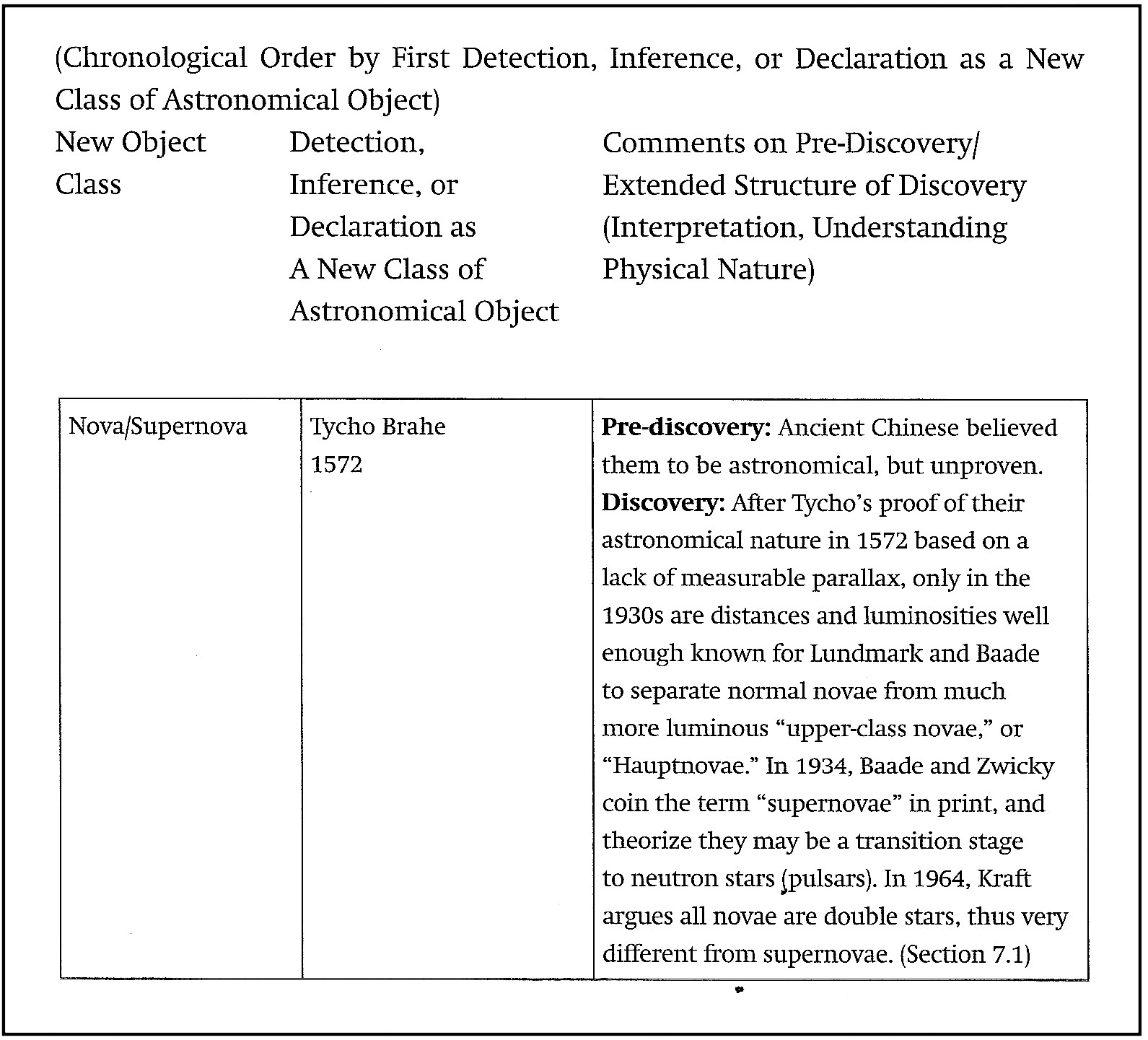
Steven J. Dick’s Discovery and Classification in Astronomy

Thomas Jefferson did not say that it “was easier to believe that two Yankee professors could lie than to admit that stones could fall from heaven.” But he could have because the celestial origin of meteors and meteorites was not established until 1863. Steven J. Dick (NASA Chief Historian, 2003-2009) calls earlier claims the “pre-discovery” phase. After discovery—the correct identification of an object—come classification, controversy, and consensus. 

Pre-discovery of the Sun, Moon, and stars begins with our hominid ancestors. Uranus and Neptune had pre-discovery phases because they were spotted and recorded as stars before they were identified as planets. Uranus was recorded (as a star) by British Astronomer Royal John Flamsteed six times in 1690. Galileo recorded Neptune (as a star) on December 28, 1612, and January 27, 1613. When William Herschel identified it as a planet, there was some controversy between 1781 and 1783 but the matter was soon settled. Pluto, on the other hand, stands as a counter-example. It had no pre-discovery phase. When discovered, it was accepted as a planet. Only later did controversy change its classification and a new consensus evolve. The catalyst for that change was understanding, and the process was an evolution.


The stars were even less tractable and nebulae all the more difficult to isolate into classes. At first astronomers expected that better telescopes would resolve all nebulae into fields of stars. That did happen with some. Others were found to be huge volumes of gas or dust that absorb or reflect or emit radiation. Still others eventually were identified as types of galaxies, again, with some controversies that are not yet entirely settled.

Discovery and Classification in Astronomy: Controversy and Consensus by Steven J. Dick (Cambridge University Press, 2013), is a taxonomic history. Dick alludes to parallels in the development of biology and chemistry which he offers as more mature paradigms. The periodic table of elements allowed predictions. Astronomy has nothing like it. Biology still has controversies but it has millions of species to consider. Astronomy has fewer than 100, 82 by his count. In most cases, each discovery was a thing-in-itself until improved understanding (usually through controversy) revealed others of its kind. 


The main narrative of 340 pages delivers a chronology by types from planets to quasars and then reviews the works and publications to reveal the patterns (Part IV) and the drivers of discovery (Part V). Part VI closes with The Meaning of Discovery.

“… discoveries end with a basic understanding of the fundamental properties of a class, but before mature understanding, as defined by knowing an object's place in an evolutionary scheme.” (page 331). The process can take centuries as with the planetary nebulae. Dick also believes that since 1960 or so we have come to a mature evolutionary scheme for the universe. (page 331). 


Having presented the facts, Dick then organizes them into a Three Kingdoms model: Planets, Stars, and Galaxies. It fits on two landscape pages as Appendix 1. Appendix 2 “Astronomical Discoveries and Their Extended Structure” is a detailed tabulation of 82 objects, from Novae through  Proto-Galactic Clouds, identifying the discoverer and citing the pre-discoveries. 


I got the book from the library because in our home we are of one mind on not acquiring more stuff. However, I bought it because it is more conceptual than a history of astronomy or, more narrowly, astrophysics (which I regard as the touchstone of astronomy) and it is more concrete than a philosophy of science. 

As valuable as I regard the work, I do differ from Dick on his metaphysics and epistemology, and I have some quibbles with his history. In the main, however, his assertions are supported by deep foundations of facts in their correct contexts. 

One oversight is in the history of meteorites. Dick makes no mention of the surviving commentaries by Plutarch, Pliny, and Diogenes Laertius about Anaxagoras of Klazomenai who allegedly tracked and found a meteorite and from that posited that the stars are hot rocks and that the Sun is such a hot rock, “larger than the Peloponnesus.” That being so, I still agree with Steven Weinberg and Alan Hirshfeld that as much as we can relate to the early savants, their hypotheses were not science. 


Dick also credits Edmund Husserl and phenomenology, requiring that understanding be identified with “the thing itself” in other words to understand and appreciate an object without regard to arbitrary—and perhaps false—contexts. For that, however, I look to Immanuel Kant’s “das Ding an sich.” 


“The thing itself” was a primary consideration for William W. Morgan who extended the Harvard classification system (O B A F G K M) by parameterizing luminosity classes for super giants, bright giants, normal giants, subgiants, and main sequence stars: V, IV, III, II, I. Underlying the system Morgan considered the ratios of stellar spectra, not just the lines themselves. William W. Morgan published the Atlas of Stellar Spectra, with an Outline of Spectral Classification with Philip C. Keenan and Edith Kellman in 1943. Dick explicitly examines the fact that Morgan cited Husserl, and then abandoned any phenomenological framework for that research.


As for Thomas Jefferson, the historians at Monticello have come to his rescue. See “Thomas Jefferson and the Meteorites,” posted November 14, 2008, as “Who is the liar now?” by 

Anna Berkes, at https://www.monticello.org/site/blog-and-community/posts/who-liar-now.  

From there you can find a lengthy review of A professor, a president, and a meteor, by Cathryn J. Prince. (Amherst, New York: Prometheus Books, 2011), at Meteoritics & Planetary Science 46, Nr 10, 1608–1616 (2011) by Ursula B. Marvin of the Harvard-Smithsonian Center for Astrophysics.

"Between 1794 and 1804 an astonishing succession of new ideas, four witnessed falls of meteorites and chemical analyses of them, took place that established meteoritics as a new branch of science. Prince ignores this chain of events almost entirely. Her approach leaves such a gap in the founding of meteoritics that herewith is a brief sketch of the main events that are missing from her book.

"In April, 1794, Ernst F. F. Chladni of Wittenberg published the first modern book on meteorites and their origins. He began by discussing the Pallas Iron, a huge mass of metallic iron found on a high mountain in Siberia. After reasoning away hypotheses that it formed in the atmosphere, or was smelted from ore by lightning or by prehistoric men, he concluded that it, and other masses like it, must have fallen from cosmic space. This was a completely new concept at a time when space was ‘‘known’’ to be empty." The Meteoritical Society, 2011, at https://onlinelibrary.wiley.com/doi/pdf/10.1111/j.1945-5100.2011.01242.x


Thomas Jefferson only wrote in a letter: “It may be very difficult to explain how the stone you possess came into the position in which it was found. But is it easier to explain how it got into the clouds from whence it is supposed to have fallen?”  (Transcription from Lipscomb-Bergh 11:441-2 - the polygraph copy of this letter is online here.)

http://memory.loc.gov/master/mss/mtj/mtj1/040/1000/1084.jpg

The Thomas Jefferson Papers Series 1. General Correspondence. 1651-1827

Thomas Jefferson to Daniel Salmon, February 15, 1808

http://hdl.loc.gov/loc.mss/mtj.mtjbib018246 Image 1084 of 1330.


PREVIOUSLY ON NECESSARY FACTS


Gregory Browne’s Necessary Factual Truths 

The Philosophical Breakfast Club 

Harriman’s Logical Leap Almost Makes It 

The Big Whimper of Modern Philosophy 

New York City, Covid-19, and Conservative Business Interests 


Saturday, May 29, 2021

$2500 Viewed Through a Telescope

I went 35 years without a telescope. Back in 1980, at Lansing Community College, to be employed as a lab aide, I added a couple of independent studies in celestial mechanics to a couple of classes in physics and got approved to use the school telescope in the dome on the roof. I took our daughter to the planetarium often, of course. But only in 2014 did I get an instrument for myself. My wife and daughter bought it for me. I picked it out. I chose one that most reminded me of the telescope I had in my early to mid- teens. But they don't make 'em like they used to. I was never happy with it. 

As a member of the Austin Astronomical Society, I borrowed several large catadioptrics, eight- and ten-inch Schmidt-Cassegrains and a (fake) Ritchey-Chrétien, all from Meade. Nice as they were to view through, and as much as I appreciated the big setting circles for more accurate measurements, they were a bear to wrestle with and set up. It was hard enough to lift 65-lbs from the box. Putting it back without dropping it was the real challenge. 

The last straw with the gift from my wife and daughter was having to collimate the mirrors. When the secondary swung free, I just tightened everything back up before it came apart in my hands. Like one of the used SCTs I bought from the club, I donated it to the Goodwill. The scopes did some social good along their ways to new homes.

Last autumn, I bought myself a 102-mm refractor from Explore Scientific because I could lift it with one arm and carry it in two hands, out my office door, down the hall, through the dining area, through the kitchen, out the back door, and down the porch in to the backyard without hitting anything. The other factor was its larger aperture versus the 70-mm National Geographic that I bought used. I made sketches of Mars with it and viewed much else. What failed was splitting the double-double in Lyra. I tried several times over several months, but it just did not gather enough light. So, I bought more diameter. I got the ES 102 because Scott Roberts spoke to our local club (along with Stuart Parkerson of Astronomy Technology Today) about the markets for instruments.  I have been happy with my choice.


Earlier this month, I got some emails from other sellers. Astronomics is in Norman, Oklahoma. They are second-generation suppliers to the hobby. They sponsor the Cloudy Nights discussion board. First, I bought an oddly-branded not-Meade 82-degree 14 mm ocular (Meade colors and logo, but no logotype name). Then, they sent notice of a new shipment of 115-mm apochromatic refractors for $1399. 


My 102 is achromatic. The design goes back to London instrument maker John Dollond. Flint glass and crown glass are used in combination to reduce chromatic aberration. It is not perfect, but it is close. (Reflectors do not have that problem.) Better still and nominally perfect is the triple lens apochromatic system. Not only do they cost more, but to appreciate what you are paying for, you need good seeing, clear and steady atmosphere, and dark skies. I have none of those in my backyard. But the telescope and the other accoutrements were all good deals, and belonging to an astronomy club, I do have access to dark sky sites with overnight camping. 


So, this is what $2500 looks like viewed through a telescope.

Astro-Tech 115 mm Apochromatic Extra-low Dispersion refractor
from Astronomics ($1399)


Nagler "smoothie"
(before Series numbers)
7mm ocular
from Enerdyne, Suttons Bay.
(Last one on the shelf;
inventoried 01-16. $199)


Meade logo branding
but no logotype Name
14 mm 82-degree ocular
warehouse close-out
from Astronomics ($79.95)


2-inch-to-1-1/4 inch 99% right angle prism
adapter for oculars
from Explore Scientific
(factory refurbish; $119.95 )


Right angle adapter 99% erecting prism
with focusser
from Stellarvue ($79)
(for use with the 102 mm)


Explore Scientific Twilight-1 Mount and Tripod
(factory refurbish $209.)

Sun Catcher solar filters (bought 4 mediums)
$19 and $25 each Explore Scientific
(Thousand Oaks Optical sheets).
The Sun is the nearest star
and it is very average.


PREVIOUSLY ON NECESSARY FACTS


Binary Star Project 

Viewing Mars 

The Andromeda Galaxy 

M44 The Beehive Cluster 

Jupiter-Mars Conjunction 

Jupiter-Saturn Conjunction 


Tuesday, May 11, 2021

Westrum’s “Three Cultures” Organizational Typology

Ronald Mark Westrum’s typology of organizations is an investigation of information flow in order to understand how groups thrive, survive, or fail. He finds that generative organizations get the right information to the right people in the right context. Bureaucratic organizations do this when the environment is conducive to stability, but they fail to perform under stressful new challenges. Pathological organizations have no concern for their outcomes and are defined only by how successful their leaders are at hoarding and controlling information for personal gain.

He writes: "I created a typology in 1988 to compare the way that organisations processed information. … The idea was to characterise general ways of coping with information, especially information that suggests anomaly. Failures in information flow figure prominently in many major accidents, but information flow is also a type marker for organisational culture. In some organisations, information flows well, and elicits prompt and appropriate responses. In others it is hoarded for political reasons or it languishes due to bureaucratic barriers. This typology has proven useful in a variety of safety related fields, such as aviation, nuclear power, and, increasingly, medicine. 

"The underlying idea is that leaders, by their preoccupations, shape a unit’s culture. … These preferences then become the preoccupation of the organisation’s workforce, because rewards, punishments, and resources follow the leader’s preferences.

"Generative organisations get the needed information to the right person in the right form and in the right time frame. This behaviour is based on the leader’s emphasis that the most important goal is to accomplish the mission.

"By contrast, pathological circles tend to view information as a personal resource, to be used in political power struggles. It will be withheld, doled out, or used as a weapon to advance particular parties within the organisation. 

"When bureaucratic organisations need to get information to the right recipient, they are likely to use the standard channels or procedures. These standard channels and procedures are often insufficient in a crisis. They failed, for instance, in communications between New York police and fire departments on 11 September 2001. The police knew that the World Trade Center north tower was about to collapse, but failed to communicate this to the firefighters inside the tower, many of whom died. By contrast, in the same circumstances many generative organisations would cross departmental lines or use a back channel to get the information to where it was needed. The Apollo 13 space crisis shows an excellent example of a generative response. By contrast, the fumbling that led to the demise of Columbia space shuttle shows bureaucracy at its worst."
 “A typology of organisational cultures,” BMJ Quality and Safety, 2004;13:ii22-ii27. https://qualitysafety.bmj.com/content/13/suppl_2/ii22

 Ron Westrum was my professor for five of eight sociology classes at Eastern Michigan University 2005-2010 as I completed a BS in criminology and an MA in social science. Among those courses were Complex Organizations and the Sociology of Technology. He wrote Sidewinder: Creative Missile Development at China Lake (Naval Institute Press, 1999), which was my introduction to the U.S. Naval Institute of which I have been a member since 2015.


Studying information flow in airline cockpits, Westrum applied his reseach to hospital operating rooms. From there, his theories gained even wider acceptance. You can find the full text of the paper in many places online. “A Typology of Organisational Cultures” by R. Westrum. Quality and Safety in Health Care 13 Suppl 2 (suppl_2):ii22-7 January 2005 https://www.researchgate.net/publication/8150380_A_Typology_of_Organisational_Cultures  This work is widely cited. See “DevOps culture: Westrum organizational culture,” at 

https://cloud.google.com/architecture/devops/devops-culture-westrum-organizational-culture He has a stub in Wikipedia: https://en.wikipedia.org/wiki/Ron_Westrum


Dr. Westrum’s typology pinpoints the failure mode for a bureaucracy. However, in our class in complex organizations, we also examined its strengths. Bureaucracy is a pre-requisite to democracy, especially for a complex society. In a functioning bureaucracy, each piece of paper moves from desk to desk on its own merits regardless of the tribe, family, caste, religion, class, race, ethnicity, sex, gender, age, or wealth of its originator. America’s failure to establish democracy in Iraq and Afghanistan is attributable to the lack of functioning indigenous bureaucracies. A functioning bureaucracy does not necessarily bring democracy. We studied the Ottoman empire as a case in point. It is necessary, but not sufficient.


Our model for rescuing a bureaucracy was Capt. D. Michael Abrashoff’s It’s Your Ship: Management Techniques from the Best Damn Ship in the Navy (Warner, 2002). Since then, I believe that Turn the Ship Around!: A True Story of Turning Followers into Leaders by Capt. David L. Marquet (Steven R. Covey, 2012) took the lesson even farther. Proof of this is the fact that Marquet’s Santa Fe and its people continued to thrive after he left, whereas the USS Benfold did not continue the journey charted by its captain.


 PREVIOUSLY ON NECESSARY FACTS


Team of Teams

Centralization and the Inverse-Square Law

A Good Place with Inadequate Philosophy

Not Less Grammar Errors

Minimizing the Likelihood of Bad Cops


Sunday, May 9, 2021

Constellation Corvus and Delta Corvi

Last week, I went out on a nominally clear night to see if I could find the Virgo Cluster of galaxies. I could not. But there was a very apparent quadrilateral in the south. So, I targeted that. I found delta Corvi, an interesting binary.

Wikicommons from Sky & Telescope
“Delta Corvi has more than 2.7 times the mass of the Sun, which is causing it to radiate a much higher energy output—roughly 69 times the Sun's luminosity. … Hence it is either a subgiant star around 260 million years old …  or a pre-main sequence star around 3.2 million years old that has not completely condensed and settled on the main sequence.”

Its companion shares its radial velocity and those have not changed measurably since the pair was determined in 1823 by James South and John Herschel. They may be 

The angular separation is given as 24.2 arcseconds. (Wikipedia – Delta Corvi)

The constellation has been called the Crow or the Raven for at least 3,000 years. To the Babylonians, it heralded the autumnal rainy season. The Romans called it Corvus and the Arabs gave it the same name in their language.  


5 May 2021 2300 hrs CDT
 Moreover, delta Corvi was called al-ghuraab, rendered as “Algorab” on European charts, which means crow. Gamma was Gienah or “right wing.” Epsilon Corvi was minqar (Minkar on our modern charts), meaning “wing.” The named attached to Beta, Kraz, has never been traced adequately. 

 The USS Algorab was an Arcturus class attack transport in service from 1939 to 1945. The ship served in the Atlantic, the Caribbean, and the Pacific. For its action in the Pacific, it earned four battle stars.


As a petty officer in the Texas Maritime Regiment, my insignia were crows. I joined the service late in life and was placed in the command group to serve the general staff where I fit in well. However, there were a couple of times when my top sergeant had to counsel me to keep in mind that my crows were not eagles.


Previously on Necessary Facts

Binary Star Project 

Scorpio and the Precession of the Equinox 

Asterisms 

Astronomical Symbols on Ancient and Medieval Coins 

Why I Served

Monday, April 19, 2021

To Explain the World by Steven Weinberg

Write about what you know. Write from your experience. Those two mandates are easily given to anyone who wants to write for a living. They apply to fiction and non-fiction. The rules were too easily ignored by Nobel laureate Steven Weinberg 

To Explain the World: The Discovery of Modern Science by Steven Weinberg (HarperCollins, 2015) presents—and I believe, proves—the thesis that science was not invented, but exists independent of the observer. In my words, not his, science is as objective as helium or an elephant: it is what it is for any observer. Although science is a very human pursuit, it would be the same for a practitioner in another galaxy. Dr. Weinberg asserts that modern science had to be discovered. It was not practiced in Ancient Greece, the Islamic Middle East, China, or Medieval Europe. The essence of modern science is the controlled (and therefore “unnatural”) experiment. 


To Explain the World is Dr. Weinberg’s personal review of Western intellectual history. I had several classes in it at university and it remained a pursuit integral to my own lifestyles. So, I had a firm foundation from which to take issue with many of his assertions. However, someone who comes to this book without prior learning will be given some clichés, now abandoned by historians at his level. Some claims are just plain false, though they come well-attributed by second-hand sources. For one thing, Steven Weinberg admits to not reading Greek, though he seems to know Latin well. So, the review of the natural philosophy of the ancient Greeks is based on the usual English translations. 
 

Weinberg knows science. His Nobel prize attests to that, though his degrees and research seem to be enough. Where he is weak is in history. This is his view, his interpretation. I accept the thesis. I am forced to reject some of the evidence. Also, oddly enough, he is less than perfectly clear on just what science is. Very much like a university textbook, he just assumes that you know the scientific method, though he never defines it and certainly does not investigate how its procedures were integrated into the modern practice we know. (My overview of "The Scientific Method" is here.)


In science, we might accept authority, but we never take anything on faith, and Prof. Weinberg is a teacher. So, this book delivers a special value in the Technical Notes at the end. There, you will find proofs and elaborations of the mathematics, astronomy, and physics supporting the narratives.


Where he goes astray is in the history. The book is replete with small errors of fact. “If Archimedes by his measurement of specific gravity had identified a gilded lead crown as being made of solid gold, he would have become unpopular in Syracuse.” (page 41) The crown was not gilded. If that were the suspicion, just cutting into it would have revealed the lead core. We know hundreds if not thousands of just such false coins from the ancient world. No, the crown was an alloy of silver and gold. The jeweler removed some gold and replaced it with silver. Visibly, the crown looked like pure gold. Only the test of specific gravity betrayed the culprit. It seemed to me to be the salient point, not to be missed or confused by a practicing physicist. Moreover, the book was read through by several others, including historian of astronomy, Owen Gingerich. Someone should have caught it.


Weinberg accepts the common narrative that the ancient Greeks, especially the Athenians, did not value labor and therefore did not perform experiments. Weinberg quotes Shakespeare’s Midsummer Night’s Dream: “Hard-handed men, who work now in Athens, and never yet labor’d with their minds.” (page 34) He could have looked closer to the source. “Now I observe that when we are met together in the assembly, and the matter in hand relates to building, the builders are summoned as advisers; when the question is one of shipbuilding, then the ship-wrights; and the like of other arts which they think capable of being taught and learned. And if some person offers to give them advice who is not supposed by them to have any skill in the art, even though he be good-looking, and rich, and noble, they will not listen to him, but laugh and hoot at him, until either he is clamoured down and retires of himself; or if he persist, he is dragged away or put out by the constables at the command of the prytanes." -- Plato's Dialogues, "Protagoras," translated by Benjamin Jowett.


Weinberg notes that more investigations that we recognize as science were carried out in the Hellenistic era, than in the classical. That is true. Supporting his claim he offers the work of Philo of Byzantium (280-220 BCE), Mechanike Syntaxis, in which an experiment in hydrostatics demonstrates that air is a substance. However, readers or viewers of Carl Sagan’s Cosmos learned that in the classical era Empedocles of Akragas explained the action of a kitchen tool, the water-thief (clepsydra), 200 years earlier. 


Taking common easy claims in lieu of research into ancient history, Weinberg says that the Greeks named the planets Hermes, Aphrodite, Ares, Zeus, and Cronos. (page 77) .They did not. Very many sources, including the works of Otto Neugebauer, correctly identify the ancient Greek names Stilbon, Eosphoros/Hesperos, Pyroeis, Phaetho, and Phainon: Sparkler, Dawn-bringer/Evening, Fiery, Shining, and Blazing. Giving them names analogous to the Roman gods happened much later. Note, also, relevant to ancient astronomy, that the morning star and evening star were only correctly identified much later (by the time of Claudius Ptolemy) and properly identified with the planets Venus and Mercury depending on their relative positions. 


Similar errors mar the history of science in the European Middle Ages. At the start of Chapter 10 Medieval Europe, the seven liberal arts are listed as “grammar, logic, rhetoric, geography, arithmetic, astronomy, and music.” (page 124). Later, geometry is correctly placed among them to replace geography. Even as Weinberg probably made the mistake in his manuscript—an easy enough mistake if you are writing off the top of your head—someone should have caught it. 


This was a library book. A previous patron penciled very neat corrections to the errors in Greek and Latin. Among the half dozen or so, Philo's work was rendered as Mechanice syntaxism.


Weinberg refers to “… Newton’s own commitment to Unitarian Christianity…” (page 245) In point of fact, Unitarianism was anathema to the Anglican Church, and Newton perjured himself to get and keep his job at Cambridge when he swore to the Anglican confession and Trinitarianism. It is not a moot point. Also, though he cites it as a primary source, Weinberg seems to know Newton’s Principia only second hand. He cites Richard S. Westfall’s Never at Rest: A Biography of Isaac Newton (Cambridge 1980) and Chandrasekhar’s Common Reader edition of the Principia. Granted, it is difficult because we do not know geometry at the depth and breadth of Newton's time. We replaced it all with algebra and calculus. (Weinberg makes that point, also.) Even Richard Feynman failed to be able to independently recreate Newton's proof of Kepler's Third Law. (On the blog here.)


At worst, Weinberg’s narratives are as bad as Neil de Grasse Tyson’s. For example, telling of how Galileo rolled marbles off a table to record their path in freefall, Weinberg claims that “… the trajectory is a parabola.” (page 194) It is not. It is an ellipse. We allow college freshmen to assume that the Earth is flat and that gravity vectors point down parallel to each other and perpendicular to the ground. The math is easier and the approximation is close enough. 

The Wonders of Physics: an Introduction to the Physical World 
by Irving Adler  ( Illus. by Cornelius De Witt);
New York: Golden Press [1966].

However, as Weinberg says later: “Halley asked Newton what would be the actual shape of the orbit of a body moving under the influence of a force that decreases with the inverse square of the distance. Newton answered that the orbit would be an ellipse, and promised to send a proof.” (231) Again, this is not exactly true. The path is a conic section—circle, ellipse, parabola, hyperbola, line—depending on the tangential velocity of the object relative to the central force of the ponderable body at the focus. That eccentricity defines the shape of the curve. When you toss a baseball, the path is the same as it would be if you were 13,000 km from an extremely small object with the same mass as the Earth. Throw it faster and faster again and the path becomes a parabola, and then a hyperbola. Impel it extremely fast along any vector except directly at the center of mass and it will zoom off in a straight line, never to return.
 
Basically, Weinberg’s personal views aside, his editors at HarperCollins failed him. That being so, the thesis stands proved as asserted. However insightful were Democritus or Walter de Merton in teasing out the truths of motion in particular and the physical world in general, their work was not science. Science was a modern discovery. Consequential to that discovery was understanding the distinction between description and explanation. Unfortunately, Weinberg does not say more on that point, even though it is in the title of the book.


It is a whole lot easier to criticize than to create. In Fahrenheit 451, in explaining why he is attracted to reading, the fireman Montag says that inside each book is a man. This book was interesting and informative not because of the traps hidden by the putative histories, but for the opportunity to spend time with Steven Weinberg and to understand his view of his practice of his science.


PREVIOUSLY ON NECESSARY FACTS


Copernicus on the Revolution of Heavenly Bodies 

De Magnete by William Gilbert 

Feynman’s Rainbow by Leonard Mlodinow 

Harriman’s Logical Leap Almost Makes It 


Sunday, April 18, 2021

Liza Mundy Breaks the Code and Misses the Message

Write about what you know. Write from your experience. Those two mandates are easily given to anyone who wants to write for a living. They apply to fiction and non-fiction. The rules were too easily ignored by Liza Mundy. Granting that Liza Mundy recorded well what people told her, it is obvious that before she wrote this book, she knew nothing about codes, the military, or World War II. 

 Languages change. I was born in 1949 and in my first grade classroom one of our phonics charts spelled waggon in the old British style, just as Abraham Lincoln wrote shew for show. I mention that because on page 112, Mundy says that Ruth Weston was “olive complected” and I learned “complected” to be regional American dialect and not proper American English. Whatevs.


Code Girls by Liza Mundy 
(Hatchette 2017)
More consequentially, Mundy does not understand why military people salute each other, who salutes whom, and the differences in rules for the customs and courtesies as followed by the Army versus the Navy. She says: “… but Bea Norman felt the Marines guarding each room ‘took pernicious pleasure’ in making the women salute over and over.” (page 169) 

But she also notes later that by the rules, as officers, the WAVES were entitled to salutes from enlisted men (page 191). They would be entitled to the courtesy from all enlisted personnel, regardless of sex, but that aside, the Marines may have been pushing some regulations. One fine point is that by Navy customs, you only salute the first time you see an officer because on board a ship you will see her a hundred times a day. Sailors and Marines would all be waving their arms all the time and in confined spaces. Also, unlike the Army, the Navy does not salute again after coming on deck (or inside a building). That being as it may, the bottom line is easy: If someone salutes you, you return the salute; it is that simple. But clearly, the salient facts are not military customs and courtesies but how many insults and injuries Mundy could find to curry sympathy for the women in the story. 

The irony compounds because in the Index, the women are listed by their married names despite the fact that we worked with them for three, four, or five years when they were single. Among the many people buried in the Index was Genevieve Grotjan who was instrumental in breaking the Japanese Purple cipher. After we follow her work as a cryptanalyst for five years, she is listed as Feinstein, Genevieve Grotjan because she got married on page 344.


The English and Americans broke the Enigma cipher machine in part because an early version of  a cracking machine was delivered to British intelligence by Polish intelligence agents after the German invasion. It was called a “bombe” or sometimes “bomba.” Mundy does not say this, but one story had it named after a chocolate cake because that was what the Polish mathematicians were eating at a restaurant when they outlined their theoretical solution to the German cipher back in 1932. Anyway, on page 135, it appears as a “bomby”—gratefully just that one time. It is an example of the many empty files in Mundy’s knowledge warehouse. 


Mundy says three times that making codes is “the best possible training for learning how to break them.” (page 75) That is not true. It is true that learning the history and application of codes and ciphers is basic to cryptology. But making up arithmetic problems will not teach you how to solve them. The fact is that experts break the codes and ciphers of amateurs specifically because tyros are inept at cracking. Mundy had never done the work herself. This was all new to her. 


So was World War II. We all commonly see this as the three Allied powers against the three Axis powers. We also accept the USSR as our ally and still consider the French to have been in “the free world” (page 308) even though French reactionaries had spent four years helping the Germans to round up Jews. Mundy never questions it, even in the context of a war in which the British and American intelligence groups did not always trust each other. As a recent ally of Germany, the USSR was never to be trusted. She mentions the America First movement only in passing. Therefore, Mundy does not explore the motivations of the women who asserted themselves to join the civilian government defense efforts before Pearl Harbor. 


I accept as an assumption that Mundy is not comfortable with firearms and she has never flown an airplane. So, she quickly passes over the firearms qualifications that several women earned, among them Louise Pearsall, (page 273), and Fran Steen (page 191) who also earned a private pilot certification while working as a cryptanalyst (page 191). The author just does not appreciate those accomplishments.


Unlike the reviewers for the mainstream media I spent two weeks with this book. Despite the many reasons to put post-its on pages, this was not painful. Mundy writes well. I was pleasantly surprised to learn that among the cryptanalysts were philosopher William Van Orman Quine, actor Tony Randall, classicist Richmond A. Lattimore, and contract bridge mavin Oswald Jacoby (page 181). It was also interesting to get the backstory on William Friedman. I always accepted his being the master cryptanalyst who singlehandedly broke Purple. In fact, Mundy says (and my wife concurs) that Elizabeth was the brains. She introduced him to crypto. And, of course, this book is the story of the women who really broke Purple. So, there is a lot here. 


But the untold story of the Code Girls was always hidden in plain sight. In 1996, when I was working for the US DoD back home in Cleveland, Nida Glick, my mother’s Latin teacher (who had been the language department chair when I went to the same high school), passed away. Her obituary in the May 6 Plain Dealer showed her in her Coast Guard uniform from World War II when she served as a codebreaker. 


Mundy’s experience with Politico, The Atlantic, and The Washington Post, and her work on behalf of Michelle Obama reflect her engaging and compelling narrative style. However, pop culture books and magazines are different from history books. I know from personal experience that as painful as it can be, a newspaper can always print a correction or even a retraction. With books, the errors and omissions are more permanent and revealing. 


Also, even if the New York Times and Kirkus were not pre-disposed to ladle praise on this work, the fact is that professional reviewers also bang out copy on deadlines. So, fact checking is not always possible, even if it is wanted by the editors.


Historians labor under a special conflict of norms different from the other sciences. (My Marxist professors easily convinced me that history is a science.) If a historian judges the people of the past by the standards of the present, no one looks good. If you accept the cultural standards of another time and place, then you fail to be objective. In anthropology that is called the error of going native. 


Mundy acknowledges that many of these women were born in or around 1920 when American society was changing. The social revolutions in norms of behavior were more dramatic than the material progress of the 19th century. These women left their old world in 1940 and then left it behind irretrievably in 1945. Some did well. Ann Caracristi became the first woman deputy director of the NSA. After years of peak experience, and then dumped into an environment where the only pressure was to conform, others suffered the same PTSD as other combat veterans and never reintegrated completely to civilian life. Some took the hard road down. Others recovered. It is a complex story and Mundy tells it well enough.


PREVIOUSLY ON NECESSARY FACTS

The Second World Wars by Victor Davis Hanson 

Codes and Coins 

A Successful Imitation of Alan Turing 

2nd Lt Frances Slanger: American Nightingale 

World War II Sweetheart Dance 

The Wise Men