Monday, May 28, 2018

Superheroes Live in Cities

The easy narrative is that good guys protect cities because bad guys want to rule millions of people and that is hard to do by extending yourself over a thousand villages. But there is more to it. The Smallville stories underscore the fact that in order to maintain their dual identities, superheroes need the anonymity of the city. And there is more work in the city. Batman could clean up Traverse City, Michigan, or Rapid City, South Dakota, in one night. Then what? 
 
Austin: 6th Street facing west from the Littlefield Building
It is tautologous that the city is the center of civilization. Cities acquire populations from the surrounding countryside as much as they grow internally. The city offers opportunity. Coming from diverse local cultures, some close, many distant, the newcomers shed their folkways and adopt new amalgamated customs. The hallmarks today include pizza, burritos, stir fry, and kebap (appropriately being the German adaptation of the Turkish shish kabob).
 
Austin: Reflections in Frost Tower Southward
Metropolis - Superman (Clark Kent)
Gotham - Batman (Bruce Wayne)
Central City - 2nd Flash (Barry Allen)
Keystone City - 1st Flash (Jay Garrick) and 3rd Flash (Wally West)
Midway City - Hawkman (Carter Hall); 
and Hawkgirl (Shiera Sanders Hall, Kendra Saunders, others...) 
Star City - Green Arrow (Oliver Queen)
Coast City - Green Lantern (Hal Jordan)
Austin: Frost Tower
from the Parapet of 301 South Congress
 Fantastic Four – New York City, Baxter Building
Avenger Headquarters – New York City, Stark Tower
New York City is the hometown of Captain America (Steve Rogers). 
It changed in the telling from the borough of Brooklyn to Manhattan. 
Though Captain America is often on deployment, 
Spiderman lives and works there on a daily basis.
 
Austin: South from the Capital Factory
enterprise incubator
atop the Austin Center
Marvel Superheroes Who Basically Only Protect New York City
https://io9.gizmodo.com/marvel-superheroes-who-basically-only-protect-new-york-1797953197
"...Truth, Justice, and the American Way."
A Guide to the Fictional Cities of the DC Universe
https://www.hollywoodreporter.com/heat-vision/a-guide-fictional-cities-dc-861874
Downtown Cleveland looking east from Lakewood
Miami from Miami Beach

Fictional Towns in Comics
https://en.wikipedia.org/wiki/List_of_fictional_towns_in_comics

 PREVIOUSLY ON NECESSARY FACTS

Saturday, May 26, 2018

Captain America

Directed by Joe Johnston
I watched Captain America: The First Avenger expecting no more (and hopefully no less) than the other superhero movies. But I liked the character because we share the same virtues. I bought the movie on DVD. I also shopped the comic book stores and subscribed to a current series. I now have a shelf of Captain America stories; and I went through half a dozen graphic novels from the library. But I did not find the origin story that I was looking for. The origins are all the same, yet all different. From being a non-descript and anonymous teenager, he became an artist. He was reborn many times, at least once as the Red Skull. He grew old and was rejuvenated. He was replaced by Sam Wilson, Bucky Barnes, and then by his own son (by the Black Widow), James Rogers. None was the story told in the screenplay by Christopher Marcus and Stephen McFeely. 

Myths are not merely repetitions of traditional stories. The retelling changes as we change. The definition of fiction (from Aristotle) is that drama shows what could be. Moreover, the telling must be integrated, whereas historical events just happen, seemingly without reason (and therefore without rhyme). I believe that now, 2500 years later, we do demand and get integrated narratives from historians. That being as it may, the fact remains that enduring popular fiction changes to meet the needs of the audiences. According to Joseph Campbell that has always been true. In the retelling of myths, characters can be split off or merged. Some retellings transmogrify characters into their opposites. But always, the poet speaks to the audience of the moment.
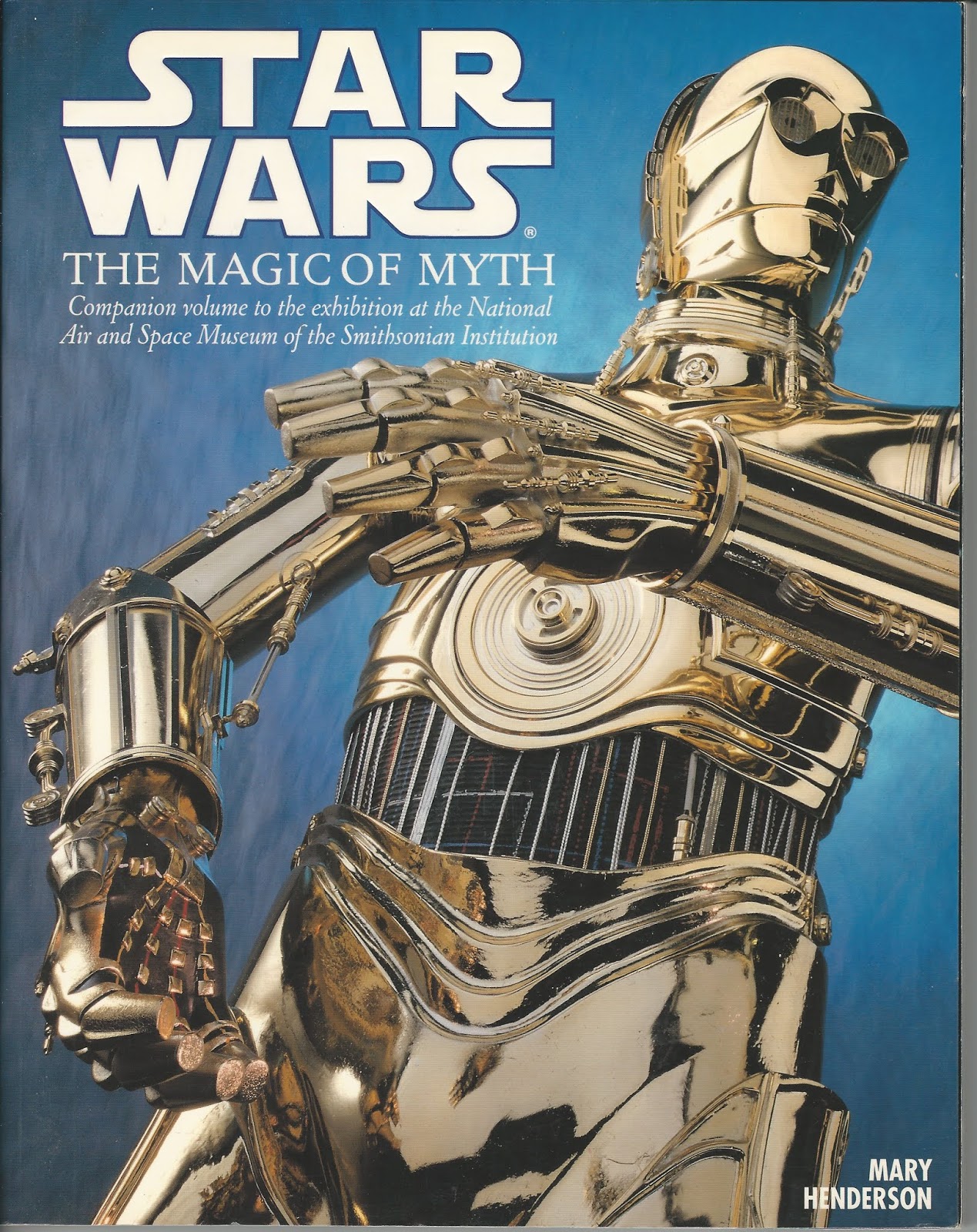
Star Wars: The Magic of Myth
by Mary Henderson
Bantam Books, 1997
Jospeh Campbell, Carl Jung, and more.
In The Virtues of Captain America: Modern Day Lessons from a World War II Superhero, Mark D. White argues for a continuity of character in The Captain despite the many authors who penned the narratives. Of course, he represents the best aspects of the nation he personifies. He does not just beat up bad guys – though he did a lot of that, and not much more, in the Silver Age of the 1960s. Nonetheless, he went to Vietnam twice, the second time to rescue a kind of Medecins sans Frontiers doctor. The Captain is honest, courageous, persevering, and loyal. Above all, he is honorable.

On the other hand, for many people, America is not inherently good; and, therefore, as its embodiment, The Captain is also flawed and perhaps evil. 

Captain America Complex: The Dilemma of Zealous Nationalism by Robert Jewett went through two editions (1973, 1984). It was reborn in 2003, co-authored with John Sheldon Lawrence, as Captain America and the Crusade Against Evil: The Dilemma of Zealous Nationalism. It garnered an accolade as a ForeWord Magazine Book of the Year Finalist. 

The Evolution of a National Icon: Captain America, Masculinity, and Violence by J. Richard Stevens also encircles The Captain with the negative energies of our culture. 

Despite their leftwing titles, both books are approximately objective, though selective, in teasing out the threads of a long-running story. What that story means depends on who you are.  
"We're not conquerors." 
The men in Washington are not impressed with the shield. 
They want The Captain to sponsor The Ameri-Gun.
Two scenes in the movie resonated with me. When Colonel Philips tossed out the dummy grenade, Steve Rogers threw himself on it. “Well, that’s what I’d do,” I said. “You would??” Laurel asked. It is not the sentiment of a Randian egoist. “Hand grenade comes into the foxhole, everyone’s dead anyway. You might as well do what you can to save the others.” It is not a rational decision but a heartfelt response. The other scene was the flag pole climb. I would not see the outside-of-the-box answer right away. I would have to sleep on it – which is why I am not a field commander or even a department manager-but it would be clear to me eventually that there is a better solution. 
The Captain was always man of his time 
Today, everything is complicated.
"An Allied superspy from World War II working with
a rogue Hydra cell. Now I really want to know what
went wrong on that mission."
(Man out of Time by Ed Brubaker, the longest-running writer.)


For one thing, though not 4-F, I was 1-Y in the draft. Like Sheldon Cooper and Leonard Hofstadter, I was never anyone’s choice to be in their squad in gym class. All I asked of my body was to carry my brain around. When I joined the Texas State Guard, my friends and family were surprised, if not shocked. I was never in favor of any of America’s military adventures. But the TXSG is not issued weapons; and we cannot be sent overseas. We are Texans serving Texas. The physical requirements are minimal but when I enlisted, November 22, 2014, having just turned 65, I found that I could do zero push-ups and zero sit-ups. Fortunately, I was always a walker. So, clearing the mile under time was the first win. Now, what I cannot do is 20 push-ups. This morning, I did 31 sit-ups. No serum. No vita-rays. Just the will to succeed and to do better the next time. That, too, is easy to find in the mythology of Captain America.

PREVIOUSLY ON NECESSARY FACT

Friday, May 25, 2018

Blaming Ayn Rand for the 2010 Financial Crisis

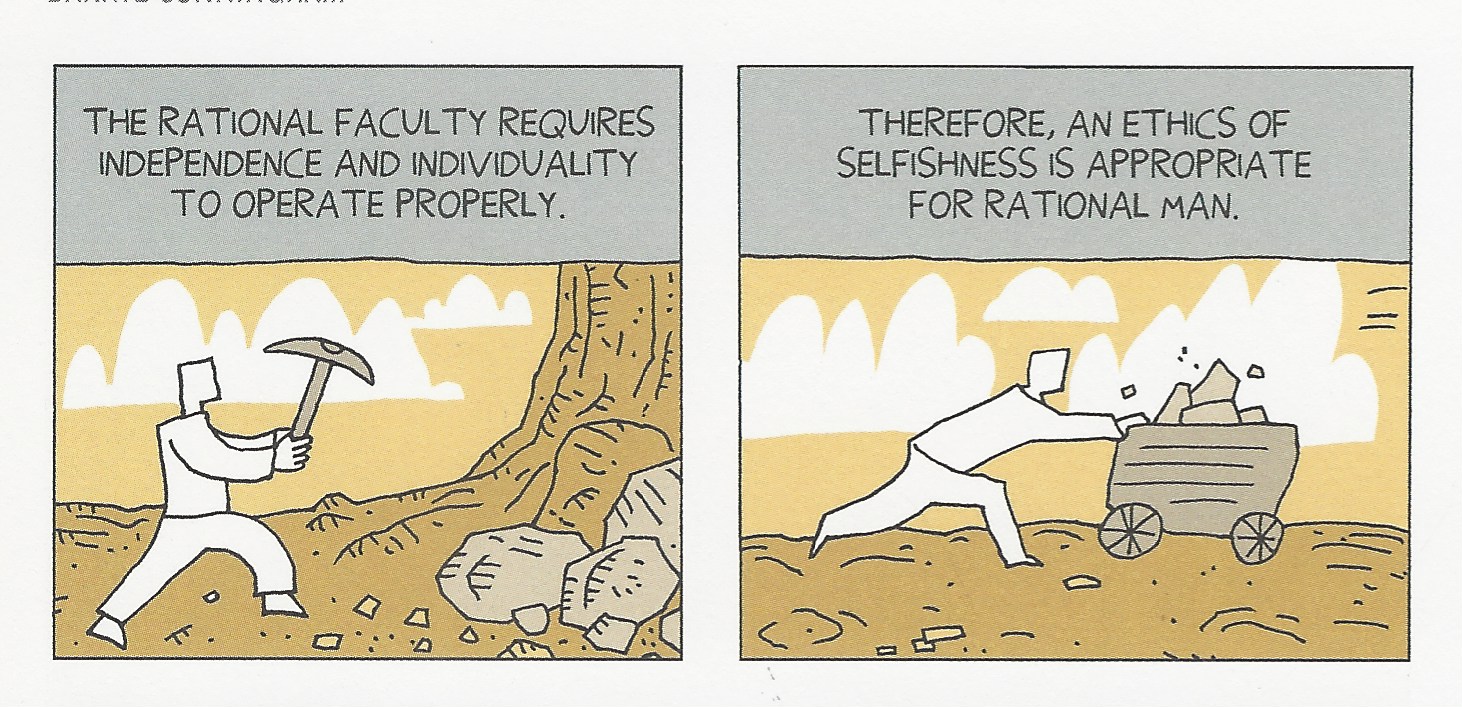
The Age of Selfishness: Ayn Rand, Morality, and the Financial Crisis by Darryl Cunningham (Abrams, 2015) is a closely written and tightly integrated misinterpretation of Ayn Rand’s life, her works, her philosophy of Objectivism, and the causes of the market collapses of 2007-2010. This book is a graphic novel because Cunningham is a cartoonist. His drawings can be crude, but are often essentialist and representational. He does sublimely capture people, often through their coiffeur and stance. But his work is never fine, detailed, or realistic. This book is largely a running monologue that needed no illustrations. The author claims that the popularity of Ayn Rand’s ideas among American (and British) conservatives caused the mortgage meltdown and subsequent bailouts.

Cunningham latches on to all of the negatives of Rand’s life and disparages the few successes that he acknowledges. 

What I find most interesting in this and similar attacks is that no one seems to be motivated to rip apart Karl Popper, Ludwig Wittgenstein, Jean-Paul Sartre, Jacques Lacan, or Richard Rorty for their foibles. We can condemn Thomas Jefferson’s relationship with Sarah Hemings without dismissing the Declaration of Independence as a hypocritical façade to justify the theft of lands owned by the British crown and its loyalists. Ayn Rand is different. 

Cunningham takes the time to make his case. The 231 pages begin with Ayn Rand’s life (Part One), explain the details of the financial contractions (Part Two), and then tie the first to the second (Part Three). His sources include biographies of Ayn Rand by her nominal admirers, Barbara Branden, Ann Heller, and Jennifer Burns. Ultimately, the thesis is not supported because the summary rests on omissions, flaws, and fallacies. Of necessity, the author contradicts himself. 

Cunningham does nod to the virtues of traditional conservatism, though he finds them not as powerful and promising as progressive liberalism. We need to be conservative in order to preserve the family, social order, and the freedoms we enjoy in our democracies. He presents World War II as an example of that. The error here is that Ayn Rand was not a traditional conservative. (And she was not alone in being less than sanguine about America's role in World War II.)  She called herself a “radical for capitalism” explaining that capitalism rests on a foundation of reason in acknowledgement of reality. Cunningham admits that Rand was opposed to the war in Vietnam, the draft, and laws against abortion. He fails to identify Rand as having been as “liberal” as she was “conservative.”  It would be possible to criticize Rand’s novels and her philosophy as an expression of unbridled liberalism.

Cunningham does not perceive the contradiction in his thesis.
Liberals actually share Rand's epistemology and
much of the "psycho-epistemology" of independence.
Conservatives attempt to advocate for the
consequential material gains, but deny reason and
independence.
Her heroes are socially disruptive. In AnthemThe Fountainhead, and Atlas Shrugged, the bad guys are the people in power who fear change. In the last two, the wealthy and powerful are mediocrities. The heroes also achieve wealth, but do not pursue power. (In The Fountainhead, the pursuit of power destroyed Gail Wynand who “was not born to be a second-hander.”) Her heroes famously stand on their own, especially in confronting adversity, a virtue that Cunningham identifies with children who grow up to be self-identified political liberals. 
In truth only six of the eight needed the bailout.
Moreover, all were forced to take it.
And all were forbidden to discuss it publicly
under threat of government retaliation.
Cunningham never grasps the fact that Objectivism is a personal philosophy. Rand’s heroes live sparsely; her villains are ostentatious. Ayn Rand’s heroes are more concerned with their own place in the physical world than in the society around them. Personally, I find that the conservatives who discovered Ayn Rand's works only through the Atlas Shrugged movies think that this is all about politics. Hank Rearden had a mansion to house his family, not himself. And it was his family that oppressed and exploited him. The government’s interference was just a footnote in his life. He cut the chains of government regulation only after he was able to get himself an apartment in the city. 
 
Cunningham is wrong.
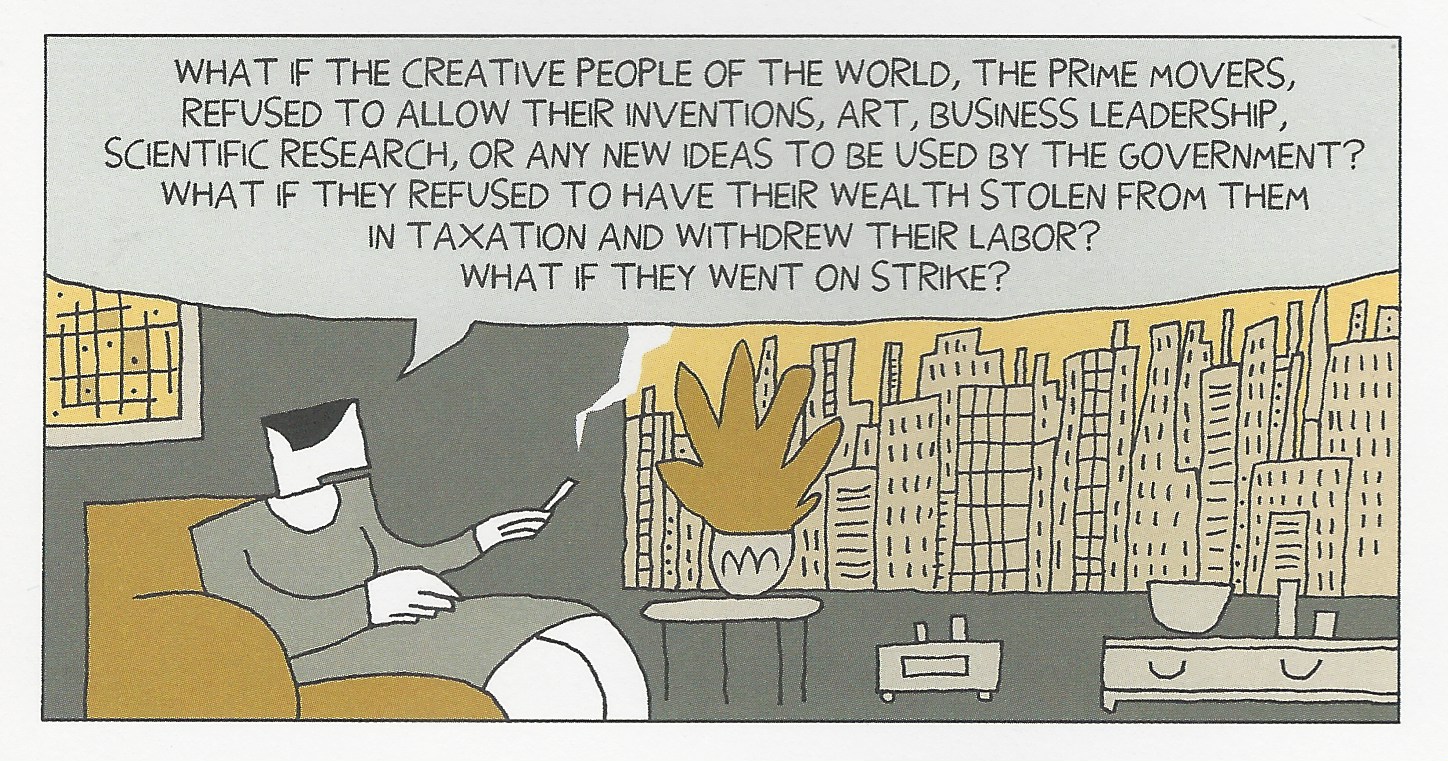
The accepted story is that Ayn Rand was on the phone with
Isabel Paterson. Paterson insisted that Rand "owed it to her readers"
to follow The Fountainhead with another novel.
"What if I refused?" Rand asked.
The Strike was about the cause of such demands.
Ayn Rand did not consider the government
to be metaphysically important.
The central failure of Cunningham’s thesis is that the personal morality of Objectivism would never suggest, support, justify, or excuse the acts committed by the people who caused and profited from the financial crisis of 2007-2010. Those men were portrayed in The Fountainhead as Homer Slottern the successful businessman who was terrified by religion and in Atlas Shrugged as Mayor Bascom of Rome, Wisconsin, who turned a quick profit buying and dumping the remains of 20thCentury Motors. The Fountainhead also has looter architects, among them the hooligan Gus Webb, just as Atlas Shrugged’s villains include Mr. Mowen and Orren Boyle among the businessmen with Washington connections. 

Cunningham’s story contains a kernel of truth. However, deeper than the mechanics of shady deals was the lack of integrity of the dealers. “Do you think integrity is the monopoly of the artist? And what, incidentally, do you think integrity is? The ability not to pick a watch out of your neighbor’s pocket? No, it's not as easy as that. If that were all, I'd say ninety-five percent of humanity were honest, upright men. Only, as you can see, they aren't. Integrity is the ability to stand by an idea. That presupposes the ability to think. Thinking is something one doesn't borrow or pawn.” Kent Lansing to Howard Roark in The Fountainhead (Chapter X, p. 333; via Wikiquote) “Honesty is the recognition of the fact that the unreal is unreal and can have no value, that neither love nor fame nor cash is a value if obtained by fraud...”– Galt’ Speech.  

PREVIOUSLY ON NECESSARY FACTS

Monday, May 14, 2018

Physically Fit is Mentally Fit

"The chief function of the body is to carry the brain around." Widely attributed in several forms to Thomas Edison, I am not sure that he actually said it, though it does reflect his thinking. Regardless, I had always pretty much held the same attitude. Joining the Texas State Guard set some minimums for me, but they were not challenging. What did it for me was a reply from a friend: "How long will your body carry your brain around if you don't exercise?"

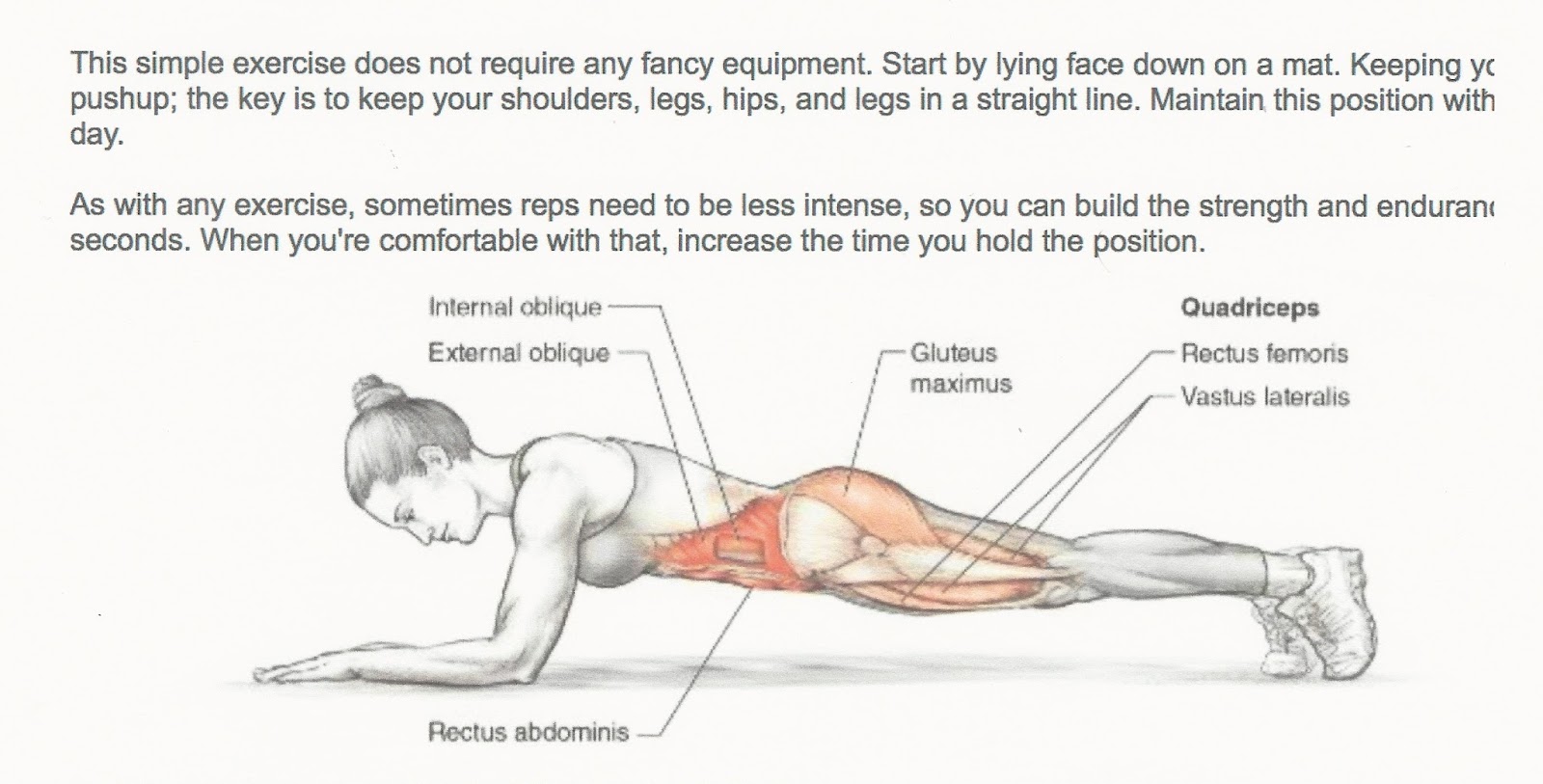
Recommended by the health and safety manager at my current job.
Not a push-up, you hold it for 30 seconds and rest for 15 seconds.
The number of repetitions is up to you.
When I was employed directly by the Texas Military Department's Domestic Operations task force, I worked with young junior officers. They were inspiring. Since then, I have slacked off. I try to do five mornings out of seven. I still write the numbers on my calendar. I note the measured degradation when I go too many days without push-ups, sit-ups, and aerobics with weights. It takes about half an hour all in all. I do it while brewing coffee and feeding the cat.

Texas State Guard Standards
I can beat 21 sit-ups any morning, usually going to 30. I was up to the high 40s, but lost interest. Push-ups are harder. I did 18 this morning. The USMC minimum for a man age 50 is 20 push-ups. I have done that, the last time in competition with an Air Component guy my age doing them one-handed. (For the two-minute test for the fitness ribbon, we can rest in a set position, but I do not do that. I just crank them out until I cannot do the next one.) My last timed mile was 11:03 and I was getting yelled at for walking between sprints. They don't ask much of us. Fortunately, we can still carry our brains around.

PREVIOUSLY ON NECESSARY FACTS
World War II Sweetheart Dance
AFK: Hurricane Harvey
Base 7
Mapping it out: Contemporary Cartographics

Thursday, May 10, 2018

Spanish Coins on American Notes

Until 1857, silver and gold coins from Mexico, Spain, France, Brazil, and other nations were legal tender in the United States. We know commonly that that US dollar was modeled directly on the "Spanish milled dollar" or "pieces of eight." However, the influence of international trade on the new republic was very deep and broad.

http://scoan.oldnote.org/
The website linked at left is replete with examples of private banks from the 1830s, 1840s, and 1850s that issued paper money promising American federal dollars (most often, fractions, actually) but showing Mexican or Spanish coins as graphic images. 

We still sometimes call a 25-cent quarter dollar coin "two bits."  Two hundred years ago, one bit was was one Spanish real. Eight reales made a Spanish dollar. When I was in high school in the 1960s, it was a known cheer: "Two bits, four bits, six bits a dollar. All for [our side] stand up and holler." Spanish Mexican culture continued in the West, of course. You can find The Texas Rangers: Wearing the Cinco Peso by Mike Cox (Tom Doherty Associates, 2009). The 5-peso dollar-sized coin of the United Mexican States of 1947 was a much later version of the Spanish dollar and the Republic of Mexico "Cap and Rays" silver 8-reales (1825-1897).

Thames Bank of Laurel, Indiana, 1856, promises Two Dollars
and shows two Mexican 8-reales
The website Spanish Coins on American Notes lists two dozen examples from twelve states. Most of them were "wildcat" banks from the era of unregulated banking. State regulation was no more successful than the constraints of market competition. Even numismatists look askance at that period of rampant laissez faire. A more objective appraisal would put banking in with other businesses. In the frontier era, economies were shaky at best. People enjoyed a lot of opportunity, but few guarantees. We think of "ghost towns" as a consequence of mining in the West, but Michigan has many from the lumber industry, as well from copper mining.

It is also true that along the eastern seaboard, where trade with the United Kingdom dominated, merchants often kept their books in pounds/shllings/pence into the 1830s. The florin and crown coins of the UK were their attempt to bring their currency into some accord with the dollar. Meanwhile the 4-dollar "Stella" gold coin of the United States was our attempt to align with the 20-franc gold coins of France and other nations.

PREVIOUSLY ON NECESSARY FACTS

Tuesday, May 1, 2018

Wednesday, April 25, 2018

Confiscation: Gold as Contraband

Confiscation: Gold as Contraband 1933-1974 by Kenneth R. Ferguson was a pleasure to read. Ferguson writes well. I met Ken Ferguson in person at a coin show here in Austin. He speaks as intelligently as he writes. Our time together was enlightening. 

Few people ever get past citing Executive Order 6102. Even when they do point to that document, they most often stop short of fully citing and discussing it. This book delivers the facts. Ferguson tells the whole story, going past 6102 to the subsequent orders and laws. He lays out carefully and logically the many relevant details that highlight this singular event. He also examines the public response. I was impressed with his explanations of how and why Britain, France, and Switzerland returned to striking gold coins after World War II, using dies from previous years. 

This book carefully explains the intentions and consequences of the rolling orders and laws that redefined the monetary policy of the American government in the 1930s. On the first level, obviously, the goal was to get gold into the U.S. Treasury in order to meet foreign obligations. Moreover, the revaluation of the dollar did more than expand the money supply, though it did that. When the official price of gold moved from $20.67 per ounce to $35 per ounce, all of the paper profits went to the Treasury. Citizens who turned gold in were paid at the face value of the coins (or the equivalent for bullion), $20 for a $20 double eagle, not $33.86. 

As for whether surrendering gold was necessary, Ferguson demonstrates from several perspectives why it was not. Other nations made similar changes – demonetizing gold, going off the gold standard – without confiscating the private property of their citizens. That is a theme that Ferguson returns to often as he dissects the events and laws. If gold is money, then Congress (not the President) is authorized to define how much goes into what coins. That happened in 1834, for example. If gold is private property, then its uses as money are irrelevant in that context. Moreover, and most insightful (and damning) Ferguson shows that (1) Treasury stocks were not greatly improved by this law (though the Treasury did profit directly), and (2) the reason why is that half the gold in private holdings in the United States remained with its owners. People just ignored the law, as they had Prohibition earlier.

In 180 pages, this book provides a close and yet conversational examination of Franklin D. Roosevelt’s executive orders and the related Congressional acts that became laws. Ferguson identifies and explains the half dozen presidential orders and parallel banking acts, the criminalization of gold ownership, and the exclusions left open to numismatists. Turning to the international theater, the presentation builds on the official purposes of the Bretton Woods accords to illuminate the history of the 1950s and 1960s.  It was that context which provided the impetus for President Gerald Ford to lift all of those restrictions in 1974. 

From there, Ferguson considers the modern world, whether and to what extent gold is money, whether and to what extent it is an investment, and the prospects for a repeat of the draconian laws of the 1930s. That last is too often a springboard for ideologues who sell gold coins to harry the public into buying them. As a professional dealer in numismatic rarities, Ferguson shows more aplomb. 

Ferguson earned his master’s degree from the Lyndon B. Johnson School of Public Affairs at the University of Texas at Austin. Since then, he was worked as a coin dealer. Those two facts explain why this book rests on careful research. His bibliography of 35 sources includes works by both John Kenneth Galbraith and Milton Friedman as well as authorities such as Q. David Bowers, John Craig, and Hans Schlumberger who are recognized within the numismatic community.

The weekend before, I attended a three-day seminar for authors on self-publishing. It was well worth the money. This book was published by the author and Ferguson did it right. The book is set in 11-point Garamond, which the user experience designers here in Austin assure me is the new standard in Roman (serif) fonts.  Of course, it is perfect bound. Ferguson told me that he turned for help to a professional editor. From the seminar I attended the weekend before, I learned how much he paid for the ISBN. It makes a difference in the professional presentation of any work that claims authority. Confiscation: Gold as Contraband 1933-1974 by Kenneth R. Ferguson adheres to that standard.

PREVIOUSLY ON NECESSARY FACTS


Monday, April 9, 2018

Soldiers of Peace

The military teaches the way of peace, said Paul K. Chappell, because they praise in public and reprimand in private. I heard Paul K. Chappell interviewed on an KERA’s “Think” with Krys Boyd, on March 20, 2018. A West Point graduate, Chappell left the Army as a captain and now works for the Nuclear Age Peace Foundation. I bought two copies of his book, Soldiers of Peace, and gave one to the director of our state guard officer candidate school. I finished reading it this morning. Overall, it was easy to find much to disagree with but Chappell argues well for finding other solutions to our social problems.

Chappell repeats his claims, which begin (easily enough) with the observation that 200 years ago, slavery was accepted and women could neither vote nor own property. But here we are today. So, what about us now will seem short-sighted to people 200 years in the future? Chappell calls his program “peace literacy.” It is a path, a way of life, not a formula or a checklist. Peace literacy includes empathetic listening, respect, integrity, and selfless service. Peace literacy depends on knowing how to calm yourself so that you can calm others. All of this takes discipline.
Soldiers of Peace: How to Wield the Weapon 
of Nonviolence with Maximum Force 
by Paul K. Chappell, 
Prospecta Press, 2017; 272 pages; $16.  
Chappell denies moral relativism and epistemological subjectivism. He says that the truth exists and we can know it. He warns against romanticizing the past, and even against romanticizing nonviolence. He calls himself a realist, and differentiates that from the common “realism” that is only cynicism. It is not surprising that he repeatedly cites Socrates, Lao-tze, Gandhi, and King. I did find it curious that he echoed Ayn Rand (though Rand is not cited anywhere). Rand found the basis for morality in our mortality. She posited an indestructible robot and explained that it could have no values. Chappell makes exactly the same argument. Like Rand, Chappell points out that humans have no instinctive, automatic modes of survival. Oak trees and caterpillars, he says, have no need for mentors. We do. And he provides many. Among them are Gen. Douglas MacArthur, the heroes of the Iliad, and Lt. Gen. John Schofield, the superintendent of West Point.

I never learned anywhere else that one impetus for Rosa Parks to resist segregation on the city bus line was her experience with the integrated transports at Maxwell Air Force Base where she and her husband both worked. In fact, Chappell says (at least twice) that his mother yelled at him when he announced that he was leaving the military because nowhere else in her world could a mixed race (African-American/Asian) person be treated fairly.

Chappell also speaks well of the discipline of martial arts that teaches respect for one’s opponent as the path to avoiding conflict in the first place. Contrasting that, he notes that during World War I, in the mad charges from the trenches, cruel officers were sometimes shot in the back. In the military, everyone is armed and trained to kill, so the social formalities reinforce respect.

It is salient that the military succeeds by training. Chappell cites Julius Caesar who recorded that the Gauls, Celts, and Germans made fun of the small stature of the Romans—until the battle was engaged. And in the military, failures in the field are traced back to failures of training. Learning the literacy of peace requires deep and extensive training, of course. And Chappell and the Nuclear Age Peace Foundation provide such classes (here) though he says nothing about them in this book. (His own website is here.)

Toward the close, Chappell says that the best use of the military would be for humanitarian aid and disaster relief. As killing the enemy still has not worked out very well, that seems hard to argue with.

Easier to take exception to are the very many glittering generalities, glib statements, easy oversights, and incomplete examinations that litter the book as Chappell wanders over the landscape of his personal life.

Just to take one point, the author asserts that women in ancient Athens were oppressed. It is the liberal, enlightened view. Women could not vote. They could not own property. Indeed, they were property. But so was everyone else. It is famous that the philosopher Diogenes was one of the very many who were captured on some voyage or on some road and were sold into slavery. Outside of your city, you had no protection. Even within the city, rights as we know them did not exist. Socrates is the most famous case in point, but not unique. On the other hand, Chappell at length cites Greek myths and Athenian dramas in which women were the driving force, the wise speaker, the effective agent. The god of war, Ares, was less powerful than Athena, the goddess of wisdom (and strategy). Beginning with the assumption that he seeks to prove, Chappell cannot reconcile that against the civil status of women.

A dozen other problems run through the book, repeated and restated, cast as assertions and reused as proofs.

In balance, Soldiers of Peace provides cogent reasons to re-examine our assumptions about war and peace. Chappell’s thesis includes the minor premise that nonviolence is not peace. Pacifism will not end war. Rage is an expression of pain, not of strength. Perhaps the most arguable and yet insightful assertion is that the threats to peace include disparities in wealth, rapid population growth in the cities, and climate change. Those threats were identified by the U.S. Army Sustainability Report (2009). “When the U.S. Army and the Occupy movement agree on something, I think we should pay attention.” 

PREVIOUSLY ON NECESSARY FACTS

Sunday, April 8, 2018

Aaron Feldman:"Buy the Book Before You Buy the Coin"

BUY THE BOOK BEFORE THE COIN headlined an advertisement in the March 1966 issue of The Numismatist. Aaron R. Feldman offered 25 titles, some of which were classics then as now: Sheldon, Beistle, and Bolender. Don Taxay’s book on counterfeits (1964) was a new addition to our knowledge base. The Friedberg family was still in its first generation with Paper Money of the United States

(An earlier version of this article originally appeared in the Winter 2008 issue of the MSNS Mich-Matist and is archived at www.CoinTalk.com, here. )

Today, the self-styled "bibliomaniacs" of numismatics easily recognize Aaron R. Feldman (1894-1976) as an iconic literature dealer. He said, “I’ve always thought that if a man doesn’t own one coin, but has the knowledge that is in the books, then he’s a real numismatist.” However, Feldman himself owned many coins.

After returning from World War I with a mustard gas injury, he worked in his uncle’s millinery business. As an astute businessman, his serious collecting began during the 1930s. Like most, he began with standard U.S. issues but soon discovered the untapped markets in Civil War Tokens, Hard Times Tokens, and Presidential Inaugural Medals. He bought whole collections and became known to the dealers. Feldman then moved into paper money, assembling an admirable inventory of U.S. Large Size notes under the tutelage of George Herbert Blake (1858-1955) who was called “the dean of American paper money.” 

The depth of Feldman’s interest can be gauged by the fact that he wrote an article for Coin World (Dec. 22, 1961), “Irish Revolutionists Issue Freedom Bonds.” The sidebar called him an “avid paper student.” Whatever his other interests, this is the only article attributed directly to Feldman. His influence was personal.

He lugged his books to ANA conventions. He entertained customers at “the world’s smallest coin shop” amid the diamond merchants at 1220 Avenue of the Americas (which natives always have called “Sixth Avenue”). 
Q. David Bowers has fond memories of the little store. “He had a small cubicle in the NY Diamond Exchange just off 5th Avenue, where he went during weekdays. It probably measured no more than 8 feet square, with diamond dealers and jewelers all around him. I knew him well and visited many times.” 
In 1991, the Numismatic Bibliomania Society raised $3,000 for an endowment for the ANA convention exhibit awards. 
 Aaron Feldman was a member of the ANA, the ANS, the Empire State Numismatic Association and many other coin clubs over the years. Successful in business, Feldman could afford to indulge his passions. He was known to sell books at cost to beginning collectors.

Feldman endured Parkinson’s disease in his declining years. He closed his shop and did business by mail. When it came time to sell off his literature collection to meet his medical expenses, he was caught by bad timing.

His own favorite literature dealer was Frank Katen (1903-2001) who has been called “the pathfinder of American Numismatic Bibliomania” and the “Moses” of numismatic literature. Unfortunately, Katen could not handle Feldman’s collection immediately. So, impatient because of his failing health, Feldman consigned his library to Swann Galleries, another specialist in books. But Feldman was not impressed with Swann’s appreciation of numismatics as a specialty. Like many coin dealers, their auctions had, in fact, treated coin books as “throwaways." Nonetheless, George S. Lowry, president of Swann’s was happy with the results: the sale grossed $13,000 (November 29, 1973), which, relative to the price of gold or gasoline today would be like a quarter of a million dollars. However, for Feldman, it was a disaster.
 
Boxes of 19th century auction catalogues, back issues of ANS and ANA publications, cartons of catalogs and ephemera from Wayte Raymond, James Kelly, Morton and Jospeh Stack, and Max Mehl all went for fractions of the pre-sale estimates. The two-volume Saxonia Numismatica by Wilhelm Ernst Tentzel, written in German and Latin and published in 1708, sold for $275. Writing this in February 2008, I found the same books for sale from a German dealer for €350 (about $510-$520). Compared to gold and gasoline, these books remain greatly undervalued.

Literature is a tough sell. Coins are shiny; gold and silver are hard money. When you hold a 20¢ piece you can imagine what it bought in 1875. But if coins are “history you can hold in your hand” then without the history, all you have is a melted rock. The imagery, the iconography, the devices and legends, all lose meaning.


Collectors come to the bourse floor armed with price guides, Greysheets, Red Books, or armed with phones and tablets connected to the Internet. They want the best prices – and rightfully so. It is an immutable law of economics that price is a matter of supply and demand. With old coins, the supplies are more or less fixed. All that changes is the demand. Demand begins with literature. One collector writes an article for a magazine. Another collector creates an exhibit. Someone else gives a talk at an ANA convention. Eventually a book comes out. At every step, from original research, to the sharing of information, to the reading of good books, each aficionado enjoys profits not available to later buyers and sellers. The people with the price sheets are the last in line. They pay for the profits not realized in the sales of rare books.

It is perhaps unfair that collectible books are not prized more highly. The advantage is that almost any book at almost any price is a bargain. You cannot buy them much cheaper. The profits come from knowing what is between the covers. 

Sources
  • Bowers, Dave, email to author, Wednesday, December 26, 2007 11:13 pm
  • Feldman, Aaron, “Irish Revolutionists Issue Freedom Bonds,” Coin World, December 22, 1961, page 56.
  • “Frank Katen, 1903-2001” The E-Sylum: Volume 4, Number 5, January 28, 2001, Article 2. http://www.coinbooks.org/esylum_v04n05a02.html
  • Smith, Pete, “Names in Numismatics: Feldman Promoted Numismatic Literature,” The Numismatist, December 1998, page 1373.
  • “Aaron Feldman dead at 81; famous for book advocacy,” Coin World, April 7, 1976, pg. 3. 
  • Hamburger Antiquariat Keip GmbH, Grindelhof 48, 20146 Hamburg, Germany http://www.antiqbook.de/boox/ham/266999.shtml   
  • "Aaron Feldman: Buy the Book Before You Buy the Coin," https://www.cointalk.com/threads/aaron-feldman-buy-the-book-before-you-buy-the-coin.129198/)
PREVIOUSLY ON NECESSARY FACTS